The 7 Stages of Emotional Freedom - Teaching From Joe
14m 43s
The podcast introduces a seven-stage model for emotional development, guiding listeners from early, non-personal emotional experiences in infancy to a state of emotional freedom and integration. The journey begins with unfiltered emotional expression, followed by emotional suppression due to childhood conditioning—such as love being removed during outbursts. This leads to emotional management, where people use techniques to avoid being overwhelmed by emotions. The key breakthrough comes when individuals learn to feel emotions without resistance, allowing them to understand emotional signals and release internal narratives. As emotions are accepted and experienced, they become non-personal and less controlling, dissolving the fear of suffering. In the final stage, all emotions are met with joy and aliveness—angry, sad, or fearful moments are no longer seen as threats but as natural, valuable experiences. The podcast emphasizes that progress requires embracing discomfort, not avoiding it. A central warning is against viewing the stages as a hierarchy of "better" or "worse" states, as this leads to emotional avoidance. Instead, the model is presented as a flexible guide to cultivate presence, curiosity, and somatic awareness. The ultimate goal is not emotional suppression but deep connection with all experiences, leading to a life that feels savored, alive, and deeply human. This approach is grounded in real-life examples, such as a moment of anger shifting into understanding due to a personal loss, illustrating how emotional narratives dissolve with acceptance. Listeners are encouraged to participate in a feedback survey and engage in a Q&A with the host and Joe, reinforcing the show’s commitment to community and continuous learning.
Hey everyone, just a quick ask here, we've learned so much about this show from your feedback
over the years and we want to keep that going. We've got a short survey for you and at the
end you can drop in a question for a Q&A episode that I'll record with Joe. Find it at artofaccomplishment.com/podcastfeedback.
The link is in the show notes.
If you were to look closely at your life, how much of it is driven by your emotional states?
We are emotional beings, there's nothing wrong with that and it can feel overwhelming to navigate.
But what if there were a map we could use to track emotional development through our lives,
to help us understand our relationship with emotions today and to see what we might be going?
A huge part of the work that we do at AOA is helping people to move from emotional congestion
toward emotional freedom. After spending years watching people move through this process,
Joe created a map with different stages that he's seen many people move through on the journey.
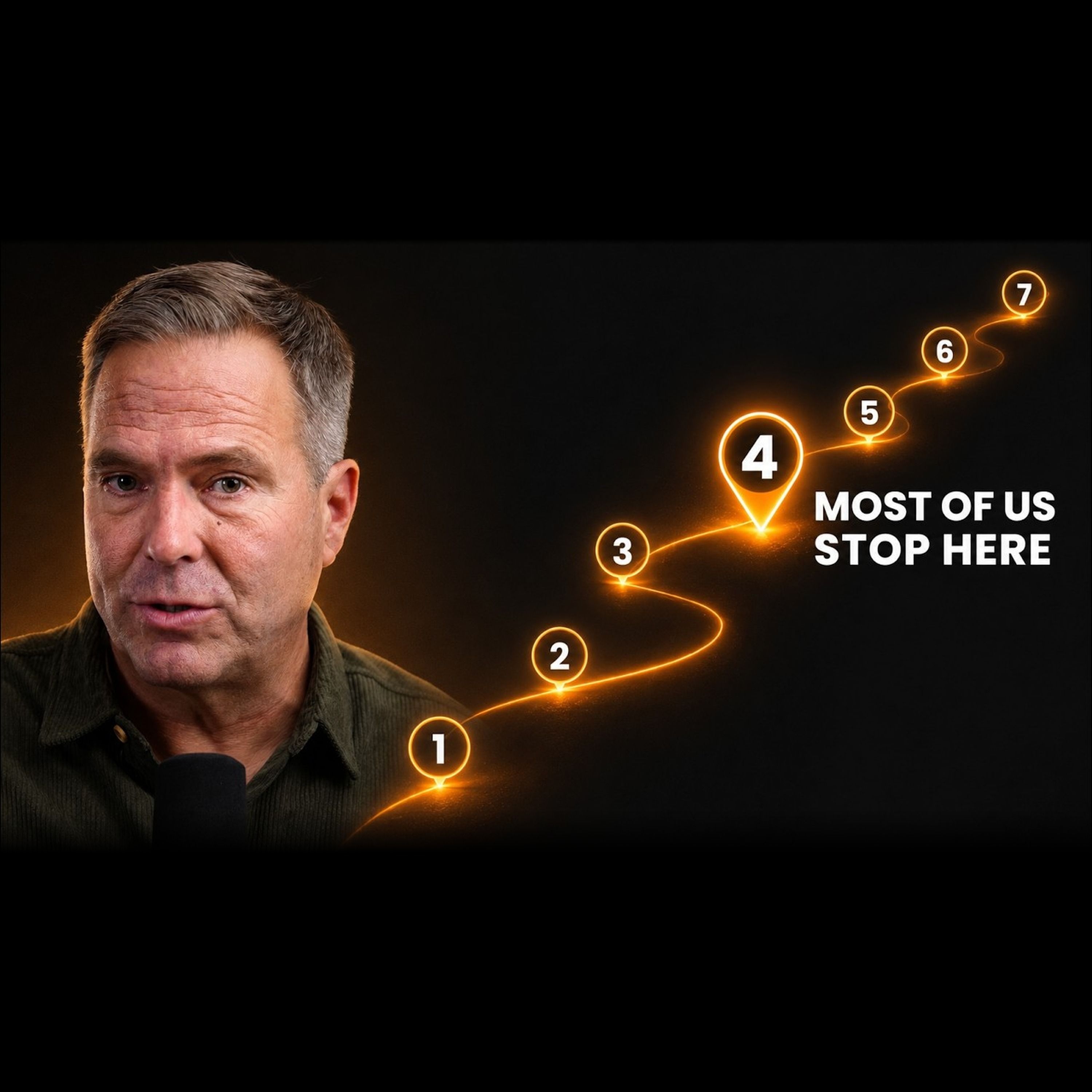
Here are the seven stages toward emotional freedom.
Here's a map for emotional freedom and by map, what I mean is the developmental steps.
If you're going to walk, you probably need to crawl for a while and cruise for a while and then
walk and fall down for a while and then you can get to walking. It's the same thing with emotional
freedom. There's some steps that you have to go through. In fact, there's seven of them and we'll
go through all of those. But before we do, there are some pitfalls with just having a map.
So the first problem is that when you have a map, you think, oh, developmental step one is not as good
as two, which is not as good as three, which is not as good as four. And all of that is hogwash.
In fact, doing that, thinking that, thinking, oh, this step is better than this step is just a way
to avoid your emotions. If you think that you're better than somebody, if you think that you're
advancing, if you're trying to figure out how to advance, how not to fall behind, all of that is a
way not to feel an emotional experience. And the best way to progress through all the developmental
steps is to feel your feelings. So that's a massive pitfall. And a lot of people fall into it.
And so really see these just as like a guidepost. The other problem with it is that none of these
developmental steps are cut and dry. Just like when you're walking sometimes, you can still crawl.
Or when you're crawling sometimes, you might get up and cruise for a little bit and then not for
a couple of days. And so the developmental steps aren't cut and dry. And if you start looking for
them to be cut and dry, you get lost. You start mistaking the map for the territory itself.
So that's really critical to just see that this is a general guide. It's not absolute. It's not
set in stone. It's not a perfect model. But it's a way to know what the next things that are going
to happen are and a way for you to be relaxed in that process. And that allowing that relaxation,
that gratitude, even if you can feel it, is what's going to make this whole journey quicker.
Okay, so let's get into the seven steps. So the first step to emotional freedom is the one that we
all feel is intense, which is the emotions are non-personal. They're just running through us.
Right? We cry when we want to cry. We get upset when we want to get upset. There's nothing in us
that's trying to control any of it. And with that, you can see our bodies when we're children
are just very fluid in it. There's not a lot of muscular constriction around it. It's why an
infant can cry with calling for like two or three hours straight and then not have a sore throat,
whereas almost any adult cries for about 20 or 30 or 40 minutes out loud whaling in that way.
And they're going to have a sore throat. Or if they yell for 20 or 30 minutes, they're going to
have a sore throat because there's all this muscular constriction. But infants, none of that's there.
They're just moving their emotions. It's just happening. They don't think that they're bad for it.
They don't think that they're good for it. It just kind of flows right through.
And so that's the first step. And the second step is when we are taught that some of these
emotions are bad. Mom removes love when I cry. So I got to stop crying. Or dad gets angry when I
shout for too long or I get abandoned or whatever it happens, I start to realize, oh, some emotions
aren't safe. And we start to compress those emotions. And to compress those emotions, it means that
we actually have to hold on to our musculature. We have to tighten down. And there's this amazing
study. It's called the Stone Face Baby Study. And if you look it up, it's disturbing. And so it's a
child trying to get attention because they're uncomfortable in some way. Or trying to get attention
through play and they don't get the attention. And what happens is the child goes through a series
of emotions, even to yelling and screaming, but if they don't get the emotion, then they just go, boom.
And they just don't face. They just stop reacting. That happens to almost all of us in one
form or another, some way in which one of our emotions was punished or love was removed. And
then that creates a certain musculature holding in our system. And a lot of people when they see
me do rapid coaching, they're like, how do you know so much about somebody? Well, part of it, a
small part of it is I can see what muscles they're holding. So I know the pattern of emotions that
they don't allow themselves. And then that tells me a lot about how they were raised or what was
going on in their childhood. And so this is a huge component of our personality. Our personality
is often dependent on what emotions we thought were okay to have and what emotions we didn't think
were okay to have. The next one is where the emotions control us. It's the moment where we're like,
oh, this is an emotion that I'm having. I don't want to have it. And it's just running my life.
Right? It's like when you're five years old and you throw a massive temper tantrum, but you start
to recognize like, oh, like I just did something I didn't want to do. And I'm just totally controlled
by this emotional state. Now this can happen obviously to people when they're five years old,
three years old. And it can also happen to folks when they are 50, 60, 70 years old where they're
having road rage. And they are driving along and somebody cuts them off. And next thing you know,
they're shouting and screaming. And what are you doing? And they're getting so upset. And so they
can completely lose themselves in the emotional experience. A grand majority of us are saying, oh,
no, I don't want to be controlled by my emotions like this. I don't want to do things that don't feel
good in my system because I'm lost in this moment of anger or sadness or fear. And so out of that
stage where it's happening all the time, that's so uncomfortable that we start to manage our emotions.
And this is where a tremendous amount of people in our society are at, where they're saying, I can't
be angry. I can't be sad. And it all stems often from certain experiences that they had as
children. For instance, if somebody just hasn't felt anger in a long time, then I can tell certain
things about them. Typically it either means that they had a rage a hole in the house and they swore
they would never be like that. Or in their house every time they got angry, they had all the love
removed. They're just like, this doesn't happen in this house. We don't do that. And we're not going
to love you if you do that. 80% of the people who haven't gotten angry in years have had those
experiences. And they also felt this moment where they got really angry. They felt out of control.
They're like, no, no, no, no, no, no. I don't want to do that. And so our emotions start to get
managed. And it's kind of like the repression, right? When I talked about the circular nature of
the developmental path is the repression that we have in those early ages, it now has a thought
process with it and we call it management. But it's still very much like repression except for
we're thinking about how it's bad, how we don't want that to happen. We start having systems and
techniques. We read books about how to be under control or how to have great EQ. We figure out
like, oh, if I breathe deeply, then I won't have to feel this thing. And so that stage ends when we
recognize, oh, I can still feel my emotions and I don't have to be taken away by them. I don't have
to lose myself in these big emotional experiences. And so that's when we start feeling and allowing
our emotions. But this time we're not doing it at people. What's the difference between feeling
your emotions in a healthy way and feeling your emotions in an unhealthy way or what's the difference
between indulging your emotions and feeling your emotions? And the difference is that if you're just
feeling your emotions and you're expressing them, you're not doing it at anybody. You're not
controlling anybody with it. You're not telling folks, hey, you have to be different because I'm
angry or because I'm sad. I'm not going to make you hold my fear because I'm scared. You need
to do something to make me feel comfortable. You're just feeling those emotions. You're experiencing
them. You might even be expressing them, but you're not doing it in a way to control anybody. And
that's the main difference. And so in this phase, you start to feel all of these emotions. You
explore them. You start getting curious about them. You start finding out when you're angry. It
probably means you need a boundary. When you're sad, it probably means that you're grieving a change
or you're done with something being in a certain way. And so you start hearing these signals and
they're quite wonderful signals. And you start to befriend your emotional experiences. You start
to go, "Oh, wow. These emotions are pretty cool." And as you start feeling them and as you stop
resisting them, they change. Just like anything changes. If you're on a roller coaster, right? Two
people are on a roller coaster and they're going down the roller coaster like this. And one of them
is resistant. Their experience is, "Oh, fear. Their body is literally producing chemicals that are
carcinogenic in their system." And the other person is like, "This is great. I'm not resisting.
Their hands are in the air. Woo!" And what happens to them? They actually produce anti-carcinogenics
in their systems. They actually
produce healthy hormones in their system because of this excitement.
But the experience is exactly the same.
And that's the same way it is with emotions.
As you start to get to know them, as you start to feel them, as you start to welcome them,
they change their texture, they change the way they present.
And it's less and less hard, less and less necessary to stop yourself from falling into
them or be taken away from them because you're like, oh, this is a great thing.
And so that's the stage.
And that's where a lot of folks who come to AOA are there, like trying to really start
to feel their emotions, express their emotions in a healthy way.
And it's why we created something called emotional inquiry.
And it'll help you really get in touch with the emotions, using a lot of wonder, using
a lot of curiosity and a lot of somatic experiencing, try to find out what these emotions all mean.
But not in an intellectual sense, because a big part of this particular stage is moving
the emotions out of your intellect into your body.
And so if you're not actually having the experience in your body, you're not feeling
the emotions.
As you start to feel and allow all these emotions, all of a sudden, the emotional story starts
to dissipate.
It becomes non-personal again, just like it did when you're an infant.
Because these emotions are moving through you, they send you signals, your intellect can
go, oh, I know what this emotion means.
I know what to look for.
But it's really not personal.
The stories that come along with them just dissipate.
There's 100 stories like the one I'm about to tell, but the one that I like the most
was the sky is on the subway, he's got three kids, the kids are acting out, all the heck.
They're just like running rampant.
And this other person who's on the subway is just getting more and more frustrated, like
control your kids.
What are you doing?
This is so annoying.
I just finished a long day of work.
And the father looks at the guy on the subway and says, I'm so sorry, their mom just died.
And the person who was super angry at that moment dropped the story, couldn't believe it
anymore.
Why would I be angry at these kids who lost their mother and all that anger just dissipated
right away?
And that's what happens is your emotions start becoming non-personal.
And now the seventh step is where the emotions start to kind of blend.
It's a hard thing to describe, but the best way I can describe it is there is pleasure
in all of the emotional experiences.
And so there's a way in which all the emotional experiences are very similar, right?
You can get angry, but there's actually an aliveness in that anger.
You can get sad, but there's an aliveness in that sadness.
There's a joy and enjoyment in all the emotional experiences because there's no resistance.
It's not personal anymore.
It just sends you signals.
It's just this lovely thing and the less you resist them, the more they just blend.
You still know if you're sad, right?
You still know if you're angry, but it's this almost unification of the emotional experience.
You just have a lot more access to joy and love.
And I don't mean like polyannish, hippie walking through, everything's great.
I don't mean that.
Everything happens for a reason.
I don't mean that.
What I mean is just the feeling of, oh, I can enjoy this experience.
I can take a deep breath in almost anywhere and I can enjoy it.
I don't have to run for myself.
I don't have to run into my phone.
I don't have to run into work.
I don't have to run away from my mom because whatever is happening, I can actually enjoy
that emotional experience.
And it just creates a life that feels like it's being savored all the time.
That's the best way I can describe it.
So those are the stages.
And again, I just really want to encourage you.
Now you know basically how it unfolds, but if you try to unfold it too quickly, it's
just a way of saying I don't want to feel bad.
And the whole thing doesn't work if you don't want to feel bad or you don't want to feel
sad or you don't want to feel angry or you don't want to feel frightened or you don't
want to feel anxious.
The whole idea is to embrace, to love, to welcome, deeply welcome all of these emotional
experiences and the more you welcome them, the less personal they get, the less personal
they get, the more you enjoy them, the more you enjoy them, the more life is just something
beautiful to be savored.
Thanks for listening to The Art of Accomplishment.
You can learn more about our programs or join our newsletter at artofacompishment.com.
If you liked this episode, leave us a review or share the show with a friend.
Podcast Summary
Key Points:
The journey to emotional freedom consists of seven developmental stages, each reflecting a shift in how individuals relate to their emotions.
Early stages involve non-personal emotional experiences in infancy, followed by emotional suppression due to childhood conditioning.
Emotional management emerges when people learn to control emotions, often through repression or intellectualization, avoiding emotional overwhelm.
True emotional freedom comes from allowing emotions to be felt without resistance, recognizing their signals and signals of need.
As emotions are welcomed and experienced, they lose their personal narrative and become non-personal, signaling a shift from suffering to awareness.
The final stage involves the integration of all emotions, where each experience is met with aliveness and joy, not resistance or fear.
Misusing the emotional development map—such as judging stages as better or worse—leads to emotional avoidance and prevents genuine progress.
The core of emotional growth is not avoiding discomfort but embracing all emotions as natural, valuable, and life-affirming experiences.
Summary:
The podcast introduces a seven-stage model for emotional development, guiding listeners from early, non-personal emotional experiences in infancy to a state of emotional freedom and integration. The journey begins with unfiltered emotional expression, followed by emotional suppression due to childhood conditioning—such as love being removed during outbursts. This leads to emotional management, where people use techniques to avoid being overwhelmed by emotions.
The key breakthrough comes when individuals learn to feel emotions without resistance, allowing them to understand emotional signals and release internal narratives. As emotions are accepted and experienced, they become non-personal and less controlling, dissolving the fear of suffering. In the final stage, all emotions are met with joy and aliveness—angry, sad, or fearful moments are no longer seen as threats but as natural, valuable experiences.
The podcast emphasizes that progress requires embracing discomfort, not avoiding it. A central warning is against viewing the stages as a hierarchy of "better" or "worse" states, as this leads to emotional avoidance. Instead, the model is presented as a flexible guide to cultivate presence, curiosity, and somatic awareness.
The ultimate goal is not emotional suppression but deep connection with all experiences, leading to a life that feels savored, alive, and deeply human. This approach is grounded in real-life examples, such as a moment of anger shifting into understanding due to a personal loss, illustrating how emotional narratives dissolve with acceptance. Listeners are encouraged to participate in a feedback survey and engage in a Q&A with the host and Joe, reinforcing the show’s commitment to community and continuous learning.
FAQs
The seven stages are: emotions are non-personal, emotions are suppressed or punished, emotions control us, we manage emotions through repression, we begin to feel emotions healthily, emotions become non-personal again, and emotions blend into a joyful, unified experience.
Suppressing emotions leads to muscle tension, emotional repression, and a lack of self-awareness. Feeling emotions allows for healing, self-understanding, and a more natural, healthy emotional flow.
Managing emotions through techniques is a form of repression that replaces emotional suppression with mental control. While helpful temporarily, it doesn't lead to true emotional freedom.
Childhood experiences—especially when emotions like anger or sadness are punished or silenced—create muscle tension and emotional patterns that persist into adulthood and shape our emotional responses.
No. Emotional freedom develops over time through consistent awareness and acceptance. Trying to rush through the stages often avoids difficult emotions and prevents genuine growth.
Healthy expression involves feeling emotions without controlling or blaming others. Unhealthy expression uses emotions to manipulate or punish others, often rooted in early emotional suppression.
Chat with AI
Loading...
Pro features
Go deeper with this episode
Unlock creator-grade tools that turn any transcript into show notes and subtitle files.
 PodcastTranscript AI