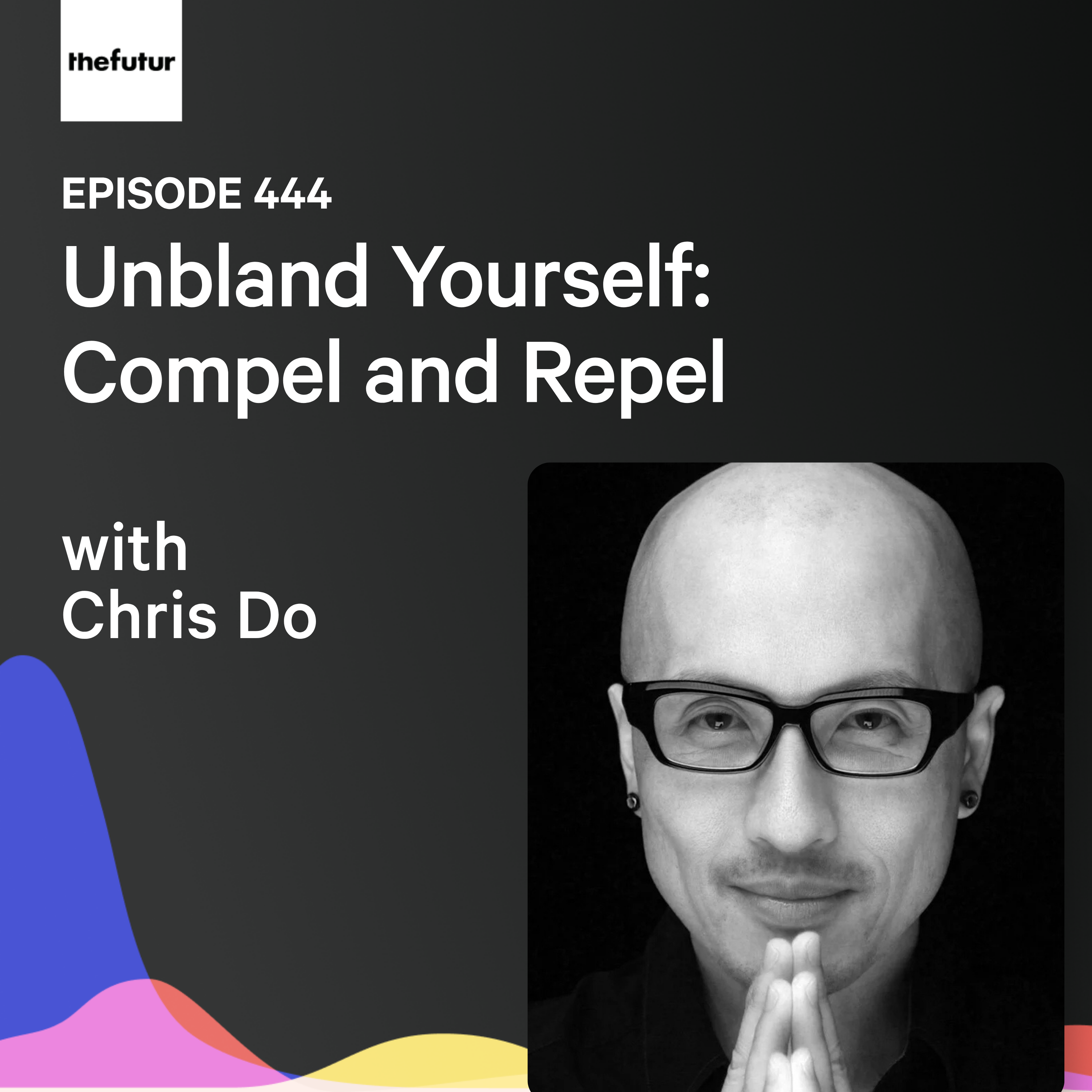
The 3 Rules of Personal Branding Nobody Tells You w/ Chris Do | Ep 444
from The Futur with Chris Do
33m 4s
The host discusses the dangers of social conformity, where people suppress their true selves to avoid conflict, leading to a life of invisibility and lack of authenticity. In response, the book *Unblend Yourself* offers a structured, reflective journey to help individuals rediscover their core identity, values, and purpose. The core philosophy emphasizes being intentionally different, courageously embracing discomfort, and using visual and verbal presence to signal authenticity. A strong personal brand arises not from what one does, but from a clear mission—like being known for a specific value—and an enemy or issue one seeks to eradicate, such as judgment or death. This creates a compelling narrative, like Brian Johnson’s mission to “not die” in the longevity space. The host also highlights the power of visual cues, arguing that clothing and appearance send subconscious messages that shape perception. To build this brand, one must own a niche, aiming for number one within one to two years or pivot to a different space. The process combines deep self-inquiry with practical, low-effort exercises to make personal growth accessible. Ultimately, the goal is not perfection or popularity, but authenticity—showing up with vulnerability, honesty, and purpose so that people feel compelled to connect, while also being repelled by what is false or out of alignment. The workbook is designed to be a standalone, intimate experience, allowing individuals to explore themselves at their own pace and build a brand rooted in truth, not just expertise.
people are so afraid of alienating everyone that they wind up saying nothing to everyone and
they're just blending themselves into oblivion into a relevancy. So when you say something
and you say something that is based on your convictions, not to say it's a rile people up. I'm not
saying to be a contrarian, to be divisive, but to say things that I have meaning to you, it should
both compel and repel. Chris. Yes sir. Welcome back to the show. Appreciate it. You just launched
a new workbook on Blan yourself. Tell me a little bit about when Spire that on Blan yourself comes
from philosophically this idea that we have been socialized to blend in to get along and
depending on what culture you come from, it's stronger than others, but we're wearing, in my
opinion, a very, for some people, a professional mass, you show up, you see certain things and you
play your cards, you don't try and upset anybody. And then if you do this for long enough, you forget
who you are, what your core beliefs are and you're afraid to go against the grain. And this is
amplified across social media. We were so fearful of saying our thoughts expressing ourselves and
our true self dressing the way we want to because we're afraid of the backlash. So Blan yourself is
a culmination of the last three years of research, testing, experimenting in virtual and in person
in real life workshops where I'm testing concepts that help people figure this out for themselves,
like who are they, who are they meant to be in this lifetime and who were they when they thought
to themselves when they're seven years old, this is what I want to be when I grow up and something
happened to that plan. Did you always have the thought of making this book versus like a sales
book or like how did this come together? I realized that my ability to teach as many people as
one is finite if I do it as an in-person experience or even through the price barrier. But I believe
this is fundamental to our overall well-being, our sense of self that I want to be able to do
something that's a standalone thing that can be done on your own pace in the privacy and comfort
of your own home that you can go through and ask yourself these deeply personal and profound
questions that require a really kind of contemplative, reflective moment and it's not always conducive
to do around people on a certain timetable. So I recommend people go through the book at a certain
pace that they feel comfortable with and the goal is not to try to finish it as quickly as possible
but to learn about things that you kind of pair way deep inside of you and to have some honest
conversations with yourself. When did you start to unblend yourself? It's been a progression of
exploring is a safe I'm going to be okay. I think for me doing video with Jose in 2014 was how
I was able to do this at scale. So of prior to that point in time it's not like I was sitting there
trying to fit in. I've always been intrigued by this idea of pushing buttons and using
the things I say my actions and the way that I dress to kind of push people's buttons and this
has happened but now it's happening at a much larger scale so it's kind of that expression of
you can't put the genie back in the bottle so you do it in measured steps like if I showed up
and dressed like this and said these things what is the consequence of that and like many things
there's a quote the quote is something like the human mind once expanded does not shrink back to
its original size and this is like many things when you find out that these self-imposed rules that
you live by are actually just that self-imposed and that real rules they're not laws that you start
to be more free. It's this classic story of a dog who wears electric shock collar and when they
approach the perimeter to offense that they're not supposed to go beyond send them a little electric
signal. After a while they learned that there's a perimeter and you can just take it off and they
never cross a boundary and the same is about an elephant who's one since childbirth is held by
chain and eventually it's just a string and they never push past. We are like that we learn really
fast about what we can and cannot do according to certain societal norms and then we play small
the rest of our lives we never realize that once we leave the city in which we grew up in or we
leave a group of friends that we thought this is my core group I must need them always or the job
that we've always had. We learned that the world's much bigger there's a lot more to us to give
and I think that's one of the most liberating things. So with Jose I guess what was that chain
that you had to let go like what was holding on to you? I think the biggest hurdle I had to get
through was if I am myself what kind of negative impact is it going to have on my business because at
that point in time I'm still running a service design company doing really big projects and if I say
this does it mean that I lose that and that was the thing I need to figure out. So a couple things
to learn in that process a number one nobody's really paying attention to you. In our own little bubble
I think we falsely believe we're the most important thing in the world because we have no other
thing to reference we're always thinking about ourselves we're looking at ourselves we're just
dealing with ourselves most of the time and we don't realize clients are busy they're thinking
about themselves so they're not sitting there looking at every social post that you make and just
listening to every podcast like oh my god we disagree politically we can no longer work with that
person unless you do something super sensational in a way that's not good for you and number two is
there's a wider level of acceptance for you than you think so even if they were paying attention
what what inevitably happened is as you show more of yourself some people get to say I like that guy
or I like her or I don't like that person and I think that's a good thing so when you say something
it should both compel and repel it should compel people to say yo I get your vibe I get what
you're putting down I want to be around you this is cool let's chop it up sometime and it should
repel the people like I don't like the way you think I don't like that expression of whatever
for example sometimes I wear fashion that is unpalatable for some people if I wear some kind of
weird crazy color or floral print for some people some straight people they might think that's
suzesty you can't do that or if I talk about therapy and how that's been one of the big isn't
return investments I've ever had they're like well don't bring your therapy agenda to this
conversation everybody needs it I never said everybody needs it but if you're searching your loss
it's worked really well for me I recommend you give it a try not try to impose anything on anybody
for the people who feel called try it if not no worries find whoever you think is most
line with the way that you want to learn I think a lot of us get stuck in a place where we want to
make content as we grow personal brand but we talk about what is it that we do versus who we are
how do we navigate that road okay some very different things before I answer our question when
I talk about the comments okay everyone has an a-hole and everyone has an opinion that doesn't
mean I want to see either let's just put that out into the universe okay yeah and everybody needs
to know that sometimes they both think so people would say things like your hat or what he's
saying he is he's trying too hard or every time I tune in there's another necklace and it's just
getting out of control here's where it gets real interesting when you're in real life and people
start saying nothing now you're dealing with heat in real life but people are very brave behind
your back they're not so brave in front of you here's a class example I think you were there we're
at Ford I think it's two years ago and at their main event Ford is run by Neil Dingra it's for
mortgage professionals and real estate people my buddy Trevor Trevor York is there he goes Chris
Chris I love the way you dress but I don't fully understand it and he's giving me a hard time
as a straight white guy he's giving me a hard time but with love Trevor and I work we have
great relationship and he's like I see I could never pull off that man bag that you're wearing that
purse and I said are you sure and why don't you try it on and he would try it on and all the women
around it that part of the staff is like oh Trevor you look so good he goes do I so that's a
presumption of reception of how people would read you and also a limiting belief about what you
can and can pull off in a slide and the next thing you do is say oh what is that did you take that
belt buckle off the airplane like dude does TSA know about this trying to give me a hard time I'm
like I'm going with it you want to play we can dance and we have these conversations about what makes
you come from one comfortable and now this is great customer his game has changed he's dressing
differently and he's like sending me DMs like hey is this a good fit or not and so I like that
for each person it doesn't have to be around fashion it could be oh you never thought you could
drive that kind of car or you never thought you could live in that house for that neighborhood or
date that kind of person we have so many limiting beliefs let's get into your question your question
is why do people talk so much about what they do versus who they are because there's a lot of
templates out there that exists we don't know what to talk about we're told from very young age don't
talk about yourself don't think about yourself so much so what do we do we deflect what we're
realizing is in the 21st century we have an embarrassment of choices where we're kind of
inundated and overwhelmed with how many choices we have in the world in fact there's a cognitive
bias it's called the paradox of choice that the more options that we have the hard it is for us to
make a decision and the reason why potentially some of your clients don't choose to follow you
or to reach out to you is because they can't tell why you're different than anyone else and so
therefore they shut down and you and I both know this anytime you need to do something you don't
know about you start to do too much researching I'm just overwhelmed that's why it just takes us
too long to do something getting back to why people don't talk more about themselves culturally it
doesn't feel right we don't know ourselves we have low self awareness and if we have high self
awareness we're not quite sure what's interesting to other people historically speaking we are the
worst judge of our own value I could do something you're like dude how'd you do that why do you
even move that there or put that thing on how do you know that's going to work and I'm like does
everybody know that yeah well I don't explain it to me and then I explain it to you and depending
on your reaction to me explain it to you I think maybe I'm on to something maybe somebody else
like you would want to know this thing and that begins this whole process of understanding wow
something I take for granted is valuable to other people so if we want to learn more about ourselves
We need to put ourselves in a position where we're explaining to people what is that we know think and believe and
Judging by their reaction and if you get enough feedback from different types of people you might discover something you weren't even aware about yourself
I think
You're so aligned with who you are
So I think it's easier for you to talk about these things because you're well read and you do all these different things
We're thinking for like a lot of us me being video production and
Build my business for the past ten years around video production when I'm like, hey Chris
I don't make this video about that. You're like no, that's boring talk about this other thing
And I'm just and I just I don't see it like the way that you do for me
It's so easy like well
I could build a personal brand talking about video, but you're like well, that's not really building a personal brand
I think for you, you're so aligned that like when you hear when you say this again makes sense for you
But like I don't don't feel like it worked for me
What wouldn't work for you?
Like to not talk about videos like I don't know how to not put the personal brand around the thing that I've been doing for
Ten years. Okay, let's clarify talking about what you do is not how you build a personal brand. You're basically doing tutorials
Nobody has any sense of who you are what you stand for all the things you've learned in life. It's just manifested in how to
So if we said this if we put a robot voice on you, but it's the exact same script and we blur your face
Would anybody be able to tell with you?
Because you're not really sharing your philosophy and your ways of the world now
Let's contrast that against some people who are very strong personal brands, but maybe not put a lot of value into the world
We were talking to manager John earlier today. He's like in the OG days
All you had to do is turn on the camera and be a personality
So we got to know those people are really one they grew gigantic accounts and have massive fandoms
But to the average person is like what value did you give to me?
So the solution is somewhere in between the two to say like I create a lot of value in the world
I give you a lot of utility. I'm useful. I'm helpful to you creating transformation, but I'm also
Weaving in my story about who I am. So you have a choice. Do I want your brand of video production?
Or do I want someone else's brand of video production?
The classic example I always give to and I'm sorry if people are bored out of this until they can understand this concept
Water's water waters two molecules of hydrogen and one molecule of oxygen H2O. We put that together
We have water. Water's water water comes from the sky water comes from the earth it comes from every place and it's theoretically free and abundant
Available yet we all make this decision to go into the store and buy a bottle of water for two dollars or
25 dollars for the exact same amount
Why does one command two dollars? Why does one command 25 dollars and the answer is the story that each bottle brings and
There's a fancy word is called provenance like where something comes from this came from the Swiss Alps
This came from the Amazon River. This came from parts of Africa or the Canadian Glacier
This is never touched by man. This is vapor distilled
They're all stories because marketers have learned that we need a story
Humans are meaning making machines and we need that meaning and everything that we do
So if you tell the story I allow myself to accept your meaning so when you don't tell your story
There's no meaning. There's no connection
So if I wanted to start 2026
I want to start building my personal brand. I want to start telling my story
What is that first post that I'll start off with?
Well, you're talking about the taps because of creating something before we can create something
We need to know who like are you and there's a good chance you don't know who you are
Hence the questions I pose in the book and the workshops. Well, who are you?
What are your beliefs? What are your values? And
What people tend to do is they want to talk about all that they're good at all the strengths and the beautiful things
We're very used to that. This is why people appear too perfect on TV or on social media
It's because they're presenting their very best self on their very best day. That's really boring to me
And it reeks of inauthenticity. So I say to people look into your shadow self the things that you feel great vulnerability around
Things that might bring anxiety or make you nervous. Let's figure out how you can incorporate that into you because that makes you much more interesting
I don't know about you. I'm not perfect and when I see perfect people which they don't exist, but they present themselves to me
There's something about it feels like
They're driving a wedge between me and them my ability to connect with them is not going to be great
I hear you on doing the deep work and trying to find out more about yourself to free make that first post
But I think for some of us who get so
paralyzed of even just doing a workbook like some of us can't even make a post just to make a post
So then you said like hey, you got to do this deep work before you make something is you see that's doing away
No, I'm not saying that. Okay, you can make whatever you want in fact all over the internet is people making whatever they want
It's not stopped them
Some of them will figure it out some of them won't but if you want to be more intentional
Before you make the work spend a minute
So I'll give you an example. What is something that you've wanted to teach but you're not fully confident that you know how to teach it storytelling
Great answer. So storytelling if you want to go out and teach storytelling. You could say here's what I feel about this and based on my own life
Experiences this is what I know which could be a great video
But a learned person somebody who was like much more intellectual curious would say well
What are the top five books on storytelling and can I watch movies read stories and
Watch plays and start to understand the invisible structure that binds them together
What is the thing that makes the top 100 films of all time great and then you could do that researching
Sort of thinking about it, and then you can maybe come up with a couple of things that are obvious between these things and a couple of
Things that are not obvious that you start to share with the world
You could do this in intimate conversation with you and another person off camera
You could do this in small workshops virtual workshops, and then you start to see what ideas stick and now you have something
And when you go and make content around that something you thought about that's gonna hit much harder
Can we see the difference between these two approaches? I want to say no, okay?
Because that to me feels like what you just said of like you're a how-to person
Like if you're coming if you're like looking at these books like hey here are five books for you to go read
How's that different than what you said to like to be a how-to person?
Okay, these are two different arguments we're making
I ask you can you see the difference between someone who wings it who doesn't do any research?
Okay, and one person who does a deep dive and just try to like fill in the knowledge gaps that they may or may not have
Okay, which one will be more valuable the second one the problem is most people don't go to spath as you know
So when you say I don't know how much work I need to do. It's like have you done the basics?
So now that you have structure and you've learned these things when I say learn only weed
I mean learn like you can internalize it you can share ideas
What happens inevitably is once you learn something it gets mutated by your own brain in a good way
You say a little differently you embellish this and you remove that and all of a sudden it starts to become more yours and less layers
Now if you were to learn about storytelling and you're teaching storytelling one ways mechanically say here's how you tell a story
The other more interesting ways you tell an amazing story and said do you want to know why I did that?
Here's what happened that becomes part of your brand, but then don't you just become the storytelling brand guy?
Yeah, that's what you said you wanted to learn how to do storytelling well, I wanted to figure a way out that I'm
I just don't become that person because like why so what's the difference between me being the video guy and me being the storytelling guy?
Okay, what is video guy?
I'm the guy that you come to when you need like videos done and what is it?
There's the underlying layer that you're selling views reach for clients if I'm a strategist to help people get views
Conversions audience building all that kind of stuff. I don't talk about video production at all. I talk about video strategy
Okay, that's very different. Okay, let's say I talk about video strategy. Okay. I thought when you said about being building your personal brand
Isn't about talking about what is it that you do that's correct
So then when I just be the video strategy guy? Yeah
So how do you have anything to tell about your personal brand yet? So how do you start it with that there's a couple things you need to do
I've developed another workbook because I realized unblend yourself is dense book as a hundred plus pages
It's deep inner work and people like their heads are melting right now. So I was thinking how do I provide a quick win?
I'll share a story
You and I were in Japan. I'm having a really good conversation with my buddy Chris Sergio
He goes Chris. I love what you're doing. Can I give you some advice? I'm like sure place and he's a brilliant guy
So of course I'm gonna take advice from him
He said that what I find to be effective is when there's high frequency of exercises, but low intellectual lift
What that means is instead of giving us a big thing to figure out that we don't talk about for three days
Give us lots of little things quick check ins so we feel like we're making progress on things
Little tiny tasks and it's very different than how I think I'm a deep diving kind of guy and these seemingly
Complex problems for me are not that complex but for other people. It's very complicated
So I took that to heart so when I went to do the next workbook
I had the goal of how do we lower the lift the mental lift and how do we make it fast fun and easy to something can do
30 minutes and feel like they have some success
So what I had to do is develop a whole set of different exercises and it gave me a lot of clarity that
Dare I say I might actually even like more than the hundred page book. Okay, so I'll share it with you
There are three things. We'll call this your unblanned essence or essentials or foundational layer something like that
And there are these three things the cool thing is you only need to know one of these things to figure out the other two
So what I want you to imagine is either a triangle or three overlapping circles that then diagram where they meet in the middle
Is where do you are in your personal brand and they are what is the one thing you want to be known for and I'd like to reduce it
Down to a word if possible. There's some conditions there. So first what's the one thing you want to be known for number two
Who's the enemy? What are you on a mission to rid the world of what do you want to eradicate and this there are only so many versions of this right?
So it's universal. There's probably 12
universal concepts and just made up that number that everybody's trying to get rid of judgment,
let's say. And then the last one is, and it's the bridge between these two things,
you're one thing, the enemy, the thing that you're trying to eradicate the world of,
and you're called to arms or you're rallying cry, the phrase that when you say activate your
audience and the community. And so do you know the one thing you want to be known for, Drigo?
Or of these three things, what do you think you're clear about?
Oh, YouTube strategist. That's what I want to work on for 2026.
Perfect. YouTube strategist. The criteria now, we have to ask ourselves this question.
Can you own this space? Because the world rewards number one, not number two, three or four.
If you cannot own this space within a relatively short amount of time, and when I say short,
between one to two years, then you should not try. Something from South Gordon's book The Dip is,
we should predetermine if we're going to be successful. And once we determine we can be successful,
we never quit. What people do is they don't think they try things in the quit. They think they
try things in the quit. They never get anywhere. So if you look up right now on the internet, type
on to Google or Gemini or anything, you say, who are the foremost thought leaders in the YouTube
strategy space? Did a list double chuck your homework and say to yourself, can I with intentional
effort overtake them in a year's time? If you think you realistically can, I would suggest you go
for it. But why do I need an enemy? Like, if I'm just trying to be like the YouTube strategist,
why do you need an enemy for that? You did get rid of something in the world.
Because we are more united in a common enemy than we are in a common friend. And all the best
brands in the world, as far as I know, they have an enemy. Well, take a brand. I guess it'd be
easier if we put this to a person versus a company. Okay. Let's do Brian Johnson. Oh,
glad you brought that up. Are you familiar with Brian Johnson? Oh, what a man. Okay. He is the guy who,
I guess, for lack of better term, looks like a vampire. Sometimes he's the consider the most
measured man. He spends over a million dollars a year biohacking so that he doesn't have to age.
So we say, what's the one thing he wants to be known for? Not dying or death. Okay. But the word
would be something like longevity. Okay. I see the twist there. Okay. Okay. So longevity, he wants
to live for as long as possible. And you can say aging reversal, his biological age is going backwards.
His chronological age don't become stop goes forward. So when he does all his chemistry and they
look at it and his biology, they're like, wow, you're not 48. You're 36. And he takes a thousand
vitamins. He's doing all kinds of radical treatments, red light therapies, doing everything he can
to grow backwards in his age. What's his enemy? What's he fighting against? Death. That makes
sense. Do you see how they're connected? Yeah. Yeah. He wants to be known for longevity. And he wants
to get rid of death. So longevity and death. What is his Riling Cry to let everyone know we're on
the same mission? Let's go do this thing. Do you know what he says? No. He says don't die. It's
perfect. So when it be known for longevity, my enemy's death, my Riling Cry is don't die. So he
has a conference, the don't die conference. He might have a package of supplements called don't die.
So now it becomes really clear and he can build brand extensions from this and it's super clear
now. So whenever you think of longevity, he owns that space now. So there are a lot of other people
like my friend, Dr. Kinvoo, and he's trying to like be for longevity. I'm like, I can't remove
Brian from my mind. So you're going to be number two. And I'm pretty sure people in this space
know Brian Johnson, but they don't know Kinvoo. And that's a problem. Okay. Now there's mathematical
parts that support this. The number one leader in any vertical is three times bigger than number two.
Number two is three times bigger than number three. So basically the three top players in
the market control the entire market. And there's like scraps for everybody else to the remaining
97% fight for crumbs. If you can't be number one, don't play. That's my opinion. Who's the first
person on the moon? You know, I'm sure who's number two? No idea. Who is the first person to run
the four-minute mile? Roger banister. Who's number two? I couldn't tell you. Right. Yeah.
So let's say, for example, who is the person who's in teaching on plan yourself? You should say
my name. And then who's number two? We don't care. Right. That's the problem. But I feel like
that's so discouraging. Why? Well, you're saying like, Hey, if you can't be number one,
then you shouldn't even try. You shouldn't even try. So like if I look up in YouTube and like
the top four YouTube charges, like, oh, they're even bothers. So then what do I do? Just find a
different lane. Simple as that. Okay. So you say like, Chris, can you be number one in personal
branding? Maybe. I'm not sure. But I can definitely be number one in unblanded. Okay. It's words
and words do matter. When you think of why? Who do you think of? Simon Sinek. Who else do you think
of number two? When you think of vulnerability? Who do you think of? Brown? Who do you think of number two?
That's what I'm saying. If I cannot out research and storytell and do TED talks that is one of
the 10 most viewed TED talks in the world and compete with Renee, who's written so many books,
who's been on Oprah, who's been on every single thing you could think of. I'm not going to try to
win that game. I'll try to win a different game. Okay. Maybe I use word shadow self. And I want
to tell you something. You're like, it's discouraging. I don't see it as discouraging at all. Because if
you're number one, it means you're number one, and nobody can take it from you. So is this just one
part of the book when you actually learn this? So is your book teaching you how to find this one
thing for you to be known for? Or are there different elements to the personal branding and what
you've learned? There's more than that. There's seven points. But I realized in trying to make it
simpler, is it simple enough? I mean, I have a copy here and I've been playing around with it.
Definitely something like one I'm on the airplane. I've been going through this. So it's definitely
helped a lot. I do see one thing here. So there's like three principles to personal branding.
Yeah. What are those? They are number one, you have to be intentionally or meaningfully different.
Because if you're the same as everybody else, you might as well not have a brand. You have a blend.
Number two, you have to have the courage to be disliked. That sounds really good because it's
come from a book title that I also like a lot. So if you're different, different gets smashed.
Different gets ridiculed. Different is misunderstood. So we know as soon as you have the courage to
stand up, people are coming after you. So then you have to have the courage to be disliked. I'm
different and I'm cool with that. Number three, and this is the one that's going to surprise most
people is more than 50% of our brain is dedicated towards visual processing. So to tie it to how we
began this conversation is the way I present myself visually, signals to other people really quickly
before words are formed of feeling. And so principle number three is you have to be aesthetically
discerning. If I were to show up in a potato sack with flip flops, you might think, Oh, Chris is
really earthy. He's a manly. The people is keeping a real humble right now or somebody else might
think, Oh, you couldn't be bothered to show up for this. I showed up for you. I can't take you
seriously. So what we're doing is unbeknownst us, we're signaling to people all the time. Who are we?
How should you perceive me? So you walk into a room and you have a perfectly groomed beard and
you're wearing a super sharp $10,000 Italian suit that's tailored and you walk into a room. People
are going to think of this guy. He must be an important person. You come in there with shorts,
cargo shorts and a t-shirt with holes in in sneakers. Who let this kid in a room? Where's security?
You can literally be the CEO, but people will interpret you as a certain thing. So what I tell people
is this, your clothes are not clothes or tools and tools are designed to solve a certain job.
So the question for you is the tools that you have, what job are you trying to solve?
This is a really important question. So like if you're working in the kitchen and apron works really
well and if you're working in a car, a jumpsuit works really well, a dark one and if you're working
in a hospital, scrubs work the best. So when you're dressed and you're going to step on stage,
what job are you trying to solve? Oh, I guess I'm trying to impress. You're trying to impress.
Yeah. And how would you impress people? Very worn something unique or sharp.
So when you're trying to impress, most people say you're trying to be professional. You want to be
taken seriously. Okay. And so then what are the tools that you would use for that of all the
different kinds of fits you can put on? Most people say, well, sport coat, trousers, maybe a tie,
maybe we don't know. And that would be a pretty reasonable thing. Like I'm trying to be professional,
I'm taking this seriously. I wish for you to take me seriously. And we adopt the corporate
speakers uniform. Perfect. The problem is you're also telling them I'm like every other person
on the stage. I'm actually not that special. Maybe you guys should ignore me because what I'm
going to say is going to be like, well, everyone else is saying the way they deliver it is the way
I'm going to deliver it. You know how they start with this? I'll start with that. You know,
they conclude with this. I'll conclude with that. You see their tone. I will adopt that tone.
So you're inadvertently signaling to everybody by adopting the corporate uniform.
I'm like everyone else. Please don't pay attention to me. This hurts because a lot of people
dress this way. So my intention is different because I'm maybe more secure in myself. I'm
more self confident. I could give a flying rat whatever what you think about what corporate looks
like. What the job I'm trying to solve is I'm going to be different. Whatever you heard before
and after may or may not matter, but this will not be the same presentation. I'm not the same person.
I actually care a lot about design and intentionality. And I'm going to tell you why it's an advantage
to be different by proving it to you. Not just talking about it. And managing them I came on stage
and I'm like, dare to be different. And I look like every single other person. The best way to unblend
yourself is to look just like everyone else. There would be a mismatch and misalignment between
message and delivery. You see the problem. So I told
before my philosophy, my ideas are meant to compel and to simultaneously repel. I know
if I do something, it doesn't repel people, I'm not doing anything of note. If you play
it really safe, if you've drive down the middle lane always at 55 miles per hour, you're not
going to offend nobody. You're not going to break a speed record here. I'm here to break
things. So somebody during our conversation at dinner, I said, so what's this all about?
You're on stage right now. Why you look like this? And I like being tested, by the way,
because that caught me off guard too. I'm like, I wasn't. It's just theory, man. You
don't turn the lens back on me. And I had to think real quick. And I said, so here's
something you don't know about me. I hate social events. It took a lot of energy for me,
even to decide to come to this, even to say, yes, I'll be there. That was a lot of effort
for me. And my biggest problem as a socially awkward introvert is I don't know how to start
conversations with people, but I enjoy the company of other people. And so when I walk
into room and there's 18 people and they all know each other, they're chopping up like
they go way back. I feel like I'm brought back to junior high again, like I'm the new
kid who just transferred into school and I look like nobody and I feel very much the
outsider. What I do is I am a provocateur. So I want to wear things that invite people
to have a conversation with me. So they can say, hey, what's up with the hat? Why did you
wear this today? And let's have a conversation or are you in the creative space or you must
be doing something or you're an important person. I need to talk to you, right? I'm like,
am I? That solves most of my problem. So in social circles, the job unlike on stage is
come talk to me. Please, I'd like to have a conversation with you because I think you're
a person worth getting to know, but I don't have those skills. You just don't know that's
what I'm doing to you. I love that. So what are some ways that if you want to support
and look into the book, how can we show up for you? A lot of different things. So we have
some goals in terms of growing the YouTube channel. You can support us financially by becoming
a member. The patron level is one that counts the most, but we appreciate any and everything
you do. If you don't like subscriptions or memberships like that, you can just send
me money and demo to help build this thing. Where can we get the books, the workbooks?
Probably just go to fuchsia.com. We'll figure out where you can get them. But if you follow
me on social at the crystal, you'll know because I'll not try to make it a secret. I'll tell
you anything else for 2026 that is keeping you up at night. Nothing keeps me up at night.
I sleep really, really well, but I will tell you something. The next chapter of what holds
in what's in store for us in 2026. If all comes to fruition, fingers crossed because
I don't want to talk about chicken for the hatch, you're going to say, oh my God, that guy
had a dream and he's just making his dreams come true and we get to ride along and be
a part of it, not just from a warrior point of view, but we get to learn through the whole
process. That's what I'm doing. Cross the man. Well, great talking to you as always.
Thanks for watching the show. Of course, man. Thanks for me in the future. See you guys
in the next one.
Podcast Summary
Key Points:
People are socially conditioned to blend in, leading to self-censorship and a loss of authentic self-expression.
The book *Unblend Yourself* helps individuals rediscover their core identity by asking deep, reflective questions about values, beliefs, and personal evolution.
True personal branding requires being intentionally different, having the courage to be disliked, and being aesthetically discerning to send clear signals about one’s identity.
A strong personal brand emerges from a clear mission—such as a “one thing you want to be known for”—and an enemy or issue you’re trying to eradicate, creating a compelling narrative.
Visual presentation is a powerful, subconscious signal that shapes how others perceive you, often before words are spoken.
Success in personal branding demands ownership of a niche, with the top leader dominating the space three times larger than the second, so competition should be intentional and focused.
The recommended approach combines deep self-reflection with actionable, low-intellectual-lift exercises to build confidence and momentum.
Authenticity and vulnerability—especially in one’s weaknesses or shadows—make a brand more relatable and impactful than perfection.
Summary:
The host discusses the dangers of social conformity, where people suppress their true selves to avoid conflict, leading to a life of invisibility and lack of authenticity. In response, the book *Unblend Yourself* offers a structured, reflective journey to help individuals rediscover their core identity, values, and purpose. The core philosophy emphasizes being intentionally different, courageously embracing discomfort, and using visual and verbal presence to signal authenticity.
A strong personal brand arises not from what one does, but from a clear mission—like being known for a specific value—and an enemy or issue one seeks to eradicate, such as judgment or death. This creates a compelling narrative, like Brian Johnson’s mission to “not die” in the longevity space. The host also highlights the power of visual cues, arguing that clothing and appearance send subconscious messages that shape perception.
To build this brand, one must own a niche, aiming for number one within one to two years or pivot to a different space. The process combines deep self-inquiry with practical, low-effort exercises to make personal growth accessible. Ultimately, the goal is not perfection or popularity, but authenticity—showing up with vulnerability, honesty, and purpose so that people feel compelled to connect, while also being repelled by what is false or out of alignment.
The workbook is designed to be a standalone, intimate experience, allowing individuals to explore themselves at their own pace and build a brand rooted in truth, not just expertise.
FAQs
The book challenges people to move beyond social conformity by exploring their true self, core beliefs, and values. It encourages authenticity by helping individuals identify who they are beyond societal expectations and what they stand for in life.
People fear backlash and judgment, especially due to social media pressure. They've been socialized to blend in and avoid conflict, leading to a loss of self-identity and a habit of staying silent when expressing personal convictions.
The book recommends identifying one key thing you want to be known for, your mission to eliminate (your enemy), and your rallying cry. This creates a clear, focused brand identity rooted in authenticity and purpose.
Visuals signal how people perceive you before they hear your words. The book emphasizes being aesthetically discerning, as your appearance sends subconscious messages about your identity, confidence, and intentions.
Being different helps you stand out and creates a unique value proposition. The book argues that if you're the same as everyone else, you blend in and lose your distinctiveness, which is essential for building a meaningful personal brand.
The book encourages embracing vulnerability and sharing authentic, imperfect aspects of oneself—like insecurities or struggles—because these make a person more relatable and interesting to others.
Chat with AI
Loading...
Pro features
Go deeper with this episode
Unlock creator-grade tools that turn any transcript into show notes and subtitle files.
 PodcastTranscript AI