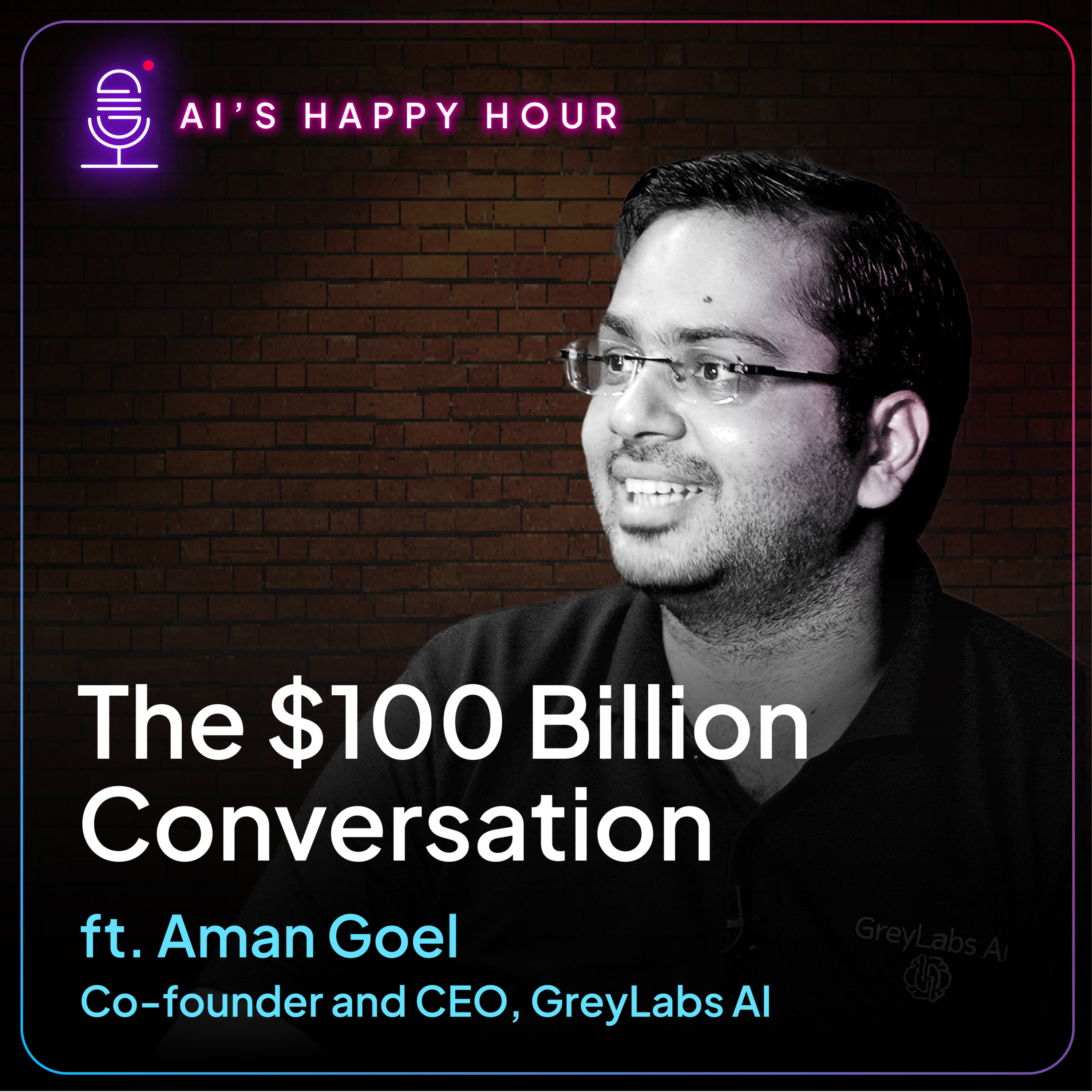
The $100Bn Conversation Ft. Aman Goel of GreyLabs AI
72m 39s
The speaker reflects on his journey from being an introverted computer science student to becoming a more extroverted entrepreneur. Emphasizing the value of prioritizing customers over investors, he shares the experience of securing a significant contract with State Bank of India and the challenges faced during negotiations. The story highlights the critical role of partnerships in founding successful ventures, with insights on managing relationships effectively in a fast-paced business environment. The speaker's journey underscores the importance of adaptability, perseverance, and strategic decision-making in entrepreneurship.
Transcription
14185 Words, 77522 Characters
It was a first negotiation of our lives, both of us were computer science people so you know, engineers are introverted, we were like that. I am talking now over here very fluently and seems like I've always been an extroverted person, no. I was someone who used to work on my laptop, don't disturb me, don't talk to me kind of person. The profession of being an entrepreneur that changed my personality you can say, right? Every single day companies around the world have millions of conversations with their customers, some on the phone, some over email and some to chat about in today's world. It's a constant stream of data, potential target throw of insights, feedback and opportunities, but for most is this noise of black box of unstructured data they can't really use. What if AI could help you listen to all of it? What if it could understand the nuance, the intent and the emotion in every single interaction and help you understand your customer's expectation a little bit better and truly improve your customer's experience? Welcome to today's episode of AI's Happy Hour. We are talking to a founder who has already completed the start of Dream once. Building and selling his first AI company, Cognitive AI, right after graduating from IIT Bombay and now he's back with Brilliant to tackle that even bigger challenge of decoding conversations at still. He's a brilliant builder of very sharp pinker and someone who truly understands how to create value from the ground up. Aman, it's a huge pleasure to have you on the show with me. Thank you so much. Pleasure is mine. And I'm telling you, I was just getting started, frankly, especially in the pre-recording conversation that we were having. It definitely gave me goosebumps because I suddenly thought there was there's going to be a bunch of insightful nuggets now. I'll be able to surface for our listeners in this episode. And Aman, you have charted some interesting pathways as an entrepreneur and I wanted to really start there. Let's start with your partnership with your co-founder, who also happens to be a life partner now, which was interesting. And that started with you both building Cognitive AI with a very distinct customer first, not investor first, philosophy, bootstrapping it to a multi-million dollar exit. You know, more frankly, where most of us are running around, funding rounds and focus there are often, and that is often seen as the primary milestone as a starter. What's the core belief that drove you to chase customers instead of actually investors and how has that discipline shaped you as a founder and how you built your business? So to get prior to starting the company, let me take you back on how exactly my dream of becoming an entrepreneur started, right? So like any other idea, I was also in the rat race of going to the US, working for a large tech company there, settling, getting the H1B visa, right? 2016 summer, right after I completed my 30th year of college, I got a chance to intern at a US based startup called Rubrik. They recently got listed in the stock markets as well. They were in the cloud backup and recovery space. So I did a fantastic internship there. You know, at that time, I was getting paid like something like $8,000 a month, one of the highest stipend. So it was like a dream internship, but spending three months in Palo Alto in the Bay Area, I felt a bit lonely. I'm more of a person, you know, who wants to talk to people after seven o'clock in the night. I want my family, I want my parents around. So I felt a bit lonely in the Bay Area. It's more of a personal choice. After that, I decided that I will move back to India after my internship and do something of my own within the country itself rather than going to the U.S. I was not very excited about working at some company in India. And fortunately, entire fourth year of college was left as free time for me, right? I had already completed most of my courses. There was one year left and I had a pre-placement offer. I did not have to sit for masters or GRD preparation because I did not want to go to the U.S. And in my college and computer science department undergrad project was also optional. So practically 7th and 8th semester, one year, it was left for me to explore myself. And, you know, the best part is you can fail at this time and not be judged by the society because you're still a student still in college. So that's when I decided to get into entrepreneurship. Every college today and even at that time, every college has a school of entrepreneurship or, you know, entrepreneurship sale or an intermission sale. IIT Bombay is going to step ahead. They have started Decide City School of Entrepreneurship, which is funded by Mr. Bharat Desai. I think he is, if I'm not wrong, 1975 batch alum who told his company for several billions of dollars and now is giving back to the institute via this school of entrepreneurship. So I took some courses in the final year of college in the school of entrepreneurship as a part of my institute electives. So in the final year, you're allowed to choose the courses you want to take and you can tag them and they will be counted in your grade point. As well as, you know, you can take up courses, you have more flexibility, you can go beyond your code department for me, it was computer sign. So and the professor, the school of entrepreneurship, they are not proper academicians. They are industry veterans. So like I mentioned, professor Bharat Desai, he was an entrepreneur then there is professor Rajaswar. He's also from similar batch, I think 75 batch and he has two of the companies which he co-founded which are listed in the US stock market. So it was pretty exciting because they did not have 10 paper exam. Their premise was very simple, find the problem statement, try and build a solution and go build a company out of it. That was the assignment literally. So for me, it was a dream come true where I'm getting grade point and I'm doing the thing which I enjoy, which I want to, you know, I wanted to build something off my own. So that's how my entrepreneurship journey started. In the 8th semester, one of the courses I took was in the professor Devvi Purkaya sir. He was the VP of VHL South Asia. He's I think from 1920, 85 batch IIT Kharpur Alam, 87 batch IIT. So proper, much older than me, his experience was more than my age and he was very excited, very enthusiastic person even at that age. So in his course, the most interesting part was the premise that you have to sell before you write code. As engineers, we are very biased towards writing code, it's very easy. You start writing code, you feel there is a progress that is happening but the reality is no one wants your software. First, you need to validate, you sell a concept via minimum viable product. That minimum viable product could be a presentation, a landing place of the website or a video. That's how this whole thing started. And Devvi Purkaya sir was the one who imbibed the right kind of mindset for me where he used to always tell me, am I always think customer first, if you have customers, if you have paying customers who are giving you their precious money, investors will share you. And I came from a very clean slate, typical software engineering undergrad, who is few less about entrepreneurship. So that learning got imbibed in me because I did not have to unlearn anything. There was nothing to unlearn except for the fact that I need to stop writing code and talk to customers. The whole venture capital game was very new and less mature at that time compared to what it is today. So I did not have to unlearn anything and I fortunately was able to learn from scratch that I need to focus on customers. So in my first start of, we never change any investors. Even today in my current venture, great lab say, we talk about it, we raise some money, but we never change any investor. We always were very focused on finding the customer, solving the problem, getting revenue out of them. So that's how the seeds of customer first mindset, they were shown in the founders mind, in my mind. And that got calculated as a DNA of the company. You always share customer investors will follow me. That is awesome, but it does take a lot of discipline, by the way, to be able to follow that route. And I'm sorry, it would not have been easy pathway. And would there any lessons that you learned along the way, as in especially when saying that the customer first is easy, but when you suddenly start going with your idea or concept of the product into the market and you start seeing your customers and show you suddenly realize the friction when the rubber meets the road really can be challenging. And do you have any insight on how did you ensure that you did not get probably, did you did it with this whole idea that let me just focus on the customer and everything else will follow. So the touch would be a little lucky, because I believe success is always a combination of hard work as a luck. Our very first contract was with straight bank of India and it was a 75 lakh rupees contract. Me and my co-founder, so prior to Harsita, I had a co-founder from college with whom I started the company. Both of us were 21 years old, stayed out of college and in fact, even not even out of college, we were still in the seventh eighth semester. This is February 2017. When our last semester was going on, we cracked the 75 lakhs contract from the largest bank of the country. And that was enough money for us to bootstab the company, right? It's practically 100,000 USD, which is like just enough amount of money that people use today that's feed round at that time. Back in 2000, now the feed rounds have become much larger. Millions of dollars, free feed and feed of course, but at that time, we did care for us, it was good enough to pay the rent to rent a house, to have food, to travel, to build a software. And both of us were programmers, so we did not have to hire expensive software engineers at that time. We were the expensive software engineers for the companies, right? So we honestly did not have that challenge of and plus now the venture capital ecosystem has matured a lot more in the country, where the investors are also looking for much younger founders straight out of college. At that time, funding at the college level was almost unheard of. This I'm talking 80 years back in 2017. Okay, so I will double flick you mentioned that both of you were programmers. Obviously, you didn't have to go and hire anyone to program or build the product in terms of the software code. But selling is a different animal and beast altogether. A programmer trying to go and sell. And as a 21-year-old trying to go and sell to a large enterprise like FBI, what were your lessons from that? Wasn't it intimidating and overwhelming? Has it really been able to crack it? Or was it just that this is give you the ignorance? I will go and try my luck if it happens. It happens. Otherwise, I will try and look somewhere else. So, there is a little bit of backstory. So, what happened was our professor, David, he was very kind and helpful because he saw the enthusiasm in the two of us, me and my co-founder. And he saw that these guys are serious. My co-founder was Gujarati, I'm a Marvadi. We have to do business. It's not being business is not an option for us. But juke aside, as a part of the course, we started building a product which is like a assistant for parents and elderly people. So that they can book flight tickets or they can order a cab or order food from Swiggy or something from Amazon without having to rely on me as their child. Right? My parents are, they are 60 plus and they have to call before any kind of help with all these digital platforms. There is always an issue of fear about making the payment via credit card or a UPI where there is a fear that if something goes wrong and you are frauded, defrauded. So, all those challenges happen. So, that's why we were trying to build something around that. Our professors told that if you are building something like this, why don't you build it for a company which has already acquired a massive customer base? Because otherwise, if you are a B2C company, you will have to spend a lot of capital on acquiring your users, making them aware of the product. Instead, go and meet some of these companies. So, we said, look, we are young people. We don't know any of these companies. Why don't you help us? So, one of his friends was working at Yes Bank. He introduced us to him. We just met and got some fun day. HDFE Bank at that time had launched a robot, a physical robot in their Kamalamil's branch in South Bombay in lower rail. So, we went to the branch and we told that we had academicians and researchers from IIT Bombay and we would love to meet the team behind this project. So, the college ID card is really the most powerful tool because you don't talk about, I am a salesperson, I am an entrepreneur. We just say, I am a researcher from IIT Bombay and touch with the brand name of the college is supportive enough where people will give you half an hour of their time. So, we met the team behind the project, the digital banking team of the bank. We had some discussions with them about what they are looking for. So, that's how some interactions with these large cooperate started. Which I talked about, they also have an intuition cell and the intuition cell has an MOU with State Bank of India. MOU is Memorandum of Understanding with State Bank of India, where we were allowed to picture product to SBI leadership. We showed them are offering in terms of a chat based interface. So, they told us to go and incorporate a company and then come back because we can't work with two individual site or two college gates. So, we incorporated a private limited. This is again, final year of college last semester going on. After about a month, the company got incorporated. We went back to SBI. So, what happened was they had forwarded about that and we were chasing the deadline. Both of us had had some job offers in the US and India and our joining dates were coming and we realized we don't have any more time to pursue any other customer. State Bank of India liked our early version, the video that we showed them, the concept. They liked it and they showed interest. They got us to incorporate a company. Now they don't have an option to, you know, turn us down. So, we begged to their department general manager. We begged to the junior people in a team to please give us one opportunity. So, they had their foundation day coming in in the first week of July that year. It happened every year, first of July is the date and they said, look, we want to launch a chatbot solution and we have three months, barely two, three months of time and we don't want to go through a formal process of onboarding a large corporate and then they will take their own time. It's a large process. You guys give us a reasonable quote and we will onboard you guys for chatbot product and you launch it on our foundation day. So, that's how early started. They said, first we show us a proof of concept. We don't want your video. We want a working prototype. So, both of us were programmers. We tied up some open source tools together, showed it to them and they really liked it. It was, you know, technical part was always easy for us. Both of us IIT bumpy comp sites, we had done a lot of courses and both of us were, you know, we carried that mindset of putting things together quickly to create a project which kind of is liked by the other people. So, we were able to do that and they, they, I think more than are software which was still in early stage. They liked the fact that we had the willingness to work with them. We, we were fighting, we will do whatever you say, please work with us. We had that willingness and enthusiasm. So, they gave us an opportunity. It went, we went through rigorous negotiation. If I talk about it, it's the whole story, but let's say the person negotiating is experienced was more than me and my co-founder. They had come mine. So, we went through those kind of negotiations from there. So, they have something called as TPNC technical price negotiation committee where one general manager and six department general managers, they come and negotiate and it was first negotiation of our life. Both of us were computer science people. So, you know, engineers are introverted. We were like that. I am talking now over here very fluently and seems like I am always always been an extroverted person. No, I, I was someone who used to, you know, work on my laptop. Don't disturb me. Don't talk to me kind of person. The profession of being an entrepreneur that changed my personality, you can say, right. So, that's how we started. Then we went live with State Bank of India towards the end of June for a chat widget on their website. That was the starting contract. It was stopped. In the process, my co-founder's grandmother expired. He had to travel to his hometown. I was all alone negotiating with the State Bank stakeholders. It was fun. It was a great learning activity, but what happened was we got the very first contract from the largest bank of the country. So, we had that confidence that now we can do a lot more with a lot of other companies, because you crack the toughest one. Then the rest of it is much easier. And SBI, they supported us. Of course, they, by negotiating with us, they are doing the right thing for their company. They have paid ultimately to get the West Deal for the bank. They negotiated with us. They got the West Deal. But one thing they did was they floated our names to the State Bank Group company. Thank you. We have onboarded this vendor as a service provider for chat in the face. So, it's their life had onboarded us soon after that. SBI, mutual fund onboarded us soon after that. So, the afforded State Bank paid off across three customers. That's how we started. Amazing. I think a great learning, especially selling to a large enterprise, but initially, can be challenging. But once you make a breakthrough, it can actually open up floodgates to you. And I think I'm seeing more and more acceptance within the enterprise ecosystem in India, where they are happy to support startups with great products that they're bringing out that can be relevant and useful for their core businesses. I want to double click and come to the co-founder and founder relationship, right? Because that is super critical and it was very evident as you were telling the story of how you started your initial success with your initial founder. With the first year, you built two successful fighter companies as in including Ray Labs, who also happens to be a life partner now. And this relationship is critical, but at the same time, can have a lot of tension, which is very, very natural. How do you to really divide and conquer and what's the dynamic that makes this partnership so effective, especially in this high-speed, world where everything is running at such a super fast pace, you will have somewhat going on in a person's face too. How do you really manage that equation? So, Sujith, I think the learnings go back to when my co-founder decided to quit my previous co-founder from college. So, both of us were good friends. After about a year, what happened was we had on-boarded a few clients, but it was becoming more of a service heavy kind of offering rather than a productized offering. And I came from a small middle-class family, so for me, in state bank contract was like 10 times my father's annual learning. He came from a much wealthier family. For him, it was a big downgrade and maybe a tenth of his father can well learning. So, after a year, he decided to move out. And that's when Harsita was at 30 bank. She was in the she graduated from IIT conference same batch 2017. And she had joined Citibank as a software engineer in the compliance function in Pune office. And then to whom my previous co-founder, Soham and I were learning the business. She also got very excited. So, she was deciding to quit her job and pursue something else. Maybe as an entrepreneur, maybe something else. So, when my co-founder left, I called that up and I said, look, this is what has happened. He has moved out. There is enough opportunity if we start working together. If you know dedicated co-founders, they start collaborating properly. A large business can be built over here. Large enough to pay bills and get us financially free. I did not over sell it to her that it will be a billion dollar business, but good enough for us to never have to worry about money in our lives in future ever again. So, it took a lot of convincing, but then she put her papers down at Citibank and decided to join me as a co-founder. So, when my previous co-founder and I both were meeting the customers, both were writing code, and customers knew both of us, right? Neon, Soham. They had seen Arse. With Harsita coming in, suddenly there is a third person. So, I told her that look, here is what we do. Use it down in the office, work with the developers and develop the product. Customers already know me. I don't want to place you in front of them as a new person. I will go and be on the field. I will meet customers. I will spend time in the office of the banks, right? So, that's how that's how the genesis, the roots of us, the aggregation of roles and responsibilities started. I mean, we all know, right? A great co-founder relationship is where you have clear boundaries, clear responsibilities, yet common vision. So, the common vision was to make money, build a venture, build a name for yourself, segregation of responsibilities, where you can start to see that she was the one who was building, I was the one who was selling, that's how we started. So, that really changed the game for us. I used to spend a lot of time with the customers. Every day I used to go to BKC, BKC Bandra Kolar Complex Area in Mumbai, you would be aware, right? It's a financial hub. We had one of our customers, I say bank, I used to spend so much time in their office that their security guard, you know, she knew my laptop serial number. Every time in their entry, we have to put the register, your laptop serial number, she had memorized it. You know, at that time, UPI was newly launched and ITHA bank being at the forefront of the UPI revolution, they had mandated that in their canteen, no cash and no cards will be accepted, only UPI. So, UPI payments used to fail. The canteen guy used to tell me, "Sir, after a few days, you can't payment tomorrow, no problem." Like, because he knew me. I was a vendor, I was a service provider, but I showed up every single day. So, and at the same time, Harsha was sitting in the office, talking to her existing customer, state bank, SVA life, making sure that the product is delivered, as per what they want, co-creating the product with them. So, that segregation of responsibility, we started back in 2018, right, when my previous co-founder left, and that paid off really well. Till date, we have clear responsibilities. Even in fact, you know, we have put the learnings of business in our personal life. In our personal life, we don't look at it, I am a male, you are a female, I should handle financial, and you should handle household, no. Both of us, we run our household like a company, you may not like your work, I may not like your work, doesn't matter, we have our roles and responsibilities, you do this, I will do this, I will not like it, but then I know you don't like it more than me, so I will take care of it. Or, if I like something, I will, I am up for it. Like she hates all the taxation, finance, income tax filing, sending bank statement, so I have created a Python script which pulls all the bank statements from her email, and tends it to my charted account. She hates it, I also hate it, but I know she hates it more than me, so I take care of it for her. So, that's how we have done, so there are similar other things, which she knows, I hate it more than what she does, so she takes care of it for me. So, we don't let any ego come into picture, why am I doing this, why are you doing this, we try to run it very efficiently. Same thing on the company side, anything on product, it's her decision, I can give hundreds of my opinion, ultimately she has a veto right. Anything on the customer side, on the GTM side, she can give her inputs and feedback, but ultimately it's my decision, I am the veto part. If it is right, we both make money, if it is wrong, we both lose money, but then we are in the shared together. That's the philosophy behind how to segregate and work together. I love this, as I love the insights that you shared in the experience. Let's take it to this whole thing, as in the first milestone of the founder partnership with Harshita, obviously resulted in the M&A with ExoTel, and I'm sure most of the acquisitions are a very interesting phase, our journey, when our two organizations are trying to come together. What are some of your insights that you gather that you think will be useful to the audience to understand? When you are preparing for M&A, when you're trying to make choice with the right partner, is there anything that you would want to do differently as you're building out the rail app, and probably you would also look at opportunities where there could be an M&A opportunity with rail apps too. So unless I'm learning from there that you're actually inculcating on how you've been building the business down there. So there is a lot I can share about it, but let me try and consolidate. The very first thing is startups are never sold, they are almost always bought. So if you are going out to sell your venture, think you and listed for sale, you are bound to be in low world on drive, you are bound to be not getting a great offer. The best startups are bought when they are not in the mode of selling, when they are in the mode of building, they are given an incredibly good offer, and the founder decides to sell. That's what happened with us. We were at least interested, so actually we had thought about telling the startup at some point in time. When we started, when I started, we said, look, this is not a very big opportunity. Next bootstrapped, it can be a good profitable business. At some point in time, we can sell it off, make money, and then we can think of something bigger. But what happened was, we are revenues in 2018, FY 2019, it is the year in which Hachita joined us, 75 lakhs. In two years, we were at 10XR revenue, we were at over 7.25 crores of revenue in the year ending March 2021, and we were profitable, we were doing crazy 40% profit at that time, and two of us owned pretty much the entire company. There was no reason to sell, it's a great profitable business, we did not take it to 10, 15, 20, 30 crores of revenue. But what happened was, we started, we were in the attractive range of $1 million revenue, which kind of shows that you have a product market effect. So, you have proven something, but then you are not very expensive, because if you cross $5, $10 million revenue, suddenly your price tag goes up dramatically. So, we were attractive towards such funded companies for an acquisition. So, that's where Ex Hotel approached us, we were approached by other companies as well. And in 2021, if you remember, there was a lot of money in the market, investors were coordinating capital, left, right and central. So, Ex Hotel raised four rounds of funding in about a year. This was public information. So, they had about a 40 crore rupees CVJ, 45 crore rupees CVSB, 35 million dollars, which is roughly 250 crores CVC, and then 40 million dollars, which is roughly 300 crores CVSB. So, they raised a lot of capital in about a year, they had money. They had approached us multiple times, we said we are not interested in selling. As someone in time, I think they got frustrated and they said, why don't you put a number? Why don't you put a price tag at what price you will sell? So, Ashita and I, we were connected over a call, we had a call with them in 10 minutes. She was in conflict in our hometown because it was COVID time, COVID second wave, it had just ended, and because COVID wave had ended, I had gone to one of my cousin's house, and we both were connected, and we are like, we don't have to sell. And let's just quote our random number, if they agree, they agree, if they don't agree, anyway, we don't have to sell. So, both of us had a number in mind, wherein if we earned that much money, then we are financially free. That was the idea, the fire number as you call it today. We had our own fire number in mind. We got in a meeting with them, and just five minutes tried to meeting, I told Ashita, I will double this number and quote it, I'm pretty sure they will not agree, but let's see. And luck was in our favor, we quoted the number and they agreed, we were very shocked, we were, we could not believe. Over the weekend, they asked us for some financials, I think Monday next week they made an offer, and in another two days we had a town sheet. So, it was very surprising, but then as I said, we were, we were not listed for a sale. It was just in the heat of the moment it happened, and it was a great outcome for us, it was I'm sure a great outcome for them as well. So, that's the biggest learning, never be listed for sale, always be focused on building the customer, nobody wants to buy a startling startup. Number two, heat your books and finances in order. So, my CA always used to tell me that, you know, you will build a big company, you will be a big entrepreneur, don't do stupid things on your books where you are mixing your personal expenses with company expenses, or you know, you are putting pretty random expenses in the books of the company or drawing cash and doing wrong things. So, we were so rigid with our books and accounts that even at 10 rupee in voice, 10 rupee expense, we will have an invoice. In 30 seconds, if we can need bank statement entering 30 seconds, I can get you invoice, how so ever small the entry is. That was the level of detailing we maintained, because Exotel had appointed Deloitte for doing a due diligence offer company, even the Deloitte that told me that I have done so many due diligence, but for companies, smaller companies which are in 5 to 10 crore or less than 10 crore revenue stage, their books are all messed up, but I am very surprised that you guys have maintained books very professionally. You know, even Green Labs is almost 2 years old now, not slightly less than 2 years old. There is not even a 10 rupee of cash withdrawal from the company bank account, we have maintained it so professionally. Every single expense, every single selling, we have a proper. So, if you make sure you do the right thing for the business, have books and accounts in order for for people who are big, for acquirers who is run by professional investors, professionals, you know, auditors and board and directors and founders, that gives them more excitement, it gives them confidence that you have not done anything shading the books. So, having that in order and third and most importantly, being exceptionally strong either in product or in technology or in the market world. So, we had more than 50 BFSI clients, when we were required, we had state bank, quota, ICIT, ITHD, FTC, Aditya, Bajaj, Access IDFC. So, we had cornered the India financial services market. The tickets I was small and so the revenue was not like hundreds of crores of hundreds of millions of dollars, but then we were on-rooted vendor of every single institution. You know, we had our put in the door, which means Exota could go and cross-tell their products to the customer very easily. That was the idea. Awesome. I love some of the valuable lessons that you've shared and I'm sure you've brought those lessons into how you are building and solving even a bigger problem with Drey Lager. So, let's get our attention and focus on Drey Lager. And let's see if he can make this really real for our audience, right? Being the picture is for us time thing. And I want to double click on the problem statement. Now, a large bank, I think that's been in the states that you're largely operated in even in the previous trend has thousands of agents okay, who are having conversations with customers and millions of these customer conversations called the email etc. Before gray labs, their quality team might manually listen to few of these calls. I've got a number of 2%. What are they missing in the other 98% and what's the first thing you show as it has been as to a customer that delivers that aha moment to your customers? So, the two percent in fact is on the higher side post companies don't even have 0.5% of calls audited because who cares, right? So, I'll explain you how this problem statement started. We went back to after when we wanted to start gray labs say, we spoke with some of these convention institutions to learn about the problem statements they have, right? People told us that they want to improve the productivity of field agents. That's how it all started. So, it originally it was not calls intelligence, it was field agent. So, we spent time with some of the field agents of a bank and we went with them to the end of the customer's house, right? Field agents they do a house with it for collecting documents, for KYC, for pitching a product, for netting signatures on a form. So, we realized that they make a lot of mistakes. They will give the same time to two different customers and both come shouting on them. They're not even to locate the address. They are pitching the wrong product. They're not explaining correct benefits of the product. They are not falling upon time. We made a quick prototype where you know all these things are there. Let's say I'm visiting somewhere near your house or somewhere at your house to collect documents and app can show me other customer near your location so that I can save my time. I can go and call these people. Yeah, I'm already in your area. Can I meet and collect your document? One of the features was that when I'm pitching the product to you, I can record the conversation with a mobile app and at the end of the conversation, it will show me how I pitched what are the areas of improvement, feedback, what product could I have pitched instead of you know pitching the product that I talked about. So, when we showed this whole prototype to some of these banks insurance companies, they said among this one feature of call analysis, the conversation analysis is very interesting. Can you put this in our call center? So, I was a little surprised, but because they said we need efficiency of field agents and now they are saying, can you put this in our call centers? So, we spoke to more than 20 such companies in the market in a span of 15-20 days and we got a consistent feedback that this is very interesting. Put this in our call center. So, we said wow, this is it. Let's start building it, right. So, we partnered with a bank. We partnered with an NVFC. We partnered with a frintech. So, one bank, one NVFC, one frintech and we said, let's co-create the product with them. And that's how the journey started. So, they wanted the first point was they wanted automatic call auditing, which is where you know less than 0.5 percent calls are audited. It's a manual procedure. So, I'll explain you the challenges. For every single language, English in the Tamil Telugu, Canada, you have to have an auditor in place. You may have just 10 customers, but then you need to have an auditor who audits them. So, hiring auditors becomes hard and then hiring auditors in Telugu, Canada, Marathi, Hindi, it becomes even more difficult problem. So, that is point number one. Point number two, auditors themselves make a lot of mistakes. Who will audit the auditors? That's the second point. Third is that they audit a very tiny percentage of calls. So, that's, I'll give you an example. I am a tele-collar. You audit, I do 1000 calls in a month and you audit 5 calls 0.5 percent. You audit 5 calls or 10 calls of mine. It is unlikely you will find anything wrong, because I may have made mistakes in the remaining 995 calls. Right. So, if you pick a random sample of 5 or 10 calls, the probability if you do the math, the probability of you finding the wrong call where I missword something, where I misbehave with a customer or something like that is very low. So, that thing, that's what you are missing from a quality and compliance perspective, the rescue carry on those 995 calls which you are not auditing, where RBI can come behind you, where the customer can come behind you. That is something which you are missing. Number one, number two, in a call two people are talking the agent and the customer. The entire audit piece is of the agent's side, but what about the customer's side? Imagine, you make 1000 calls. I am an agent, I am making 1000 calls or 100 agents are making 100 calls feet and let's say 10,000 calls are happening. There will be customers who wanted to buy, but agent could not explain them properly, or agent did not offer an interactive loan offer, because of which these customers are gone. If you are software can scan through every single customer call recording and tell you that look, Aman Goyal could have bought the product, your agent screwed up or the voice was not clear, agent could not explain please call him again and convince him. So, fuck that. You read a larger sample of auditing 100% of the calls. So, it is not audit. This is customer insight. Can we tell you that you know, insurance is sold across 7, 8 calls on an average. It is a complicated product. From the first call can I tell you that this customer is going to buy or this customer is not going to buy, don't waste time on them, because you have to, you can award 7 other calls right 6 or 7 other calls if from the first call we tell you the propensity to purchase. That is where great app say I come in, it helps you get all the agents improvement feedback, all the quality compliance parameters of the telecolor, and on the customer side we give you insights about who is going to purchase, who is not going to purchase, you know what is the ticket size, which customer dropped off unreasonably and should be called and converted again. So, that is where we get into picture. And these are such important insights enabled inputs for a business to be able to make that difference right, because everyone is trying to figure out that additional inch that they can win in their top line or bottom line all the time. And this is interesting. In fact, I came across a post from one of your customers and I think they are in the insurance space who said that using a platform was really eye-opening, they could actually boost their call audit coverage from like 2% to over 50%. And the most important part and this was pretty fascinating right, they saw that you could help them with predict leaked conversion as well as also auto generate winning sales scripts which is amazing. So, I want to double click on a little bit under the hold right here, I mean as it seems, as I'm using a solution, you actually don't just analyze the past data, but it also helps understand the future or what could you do next to be able to make that difference. How technically enable this journey from a historical analysis to predictive genetic insights to your customers? At a tech level, I'll explain in very simple terms, we have our own speech recognition engine, which converts all these call recordings into a transcript. Right, what did the customers say, what did the agents say, the entire transcript along with proper timestamp and the text which has been spoken by both of you. This transcript is fed into a large language model which has been trained for the financial services industry. We have used some open source LLMs and we have trained them very heavily on the BFSI which is banking financial services insurance data stack so that it can understand the terminology, the keywords, the language, the sentences much better. Right, so keywords like civil score, a term plan, an insurance plan, you know endorsement of policy, these are not standard words which we use in our day-to-day life, but these words are deemed in the terminology of a financial services company. So the whole model has been trained, so first speech to transcript, so we extract all the parameters from this transcript, did the agent authenticate the customer, did they, you know, understand their problem, did they give a solution, did they ask for feedback at the end of the call, all those things. And we also pull out hard properties from the sound, was the agent very loud, was they impolite, what was their tone, what was the sentiment of the customer, was somebody being sarcastic on the call where they are making a polite statement, which the text is polite, but the sound is not polite, right. So those kind of things, or they say profanity detection, so properties from the sound itself and the properties from the transcript itself, those are extracted from the agent side and similarly from the customer side, you know, how how engaged the customer was, did they express the intent to purchase, are they evaluating any other competitors of the company, all these parameters we show in a combined dashboard. So this is a technology behind the scenes, what is happening. And of course, it has to be very scalable because we process millions of call recordings every single day, there are a lot of, you know, these big enterprises, they have thousands of callers, every single one of them makes, but they call 100 calls a day. So having that scalable infrastructure, which can take care of the transcription at scale, the language model processing at scale, and as I talk to the call, our software updates the CRM. So a summary of the call has to be updated in the CRM. If it's a support call, then the disposition of the call, which is a short drop-down selection that has to be done, updated in the CRM, the sentiment needs to be tagged, any callback, which customer has asked for that needs to be tagged, I'll take it if it is being created, that needs to be created, this has to be done within 30 seconds of call getting ended to save the agent's time. So our infra needs to be extremely scalable, extremely robust, and there is practically no room of error. So that's the technology backbone. Amazing, because we are talking about DFSI, and which has a bunch of unique complexities, the complex financial jargon that you touched upon, multilingual, different dynamics in that, and then obviously there is strict compliance and data security rules, etc. What has been the thing with biggest challenge that UN team had to really solve in the way the solution was built, when trying to address the unique context of Indian financial services? I think handling the large volume of data, which is being processed by our systems, and handling it at very low latency and very high accuracy. That has been the biggest challenge, and I think we use NASA's Cloud for our entire LLM infencing where we have hosted our models. We have to make sure everything is resident within India. Data cannot go outside India as per RBI, SEBI, and IID regulations. So that's where the NASA Clouds which we use, it is hosted within Indian boundary, it's highly scalable. We can set up clusters and GPUs in no time from the dashboard itself, so that we can spin off more machines. So what happens is let's say in some bank, mobile banking breaks down or some UK system goes down, they have a call volume spike at their end. That leads to sudden spike in the volume set R end, which means all of a sudden more call recordings have been processed and we have to handle things in a more parallel and concurrent manner. So that requires a ton of scalability of the backend solution, which is where we are using NASA's Cloud and have seen fantastic results. So that has been a, honestly, a biggest bottleneck making sure that LLM STT, which is language model and other speed recognition, the costs are affordable, the platform is scalable, the output is accurate, having a combination of these three things coming together was the biggest challenge which we could, which we are proud that we have sorted together. No, thank you, and thank you for the partnership as in these complex problems or something that we would love to partner with partners like yourselves as we solve for the Indian market. I wanted to get a little bit of the customer perspective, right? This seemed like a problem that everyone had given up on, that we will never get insights out of customer conversations and suddenly we are able to solve that with realized. Do you have a specific piece of feedback which was an insightful information that was surfaced because of the solution for this customer, they said, you know what this is amazing, I never knew this was happening in my business. I can go on, I can talk a lot about it, it is the most interesting part of doing meetings with corporate executives on our customer side. So one of the banks, they were one of our early customers. So our insights of our product are shown in the mode meeting of the bank every single month and mode meeting and customer service council meeting. So what happened was it's a large private sector bank, one of our customers. I tell you some of the insights, right? So one very interesting insight we found was many of the agents were deflecting the customer to branch, just to not get into a hassle of raising a ticket and tracking it and all that. Customer calls for something, they will say, go to the branch and your issue will be resolved. That is one very interesting thing and then we tracked it, we highlighted this and now the branch with it has gone down dramatically from the call center deflection which was happening up here. That is point number one. Point number two, this bank, they have a large business which is credit card and a small banking business. Now which is like 80/20 split, 80 percent of the customers are of credit card, 20 percent are of the banking. So they had two separate call center numbers for credit card customer and for banking when I say savings account. So credit card customer is 80 percent separate contact customer support number, savings account, 20 percent customer base, separate customer service number. On Google if you search ABC bank customer care number, unfortunately the banking customer service number was being shown up, which is just one fifth of their customer base. So now everything will credit card customer who is trying to call via Google search, they are first landing on the banking call center mobile number, they are explaining their problem and at the end of 90 seconds of explaining the problem, we didn't selling them serve, you have called us on a banking customer care number, this is our credit card number, this is where you have to call. So we flagged this because this was happening on roughly 40 percent of their calls. So 90 second, it's worth of average handling time, right, agent time and customer time getting wasted on 40 percent of their customer base, purely because of this confusion. So we highlighted this and now they have a unified single calling number, you call them and then you know they authenticate you and then the journey is much more smoother. Of course, it has done a significant cost reduction, but if you think about the customer experience side, customer is already irritated in the agony and then after 90 seconds to tell them, you search please call this number, they will be even more frustrated. So the customer experience, the CSAT score has gone up. So apart from this, I mean there are a bunch of insights, you know we figured out that some of their agents, so when when an inbound call happened, I am an agent, you ask me some issue which I don't know about. So rather than, so they have, they track whole times who is putting the call on hold for a longer time because I am putting a longer hold time, which means that I don't know something about that topic. And so I can be penalized, why are you not aware of the topic if you went through the training process. So I can agent what I do, easier thing for me, sir, I am not able to look up your details in the system, can you call back after 1R? The customers will say fine and no problem. After 1R, you call the call lands to some other telecallers because there are 1000 others. So that's all, as an agent, I have avoiding calls where I don't know how to resolve the issue by making a, making an excuse of technical issue in the system. So we flagged it out and the corresponding agents were, you know they were coach, they were explained and some of them were even removed. In one of the insurance companies, we found very interesting thing. So they do a lot of renewal calling, policy renewal calling. And in fact, they do a lot of retention calling where the policy due date has gone. Customers still not paid. As the process, what they are supposed to do is that they are supposed to tell the customer. If the customer says I have a financial issue, I had a job loss or a medical emergency and some unexpected expense. So I don't any caller, I'm supposed to give them an alternative payment plan, which means if they are on an annual plan of let's say 5000 rupees a year, I will tell them sir, I will put you on a monthly plan of 500 rupees a month for three months. So in one short, you don't have to pay a large amount of 5000 rupees. You pay 500 rupees plan so that your policy doesn't lapse and your premium paid so far doesn't go waste. So we figured out that 80% of their teddy collars were not trying to retain the customers by proposing alternative plan. They were just canceling the policy. Wow. I mean, that's amazing. If a business can get me the insights on where these pieces are dropping, things that they could have just solved. Some of these are so simple to solve action. Why do you know? Amazing. This is super insightful. I'm going to change track as we go to a fun segment before we dive into more of the technicalities of the stack. I would call this section knowing how among things inside is great. Okay. So these are just quick questions. It's going to be a random mix of questions. If you're ready, let's get started. The first one and I picked this up while I was reading about it. You're actually famous for your input/output framework for productivity. Now besides work, what is that one per see input? I don't like to be a book, a hybrid or a podcast that gives you the highest output in your life. I think spending time with my parents. So I have always been very close to my parents and in 2021 after my startup but required, I got them shifted to Mumbai. It was a little difficult for them initially, but then I could not stay without them and I could not build up professional career in a small town city like Kanpur to the aspiration level that I wanted. So I spent time with my mom, I spent time with my dad. I go out with them. I sit with them during my breakfast and dinner time. So I think that has been very high ROI activity for making sure that I'm happy in my life. Oh, I absolutely love that woman. This is something that's very close to my heart too. I also managed to move my parents from Downsouth in Kerala to Bombay. It took them some adjustment, but trust me, it's in great Ottawa. I completely agree. They love the fact that they got access to us, they got access to their grandkids, all of that. So beautiful. Okay, let's get into the second one. It Gray Labs had a personality or a persona, which celebrity would it be and why? Celebrity is a hard question. Actually, don't watch movies. So I don't know. Maybe a character from books you read or anything that you follow. I'm inspired more by entrepreneurs. I'm inspired by Mr. Mukesh Ambani. I'm inspired by Elon Musk, what he's doing in the electric vehicle and space revolution. So maybe something like that. I think what did you get done last week? But why? So that is something that I find pretty fascinating. Elon Musk, what did you get done last week? So I definitely asked this question to my team members. Being more focused on what do you do for the customers? What did you get done last week? I think that's a personality. Maybe Elon Musk has the answer. Very interesting. Okay, cool. I'll make a note of that too. Yeah, I did capture that about Elon Musk as in the statement and how he looked at driving everyone around the certain mission. Okay, let's dive into the next one. If you could use AI to instantly solve one non-tech everyday problem in Mumbai, what would it be? So in Mumbai, it's a racket problem. Honestly, you know, the way I've solved it is all meetings between 12 p.m. and 4 p.m. only so that you avoid the traffic. My office is 10 minutes from my home. In personal life, I would want to suggest an interesting problem slightly deviating from your question. That's a million-dollar question. Everything that day that question comes up, that's a million-dollar question. If I could solve this question by looking at past food, past menus and keeps, I just think my mom, what the cook is supposed to cook, right? Because every day she's like, what do I cook? She asked me, she asked Sashita, she asked my dad and then she instruct the cook, right? So somebody who can crack this, which we have big, big hit in all the Indian household. That's a great idea, by you. Maybe someone can build that out. Maybe a student sitting on my ID, Bombay. When they hear it, they'll probably fix it out. Yeah, I think I hope it's not a very technical problem. I don't think so, but it's a very interesting human problem. Yeah. Her roots problem, yeah. That's correct. Let's let's dive into the last one, right? Now Shagad, who's the founder, co-founder and CEO of Nisa, is also an alum of ID Bombay and also an angel investor in Grey Labs. How did the two of you really meet and what did really click? So you were, you know what, I would want to have Shagad on board too. So Matrix partners, which is G 47, they are a common investor, right? In both the companies, I think G 47 did some, did our feed-round last year and they also partnered with Nisa Networks last year with Shagad sir. So when we were doing our feed-round, along that we had a pool for angel investors as well and I was talking to Trane, Trane is the Emily at the G 47. He looks at all the fast company, fast portfolio. So I was talking to him, can you tell me some good angel investors who I can get on board? Who can help me, you know, guide me in my, in my times when I need help, right? Going beyond my investor network, having an advisory board. So that's when he was, when he mentioned Shagad sir's name very highly and I spoke with Vikram, who is at Matrix, G 47 now, sorry, Vikram Vedinathan. He also spoke very highly of Shagad sir. I went to Shagad sir's office to meet him and I was very inspired. We ended up chatting about a bunch of things. He's much older than me from IIT Bombay, I think 1989, but if I'm not wrong, I'm born in 1995. So he graduated six years before I was born. But we ended up chatting a lot about a lot of things about the hostel, about the college, the campus, right? So I was pretty inspired by his journey of building NetMagic, selling it to entity data corporation and then starting NASA networks. So in the first half an hour itself, we, we, we, you know, we, we gel very well. So, so that's why we decided to take some money from him. Money honestly was less important than the time, the expertise, the networking brings in the credibility he brings in to the market. We have many common customers, right? We have a lot of BFI companies as NASA customers and also our customers. So he had spent decades in the industry. People know him. When I take his name, it does bring credibility, especially in front of the CTOs. So that's how we came together. In fact, you know, we had extended our feed-round by a small amount to incorporate his check because the Z40-70 and I have both, we want him on board as a mentor, as a advisor in this journey. Awesome. No, yeah. I think value will to get access to share of experience. Plus one to that one. Yes. Okay. Let's get back to the engine group. Okay. Okay. Of great lamps. The, the problem that you're solving, okay, especially for banks, large banks, we're 99.99 percent up time and accuracy while analyzing their most sensitive data at massive scale, right? And you just spoke about millions of minutes of audio, huge spiky, data loads, etc. Super complex to really build for. What are some of the core pillars of the solution architecture, the way you build that also incorporates partners like NASA and the old picture, right? Because how do you how do you ensure that it can actually scale or it's already because this is also something that I picked up when we were having a pre-recording chat. And if you could kind of simplify this even for our non-technical listeners, right? If you could break that down, that would be super helpful. Yeah. So, see, in simple terms, there are components of our solution. One is the speech to text, which converts the call recording into transcript. Second is the large language model, which is, you know, we all have heard of chat GPT, Gemini, Lama and a bunch of anthropics, some of these names, right? The language model, which takes text as input and gives an analysis or something as an output, some process, some processing on that text as the output. And there are multi-model language models also. Multi-model means they can take image as input or an audio as input or a video as input. And then they can generate an image or audio or video as an output, which means not going beyond text. So, speech to text is the core component and then there is language model. So, if you go with some of these service providers like AWS, as we are, they are extremely expensive. GPUs are scarce. There is a shortage of GPUs plus these companies charge a bomb. So, from that, making sure that our infra costs are low because, you know, right, AI in AI costs are very high at this moment. And it impact the big loss margin of the company directly. If your technology stack is expensive, your draw margin goes down and you have letter room where you can put other costs to be able to offer better service to the customer, better support and so on and so forth. So, we had evaluated a bunch of AWS, some of these cloud providers. And frankly, many of these companies, they offer $100,000, $200,000, what are GPU credits for three? For start-up like us to start off the start-up building with them. But very soon, we realize that the costs are piling up like crazy. While the credits are the ones from which this cost is going away, but imagine when these credits of $100,000 are gone, that cost is going to come to our bank statement. Right. It's going to come through our TNL. And it will make the business very unsustainable. And we were seeing the volumes of our customers exploding fast. We were acquiring customers fast. We were, you know, our many of our customers were expanding their existing volumes. Somebody was gone live with customer support call audit. They were looking at any sales call, EMI collections call analysis. So, as the use cases were expanding, customer base was expanding, the volume within the same use case was expanding. We wanted a solution, which can scale as good as AWS or any other provider as your or Google cloud. But at the same time, it's got defective. That's point number one. Point number two, again, in these companies, if you go for AWS Bedrock or Azure and all that, they have this standard set of language models which you can use. Now, the problem is in our industry, if you use standard language models, which are very horizontal in nature, they will not give more accurate output for a vertical like financial services. And this quality of output is important for us because anything wrong in this output will lead to some ticket not being raised, some product not being sold. It directly impacts the revenue and directly impacts the, you know, compliance of the organization. For us as an organization also, that's our important pitch to our customers that look. Our language model is way better than these boilerplate standard language models, which are being offered by 10 other competitors in the market. We are at least 15 to 20% more accurate when it comes to the financial services domain. So we wanted a platform where we have complete control of the training, the, you know, enhancement of the language model, right. So that was the second point. Hurd is we wanted to make sure that the entire data, the residency data localization, all of that is taking care of because we don't want any data going outside India, that's against the regulation. Lastly, we wanted very high amount of scalability. So combining all these factors, we evaluated a few providers. And of course, share itself was our angel investors, so we were fully aware of NASA network. We tried, we spoke with current from your team share itself as, you know, he had assigned current to work with us. So we went through some proof of concept. We took a look at the dashboard. We tried everything. I think they were kind enough to offer us the platform for some days on a trial-fitted model. So my engineering co-founder, Shreya, he did extensive evaluation, extensive load testing. We tried it with some of our customers. And then we got fantastic output. So, you know, we want convenience of setting up our language models quickly. We want, you know, horizontal scalability. All the things I mentioned about being able to provide multilingual speech recognition hosting in one platform, low latency. All those things we hosted in the NASA cloud, and we were able to get them as a part of our output. So today, 100% of our workloads are running on NASA networks, where it comes to all the interesting on the speech to text, anything to do with AI, NASA is a more to cloud provider. Awesome. I love the insights, Shreya. I think you made it really easy and simple for anyone to understand. I think if I put it in the summary or in an nutshell, is you've ensured that you've got complete control over all the components and parts so that you can actually keep on keeping it the way the customer requirement really changes. And the best part is we have priority customer support. We have shared it, sir. All the way, as it would be, NASA, that's the one thing that you can just assure is that you will always have priority customer support, and it starts from a CEO downwards, I have 100%. Awesome. So, you build a super powerful scalable engine in a very decent complex industry vertical, which has huge scale. You taught your full solution to be able to do certain things in terms of listening, understanding. I'm sure you're already looking towards the future, hasn't? What's the next frontier look like for great labs? I mean, this if you could kind of touch upon what do you think you're trying to focus on solving next? What's in the roadmap of probably investment? What areas are going to invest in? I would love to hear, and I think you also taken a very different perspective on building this, most startups would choose to start building in tangling. You chose to build out of Mumbai, and then what has that been, and then how do you make those choice? I would love to even get that perspective as we talk about what's the future looking like. So, see, we started with post call speech analytics, which means after the call has ended, how do we analyze the call and give you the output? That's how we started as an entry hero product. Now, we are also into real-time agent assistance, which means, let's say I am a customer, I have a tele caller, you are the customer, we are on call with each other. I am from ABC bank, and I call you and say, Suji, there is a credit card per you with unlimited lounge access and all the anti-benefits of reward points. Your instant reaction would be, you know, I already have a better card. Now, as an agent, I am trained on all these credit cards of my bank, but then you have a credit card of some other bank, and there are dozens of credit cards, now there are co-branded credit cards, there are frintakes, and a bunch of such providers. I, as a 12th pass agent, not so educated, not so tech savvy, not so, you know, it cannot be expected of me to be aware of every single feature of every single credit card. But imagine, the software, which is listening to our conversation, it listens that among this card, but Sujiit has this card, but it knows that one feature, where my card is better than yours, with the card which I am pitching to you is better than yours. Imagine it says, Kiaman, please ask about movie tickets, we have a OnePlus 1 movie ticket, via some company, which is not offered in Sujiit's card. Imagine, it tells me as a pop-up in real time, and I can tell you Sujiit, we have this, you know, book my show OnePlus 1 movie vouchers in our card. Are you a movie buff? Do you watch movies? Do you like watching movies? You know, I'll catch you spot on at exact one feature, that will directly boost conversion. So this product we have recently launched, and we are implementing it with a few customers, which is real-time accident access. And the third natural extension is what we have launched in a big way, which are voice AI agents, which can talk to customers autonomously in real-time. So two years back, the technology was not there, where the technology was very basic, the voice assistance could understand some basic keywords, and they did not sound human like, they were very robotic. But we have launched the first of its kind, extremely human like something voice AI agent, which can talk to you, which can understand your problem, which can pitch you products, which can negotiate with you, which can look up your details from the system, and completely resolve the ticket, or completely close the fail, or completely collect EMI pending EMI on the call itself. So the way I am seeing it is that in future the contact centers would kind of either not exist, or they will be run without humans, or with minimum human capacity. 70-80% of the capacity will be gone very soon. They will be repurposed for other important activities, handling important edge cases. So that's the product we are building. It will require enormous amount of scalability, because you know, imagine thousand daily collards, all of them are on call real-time assistance going on, or a voice AI agent, which can talk to one-lack customers, currently at scale, a loan-offer being pitched instantly in real-time to all these customers. So that's what we are building as the next frontier of technology. We are launching it on, we have launched it on, all Indian languages, Indian accent, Indian dialects, which is, you know, regional languages, regional dialects, a person from North India, talking in South India, accent, or Vaichi, but the person from southern states of India, talking in Hindi, combined all of that to build the most power-packed financial services-focused solution. Super cool, isn't it? This is a great snapshot into what the future could look like. If you have to kind of give your take on, what would then the role of AI along with a customer care center agent look like? Five years down the line. Is it going to be like a collaborator? You said, in some cases, it will completely be replaced, which can, and humans can be moved to more higher-value edge cases, etc. But in other cases, then I love the example that you gave me when you gave that credit card example, where a 12-pass-out agent who's staying behind that phone will not have the ability to learn and remember the features and comparisons against multiple cards, but AI can actually enable them to do that to your time, which means that you are certainly making that same agent way more productive and also a lot more confident when they're interacting with customers. I was compared to they're probably using their credit and saying, you know, I can't remember anything on this call, let me close this call. What do you see the role of this customer care agent changing through tomorrow? Yeah, I think they will handle more corner cases, the escalations, the problems which AI cannot handle, the problems where, you know, you have to talk to someone senior, look at the documents, maybe look at physical paperwork and so on and so forth. So ultimately, all the standard set of queries where I want my account balance, I want my statement, I want my ledger balance, I want to open an account, why are you better than XYZ competitor? All those things, ultimately, we want to completely automate using voice AI and the important queries which AI is not even to handle, those will go to the agent and they can handle it more productively. So the volume of tickets you can handle will remain the same, but the human capacity can dramatically go down or with the same set of human capacity, you can scale 10 times more and you don't have to worry about hiring humans, training them, you know, people moving out at risk and a bunch of those problems. So as a business head or as a call center head, you can have a more predictable and more scalable call center mechanism. Awesome. Cool. I mean, this has been a fascinating look into the future, into the world of gray labs. But before we let you go, I have two questions, okay, for, and I think this will be interesting nuggets of information for hundreds of aspiring founders and builders who are listening in, you have successfully navigated the difficult 0 to 1 journey twice, okay. What is that one piece of non-obvious advice you would give to someone trying to build a deep tech B2B company for the Indian market today? I think spending time with customers rather than investors is the biggest learning that I have seen. You know, I have founders who want to sell in the India financial services market, they reach out to me for advice and guidance. I tell them that stop talking to me and go and sit down with the bank, go and sit down with the insurance company executives. They've been telling you much better advice than we don't go via middleman. I am a middleman in this case if you're coming and talking to me because I'm not the bank. I am building for banks and financial institutions, but I am not the end buyer of your product. Bypass everything cut down all the layers, go and sit with your customer and a lot of new insight, a lot of new things will come up, observe how they are doing things today. So, my team has an activity, a mandatory activity to visit call centers every now and then. We have to sit with tele-callers and then I say team, I don't mean the product manager, I mean the leadership team, the founders. Every single one of us have to sit in the call center of a bank with an agent for at least a day every single month to be able to understand, empathize how they are working, how is the customer who is frustrated, who is calling the bank or the insurance company or a stock working company, how is the agent handling the query, where are they struggling. So, a lot of insight come up just by doing these conversations and sitting and observing people rather than reading reports and talking to investors, talking to other people, doesn't help. Let's focus on the customer and you can build a lot better product and win the market very easily rather than wasting time on other activities. And in fact, this includes not worrying about Forbes 30 in the fortune, 30 in the 30, not worrying about awards, recognition. In my life, I have never applied for any award, any recognition. We have been given some awards and recognition, but we never applied, we never feel any application form. Our customers are our biggest award, you know, like collecting Pokemon badges, that's probably collect customer logos. Awesome, I love that analogy. And the second one, Ahmed, is there a secret that folks who are building especially tech businesses are missing out on when they choose Bangalore or any other location over Bombay? See, so both cities have their pros and cons. I think I believe my hypothesis is less on the city side. My premise is more on, to build for an enterprise, you need to be close to them. When I say close, I mean physically close to their office location, it helps a lot. So, we are in Mumbai, our customers are in BKC, which is Bandra Kudula complex and lower parallel area, that's where most of the financial activity of the country happens. We have clients in NCR, DLS, Fiber 30, we have clients in Bangalore, HSR layout, Kormangla, Indra Nagar areas. But the large chunk of our customer basics out of BKC and lower parallel in Mumbai. So, that is why we as the leadership team have to be close to our customers. It helps, I mean, you know, honestly, we tell our customers that by the time of Bangalore start up, catches their flight or reaches airport, we will be at your office. You call us at three o'clock in the night, we'll be there at 3.30 and it gives a lot of comfort because we are not in the market business. We are not selling to mid-market SMBs or a B2C product. We have a base of 300 to 500 target enterprises in our industry and that's what we need to take care of. We need to give them the most luxurious, most, you know, high-end treatment because they are, they are opening up their wallets with crores of rupees. Somebody is spending that kind of money, expects the founder to show up when they want some assistance and I make sure that I am the customer support head of the company. So, so I think that's that's the difference. But yet, we find value in building technical teams and hiring talent in Bangalore. There is extremely high-quality talent in the city in terms of technology product. We of course have sales teams in Bangalore, we have sales teams in Gurgaon, but we have seen very high-quality talent in both the city Gurgaon, which is NCR and Bangalore area. So, a combination helps, but the principle is very simple, be close to your customer, it helps a lot in making sure that your business is successful in the long run. So, Aman, when you're talking about all the things that you are focusing on building with your team, I'm sure that requires a lot of investments as in how are you thinking in terms of resourcing all of these these investments to be able to get to where you really want real apps to be especially while focusing on solving the customer problems? So, of course, capital helps a lot in building the right quality of team, right quality of talent within the company, right? So, last year we raised our seed round from $3.47, $1.6 million, roughly $13.5 crore rupees. We closed recently as CVs around of $85 crore rupees, which is $10 million, led by elevation capital, and with participation from our existing investors at $Z47. So, this capital will help us build the right kind of technology teams, build the right kind of product teams, ensure that we have local offices in NCR, in Bangra or in Chennai, where our customers are there. We are already, of course, in Mumbai, that's our headquarters, that's our main base. So, making sure that we are closer to our customers in all of these locations. And yes, I feel that a lot of M&A activities, mergers and acquisitions will start happening in the AI space very soon. So, the capital helps us acquire smaller teams, smaller startups, which are much more nimble, much more agile, and they have built some fantastic product, which we can integrate into our product and accelerate our go-to market. That's awesome news, Amin, and congratulations. And I think it's great, especially with the kind of business mindset that you have. And I think yes, the AI ecosystem is really, really thriving at this point in time, and there will be a lot of opportunities to kind of find synergies, and look at M&A opportunities where there can be more value unlock for both the builders as well as for the consumer, which is the customer in this market. So, look forward to what's next for great lunch and you as a team, all the best. Thanks, it's done, Amin. It's been such a close now. You actually proven that the most valuable data isn't in an action spreadsheets. It's in the conversations we have every day. It made a privilege to have you with me on this particular episode of AI's Happy Hour. I would love to look forward to another follow-up conversation as we build the next phase of day 11, and where you take the business. Thank you. So, did you really enjoy the conversation and hoping for more conversations and a deeper partnership with NETA Network? Look forward to it, too. Thank you. To learn more about how great ads are facing insights from customer conversations, you can visit brlabs.dei and to discover the AI-nated cloud platform that helps innovative life. Amin, build for scale, check out NETA.dei. Don't forget to subscribe to AI's Happy Hour Podcast for more conversations with the people shaping our future. Until next time.
Podcast Summary
Key Points:
The speaker discusses how his personality transformed from introverted to more extroverted due to entrepreneurship.
The importance of focusing on customers first rather than investors in building a successful business.
Details shared about obtaining the first contract with State Bank of India and the challenges faced during the negotiation process.
The significance of partnerships in founding and growing successful companies, with insights on how to manage and divide responsibilities effectively.
Summary:
The speaker reflects on his journey from being an introverted computer science student to becoming a more extroverted entrepreneur. Emphasizing the value of prioritizing customers over investors, he shares the experience of securing a significant contract with State Bank of India and the challenges faced during negotiations. The story highlights the critical role of partnerships in founding successful ventures, with insights on managing relationships effectively in a fast-paced business environment.
The speaker's journey underscores the importance of adaptability, perseverance, and strategic decision-making in entrepreneurship.
FAQs
The founder's personality changed as a result of becoming an entrepreneur, from being introverted and focused on working alone to becoming more extroverted and open to conversations and negotiations.
The core belief that drove the founder to chase customers instead of investors was the philosophy of 'customer first.' They focused on finding customers, solving their problems, and generating revenue.
The founder secured their first contract with State Bank of India by showing a working prototype to the bank's digital banking team, incorporating a company, and demonstrating willingness and enthusiasm to work with them.
The founder's college provided courses in entrepreneurship, and professors with industry experience taught them to focus on solving problems for customers, validating ideas before writing code, and prioritizing customer needs.
The founder's partnership with their co-founder, who later became a life partner, involved dividing tasks effectively, managing tensions, and leveraging complementary skills and backgrounds to build successful startups.
Chat with AI
Loading...
Pro features
Go deeper with this episode
Unlock creator-grade tools that turn any transcript into show notes and subtitle files.
 PodcastTranscript AI