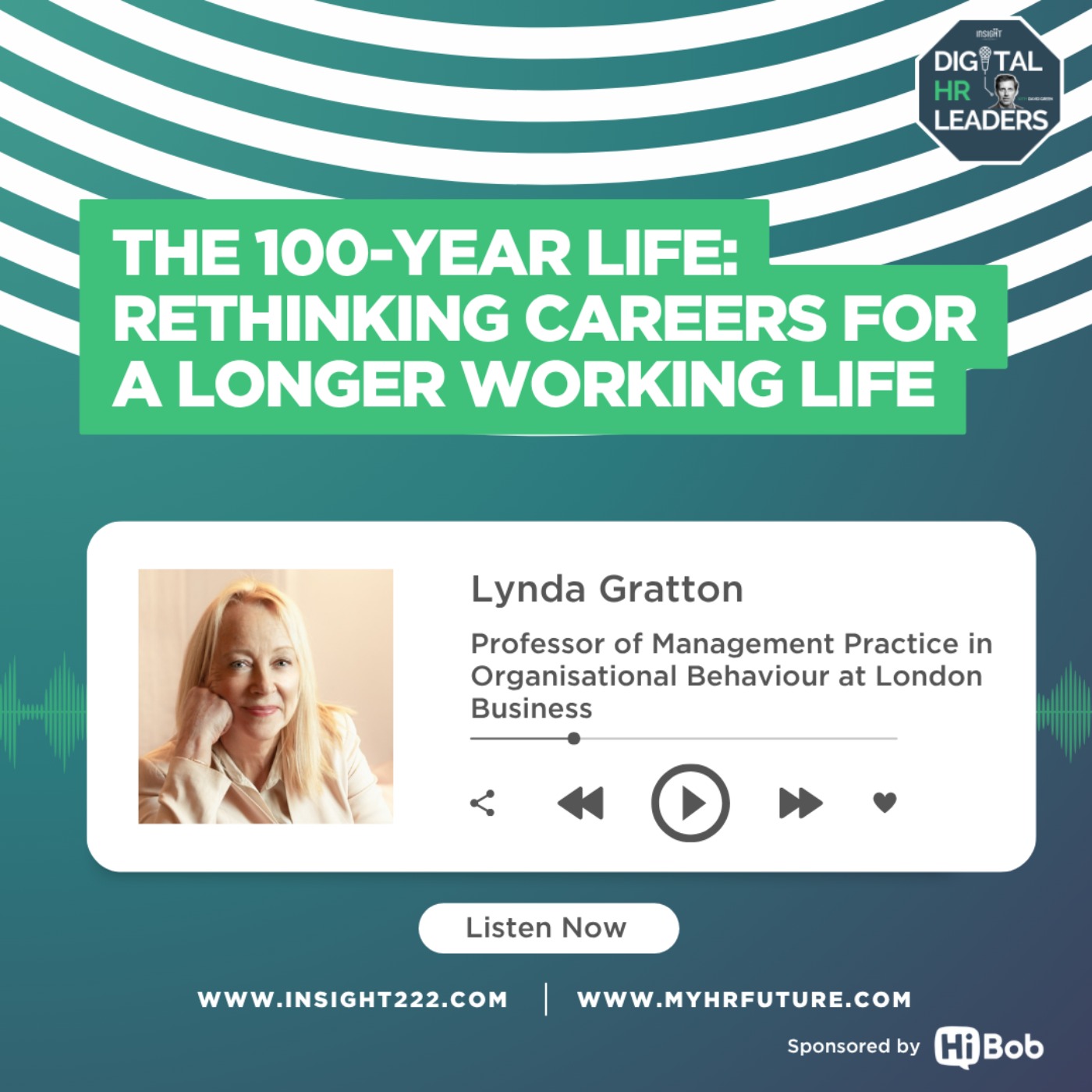
The 100-Year Life: Rethinking Careers for a Longer Working Life
56m 22s
Linda Grapp, Professor at London Business School and author of *Living the 100 Year Life*, presents a transformative framework for navigating longer, more complex working lives in an era of technological change and demographic shifts. Central to her vision is the metaphor of "weaving a life," where daily choices and relationships contribute to a dynamic, evolving life built on eight key threads: mastery, cooperation, knowing, amplification, friendship, intimacy, calm, and adventure. She argues that traditional career models, rooted in a linear path from education to retirement, no longer apply. Instead, individuals must embrace multistage lives with flexible transitions, such as sabbaticals, volunteering, or career pivots. A critical insight is that calm—the ability to pause, reflect, and recharge—is the most neglected thread, especially in fast-paced work environments. Grapp highlights that while AI and automation amplify productivity, they do not replace human experiences like adventure, intimacy, and deep connection. For organizations, this means rethinking career structures to support internal mobility, skill-sharing, and personal agency. HR leaders must shift from rigid job hierarchies to task-based work design, enabling individuals to thrive across stages of life. The book offers a diagnostic tool, a workbook, and a podcast to help individuals assess their personal threads and engage in reflective conversations. Ultimately, Grapp calls for both individuals and organizations to prioritize well-being, adaptability, and personal meaning—ensuring that long working lives are not just sustainable but deeply fulfilling. This approach is especially vital as people live longer, work longer, and face unprecedented technological change.
This episode of the Digital HR Leaders Podcast is brought to you by Highbob.
If you knew you were going to live to 100, how differently would you think about the
career you're building today?
Because many of the assumptions that shape working life were built for another age, education
first, then work, then retirement, a relatively linear career followed by a relatively short
retirement.
After lives a stretch and net model to breaking point, some of us could now be working for
five or even six decades through profound shifts in technology skills and the nature of
work itself.
Few people have shaped our thinking on this, more than my guests today, Linda Grapp.
Linda is Professor of Management Practice in Organizational Behavior at London Business
School, where she has taught for more than 30 years.
She is also the co-author of the International Best Seller, the 100 Year Life, which sold
more than a million copies and helped put longevity firmly on the agenda for individuals, organizations
and governments.
Ten years on, Linda is returning to the subject with her new book, Living the 100 Year
Life, How to Build a Career that Lasts in a Life You Love.
Linda now describes her working life as a fabric woven from eight threads, mastery,
cooperation, knowing, amplification, friendship, intimacy, calm and adventure.
So in today's conversation, Linda and I explore what it really takes to build a career that
can last for 50 or 60 years and a life you actually want to live alongside it.
We also explore why looking at how AI changes individual tasks may be more useful than
simply trying to predict which jobs will disappear.
And for HR leaders, there is a bigger organizational challenge running through the conversation.
As all to explore, so let's get the conversation started.
Linda, welcome back to the Digital HR leaders podcast.
Thank you, David.
Thank you for having me back again.
I was working out before it's been two years since you last joined me on the show, alongside
Diane Geerson, since what changes in work and society of most influential thinking?
I guess, David, the world changes all the time.
I mean, I can't believe it's 15 years ago since I wrote the shift, which was 2025, what's
going to be happening in 2025.
And I think some things are pretty predictable, demography, technology, social changes.
Of course, the pandemic wasn't predictable.
And I think since the last two years, what we've seen is a real acceleration of the technical
piece, obviously driven by large language models.
But also, years ago, I used to ask CHROs about the impact of globalization, the impact
of governments.
And that was pretty much low down on the list.
I think it's kind of very high on the list.
So I think we're in a world I was just teaching a class at London Business School only last
week.
Some of them from the Middle East, and they were talking about their offices being bombed.
It's a tough time for everyone, and a lot of change.
And that really means that constant resilience, adaption becomes the order of the day.
We had that period, didn't we, in the 1990s, when the end of history I think people were
talking about.
And maybe we got a little bit complacent, and a global financial crisis happens, and
it seemed to have been on a bit of rollercoaster ever since.
Yeah.
I think we've always understood the forces that shape work.
We just don't always anticipate the dynamism or the speed of them.
Well, we're here to talk, Prince, and actually, Linda, I think most of our listeners will
know you.
But again, just maybe a brief introduction to your work at London Business School and the
other things that you do before we get into the conversation.
Well, yes.
I've been a professor at London Business School now for more than 30 years.
I teach the world's leading programme on human resource.
We know that it was just ranked number one in the world, human resource in transforming
organisations, which is a huge privilege for me.
I teach an MBA class about the future of work.
I have a consulting practice, HSM, which puts some of that into practice.
But I'm primarily a writer, and I've just finished my new book.
This is a quick reveal of it for those of you who haven't seen it, and you can see how
gorgeous it looks.
It's a weave.
And as you feel it, it actually is embossed.
Oh, it's absolutely lovely.
So I'm very excited about this.
It'll be out on the 9th of September.
So that's really what I've been up to.
I've been, since I last saw you, David, I've been writing that book.
It's taken me three years to write it.
OK.
Well, I'm looking forward to reading it.
And for those that are listening, we're going to be talking about the book living the
100 year life now.
And this episode is actually going out a few days about a week or so before the book comes
out.
And you're getting a little bit of a preview here.
So Linda, the book living the 100 year life, how to build a career that lasts and a life
you love, what prompted you to write this book?
And I believe it's about 10 years after you parted with Andrew Scott on the 100 year
life.
So it's almost like a sequel.
Yeah.
This was 10 years ago.
And actually, David, you probably know this was a hugely important book.
It sold a million copies, more than a million people read it.
It was very influential.
I still meet people who said, you know, I changed my life.
And the argument that Andrew and I made, and you know, you can see it's me and Andrew
Scott.
And I think that was a really important part of it, because Andrew is an economist.
I'm a psychologist.
And actually, when you think about demography and long working lives, part of the argument
is an economic argument.
It's about how do you make it work financially?
And we were able to look at both those things.
I think in the 10 years since the 100 year life, a lot has changed.
I think the idea that you're going to live longer is now pretty much part of the conversation
in most countries.
You saw in the UK just recently an announcement that the pension age is going up entirely
predictably, in my view, but we're also focusing less on long lives, but actually on good
lives, healthy lives, you know, lives that make a difference.
And that's really why I wrote this book.
I wrote this book because I could see that many of us were sort of struggling with living
a long working life, you know, if you live to a hundred, you're working into your 70s
or 80s.
And what does that look like in me?
Look at David Attenbrunn.
He's a hundred.
He said, right, my God, you know, he's astonishing.
How does he do it?
But actually, I think for all of us, we're asking, I'm 71, I'm asking myself, you know,
how do I do it?
How do I continue doing it?
So the book is really about that.
And what I realize as a writer is that I know my readers, and in fact, my students love
metaphors.
I mean, I love a metaphor, my students love metaphors.
And so for this book, I, the metaphor that I brought forth is the metaphor of weaving
a life.
Hence that you can see the weave there.
And the idea is that, you know, we don't just plan a life and then move towards it.
We actually just weave it day by day, action by action step by step.
And so what I tried to do in the book was also to get a sense of, well, if you weave a
life, what are the threads that hold your life together?
And I did that.
I understood those threads by looking at my own life and thinking about, you know, the
70, one years that I've been alive and wrote a lot of stories about my life, which helped
me think about my life, other people's lives, and some of those stories, just a few of them,
I think 15 of them are in the book.
But mostly I talk about the threads, threads that help us to be productive and threads that
help us to nurture ourselves.
Great.
And we're going to get into those threads as well in a minute.
And then actually, you know, you talked about one of the, you know, big challenges that
we face as a world is demographics, particularly in developed countries, particularly in Europe,
you know, in terms of shrinking, sort of shrinking working population.
But then as you said, people are living longer than the working, you know, the working age,
the length of your working, working life, you know, it's likely to go up, you know.
So maybe that's a bit of a counterbalance to the challenge on, on demographics, as
he's probably technology is we'll get into later.
I don't have just your initial thoughts on that before we may be getting into the challenge.
Well, I think that's right.
You know, the demographics are really fascinating and the reason that demographics are such an
interesting trend to look at is it's very predictable.
You know, if you think of what's going to happen in 50 years, time to 50 year olds, well,
they've already, they're just being built, they're just being born.
So we sort of know what's going to happen in 50 years to 50 year olds.
But there are children, there are grandchildren.
So we know how many numbers there are, we know how many are born right now.
And two things have really shaped demography and it happens in every developed country.
The first is we live longer, primarily because we've, you know, looked at the diseases of
child who are the disease of middle age and now the diseases that we face the diseases
of long age, long life.
So we're living longer.
And the years that we're living healthily have gone up because the years of morbidity,
you know, when we feel ill before we die, those have remained pretty much the same.
And so the years of staying healthy have increased.
And at the same time, we're having fewer children.
And there's a whole set of reasons why that's the case.
But in every developed country we are and it's happening everywhere.
I was with a group of Saudi people from Saudi last week and they, two of them came from
families of over 20 children, two of them.
And none of them had more than three kids themselves.
I mean, that's an astonishing, you know, reduction in family size.
And it's because I'm, you know, children are no longer an asset.
So we want fewer of them, when we want to focus on them, when we want to focus on making them as the best they can be.
So we have a world where populations are aging and then they're reducing.
And in that world, we have to really celebrate long working lives, not just at the very end of life, but right from the very beginning.
This episode of the Digital H.R. Leaders podcast is sponsored by Highbob.
As your organisation outgrown its HR stack, AI is about to make that expensive.
The latest Brandon Hall Group report explains why fragmented HR systems are becoming a liability and why unified workforce platforms are emerging as the foundation for the AI era.
Discover how leading organisations are connecting HR, finance and operations to improve execution, reduce complexity and scale with confidence.
Download the report at highbob.com/davigrean2026 or visit highbob@hrtechbooth1927 or Unleashworld@booth101.
Highbob, HCM for people proud companies.
So Linda, you organise the book around three key questions. Who am I? How am I working now? What actions and promises am I making to my future self? Why do you believe these are the three essential questions but for navigating a longer working life?
What I love about the metaphor of the weave is it gives you a sense of dynamism, you know, that actually every single day, every choice you make, every relationship you build or fail to build, every skill you build or don't build actually adds to your weave.
And it seems to me that, you know, as you weave your life, these three questions become very important. The first question is about yourself and it basically says, who am I and what am I doing, what am I doing?
And we deep dive into three things. One is, you know, what's my heritage? So for example, I know for myself, David, I can't really understand myself unless I realise that I come from a long history of women who are basically washer women.
I mean, I come from three generations of women who are supported themselves, husbands, children died in the first and second world war. You know, my mother was at the age of six, her house was destroyed by a bomb in the Liverpool Blitz.
And that's made me sort of pretty resilient. I mean, I know my childhood thing is don't make a fuss. You know, that's what my metaphor was. Don't make a fuss.
And of course, I think all of us need to think about our heritage, but also our personality, you know, for example, in my case, although people are always surprised, I'm pretty introverted, most writers are introverted. I need time on my own.
And then of course, there's work experience that changes who we are, you know, the fact that I've been a professor for 30 years has changed from if I stayed in consulting, you know, 30, 40 years ago I was in consulting.
If I was now running one of the big consulting practices, would I be a different person? Well, I probably would be to a certain extent.
So, you know, knowing yourself is about understanding your heritage, understanding your personality and character, understanding how workers already shaped you.
And I think that's an important question that all of us should be asking ourselves.
And then where am I now? Is the threads question? And the simple thread question is that there are eight threads that hold your life together. And at any point in time, you want to ask the question, which is strong and which a fragile.
And then the final question, which is what action should I take now? What promises should I make to my future self is that actually when we weave our life, we weave it through experiments, through small actions, never very rarely through massive decisions.
Of course, we make massive decisions. Who am I going to marry? Is a big decision? Where am I going to live as a big decision?
But most of the decisions we make are rather small ones that accumulate over time. So we need to ask ourselves other things I need to be doing right now to strengthen my threads.
And the future self is just a really wonderful question, which is to say, you know, in your case, David, if you imagine me being you at the age of 71, what would you wish for me?
You know, what would you want for your 71 year old? And actually, it's quite nice for me now that I'm a little older because I can stand in in a class and say, OK, I'm now your future self.
Here I am, I'm standing in front of you. I'm 71 years old. What would you promise to your future self? And so it's those three questions. Who am I? Where am I now? What can I promise? And actually, when we think about living and working a long life, that's what you do. You do those three things.
Yeah, you're so important for people to learn who they are. You know, and that's, and I don't know, I'm 54 now. So I'd say that's only really happened in the last 10 years.
Yeah. Well, we all find our own way. Actually, when I wrote the book, I've got characters in the book that go from the age of 32.
And I do think that if I look at my own children now in their mid 30s or I look at my MBA students in their 30s, I do think you really begin to get a sense of who you are in your 30s because that's the age when you're making choices.
Really massive choices. Who do I want to be with? Who am I? Where do I want to live? Where do I want to work? In fact, it's, it's a period of enormous choices. And I would hope that the book was read by young people.
You know, I'm really hoping that my MBA student, the ones who've already read it have loved it. I'm hoping young people will read it and will love it.
And it's not just for people in their 50s and 60s and 70s. The book is the ideas of the book start from the moment you start work.
What, you know, what does this reveal, do you believe about, you know, conventional ideas that maybe usual or typical career planning actually misses?
Yeah. Well, it was very interesting getting the threads. And actually, David, they came out because of my, my stories.
So I had written, I mean, a hundred loads of stories. I spent a whole year just writing stories. I didn't really know what else to do.
I was, the book starts with me feeling, oh my goodness, I'm feeling really lost in my life. You know, I don't want it to continue to do what I've done forever.
I'm already way further ahead than my father was in terms of the point at which he passed away.
So, and I think lots of people are feeling that they're living much longer than their parents. So the role model of your parents is no longer available.
And, and, and those, I'm looking at those stories. Some of the threads were just really absolutely obvious.
You know, so I'd written two books on cooperation. So cooperation was always going to be a thread. I know how important cooperation is.
I know how important knowing is because I'm a teacher and a teacher is about knowledge and knowing and so on.
Mastery again, I, you know, I've always felt and I've argued for years now that we've got to learn things deeply.
This superficial, it just isn't going to happen. And I feel that even more deeply. And of course amplification is there because you can't write anything at the moment without saying that we are going to be changed by the technology that serves us.
So those are the, those are the productivity threads. And I think, you know, as we think about working lives, we often focus on those.
But then there's another set, which we sort of call well-being. And I don't like that. I don't think that it's well-being. I actually think that they're part of our lives.
And they show up in two ways. One is in a, is in a relational way, which is our friendships and our intimate intimacy, you know, the people who love.
So those are the two there, but they also show up in our energy, both how we calm ourselves and how we excite ourselves. And the calm is one and the excitement is what I call adventure.
When I looked at my own life, it was the adventures that I remembered. And if I were to ask my, you know, my 80 year old self, I mean, it's ridiculous me saying this now because I'm just around the corner.
But, you know, I would always want to say to your future self, I had great adventures to talk about, you know, I had wonderful things. And that's why I've put adventure in.
I have a diagnostic, which is there right now. Hundreds of people have already filled in. Do put it in the show notes.
It's on our website, www.livingthehundredyearlife.com. And what I'm learning from that diagnostic, and I really shouldn't tell people because it's I'm doing the wrong, I don't want to lead you on here, is that the weakest thread.
And I notice this when I'm teaching a class as well, the weakest thread is calm.
And I think that's a very, and I've written about that, I haven't caught them in MIT Sloan, and I also write for hbr.org. And in both cases, I've written about calm.
And I find that very worrisome really that at the very time when we're asking ourselves to answer those three questions, which take reflection, they take conversation, we don't have the calm to be able to do that.
And I've designed and have now piloted a 10 week program for executives, a virtual program, which is based on the book.
I just wanted to see how does it work in companies, and we've just finished actually, and I learned a lot from it.
And one thing I learned is that when you're given a chance to talk to each other about those three questions, who am I, where am I now, what actions to take promises to my future self.
People find that an incredibly engaging conversation to have.
And so one of the things we're going to be doing at London Business School with our alumni
is actually to provide a framework for them to think about that.
We think it's such an important three conversations, but to have that, you do need calm.
You need to find time in your life when you're not doing your emails, you're not running around,
you're not working with social media, you're actually calming yourself.
Yeah, very good.
Yeah, I must admit, I only do LinkedIn social media, and that's just for work.
Don't do personal social media anymore.
Well, I think there's coming back to this thread again, these weaving.
I mean, one thing that we've all got exactly the same amount of is we've all got the same amount of time.
You know, it's your day is the same length as my day, your year is the same length as my year.
I may live less longer or shorter than you, we don't know that.
But the actual time we're allocated is the same.
So, you know, how we decide to change, to use our life our time, I think is a fundamental question.
And some people as you don't engage in social media, some people go walking, some people take time off to run, some people spend time thinking.
But whatever your habit and that, by the way, goes back to your whom are my, you know, who are my tells you how you find calm.
You know, I was brought up in the lake district with a father who walked all the time.
So for me, my calming mechanism is, is, was walking.
But that's no surprise if you know who I am, you know, that's sort of self-evident.
So that's why knowing who we are is so important because it helps us to understand how we personally are going to strengthen our threads.
And he's calm, the most neglected thread you believe in today's workplace, isn't, and, you know, if so, what are the consequences for people in organizations?
Well, it's certainly coming out, the diagnostic is a workplace diagnostic.
So we think about the threads across your whole working life.
And it's certainly coming out as the most neglected of the threads.
Yeah, I think it's a real challenge where we're just going faster and faster and faster. And I think AI is, for all its, you know, majesty and extraordinaryness, it does speed us up.
I notice that with my own practice, and, you know, so if you say with amplification that the most experienced people like you and I are six times more productive, which we probably are with using AI, that that comes from somewhere, you know,
that being six times productive means you're working harder.
And so that actually carving stuff out, carving time out to strengthen your threads is really important.
And the ones that are particularly susceptible to time are calm, as I've mentioned, but also the two relationship ones, you know, friendship and intimacy.
You make and keep friends because you spend time with them, you make and keep intimate loving relationships because you spend time.
These are all things that require time. So again, the allocation of time becomes so important.
And is that why you've poured amplification out as a thread on its own, you know, in terms of how people work with technology and AI?
Because if you get the amplification bit right and you've channeled it the right way, you can actually help yourself from a calm perspective and the intimacy.
So the amplification is an opportunity, arguably, that if we do it right both individually and as organizations, we can support the other threads.
Yeah, yeah, it was the most, obviously, it's the newest of all the threads. I'm sure if I'd written this book 10 years ago, I wouldn't have had amplification in, you know, because AI, we've only been operating with it for a few years.
And it's, but of course, it's changed our lives and it's changing our lives on a moment-by-moment basis, as is robotics.
So it had to be there as a thread and it is a thread that can either help you or really destroy you.
One of the things that I did, David, I mean, I talked earlier about the diagnostic and the corporate learning journey, which are with the book.
The other thing I have is a podcast, which is coming out at the same time as the book is coming out.
And in it, I, each episode is a thread. And so, you know, the thread of amplification is really sort of fascinating actually, because I talked to two of the great experts in the world on how they use AI and what they think about it.
And it's very obvious that it's a deliberate process.
One of the words that's really coming to mind, actually, when I think about the future is that, you know, when we had these shorter working lives with three stages, full-time education, full-time work, full-time retirement, we could pretty passive about what we did, you know, we could sort of go with the flow, institutional flow, age flow.
But actually, when you say it's a multi-stage life and you can each live a different life, you have to have so much more agency.
And I think that's particularly true for the amplification thread.
We have to be much more clear about what we're doing and why we're doing and how we're doing it and how our relationship with technology changes our world.
And I'd love to get your thoughts on this. Obviously, there's lots of public debate, hyperbole at times, sensationist headlines, you know, focusing on whether AI will replace jobs, you know, and obviously history would suggest that, you know, when every time there's a big industrial revolution, there's certainly a lot of disruption, but it usually has historically greater more jobs than it's replaced.
But is the more useful question how AI changes the task? So it's the disruption piece, it changes tasks, it changes relationships and sources of meaning maybe within a job.
It does, it does exactly that. And when I teach, you know, this to my MBA class, I always use the sort of David outer model, which is to say, you know, there are, if you think about your work in terms of tasks that there are some are very routine, some are non-routine, some are manual, some are cognitive.
And the piece that we're really excited about is the non-routine cognitive work, which is writing reports, doing an analytics, which actually, you know, I go back to doing my PhD, I don't know, 40 years ago.
I mean, I used a computer that was the size of a lot of a medium sized room. And I put the, put the, you know, punch cards in the in the evening. And it, yeah, and of course that could be done on my computer.
So, so this speed has been completely astonishing. And, and yeah, so it does, it is reshaping our, our life at the level of the task.
One thing I think is really important to remember about, about technology as we think about, you know, the industrial revolutions and so on, is that we can always relatively reliably predict where jobs will be destroyed, but what we don't, we find very difficult to predict is, is the creation of work.
And that's because it's what, it's a sort of second-order factor, you know, for example, if you'd seen the very first, I talk about this in the book actually, the very first steam engine going past you, you wouldn't really be able to realize that the Gulf States would have huge political leverage, you know, 100 years later because of, because of the oil rich nature of their, of their economy.
So, I think it's very difficult to work that out. And, and so what I would say to young people is, you can't really predict the future. I, in my book, the shift, I predicted 2025. And so the publishers came back and said, Linda, could you do one, which predicts, you know, another 15 years ahead.
And I just said, there's no way I could do that. It just, in fact, I don't even write about AI unless it's the publication is coming out in the next week or so.
You know, otherwise you end up looking so completely foolish. It's moving at such speed at the moment. So you can't predict the future.
So what you have to do is you have to build the capability to adapt. And I think that's what the threads allow you to do. It's to say, I don't know what the future's going to be, but whatever it is, I feel as if I can adapt to it.
I want to take a short break from this episode to introduce the insight to to to people, analytics program designed for senior leaders to connect, grow and lead in the evolving world of people analytics.
The program brings together top HR professionals with extensive experience from global companies, offering a unique platform to expand your influence, gain invaluable industry insights and tackle real world business challenges.
As a member, you'll gain access to over 40 in person and virtual events a year, advisory sessions with seasoned practitioners, as well as insights, ideas and learning to stay up to date with best practices and you thinking.
Every connection may bring new possibilities to elevate your impact and drive meaningful change. To learn more, head over to insight222.com/program and join our group of global leaders.
So I think that's quite a nice pivot there a little bit in the conversation to organizations, you know, you know, longer lives, you know, hundreds a hundred years live, you know, effectively means that people can be working longer and maybe working, you know, five, six, maybe more decades.
But most organizational systems were designed for much shorter and more linear career. So for instance, you know, partners in the Big Four are still required to retire.
[BLANK_AUDIO]
you know, in most countries, sort of late 50s, early 60s, which is a little bit ridiculous,
perhaps. To where are those career systems sort of breaking down, and again, in your work
with organizations and HR leaders and the work that you're doing at London Business School
and elsewhere, what are the more progressive companies doing about trying to remedy that situation?
Well, I think, you know, when we think about the career systems that were put in place,
they were basically based on the three-stage life, you know, full-time education, full-time
work, full-time retirement. And the reason that was a sort of rather passive system
is because everybody went through it at the same age, you know, you're, you're, I don't know,
18, you're going from education to work, you're 60, you're going from work to retirement.
And then in the middle, at the work piece, you progressed, you know, up, and if you didn't progress,
then you had to get out. And so that was a very relative, I know we made, the HR made a great
big deal of it, but actually, to be honest, it was a relatively easy thing to do. We were basically
either, you know, building or buying, you were either, you know, building people up or you were
buying them. I think that the challenge now is that that system isn't working. And I can see that
that people feel, individuals are feeling frustrated, you know, I've just run three companies
through my corporate program. And I've listened to all of the people, the people engaged in the
participants. And they're pretty frustrated about, well, what am I supposed to do next? And I can't
go up. So what am I supposed to do? And I think what we sort of failed to realize is that,
you know, we could, but we, you know, we could bring people in from the outside as freelancers.
And we also could think about bridging from one part of one type of work to another. So
I think these sort of borrow and bridge strategies become much more important from an HR perspective.
And I think also just the age of something is so dispiriting. And I've already told you,
I don't know, four times that I'm 71. And it's unusual for women to tell her age. But the
reason I'm doing that, David, is to say, for God's sake, get over it, you know, really, you know,
David Attenborough, a hundred years, just get over it where people are changing all the time.
You know, each generation, each cohort of 40 year olds, 50 years, 60, 70, 80 year olds,
well, all different from previous generations. And that's, you know, that's changing really fast.
So we've got to drop ageism. I find it so upsetting that people find it hard to get a job after
the age of 50, but it's not even 60. It's actually 50. There's a Claire Barrett did a piece in the F2
last week about about the new pension. And I've just been looking at the cut you and I've just
been looking at the comments today. And so many people have commented and said, I can't get a job,
you know, I've got to take 10 years off my life. And so that's the first thing is forget ageism,
just drop it. It shouldn't, it should not be part of, it's a discrimination just like every other
formal discrimination. Number two, just be more aware that people are living multistage lives.
And a multistage life means that you do more things and you either do that as multistage by which
I mean, you know, you take a sabbatical, you learn something new, you start your own business,
you volunteer, all the things that you could do sequentially or people are building portfolios
where that's horizontal, you do it and and, you know, you do your job and you volunteer
and you do this and you do that. And that's where most people now are seeing their lives, you know,
if I talk to people about how do you imagine your life will be, they say, you know, I can see I'm
going to do different things because, you know, if I say to you, you need to work until you're
in your 70s, in my case, probably up into my 80s. I mean, obviously I'm a professor and we have a
very particularly nice life. But, but for many others as well, the first thing you say is, well,
I don't want to carry on doing what I'm doing until 70 or 80. I've got to do something different.
And so thinking about something different, thinking about, you know, what is there in your organization
that's adjacent that you could do? What is that? What's the new development you could do? Could you do
some more volunteer work? Could you start an interesting project? Could you, you know, there's so
many things we can do? And I think part of why, you know, gift to the world, really, I think,
and that's how I'm sort of seeing this book and all the other things around it is to say,
you could be so many different things. It's not just up and out. And HR has got to realize that.
You, in the book, living the 100 year life, you vividly describe a job as an island,
where should this, this definitely resonated with the water slowly rising. Yeah. Yeah. Yeah. What, what should
all can I, yeah, the AI? Maybe not so slowly. What should organizations be looking for a thing
want to recognize that process before a role becomes unsustainable? Well, I think individuals doing a
role know themselves when it's becoming, I mean, it's not difficult. I don't think to work out which tasks
are going to have a high AI component. I mean, there's lots of easy ways of doing that. And I think
most people know the tasks that are going to have will disappear. I think the more difficult question
is to prepare people to jump off the island. You know, as if you think about the island as your
job and the water's coming up, at some stage, you have to jump and, you know, encouraging people to
jump either because they jump up, they go into a job that's better paid, whether you some of the
skills, but also build new skills or more likely jump across. So they're in the same sort of pay
grade, but they're doing something that's, that's, that's different, that gives them, you know,
new skills. And to do that, an HR person has got to provide people with an idea of what jobs are
in the organization that they could jump into. I think that one of the problems with the three-stage
life is it's really created a mindset that the only way is up. Now, the truth is, of course,
most of us didn't go up, but it somehow feels, if you didn't go up, it was a failure. Well, in fact,
actually, you know, another mindset would be the only way is across or the only way is, you know,
jumping. I mean, we need to be to think about there's so many other ways that we can work. It isn't
just if you don't make a partner or you don't get to the top, you failed, but actually what sort of a
life are you building for yourself? And how are you allocating your time in that life?
Yeah, very good. And that shows listening, listening to you then, and I was thinking, you know,
will we, should we still organize work by jobs or should we be thinking a different way of
looking at it now? Is it, should we start the work? I mean, I hear people like, rather than
Jesu Thason and John Boudreau talking about starting with the work. I mean, I'd like to hear your
thoughts on that. Yeah, I think it's the job becoming a bit redundant of people. Yes, I think it
already is. Isn't it actually, I mean, it's the tasks that you do and the way that you pull those
tasks together, give you the job. But actually, if you think of so many, so much work now in a
company's project work, we're just a project member, you don't come in with a job task. You know,
you, you come in with doing this particular sort of work, you pull, you get pulled together to
do a project, you're dismantled. What's the project finished? Some of the things that you're going
to be working with are going to be AI agents. So I think it's, it's, I think a job was always a
sort of again, an old-fashioned three-stage way of thinking of things. You know, you had a job,
it had 24 tasks. That doesn't really make very much sense. Why would you have that? Because most
of us, if I think of how I spend my time, I have so many different tasks I do that are not really
related to any particular job, but they're related to me and my skills and how I, how I'm weaving my
life. And I mean, obviously internal mobility is a big focus for organizations. Yes. From
a number of reasons, partly demographics, partly because of, you know, it's so difficult to find
the right, the right skills. And then maybe that lends itself into there. I mean, you can be a data
scientist working in an HR, but actually you've got data science skills, which could be applied across
the organizations in different function. Yes, exactly. What should organizations maybe change in
their approach to internal mobility, job architecture, career pathways to support maybe repeated
transitions rather than that single-up good climb that you mentioned there? Yeah, I think they could
do a number of things. First of all, I think they could be clear that transition is a skill,
being able to make a transition to upskill yourself is a skill that all of us need to learn. Secondly,
I think they need to be much clearer about what these jobs need to skills that they require,
because I know some of the companies that I advise, you know, they're quite shocked that there's
another part of the company that needs almost the same skills, but because the job title was so
different, they hadn't made that connection. So, and of course, AI helps you to do that, helps
you to work out where it is. And then I think the third thing is to give people, to help people feel
as if they've got agency, you know, as if they actually could make this switch, make a decision,
make this jump. So, and that's really what I wrote the book for. I wanted to help people,
well, as it says on the cover, build a career that lasts and their life they love. And to do that,
they've got to take control of their life. Most companies aren't going to help them to do that.
They might, along the way, it might be a sort of nice outcome, but it's not going to be the thing
that any company does for any individual. The individual has to do it for themselves.
We're talking a lot about technology here. You know, I'd love to hear your thoughts on this,
some of this study in work.
you know, for so long and not one see, you know, made the leap with the shift of to think
about what might happen in the next 15 years. What should remain distinctly human as work
becomes increasingly amplified by technology? Well, you know, that's what I loved the threads so
much because when I look back at the threads, some of them are so distinctly human, you know,
adventure. I mean, I have a very well-trained, large language model, but it honestly is not,
it pretends it can have adventures. It pretends it's, it's a real person, but it really isn't.
I mean, it really hasn't had any adventures. It doesn't, it hasn't got out and smelled, you know,
this, you know, this sun, it doesn't do any of those things. So I think adventure is something
that's really human and I would, for example, with my MBA students now, I used to teach them
a one semester of the future of work. And now instead of that, I take them to Tokyo when we look at,
we look at the future of work sitting in Tokyo, having an adventure in Tokyo. So actually really
leaning into the things that humans are, which are, you know, we can see, we can hear, we can smell,
we, you know, we, that's the first one. Obviously, intimacy is enormously important because quite a lot
of the burnout people have right through their life is because those intimate relationships start
break down and it causes us such personal stress. I think that friendship is something that we
know sustains us through our life, you know, if you look at the long term studies of happiness in
lives, you know, one of the thread that goes through that is the thread of friendship and how you
have friends. So I think that particularly the nurture threads, the adventure, the calm, the
intimacy, the friendship, those are threads that are very, very important in an age of AI and we
need to really strengthen them. But of course, there's also, you know, judgment and taste and all
those other things. I, I'm very familiar with, I use large language models a lot, partly because I
want to see how my students are using it. So I need to be clear about, you know, how people
interacting, it's changing all the time. But it doesn't have my taste and it doesn't have my
judgment. And, you know, really understanding who you are, what you believe in. Otherwise,
you do, you could become entirely overwhelmed by what it is, you know, Claude or Chatchy beauty will
do for you. Yeah, three, I think in listening to you there, Linda, you know, and I love the way
you've done it with, you know, with the amplification piece, because I was thinking, you know, obviously
probably like you've been using LOMs increasingly over the last sort of three, three, well, was it
three, four years now, isn't it? Three years, yeah. And obviously they get better and better with each,
with each version release. And, you know, oh, you know, I've worked too hard, always have worked
too hard. But what I found with the amplification is I'm actually giving, I'm still working too hard,
probably, but I'm giving some of that time back to my intimacy with my, my children. Nice.
17, 16, my wife, my poor wife, who's had a family for years. And, and, and friendships, because,
but I still feel like I'm being more productive, but I'm actually having more time for those that,
the intimacy. You are a smart person, David, because sadly, I mean, this was always the dream,
wasn't it? And I read it, I've written about the dream of AI, you know, on the number of occasions,
which says, if you become six times productive, then you could do six times less. And it means
that you could spend more time with your other threats, particularly your intimacy threats.
Of course, the reality and the research is already coming through on that, is people just do six
times more things. They, you know, they, they, they, they do more presentations. They write more
books. They, you know, they just do more and more and more, and they don't take time. And it comes
back to the conversation we were having earlier about time and the allocation of time. You know,
you're very foolish if you use AI a lot and don't save the time, and don't use the set time you
save to build your nurture threads. You know, that, that is a foolish person. And I certainly would be
very explicit about that with my students, that it's not about just doing more and more.
It's also about building your nurture threads, because these are the threads, the four threads of
nurture, intimacy, friendship, common, and not, and, and adventure are going to be the threads
that hold your life together in your 70s and 80s. At, at any stage, actually, but, you know, really,
if you want to be happy in your 60s, 70s, 80s and 90s, those are the threads you've got to be
building. From the age of 30 onwards, I'm in my podcast, I, and it's in the book as well,
I talk about my threads of friendship on, my is not very strong. You know, I've been really focused
on mastery and all of that, right? You know, hugely strong mastery thread. You can see it and
everything I've written. But actually, I have got a friend, Shirley, who I've had since I was 10
years old, and it's just a marvelous gift to me. And, and it's because that, it's because Shirley is
very good at nurturing the thread of, of friendship, that she who does it, it's she who remembers,
it's she who sends cars, it's she who texted me this morning and said, "Are you back? How are you?
Because I came in from some of this morning. How are you feeling? Let's try and get together."
And she's been doing that for the last 5th, the, the last 60 years.
Listening to you, Linda, you know, you know, you know, people like you, particularly and they've got
fortunate enough to have, you know, a voice in the field. You know, we, we need to, like, you have been,
and like, I hope I have been, you know, be honest that we are using the aptification to give us some
time back, to help us with the, those that those are, that the intimacy and the friendship and the
calm, you know, because, and the adventure, because you need to have that to have better balance.
And if you have better balance, and frankly, you, you're going to be better at work and, you know,
people that are working for you are going to have a better experience as well. And we'll have to
leave from the front a little bit on this, I think. Yes, you do. You're absolutely doing.
And to keep those threads strong, you need to show that you're keeping them strong. You know,
you need to talk about your, your, your family. You need to talk about your friends just as I've
told you about Charlotte. You need to talk about your adventures. You need to talk about your,
the way that you create calm. These are very important for, for people to describe to others how
they do it, because if you're thread of, of any of those as weak or fragile, and if, you know,
you, you know, listeners do just go into the diagnostic and do it. We, I'd love you to do it,
because I, I like to look at the data as well. You know, that's, that's something you really need
to invest in. And I'm watching others, watching how others do it is. So one of the articles I've written
is called them, the calm minority, because when I ask a class, how many people have this as a
strength, calm as a strength, in a class of 40, maybe three people have it as, as strong as thread,
and then I go and ask them what, tell me about how you do it. And it's just really fascinating.
Actually, some of them do it because it's part of their heritage, it's their personality. They've
seen somebody else do it, but it's often because they've seen somebody else become, and they've learned
how to do it from them. So all of us should really be showing people how we keep our thread strong,
because others can learn from it. No, no, really important. I will definitely put the article,
that article in the, in the show notes. Well, no, I'm going to go off and read it when we finished.
Okay, actually, there's another one of, an adventure that's, is it twin? I love doing twins.
I've got one on one adventure, both in MIT, yeah. MIT, okay. Or we'd put a link to the
column that you've got in there as well. Yeah. So we talk about, you know, we're talking about
coffee. We've got, we've got a, we're going about three questions, uh, left window to looking at the time.
So, and you mentioned data, um, you couldn't expect over conversation with two of us without talking
about data. And what, what data would tell a chief people officer, whether the organization is
helping to build sustainable careers? And what, which measures would you place related to that,
maybe on an executive workforce dashboard? Yeah. I don't know, actually, I don't know the answer
that question. It's a really good question. I think I'd say a few things. One is, I'd say,
retaining people during their 40s. If you're, another really lovely piece, I've written since the
book is an HBR dot org piece about the pivotal 40s. And what I'd learned from the people who came
through my corporate program is just how difficult the 40s are for people. And that's because it's,
it's now the halfway point in a long career. It never used to be, but it now is. And now you're looking
up, you're in your photos, you're thinking, what is it? Is this it? Am I going to have to do this
all over again? So you actually have to completely rethink. And, and what I noticed is that people really,
the 40s is a very, could be a really reflective point. So I think at the first thing I'd say to a
CHRO is, um, have a look at what's going on with your 40 year olds. Because if, if they're leaving you,
because they're going to find out something's going really wrong. I think the second thing I'd say
to them is take a look at your horizontal development mechanisms. You know, is it just that you're
building? Or can you also bridge? Um, I think the third thing is, I've just been looking to see whether
you're supporting, you know, multi stage lives. I mean, people taking sabbaticals, they're taking time
out. You know, and then you could just also look at the threads of productivity, which is,
are people really learning something deeply? The thread of mastery, the thread of cooperation,
are people cooperating with each other? So you could actually build, I'm sure somebody will,
a whole sort of dashboard based on the, on the eight threads. I'd basically look at each of the
threads, but also across the life. And the 40s turns out to be very pivotal. I think the HBR article
in the end was, I think it might have even been called the pivotal 40s. Yeah. Okay. I'll have a
look for that. Yeah. I mean, I've just said, again, look back to the porties for me,
that's having young children, moving, you know, leaving France and coming back
the UK in a new career. Yeah, there was a lot going on. It is a really tough actually because
it's also the point at which you sort of push through your thirties, you're feeling good,
I'm making it. Hey, here I am. And unfortunately, go, oh my god, you just told me I'm going to have
to work until I'm 70. You know, oh, yeah, very good. Yes, when I have to say it's not that bad,
you'll be fine. So what's one practical experiment and organization could be could begin in the next
six months to help employees build more resilient and more fulfilling working lives? Well, I would
actually, I mean, this sounds terribly self-serving. I don't mean it to be, but I would actually ask
them to look at their threads and to have a conversation around that. And we've started doing that with
companies now. And what's the, when the book comes out, you'll notice this is also a work book that
goes with it, which I illustrated it. I'd love to show it to you, but it's not. It's still still
in production, but it will be out in September, on September 9th. And I would actually recommend
people do the diagnostic, have a look at their threads and talk to each other about it. That's
what we've been piloting in the last four months with three, three large companies. And it's been
really fascinating actually. So I think give people a new model of thinking about their lives,
the threads, there's good as any, give them a sense of where they are now, and then give them
an opportunity to talk to others about that. So I would actually put in a reflective process.
I don't know the grits that I'm getting listening to you into about the threads and the diagnostic
that you build up. This is something that people can use from an individual basis,
but organizations can use as well. In fact, actually, I designed, you know,
I tend to, with my books, I tend to have them either written for companies or written for individuals.
This is absolutely, you know, sits right in the middle of the individual. The last book we
designing work was an organizational book. It told you what a company needs to do. This says,
"You're an individual. Do the diagnostic. Learn about your threads." And if you want to,
use the workbook. Because the workbook actually helps you to make, you know, notes about what
you've learned. And I would love, my dream for this book is that people create groups
to work on. And I'm going to be doing that. If you go to my website once the book's out,
you'll, the website's already up and running, but you'll see that I'm going to do more to help
teams. Good. You know, be creative. And it's a nice link there, isn't it, between redesigning work
and living the 100-year life, because they go hand in hand. They do. They do. They do. And
redesigning work, my last book, actually really talks about, you know, how would you redesign
work? So it was about tasks and not about jobs, yeah. Very good. Well, Linda, we got to the final
question. This is the question of the series. So this episode is going to be the first one of this
series. So you're going to the first one. It's going to first one. It's going to answer it.
How should H and it's, it should definitely in your suite, but Linda, how should HR redesign work
to unlock business value? I think an easy way is to think about workers, a series of tasks and to
ask yourself, who's best to solve during that task? Is it human? Is it a team? Is it an AI agent?
And then really focus on the design of work. I do think that the piece that HR has not got
right yet is the design of work. So I would say learn how to design work. Great. Fantastic.
They heard it there then. So Linda, absolutely fantastic to talk to you as it always is.
Thank you. Living the 100-year life is a set, published on September the night. So I think
that's next week. For those listening to this live, we're recording a couple of weeks before.
Where can listeners learn more about the book as well as your work at London Business School and
the new initiative? We have a new institute for work, longevity and careers, I believe it's called.
Yes. So this is an enormously important institute that has, has a reason because we have a donor
who's fascinated in this. I and Hermione Ibarra will be running it, the dream team.
And we're going to help organisations across the world and individuals think about how to
support long-working lives. You can learn about what I do by joining me on LinkedIn. I have a very
active LinkedIn. Everything I do is in LinkedIn. So that's the best way to find out what I do.
The website for the book is www.living100yearlife.com. And in it, if you're going to it right now,
you'll find the diagnostic, the workbook, the podcast. I built a whole ecosystem to support you.
Because it matters so much to me that we get this right. Linda, as ever, it's an absolutely
pleasure. I wish you best of luck the book. I don't think you need much luck from me. I'm sure
it's going to be a roaring success. So, and thank you for taking the time to speak to listeners on
the literature I just spoke of. Thank you. Thanks.
Linda, thank you so much again for coming on the show. And for being so generous, we feel
thinking on how we build lasting careers and lives that we love. It's a topic that touches every
single one of us. And I know our listeners will be reflecting on our own threads long after this
episode ends. So thank you again. Turning to our listeners, thank you for tuning in. I'd love to
hear your take on this. Head over to LinkedIn and let me know which of the eight threads feel strongest
in your work and life right now and which one needs a bit more attention. And if you enjoyed this
episode, please do share it with a colleague who'd get something out of it. And if you haven't already,
hit subscribe so you don't miss what's coming next on the podcast. One last thing before we go.
For those who would like to keep up with what we're working on at Insight 222, follow us on LinkedIn
or head to Insight222.com. You can also sign up for our biweekly newsletter at MyHRFuture.com
to get the latest thinking on HR, people and analytics, work full transformation and everything
shaping our field. Right, that's us for today. Thanks for listening and we'll be back next week
with another episode of the digital HR leaders podcast. Until then, take care and stay well.
Podcast Summary
Key Points:
Linda Grapp introduces her new book *Living the 100 Year Life*, which reimagines career longevity through the metaphor of weaving a life across eight interlocking threads.
The eight threads—mastery, cooperation, knowing, amplification, friendship, intimacy, calm, and adventure—represent core elements that sustain a fulfilling and adaptable long-term life.
A key shift in work life is moving from a linear, age-bound career model to a multistage, dynamic life where individuals can transition, volunteer, or start new ventures across different phases.
Calm is identified as the most neglected thread, emphasizing the need for intentional time and space to reflect, connect, and recharge—especially as technology accelerates work demands.
Organizations must abandon rigid career pathways and instead support internal mobility, cross-functional skills, and flexible transitions to align with longer, more complex working lives.
AI and technology, while powerful, do not replace human qualities like intimacy, adventure, and judgment; these remain essential for personal fulfillment and well-being.
The book calls for individuals and organizations to adopt a reflective practice—using diagnostics and conversations—to assess their personal and professional threads and evolve over time.
HR leaders are urged to redesign work around tasks and human-AI collaboration, focusing on skill depth, well-being, and personal agency to build sustainable, meaningful careers.
Summary:
Linda Grapp, Professor at London Business School and author of *Living the 100 Year Life*, presents a transformative framework for navigating longer, more complex working lives in an era of technological change and demographic shifts. Central to her vision is the metaphor of "weaving a life," where daily choices and relationships contribute to a dynamic, evolving life built on eight key threads: mastery, cooperation, knowing, amplification, friendship, intimacy, calm, and adventure. She argues that traditional career models, rooted in a linear path from education to retirement, no longer apply.
Instead, individuals must embrace multistage lives with flexible transitions, such as sabbaticals, volunteering, or career pivots. A critical insight is that calm—the ability to pause, reflect, and recharge—is the most neglected thread, especially in fast-paced work environments. Grapp highlights that while AI and automation amplify productivity, they do not replace human experiences like adventure, intimacy, and deep connection.
For organizations, this means rethinking career structures to support internal mobility, skill-sharing, and personal agency. HR leaders must shift from rigid job hierarchies to task-based work design, enabling individuals to thrive across stages of life. The book offers a diagnostic tool, a workbook, and a podcast to help individuals assess their personal threads and engage in reflective conversations.
Ultimately, Grapp calls for both individuals and organizations to prioritize well-being, adaptability, and personal meaning—ensuring that long working lives are not just sustainable but deeply fulfilling. This approach is especially vital as people live longer, work longer, and face unprecedented technological change.
FAQs
The eight threads are mastery, cooperation, knowing, amplification, friendship, intimacy, calm, and adventure. These threads represent the core elements that help individuals build a resilient and fulfilling life over a 100-year span.
Calm is often overlooked because fast-paced work environments and constant digital engagement leave little time for self-reflection and personal renewal. The diagnostic shows that calm is the weakest thread, especially among executives who are under pressure to perform continuously.
AI amplifies productivity by automating routine tasks, but it shifts focus from job roles to task-based work. The key challenge is using AI to free up time for nurturing relationships, creativity, and personal well-being rather than working longer hours.
The three questions are: Who am I? How am I working now? What actions and promises am I making to my future self? These questions encourage self-reflection, awareness of current life status, and intentional planning for the future.
Traditional models assume a fixed path from education to work to retirement, but today’s workforce lives in multistage, non-linear lives. People take sabbaticals, start new ventures, volunteer, or shift roles—requiring more flexibility and agency in career design.
Organizations should promote internal mobility, clarify skill requirements across departments, and foster a culture where transitioning between roles is seen as a strength. This allows employees to build diverse portfolios and maintain engagement throughout their careers.
Chat with AI
Loading...
Pro features
Go deeper with this episode
Unlock creator-grade tools that turn any transcript into show notes and subtitle files.
 PodcastTranscript AI