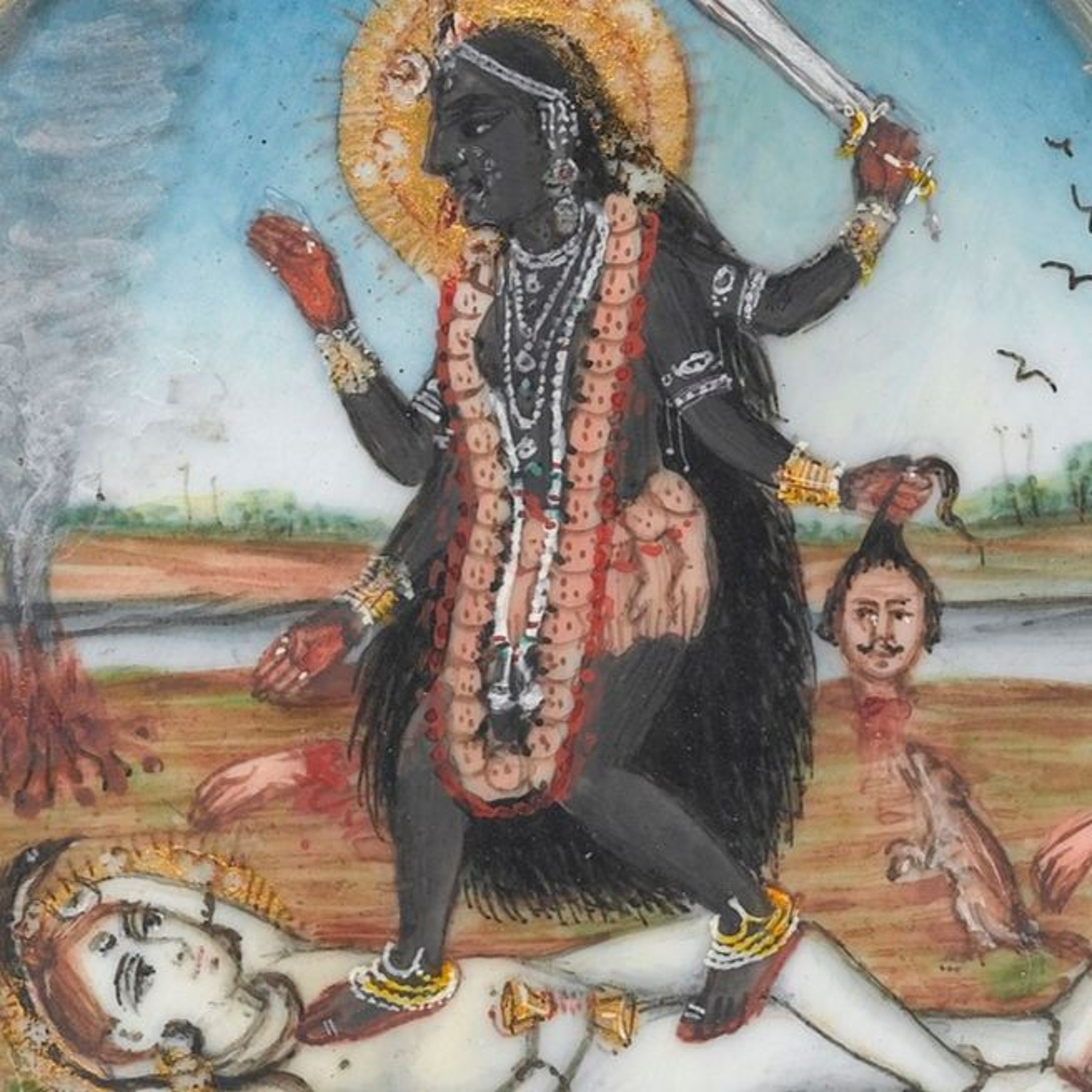
The discussion on goddesses delves into the concept of divine feminine form, exploring the existence of a divine mother, gender differences, and feminine power. Goddesses like Ishtar and Shakti are highlighted for embodying various principles in different cultures. Indian traditions view divinities as abstract principles beyond gender, contrasting with the narratives of goddesses emphasizing key womanhood ideas. The Western literary tradition depicts gods and goddesses influencing lives, with differences in the perception of male-female relationships between Western and Eastern traditions. Feminism in India embraced Shakti as a source of empowerment, reflected in literary works and titles like "Devi," emphasizing the complexity of human and divine interactions and the role of goddesses in shaping cultural and societal norms.
Transcription
10650 Words, 60480 Characters
Welcome to Sintok, the Sintokers around the table today discuss the goddesses in particular. We will think whether divine feminine form in various contexts and manifestations. Is there one divine mother or the structures of the human body and the cosmos similar? Are men and women fundamentally different also? Are goddesses a response to patriarchy in societies? Is feminine power imminent in the world? What is taboo? What is divine? What are the various archetypes of goddesses? Are all goddesses for tile mothers? And what is the likely future of passion, rapture, and sense perception in general? We are pleased and privileged to have please in talk us with us here today, professors such that at the Mohanti he is a national fellow at the Indian Institute of Glad Studies Shimla, he is an academic critic, translator, and cultural historian. His areas of interest are English literary studies, cultural studies, history of ideas, and cosmopolitanism among others. Dr. M. Di Muttukmariswamy is a Tamil writer and a bilingual poet and also directs national folk low support center in Chennai. His research areas are semiotics and performance studies, and Dr. Bihani Sarthak, she is at Lancaster University, her research areas are structured traditions in South Asia, classical sounds with poetry and drama, and early Indian history. So Bihani what it was at the ball rolling with you perhaps just latching onto that word goddesses. What is that word? How has that meaning evolved over the years? When did that first come to be in any concrete shape and form? Essentially the idea, the history of that idea, the history of that concept, that notion, what does that predate, what does that follow? Just take us through that to some measure, and then of course we'll unravel it in many different directions. That divinity is twinned, twinned into both a male and a female principle, is quite an ancient belief and practice. It goes back to prehistoric religious traditions. It continues into the great Bronze Age civilizations. For example, one of the most important divinities in Anatolia was the goddess Ishtar, who was the goddess of political power, but she also combined other principles such as being the goddess of love, of fertility, there are linkages to the Greek Aphrodite, and there are close connections to our own part of the world in South Asia, with the goddess Shakti, the one who combines in herself all manner of principles, both the violent, as well as the benevolent, all kinds of paradoxes. And the worship of Shakti in South Asia really goes back a very, very long way. Certainly we cannot date it, but an ancient aspect of this practice is still present in the form of the worship of the Yoni, in various Shakha beatas, cross India, one of the most important Shakha beatas being in Kamakya, in the beatas of the goddess's worship simply as a stone, so it's a natural and iconic form, and this an iconic form is a testament of her ancient pre-kind of iconic state. And do goddesses follow gods? I mean, does the conceptually, notionally, is there a sequence to it, or what is it like? I know you said you can't predate it, but surely the idea of divinity, does it start within it, does it start with the heat, does it start with the heat, she know that it matters, but since we're discussing goddesses, is there a sequence, is there something universal about this notion, is there some kind of a mapping to the way society has been, may have been, etc. That's a big question, and it's a difficult question. I can say that from our Indian side, the idea of ultimate reality is genderless. So if we think of the way ultimate reality is conceived in the Upanishads, it's the self, which is just an it, it's without a gender. And there is, I think, similarly an idea that goddesses and gods, while in their particular forms are gendered as male or female, but somehow in their absolute form, they are beyond gender. So these divinities in the Indian sense, I think, are more principles, abstract principles, but it becomes complicated when we look at the narratives of the goddesses, because in most of the ancient Sanskrit legends of goddesses, there are certainly key ideas of womanhood that are articulated. Interesting. And Motu, if you go to like various folk traditions, etc., that you might be familiar with, is the idea of goddess, similar, different is the valence, similar, what's it like in you. And of course, you know, the moment you go into non-major faith traditions and religious traditions, there would be just very many. So I don't expect to summarize them all. But given that you're obviously familiar with this and have thought about it for many years, what would be your take? I mean, what's the report from the fringes? I would say the report from the fringes varies from one century to another. But it was always in the mainstream culture, mainstream, Shaktar tradition was in the mainstream for many, many centuries. And then later on, it became discourses in the fringes, as I would say. So what is in the fringes? What is in the mainstream depends on which century we are looking at. As she was saying about the origin was a genderless, it was here in Nia Garbha, the golden Nia Garbha, the Upanishads were conceived of the world as a, the cosmos as a golden Nia, but then there are two principles that were always conceived to be more than the folk tradition and also what we call the classical traditions. One is the principles of energy. Another is the principles of matter. The energy matter. Yeah, the matter as a concrete thing that we can see, perceive, but then the energy is like hidden and then it is to be understood, it is to be perceived in both your body and also what you see outside. So this is the idea of a creation and how the wonder about the creation is the origin or the discourse about the goddesses. The creation is always something that that we are one to stuck with, all the mythographers, all the storytellers, all those people who can look at the nature and also our society, think of creation as something mysterious, something powerful, something dark, something also enlightening, something full of light. So these are the paradoxes she was saying about the paradoxes and the embodiment of paradoxes. But like what does the cosmos come from? Does it not have, does the cosmos have a mother, does the cosmos have a father? The cosmos as the mother, cosmos as a, is not necessarily the mother, the darkness of it and that is a kali that gives rise to a kali which is a destructive, which is also procreative, which is also darkness and that acts as a background for the light to travel. So you see the, the background for the light to travel and also to exist. So you see when you think of the cosmos, not necessarily cosmos is a big thing, if you look at this any energy, anything that grows, that lives, there is a life energy, you know, what a Henry Berkson would call Elon Vita, the life energy, the life force, which is both positive and also negative. That is what is creating, creating but grow and flower, a seed to break there, then come out. There is a lot of energy that goes into it and also the conception, the conception of another, another life in your body, that is also something magical, something you, you wouldn't even be able to imagine on your own without seeing it. So these are the things that, that makes the feminine principle very mysterious at the same time very fearful and you are one to struck with it. So Indian traditions, Indian traditions both at the grassroots level and also at the textual level have come with many many many manifestations of that. One of the ways of looking at it is, see, we are comfortable always with the number 10, so we would say that's a maha with the earth is one way of looking at it. The other way of looking at it is the energy points where the energy points meet, you know, in the world of concrete objects. That is also the point of the energy and each energy point will be manifested as a somebody, some feminine form and each of the forms, what do you mean by energy point? Energy points, you see, but it was the ancient text, especially the text that is attributed to Adi Shankara, the Sonderi Allagheri. Sonderi Allagheri is getting intoxicated with the beauty of the universe. As Shakundati Allagheri, Adi Shankara conceives of the entire universe as energy, energy and Shakti. And in that, there are certain texts which are esoteric in nature, certain sections of the Sonderi Allagheri or esoteric in nature which names each of the goddesses with the certain energy points both in the cosmos and also in the body. So there's an intersection of sorts? Yes, that is how, see, to visualize it, Adi Shankara is attributed to being invented the Sri Chakra. Sri Chakra is the norm. And is that where Shakti traditions start, like this thing? Shakti traditions, of course, get at the time of Adi Shankara, they get consolidated rather. It has been there before with many, many, many traditions, a huge Bengali tradition, warrior tradition, Tamil tradition, Tamil tradition is very benign, the Sri with the tradition. Very benign. Very benign and comparatively, compared to the Bengali tradition, they are all united by one mythology, the one mythology of Shiva and Shakti. Shiva and Shakti, it is about a Shakti being a Shakti's father, Daksha, who refuses the sacrifices to Lord Shiva. So Shiva destroys the Daksha's yanya and because he has destroyed the Daksha's yanya and Daksha and par with the, they get into a conflict and Shakti becomes a Shakti, she emulates herself. And afterwards, when Shiva becomes mad with the, with the death of Shakti, he carries her body and walks around all over the subcontinent of the body. That creates the Shakti Pita or that. I Shakti Pita. All these body parts which, which Professor Behali Sarkar mentioned, that Kamakya being the Yoni Pita, the Kanchipuram being the Neville Pita of, also there are some, something to be a sacred geography of the entire subcontinent, evolved with the Shakti tradition, which are, they are conceived to be something like 51 Shakti Pitas are there. Each Pita representing one bodily part of the Shakti. The Neville being Kanchipuram, Yoni being Kamakya and then Mugambika temple. There's no such thing for the male god, there's no such thing as that. And no, no. There are no such thing as that. Interesting. We'll go to, we'll go to Sachi, Sachi, bring literature into this, into the idea of goddesses, into the idea of a woman perhaps, more generally speaking. But what is a goddess for you, if you think of it as a cultural historian, as a literary critic, as a literary academic, and what do, what do different schools have to say, what does English literature have to say, what do the various vernacular literature have to say on this? Thank you very much for thinking of a theme which is of future and exceptional significance then and now also. Now before I give literary response, may I say that no literary response in the east or the west can be meaningful unless it is backed by a metaphysical kind of an understanding of the situation. Now I tend to agree with what Bihani has said and Muthukumar has said. But if you're talking about the Indian metaphysical tradition, which is a very rich and multi-layered one and there is no single understanding and explanation is there, if you were to think of one, which is one of, which is maybe described as qualified monism. So there are two things which are in operation. One is the relationship between the individual, the universal and the transcendent. Secondly, there is a notion of the transcendent and there is a notion of the imminent. Now if you're talking about the gods and goddesses, I tend to agree with what both of them have said. It is gender neutral in the beginning itself. But in terms of the manifestation and the eminence, then the duality comes into being as Surebindo says, for the sake of creation and Lila, the joy of creation, the Vidya becomes Abhidya. And so therefore there are two dualities and these are also manifest in many scriptures, including the Sanke system which finds portrayal in the Bhagavad Gita, the Purusha and Prakriti. That is at one layer itself. So duality is there but not necessarily conflictual. Now if you come to the imminent world, the world as we understand now, then conflicts and contestation and dualities come into being. How do cultures respond to these dualities in terms of male and female? In India, there is a way of really accepting both in a harmonious manner. As benevolent and malevolent, both have a role and raise one there to play. In contrast to that, largely in the kind of feminism that has come to us, beginning with Simhondas Bhuvar, this has been regarded as conflictual and patriarchy is a manifestation of that kind of a dualistic conflictual relationship. Therefore, Simhondas Bhuvar, in second sex, says that Eve came out of Adam, so therefore Eve is playing a secondary kind of first status and the same thing has been highlighted by Ketmilit's sexual politics. So there is one kind of a trajectory which is taking place in the Western literary tradition because we have Hikate, we have also Nemesis which are goddess of retribution. We have similar kind but not exactly the same thing in the film of Kali, for instance. In other words, I would say that the male and the female in the ordering of the malevolent and benevolent. No, in the Western tradition, in the atmosphere more less. No, I will tell you. Where are the parallels between the West, the Greek Roman tradition and not going so much into Egyptian and the others also with the Chinese, etc., very hugely complex. But for our purpose we might have a fairly fairly simple kind of a polarity between the Greek Roman tradition, that is how we know the European tradition largely. And the oriental tradition, the Chinese, Chinese, Japanese and Indian, today we are talking about the Indian tradition. Both malevolent and the benevolent are really playing a role in the Western tradition. Gods and goddesses are having a kind of an impact and influence on the lives of men and women in the West, Elliot, Odyssey, etc. In India also you find that gods and goddesses are having a kind of a role and influence on the lives of men. But there after this the differences are started. The major difference is that there is a certain kind of a complement to it with regard to the males and females in India because you have goddess of harvest and we have goddess of harvest here also like Surabhi for instance. But at the inter-tradition I would say the males and females are perceived and envisaged as complementary to each other. Whereas for example in the Western and the Greek Roman they are antithetical. And therefore it has been easy for Simandhubuwar which is located in the Western tradition to talk about patriarchy of the kind. But I think in India the kind of a patriarchy which is manifest during the 19th century etc. It was overcome in a certain manner and here I will come at the entry point of the literature. Though way for example literary women in India which had got to indigenous feminism embraced very powerfully the notion of Shakti. Shakti as a source of empowerment and power for example. And they call it out of the door. For example I will say the 19th century to talk about not only in the context of Bengal and Urisa is in India but in Maharashtra where we are right now Pandita Ramayana. So a spousal of the notion Pandita which was considered to be a preserve only male their geogel yet had to take us to the Pandita Pandita. So it could be Pandita so on so. So it was an assumed title? Yeah because you will see for example Pandit Nehru Pandit Govind Balav Pandi but we have not really come across in the late 19th and 20th century the notion Pandita and when Ramayana is consciously espousing and she was given this kind of a title also. By whom? By the by the learned but the learned people of their own time because she had to fight a battle. Was it self-conferred or? No it was she she espoused this kind of she had a winds to kind of a desire to be a learned woman which was considered to be politically or taboo at that time. Just like for example Mary and the events had to take up a pseudonym George Eliot to find respectability in the pantheon of the main writers. In the context of Urisa for example Ashapunna Devi, Rasundari Devi, my own mother Vidutra Devi, Sarala Devi and many others had used the title Devi and this Devi does not change after the marriage itself. This is something which is consciously espoused by them, a source of empowerment and may I say at this stage that it was double hitched and it was a kind of a burden because in the private self the private self was marked by doubts, dilemmas and uncertainty but in public the life of assertion and positivity for example. So this constant oscillation between the desire to be a goddess and the reality to be a human person for example that is something that we find characteristic in the 19th century Indian feminism. And the idea of the goddess itself, what worldly purpose has it served like over the year, like does it have anything to do with the with managing the state, does it have anything to do with the way harvester happened, does it have anything to do with the way worldly affairs are governed. What's the intersection of the divine realm with the day-to-day, with the quotidian and you know what I'm going with this behind me? Yes, certainly Durga had a large role to play in sanctifying political power. She was the one who was worshipped before a king would go off into battles, she was the one who was held to be the maker of her ruler's power and also the power of an entire polity. So goddesses were not just a transcendent but they were very eminent as well in that they created power and they created the substances of power in this world. I just wanted was really struck by the conversation on energy and matter and the metaphysics that was just raised here and I had a couple of points that I wanted to make in relation to that. They were just ideas that came into my mind while both of you were talking. One is about energy and goddesses is energy and indeed in very early myth, so certainly in the Devi Mahatma. Is there a god goddess energy matter split or not really? Yes, there is a relationship between god and goddess that is conceived in terms of energy and matter. So in very early myth that some of which we find in the Devi Mahatma, goddesses are held to be the inner essences of male gods embodied. So while male gods remain inactive, the inner kind of power or energy is then externalized and embodied as an active dynamic female divinity. An early kind of understanding of this idea is from the version of a realm in myths of Vishnu's Maya or Vishnu's kind of magic in a magic which comes out of him. Vishnu is put in a sleep in a trance because of this goddess Maya, this goddess illusion and then while he is asleep demons arise and it is Brahma who sings a song and rouses Vishnu's inner female magic who comes out and then destroys the demons. So there is a sense that in very early version of a myth that the goddess, this dark form called Vishnu Maya is Vishnu's inner essence, inner energy made embodied, made embodied outside Vishnu. There is that and there is this similar kind of idea in the Devi Mahatma where goddesses come out leap out of the bodies of the chief gods of heaven. There you have one sense that goddesses are male energies personified and if we kind of look further in those myths we also find that these embodied feminized male energies conducting or engaging in activities that male gods themselves wouldn't necessarily engage in. So really, really violent acts, real, real kind of Sanskrit, I mean the narratives in the Devi Mahatma talk about hedonistic blood lust that the goddesses would run around the field intoxicated by blood but you don't see the gods engage in that. So there is an interesting division of division of labor but in one sense that's one relation to the male and I'd like to think of it as primal energies within the masculine being identified as the feminine. That's one way that I'd like to think of that. So that's on energy. Now on matter I again think of the Sankhya that was mentioned just now and in early Sankhya philosophy creation is the principles of creation are dual. There is actionless consciousness which is called purusha and purusha is the witness. He is consciousness but he does not engage in any activity. He's simply a witness, a Sarkshi and inactive witness. The other side of this dual creative force is matter which is inert. It is the primal source of creation. It is called prakriti. It is full of transformation and it engages in constant transformation almost in like a dance before the eyes of the witness purusha. Why by itself or does it need the purusha? It needs the purusha to watch her and while prakriti, while nature is an it, it's a thing, it's material. So the Sanskrit texts, the philosophers will call prakriti material and inert. It's like dead clay. On the other hand in the descriptions of prakriti, there is certainly an understanding that this dynamic ever changing matter is feminized and a woman and goddess like and this prakriti is the hub, the womb. We were speaking of womb. This prakriti is the hub, the womb of all the universe. The entirety of creation flows from a prakriti, this changing kind of dynamic hub of creation. The soul is detached. The soul is simply a kind of entranced spectator of prakriti's dance. So that's one thing on on the goddesses matter and then there was one third point and I will end there. The third point was on the notion of duality, on the notion of non-duality rather that gods and goddesses are so intrinsically bound up in Indian thought that you cannot really differentiate them into two separate conflictual and conflicting genders and this reminded me of the first verse of Kali Darsa's Raghuvanksha where he talks about parvati and Parameshwara Shiva in divine unity but unity like the words and the meanings of poetry. No, this is this is this is to the Raghuvanksha and the verse is Parvati Parameshwara. So I praise Parvati and Parameshwara who are the ancestors of the universe who are some prictha who are united just like speech and meaning, speech and meaning in this indesoluble marriage is the very essence of poetry. Bhamaha describes Kavya poetry as Vag and Arta as speech and poetry in deep union. Similarly Shiva and Shakti are in this deep poetic union. Vagar taprati Patayi for the sake of in order to create further speech and poetry. So it has a generative effect. So yes, this idea goes deep into Indian culture that male and female principles cannot be differentiated. They are in subtle and indistinguishable union. And is there a limit at all to because if it's all union, monist, one thing atman or whatever in the beginning there were so many evocations you can think of. Why are there so many manifestations then? Like why are there so many gods? Why are there so many goddesses? Like in practical terms, if you go at the historian lens and you go back several centuries decade after decade, clan after clan, kingdom after kingdom, they tend to be an indemorable number of goddesses. Do they all are they all different personalities, different persona? Is that the place where it maps into the world? What's going on? Goddesses are both particular as well as singular supreme and transcendent. So Shakti is absolute transcendent reality, the hub of everything. And Shakti manifests herself through particular identities and these particular identities are various goddesses. Certainly. But there must be something that makes something a goddess and not, right? Because there are an infinite number of manifestations out there. You know what I mean? Like what is goddess an elevated status of something? Do you know what I mean? And not necessarily, not necessarily in the sense because they are complementary. The goddesses are residing within you. Goddesses are residing within you means with your finer qualities or also not so, not so finer qualities. It is both beauty and the ugly, they reside. So it is not it is not an elevated status, but it is a divinity that we are talking about. Divine in the sense, it is not within the control of the human mind. Or rather, as she was explaining the walk devi, walk devi between the as-professor was saying about the relationship, the complementarity of the forces, the feminine and the masculine, with the speech and the meaning as she was saying. The speech and the meaning is always deferred. It is not final. There is always open to interpretation. That means there is an infinitive semiosis opening up and then there is the creation is always in the constant flux. The constant flux, there is nothing which is elevated, nothing which is there. That is why, in the Shalta tradition, Indian Shalta tradition, especially, there is no concept of evil. There is nothing evil here. All the forces are, we need to be, we come to terms with that. Is that anything virtuous? No. That is everything is divine and then they are in the constant flux. That is one of the reasons, many of the Shalta fanthra texts talk about that, the transcendence, what do you transcend from? Something based or something. See, your idea of what is beautiful, what is ugly, what is dirt, what are human waste, menstrual blood. These are not considered to be dirt at all in the Shalta tradition. No. So, what is Shakta tradition in opposition to? Shakta tradition is not in opposition to anything else. Rather, there were six systems of worship patterns. You know, worship patterns are one that is based on Surya, another based on Kothigaya, another based on Ganesha, one based on Shiva and another based on Vishnu and one based on the Shakti. So, there are six systems of philosophy in Indian philosophical traditions. There are six systems of worship and one of the worship patterns, I would say, is the Shakta tradition. That is where we get all these Kula texts. The Kula texts are the Shakta panthrik texts. They are available both in the science grid. They go back to any many. And also in Tamil and also in other languages as well, mostly in Bengal tradition also have many of the Kula texts. The Kula texts, the huge corpse of the Kula texts, which talks about the origin and the development of the individual courtesists, that make up the Shakta tradition. Those in those Shakta traditions, there is nothing which is ugly, nothing that is bad, nothing which we come across in this aspect unique to the Shakta traditions, like do the others have an idea of evil, have an idea of bad, have an idea of being. Yes, there are concepts of this. We are talking about the Ashras, Ashras being destroyed. Most of the Devi Mahatmaiam stories, the Ashras and the conceptualization of something evil force come into existence and then she destroys them. How she destroys them, she takes them in and transforms them. It is not the destruction that we see as a complete, complete, what do you call it, vanquish. They don't vanquish the evil. They kind of absorb them into them, Mahishasura Madhini. She kills the Mahishah, but then she also absorbs Mahishah into one of her, the iconography of a Mahishasura Madhini, if you see, the bull's head is underneath her feet. She has just absorbed it into her. The kind of absorption is what we are talking about in terms of a Kantian terms of Immanent and Transcendent. We are talking about the transcendence means a transcending what the human beings normally perceive as sin and punya and the power and the dirt and ugly. The transcendence is to transcend all this. That is why many of the sexual practices, the Shaktatantra sexual practices came into existence to many of our prejudices which are operating as we are thinking this is dirt, this is good. That kind of transcendence is very much in the practice of Shaktatradition. But then the Shaktatraditions also had the downtime, right, like it kind of went through several centuries of… In the sense that they see there were many things happened with the Shaktatraditions in Indian history. If you look at it a Buddhism absorbed many of the Shaktat practices. At one point in history, it was indistinguishable whether it was a Hindu Shaktatradition or a Buddhist tradition, that is how Buddhism was, but people normally tend to the popular belief is that Buddhism was a driven out of India, no, Buddhism was absorbed by the Shaktatradition or Buddhism, Buddhism in its aspects of it. I just wanted to interject with two points that maybe I can talk later, in relation to what you just said, Muthu, which is, I think you mentioned something about what makes goddesses different from gods. And also from human beings. Why aren't all women goddesses? No, there is, I think we're getting, perhaps our conversation is getting too lost in transcendence and too lost in kind of non-differentiation because there really is a sense that goddesses can be a womanhood, an aspects of womanhood and particular aspects of womanhood. So I'll come to that later because I'd like to give the floor to such in the second thing that I will mention in relation to what's pure and what's impure is that Shaktatraditions did arise in opposition historically, and that was to Brahmanism. And that was to strict notions of purity and impurity in Brahmanism. So I'll speak about those two. And all of those conceptions within things in very highly shocked the Tantras, certainly in the Tricker, they are all to do with practices that deliberately transgress Brahmanical norms of purity and impurity and cultivate non-duality. These kinds of ideas are spoken about a great length and a great sophistication without being able to go up, for example, it was one of the most kind of important shock the philosophers, but I'll pause here because I would like to hear such as speak. It was transgressive at some level, right? Not at some level fully, yeah. No, as a student, thank you so much. And we all realize, and especially me, as a student of post-colonial writing and literature and culture, that the existing reality is so important. The felt experience is so important in the empirical sense. Having said that, I think I would like to really go back to the entire question of the generation of the archetypes in terms of the gods and goddesses. I will briefly touch upon that, then I will talk about the colonial encounter, and what kind of a, you know, impact it had in ununderstanding of gods and goddesses also. First of all, one finds a colloiding worldview, which regard to the generation of the archetypes and gods and goddesses. There is a worldview, which is generally a question of a personification of the gods and goddesses of the animistic kind, nature, worship, state of awe, before the elements of nature, wind, etc. And the different power and manifestation of nature, and you personify that. How do you decide that? I just go to come to that. In contrast to that, there is also a powerful worldview, which has not been articulated so often, which is not really in the public domain. That is a symbolic worldview, which is given by critics like Shior Bindo and the secret of the Vedas. So, Usha is not only the physical dawn that we know, but Usha is also the dawn of a awakening. The herd of cattle, because cow stands for the, the physical cow, but it also stands for light. The herd of cattle entering into the cave also stands for the light entering into the cave of the unconscious. So, that is how he explains. And he also translates Isha Upanishad's others from the symbolic point of view. So, that kind of a duality and understanding has not been there, largely in our own public domain itself. And we have been caught and rightly so with the notion of the goddess sense and the gods, which really appealed to us. But I believe that both the explanations should go hand in hand. Next thing I want to say with regard to the kind of an impact that was made because of colonialism. As Ashish Nandhi says in intimate enemy, that colonialism in the non-western society comes on a jarring note in a very violent manner. And there is an amnesia which is caused because of colonialism. Between what could be described as the pre-modern past. And when we are talking about women were espousing the Shakti model, they are appropriating and they are dipping into this kind of a past for their own kind of an empowerment. By this, I did not mean to idealize the Indian tradition versus the west. What I was saying is that the given reality of patriarchy is so much reinforced during the colonial period itself because we must know that the kind of a puritanism that comes from, you know, Victorian England also influences powerfully our own society in Bengal, Uri side, etc. So the kind of a freedom which women enjoyed in the pre-colonial period, they did not really take place. Already we find which regard to the writings of William Dalrymple for example the white moguls. The relationship between the white is so-called colonizer during the company era was far more fluid with the native women than the kind of a stratification and the rigid manner in which for example the European masters began to view the Indian women for example. So I think colonialism is a very important thing and may I also tell this learned audience about the importance of a great book by Dharmapal called the speaking tree because we do not have a knowledge of the kind of a indigenous knowledge system which existed including the way we look at men and women Purushan prakriti in the pre-colonial period. That has been wiped out completely or if not marginalized because of the colonial intervention. So the kind of a knowledge system which was produced in the colonial and the post-colonial period is largely metropolitan west centric and as a result of which the reservoir of knowledge which could be used very footfully meaningfully by the men and women have not been really utilized properly. So there is a lesson there and the lesson is through recapture not in a revivalistic and regressive manner in a manner which would really be suitable to the post-colonial condition. Who is the goddess? As I said there are many manifestations of the goddesses for example and and when I talked about goddess it is not in an idealized manner that a celebration of the women would because there is nothing like a celebration. It is always mixed signals. What do you mean? Mixed signals. A way one is being perceived at home and in the intimate circle for example many of these literary women and you asked me this question about literary women. I want to answer. The fate of the literary women was to be subjugated to mix signals. In the realm of the private self there was great deal of doubt, uncertainty. Within themselves for example with regard to the relationship with the spouses, relationship with the mentors it was always in a clandestine manner because they could not really come out into the open. If you look at the life of Kuntalakumari, if you look at the life of Saruladevi, so could not come out into the open world. Because patriarchy would not allow, if for example Scarlett later, Nathaniel Hawthorne 19th century classic would not allow Hester Prem to really come out into the open and to acknowledge about the father would have pulled in the 19th century America itself when the Puritan fathers are trying to create a kind of a new Jerusalem. You can imagine how difficult it must have been for Indian women, particularly literary women for fighting against the current to create creativity. One is that for example, which regard to the spouse selection, intimacy in the sexual life, etc. They could not come out into the open and I'm sure Bihanees here, she would remember about the life of Rasuladevi. She had a desire to learn the alphabet. She did not have the access, although she belonged to the Badramayla tradition, plan and she had to tear off the page of her son, little boy who was going to the school and to hide it inside the fold of the sari. So one at home, of course you are respected, but you do not have access to the alphabet and learning itself. So duality, constant dilemma and doubt is marking the lives of this, but in spite of that they're coming out and they do not have the benefit of higher education, but they have learned the art of writing itself and there's a wonderful tradition of writing by Winnan. And if you have to read about Suzy Tarwenke Lalitha's book, Winnan Writing in India, or my book, for example, Lost Tradition Early Women's Writing Inurisa. So I think that Goddess Notion is really helping them in a very powerful manner, as I told you. You mean as a source of inspiration. I think it's more than a source of inspiration. I think it's an appropriation of models which exist out there and much before the discovery of those models by the archivists, those models have been really used by women themselves. The notion that education is responsible for empowerment, it is incorrect because they are education at home. The self-learning is there, the self-learning of the American women during the 19th century, and their own counterparts in post-colonial societies also, and pre-colonial period also, and during the colonial age that is absolutely incredible. There were also other traditions of women writing. See, from the early Tamil literature, many of the sunken poets were women. Women composed the songs, and then when it comes to the bhakti period for take, for instance, Andar. Andar had no reservations about the expressing of sexuality in the open. When she is singing like that, when she is imagining Vishnu having a most beautiful lips, which is very sweetening and then fragrant, which she wants to kiss, she has no reservations about expressing her sexuality in the open. Akamadevi of a Karnataka, for instance, there is a whole lot of women writers who did not have any reservations at all. Of course, the colonial encounter, the colonialism was a big, big disrupted with the free expression of the women poets. The women writing, it does not be known as an impediment by the subter, as an impediment. In the sense, there was a kind of a new ways of thinking in the new ways of an encounter that is taking place between the colonialism that is imposed on India, and also the indigenous traditions of the order people who are encountering it, living through it. A living through it, that is in the, that is through the British rule. But what about the earlier traditions? What were the archetypes? What were the things? See, in Silaparigaram, there were two kinds of archetypes only, a chase, two wife, Carnegie, who becomes a goddess later, with a fury. The other one, Madhavi, a courtison and the dancer, there were the two kinds of the women stereotypes, but then in the subsequent and epic, Manimegalai, you have an alternative, Manimegalai, which century or year is this? This is the 2000 years ago, the Sangam literature, Sangam-e-pick traditions, we have post-Sangam literature in Tamil, we are talking about, on the other hand, the Manimegalai, the next year back, she has a Manimegalai, who is born off of the covalent hero of the slain hero of murder, hero of Silaparigaram, and who marries Madhavi, the courtison, living behind her, chased a wife, Carnegie, and then through them they have a daughter, Madhavi. Madhavi has a choice, either to become a chased wife or to become a courtison dancer, but she chooses the other way, she becomes up with this none, and then she rejects all love, and then she fools her, is she kind of cures the disease of hunger in the world. So, the women, not necessarily, has always been thought of as a goddess or divine, but in literature, both the ancient and pre-modern, pre-colonial, they were conceived off in a ways of expressing themselves and finding a way for themselves. They did not have any kind of reservations at all if you look at the bhakti tradition or the bhakti poets. So, in the bhakti tradition and the bhakti poets, for example, among that corpora, who have the status of a goddess? Ah, of course, later on they all became a goddess, and all became a goddess. All of them will have a choice of the poet today. The poets have always been sanctified. See, there was a period of consolidation and the convenient period. When they combined all the all the poetry into secret texts, and the organisers of tiramuraisa, the secret texts of sivism, the secret texts of Vaishnavism in the later period, I mean in the 17th century and the 18th century, when they were creating this canonical text of Vaishnavism and sivism, that is where they all became poet saints. Right. And the poet saints slowly became poet goddesses. Right. So, Andal is worshiped today in Tamil Nadu from December this month, Marui. Every day, you listen to the the Pasurams, the songs that Andal sang in the morning, and also it is danced as a person at him. It is sung in the kinetic music, all the concert halls as songs. You listen to it, you live through every marketing, every December with Andal. Andal is being worshiped, and also she has become both the goddess and also the poetess. So, she also becomes a vehicular of expressing what cannot be expressed. So, that is this kind of a yes, colonial encounter was a major major disruptor, but then the parallel traditions existed very well lived in a rich way, continuing to reach in several parts of India. What does it take me, honey, on this whole colonial encounter question? I would tend to agree that it's that the advent of colonialism did harden ideas of boundaries between masculine and feminine in a way that did not exist before. I mean, certainly now, pre-modern traditions, I do think that sharkism, shark the archetypes, mythologies of the goddess offered indigenous forms, expressions of feminism for Indian women. It certainly did for me growing up, reading myths about the goddess. These for me were homegrown tales of female agency, and it was only later that I encountered feminism. I do think that these tales about the goddess, goddesses themselves, they have links to real womanhood, real issues of womanhood that we haven't really thought about very deeply. So, as of up to now, so one link is that you find that while goddesses are always autonomous, they don't have a male consort. Wild goddess. Yeah. Wild goddess. So, in fact, their wildness is supposed to be their autonomy. Chamunda, Kali, Durga, they are without their autonomous, and in fact, shark the tantras, in which the goddesses ascendant, those shark the goddesses are who are considered supreme are always autonomous. They always were tantra, they're always without male consorts. The second thing is we find goddesses, and not just wild goddesses, any in all goddesses, expressing very openly primality, needs. So, Muthu spoke about and are being very open about her sexual desire. When we look at goddesses, goddesses openly express sexual desire. In fact, in the Kumar Sambhava, parvati quests, she searches for Shiva's love, she actively goes out to get Shiva. That's the whole premise of the story. So, the story of agency, this old goddess question, is a question of agency. For me, it is completely a question of agency. For me, the more I think about shark the traditions and goddesses now, I cannot think of goddesses separately from the issue of womanhood. I cannot think of goddesses separately from the issue of subjectivity in agency. What happens in the post-liberation, post-emancipation world? Like, do these things kind of loose? Male agency is an illusion. Male agency is a reality. I think feminism or western feminism has constructed female agency in a very particular way that isolates certain aspects that are very important to non-western women. For example, and I think black feminists also complained about those same issues with when it came to white feminists. One, for example, family is very important. Communities very important for a lot of non-western women. And we see aspects of community and family constantly being accorded in stories about goddesses. Certainly in the Kumar Sambhava, it's, you know, the family context is always there. The importance to the family is always there. The goddesses' importance to her family is always there. Sisterhood. Sisterhood, that's a key notion, I think, of indigenous feminism. If I think of shock, the traditions, I always think of sisterhood. Goddesses go out in packs. It's a great point. They never go out alone. It's always in a yoginijala. That's a great point. And in a way that identities of these goddesses are quite interchangeable as well. There's a hierarchy of order. If you notice the relationship between these goddesses in these groups, there's a hierarchy of order. So, for example, in chapter 8 of the Devi Mahatma, when Charmunda comes out, we were just talking about Gali is the black, the dark night of destruction and creation. So, that's that wonderful chapter when, you know, Gali comes out and she goes about destroying everybody in mad glee, by the way. Enjoyment and fun is at the heart of goddesses. They're not serious. They have a lot of fun. So, when Gali goes about, she takes her order directly from Durga. She's not going to go about destroying things without Durga's order. So, there is this kind of order system within the sisterhood. So, really, these are expressions of, I know that they are myths about divine myths, but they articulate very strongly notions of indigenous Indian womanhood. Relationships with spouses, I think it was mentioned just now. That's a whole other thing. I mean, it's such, if you look at these narratives, the goddesses' relationship with her spouse, Shiva, described in so many different ways. But I'll pause there because, you know, I would like to listen to my knowledge. No, they just want to bring in one idea here. I'm sure Mutu has something very interesting to say. You see, colonialism has been alluded to by three of us, but colonialism basically means the hegemony of the Eurocentric value systems. Eurocentric way of looking at the reality, the Eurocentric worldview. And with regard to the goddesses, may I say, that the opacity or the blindness of the West, particularly the Western male view regarding the goddesses in India, has been manifest also in the post-colonial period that you are talking about here and now. I'll just give you two examples. One is the title of a book called "Savijing the Civilized" is a life of very relevant colonial anthropology. And this is by Ramchandra Gua. There is a so pattern that you find here and uncanny manner, the pattern is also found in a supposedly sympathetic writer of a mountain literature, Billitekin, Nandadevi. Now, most mountains in our country, including in my state, of Urissa, are not named after goddesses. They're named after gods, they're a male. And the rivers in contrast are the female names, like Vannokadjodhi, Mayanjurthaniya, and in also Vaigai, all the rivers, source of nourishment are named after females. So hills are male. And there is a story, and I'll go to Billitekin, that Nandadevi and one juncture was called Nandhi, after the bool of Shiva. But in courts of time, that idea is not really striking deep roots, Nandadevi becomes a goddess. I'll mention first about barrier railway. When barrier railway comes to India, the kind of a male gaze that he has, in Basta district, etc, is looking at the tribal women in very voluptuous terms, fullness. And in erotic terms, for example, I think what you find typically is a western male view of the Indian women, particularly in the tribal context. Now he gets married there, and how so ever sympathetic the biographer Ramchandra Gwai is, but there are subtexts which is really glossing over. The first woman that he had got married to, it was an ex-party kind of divorce, in Calcutta High Court. Though she did not have a chance even to defend herself. Second time, for example, the woman that she gets married to, and this is also hinted at, indicated in Ramchandra Gwai. Very well. That around the time that she was expecting a child, he was seriously interested in getting married to an American woman who had come on a fulbright program, to India itself. And you can see the appropriating manner in which Indian women in general, and particularly tribal women who did not have the agency of their own. That is one, what is important to know, and I did, that he comes from a theological background. He was trained to be a theologist, a priest, he comes here, becomes a kind of a anthropologist. Turn to Billitekin, pro-India, and both of them have become Indian citizens, incidentally. They are not typical colonizers. Billitekin also comes from a theological background, and gets married to an Indian. Can it not be incidentally? No, it's not incidentally. It is representative, because I think there is a certain male gaze, Western male gaze. No, I have something important. I tell you what is happening. You see, you have to look as a student of literature and language. You have to see between the lines also, how the language is operating. How you are looking at the Indian reality, including the goddesses also, how you are defying Indian women also, as goddesses. Variant women is really defying the tribal women as goddesses, for example. Certainly not. The transformation was very important. The transformation, see, here the barrier, when comes in as a theology and priest and a Westerner, and he was initially was off-struck by the promiscuity of the gond women. And also, go to, go to, go to. And then he writes that in the, in the life in a gond woman, he writes it very vividly, that he was off-struck by the promiscuity of these gond women, and he couldn't make any sense of it. And in the process, he leaves behind his religion. He leaves behind his priesthood. He leaves behind his male guest. He becomes a gond. And he was the architect of the tribal policy. So, and just, I tried the tribal policy, that he wrote for the Nehru. Nehru appointed him as the advisor to the not. Adversity to the not. And his widow, who was living in Shilong for a very long period of time, she would say that the tribal women of India transformed a tree of a priest. Absolutely. Transformed a priest. No, no. To sit and extend, he became a tribe himself. No, actually, it's not incidental, because you see, the American anthropologist, to which he was submitting articles regularly and photographs also. There, many of them were again and again asking him to talk about the so-called sexual interaction or intercourse in the good tool. Tell us more about good tool, for example. They were interested in the so-called Indian and the tribal female sexuality. They were interested. And they were trying to sort of objectify that. Well, the point has been made. So, the second one, I want to tell you. It's not the boy upset, because now it's a acknowledge. Second one also. Second one also. I'll tell you about Nandadevi. Very sympathetic and we are very grateful that a mind-warnier, writer of mountain literature has really written about it. But there are two or three aspects also. Well, not problematic, but our worth noticing. And also to tell us how he comes from a theological background, the priestly background. One is the kind of a therapeutic and cathartic role that Nandadevi plays in his own personal life. When he falls ill in this book called Nandadevi. He falls ill and then in the company of beautiful women there in the Gandhi ashram, he discovers the importance of erotic love. Importance of erotic love, he discovers in Gandhi ashram because it is a citadel of asceticism. Nandadevi is triggering that notion of eroticism in him. He understands that. The second one is that there is a mountaineer who goes there and his daughter. His daughter has been named, American mountaineer has named his daughter, 22 year old, as Devi sold Devi and Devi has climbed the mountain. And just after the summit she dies. And what is the commentary of Billitekin? He says that she apparently violated the unwritten code of the mountain life and the tribals that if you wear scanty dress, for example, by wearing scanty American dress, you have invoked the wrath of Nandadevi. That is the kind of explanation that he is giving here say. And another thing is that she does anything, something more forbidden according to Billitekin. She has taken her fiancée into the tent. And because of these two reasons, he says, tongue in cheek, perhaps. Here we are talking about the life of the Khomeim and Gharwalis, a full of life and celebrating the interaction between men and women. But you are also invoking, I could not help preventing myself from seeing the theological and the protestant puritanical self, which is imputing this kind of a mythic to the tragedy. And this tragedy in a way was overcome when an Indian mountainous course and comes down and plants are, you know, a black kind of a plague there. Very, he is quoting from the beautiful lines, poetic lyrical lines from this woman Devi sold. He says, I am in the presence of the elements. And I am free bird now itself. So that I think is a very wonderful testament that an Indian mountainous has given to her. Rather than imputing motive, because you dare take your own kind of a fiasco into the net, therefore he invoked the wrath of the goddess itself. So I think there is something to be said about the Western Melchized. That brings us to the ways of looking at two distinctive traditions and what feminism does here. What is the role of feminism? The idea of sex as a sin is very Christian. And it is very rooted in the Judeo-Christian tradition, which has the father, son and the holy spirit, all are male. The male goddesses and then the Judeo-Christian religions, especially imposed upon a patriarchal view of the world. The feminism actually came against this patriarchal imposition, whether it is a modern contemporary feminism that starts off with the with the Simone de Boa or earlier one that are written by Engels, the family institution and private property, Marx and Engels as the theoretical work, which is considered to be the feminist Bible for the Westerners. And then there is a look at all these witch hunting and burning of the witches in the European Christian era, who were expressed in extraordinary devotion to the Christ or expressed in sexual desire, were all characterized as the witches and then hunted down and burned down. So the Western feminism as its roots in going against the patriarchal system imposed by their religion. Is there is there an idea of goddess at all in the Judeo-Christian mother Mary, Virgin Mary and there's so many other, of course in the pagan religions in the Greco-Roman religion, so you have plenty of goddesses out there. I don't think you have it in the way that the South Asian tradition where primal need is expressed by goddesses. So Charmunda manifests herself at the time that the universe is destroyed and she eats everything that is all around everything goes into Charmunda's body. She ravenously devours the universe. Now hunger, this kind of hunger that cannot be satisfied and a woman actually kind of indulging in it in a very joyful manner. Charmunda all the Sanskrit poet says when she's out on rampage, she's enjoying herself, she's having a ball. So I think this idea of women showing their needs, showing their primal needs in the Western tradition. Different manifestations, so there's a chin number for instance, she cuts her head and then carries it. So it is a kind of a self-sacrifice. The women, Charmunda, there's totally against the presentations and the manifestations of Charmunda, chin number star would be cutting her head and carrying her head in the road. Understood, understood. What's the future? The future of the idea of goddesses. No, I think a way to add to your, the future is that today in you find, for example, the Deshi tradition rather apart from the Marga tradition is very alive. Deshi tradition. The Deshi tradition and Robert Redfield and Milton Singer had talked about the great tradition, the little tradition. When I'm talking about the Deshi tradition, I'm talking about the little traditions, which exist in the rural villages in the villages. So if you're asking about the folklore, that's where you come in. If you're asking about the future and the future is the present, if you look at the villages, for example, the villages, I mean it's the villages and the hamlets in our country today, there is the Chandi tradition. There's the local deities, local goddesses, for example, in my own village, no marriage, no significant activity, till today can be performed without going to the Chandi. And what is the Chandi? There's not a deity there, but a tree trunk which has been painted with Sindur, with Vermillion, is worshipped as Chandi. So my answer to you is that it is something living and pulsating in the villages and the hamlets of our country itself, as far as Southeast Asia is concerned. And by Southeast Asia, I would like to bring in, you know, Bangladesh also and India and the entire variety and the heterogeneity of the goddesses who are still worshipped and the part and part of our own existence is self. So that will tell you about the living continuation of the goddess tradition in India. Interesting. I love the word pulsating. Yes, the future for me would be a male surrender to the, to the female, charm and the power. Charm, charm and the power. And you see, there is a great iconography where she was. I mean, you will need to do, you will need to do structural traditions like 2000 years later, the other kind. Yes, and there is a famous iconographic depiction of Vishriva lying down and then allowing Kali to walk over him, you know. Yeah, that's stunning. That's stunning. No, also, let us take that. Also, we were talking about Simandhu Bhuvad. But back, it was a fear of the woman. Yes, yes, yes, rather than. No, no, no, no, no. I mean, as the only woman present here in a conversation about Shakti, may I please say that it shows my true feelings. No, I, I, I, I, I am on your side. I agree with you. But since we're talking about Simandhu Bhuvad, the GM six and second six and you said six is biological and gender is a culture context, which will become a cliche now and of repeated truth. But also the French said Vivla difference, Vivla difference, the different ways of really looking at the reality, engaging with this and getting ourselves empowered. No, that's fine. What the future, Bihani, as someone who as a historian, well, as someone who's immersed myself in shock, the literature, mythology for a very long time, and someone who continues to think about it now, I hope that our shock, the theories, our goddesses might lead the way towards a systematic indigenous feminism. If at some point all around the world, I would see this as an intellectual project, as well as a real project, something that I hope may be myself and a few other women, we can get together and work on, to write and work on a form of feminism that is Indian, but drawing from our own, our own shock, the traditions and ideas, that would be the future is for me a future would be of an Indian feminism drawing from shock, so maybe a book that might change or electrify Indian women in a few years' time on feminism from the shock, the goddesses. Wonderful, more power to you. So, something that Bihani says deeply appeals to me and when I look at your work, I found an expression which was very good and very commendable and you talked about the counter normative narrative, counter normative narrative, and I think many of us are in the same line. So those are the kinds of work which are and the most important, the other work by the indigenous feminist in India, also have done, those are in the same direction of looking at patriarchy in the east and the west and the way men and women as now we both had said, can really come together on equal and equitable basis. Wonderful, thanks to all of you for making it and we look forward to having you soon again, thanks for coming. [Music] [Music] [Music] [Music] [Music] [Music] [Music]
Podcast Summary
Key Points:
Discussion on goddesses explores divine feminine form, existence of divine mother, gender differences, and feminine power.
Goddesses like Ishtar and Shakti are significant in various cultures, embodying both benevolent and malevolent principles.
Indian traditions view divinities as abstract principles beyond gender, while narratives of goddesses emphasize key ideas of womanhood.
The Western literary tradition portrays gods and goddesses influencing lives, with Western and Eastern traditions differing in the perception of male-female relationships.
Feminism in India embraced the notion of Shakti as a source of empowerment, reflected in literary works and titles like "Devi."
Summary:
The discussion on goddesses delves into the concept of divine feminine form, exploring the existence of a divine mother, gender differences, and feminine power. Goddesses like Ishtar and Shakti are highlighted for embodying various principles in different cultures. Indian traditions view divinities as abstract principles beyond gender, contrasting with the narratives of goddesses emphasizing key womanhood ideas.
The Western literary tradition depicts gods and goddesses influencing lives, with differences in the perception of male-female relationships between Western and Eastern traditions. Feminism in India embraced Shakti as a source of empowerment, reflected in literary works and titles like "Devi," emphasizing the complexity of human and divine interactions and the role of goddesses in shaping cultural and societal norms.
FAQs
Goddesses embody various archetypes such as love, fertility, power, and paradoxes.
Goddesses have been considered as a response to patriarchy in many societies.
The future of passion, rapture, and sense perception is uncertain and subject to various interpretations.
In many traditions, goddesses are intertwined with gods conceptually and share a dualistic relationship.
The concept of goddesses has evolved from ancient beliefs to embody various principles and archetypes over time.
Chat with AI
Loading...
Pro features
Go deeper with this episode
Unlock creator-grade tools that turn any transcript into show notes and subtitle files.
 PodcastTranscript AI