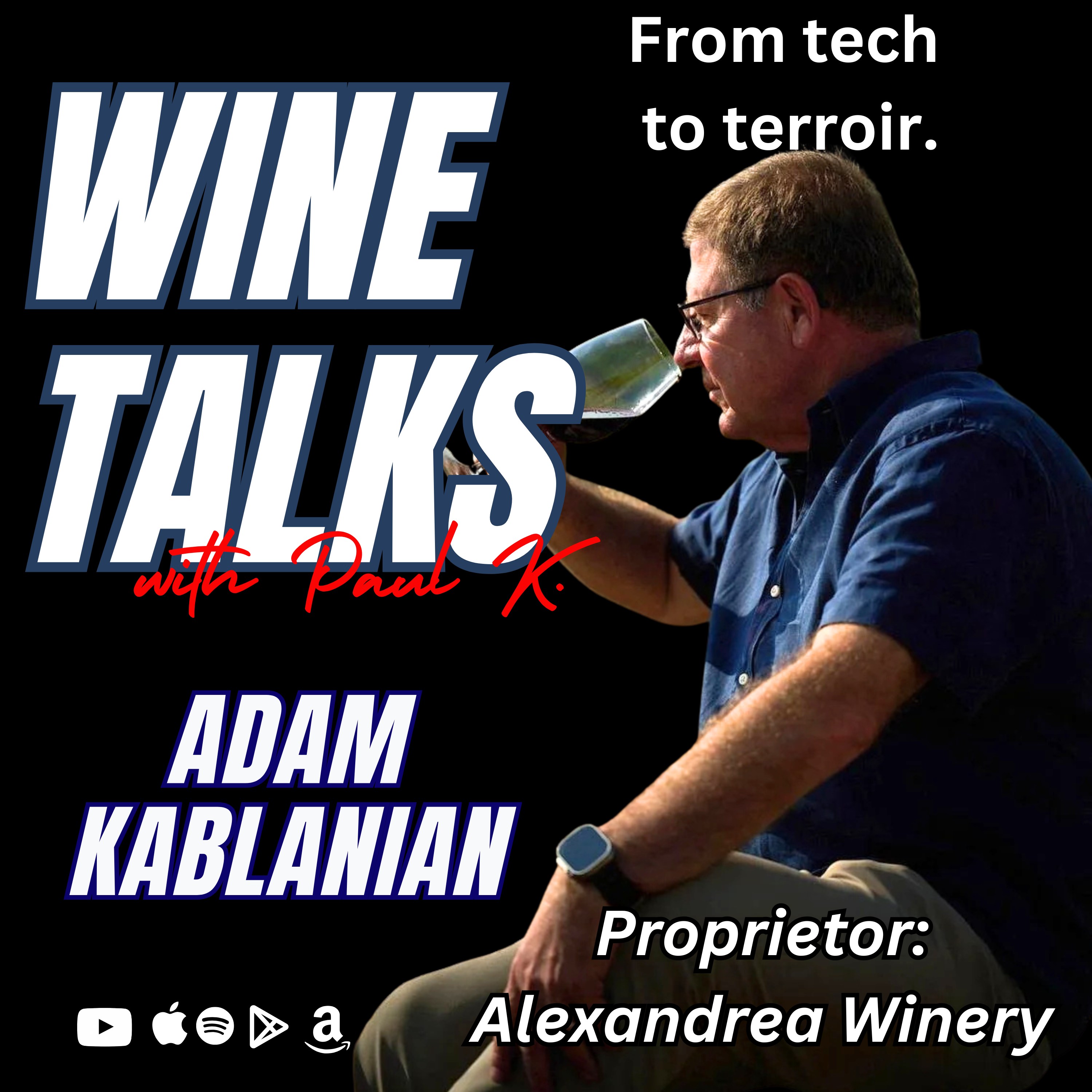
Terroir, Technology, and Taste: The Future of Wine in Armenia
57m 14s
Adam Koblanyan, founder and CEO of Alexandria Winery in Armenia, discusses his vision to elevate Armenian wine on the global stage by combining international grape varieties with indigenous ones. He recently won multiple awards at the Rodeo on Court competition, including two double golds, from wines made in second-year vineyards, proving that new vines can produce high-quality wines, especially in Armenia’s volcanic soil. Adam strategically uses familiar varietals like Pinot Noir, Chardonnay, and Riesling to introduce consumers to Armenian wine, then showcases unique blends like Voskehat and Chardonnay. He emphasizes terroir, selecting high-altitude vineyards (up to 1,100 meters) to match grapes with soil and climate, ensuring phenolic ripeness and complexity. Adam faces criticism from local winemakers for focusing on international grapes, but he argues that this approach reduces market barriers and proves Armenia’s potential. He prioritizes precision in vineyard management, such as using anti-hail nets and staggered harvesting, to optimize quality. While acknowledging historical challenges from Soviet-era practices, Adam believes Armenian wine is rapidly improving, with indigenous grapes like Areni holding great promise for the future. His ultimate goal is to create affordable, high-value wines that attract global attention and investment to Armenia.
My vision was in the next 15 years at the time, is to put Armenia on the map of the world where you can grow any types of wine in Armenia. So if I'm successful in creating high value wine and attractive price, and when the world goes crazy about this type of wine and they're affordable, then I think we'll get lots of big names come to Armenia and you best because of now they have a proof into putting that you can make excellent wines. Sit back and grab a glass. It's Wine Talks with All-K. Hey, welcome to Wine Talks with Paul K and we are in studio today, the beautiful Southern California Day here and getting into the holidays. But to have a conversation with Adam Koblanyan, the CEO, you know what I'm saying? CEO, the founder and owner of Alexandria Wineery in Armenia. Hey, have a listen to a show that just came out with Greg Lombrack. Lombrack, you can say, Lombrack. He is the founder and owner of Chloravan Wine Preservation System. Incredible feat of engineering that came from his boredom with fusion, building nuclear plants. Listen to that, but not over here. So glad to have you here. Adam, thanks for coming in. Well, thank you for having me. I hope we're not talking about fusion. Even though I studied physics, I understand fusion, but we're not going to talk about fusion. You know, but he did say I got bored with it. He said it'll never work, whatever he was working on. And he went into medical devices and that turned into the core, you know, the Corban button. I used it. Yeah, yeah. It's a crazy, crazy good story. But when I got to talk about him today, you know, you're in LA for a little bit, but you spent a lot of time in Armenia and you've founded Alexandria Wineery, which is, I think, a blend of your kids' names. Alex is my son's name and Andrea is my daughter. Alex. The role's right off the tongue. Yeah, I know it's Alex, Andrea. It's beautiful. And you just, let's start with this. You just won. And I looked this up. I hadn't heard of the rodeo on court, but it's just to give it, you know, some reference for years and years and years the LA County Fair was the largest tasting in America for many years. And it was 2,500 wines. And so you can imagine now this rodeo, and I've heard some more about it since we talked about it, is over 2,800 wines. So it's a big tasting. And you came away with some accolades. Yeah, I was really pleasantly surprised. Not surprise, not the right word. My why-maker is a judge there. And he's been going there for several years. And, you know, Jeff Ricci is an excellent why-maker, 30 years experience. He said, we should submit our wines there. I said, why do I need to six of them? So let's send them all. So three days ago we got the news that we got two double golds are reasling and a white few there we can discuss those later. We have two golds and two silvers. And three of the six is class champion within their Christ range and the type of wine. So, and these are all produced from second year vineyard. So this is not an old vineyard. This is not a mature vineyard. So, you know, it's interesting because when the Americans beat the French in 1976 in the in the Jesuit Paris, people argue that vineyard has to be old. It has to be old vines here, but a new one, I think in general, is probably accurate. But the cabernet that won the beat the bordeaux and that tasting was the first crop of that vineyard. So I guess it doesn't always apply. It doesn't always apply, but it does help like when the rustic hole then goes deeper and extracts nutrients and extracts minerals, makes it more complex. But you know, in Armenia, we're lucky we have volcanic soil. You don't have to go really deep. It's the whole soil is volcanic. So it's rich in minerals. Yeah, very porous. And vines like that. Yeah, vines love volcanic soil. So this just tasting. Let me just kind of peel that back and get dig into the marketing of wine because this certainly many, many brands that win gold like this would probably go after later and put a sticker on the label, hoping that the consumer will see that on the shelf. But I think it's the beginning of, you know, part of the process. And you asked if this, if this was a well known tasting, it's, it is, as far as I can tell, and certainly by the size of it, it's reputable. And so now what do you do with this information? I'm not, I mean, that's a question. What is it in general? What do we do this? What does your wine maker think now happens with these accolades? Well, we also have obligation. I guess there is a tasting in February as a follow up to this. And there's also some gala afterwards where officially the stickers and certificates will be, will be kind of awarded. We haven't thought about how to market it, how to, to, to put the stickers. Definitely, we want to publicize it. But more importantly, it gives the team great confidence that this vineyard's had huge potential. So that's really the most important thing is not so much the, the marketing angle. It's so that, you know, the path that we have outlined back 2017 when I decided to get into wine business. And the decisions we made right now is really proving to be the correct decision where we select the vineyard, the type of right is we, we, we plant there. One of the things I did differently than other Armenian wine makers is that I decided to also make wines from international varieties. Which is not typical in Armenia. We have only Karras has some international varieties. But the rest of the wine, the wine makers are only working with indigenous Armenian varieties. Which is fantastic. I think we need to nurture that. We need to understand how to make better wines from these varieties. But my business approach and my outlook was a little bit different. I said, well, I knew that majority of my market will be outside of Armenia. So I want to start with labels, wine type that people recognize like Pino, Shardone, Rizlink. And now they said, wow, this is from Armenia. And where is Armenia? Here is where Armenia. Oh, by the way, we also have indigenous, like RNA varieties. Oh, by the way, we're also experimenting with making Queh between Voskeh and Shardone, which is, which one double gold, for example, in this competition. So now we have no opportunity to unique wines that doesn't exist. It's like, you know, ancient vines with, you know, old-world wines combining them. One of my German, why makers, I made this. Oh, I can know, I see what you, why makers trying to do is having East talk to the West. So it's kind of an expression of how this Queh is. That's an interesting thought. And I want to touch on that. The new world wines and the style that you have. But it's interesting thought that maybe from a molecular basis. There might be some kind of agreement between the molecular structure of an old-world wine from Armenia. It's been there for 6,000 years. And a Shardone coming from another part of the world. Who knows what's going on in there? But, you know, certainly when you blend wine to whether it's international grapes with indigenous grapes, or even these to be wines in America. It was South American, South American, Cabernet blended with North American Cabernet. That there's some kind of synergy. And that there's some kind of thing that we can't even explain that's going on in those wines just because we tried it. The wines I've had for you are very good in there. What I tell people about them when I talk to them is that they're of current modern character. And that's what sells today is they have to feel modern. You know, we are in Italy and we went to Pimonte and we went to Borolo. We went to two distinctively different houses. One, my wife couldn't even stay in the cell because it was so musty and moldy. And that's the character. And then the other one was this new hip, you know, bright fruit forward type wines. So it's just an interesting thought. But let's go back to the domestic varietals or the French varietals versus indigenous. Here's the way I see some of that. You've got unknown grapes, Arane Vosca, Kangoon. And an unknown region really. And you try to bring it to the world stage and go up ahead against Bordeaux, Burgundy, California, Napa, Sonoma, Central, I mean, that is a tall order. It is. And I think by eliminating one of those variables, which is the indigenous grape names, I had this conversation for the last couple of years with people in the industry that you at least have taken some of the permutations out of the headwinds or some of the things that might cause people confusion. So you say Shardinay or Shardinay or recently or recently that at least on the shelf. Somebody might say, oh, this is interesting. Yeah, Shardinay from Armenia. Wow. Let me try it out. And I know Shardinay, I like Shardinay from Burgundy. I do like Shardinay, Sonoma. But this is kind of unique. Never heard about Armenia. Well, I get also criticized by Armenian lawmakers that I don't believe in the Armenian indigenous world.
I feel that I'm spending all this investment, making wines that's not native to Armenia. And my reply to them says, look, it's a $10 million investment, which is large for an Armenia scale. I said, how is it that I don't believe in Armenians? Why making? And to me, one of the things, as I took this journey and I understood, I understood that 95% of high quality wines is really to do with the terroir. Terroir, terroir, terroir. And so when I start looking at where to put my vineyards, so I select the three different distinct regions, 60 kilometers apart, 120 kilometers apart. So we have one in Boroschen, in Godake, where I do all the earlier ads and pin on water and the white, the reasling and Voskehade, as well as Muskot and Shargonay. And then I have another region where those are all high elevation vineyards, 1,130 meters, so it gets lots of sun. And another, how are they? One having vineyards? 1,137, one, the other's 1,1,100 meter high. The other one is also volcanic. That's why I have all the Bordeaux varieties. The first harvest was this year for the Bordeaux varieties. So we will not see this wines for another year and a half, so in 2027, but they're developing very nicely. And the berries were fantastic. When we picked them up, we kind of tasted and there's good Finals there. And it's as potential is amazing. So what we have done is we matched the terroir and not just the soil composition to the type of variety that does well there. And that's why I have international as well as indigenous. - Well, let's start there for a second. Couple of things you said are very important. And it helps define some of this. And for the listeners, when you talk about 1,100 meters about 3,300 feet a little more than that, and you compare that to like Napa, which is like 700 feet, you, there's a substantial difference in altitude, which has a lot to do with the quality grapes and the way the grapes develop. But is that not a wine geek thing? And that's not a question. Like if you're going on the shop supermarket aisle, you're not looking for which ones have the highest altitude unless you can't reach it because it's so high on the shelf. And that was a good joke. (laughing) I remember that. But so it's important for us as wine people to recognize those things, is that what goes into the grape and what goes into the bottle or doing it. So what's important to the consumer is, do I really like it, is a really good value? And will I share with my friends where I poured it home? Like really, when I tasted wine at the wine at the month club every Tuesday, sometimes when I couldn't arrive at a decision as to what I would feature that wine or night was, would I serve this at home? Would I be happy to have this for a guest that came to my home expressing something? And I think you're on the right path with that. Because by examining terroir, phenolic ripeness, understanding what that vineyard's gonna produce, you're gonna produce an honest wine that expresses where it's from and why you made it in the first place. It's in the bottle already. And that resonates with people, I think. Yeah, I think the essence of the wine is really the terroir and all the conditions that some get summarized at the harvest time. Of course, harvest picking is important when you pick them and how often you pick them. So usually harvest over three weeks so we don't pick all the grapes from the same vineyard, same type, all the same. If it's not ripe, then we leave them on the vines for a little bit longer. Because we want as much hand time as possible. We have high altitude. High altitude, wine is very difficult because the sun is really developing in the sugar level very, very fast. So you need to make sure. Yeah, you have to. So we don't have the opportunity in the vineyards to have long hand time. So we need to manage it. So one of the things we've done, it has a small effect, but every little thing helps. So we had this anti-hell nets that we put just for hell because we do have hell in Armenia. But we leave them on throughout the whole harvest season just to reduce the effect of the sun. So they actually do some canopy work with that. Exactly, a little bit. Yeah, a little bit. Yeah, maybe five percent. But every little thing else. So you need to really measure, be precise, pick the right time. And that's where you would take in terms of producer or the wine maker and it comes into picture, making decision how to segregate the different lots, the ones on the slope, harvest them differently than the ones a little bit down on the plain. And sometimes we have like 12 different types of varietals we're working like this harvest because we had the burdo. We had like 35 different bins. Wow. And so in February when I go back to Armenia with Jeff, we will sit down and start experimenting blends, what to do, which one and which lot. Of course, we also doing the QV. So we need to decide the percentage of char donet and Voskehat for our white QV. So lots of measurements, lots of tasting. And if we're not sure we go back to it again and we invite other people in Armenia who have good nose to give us feedback. So we have no ego. We just want to make the best wine. Let's go back to that for a second. And that's a whole, probably one hour conversation to say we just want to make the best wine. And this is one of my challenging questions I don't want to get into right now, which is, what does that mean? Where are we at? Is it expression? Because I have this definition, which has been circulated amongst some of the French people I've had in here, which is there's really no bad. If you're doing what you're, if you are successful in doing what you just said, then there are no bad ventages. Because if you express the vintage, what you were given by the soil in a proper way, without diluting it, messing it up on the way, on the way out into the bottle, then you've done the right thing. And yes, 2014 in Bordeaux may not be as interesting as 2015, but as an honest wine, it's not a bad vintage because it expresses the time and place. That's my definition of that. Now, but you said something important, something important, ego. You know, in the wine industry, and I mean, I started to evolve and after freedom, and then the little technology came in, and then people understood what was going on, and we kind of got away from what was being produced or in the Soviet era into now modern wine making techniques. There was that big expression of, well, we're Armenia. We're proud of what we are, and we have auto-need, and we have these grapes, and you know, no Atlanta, Dizarca, Mount Arot. And you know, the marketability of that is full of headwinds. Was that one of the initial headwinds, like the wine making symposium sort of speak? In Armenia, we're saying, look, we want to be Armenian only, and they thought you were not, besides your $10 million. I mean, is that a huge headwind? It's a huge headwind because I remember when I first started going to Armenia in 1998, I used to have a tech company branch office in Armenia. That's when I was first exposed to Armenia. I could not drink any of the wines it was produced in. Well, here's that, 98. 98. Well, I couldn't drink 'em with '07. So, yeah. Well, I think things got start getting better after 2012, with Armas coming out with state of the art, you know, winery, with indigenous parietal caras, you know, Vahe, Kashkier indeed, fantastic job in spearheading and believing the Torah, of Armenia, and others. Right now, we are producing good quality wines. Still, I believe you still have ways to go. For example, Arne, Arne has the potential to be as good as pin and wire. Really, but the problem with Arne is there are different types of Arne, and we don't understand, you know, how to manage the care of you. We don't understand, you know, how to grow it. We don't still, still lots of experimentation needed to reach its full potential. There'll be another 10, 15 years before, but it does have that potential, which is very, very exciting. Yeah. I knew that. I'm somewhat taking the easy path by doing pin and wire and shardune because those are proven, but Arne has a fantastic potential. I don't think they're proven. I mean, you know, as a variety, as a variety, but not in a thousand feet. Yeah. And with volcanic soil that's completely different than the one that grew in. That's true. Yeah. I don't think that's true at all. But I think Michelle Rolone had told Julia at Kadas, you know, years ago, and if she started, she's like, okay, it's suitable, but we won't know for a hundred years. That's how long he feels it's going to take to understand these grapes in these areas. Yeah. So I think what Arne has done in the short amount of time is pretty amazing. It is amazing. And then I think, you know, but also people, you know, think that Arne has been making wine continuously for all these ages. Not true. I mean, it's not true. I mean, there was a big disruption since the Soviet time,
because all, and the vineyard management is really made for Konyak, just give as much water as possible because the farmers are selling those to the Konyak factory by the kilos. So they're not really focusing on quality, managing the yield. So it's a completely different approach to why making, but that's slowly changing. And now I say that our wines are actually better than the Georgian wines. The Georgians had like fantastic marketing from the Soviet times it was known to produce wine into Soviet Union. So it had the head start in terms of marketing and in terms of exposure, but I think Armenia's catching up very fast. - Well, that's interesting thought. Even I just heard, where was I listening to? Oh, there was a woman on yesterday, I was on LinkedIn. There was a PhD Italian wine person in Italy had a Turkish specialist, wine specialist on. And I wanted to see it. Now, I don't know if viewership is a litmus test on how interesting your show is, but I was the only one watching. (laughing) Yeah, it says, "How many viewers are?" Is the one. But I want to hear what she had to say. And this woman was defending the Turkish wine industry, though it's not Appalais, those kind of things. And she's sort of, and I asked about Armenia, why does she see what she would say? And she said, which I've heard before, like there was no Armenian and no Turkey, no Iran, no Georgia at the time that wine was sort of founded, let's just call it, let's assume it was 6000 years ago. So you really can't say Armenia was the first country to do this, but it was certainly in our neighborhood, right? That was the way we thought it. - There was a triangle there between North Iran, Georgia, Armenia and Eastern Turkey, Von region. You know, actually the Uraartus ancient kingdom in Lake Von area. Actually, they sent, they understood the value of Tawar. So in fact, they wanted to expand their wine production. So they sent emissaries all the way to Vietzor, Armenia, to explore New Tawar, and that's where Vietzor, they identified Vietzor, it's been fantastic. This is like going back three, four thousand years. - That's pretty interesting. - Very, very interesting. Then I was, I gave a keynote speech on silicon summit in Armenia. They asked me to combine AI with wine. How can AI can be used to produce good wine? So I did some research, I dig in. So those are the information I found. And the conclusion I came was, it's very difficult to use AI to make better wine. There's 30,000 substance components in wine. When you evaporate it, how do you change that? How do you modify it? However, what I've learned is that the Tawar is the key. And not even the grapefruit, it's really the Tawar. - Not Tawar, it's everything. - And then from, the French recognized that in 1855 we need the grant classification. The Uraartus four thousand years ago, they recognized that. I experienced that when I was looking at the vineyards, what we to grow and the nature of the Tawar. So I think actually the monks of Burgundy figured it out. And I think it's probably the most classic example where you have these one hectare, two hectare vineyards where the next row over is a different wine just because the Tawar, so to speak. - Exactly, exactly. - Which is one of my fascination with Burgundy right now, which cost me plenty to understand. (laughing) - It's expensive. - So why did you rule? - You're in the tech world. And so many people come to this industry for a lot of reasons. And I think most of the time, at least earlier on like a nap they'd make their money in being a government contractor or a surgeon and then they seek this lifestyle of wine. And in America now, because it's so expensive to do, this is for example, if you and I went to nap at today and tried to buy land and make a wine, probably couldn't sell for less than $200 a bottle just to break even. - Exactly. - So what allured you to this? When you went to our media for the tech side first and you saw this industry or you were a wine lover prior or what happened? - I've been wine lover since, I guess I graduated from college. I mean, I do not do bench drinking, but it was just manly with food. And my wife and I always enjoy glass of wine, the bottle of wine, 40 years ago when we started. Somehow, I found myself pulled into wine every time we travel, I seek wineries to go and figure out what type of wines they have and how do they make their wine, how is the wine, it's part of their culture. So there was kind of interest that grew over time, but main focus was really technology. I'm a microchip designer, studied physics, and I master's was in chip design and started a company in Silicon Valley in 1996 called Virajlogic. And man, in four years it was just amazing success. We went public with corporate funding, we had one corporate investor two years into the operation. And nine months before going public, I had my first venture money. - Wow. - And then within nine months we were public. So all of a sudden I found myself, you know, with broken English being a CEO of Public Israel company. So I was like, I was drinking from the fire hall learning about sales, marking 'cause, you know, I come from engineering background. And so that was very transformative. So the reason I went to Armenia in 1998 because I could not find qualified engineers, or when I found them they didn't want to work with this kind of startup that nobody knows and Adam is not a proven CEO. I'm not gonna spend time, you know, this was during the, I can see that. - I can see that. - The dot com bubble. It was, I couldn't find anybody. So I decided, okay, let's go to Armenia. So I went to Armenia and it was a gem. I found so many talented experts, not necessarily in microchip design, but they're well trained scientists, well educated PhD level, master's level, they didn't have jobs and they didn't speak English. So I took a bet. Says, well, you know, I always look at quality of people not necessarily the experience they have. They're good people. I categorize them as, there's three different types of people when you want to hire. One that you want to hire are the ones that you don't give them any input that continuously produce. 'Cause they understand the environment, how it's changing, they're coming with ideas, working with customers, working with colleagues. The second type, I call it the B type, you give them an input and you get some output. The third one, we never want to hire, which is like, you give lots of input, nothing comes out. So in Armenia, we find there's several of those. So in Armenia, we find the first, however, we need to train them in communication, we need to retrain them into microchip design, and that was the best investment I made. So over time, we hired 150 specialists. Within three years, there were designing chips that went into the first iPod that Apple introduced, this three component made in Armenia in 2001. 2001, so that's kind of how I got hooked, it was not well-winded, it was about technology. But the intellectual, let's just touch on it, 'cause there's two more, which for the listeners is a school for young kids, it's a start in Armenia, they have one in LA now, they have one in Paris, there's others where they're teaching kids tech, all different parts of tech. Is there truly a bank of intelligence, intellectual intelligence, tech intelligence, regionally focused in Armenia, meaning, can we claim, we mean Armenia, and say that we have this amazing quiver of people that's different in any place in the world, that the Americans don't necessarily have it, they have more people, but the concentration of engineers that can handle this kind of work is quite obvious, and I mean, is that accurate? It is accurate, and that is due to the Soviet system, even though Soviet did not emphasize making wine in Armenia. Armenia was the Silicon Valley of the Soviet Union. I see. So like, they were replicating PDP 11 computers there, and there's an institute called Merigalean, or four or five thousand mathematicians and computer scientists working there. The air defense system of the Soviet Union was designed in Armenia, so there was a huge focus on the education Armenia, so we are benefiting from that after the collapse of the Soviet Union. That's interesting. So that tradition's kind of continuing within a different way, more like with the rest of the world, we have over maybe thousand startups there, some well-established companies like MVIDIA, Service Titan, and AMD, they all have branch office in Armenia. AMD's there too. AMD is there. Everybody did that. Well, Facebook is not there, but really people in deep tech that to do with synopsis, like Vierage Logic, we saw the company to synopsis, and because synopsis was interested in personal,
choosing us after we went public. They found out about Armenia when they were doing due diligence and they said, well, you guys have a gem there. We've been trying to find a stable workforce and we went to India, we went to China, the numbers are big, but to turn over, the attrition rate was like 20, 25%. It's not sustainable. When they looked at our attrition rate, it was like 1%. And mainly because people migrating to Canada, but there's nobody else that they were kind of jumping ship. They made an investment, we did not reach a deal at the time. Then they went ahead and started hiring people on their own. And in 2010, they came and purchased us anyway. That's really interesting. So that's what I think. We have 45 to 50,000 tech workers in Armenia contributing 7 to 8% of GDP. In 1998, when I went there for the first time, it was Sam Simonian, Tumor, and ourselves, Viraj Lajjik, and there was another company called HBL. It's only three of us. And we were getting the best talent because, you know, 91 was freedom. And I'm thinking, my in-laws bought the Any Hotel about that time. And their thought process was, they thought they were helping. They actually thought this was a philanthropic thing to do. And that whole period, maybe up until 1998, maybe it was last of past 98, is when the diasprins were investing and people wanted to buy vineyards, and they were getting their ass kicked. My mother-in-law came out with a profit. Like, is it almost as a Western investment? They made decent money on it. And I don't think that was the norm then. No, that was not the norm. People were taking advantage of everything. I think that's maybe still around a little bit, the corruption, whatever. But that seems to have settled down, and that has filtered through. And now we have people like you, and solid investments, and solid industries, doing solid things to benefit not only Armenia, but the world as well, and it comes to that. Do you think then that the rise in the cultural appreciation of wine is partially because of this investment by people like you coming to Armenia and educating people? There is that effect because now we have increased the standard of living because the tech companies are paying well compared to the local other non-tech workers. So now many of the talkwares are very affluent. They can spend money on wine and stuff. So that's part of it. Part of it also, lots of, due to the Ukraine war, lots of Russians and Belarusians and Ukrainians came to Armenia, they brought in the actually good culinary culture. The restaurant quality is improved. The first wave was when the Syrian Armenians came, and they improved the quality of the food. Great. And now the Russians came, actually, the two beaches are next level. So right now it's thriving gastronomically with the quality of wine improving. So the other advantage about Armenia, the has, it's, you know, the land is cheap in one of the reasons. You asked me a question, why not start a winery in Napa? In fact, I looked into briefly and I met this gentleman who had eight acres and he was producing, you know, high quality, high quality. He wants eight million dollars, so eight million. And then, oh, by the way, I want to get the grapes and make wine. So he can only sell me the grapes. I said, you must be crazy. I mean, I'm going to put eight million to sell the grapes. And instead of thank you, you know, they say the rough number is the per tonnage. Let's say 8,000 a ton, which is not expensive these days. Let's say you're paying 15,000 a ton, then you just drop off the zeros. And that means the minimum bottle cost, retail cost is going to be $150. And that's just, it's unsustainable. I think in today's market it's gotten really, really complicated. And sort of why I was defining the position that your wineries, wines are coming into the marketplace. And I've clearly defined in my head through sort of through all this that there's just that collector mentality and then the rest of the market. And so the collector mentality probably should stay the course. Probably continue the market to its like some of the best advice I ever got, which is from Kevin O'Leary when he's on the show. And he and I spoke a few times after, which was, you got to stay the course of what wine the month club is and sell your customers who trust and believe in you. More of what they want instead of trying to get onto the marketplace and fight that slug it out with people that have more money and more excused offer and all kinds of avenues to go that you don't have. So I thought that was very interesting. But why did you do this then? You became aware of wine during your.com bubble and it's part of a cultural, interesting part of life. Not everybody takes to it. I think everybody would and should take to it because it's the expression of humanity in my opinion, the expression of civilization. But what happened with you? It's in a really an extension of the culture and the land and the people. You're basically when you have a bottle of wine, the essence of the soil came from is in that bottle, right? So for me, I was looking to kind of slow down and from the tech world and said, "Okay, 2017, when I decided to seriously get into creating vineyards and start the process." And my vision was in the next 15 years at the time, is to put Armenia on the map of the world where you can grow any types of wine in Armenia. It doesn't have to be the engineers. So if I'm successful in creating high value wine at attractive price and when the world goes crazy about these types of wine and they're affordable, then I think we'll get lots of big names come to Armenia and invest because of now they have a proof in the pudding that you can make excellent wines. And I think part of the problem with the wine industry, again, I'm not expert in the wine industry and I may be wrong here, is that it got so expensive that many newcomers can't afford to buy a bottle of wine in a restaurant for $90 just to drink it. It's not affordable for the new generation. So if we can make high quality wine at affordable prices, I think there is room for growth, the room for getting new people into the wine culture. There is. There always is. And this is why my optimism in the industry is based on that. And the fact that there is, every generation eventually comes to this glass of wine. And because of its real expression, and all the things you see in the supermarket are launching points to get to some other point. Now, people all stop at some character wine that they decide this is how far as I go. But even my best friends who were stuck on certain brands in America, which are the types that have a high residual sugar that are on the shelf everywhere and they're very popular, have gotten bored with them. And I had a master of wine on the show, Tim Hanai, who talks about that they were able to identify this phenomenon and trace it back to sugar content. The people get bored of that in their palate and the complexity, which comes from what you're saying, which is the terroir. That's where the complexity comes from. That's where the expression of humanity comes from. It's where we feel something when we have a properly made wine is because of that. Can't explain it, can't identify it, can't codify it, it just is. And I think that's the optimism of wine. In fact, I'm going to do a, I just found some canned wines here, but five years ago, maybe it was seven years ago, I did a canned wine special and it tasted probably 150, 200 different canned wines. And found some that actually were pretty decent wines, but not meant to be drunk after a year. Yeah, yeah. So I found these, they're probably five years old. So I'm going to do a video of me opening it. I'm interested because I'm looking into ways to attract the generation Z into the wine and they're drinking lots of stuff with cans. And if I can make high quality wines affordable in the can to get them going to get them in, that may be a way for them for us to, but I don't know, I have not looked at this. No, it's possible. I have noticed in our local markets that the canned section is getting smaller. On the other hand, I had a guy in the show from Cornell whose job was as a PhD to find a better lining for the cans, you know, the Coca-Cola line, whatever they can't line the cans with for Coca-Cola doesn't work with wine. Yes, that's especially I had to eat at it, which is amazing because you put a tooth in a bottle of Coke and it dissolves it. But so that's happening. I don't know that this is a difficult decision to make as a winery owner that you're going to spend and decide to invest in the alternative packaging, the alternative methods, non-alcohol. That's an investment that you have to decide, well, I think there's enough market there for me and I think I can build a brand Alexandria around a non-alcohol sparkler or a non-alcohol whatever. There's a whole different department. There's a whole different marketing program. There's a whole different branding program versus what you've done is create quality wines at a brand.
price range that people can afford. And there's a sweet spot, $23 or $30.29. - Between 20 and 30, and yeah, it's a sweet spot right now. That's crept up over the years. So that's a tough decision. That's something you have to say to other people to decide is their marketplace. If you watch LinkedIn, you think that non-alcohol wines were the biggest things in the world, but they don't taste. - Oh my gosh, they're talking about alcohol. I just wonder that it is pretty decent. I mean, meswell just drink juice. So to me, I'm not really deviating from my plan in terms of doing non-alcoholic wine because really-- - Cannes or whatever. - Cannes, I want to wait a couple of years. I want to continue studying it, figuring out. Because it's really, if there is a way I can deliver the same quality wine in different format, that's more accessible to the younger generation. Why not? But right now, I'm not ready to make that decision. Plus, I do have, from cashflow point of view, I'm building a winery, I start the architectural plan. So I need to invest there. I also need to invest in the sales and marketing channel in the US and abroad. So I'd be busy for the next three, four years, kind of building the different channels for distribution and also making the winery. So I think at some point in time, it will be unwise to ignore trends. I mean, we need to be careful because that requires huge investment in terms of, you know, bodily line, in terms of-- - You distract the team and it's not clear if that's-- So I'm gonna stick with what I started making it affordable in the price range and making exceptionally good wine and we can go from there. - I think that's wise. - Yeah. - You're right. The investment to do cans has been huge. I used to sell copiers in the old days to the people that used to can seven up. You know, those machines are huge and much different now. But there's a woman out now and he was Abby Bogle. She is produced a company called Small Models and she will take on short runs and put things in cans, put things in 100 ML bottles, all kinds of different formats. And it's kind of a brilliant little thing for whiners to experiment with the format size to see if they wanna go further into a larger production. Let's talk about that. You're building a winery. I don't know if you know that my wife's cousin is James Tufankin. That's James Tufan's a very good friend. - Is that he's Sandra's, my wife's a Tufankin. - I know that. - Her dad's first cousin is James's father, I think. I had him on the show a couple of times. And so he started that wine tourism hotel, a thick, quick story, it's crazy in Adonis but he's suspended it right now. But let me tell you this really crazy story. We were in Paris and we decided to jump over to Porto and we sitting at a cafe in Porto, we hear this people speak our meaning and my wife introduces herself in our meaning. Turns out that guy was the architect on the Adonis hotel that James was building. - Yes. We're in Portugal. We go back to Paris for a few days. We go to a different cafe. We're sitting in a different place. Another couple of speaking our meanings, William Soroy and two our meanings get together anywhere in the world, right? And he worked for James on that hotel as well as an architect. Is that bizarre? - It's a bizarre, right? Now nobody's working that hotel. - Well, let's talk about that. Wine tourism, I've had Lille Gugroyan on the show. I've had Zada Muradian on the show and we're talking about, and I think this is a firm approach all over the world, not just the Armenian. One of the things that wine has and you've already said it when they go travel, you look for wineries. Wine tourism is a huge thing. And I think it has a lot to do going forward with the experience of wine. Like when I take friends on the road, I go, we go to wineries, that's what I do. Why wouldn't I? And I think travelers all over the world are seeking that. Is that what you want to do with this winery? And is there a concerted effort in the Armenian trade to create wine tourism? - Definitely, there is an interest and to pool resources between the different wine makers to promote Armenia as a winemaking region and not each winery is promoting their own because it's very, very expensive to promote Armenia through one winery or two wineries. - I'm glad to hear that. - But we have not succeeded yet and we don't have the necessary budget to promote Armenia as a wine growing region. So it probably requires 10 to 15 times more resource allocation that it is today. So something Zara has been struggling with and I don't have a solution to that. It has to come from the government, the government says the right things but when the time comes to put money in the budget, it's not there. The winery, I am building or will build right now, I just have plans and those plans are going through my education. So the wineries, the winery I will build would be the closest winery to Yerevan, the capital. - Oh, and closer to Voskovaz, closer to anybody else. So it's going to be minimized design, Napa style winery where people can have tasting, I have restaurants, I would have, you know, best-or-nominated event wine pairing, I have a conference room for corporate event. - Excellent. - It has a prime location, not just because the proximity to Yerevan is like 15 kilometers so we didn't have an hour, we can reach my winery. The idea is to attract all the day tourists that come to Armenia for three, four days, five days, six days and they want to have a taste of Armenia, the winery, they will come to my winery because they don't have half a day or full day to go to the two hours. - You know, almost two hours. - Armass is an hour, but once you put everything together, then three, four, five hours, right? So my idea is not ideas, just because of the location, I would be attracting lots of tourists, business tourists, day tourists to come and get a taste of Armenia. So that's kind of a plus on my side. Because I have also three different vineyards, three different terwars, one of my ideas is to grow art in the, in three different terwars. And then have our visitors taste art in you from the same village from three different terwars. Again, expression of the terwar. - Sure, that's a good idea. - Yeah, and so that's kind of what I'm doing with Alexander Winder in terms of promoting tourism and experience, and I agree. James and I had lots of conversation about wine tourism and because of the war unfortunately, the whole project that stuck a little bit, and it's very close to the border. I think James, I cannot speak for himself, but he wants to have some guarantee from the government or that there will be peace agreement finally, and then he can go continue building. - You know, the first time, the first time we went to Armenia is 2007, wines were still undrinkable. I had the Armenian pride issue, you had to tell the guy it was really good, but it really lived undrinkable. And I was talking to Maryam Sakataliyan on the show, and she said, you know, I tell them when they come in and bring a wine that this is no good, or this needs this before it's palatable. And I said, that's so interesting, 'cause in America, I would never do that, even after 35 years of tasting every Tuesday, I would still, if the wine maker was in or the wine, it made me, 'cause it's a more mature market, if the wine maker or the, if it was a representative, no problem, but the proprietor or the wine maker was there, I would just tell them, this is very interesting, and I would just fluff it off, 'cause these guys made a huge effort. And I mean, they're just starting in some cases, and some of the stuff still isn't that great, but, you know, anyway, the point I was gonna make was, I had a studio in civil next place downtown Yedowan, and I saw James, Maryam, and Vahekusgarian, who I've known since the '90s. So I had never met James before. And I knew he was a New York guy, and somehow my sister, what was this? This was the two trips ago, so probably like four years ago. Okay, three, four years ago. So I met Shokans. I know he knows I married to his cousin, and I know that my sister and him cross paths in Princeton or New Jersey or somewhere in New York. So he was just, yeah, I go so nice to me, let's talk a little bit before we turn on the mics. And I said something, and he goes, "Let me tell you something. "The biggest regret of my life "is not marrying your sister." (laughing) And I'm like, (laughing) I got that come from. I had no idea that that was even in anybody's mind. My sister's already, you know, who he was, it didn't matter, but I thought, "Wow, what interesting way to start conversation." So, 'cause when we were down that way, I actually got out of the car and tasted wine with one of the key asks, you know, one of the women's selling wine. - Oh, this is like an R&D and another AAS. And that's kind of where he's, the same way. - Yeah, he is, yeah. We, I think we raised funds through one Armenia, which James and I are board member, founding board member with Patrick Sarcusian. We wanted to promote the villagers to make local wines. So we created, we fundraise and we create a key ask for them to go and showcase,
that. So that's probably what do you guys stop it? Yeah. So I was, and I'm with the director and producer of these things I produced, and I'll send you the link from civilnet. And he was, you had to taste them. I go, come on, man. And my dad taught me early on, you taste everything. You can get your hands on whether you smell problems or that or not. You just got to taste it because you'll never learn the flaws without tasting the flaws. And I taste this one. I go, you know what? The stuff is okay. This is okay. Yeah. It was no major flaws. It was, you know, it wasn't exactly exciting, but it was, I was, I could drink it. Probably wouldn't. The funny part was it was in a two-liter coke bottle. Yes. And I said, you know, I want to buy some, but that only two liters. So she went in the back and brought out a one-liter coke bottle and put a funnel that import the wine in it. I go, well, that's interesting. I remember I was in Artsakh in 2018 before the war. And I was doing kind of jeeping and hiking in remote areas. And we had like, we went to the supermarket, got wine. It was in like two liters in. Yeah. It was fantastic. It was fantastic. It was fantastic. It was fantastic. So I know, we've got like two or three dollars. It was amazing. Yes. It's the bad. Well, you know, we're almost at a time here. And we've probably talked longer, but what is the plan then in the US? We were talking about the issues, and I don't know if they're worldwide. Maybe you can reflect on that. You're aware of what happens here. We've talked about the consolidation of distributors, the three-tier system. When I was in Puglia, Italy three weeks ago, I did a podcast with a wine called Amano. I looked on my database. I had tasted it a few years ago. He's completely pulled out of America. Just doesn't want to deal with it anymore because it was just his marketplace. The amount of effort he was taking the hit in revenue, but his margins were better. Have you seen that elsewhere? Well, I'm right now selling in Armenia and the US. I have small distributors in Russia, but Russia, for the foreseeable future, is not a market for us because they're looking for cheap alcohol and my whole family is angry on not necessarily Armenian. Yeah. There are lots of Armenian-wise, like for two, three, four dollars, you know, as being shipped to Russia. And that's fine, but that's not really my market. Buying power is not there. Many Russians are not going to restaurants just because of the war. And there's inflation, high inflation. So it's going to take five, six years before it recovers. So my focus is really in the US because it's a big market. My price point is attractive. I understand the US market. I have lots of contacts. And so far, I was able to convince four or five high level Armenian liquor shops here, Misha, Winsaf Armenia, and Remedy to carry my wanders in you. Winery, a wine shop called Guinea and Glendale. They also carry all my wines and he's very, very happy. Of course, I'm looking for distributors. I do have one distributor signed up in Virginia, international sellers. So I sent the first palette two months ago and they're selling. And so I'm hopeful that will expand. I have another distributor I signed, a small distributor in New Jersey, but that shipment will happen next year in March. I'm working with a distributor in Houston, Texas. They have two. So they're interested in our wines. We agree on a price and then I'm waiting for an order. And now I'm looking to expand not just where Armenians are really live, but throughout the US. And one of the other ideas I have is to have a Shopify type store and why web work and ship wines through using somebody's else network through different locations. So people start tasting because I believe the wines Alexander's making are attractively priced. They're excellent wines and people will bite. They are. I thought so. Like I said, and plus not only that, they were they were new world in character. Yes, that was important. Well, fascinating. I know we'll do this again. Thank you. Well, I think we'll do it in a year. We'll see where we are in the time. And there's a slow industry, right? One year is one harvest in this kind of. Well, so one of the things I learned coming to the industry, like being more patient because in the tech industry, things move fast. Like in, you know, I sent an email to somebody we didn't have a day or day maximum two days. I get a reply in this industry. I send an email and they get a reply a month from. Never. No, never. No, it goes. And sometimes it shows up. And so it's very, very interesting. The tempo is very different. That was one of the greatest business lessons I ever learned when I first started this. Not with a punk kid. I don't know what I'm doing. That's in 1975. That picture was working on my dad's wine shop. But there was a importer. His name was Henry Vandervort. He was a portal. He owned a winery of Cheto and Puyak at the time. And I didn't know how which pedigree this guy had as a human. I just knew him as a guy trying to sell me wine. And the company was called Berkut Vanityward. He was a lot of our own wines, a lot of Bordeaux, had his own brands. And one day, he wanted to sell me a wine called Leap Puyi, which was a wine that he vented for Chinese food. So it was recently in the first-streamer base, that kind of thing. And I was being a punk kid, you know, buyer. And I wouldn't return his calls. And I would, well, only when I felt like it. And he finally called my dad. No, my dad was Cairo-born, English-bread, you know, he was a very proper guy. And in French, they spoke in French. He says, "Your son needs to give me the courtesy of a response." Yes. And that's one of the greatest lessons I ever learned. It was from a wine person because whether the response is yes or no, maybe, or I'm thinking about it, it can be, he can be short. That's not a response. Thank you. Good luck. I mean, it doesn't take much effort, right? It's a response. I also highly regard people who respond, you know. It's okay. You're not interested. Just say, you know, and I brought that up the other day with Bartholomew, who brought Ben to his father, was one of the greatest wine critics in the world. And he looked at me and he goes, "You know, I can't respond to everything." I said, "Well, okay, but, you know, but the ones that matter." You have to respond, you know. There are people trying to sell you a product. You never met them. You were, you have a relationship with a business colleague, the new to respond to you. The new to respond. With that, we'll say cheers. Thank you for coming. Cheers. Thank you, Sue.
Podcast Summary
Key Points:
Adam Koblanyan founded Alexandria Winery in Armenia, blending international and indigenous grape varieties to put Armenia on the global wine map.
The winery won multiple accolades at the Rodeo on Court competition, including two double golds, from wines produced in second-year vineyards.
Adam focuses on terroir, selecting high-altitude volcanic soil regions (e.g., 1,100 meters) to match grape varieties for quality.
He uses international varieties like Pinot Noir, Chardonnay, and Riesling to attract global consumers, then introduces indigenous grapes like Voskehat and Areni.
Adam blends new-world and old-world styles, such as Chardonnay with Voskehat, to create unique wines that resonate with modern tastes.
The winery emphasizes precision in vineyard management, including anti-hail nets and selective harvesting, to maximize grape quality.
Adam acknowledges challenges in Armenian winemaking, such as Soviet-era practices focused on quantity over quality, but sees rapid improvement.
Summary:
Adam Koblanyan, founder and CEO of Alexandria Winery in Armenia, discusses his vision to elevate Armenian wine on the global stage by combining international grape varieties with indigenous ones. He recently won multiple awards at the Rodeo on Court competition, including two double golds, from wines made in second-year vineyards, proving that new vines can produce high-quality wines, especially in Armenia’s volcanic soil. Adam strategically uses familiar varietals like Pinot Noir, Chardonnay, and Riesling to introduce consumers to Armenian wine, then showcases unique blends like Voskehat and Chardonnay.
He emphasizes terroir, selecting high-altitude vineyards (up to 1,100 meters) to match grapes with soil and climate, ensuring phenolic ripeness and complexity. Adam faces criticism from local winemakers for focusing on international grapes, but he argues that this approach reduces market barriers and proves Armenia’s potential. He prioritizes precision in vineyard management, such as using anti-hail nets and staggered harvesting, to optimize quality.
While acknowledging historical challenges from Soviet-era practices, Adam believes Armenian wine is rapidly improving, with indigenous grapes like Areni holding great promise for the future. His ultimate goal is to create affordable, high-value wines that attract global attention and investment to Armenia.
FAQs
The vision is to put Armenia on the world map as a place capable of growing any type of wine, creating high-value wines at attractive prices to attract global attention.
They won two double golds (for Riesling and a white blend), two golds, and two silvers, with three of six wines being class champions, all from second-year vineyards.
Since most of their market is outside Armenia, they start with recognizable labels to introduce consumers to Armenian wine, then offer unique indigenous varieties and blends.
High altitude (e.g., 1,130 meters) provides lots of sun but develops sugar quickly, requiring careful harvest timing and techniques like anti-hail nets to manage sun exposure.
Terroir is key, as they match specific regions and soil compositions (like volcanic soil) to grape varieties, selecting distinct sites for different wines to maximize quality.
Blending creates unique wines, such as a Chardonnay and Voskehat blend that won double gold, combining old-world Armenian varieties with modern international styles.
Chat with AI
Loading...
Pro features
Go deeper with this episode
Unlock creator-grade tools that turn any transcript into show notes and subtitle files.
 PodcastTranscript AI