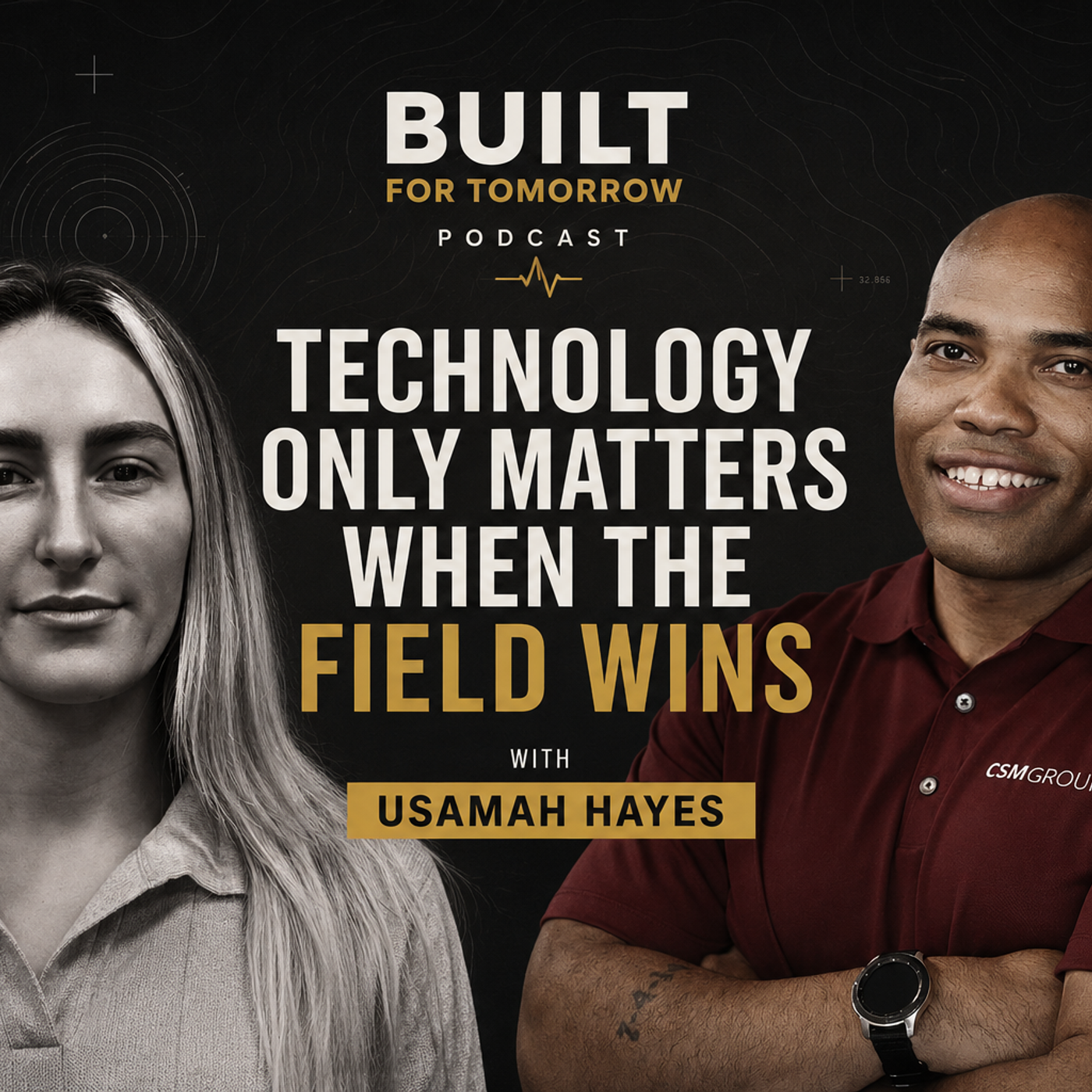
Speaker 1Today's guest has spent over 15 years making sure construction technology isn't something that just lives in the office, it actually helps the people building projects every day. From starting out in farming houses to becoming BIM Director of CSM Group, Usama has built his career around one simple belief, if technology doesn't make life easier for people in the field, then it isn't doing its job. Today, we're talking about practical BIM VDC leadership and why the future of construction starts with empowering the boot.
Speaker 2Welcome to another episode of Built for Tomorrow. Today's guest is Usama Hayes, BIM Director at CSM Group. Today, we'll be discussing all things technology with purpose and a career built from the field upwards. Before we get into things, you actually started your construction career in framing house. Before moving into design and BIM, how did that journey start?
Speaker 3Really, I guess, weirdly, I'd say I was delivering packages for Airborne Express and I didn't see really any advancement in that career. So I started going to school for architectural technology and I already had two kids, small kids. And so I wanted to essentially. figure out a better career. I wound up building fences for a summer. I really liked working with tools, you know, and building stuff with my hands. And that set me on a journey to framing houses. And then it was, it was kind of onward and outward from there.
Speaker 2Nice. How has working in the field shaped the way that you think about construction technology today?
Speaker 3Working in the field shaped everything for me. Really. I watched crews install trusses only to have them modified later because trades were not coordinated. So we wasted time, material, money, fixing problems that could have been avoided. Standing there, I remember thinking that there had to be a better way. And so that experience became the foundation of my passion. So my passion for BIM came from preventing rework, not creating models.
Speaker 2Yeah. And that was essential. And that's actually going to be my next question. Like, was there a moment where you realized BIM wasn't necessarily just about creating models and it could fundamentally improve how projects are delivered?
Speaker 3Yeah, actually, and this is going to sound foy or whatever, but it was like the moment that I touched a model, I knew, well, I should say a model with a purpose. So I went from site fabrication, building walls. And then from there, I went to prefab design and touch of the physical world. So I'd run into issues out in the field when I'd be framing houses. And then I'd run into issues in the prefab shop that would be coming down from design. But the moment I touched the design and I touched the 3D model and I moved a stud assembly and I was just like, you know, that kind of fixes everything. That was the moment.
Speaker 2That lightning bolt moment.
Speaker 3Yeah, it was just like, this is where, I think this is where I need to be.
Speaker 2Yeah, this is what I've been praying for this whole time. It's just falling on your lap. And looking back over the last 15 years, what has changed most in digital construction for you?
Speaker 3I think probably the most prominent change that I've seen, and again, you said 15 years, I'm an old dog, I was doing design and stuff like that even before that. And the differentiator or the difference between, say, a drafter, a designer, and then them has become really prominent now. I see the evolution because back when I started, it was just like, if you were a drafter, you'd have to be a really good drafter in order to be a designer. And then if you're really good at design, then you started looking at coordinating. What you were designing and then was kind of like, well, building, building information modeling really wasn't a thing. It was just more using a three to three dimensional model in order to, you know, create what you were creating. And there was no interworking in between the individuals who were creating one discipline or another discipline or one trade and another trade. And so the fact that that's actually became, it's become roles within the industry is like one of the biggest changes that I've seen.
Speaker 2And if you could give yourself sort of one piece of advice, if you was to come into construction today, sort of your younger self, what would that be?
Speaker 3Nothing. I wouldn't change my journey because every experience taught me something that's to me like right now in my career is very valuable. So I get to look back at those instances where, you know, I broke something or something broke me. Or someone broke me or, or I, you know, handled a relationship with somebody the wrong way. And it just, it's all lessons. But I would say, I guess the overarching trend that I see from my experience is to treat people the way that you would want to be treated.
Speaker 2Yeah, no, definitely. I agree. I think you have to make mistakes in any role. That's how you learn. Right. That's what shapes you from them experiences. It makes you who you are today as a leader within the industry. So no, I like that answer. You often say technology should work for people building the project. What do you mean by that?
Speaker 3Yeah, I mean, technology should remove obstacles, not create them. If, if crews are still hunting for information, then the technology failed in my opinion, you know, so I see us in the technology sector of construction as the preventative measures. So we improve planning and we help people with confidence. And that's the only way that the technology, you know, succeeds. So the purpose of technology is to remove the obstacles.
Speaker 2Yeah, no, for sure. And where do you think companies still get BIM wrong?
Speaker 3I think by treating BIM like it's a delivery. Deliverable rather than a process, you know, it's just like, we've been this, it's, it's coordinated because, you know, many times we'll have to come back to the table. Something will happen. A bulletin will come out down the line and we'll, you know, have to change something else, but something up, but it'll be like, what, but it's already coordinated. We don't, you know, want to do that. Like that's sort of the, the, the temperature, you know, in the room, but then when you bring like a really valuable thing, you know, based on the bulletin and the changes that are going to happen, it's just like, well, maybe we should all relook at this and figure out how to reduce the amount of RFIs that are going to come from this bulletin or at least better define the RFIs. So yeah, that's what I would say is just, you know, working it into all the processes, the safety, the, obviously the planning, but also the scheduling and everything like that.
Speaker 4And how do you measure whether BIM's been successful?
Speaker 3Well, I would say, you know, with fewer RFIs, projects don't struggle as much and over overarching is there's no disconnect between operations and, you know, the, the technical aspect and the modeling. It's all a cohesive connected thing. The field teams are involved.
Speaker 2And in your opinion. What's one simple thing every contractor essentially could do tomorrow that would immediately improve field adoption?
Speaker 3Simple. Yeah. Bring the foreman and superintendents into BIM earlier and, and stop building models for the field and start building models with the field.
Speaker 2Yeah. I feel like I hear that a lot in the industry, whereas if you actually get everyone involved in the beginning. And you've worked through them processes and workflows together, then it's less, less error down the line, right? Or changes down the line. Yeah. And you regularly speak about sort of helping foremans, superintendents, installers. What are the biggest frustrations they still face today?
Speaker 4The biggest frustration that I've noticed they face is uncertainty.
Speaker 3So field teams constantly ask what change, you know, who's in the way and what information they can trust like that, that right there is, you know, really heavy as far as what information you can trust because I guess the whole point of building information modeling and, and BIM coordination and VDC coordination is to express what the drawings have. And so I think that's a really important part of the process. And I think that's a really important part of the process. all of the kinks worked out in between how the materials and the systems need to interact with each other and so that's where kind of the distrust you know comes from is because a detail wasn't necessarily worked all the way out or didn't have a chance to work all the way out new materials have been introduced you know every project wants to have the newest material the best kind of building materials that you can have on a on a building the best looking best you know environment best performing and those are new advancements and so you often find that not only has you know the design partner not necessarily worked through all the kinks in between those building materials and how they interact with each other but you know the manufacturers haven't because they just haven't put the materials and systems together in that way
Speaker 2but and what would make i guess field teams trust it more like what things would you implement to to win that trust or or buy that trust
Speaker 3my theory how i interact with the field team is less actually no you know no dictating all questions you know and and from the questions that i asked them the answers that i get back leads to better questions for me to ask them and the more that communication happens they start to see that you know because you know i'm working i'm a construction manager you know and so i'm bringing the design partners trades all into the same room and you know because it's my meeting the coordination meeting is my meeting and i'm driving the process it's often mistaken that i want to run the show or make the decisions or or that sort of thing and and actually it's there it's actually none of that i just want to point people in the right direction for that information that they need in order to get their job done and so it's it's asking questions it's you know how would you do this uh would you install it that way those sorts of questions really really gets them going to a place where they you know understand that i'm there to support them not to tell them what to do
Speaker 2yeah no definitely it's more like an open forum right i think in environments like that it's asking the questions to almost let them uncover their own pain points and then being able to give that solution sort of in real time or on what that looks like or at least working together to get there oh yeah absolutely and how do you get experienced trade people to i guess embrace new technology
Speaker 4partner with them spend time on the job site understand you know the sequencing
Speaker 3and and support the operations that way it's you know coming from
Speaker 4being a framer you , you see somebody out there and they're they're you know
Speaker 3in charge of your in charge of your work in charge of a workflow but they're uh what's the the saying they don't have any mud on their boots yeah it's it's really hard you know it's just a mental barrier at that point to just you know think that you can engage with them if you're not actually Out there kind of seeing what they're going through and, you know, just understanding how they add value, understanding their pain points, understanding what they're going through. That's really the only way to kind of drive the adoption is because then you can build solutions based on their problems, not based on what you think their problems are. It's what their actual problems are. And you'll be so surprised once you do that.
Speaker 2Yeah, I think it earns a lot of respect as well when you're actually in the field, I call it in the trenches with everyone, actually seeing what their problems look like firsthand, as opposed to, I guess, assuming what they could be right and then trying to build a solution off of that. So I feel like that's where that trust element can come in because you're with them in the field, seeing that firsthand. Yeah. And you've presented about projects where Scam to BIM has saved millions of dollars. Can you tell us a little bit more about that?
Speaker 3Yeah. So I'll just kind of walk you through my first experience driving the process and how that came to be. So it was a while ago, I think I want to say. 2016, 2017, not to age me or anything.
Speaker 4But. I shaved today so that you can't see all the gray in my beard. Fresh face. But it.
Speaker 3What happened was we, you know, went through BIM coordination for this building. It was a high rise post-tension structure and we had precast panels coming in. Sorry, my light keeps flipping. But we had precast panels coming in and the precast panels have to be hung on embeds. For the post-tension structure. And essentially the first truckload showed up, the first crew showed up in order to install those precast panels and they couldn't hang one panel. So there was about $50,000 sitting there and a crew, which is, you know, another, I want to say it was probably another $10,000 worth of crew just who had to find something else to do for this project. And so we had a question. And so again, this is going to date me, but I was experimenting with some augmented reality software. It's not even around anymore. And I was just wondering, I knew that laser scanning and LIDAR worked, but this was a cheaper, right? Cheaper solution because you didn't have to. Get a laser scanner and all that. And so I went and it kept on, it kept on getting out of scale. Each time I would walk this, you know, down the site, I would walk column to column. That's how it was kind of gauging, you know, whether it was scaling correctly, the model within the augmented, the augmented reality that I was using. And it wasn't scaling correctly. So I was just like, okay, drop it. And then I grabbed a laser scanner and it wasn't that easy of a conversation, by the way. But grabbed a laser scanner, started laser scanning that floor and started going up and going up and then delivering that information to the trade contractor who was in charge of installing the embeds. So not the actual panels, but the embeds. And eventually we got to 100%, but it did take some time. But for each one of those, you know, I can literally count the dollars each time that the panel showed up and they couldn't be. And so I brought that, that's, that's like the most beaming example. That was my first example is what, you know, really taught me how, how that works. But there's, there's several other instances where I've saved, you know, millions of dollars just from, well, I wouldn't say just from laser scanning because when you, when you say it like that, it's just like, okay, the laser scan is going to create a model that's going to save everything. No, you have to do a little bit of work. And that's kind of the biggest thing is presenting it in a format that everybody understands. The design partner has to understand it. The trade partners have to understand it. The owner needs to understand exactly what's going on in order to deliver that. And what, you know, typically only reality capture specialists understand is point clouds, right? So you got to get it into a format, which is a. Plan elevation sections to kind of show, okay, yeah, that penetration is three inches off and this is repeating about a hundred times throughout this whole floor plate. So what can we do to, you know, rectify this before the trades come in and install their scope and, and put it in front of the trade and say, Hey, you know, plumber, can you work with where this penetration is at? Is this going to throw your system off and then work with the architect and say, Hey, you know. This is where the plumber can't, you know, work through what they need to have their systems installed exactly where that penetration is at. Can we, you know, move the wall, you know, can we get this pipe centered in the wall? And so going through, you know, I've worked on projects where, you know, again, we've. Had hundreds of those instances where, you know, if you just leave it be, you don't. Bring the reality into the model and do that comparison and then present it in a way that people can understand it. Then, you know. Get the good answers and you still wind up with questions on site. People still have to stop, you know, reinstall work, you know, cut new openings or, you know, reorder material and it just becomes, you know, again, millions of dollars worth loss instead of saving yourself millions of dollars yeah exactly that and where do you
Speaker 2think owners are still underestimating the value of reality capture i think they're underestimating
Speaker 3the value of knowing conditions with certainty it's an underestimation of how much how much uncertainty is really out there even even if you're building a new project you know the cost the cost of knowing is usually uh or the cost of not knowing is usually much higher
Speaker 2than the cost of capturing reality like surprises are costly yeah yeah detrimental on some projects right yes and what role does data play in construction like once the construction actually
Speaker 3begins data i mean it becomes valuable when it shortens the distance between a problem and a decision so and i often say data you know data is like meaningless unless you're actually turning it into information because then you know just the word information you're informing somebody about what's happening with the data giving them plain data hey here's a list of clashes it's like okay but if you can this is an example right if you can bring those clashes together you know and make it a concise issue and say hey you know we found this sort of clash in about 50 different spots and i think the right thing to do is to have this trade move their scope but you know what do you think you know we should do and you present it like that now it's you know grouped it's spread out and it's consolidated so the last thing that a person in the field wants or needs right is another decision to make off of very little information you know like i can't tell you how many times i hear the pain points of having to go hunt down this drawing and that drawing and that drawing and then check this
Speaker 4middle and then check the spec and it's it's a simple problem to solve right it's a simple question to ask but in order to get to the right question
Speaker 3you have to go through you know six different documents in order to even get to the right question if you can help the field team just here's the question that's that's the question that we need to ask you know does this rfi look good or you want to you know that's a much simpler ask for a field team to you know help you with an rfi versus hunt down all of these clashes all of these details on these and then you know do all that work because they got to move on to the next thing they have to
Speaker 2execute you know so and you've spent a lot of time i guess mentoring people throughout your career why has that always sort of been important or mattered to you
Speaker 3mentoring matters because nobody succeeds alone you know every opportunity in my career came because somebody invested in me and just knowing you know how that feels you know both ways right to not have someone invest in you and then to have someone invest in you it really made a difference to me and so i just i hope that by mentoring others that i'm i'm making that difference to them to show on them that i'm doing the right thing and i'm doing the right thing and i'm doing the right thing
Speaker 4you may not know everything that i know but you got value and you know you got drive so let's let's
Speaker 2get that yeah and i think with that is i think everyone looks back on their career right and there's always that one mentor that that can stand out that i guess not took a liking but they they was like i can see the potential i can see the passion if i can give you that knowledge and then move you along in your career like that's what it's all about right it's like passing forward knowledge yeah exactly and how do you separate a good bim coordinator from someone who can become a great leader per se
Speaker 3a good coordinator solves technical problems and a good leader helps other people solve problems and it you working in the industry a lot of times you're like oh i'm not going to do this i'm not going to do this i've been in the industry a long time one of the things that i've found and like what i'll say is like people often people often feel like what they do is who they are because so much of who they are is wrapped up in what they do so it's a reasonable thing it's a it's a human thing you know but it's it's not in order to be a leader you have to understand okay well what i do that's not who i am i can help somebody else do this thing that i used to do you know like run a vdc coordination meeting and just have them come to me with with questions about you know what i would do in particular situations and it's not to you know it's not for me to say exactly how they should do it i just need to give them you know how i felt in that experience when i experienced it so so that's what i would say it's just like helping the other other people solve problems and like not giving them a full recipe but just giving them like yeah you know for my cookies i used two cups of sugar and you know maybe that's a lot five five cups of flour or whatever and you know but your cookie doesn't have to taste the same way it doesn't have to be the exact ingredients you just need to make sure that you get cookies out of it you know so yeah that's all i'm saying
Speaker 2yeah no for sure i feel like with that as well as mentioned it's again leading people down the right path asking the questions and then getting them to sort of solve their own problems i feel like as a sole contributor as well sometimes you're very i guess unintentionally tunnel visioned in terms of your job your work but as a great leader it's thinking about that bigger picture everyone within the team and then getting everyone sort of working towards that same goal yeah that's that's the important part yeah yeah and how do you i guess develop confidence into younger vdc professionals maybe coming into a team or into the market i believe that confidence just from
Speaker 3my personal experience that confidence grows through supported experience and opportunities to work slightly outside of one's personal comfort zone so it's identifying you know and and you have to do it repeatedly right because for each growth each plateau that you come to you have to realize that you're at a plateau right like i'm not climbing anymore i've i've found flow i i do this thing really well now and the again the natural human response to something that comes easy is to continue doing the easy thing when in order to grow and be confident you have to you have to approach the hard thing you know and and so it's it's it's more of that kind of understanding what's going to be the harder thing and everybody's different right we have different personalities for some people just speaking from like a vdc coordination meeting standpoint for some people public speaking comes easy and and the social aspect of it comes easy and they're really able to bring people together just through their personality and for other people it's like the technical part comes easy and you know so it's just you know finding out where your flow is at and then trying to help your flow meet you know what's a little bit harder for you yeah and i feel like in
Speaker 2speaking with you and how you speak about for people in your teams or your experiences i feel like you definitely get this in your leadership approach but how important is like emotional intelligence when being a leader
Speaker 4yeah it's the most important intelligence i think that i think it's the most important intelligence that we we all need you need to know how to communicate with people you know so
Speaker 3in technology adoption you know coming from being way you know over here out there with technology adoption and coming into a conversation with somebody who has you know very little knowledge of the type of technology that they need to adopt or have already you know started to adopt but haven't found success in it and then you know it really takes working with the person and figuring out what they're again what they're good at what they're what their flow is what their flow state is and then like trying to figure out how to bring those two things together like you know so it and you have to be in tune with you know what what makes them tick like what what excites them what yeah yeah the spider-man movie just came out and i was i was talking to one of my trade partners and he was really excited you know about spider-man going to see it i went to see it i'm a still need to see it yeah i'm a nerd yeah self-proclaimed nerd you know read the comic books have to watch the movies but you know so during our conversation even though we're talking about the inner workings of some of the authoring software that we have to work with in the industry you know we we started to relate on a higher level based on spider-man of all things right in our emotional you know responses to spider-man and so it drove a better conversation had nothing to do with the technology right
Speaker 2yeah cool i feel like that's that's the best one isn't it because then that's when you start to actually build relationships and people are buying into you and so forth we in my last company we've done it we used to do these tests basically do you know like a psychometric test i don't know if you've ever done one but essentially there's really random questions you'll answer the really random questions but they're so interesting because red so so at the end of it you'll get a result of yellow red green and blue and if a lot of your answers were red it means that you were someone who you know you're not going to be able to answer them and you're not going to be able to answer them and you're not going to be able to answer them and you're not going to answer them you could just throw into a task right if you tell them what this needs doing they don't know anything about it they you can throw them into that and they'll they'll sink or swim right whereas say a blue their mind was trained to be super process driven so if you was to give them a task you couldn't take that approach of them you'd have to really sit them down and be like this is the task and this is step by step and then that's how they best work and it never made me think about i guess collaboration in work on a wider scale i'm a super red person right so i don't need to know don't need to know the processes don't need to know the steps but i'll get it done but then on my team i used to work with a lot of blues and their results were blues so if i come to them with something it was very much with the approach of just get it done whereas their mind don't work like that i need to sit them down sit down the processes then when i started to learn okay the characteristics of everyone how their mind works how it ticks and how they take that information in i could then approach it in a way of right you're a blue this is how we go about it your results are more red this is how i could go about it and it was really interesting because i'd never
Speaker 4thought from that perspective before yeah we we uh i've interacted with those tests and or
Speaker 3assessments as they were i don't know if it's a test because it's not all right it's just like so yeah i love that it's super interesting and like to see it play out and be able to understand people in a deeper way yeah yeah that's what life's about right yeah i mean that's all the tech is right like it's just like better communication you know all of this building information modeling it's it's actually just to help people communicate better exactly you see a 3d model this this and that and now you have a better communication tool than just a two-dimensional plan
Speaker 2you know so yeah no definitely and you've invested time learning ai sort of the key buzzword in the industry right now vr and so forth what have you
Speaker 4or how do you see these fitting into the construction industry
Speaker 3with a small note to say small note ai should amplify people not replace them and that's how i see it fitting into the industry
Speaker 4you know it's you know it's it's education and so if you utilize it correctly right you have to have
Speaker 3the the preface or the base knowledge of the thing that you're working with or the thing that you're working on or at least know what that thing is going to be used for right so you can't come into it just you know fresh or blank or whatever you have to have some context and that's that's what the people are for right to build your context to build your experience but then with that experience you can then have something run through all of the information that you need and get you to the data that it takes to make that informed decision much faster and that's that's what i see the power of ai to be in our industry is to instead of spending you know the earlier the scenario where you gotta go hunt down these six different parts of the construction documents in order to get to an answer artificial intelligence can hunt that down as long as it has access to your data and it's looking at it from the right you know the model is built so that it understands what that data is what it should be looking for so looking at it from a construction management aspect or from a construction aspect and as long as it has that then it's going to approach it the right way it's going to essentially filter through all of that data and deliver you some information that's going to be really useful so instead of spending hours hunting down all of these documents just to come up with a question that is going to take you you know 10 to 15 minutes to write you know you just take the 30 minutes and then you you write that rfi or you write that you know change or whatever and and now you know you get an answer faster so i think it's going to be a lot of fun and i think it's going to be a lot of fun and i think it's going to be a lot of fun and i think it's going to be a lot of fun and i think it's going to be a lot of fun and i think it's going to be a lot of fun and i think that's where ai is going to play the most prominent and powerful role in the construction industry and it's just going to get better you know because right now it's more i guess the i was if i had to condense it down to one thing chats are playing more of a role in in the construction industry so being able to go out and chat with an agent in order to you know have it find things and and bring you that data in an informed way but in the future as computer vision becomes better you know being able to take a picture and you know put it in there and have it identify things from a construction standpoint right have it identify maybe a picture that you take on site or even a you know walk through a video and then being able to have that do some of the the figuring out okay i'm i'm looking at a stud wall and i'm looking at a conflict with where you know the plumbing is coming up within the stud wall it's let's go find this information from our construction documents and in the model and everything like that just based on that image and then it's just starts generating those that's that's where i see it going and yeah and i'm here for it all so it's gonna be really cool
Speaker 2so and do you think we're entering another technology shift similar to when i guess bin first arrived
Speaker 4absolutely yes because now you know the with every introduction to a new technology like building information modeling the thing that was kind of underplayed i would say and even cat to some extent but the thing that was underplayed was like
Speaker 3the cognitive load that it takes in order to compare drawings to a model you know find all the drawings you know find all of this information you know it takes cognitive load and what i see the shift becoming is you know with ai and and are in augmented reality and things like that i see that reducing the cognitive load which frees the human mind up to produce better questions which then become better answers which then becomes faster construction
Speaker 2yeah no for sure and what technology do you think people are still overlooking in the industry
Speaker 4honestly the true you know i i would say like bim like the true power of it like there's so many
Speaker 3avenues that you can take in order to get predictive analytics from building information modeling and right now i mean even in my conversation just because the industry is still there i speak more toward coordination but that's just the absolute lowest hanging fruit and the higher the you know the fruit is not to get completely physical world speak the higher the fruit is the more sun it gets the riper the blah blah blah right so the closer to the top that you you get the the better and more
Speaker 4the more important the information is going to be because just improving something that's closer to the beginning of a process is going to have compounding benefits the further you get from
Speaker 3the beginning of the process you know so it just compounds so if you can start to discover things early you know scope issues with within the building information model or with you know just and start presenting those earlier on in the conversation start presenting that to the team and all of those inferences that you can get from takeoffs from you know 4d planning from from all those things and the further up you can get that the better the outcome is going to be for the
Speaker 4project so i would say that's that's overlooked and then like secondly it's probably like laser
Speaker 2scanning on a regular basis yeah no i hear that a lot and having conversations with people they think like over time or not so into the near distance future reality capture will just be workflow within the industry and that'll start being integrated more and more in your opinion what should construction leaders be learning over the next few years and i guess the way the
Speaker 4industry is going that's a what should just to kind of wrap it back to you know emotional intelligence we spoke about it construction leaders should be learning it it's we have all of this tech and we're building these extraordinary buildings and we're doing it faster and you know timelines aren't going to shrink
Speaker 3and from the outside looking in the construction industry probably looks like a material handling you know scheduling a budget and and uh you know safety sort of industry like those are the highest impact things within the industry but that's just from the outside looking in at the end of the day it takes people to interact with all of those processes and the people have to communicate
Speaker 4with the other people so the better or the more not necessarily even efficient but the better
Speaker 3you can communicate with other human beings the better the outcomes are going to be and you can you
Speaker 4can only do that by developing you know empathy and you know treating people like you want to be
Speaker 3treated like like i said earlier like that's the only way we just have to become better communicators with each other and you know so yes technology ai for sure you know understand ai understand them understand reality capture understand how all those things come together but if you know and i've these are things that i've struggled with in my past it's like
Speaker 4if i can't convey the value of that to the person in the field i might as well not i might as well not be able to convey the value of that to the person in the field
Speaker 3i might as well have not done it because they're not going to use it so you have to communicate with the person you have to be able to get that common ground so
Speaker 4emotional intelligence by far that's that's the one yeah no for sure like you said that i think
Speaker 2you can have all the knowledge right but if you can't convey that or turn that into a conversation or be able to interact with someone i guess from a professional standpoint but on a human standpoint as well right it's like it's
Speaker 4so pointless really when you think about it
Speaker 3yeah and that needs like that needs to be the root of it too like for me that's the root of it i understood the problems and then i got the technology and then i was just like okay i understand how this technology can solve these problems you know like but it came from a really human standpoint like i don't want to deal with these problems i don't want to have to rip my walls apart you know like this is this sucks i just built that it was perfect now it's not you know so
Speaker 2and what excites you about i guess the next generation entering construction today
Speaker 4what excites me about the next generation is
Speaker 3how they're going to be able to bring new perspectives to oh like construction no one will argue with this right we have like the oldest processes we have the oldest like buildings have been built like they've been built for years like yeah the industrial revolution like not a lot has changed since the industrial revolution as far as putting
Speaker 4buildings together go so it's just but with every generation with every you know
Speaker 3different person entering the construction industry there's that different perspective and there's going to be that there's going to be there's always going to be that question like you know as soon as they run into something that they think sucks but like i think is like the best thing since buttered bread you know and they're going to be like but can we do this better and they're going to have this idea and i'm and it's gonna for me and this has already happened to me that's why i'm like explaining it this way it's just like yeah why don't we do it that way like you know and it's just gonna so that's why i'm like i'm like i'm like i'm like i'm like that's what i'm really excited about with this new generation and and
Speaker 4how they you know they they really for them like technology is not even necessarily in it
Speaker 3they don't have to adapt to it because they already right like and again this can be stepped back so the technology of our day my day you know not to lump you in with this but like vcrs probably won't even know what that is but vcrs and you know the tube televisions and the that that sort of technology and then computers coming into like when i was young computers were like still having a personal computer was still like pretty new to people like being able to go to school and be on a computer and so i just see like so it was something that we had to you know adapt to but it was younger in our lives or whatever so for this generation with the smartphone i'm not going to be able to do that and you know even social media how social media works like uh i don't know snapchat or what's the other one the i'm not on social instagram there's quite a few yeah and the way that that just the way that that technology works like you you have to go through a video fast you have to understand what you know what's going on in the video fast it's just a short video or whatever but you and like i just see that that is gonna influence the industry in a very i think a very positive way because it's just going to be they're going to be used to the newer generation is going to be used to taking these short videos and making something out of it so like a training video just think about a training video on a construction site being like okay yeah yeah okay so then i got it and it's just like a you know 30 second thing versus a document that you know and it's just going to have the highlights of what you should know about the process sure you can dig into the process a little bit more once you've got it but it'll give you the you know it'll drive the interest to the long form is how i see it so that's what i see the power of this this new generation coming in it's just
Speaker 2there yeah it made me laugh when you're talking i think about when i was like really young i remember even like a cd player for example i'd have this big round like boothy thing that used to open up and then you'd put your cd in with like two tracks on and like when we bought our first computer like that big box on the back and then you'd put your cd back like you was absolutely buzzing about and yeah it's just crazy how it has evolved i've got like younger left views and things like that and you give them an iphone and they just work it out super quickly whereas back in the day it would almost be alien and i think one point that you mentioned there growing up if you're looking at all these short videos as you mentioned you're taking in information rapidly being able to process that rapidly from a young age and then implementing it whereas before if i had a question or if i was looking up something you have to get it from a book or do this or do now you go to chat gbt or google and so you're processing information slowly to a degree whereas there you're processing so much information so moving into a world of technology it's almost like second nature at that stage with the newer generations coming in and how they've post processed information growing up yeah it's super super interesting to me like because there's a
Speaker 3lot of you know studies about how it's you know negatively affecting the brain or whatever going through such vast amounts of content so fast and it's just like yeah but we're our brains adapt and it's just like if that's what they're you know it's i'm sure i wasn't there but i'm sure that the same argument was made when it went from scrolls to books books it's just like but how can you you know how are you supposed to even you can turn through the pages so fast the brain's not gonna and now look at us with just a book is you know
Speaker 2it is true though because i was reading a book before about all the different chemicals in the brain from the natural standpoint and say doom scrolling for example you just sit there and you scroll through a feed whether that's linkedin tiktok instagram that does actually release the chemical dopamine in you so you get it at such a high hit where you're constantly scrolling so if you're doing that for 20 minutes to an hour when you come off that your brain does have a crash so if you're doing that throughout the day and that's just one form of sort of what chemical it's releasing and so forth i'm sure there's loads of interesting articles or research into it but i've not gone that far but there's definitely a definitely a connection there
Speaker 4oh yeah yeah no i won't i won't say that it's not as different but it's so new like
Speaker 3we don't know how this generation is going to improve the way that they interact with that sort of technology really like we we because we you know computers they're so they're different now right like could you imagine that you would have a handheld computer when you were talking about that big yeah you know i would not be carrying that around yeah i said you think i
Speaker 2could carry that around
Speaker 3but now you got this miniature thing that does it's way faster it stores way more information it's we adapted we adapted to it and we made it work and so just hang in with this new generation
Speaker 2they'll do they'll move mountains with it yeah 100 i'm excited about it i think as you mentioned there it's it's just the natural evolution right and then it's just getting up to speed with it and then it just becomes integrated and then everyday life and then as you know it it's it's already integrated in a flash before you even notice if say every contractor adopted one new digital process tomorrow what would you choose what would i choose
Speaker 4i would choose if every contractor adopted it would be the the same it would be something that brought them all together it'd be the same information in the same place like
Speaker 3because that's the only that's really the only barrier is as far as technology is concerned from a strictly technical standpoint is getting from point a to point b and and not not having access
Speaker 4to it or not you know and and what i hear from a lot of the you know people that i work with
Speaker 3it's like they go from one place to another and they go from one place to another and they go from one project and they're working on one platform they go to the next project they have to work on another platform they have to learn but there's there's no time for them to learn so it's just like you know that would be my that would be my wish or or for the different platforms to just make their processes so similar and i understand what i'm saying by the way the competition the i already understand what i'm saying but if if that was if that could be a thing which i think it can be but that would be the the thing that i would have everybody adopt is just a way to have that single source of all of the project information nice nice and in your opinion
Speaker 2what does a truly connected job site look like it's really it boils down to like
Speaker 4how the people interact with each other so there's no there's no you versus me it's us versus the schedule it's it's us versus you know whatever problem is being presented because that's that's kind of how
Speaker 3it that's kind of how the job sites fall apart or become disconnected one person might make a mistake something gets exposed and and i mean that from like the design partners all the way you know the owner you know if it becomes this understanding that like we're all in this together we all want this building to open on this date and then if we work it out from there like that's a truly connected you could throw whatever technology inside of that
Speaker 4equation but once once it's there
Speaker 3the people you'll see just like we're talking about people adapt people will be able to adapt to whatever technology is in there as long as they understand that they're together and they they'll find a way to kind of make it work and they'll find a way to kind of make it work for them and they'll find a way to kind of make it work for them and they'll find a way to kind of make it work for them and they'll find a way to kind of make it work for them and make it work together so that's what a and they'll find a way to kind of make it work together so that's what a truly connected site looks truly connected site looks like for me is that it's just one that everybody works together and like for me is that it's just one that everybody works together and have that understanding that have that understanding that they're just one team not you know plumber versus electrician or they're just one team not you know plumber versus electrician or you know that sort of thing yeah no
Speaker 2you know that sort of thing yeah no definitely and a quick fire round from our side you've got
Speaker 4definitely and a quick fire round from our side you've got to choose one bim versus digital twin digital twin office or job site job site AI or automation automation biggest productivity killer biggest productivity killer information gaps favorite construction technology favorite tech reality capture by far yeah I thought you could say that one leadership habit you'll never skip skip getting to know getting to know the person the person emotional intelligence best career emotional intelligence best career advice you've ever received
Speaker 3so it probably doesn't convey or translate so it probably doesn't convey or translate like it does for me but Thomas like it does for me but Thomas Obermeyer rest in peace he was my Obermeyer rest in peace he was my actually he was my instructor in college
Speaker 4actually he was my instructor in college and he said draw what you know and figure out what you and he said draw what you know and figure out what you don't
Speaker 3and it was he had all these quirky sayings but that was the one that stood out to me and as I go through time I understand what he meant more and more like if you just it's it's like reality capture you just captured what you know and then figure out what you don't know but really study what you what you can know and if you study what you can know enough the details they come
Speaker 2together you know so yeah nice the rest will follow suit yeah and in terms of say the prediction what's one construction technology trend you believe will become mainstream that people are
Speaker 4currently underestimating I'm gonna go with reality capture like I don't think it's mainstream yet but
Speaker 3I think that that's the one you know robotic dogs and whatnot it's just there's too many applications of and more specifically like point cloud technology to get accurate measurements
Speaker 2yeah I I hear that a lot as mentioned I do think that's really going to come on in the next couple of years and what's the biggest challenge construction technology leaders will face
Speaker 3over the next five years cognitive load I think knowing knowing what's right to adopt and what's not because I get a barrage of emails phone calls all sorts of things that you know it's it seems like there's a new offering every day somebody's offering something new and then but you dig into it and it's just like well it does the thing that this other thing does and so I think that that's going to be the the challenge is being able to sniff out what's truly going to improve your processes and what's just you know sales essentially yeah it's trying not to go after the
Speaker 2next shiny big thing right yeah and what advice would you give to someone wanting to become a
Speaker 4future leader in this space I would say start from the heart and let your brain follow nice I like that yeah and finally what does building tomorrow mean to you building tomorrow means embracing technology embracing the technology of the future but with all the lessons that you've learned from
Speaker 2the past nice nice way to end on thank you so much for coming on and letting us pick your brain it's
Speaker 4been a absolute pleasure thanks for having me Hayley anytime appreciate your time likewise
 PodcastTranscript AI