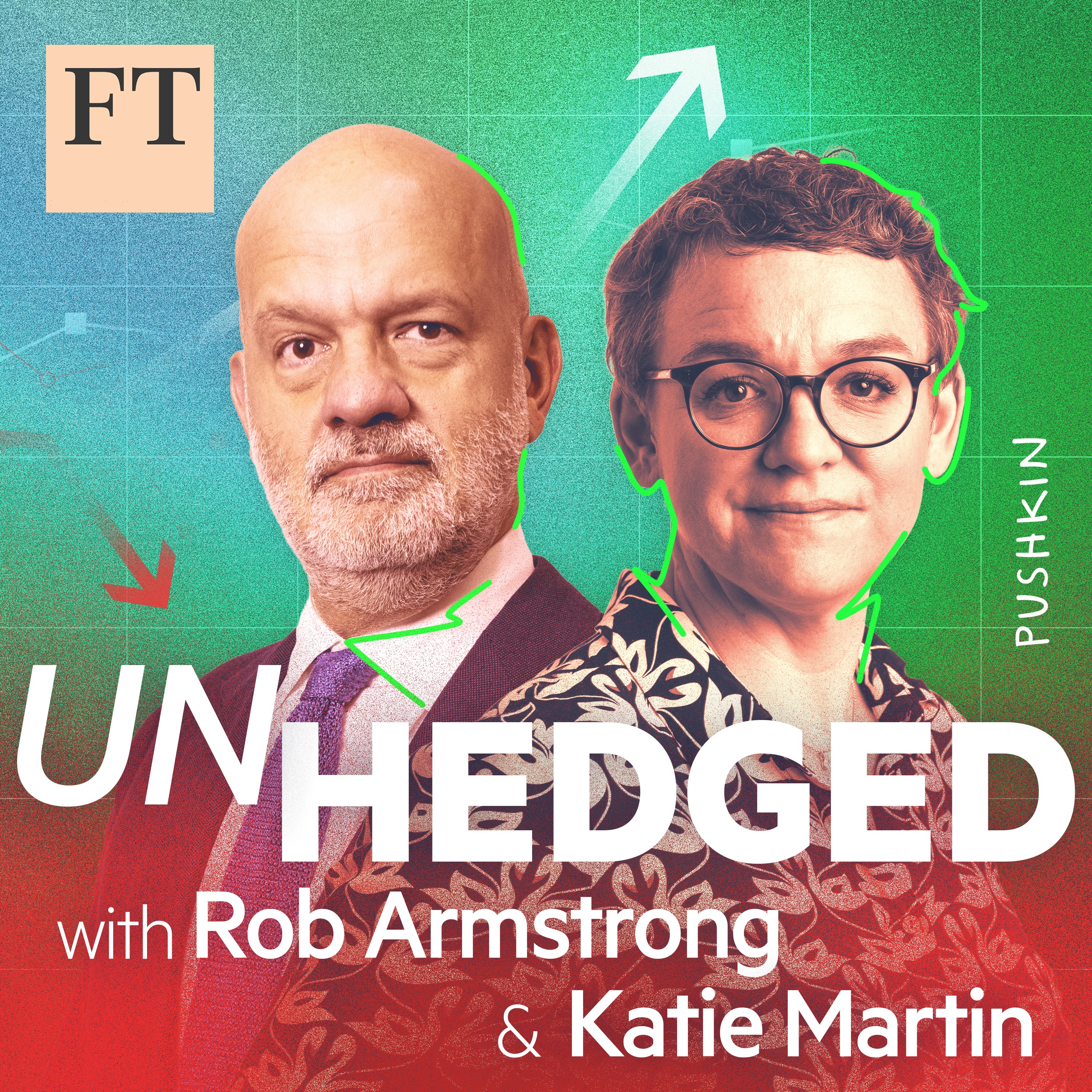
This episode of Unhedge discusses recent turbulence in tech markets, questioning whether it is a random wobble or a sign of an overextended AI trade. The hosts, Katie Martin and Rob Armstrong, note that Korea's tech-heavy stock market dropped 10% in one day, while the NASDAQ fell about 2%, though AI chipmaker Micron later boosted sentiment. They analyze SpaceX's IPO, which listed at $135, spiked to over $220, then fell back to $150, highlighting typical IPO volatility and the difficulty of pricing new stocks in a hyped environment. The conversation shifts to a broader market shift: leadership has moved from the "Magnificent Seven" (Apple, Amazon, Alphabet, etc.) to semiconductor and data center stocks, driven by the AI infrastructure boom. However, this concentration raises risks, including high retail leverage in Korea, massive capital expenditures by tech firms, and the potential for rising interest rates to pop the bubble. The hosts note that lower oil prices and bond yields have helped, but a hawkish Federal Reserve stance could threaten tech valuations. They conclude by debating whether Bitcoin or gold will perform worse next month, with Martin shorting Bitcoin and Armstrong taking the opposite side. The episode emphasizes the fragility of current market dynamics, especially if inflation reignites or interest rates rise further.
[Music] Pushkin! Big tech has been having a bit of a wobble. On one day this week, Korea's tech heavy stock market dropped 10%. In the US, it was a similar, if less dramatic story, with the Super Techie NASDAQ down 2% or so, and SpaceX, the newly listed thing from Elon Musk, struggling to cling onto its early gains. Some spectacular results from micron, another AI Biggie, seems to have got the good vibes going again, but it's been a very up and down kind of week. Today on this show, is this a random wobble or a sign that the AI trade has got a little over-caffeinated? This is Unhedge to the markets and finance pockets from the financial times, and Pushkin. I'm Katie Martin, a market's columnist in FT in London, where the current temperature is 1000 degrees Celsius. Skeletons are dotted around the streets, the city is deserted, and everyone is grumpy because it's just too hot. Joining me down the line from his bunker in New York City is that guy, Rob Armstrong. Rob I gather, it's cooler there. It's very nice, and I just want to note for the record that our editor, Brian, beg you on the phone. Beg you on his knees not to talk about the weather in today's show, and you would not be stopped. Brian does not understand how hot it is, though, man. Like everything is bad and wrong. The English do not manage the heat well. It hits different over here. It's different. It was nice to see you the other day in your hometown. Yeah, it was good, the weekend festival. Yeah, it was a great event. And there were some Unhedge podcast super fans there, so I know it's always nice to see people in real life. I know we have to remember that our listeners are real humans in real life. So it has been a weird week on the text box front. Where should we start? I think we should start with SpaceX. Yes. So it was born onto public markets just a few days ago with a valuation of ridiculous money, $1.75 trillion. And then immediately the share price sprang higher, didn't it? Yeah. And this is something that IPOs, initial public offerings, are supposed to do. Indeed, the people who design them build this in as a feature. So what is an IPO? A company has a bunch of shares to sell for the first time. It's basically offering ownership in its enterprise to the public. And it goes to a bunch of bankers. And they say to the bankers, please get as much money for each share of my company as possible. But I need certainty. In other words, I can't have my IPO fail. Right? And so they say, you know, the market will probably tolerate $100 stock price at the outside. We've got some demand lined up for you. But let's offer it at 90 or 85. So everybody has a nice warm feeling. Everybody who we've sold this stock to as the initial buyers has the nice warm feeling of initial pop. And there is a general aura of money making goodness around our equities. But the pop generally eats itself, doesn't it? It doesn't generally stick around. So this stock listed at, I think it was $135. And then it opened at $150. And then it sprang up to 220 something. And now it's basically come back down to $150 again. And that's on the radio. And that's pretty, that's not unusual. Right? We don't have good price discovery about a brand new stock. Right? The stock market is a big, very diverse group of people trying to figure out collectively what something is worth. And everybody is kind of feeling everybody out. Everybody else out when a stock is new. So it's normal that a new stock should be volatile. This stock came to life at a moment of such incredible hype that it makes sense that the figuring out what the thing is really worth process should be even harder and more complicated. Yeah, like the academic work on IPOs, on those moments when companies list for the first time, is the pops are pretty normal and they can often be in the range of about 18%, which is what we saw in the case of SpaceX. And they don't normally, they don't always last. The other conclusion from all the kind of data if you go back decades and decades is that IPOs kind of suck as investments in the first few years. Like there's a lot of dispersion here. So it's a bit difficult to draw sort of general conclusions. But newly listed companies just don't always do that well in their first one, two, three years even. They can trail behind the rest of the market. So it's easy to sort of point fingers and say, you know, "Lol isn't it funny that Elon Musk isn't a trillionaire anymore." And don't get me wrong, very happy to do that. But I don't think we can read that much into the fact that the share prices come down after the pop. No, and it makes sense that IPOs should not be particularly good stock. In their first six months or a year or whatever. Because of the point in the life cycle that IPOs tend to be at. These are kind of nascent companies still building their business, still in the investment phase of their business rather than the, they're sowing rather than reaping. I guess is what I'm saying. And companies in that phase are riskier. So there's a kind of lottery ticket aspect of an IPO where maybe you get a big winner. A really big winner. But you really might not. And on average, you don't probably get a very good, you probably don't get a very good product. No, I mean, the counterpoint to that is like these big monsters like SpaceX. They wait a long time before they list on public markets now. Good point. So they are more mature. But the point still stands that there's a reason why quite a lot of professional fund managers just do not touch IPOs. They're like, I am very happy to sit back and wait for this thing to just kind of mature for a couple of years before I decide whether to get involved or not. If you happen to be the lucky person that gets into an IPO early and then it rockets and you know, you're one of the first investors in Amazon or Apple or something, then congrats. But your chances of getting that right are pretty slim. But the, I guess the thing about the SpaceX pop and then unpop was that it came at the same time as some quite warbly markets. So like I mentioned at the top, the NASDAQ had a really bad day. It was down about 2%. Korean stocks got absolutely taken to the woodshed. And for like a day or so, there was this kind of thing where everyone was looking around going, "Oh, is the AI trade in some sort of trouble here? Like what's going on? Like what do you think was going on?" Well, when you talk about Korea, you are in effect talking about microchips. You're talking about silicon. For all intents and purposes, that is what you are speculating on when you are speculating in the Korean market. So I think what you have seen is that trade, the semiconductor trade, which has been by far the biggest trade in the market for some months now. You know, it's the data center silicon trade has kind of been everything in the markets. And I think we arrived at a moment in the last week or two where people look at how far these stocks have run and the prices they are selling at and think, "Whoa, you know, now I'm kind of vulnerable." Well, yeah, I gather, you know, particularly in Korea, there's a lot of kind of retail investors who have come quite late to this rally and have jumped in and have borrowed money to get involved in this rally. So that just means that these things get quite fragile and quite subject to some quite scary, you know, down drafts, I guess. Yeah, I was looking the other day at leveraged ETFs, which are exchange traded funds that promise you a multiple of the return on a given market. So it's like the power shares NASDAQ 102X ETF and these things use options to deliver that. If it goes down, it goes down twice as much. If it goes up, it goes up twice as much. And one now, one of the largest and definitely the fastest growing of these things is a leveraged ETF on the Korean market. Oh, really? And there is a very fast growing semiconductor leveraged one, et cetera, et cetera. So these are things that are happening. There is leverage in this market. But I also think there is a wider thing going on here that is probably worth discussing. Sometime in May, the leadership that we counted on from the magnificent seven stocks really evaporated. Yeah, so a month or so ago, up until a month or so ago, the bull market could be kind of identified with Apple, Alphabet, Google, Amazon, Meta, Tesla. Did I get them all there? Is there something? I don't know, I'm not sure, but I'll call them both. Those seven stocks and those seven stocks had led the market and in a way have led the market for five years. Something like that. But
That has stopped. Those stocks are actually not doing well. And the market instead is being led by these semiconductor guys. And that is a shift in leadership that happened, you know, a month, two months ago. And, you know, since I looked up, what's, what are the best performing stocks since middle of May, the 14th of May? And you just read down the S&P 500 leading stocks, micron, applied materials, Dell, you know, and it just goes on. And like, you know, 13 of the top 15 stocks are microchip stocks or more broadly data center stocks. - So the Mag 7 is dead, and we have not come up with a suitable little nickname for this new semi-s thing yet. - And you know what are down, double digits? Here's some stocks that are down double digits, since May, Amazon, Alphabet. Interestingly, Nvidia, which is a chip company, came off. So that's the exception to the rule. But let me just make, I know I'm rattling on here, but let me just make one final point. This change in leadership makes total sense to me, because we know that the data center boom is gonna be darn good for the chip companies. What it means for Alphabet, Amazon, Microsoft, the, you know, the big Mag 7s, we don't know what it's gonna mean for their businesses yet. But also, I think there is a degree to which investors are a little bit nervous. They look at the decline of free cash flow among these companies, and just the sheer amount of money that they're spending. And a lot of this is money that they're now borrowing from the bond market. And it's, there is just a bit of a sense of, look, this CapEx boom, this boom in spending by big companies is fun and everything, but has it gone just a little bit too far? And I think the other kind of key ingredient in all that is that, we spoke about this the other day, we had a Federal Reserve meeting the other day. So the US Central Bank got together and decided on interest rates and kept them steady, but did offer a hint that they are serious about pulling inflation down, which means all things equal that you get higher interest rates. Now, again, you and I were talking to Racheer Sharma about this on the last pod that we did in New York. Like, that is the thing that pops bubbles, is much more expensive money and rising interest rates. And so there is just a sense that, okay, tech companies are kind of running too fast and they are spending money too fast. And there's a lot of leverage money and retail money in this and it all feels a bit overexcitable. If that were to combine, still an if, but with a big rise in interest rates, that's where this can go belly up. - That is, that is no question about it. The easiest to imagine nightmare scenario right now. We did have the Personal Consumptions Expenditures inflation report this morning. It's very hot if you include energy up above 4%. And it's still above three if you strip energy out. So, I mean, I don't, the way I see inflation is that we're fortunate it's not getting worse. But it is just plain old above target, right? And I think we can kind of live. I don't think inflation at this level, even if the Fed has to do a little bit to fight it pops a bubble. But if we get another shock or another leg up, who that's scary? I don't think that's, I just wanna emphasize. I don't think that's especially likely. I don't even, I don't even know why that would happen. Why inflation would get worse from here? But that's the scariest scenario. There's no question in my mind. Well, let me tell you, the saving grace here is, the market has decided that the war in Iran is just over. It's just, we are finished. Yeah. Like that whole thing is just done. You know, so as we said in the newsletter this morning, they think it's oil over. Woo. I know. Father is telling me it's just here today and you've just made a dad joke. Well done, Katie. So the oil prices come right down. Yeah. So there's, you know, there's still a lot of haggling and arguing to be done between the US and Iran over the terms of this supposed deal to end the conflict. But whatever, market has just moved on. The oil price is closer to $70 now than anything else. That whole spike that we had up to 120 is like ancient history and the good thing about that in terms of what it means for stocks in general and tech stocks in particular is this is pulled down bond yields. Yes. Ported bond prices and pulled down the yields on government bonds from the US, UK, you know, everywhere really. That helps. And that helps because when yields are really high, then investors think, hmm, do I want to bother buying SpaceX or should I just take like five percent on this US government security that's not going to default? You know, maybe this would be the easier thing to do. So it helps that yields have been tracking lower over the past few days. I have two comments to make. Comment number one is that the lower yields at the long end of the rate curve, longer term bonds being down. I think Kevin Worsh is hawkish performance actually helps there. Like he gets up there. He's the new Fed chair, right? He's the new guy. Yeah, the new Fed chair, the new guy. And he came in at this meeting and he pounded his chest a little bit and said, you know, we're going to get price stability no matter what. And that, I mean, that might bring short term interest rates up a little bit because people think the Fed is more likely to tighten than to stand still where it is. But on the long term bond, if you think you have a credible Fed who's really seriously not fighting inflation, that can bring the long end down a little bit. So, and if he does that, that's of course exactly what Kevin Worsh wants is to scare the long end of the rate curve down. I'm not sure that's the real Kevin Worsh. We're going to find out he's had one meeting. He's done one performance. There are several other performances to come this year. You know, when the real Kevin Worsh stands up, we'll know something. So what we're saying here, Rob, basically, is that an aggressive rise in interest rates are for text docs, the Worsh case scenario. Is that what we're saying? It's certainly not. I feel like we've exceeded our quota of dad jokes we've caught yesterday. So we are going to be back in just one second with Long Short. Oh, Kido, it is time for Long Short, that part of the show where we go long, a thing we love, or short a thing we hate. Rob, what you saying? So, Katie, I have a challenge for you. You will have noticed that the two assets which we like the least and are most often wrong about. Bitcoin and gold have both been falling together for the last month or so. They've both had quite bad months. And the challenge is, in the next month, which of those two assets is going to do worse? It's a slam dunk for me. It's Bitcoin. I mean, based on nothing but a hunch, I think that, yes, I don't like Bitcoin very much. And I think it's going to do worse. Okay. I will take the other side. Not because I like Bitcoin, but because I think the shadowy cabal of frauds, villains, and weirdos who support this asset are going to do what they can to stop this run downwards. So you've got gold. I've got Bitcoin. See you in a month. Okay. Rob is a Bitcoin grown-up. Boys and girls, you heard it here first. He's going to put laser eyes and his little avatars. This exciting time is for the Unhedge podcast. Let us know what you think, which is the worst asset gold or Bitcoin, Unhedge.ft.com. In the meantime, we'll be back in your ears on Tuesday. So listen up then. Unhedge is produced by Jake Harper and edited by Brian Erstert. Our executive producer is Jake Goldstein. We had additional help from Top 4 Fores. Special thanks to Laura Clark, Greta Cohn, and Natalie Sadler. Ft Premium subscribers can get the Unhedge newsletter for free and a 30-day free trial is available to everyone else. Just go to ft.com/unhedge.offer. I'm Katie Martin. Thanks for listening.
Podcast Summary
Key Points:
Tech stocks experienced significant volatility this week, with Korea's tech-heavy market dropping 10% and the NASDAQ falling about 2%, though some AI-related stocks like Micron later rebounded.
SpaceX's IPO saw an initial pop from $135 to over $220 before settling back to $150, illustrating typical IPO volatility and the challenge of price discovery in hyped markets.
Market leadership has shifted from the "Magnificent Seven" (Apple, Alphabet, Amazon, etc.) to semiconductor and data center stocks, reflecting investor focus on AI infrastructure spending.
Concerns include high leverage among retail investors (especially in Korea), rising capital expenditures by big tech companies, and the potential impact of higher interest rates from a hawkish Federal Reserve.
Lower oil prices and bond yields have provided some support, but the risk of further inflation shocks or interest rate hikes remains a key worry for tech valuations.
Summary:
This episode of Unhedge discusses recent turbulence in tech markets, questioning whether it is a random wobble or a sign of an overextended AI trade. The hosts, Katie Martin and Rob Armstrong, note that Korea's tech-heavy stock market dropped 10% in one day, while the NASDAQ fell about 2%, though AI chipmaker Micron later boosted sentiment. They analyze SpaceX's IPO, which listed at $135, spiked to over $220, then fell back to $150, highlighting typical IPO volatility and the difficulty of pricing new stocks in a hyped environment.
) to semiconductor and data center stocks, driven by the AI infrastructure boom. However, this concentration raises risks, including high retail leverage in Korea, massive capital expenditures by tech firms, and the potential for rising interest rates to pop the bubble. The hosts note that lower oil prices and bond yields have helped, but a hawkish Federal Reserve stance could threaten tech valuations.
They conclude by debating whether Bitcoin or gold will perform worse next month, with Martin shorting Bitcoin and Armstrong taking the opposite side. The episode emphasizes the fragility of current market dynamics, especially if inflation reignites or interest rates rise further.
FAQs
SpaceX's stock initially popped from $135 to $220, then fell back to $150. This is normal for IPOs due to poor price discovery and volatility in new listings, especially amid high market hype.
The wobble was driven by a shift from the 'Magnificent Seven' stocks to semiconductor stocks, along with high leverage from retail investors and leveraged ETFs, particularly in Korea.
IPOs tend to be risky because companies are still in their investment phase, making them more volatile. Historically, they often underperform the broader market in the first one to three years.
The worst-case scenario is a significant rise in interest rates, which could pop the AI and tech bubble by making borrowing more expensive and reducing free cash flow.
The Fed's hawkish stance on inflation helped lower long-term bond yields, as investors saw a credible commitment to price stability, which supports tech stocks by making bonds less attractive.
Rob and Katie bet on which asset, gold or Bitcoin, will perform worse over the next month. Rob chose Bitcoin, while Katie picked gold.
Chat with AI
Loading...
Pro features
Go deeper with this episode
Unlock creator-grade tools that turn any transcript into show notes and subtitle files.
 PodcastTranscript AI