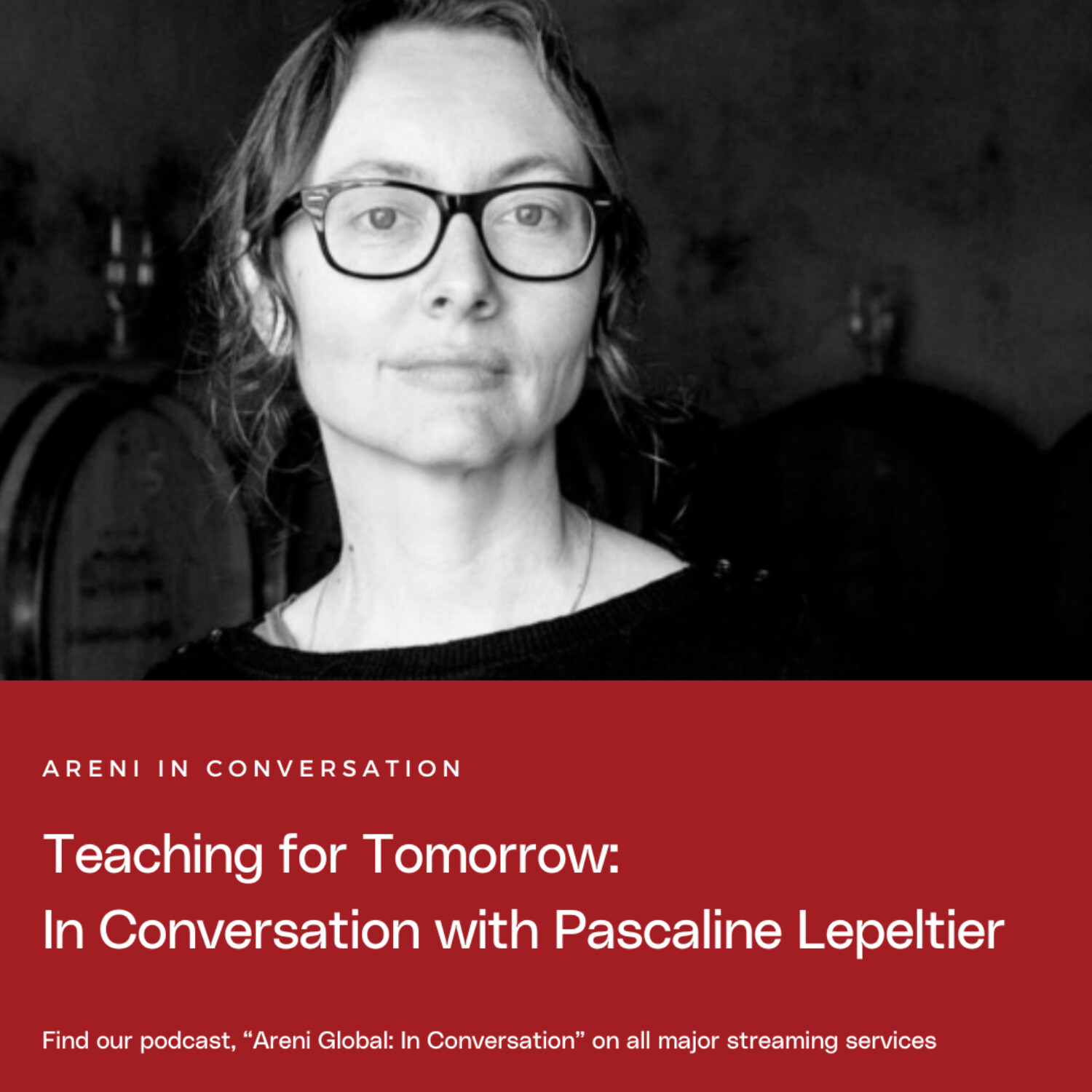
Teaching for Tomorrow: In Conversation with Pascaline Lepeltier
58m 23s
In this podcast episode, host Pauline Vicard interviews Pascaline Lepeltier, an icon in the French wine world now based in New York City. Pascaline shares her unconventional path into wine: after studying philosophy and completing an MBA, she entered wine through a practical apprenticeship because formal French wine schools rejected her for having too many academic diplomas. Her foundational wine education focused heavily on theory, especially French geography, but left gaps in practical skills like tasting, restaurant floor work, and business operations. She had to learn these on her own, often in challenging roles managing wine programs in Belgium and New York with minimal support. Pascaline highlights the lack of recognition for front-of-house craft, arguing that service skills, multitasking, and guest engagement are undervalued compared to cooking. She also reflects on building confidence through deep knowledge rather than a theatrical persona. The conversation explores a philosophical distinction in education: "educare" (shaping students to transmit existing knowledge) versus "educere" (leading them out to solve future problems). Pascaline finds this dichotomy relevant to wine education, suggesting that while factual knowledge remains important, it must be balanced with practical, contextual learning to prepare students for evolving careers in the wine trade.
Welcome to the Aurene Global Podcast. Aurene is a global research and action institute for the future of fine wine. In this series we bring you conversations with thought leaders in and adjacent to the fine wine world. To discuss how we as an ecosystem can ensure the collective future of fine wine. Welcome to this new episode of the Aurene podcast in conversation. To introduce our guest this week I have selected only a few of the many accolades she gathered in the last six years. She was frontiers best sommelier in 2018 and the same year. She also obtained the title of Mayor ouvrier de France. She would literally translate that as best craft man in France but really that translation failed to translate how revered this distinction is in my country and the importance that it represents for people working in the food and wine sector in France it's huge. She's also an award-winning author and she valière de l'ordre national de mérite so that's a very official distinction given by the French government to individual for distinguished merits rendered to the French nation very official and of course the list goes on. I could also start by talking about the deep respect and passion that she has for wine but also the deep respect that she inspires in everyone who has the privilege of crossing her path. In brief Pascaline La Palette is an icon in the French wine world and beyond she is now operating from New York City and she has more than 70,000 people following her wine and food adventures on Instagram and to me the most remarkable traits that emanate from Pascaline is her wisdom that might be coming from her former life in philosophy. She is what we call in French a first tranquille so a quiet strength someone who changes the world without violence but through sheer determination and will and having done a lot of des research on the future of education for our upcoming a really white paper. Stay tuned for this this is going to be a good one I couldn't resist the temptation to discuss some of my findings and some of my own theories with her and see what she thinks of that. So in this conversation Pascaline and I discuss why it is still important to learn wine facts even with Google in your pocket but explore why and how this factual knowledge needs to be put in context in order to serve anyone who's building a career selling wines. We also talk about tasting quite a lot and her deep opinion on the needs to totally change our current approach of tasting wine. This is a fascinating conversation. Quite geeky at times I must admit but with real life implications and suggestions on how to rethink the way we teach and learn to build successful careers in wine. I am a host, put in vicar and I hope you enjoy your conversation as much as I did. Let us know your comments on social media. Hi Pascaline and have a new year. It's such a pleasure to have you all by myself for these 50 minutes that we're going to spend together because I've been of course following you and your career and you are such an inspiration for a French woman in wine. Welcome to this podcast and thank you for being with us. Thanks for the thriving. So as you know education is a big part of our exploration this year and when we talk about education we talk about wine education for the trade so for everyone who is selling wine more than anyone making wine. And as my first question I wanted to ask you how and where you learned about wine. I know that you keep on learning you know almost every day but when it comes to your foundation knowledge where did you get it? How did that happen for you? So I got into wine quite late after university study when I was roughly 2324. I got my education in France in the city of Angé where I grew up which is all happens also to be the city really at the heart of the wine region which is the Angé in the Royal Valley. When I decided to switch from philosophy to first restaurant student and wine study I had an issue and the first issue was I really wanted to go for practical education. In terms of this called in France and I could not because I had too many diplomas and so my first really moment learning about wine was when I was doing my MBA in hospitality management so in a very standard university setup which I did roughly for a year and a half the time to get my MBA but at the same time that I was studying I was also doing some practical internship as wine was re taking more and more space in my life I realized that what I was missing was really a practical aspect and when I decided to become a sommelier I was 24 the only option I saw to really jump as quickly as possible into that field was to go to a system that we don't really have during America and not sure it's a sommelier I went to do an apprenticeship what we call a most complimentary in France which is one week in school and three weeks as an apprentice in a restaurant because I had way too many university understanding of what I was interested in wine but very little to know practical access both on two things tasting and on this and one that way and it's really not so I did that school for one year and that's it for my my official wine education when you when you said you couldn't go into practical education because you had too many diplomas is that because they didn't let you in because they wouldn't let anyone with the you know the equivalent of a back please thank coming into practical education or yeah absolutely yeah the the food that I was not a smart idea and they really encourage you to go back to university studio indeed to go to high level diplomas and go this way I went up and I went by a media in Jose but to university it was 20 years ago like 19 years ago so things changed a little bit today but it was a moment of time when especially in France education was extremely structured and was very difficult to to bridge a different category of education, a different style of education and I don't even talk about different fields of education yeah and it was like if you were good at school and if you were what was considered clever at the time you shouldn't go to practical kind of studies what would you say was a major benefit of this wine education and maybe the limitation as well the things that you didn't learn that you had to find out on your own so I don't think it was the common student when I when I intel my my education school so I as I mentioned I had before that the university study so I studied philosophy which I think is a very important about education what was in the book after and what it is basically to think and to learn was at the heart of my studying philosophy and I also did before entering university for that I did something else I don't know there is an equivalent in the American or English world of class preparatory like for three years which is it's very very intense where you basically are shaped to try to pass a very hard exam in my case it was about humanities as I was already studying philosophy and so in this years it's our extremely important in my career because they told me how to learn or they told me how to think and they told me how to absorb an extremely large amount of information in a very short amount of time so I was I was already shaped to understand that wine and wine what a fine that was getting into will be touching an extraordinary amount of data in fact from a different field of knowledge and how can I absorb that as quickly as possible so my year really doing my so many diploma was extremely easy in terms of theory was mostly focusing on France and we had to do a lot of what is today consider some your knowledge and it's extremely limited which is basically viticultural geography is basically what you do for a year like you are learning geography you know great variety you're learning French maps and yeah you are learning French maps you're learning very good at geography it's a good thing because I love geography so so that was that and a little bit of the rest accounting and talking about wine that wasn't nothing the big thing I was really looking to learn and that I realized I was pretty very bad it was all the non-intellectual rational approach which was of course testing and just didn't really what was happening in your glass where did it come from why does it taste like that why do I react to it like that on one side and the second side was also the human side of working in a restaurant care of course a physical aspect just carrying a glass of tray or curving chicken which I had no idea to do in a restaurant but beyond that's how to interact in the restaurants his guests was your team who's a chef and no gone after that with the producers and at 25 I was so so scared and so shy yeah you know it was very strange because I had a very successful university It could have been really I think a good diversity.
teacher of philosophy, really, really good at. And suddenly you solve something when you are really bad at. And it's really frustrating. You get a lot of humidity out of it. It took me a long time to feel comfortable in all that. Field of skills and I gained. I already had it because my mom was teaching in this kind of school, but I gained even more tremendous amount of respect for a whole set of skills said that for a lot of people I could not even consider, but in fact, crafts are really talents that are really not only useful, but really for the practice and are really enhancing. Are you thinking of communication skills and engagement skills? I'm thinking about really multiple skills. I'm thinking about of course that, but also, just taking the restaurant, it requires. I mean, pretty much a lot of understanding of human challenges and human opportunities from your team and your guests, but we've chosen multitasking at the same time. You have to have a pretty good amount of knowledge about of course within life, about culture and general, and just how to run an operation. And I'm just looking at the experiences of restaurants. So of course, working with chef and the gastronomy, which I think today people are recognizing, for a sort of skills and a lot of time spent, to remaster, you know, how to cook properly and so on and so on and so on and so on and so on. And maybe maybe the floor, maybe the floor skills and not that recognized compared to the cooking skills today. I'm thinking that if we've made progress with the skills that it takes to cook, we might not have made the steps in recognizing the hearts, you know, the skills that it takes to walk the floor, like to work a floor. Absolutely. You're right. And it's one of the reason when we would be crisis today of vocation, going into restaurants, it's because we are seeing that a service, like as a servant part, so if you're working in a front of the house, restaurant is often because you have no other skills. It's kind of the job you are doing just to make a bit of money and it doesn't require anything. The metroidee used to have a little bit more of a recognition that there is a case today. And so unfortunately, people don't realize how this job is. When you're re-talking about restaurants as a restaurant experience and of a restaurant where you just go and basically absorb calories. We are re-talking about craft of restaurant and gastronomy at every kind of price level. I don't need to be a French restaurant. You can just be a beautiful and casual neighborhood restaurant. There is no recognition of what it is that people are just basically you are going to serve me for an hour in a house and basically I can ask you pretty much everything I want. And there is a very, very fascinating power relationship coming into the restaurant. Yeah. Restaurant flora at the time. It's a no-reconition for that. And still no-reconition today. Well, it is very fascinating really for me. I just killed kind of job. I remember realizing that I must have been 20 in the first time I arrived in Paris as a young student and of course to make some money. You wait for a spark. That's what you do. You go for a waitress job. And I remember going to that Bahazri and being interviewed by my experience and of course being very novice but thinking that I could get any kind of job wavering really. And that guy who had been a waiter, he had been a waiter for 25 years and he's like no here. Waitressing is not considered as a you know summer job but as a career. And he was making at the time something like 3,000 euros a month which 20 years ago was really a lot of money. And he was like this is what you can get when you know your craft, when you know your skills but that took me 25 years to get there because this is a really a job. This is not just a summer occupation. And that was that. That was the first time that I realized wow okay there's something else you know that just working in my local pizzeria on the weekends that that takes other skills. Did you learn about the business part of running a restaurant as well or even running a whineless because you talked about all the skills when it comes to human relationship and reading the guests and communications and also what I took from what you said is that kind of building confidence so that you can interact in a meaningful way. But what about the parts of you know how to do a stock take and how to rotate a whineless and how to make money out of your whines. Is that something that you've learned as well through your foundational knowledge? So I really only need that sharing school because it was so little into you know this the theoretical park. Like the school where what I took from my my somebody's basically you you you you you you you you you you you you you you and you start as in a brigade and this is you become an engineer somebody and then you have a summer meeting and you have a summer meeting so you have this kind of essentially things so I didn't do that of course I do something different. I learned about over financial and economic or in aspect before when it was in my MBA already kind of the basics you know of accounting and stuff like that so I learned that before but honestly I was I was thrown just in that was maybe something I today I regret it tight is that I accept this here and when I was in this commission I started restaurant in my apprenticeship in I just went along and all that but I even really got into the operational side. I never worked under somebody my first job I was already responsible from my pocket and that first job lasted almost 10 years and took me from France to Belgium to the US where I didn't have anybody to teach me how to do it so I had to really quickly. Learn on your own yeah learn on my own and not only learn on that one but why which was already very my knowledge of why was just in the beginning but also learning in two different markets. It was not even make culture to Belgium it was already a separate restaurant it was kind of a specific thing where I was asked to change it and then to New York where we had an opening team but left and then they had just an irritated major program in a very very large restaurant in the city that I was barely at that time able to understand the language so I really wished in fact I really think that the environment our sheep is is a key and I really wished maybe we would have had six months a year with somebody else just to allow me to make mistakes so maybe to go a little faster. Oh or maybe have that part of the summary training as the as the academic training. Yeah yeah maybe there is there is some training in France when we can result of two years and find out and most of the students in fact are doing that once again you know it's very rare to get out of that diploma and to be like me and to get a such a big job right away like it's really the exception and I couldn't accept that job there was just almost my dream job so usually it doesn't happen like that you cannot call something that high in terms of management level so it's because I had this kind of all this university in the promos and a little bit of a practical experience that I could certainly find myself ever a director for an international group going to New York. We had that we had that conversation where Soren Pullenews that you know very well I think as well and Soren when we talked together about his education one of the things that he shared was that just like you he was and he's still very shy and he kind of had to build this persona to work on the floor so it looked not only on mentors but it looked at everyone he could observe working on the floor to also build this persona and say okay this is going to be my service type this is going to be the type of person that I'm going to be on the floor how I'm going to express myself how I'm going to engage with the guest it's a bit like delting your theatrical kind of persona is that something that you had to do as well? I never thought that like that for Soren I think I'm I'm very myself in the flow in fact and I think I have to be if I want to be a good son of me. I don't want to make him sound not authentic but it's something that he had to brace himself to do so kind of an inspiration he took to to feel more confident on the floor. Oh yeah I see what you mean yeah I think this is interesting I can totally see even approaching that like that I think I my confidence comes from something else okay my confidence comes from knowing from knowledge from understanding so yeah and so what I need to feel at ease is is to know that I know as much as possible and if I don't know I know how to handle when I don't know and that is why it took me some time to feel to really feel at ease on the floor I like to see right away I really enjoyed the relationship with the guest I really enjoyed living in the restaurant but I became more and more open as I felt that I could really be somebody that could be of help for the guests knowing what I was talking about. We're going to come back to the the notion of education and because I know that you know philosophy I I threw you in a philosophical question almost but when we you know when we look at the different routes and origin of the word education in English there's usually two that comes in of Latin origin and the first one is educare which means in Latin to train or to mold or to shape or for me in French so really and the second one is educare which means to lead out and to elevate and when you look at it we don't really usually define the purpose of education but those two purposes are quite different because one side Thanks.
of education as a mean to pass down knowledge. So all the knowledge that's been acquired from generation to generation and almost to shape the youth in the image of their parents. But the other side sees education as preparing a new generation for the changes that are to come and to read them to create solution to problems yet unknown. And of course like always in wine or in life it's all about balance. We do need a bit of edicarre, we need that shape, we need that education to allow the transmission of knowledge so you don't start from scratch. But we also need the educheripart which is if we want to thrive, if we want to have a thriving wine industry tomorrow, we have to have talents that can take on new things and have the capacity to be resilient, creative, et cetera, and et cetera. I know it's a very philosophical question but I'm sure you can take it. But how do you see both meanings being balanced in wine education? First, that segmentation maybe makes sense to you and how do you see it play in the world of wine? Here is this dichotomy really from makes sense. We are tackling philosophy and one of the one of the philosophy that inspired me a lot and I'm going to and going back to a lot in my career is philosophy of koreshildurus in France for me was quite known in America. And that philosophy really for about about education was a philosophy for per se because he created he wrote and he created concepts which probably means that he used to be a philosophy but he was also a teacher and he thought about teaching especially teaching in France in the 1960s. With Miss May 68 and all that it was a very very interesting moment and he did he is in his teaching and his thought on teaching there is this difference between the transmission of a representation of a fixed knowledge with all the prejudices behind it. That's for him is not what should be taught at the second verse use the educierny path which is what is in fact happening really is like the idea that there is not something outside waiting for us that we need to discover the winners and by heart according to a certain vision of the world is like it's constant to be a problem or around us in a very positive way and we need to learn how to assess and how to confirm that so I talked about the difference and today in the Waynewell unfortunately the educiary is 99 percent because the second part is then when you talk to the how to educate or to go through education there's one that calls for memorization you've got all that facts and all the facts that you mentioned and the fact that you need to have that fact and that core knowledge to become good workers and the other one is more about questioning thinking and creating. I mean it's it's a good question I guess you ask you because as I'm going to come back in a second to the fact that you are very very active on the competition, competition scene and competitions requires a lot of memorizations of facts and figures and maps and stuff and there's been a lot of criticism around the fact that as you were saying 99 percent of our education is educiary and that we at the time that there's Google in everyone's pockets maybe we shouldn't need to learn all those facts but what's your what's your take on that what do you think is the place with the factual information and memorization in today's wine world. It's really what I'm going through right now because indeed for the competition I am still have to learn some some effect and data you talk about the how for me is a question about the why and I'm thinking it's kind of correlated but I've been teaching also a little bit I don't teach a lot but I teach a little bit it's a different when you're also learning yourself and you're starting to teach to students I have a very good memory I can memorize very easily a lot of things so on that side yes it has been very complicated for me but I had to understand how I could do that about the religious just because I really have a good visual memory and I can just remember stuff but then I realize what I'm doing is I try to understand why why do I need to know that. Understand discern and appreciate yeah absolutely so and this is the very first thing I start to teach and I always I often fact I do one class one right now and I always do my class on the wall which is a region I know I know quite well I'm retrying to teach my students not all the data as I need to know about all the application I need to teach them why today this data or what they are what today you have this blend why today you have the style why today you have this geographical limits why why is a reason to start to make them connect the dots and to make the interuicist to understand what they're learning right now as a reason as a reason it's an ontological fact men are behind it there is reasons yeah economical there can be an adaptation to geography to social part and all that there is reason and the things are constantly changing and the program is the way we are learning about wine today is where we are making objective and almost universal and timeless fact and data that per se have been evolving extremely quickly over the last 200 years and we are just seeing a very small time lapse of that and we are never told why we are just told oh you have to know that it's what I have to grease and it's a blend of all these grapes and it has to be a short time months and it's a beauty stupid but it's linked to to it has to be it has to be absolutely put in parallel with ones to be known today for the markets and I really believe the education we have and the way and the way we are learning about the certain standardization of wine that wine or salsa is that is the style of wine is linked to what is need to be learned today in the larger spectrum of a wine market that has been built for I would say the last since the 1960s but before when the operation started above the idea that there is standards of quality that have to be as objective as possible in certain region to be the structure of the wine market at least in countries that where operations actually happening and then kind of spread out in the world so this is a mirror of the same thing it's like you are learning what needs to be known in an idea of with a certain idea of what a certain quality wine needs to be and it has to follow a certain standard of production approved by your community that is recognizing that as what should be the truth or the epitome or an absolutely objective quality standard and that's a problem if I understand you correctly because my question was about the why I guess coming back to the why it was about why is it important for some of the days or wine sellers to actually even know those facts that was that was my question but you are actually saying that it's by knowing those facts and knowing why those facts and that is are what they are that we can understand quality did I understand you correctly so today you need to understand this this fact because it's what your professional level is appreciated upon basically I mean in relation to your work why do you need it because it's a communication because it's my guess of the buyers or everybody at the certain level of the trade today you first have to talk about a wine of quality let's say I'm going to talk about my region Shunablou from the law okay and I see what is taught through the main big education system and as that is a Shunablou from the law that you need what you need to know that's a seven year yeah that's a good way there are ways of drive because that profile it's seven years to be like that it's it's not true it's it's not like you have that the standard that you are supposed to learn today I know by fact that there is multiple incarnation and it probably is the best today for me or the one that has the most meaningful in some of expression of the terroir is not quite what we thought but if I want to pass my exam and then if I want to have a communication with my colleagues or even when I see the promotion that is done by sort of major like marketing storm that is a wine you realize that you have this what what Olivier Jacque calls this common aesthetic canon like you have that has to be the incarnation of it and if it doesn't taste like that is no good is not true is not the right thing and not and so on and so on and so on so it's basically the wine standard become a concept of words that have to be simplified to a bear bone to be able to be communicated among the whole larger thread because this is how exchange is done is how it's both is how it's really about this very simplified concept for wine it's paradox because wine is an absolute opposite it's the absolute the wine that we care for the conjurer you are talking about absolutely unique what makes them go is that because absolutely unique and so we are teaching the absolute opposite we are teaching larger standards defined by larger concept defined by
words that they don't mean anything because it's been my brightest CVT or that. So it's the absolute opposite that we are teaching. And Fundingly enough, we're learning about those benchmark wines, you know, those style international styles that you've said have been simplified to the bone. And those are the wines that consumers don't really probably want to have so much information. And then all the wines that are unique and complex and totally different from one another are the ones that consumers at that level want to hear more about, but we are learning the wrong way. I can see what you mean. So for you, the educator and the chair part, there's one part which is I need to know the facts. I need to have those data. And I need to understand how they play in an international standard because I need to understand my currency really. Because I need to be able to exchange and to evolve within a trade that takes those facts as the currency. But then the educator part is the my own personal appreciation that I need to develop because the international currency is not enough to make decent choices and to build a unique wine list and to have my own uniqueness. Did I summarize that in some ways? Yeah, so it's okay. Yeah, it's a you can call that as a currency or by a common language. You have that. Yeah, you have the international common language. You need to know how to speak and depending on your we are talking to you, you're going to adapt it to be as extreme stretch for a world or the other side. You can look extremely, you know, deep that make you still have that standard currency. And the editor is not really about my uniqueness is just I'm adapting myself to my object and my object is very unique. My object is constantly changing and it's in constant movement. It's absolutely infinite. It's absolutely unique every time. But this is not at all something that is easy to grasp that idea that it's infinite. It's so major. It's so big. It's like how can we even grasp that? And it's very scary. It's like even as a human brain, we are not really meant to that. We're really meant to try to structure our environment. And to make stuff stable to be able to communicate and to be around that. But once you start to realize this is not scary. This is just where it is. And it's extremely stimulating and it really require in fact a constant work, a constant approach, a constant reflection to understand the dynamics. It becomes absolutely stimulating and extremely almost at peace because it's a way to accept it. You're accepting the complexity of the world and the day you are at peace with that. It's not my favourite thing all the time but this is what I need. This is my approach. This is how I need to, my relationship to the one that's to be. It's suddenly a way to live it. And suddenly you can see the one and the one differently and go for what makes this called vinyl that is experiences. This is incredible. The reason why I do my job is because I'm dealing with something and the product that I can eat and drink that is going to make me feel. Yeah. Next incredibly alive. I was in love with pleasure, in love with attention, in love with over-distimulation, holistic experience that is unbelievable to this person. I'm very interested in this experience, fascinating and this is what I want to give to my guest. I want to find this wine that I can give to my guest in every night in a unique moment that going to make them feel that and just not having them drink an alcoholic beverage that made with grapes and has absolutely very little ability to make people feel. I go back to the commercial side and the business related side because there's also one big critic in the world of wine education is that we learned about what we like, which is those amazing wines that makes us feel alive and unique and almost the la poisee and the romanticism of wine. Yes, for you in your job knowing that, having that appreciation and that discernment allows you to create unique experience for your guest and that makes business sense because that's also how you're going to make consumers want to come or want to come more regularly or maybe upscaled in wine because you then have that ability to transmit that unique experience. Is that correct? Yes, it's correct. I think this is my job. My job is really to understand my clientele, each of them, every single night at every single table to pass that moment. It's a very cater to, you know, it's a very boutique relationship I'm doing but this is really that. It's, how can I read, how can I access the intimacy of a person that is not really used to talk about his taste. About something so personal about his preference in a very specific environment, which is a social moment of the restaurant. And how can I make sure that that person that night was coming to eat and a friend and all that can have an experience with wine that is going to really make that person feel the power of the senses of that. Where was your palate and your nose and how powerful is eating and drinking the minute ask for it. You know, they just, I have a table, they just come, they just go very quickly when you want to go to the right white wine. Blah blah blah, you took very quickly with them, you tried to see what they're drinking there. And then you get the wine and that's it. And that's the only and then they are in between themselves. But that wine, I'm still going to try to find the absolute best wine that I can think about for the budget to resonate with them. And maybe he's not going to resonate or maybe we are but at the end and they call me back and go, "Well, you know what? We both did, it was so good." And I just want to create that in all my guest experience in my restaurant because this is why I am into this business. This is what I'm looking for to do to make them feel good by drinking something that I believe has been produced in a very specific way and is able to carry on that, a grove from anywhere in the world, from this small producer, be producer, cheap or expensive and all that, to make the people resonate and to leave the restaurant with a feeling that they are feeling good. And maybe they're going to come back and you know, last time was really awesome, with a really great time. And maybe one day is going to be why? Why is it different? And that is my job. And it's why I also always work with restaurants that work co-earth with a food approach. You know, there is just too many places, I can't work in too many places because the food is not going in the direction. The wine I would have to pour are not in that direction. So I always, yes, my business plan, my career, restaurant I work into, I have to have the ability that freedom to be able to peak, that to create this experience and people are coming back for that. But that's also how you maintain, again, going back to basic business, but that's also how you maintain financial profitability, right, and financial sustainability. Because that's how, that's how you can make people come back. I want to go back. So again, on that educare, edu tirere kind of different. It's easy to see how educare is, you know, transmitted and we've all been, and I'm sure in the audience, everyone's been learning about wine, you know, and facts and reading books and doing memory cards about remembering which great variety. And those facts, your knowledge that we have to do and they are some initiative outside like the WSET or the CMS that do it very well. But how do we do, I mean, from your perspective and your experience, the educare, but the things that you had to develop on your own for your 20 year career. And I think that you had to learn about either moving on the floor, the human relationship, the appreciation of those great wines that allow you to then create great experiences for the guests around that. Is there a way we can speed up the process? Considering this question in the context of having, you know, the vocation crisis that you've mentioned earlier and the fact that we don't have enough people working in the restaurant. If we have to wait 20 years for someone to be able to do that, that might not help us a lot. So is there a way we could implement that part of education sooner or any kind of good practice that you've seen or that can help people think in that way faster? I think we need to rethink how we are teaching that wine for sure. I don't think the right, not right now. It's not called the right way. And that's one thing. After the educational crisis, it's a larger thing about recognition of the job, the needs by better quality of life, the need by just a true servant, called and called perspective. So there is like multiple things happening there, there was this laughter of cultural appreciation of the job process. But for the wine education, just if you want to suggest on that. Yes, I think we are not going to need the right way because we will go right away about just longing, just all the region of the world and just like the region by region by region and just longing, just pure fact and data. And that's our we need to for me, it's why I wrote my book, you know, is going to be in English, but the reason why I wrote the book in France.
is really was to, for me, to express the way I was learning about things, which is for each subject that I'm been learning is trying to understand the why things can be speeded, just by, I think, having way more inter-disciplinary that also process to very, go to the one side and to teach people how to think by themselves and which tools, which question should they ask when they start to study a subject, whatever it is, it can be one-taste, one-taste seems a larger thing because I think we absolutely don't know how to taste today, it's really a problematic thing, but people are working on that, which is very interesting. But for the pure, vitic or geographic knowledge, getting the right approach to understand the why, because each area, each part of the world, that is own dynamic, old speed of evolution, how key players that have been had, team, or something, were another, so you can't generalize oh it's always happening like that, because every time that there is an appetition and something that is going to be put together, that is becoming a place where one is produced, it's been done according to what you call a terroir in a big team, so the geographic or historical and I'm sure you would agree with me with us being the same age and growing up in France, when I was in France, it was a clear difference between how high in the hierarchy the student was supposed to go to, so if you were to stay in the lower ranks or if you were to start to career as a junior thumbs, the education that will be given to you was about facts, it was about this is what it is, and the why behind things and the explanations about the understanding would be given to you if you were actually going for an education that would be, you know, director of something or manager, and so my question I guess for you is do you think that we can in a plausible way have that kind of education for every level regardless of the position that one is going to have? Yeah absolutely yeah, from you know, he has to assist in to manager. What we are seeing is like because you're just like a simple, deeper my your stupid, you can't understand, it's not true, right? Yeah, no, I totally agree with you, I'm just I'm just thinking about the practicality of that because one of the good things for all the criticism it can get, but one of the good things about the WSET is that it breaks down those learnings in like small units that can be quite quick to learn when you start, and it's it's very basic, but you only have two days anyway, so there's there's my point is like how many how much time that will requires us to to give someone who's going to be a junior sommelier, the the basic training that they need in order to to walk into the world with the right mindset, is it a matter of time or is it really a matter of just how we present the information? In that case I think it's both, it's a matter of how we present the information which once again, not understanding French wine is not learning every single application by heart and knowing that's not understanding French wine, that's not that or understanding Italian wine, or understanding American wine, you know, it doesn't work that's not because I know all my AVA in the US that I understand American wine, which it will be like a little bit of a simplification, but there is a different currents and the the ways that one is sold and one is fought about and what is like marketed in America is not the same way that it's marketed in France to what you need to learn, how to a project, why France matters on the IOC system and what AOC was created and how does it work in each AOCs, created by the law, there is law behind it, it has to be a group of people based on tradition and then can evolve. And that you can tijads on a short of time, in so let's let's let's take two examples, let's learn about how the Sonser Appalachian came to be, let's learn about the Bordeaux Appalachian came to be, let me show you how to think about that and then this is the resources by each region where you can go and check that out. This is how American thing were put to be, this is what it works, this is what matters, they don't care about the soul, it's just about the great variety, this is the high words, the freedom of that sort of style of one way more verse, but like this is how you need to achieve that. So it's changing our relationship to what understanding means. And so changing the criteria, like for you to be able to say that you understand a particular wine region, it's not about facts, but it's about being able to place those facts in a context. Absolutely. And use those facts in a context. But that that for sure requires just a bit more time I suppose, then just remembering that burgundy speed and law are 100%. But does it matter really for you to know all the premier grue of more essentially? No, no, no, of course, no, totally. But usually that's not what you learn from as a junior position, is it? Or maybe mistaken. No, but you learn that there is premier grue and grue in burgundy and you need to know about that and there more expensive one is grue and why does it use new oak and what else. But we can do also the same thing about tasting it. But the tasting it is a very first problem is because of your progress of point. I'm not going to start out with this. I'm going to tell you, okay, you look at the site and you look at the color and which color and you try to assess something out of it and you smell and go get your first smell and your second smell and you're going to try to recognize to identify, recognize, discriminate and talk about what you're smelling and all this familiar fruit and fruit and blah blah blah and then you go to pallet and oh, how do you taste? There is this compound, there's a texture, there's aromas and all that. And it goes. So first, and you know that because a lot of research, a lot of you have, it doesn't explain how your body works. It doesn't explain how your brain is going to work. It doesn't tell you that we're all absolutely different. It doesn't tell you that you're in the class of work and I'm always and that's something like, I know I'm really surprised and I have no idea what's not done and I'm very, it doesn't tell you you have a class of students. It may be the first times they're all tasting together is the first time maybe they're trying to understand something. There is no calibration. So you're a kid or you're somebody, you're a slightly older or whatever and somebody's saying, oh my god, this is a black paper and everybody around you, oh yes, paper, paper, I knew you're stupid, you don't smell paper. Yeah, you are not sensitive to rotting them, whatever. And can you imagine the level of non-confidence that you start to get? All like your sensibility to bitterness, for example, but in very, so much between people. Absolutely, because we know that there is one capture for sugar and there is 25 for bitterness and all that. So if we started again saying, okay, relax, this is how it's going to work. You're going to have a sensitive approach. You're going to smell test things. We're going to learn how to discriminate something extremely complex. You have so many information rushing out to your brain. You've never been trained for that. There is no taste education. That's cool. So let's go back to the fundamental first. Let's go back to try to test you. So you like see what you smell and grade you. See you a little bit. It's okay if you are high here and low there because we're all different. Let's start. You know where you start. You know that you are sensitive to that. You are not sensitive to that. You calibrate and then we are going to start with very basic things instead of starting with you. With a wine, you should start with something a little bit different, like a more basic and more. And that's something that can be done also as you grow up in your expertise. Like, you're not going to do that for the first one, but your sensitivity to breadth, for example, or to some of the, you know, discussed folds or accepted folds or things. But how consistent you are in recognizing things as well is something that we've never tested for. Absolutely. You realize that we are testing all the time. But we never calibrate each other. I have no idea about my PhD in Stibendee and I have my idea about my right recognition. I never do that. So all the time, we are almost like sports people. We also know that there is days that we are sharper and days that we are not as sharp. And we are then communicating. And we often communicate indeed at the certain level with peers where we don't know if that person I'm talking to as the same threshold that I have because we never calibrate amongst each other. And I did that this summer. So that has been something that I've been really struggling with. It's now a lot of time. I've been talking to people in Bordeaux and Paris to try to see how we can create a calibration test for me and for the people of the stocks. And so, okay, this is what I am. This is what I am. This is my tool. This is my needs. This is what I can improve. This is how I know I can interact with another person next to me to try to see with fundamental points that we are being really focusing on in how to communicate your currency about mine. And from that, I'm taking that and I'm going to learn myself and I'm also out to interact with that person, interact with numbers also because I'm also always so surprised when you start to talk about mine and so many teachers you don't even know how the one is made. They don't even know is the wine. They don't know the data. They don't know the fact behind just you take the full data of the wine, the little bit of sugar, the alcohol, the dry extract, all bunch of compound, the malo and all that. And you start to talk about the one. Oh, it's high and sweet. You may not even know talking about what you're singing. I totally agree with you. It's just like when people sometimes, you know, journalists or professional take-off.
the like well what generally is mostly the like well we don't want the technical sheets because we want the stories and stuff I'm like I want the technical sheets because I want to calibrate like I think this wine is as high as it but I need to know the the acidity I need to know the pH because then that will teach me where my benchmark is. Exactly how you react to that so I don't want to know the technical data to the technical data I want to know what is the redone to the swine I want to know is the one has been acidify has been returned I want to know is there is an event I want to know the one making process because I want to understand how this one make me react and also if I'm right in my perception or is it just one day that I'm a bit off and actually I find it high acid but it's you know there's four grams of acidity on it so something like that so absolutely yeah maybe any other program is your guts and we know that today one of the big researches of it is the guts into the tasting parts like we have no idea really how the guts influence how we are tasting so you see all that we are never thought about that and I'm like that's insane it's like it's like asking a sports person not to warm up and to understand his body before doing. Do you think that could help because that was one of the questions that I had for you in terms of tasting because when we're training to taste and in that same concept that you've mentioned earlier which is to simplify everything to the bone we are taught to taste through benchmark so you will have that wine which is supposed to represent on sale and that wine which is supposed to represent Chateau Nafjipab and this one that's supposed to represent Napoli and those are the benchmarks against which you need to build your library of taste but this to me at least I'm sure you would agree that that makes less and less sense because the only wines that are still tasting like the benchmark that they are supposed to taste like are the ones that I'm not really interesting because because this is not who you need to taste. What is a sensor and I can't focus about that because I spent a week there. But also because of the climate change but also because of how we don't have the time to go into details but you know when I grew up in Burgundy we had a definition of what was typical and what Tabisity was because my parents used to do exactly the same thing as the wine makers that they were next to them so by definition the wines had Tabisity because everyone was doing the same thing harvesting at the same dates, treating the grapes the same way so at the end the wines tasted very much similar right. The coirons between the production yeah but now in this era of authenticity that's my personal explanation that people want to have the individual truth behind the wine and not the collective truth behind the wine that makes really really interesting wines but they're very unique and they're even more one of a kind and if you add climate change to this it how can you even have a benchmark. The benchmark as we think about it doesn't exist anymore. Yeah so my question to you is as student how do we build our library because I mean I need to recognize that having those benchmark was really helpful again sometimes simplifying things is really helpful to grow so how do we grasp that how do we build our library if we don't have any benchmark anymore. We need to cross in a different way. We need to cross things in a different way. We need to learn farming first. Before you recognize the wine or blend this wine in red we need for me to recognize wine that are really made with a sense of place. This is a wine that I'm not made with a sense of place. That's the number one where the farming, the quality of the farming creates and always a plan to grow grapes that then can be transformed by fermentation conducted by one maker and incalating a very unique area. That's the source. A wine that has been done where grapes are most of the material and then I've been shaped to feed tool markets with a certain taste and a second profile that try to be as consistent as possible during the era. So that'd be very frustrating to learn and to discriminate and I really believe you can discriminate I really believe you can feel and you can taste what something has been shaped and I that's the number one. That's the absolute number one and we are not put that. We are not put to discriminate these two things and I really think it's very easy and I really believe you don't need a lot of education to make the difference because it's a something who is a certain thing with everything. You taste the difference and then what you need I think the way I was seeing that and the way I said to put it by my side. Okay let's start to think a couple of non-aromatic, quite great variety found in a way where very short elevash done with no malo-lactic fermentation. Be it in a Criache-Vascha, be it in Pinuverde or be it wherever in Chacolina being in miscari. What and try to feel the common point with non-aromatic grape, with malo-blocked, with no oak, with a little bit of leaves, with a short elevash. That's your benchmark of this kind of wine. There we go to something a little, not anywhere, don't say that's miscari, we just say that's the kind of relationship with a grape and then you go with something a little bit more aromatic, very aromatic and you try to put all the main combination we're always talking about. The style of grape. And same thing with the reds I suppose in terms of tannins and something with red. And then you create your benchmark with that saying oh that's the wine that that's how blocked malo-lwalco thing should taste like. That's the contact with leaves, this is what it's bringing out to the wine. This aromatic compound that are broad during this type of affluent issue, this what's broad by that. And then when you start to have that, you start to get the keys to understand how certain grapes and it's profile and what is in terms of, let me just go back again. So you kind of crisscross first the type of grapes and the style of fine making. You do a multiple entries and you try multiple examples from all over the world, done in certain ways and variably did it with a climate. Okay and you do that. And then you try to have the grapes made in multiple ways. So the same grape and you try to make it sparkling, still skin, sweet and old. And then you do that. And then you try to see a region where it's doing the same tehua and done in different style. And then suddenly you have a database that you can play with and understand and say well okay. Unfortunately, we ran into a technical issue and the podcast recording was cut short. So I apologise very much for that short, very abrupt ending. But Pascal in an eye continued talking and she authorized me to publish some of her thoughts that came after the recording had stopped. This additional insight, notably on the role of the plays that classic wines will play in the future of education. And the role of fine wine, all of this are available on our website with the edited transcript for this entire conversation. You will find the link in the description. Thank you very much for listening to this episode of our any global. If you are interested in the global conversation around fine wine and the opportunities for the future of education, head over to our website www.arini.global and become a member. This is not only a great way to support us, but the best way to unlock all of our analysis, reports and articles on the topic, including our next white paper rethinking education that will be live in March 2024. Because whether you are producing or selling fine wine, you need reliable specific data to make informed decisions. And we'll have just that in store for you. Until next time, cheers! Thank you for joining us for the Aurene Global podcast. If you liked what you heard today, please give us a positive review and share this episode widely. Stay connected with us and join our conversations via Facebook, Twitter or Instagram and visit our website at Aurene.global to find out how you can take action to ensure the future of fine wine.
Podcast Summary
Key Points:
Pascaline Lepeltier is a highly acclaimed sommelier, Meilleur Ouvrier de France, award-winning author, and Chevalier de l'Ordre National du Mérite, known for her quiet strength and wisdom from a philosophy background.
She entered wine late after philosophy studies, finding formal wine education in France too theoretical and lacking practical skills like tasting and restaurant floor work, which she gained through an apprenticeship.
Key benefits of her education were learning how to learn and absorb vast information; limitations included missing non-intellectual skills (tasting, human interaction, business operations) that she had to develop on her own.
She emphasizes the under-recognition of front-of-house craft and the need for respect for skills like service, multitasking, and guest engagement, comparing it to the recognition given to cooking.
The discussion introduces a philosophical dichotomy in education
Summary:
In this podcast episode, host Pauline Vicard interviews Pascaline Lepeltier, an icon in the French wine world now based in New York City. Pascaline shares her unconventional path into wine: after studying philosophy and completing an MBA, she entered wine through a practical apprenticeship because formal French wine schools rejected her for having too many academic diplomas. Her foundational wine education focused heavily on theory, especially French geography, but left gaps in practical skills like tasting, restaurant floor work, and business operations.
She had to learn these on her own, often in challenging roles managing wine programs in Belgium and New York with minimal support. Pascaline highlights the lack of recognition for front-of-house craft, arguing that service skills, multitasking, and guest engagement are undervalued compared to cooking. She also reflects on building confidence through deep knowledge rather than a theatrical persona.
The conversation explores a philosophical distinction in education: "educare" (shaping students to transmit existing knowledge) versus "educere" (leading them out to solve future problems). Pascaline finds this dichotomy relevant to wine education, suggesting that while factual knowledge remains important, it must be balanced with practical, contextual learning to prepare students for evolving careers in the wine trade.
FAQs
Pascaline Lepeltier is a renowned French sommelier, awarded Best Sommelier in 2018 and Meilleur Ouvrier de France. She is an award-winning author, a Chevalier de l'Ordre National du Mérite, and operates from New York City with a large following on Instagram.
She began wine education after studying philosophy, earning an MBA in hospitality management. She then did an apprenticeship in France, combining one week of school with three weeks of practical work in a restaurant.
A major benefit was her strong theoretical foundation in viticultural geography and French wine regions. However, she found it limited in practical tasting skills and the human side of restaurant work.
A limitation was the lack of focus on non-intellectual skills like tasting, guest interaction, and floor service. She also missed operational training in stock-taking and wine list management.
She learned tasting, human interaction in restaurants, multitasking, and operational skills like managing a wine program in different markets. She developed confidence through deep knowledge and understanding.
Educare means to train and pass down knowledge, while educere means to lead out and prepare for future changes. Pascaline sees both as important for balancing tradition with creativity and resilience in the wine industry.
Chat with AI
Loading...
Pro features
Go deeper with this episode
Unlock creator-grade tools that turn any transcript into show notes and subtitle files.
 PodcastTranscript AI