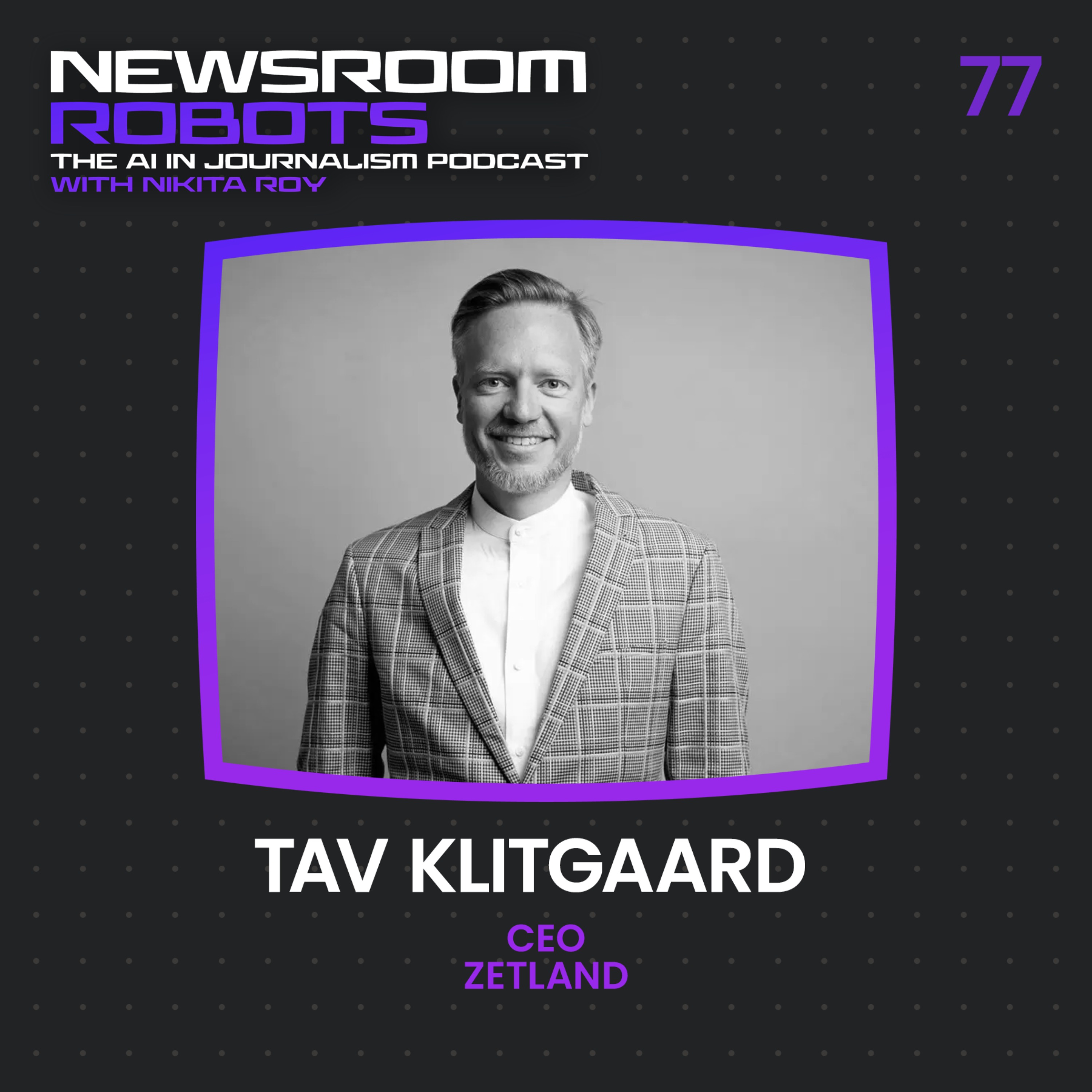
Tav Klitgaard: How Zetland turned a newsroom problem into a global AI business
38m 13s
The podcast episode features a conversation with Tav Klitgaard, CEO of Zetland, a Danish audio-first newsroom. Zetland has built a compelling membership model, especially popular with younger audiences, by delivering news through personal, engaging audio stories. A key innovation from Zetland was the creation of Goodtape, an AI-powered transcription tool. It was born from a critical newsroom need for accurate Danish transcription, which existing solutions failed to meet. After a developer built a prototype using OpenAI's Whisper, its impressive quality led to rapid internal adoption and subsequent global commercialization. Goodtape became a significant, profitable revenue stream for Zetland by serving not just journalists but a wide range of professionals, leveraging a B2C-style growth strategy focused on user experience and data security. This journey provided Zetland with hands-on AI expertise, fostering a pragmatic view of AI as a tool to enhance journalistic work by automating routine tasks like transcription, rather than as a threat. The discussion concludes by reflecting on the balance between AI utility and maintaining the human, personal quality essential to Zetland's audio journalism.
[MUSIC] This is Newsroom Robots, the podcast where we explore the intersection of artificial intelligence and the news industry. I'm Nikita Roy, data scientist, media entrepreneur, and one of the many founders currently building their ventures at the Harvard Innovation Labs. On the Newsroom Robots, I'm excited to bring you insightful conversations with industry experts about how AI is impacting the way we do journalism. [MUSIC] Joining me on the show today is Tav Kletkart, the co-founder and CEO of Zetland, the Danish audio-forced newsroom that's built one of the most compelling membership models in the Nordics, and recently joined forces with Bonnier News, one of the largest media groups in the region. Tav shares the origin story of Goodtap, the AI transcription tool that Zetland built to solve its own newsroom pain point. He talks about how it took off globally, became a major revenue driver for the company, and what had taught them about adopting AI pragmatically inside journalism. We also get into one of the biggest questions facing audio-first newsrooms right now. Like, what does it mean to build a human product when AI voices and AI-generated podcasts become increasingly lifelike? [MUSIC] Hi Tav, welcome to Newsroom Robots, it's so great to have you on today. Hi Nikita, so great to be here, thanks for inviting me. Absolutely, it's been my pleasure, and first of all, I have to say congratulations, Zetland has joined forces with Bonnier News, the one of the largest media groups in the Nordics, and I think that's such a huge milestone for you guys. I've seen the journey and I've heard a lot about how you have been really reimagining what news can be for people in this era, membership driven, audio-force, really leaning into community, and so it's very exciting to see that. And so Tav, I want to just actually just start there for people who might not be familiar with Zetland. What's your vision? And now with Bonnier News, what are you working towards? Well, first of all, thank you so much, it's such we're so proud and happy for the outcome of our of this process we've been in for a very long time. There's something that we have been proving, which is that the user needs for news is very much there also for younger audiences. And so what we are building with Zetland is a daily news service that people can get to stories about the world from. We deliver it, we distribute it mostly as audio, it comes as both text and audio, but most of our consumers, our members as we call them, they prefer consuming it via the years. And really what we are trying to do is to make people engaged in the world, to tell them story that will make them understand how crazy and the stupid and bad, but also that we wanted to be a newspaper for young people. But we are super happy that it has turned out that the product that we produce is just something that a young audience wants to pay for. We also have a lot of older members, but we do 45% of our paying members there in their 20s or 30s. It just feels me with pride also because it's like these people they need information about the world. And for people who are in their 60s, a 26 year old nurse, she doesn't have a lot of options. And we want to really be an option for her to get true and engaging stories about the world. And in many ways, actually a fairly old school journalistic product in the sense that our journalistic values and the way how we actually produce the stories is in many ways quite old school. But then we tell the stories in different ways. Why do you think that that attraction has been there for young audience when a lot of the other like a media companies and media companies in general have been struggling to get in front of younger audiences? Yeah, that's of course something we've thought a lot about. I mean, the boring answer is that it's the whole package. It has to do not so much with the stories, the types of stories we tell more about the way we tell the stories. So our focus is strong on the personal engagement between the journalist and the consumer. And so we want the stories to be told like if it was a friend who sat next to you in your kitchen and told you a story about this thing is happening. With the housing prices and I think this would really be interesting for you. And not so buttoned up way of telling things in and it has to do with the way the stories are told. It also has a lot to do with with the tone of voice. It has to do with the design of the interface. And it has a lot to do with the distribution channel. The thing where we have been doubling down on audio for the past like 10 years almost. We can see that that appeals a lot to a younger audience and it's just an awesome way to consume the type of journalism that we produce. So I think and we can see just that it's even more popular among the younger parts of our audience than it is with the older. So a lot of reasons but the whole package has turned out to be a pretty good product for a younger audience. And it's so interesting to hear about all of this. And just to actually understand the innovative culture I would say that it seems like Zetlin really has because that's actually driven for you to actually not just reinvent news for your readers, but also building one of the most widely used and successful AI transcription tools in the world, which is good type. And the fact that as a media company in Denmark was able to build that out is really speaking to the capabilities that actually media companies are able to also be able to create these tech products. And so can you take us back to the big name of how did how did Zetlin even build good take how did a media company build a tech product. Yeah, yeah, I'd love to. So it really started with a need that I think many news organizations haven't had which was we were spending so much time, you know, our journalists were spending so much time each week basically being robots sitting there with headphones on and typing into the keyboard, the manuscript, and then they kind of had to spend two hours first transcribing. And so that was a like a totally top of mind meat for us and we had been testing out several solutions over the years and the problem is that Danish is a very small language and nobody was investing in Danish. So it was not only that it didn't really work, it sort of like didn't work at all. It was like totally useless what was out there in Danish. One of our developers who was working on the news product, he discovers a commit on GitHub like just a few hours after it happened and that was that was open AI, com whisper. And in the description, it said this model will actually be able to understand audio and turn it into text also in non-English. And so he was like, that might be interesting. Let's test it out. And so he built just like a very small prototype over a weekend and then he asked the newsroom if someone had a recent interview that they needed to transcribe. And one of our journalists hesitantly sent him one because he had, you know, we had been testing these things forever and it never works. So yeah, yeah, okay, but here is a sound file you can, you can. And then he sends it back next morning and then I very vividly remember I miss being very early one morning in the office and the door like slams open. And incomes this journalist like running, yelling, you know, stop everything, allocate all resources to this project that Jacob is working on because it's like it's magic. It works and that of course sparked my interest. And then you know a very long story very short was that we were like, okay, we need to build this product for ourselves. And then when we did it, I realized that this is an open source model. We can actually distribute this. We can actually put it on our own servers and distribute it to other people who have the same need. And so we wrote out to just two or three tweets to the Danish media industry and in a matter of almost like in a matter of minutes people were replying back, what is going on? This is like, this is magic. It works. What happened? And then we were like, okay, there might be a product here and that's that someone would want to pay for. And so we built it out fairly quickly and gave it a monetization model to golf and grew from there. That sounds so exciting with the sense that you can see immediately so some of these need and you saw that that product need there and you started to build it out. I wouldn't really understand. It's not new for that length to be building tech products. You've also built your own CMS and those are other products that you're selling. When you're building out your new AI-driven product, what were the challenges that you had to experience over there? And just getting into the consumer business because it was not just, I would say, a B2B business, good tape is also like a B2C business. Anybody can buy it. So what was that transition like? Yeah, I would say it always starts with the user needs. And as you said, this was easy because this was our user needs. It was actually my, as the CEO of said, that it was my user needs. I really needed this product for the newsroom and I would be the one that the sales people would call and say, do you want to buy my new thing? And of course, as you mentioned, we have a relatively large product part of the company. I mean, we're a fairly small company but it's relatively big. And that also meant that we could allocate resources. We could kind of, we work very agile and we could say, okay, this might be a very, very interesting product. Let's take whatever resources out for whatever month and let's start building that. Then we set out some hypotheses. And I believe we had like three or four hypotheses that we wanted to prove. And the first was, are we the only one who are struggling with automating transcriptions? And that was fairly, we fairly quickly found out, no, we're not the only ones. It doesn't work for people. And then the second one was, is there actually a need outside of Denmark? Like in the very beginning, we had to ask, do people in Italy even transcribe? We didn't, you know, we had to kind of prove that hypothesis. And sure enough, yes, of course, journalists do transcribe. And then of course, there was the willingness to pay. Is this something that actually solves a need that is big enough for there to be a willingness to pay? And we also proved that fairly fast. Then what happened was, of course, that we thought this was a product for journalists because that was the need we knew from ourselves. But very, very quickly, we figured out, yeah, but there's also like, you know, researchers, students, business consultants, even like psychologists, or like there's so many professional people who were using this in their daily work. And so the product is much bigger than we actually, or the market is much bigger than we thought. And then we really figured out that we don't know how to sell B2B products. We're a newspaper. We sell to private consumers. Let's try selling this as if it were a B2C product. So we basically just started making people use it. And then we figured out, okay, if five people in the same newsroom, they're using the same transcription tool. Well, chances are that they will ask their boss to put on a credit card. And that was really the strategy. I would say that is still the strategy because calling whatever central offices that buy software, that's, you know, forget it. It'll take months and months and months. Or just making people use it and really proving the value. That's what we know how to do. And so that's what we did. That also meant that we didn't really have to change the product because this is all about getting as fast as possible to the wow moment. And what we were able to do was to just get people to the wow moment in a matter of seconds. Just get them on the front page, make them find an audio file on their computer, and just let them try it because people will drop their jaw when they actually experience the quality of automatic transcriptions for the first time. And really that's what we are still doing because the quality just, you know, proves the case. And I think that's what I love about this story about good tape and Zetland. And the fact that Zetland built it because a lot of problems that we solve in the newsrooms and that be faced are also things that people in other industries, other professionals are facing. But I think one of the biggest power that newsrooms have is that we have such high quality data that well technology companies are building off of. But data is the fuel for AI, so why don't we start building it? Yeah, and another thing I think is interesting that we have is that we have brand. So when we're talking to, for instance, you know, business consultants, they will tell us, "I just want to use whatever tool the journalists are using because I know that journalists, they are the ones who are good at interviewing." So I'm just a business consultant. I don't know how to interview. So I want to use the same tools as the journalists. So for us it was actually a pretty good, you know, branding exercise to say, "Well, we are built for journalists but available for anyone who wants to use it." And I think sometimes we also, as an industry, look at ourselves, like I think sometimes we're too humble. We're working really, as you say, with like high quality. We are so much into source protection. So for us it's not just GDPR, yeah, of course, but that's table stakes. It's also like really source protection. It cannot leak. It's, you know, we have to have the highest standards of data protection. That's not a given in all industries. And so, and I think people know that. That's what we've been experiencing that people are like, "Okay, if it's good enough for journalists, it's definitely good enough for me." And I think that privacy part is such a key thing for AI products. And that's why that's one thing that makes Zettlen, I mean, good tapes stand out over there. It's privacy first is really the mandate over there. But then also you fine-tuned it to work for the Danish language. Then you found a lot of different other languages as well and started to fine-tune that. Can you describe a little bit more about what that process has been like? Yeah, of course, I think three years ago, if you just, or like two and a half years ago, if you just threw an audiophile into the whisper model, you were mind blown. Like that, the quality was so good. Now no longer. Like we've got news to that. And so very quickly, we of course started working with it. And nowadays the technology is pretty advanced. It's actually sometimes not so much training the models. It's more like optimizing the workflows around the models. So it's pre-processing and it's post-processing and it's stitching. And it's a way to figure out how to make speed and quality move together. Because of course speed is important. But quality is the most important always. Like if we can improve the transcription quality by 1%, it doesn't really matter if it takes a minute longer or two minutes longer to process. So basically that the top notch security always never compromising the data security. And then trying to scale this because we instant, we got so many hours of audio, just pouring in every day and taking that, scaling that, and then constantly improving the quality. You know, we're lucky enough for whisper to be an open source model. And that means we are training it. A lot of other people around the world is training it and it's constantly being better. And then our the secret source behind the quality of good tape is in many ways what happens before the audio file goes into the model and what happens afterwards. And what I love about the good tape stories also, it's a big financial success. Can you tell me more about that and how it would Zetland. It's been a big success there. Yeah, again, as I said for us, in the beginning it really was, we wanted to build a product for ourselves and that had its own small business model. That, okay, we would save so-and-so many hours each month. But then of course, as I said, we've fairly quickly proved the willingness to pay and it's been a subscription product from the very beginning. And that's really going fairly well and it's growing. So it's actually been a profitable company for like, it's like it almost instantly was a profitable company. We spun it out from the get-go because we knew it had to be its own thing. And then we actually just recently, as I just told you, we recently, as a part of a bigger transaction deal in Zetland, we divested the company so and actually got a very nice return on the investment and the risk that we took in it. And at one point it was almost like three million dollars that a good tape was making and that was quite a big fraction of like Zetland's overall revenue as well, right? Yeah, so in the process of establishing good tape, we've also done a number of other things we've opened in new countries in Finland. And so just remembering back like when we started good tape, Zetland was just for don't quote a newspaper in Denmark and then came good tape that contributed to our revenue and then came the finish market that contributed to our revenue. And now it's just a good time for us to divest that and say, okay, we did a good investment. And now it's up to someone else to make it grow even bigger. I think there's no doubt that there's a very, very big potential in good tape and there's a whole market for that where it's just, it needs venture capital and we are not venture capitalists, we are not able to invest what it takes to fulfill everything that good tape can do. And so now along the way building good tape, what did that teach you about using AI and journalism? How is that translated into the newsroom? Yeah, it's, I mean, that's an interesting question because we launched the day before first version of JetGPT and that meant that already when the whole hype was building around JetGPT, we were, we were working with it like in our office, we were working with figuring out what is this thing called hallucinations? How do you actually, what is an AI model and all of these things? So, so there was a lot of organizational learning that actually happened very fast, sort of like by coincidence because we were like just like talking about these things over lunch every day and we're like super interested in it. Then regarding how did they, that actually spread into the rest of the organization? I think it spread in the way that we've always been like very pragmatic about AI and it's been very obvious for us that something like transcriptions, well, that is kind of just a very, very obvious use case and this big evil thing called AI, well, it can solve that use case and it can make journalists lead happier lives because they don't have to spend their life being robots. You can have robots do that. So I think it took away some of the the idea that there could have been like that AI was was something that was you know out for people's jobs or something. We've never had that feeling here and I think that has to do with us just working with it from almost like day one. I mean, I know that JetGPT was not day one but it certainly kind of felt that way. And so how is Zetland's team like using it day to day right now? Is that a big culture of using AI across a choreo product? No, there isn't. There is a culture of trying, of figuring, always figuring out how to build our product the best way. We are definitely not on the forefront of before that that Zetland's product is a human product and that means and it's not about speed, it's really about quality and it's about being personal, untiling stories in a personal way. And that means that still up until this day editorial output that we I'm not in doubt that it probably will be good enough one day but it's not it's not there yet. So basically we're still at least from the editorial side we are still at a point where we're using AI for productivity gains. That is transcription is a good example but there's a lot of other things that we're using it for but I think for me the big shift comes when we move from productivity to creativity and we're of course in that move right now. We are probably moving a little bit slower than many other organizations because of the nature of our product. I think this connects all to a conversation we had last year when we were at a dinner shot out to Ida who had hosted us and we were having this discussion and you asked me this question which I keep on thinking about every time because you said what does it mean to be human in like this audio first product if AI voices are going to sound so easily lifelike. How do we be human? And so what are your thoughts on like how are you going to differentiate yourself right now when anybody can create an AI podcast? And also this was before Google notebook LM came out with their first like two podcast hosts that they were having these type of talks. So like how are you going to differentiate yourself from all of that what do you see in that sort of world that we're going to be living in? It feels like that's forever ago but to be honest I think the question is still very relevant especially we're trying to build a human product that feels human and then of course a natural question is well what does that mean and that is a very good question. For a number of years it's been so that you know the human voice instantly connects us with each other it's like it's you can definitely hear that it's me talking now. Well the thing is that those days are over and I think the interesting thing to talk about is what does it mean when the when the machine is actually more human than a human being because the machine knows what it means to be to sound like a human being oftentimes a human being doesn't know that you know we're just humans like we just talk but a machine knows how to make it sound like like it's a really human. So when we get to the point where something that is generated sounds more human than a human actually talking. Well that kind of changes a lot of things and I'm not sure we're there yet but we're actually pretty close and I don't really have an answer to that question because what we're building our product on is the ability for people to trust that when we say something it's actually us saying something it's actually a human being saying it and why is that important? Well that is important because because we are there with our journalistic integrity and we're there with with our human integrity and our personal integrity and I think that is probably one of the last frontiers I hate to say against AI because it's not because we should be against AI but it's just the connection between a journalist and the audience is just very very important and for us the voice has been a very very powerful instrument to create that connection and when that trust erodes because of people basically tricking people to think that it's a different person talking I can be a little bit worried about what that means for people's perception of humanity or of humanness probably more correct I don't have the answer and I think there will not be an answer until like maybe 10 years from now we can kind of look back and see what actually changed in our perception of what it means to have a human connection to something to somebody but we are pretty high up in an abstract level here and I think it's it's really for Siddland that's that's a very interesting question to think about it's not about how fast can we write business news or sports news as you know that was the thing we were talking about two years ago like just put out the physical results much faster now it's actually well what does it actually mean to connect with your audience as as a person as a as a as a human being absolutely and I think one thing that keeps I keep thinking about is like okay what is the future going to look like for an audio first business for podcasts I have a podcast myself so what does it mean if like people can maybe just get a transcript and have a conversation with that and I become one of many sources that people are trying to keep on tabs of what is happening in the media industry instead of actually coming to listen to my podcast which a lot of people are also tending to do I do it a lot keeping it have on like multiple different podcasts because I don't have the time and then if something I see is interesting then going and listening to that entire podcast episode so now AI is I mean AI has made journalism and podcast not just audio but also text and it can be converted into basically pieces of information combined with other podcast episodes and at the same time it can be completely personalized for somebody if they want to have that and that it's this new user behavior that we're seeing where Microsoft and notebook LM generate a podcast and you can start talking to your podcast host and be able to apply everything for yourself how are you seeing all of that shifts in user behavior and what it means to run an audio first business journalism product there it's an interesting question I think it doesn't have so much to do with the audio thing it has to do with with the connection because I think when I listen to to podcast generated by by a notebook and I do that a lot but it's not I don't have any human connections to the hosts so for me that's a utility it's convenient it makes it so that I can process information faster but that's because what I usually do is I put in some like long PDF report that I don't have time to read and then you know I can interact with it I can I can play it back but if I were to have a generated version of you know one of Settling's articles I genuinely believe that I wouldn't even let's say hypothetically that the actual soundfile you know of this recorded conversation was waveform was exactly the same but in one instance I knew that it was generated and in the other instance I know that it was not generated the value of the letter would be much much higher to me and I'm it's of course a little bit abstract but I really believe that I think that sometimes it's you know it's the same as thinking about the difference between you know art and design design is something that you use it for something and art might be just a white canvas with two lines on it and you know any kindergarten kid could have drawn that but they didn't because there was you know the value lies in the attention the human intention from the artist and it's not to sound you know two grandiose but I think that's where we are with the trust from the journalist and I think that's also why we at Settling are just doubling down on that I think that is the value that we provide it's the personal connection from one human being to another human being and I think that's that's what I liked about Zetland is you were really leaning into an audience connection and making sure your journalist know that we're human here is the person and really doubling down on that which seems to have attracted younger audience because you're putting your journalists forward and I think that's one strategy that I'm seeing you as drones really do to show that human side of them and that's been working for you. Yeah and just getting to know the personalities and the values and you know to be honest also the mistakes and the doubts and I mean that's what we try and use a lot in our story telling just be totally open about for instance doubt like also like journalistic doubt it's actually a very powerful way to build trust and to tell stories because we want to we want to be there in the process when the journalists kind of decide okay what did that source say but and it didn't really match what she said but then how how does that really and you know just taking us by the hand and leading us the trust building and the process of the of the actual editorial process I think that's so powerful that's also that's what we're seeing really on TikTok when when people relate to creators it's because they you know they see them waking up in the morning looking like shit and talking about what they want to have for breakfast and then later they endorse some you know lipstick it really just works because we connect to them on a on a human level absolutely and I think one other conversation that I keep coming back to I can tell people about this when what happens when you don't have clear guidelines on AIUs in the newsroom and can you tell us more about that story of like how you brought up the AI guidelines and found out you think was not happening yeah I think we are really trying to build an innovative culture here and and we are very consciously trying to to to do that one of the ways we do that is by having no rules rules culture what happened one day was that we were discussing our AI guidelines and and we were actually in the studio with an audio producer and the me and and Thomas our our head of editorial product we were discussing this thing about well we wouldn't use AI generated voices that obviously was supposed to use like a certain journalist like we wouldn't clone the voices of a journalist and then the audio producer said well I'm already doing that and Thomas and me were like oh what what are we doing and so yeah he told as well I have actually been doing that just correcting just sort of like the same way that we prove read our our text well then there was a small mistake and I just corrected it and we were like hmm okay that's interesting because we would probably have put down in our guidelines that that was not couldn't do that and we actually already had that in our guidelines but okay let's think about that that might actually be something that we should allow because that use case really just makes sense yeah so I think we have a culture here of just doing things and then you know it really experimenting with things and of course when it comes down to editorial ethics and stuff that that's you know we're not compromising with our guidelines but it was just an example of us actually you know leaning into that this guy had just done it because he thought that was the right thing to do and and then afterward we could actually agree yeah that was against our guidelines but it was actually probably the right thing to do so let's let's change our guidelines we actually also don't call them guidelines we call them principles because guidelines will change all the time it'll change every time a new service comes up every time something new becomes possible so I think principles is more like there are some principles that we will always adhere to that all has to do with building trust that you you have to be able to trust that what we're saying is true and who is saying it is actually really saying it tell me more about that principles and guidelines part a lot of newsrooms are sitting and putting out putting out their AI policies and thinking how that could be used you are showing a really clear example of how somebody started using AI and you're like oh okay this could be a case where it could work how should newsrooms be thinking about that use of AI I really think that the principles or the guidelines that that of course should be there and in place and should be communicated and should be discussed they need to be open enough for people to not stop experimenting because we have to experiment we have to be the great journalists that we are and then we have to to use our judgment every day and and when something new comes up then we have to just think about the trust and the ethics behind it because the problem is if it says in a guideline you cannot use jet GPT I mean I hope that doesn't but then it's like okay well then I'm not going to experiment with that or you cannot use image generation in any way well okay well then we can't really experiment with it but if you write it in a different way where you say okay you know you cannot depict real things in ways that that make them artificially generated images that look like real things like those are some of the things where we say well that that messes with people's perception of when we say something is the truth then it is the truth so something like that is a good principle I think you cannot trick people but you can definitely help people understand things better and if that's done in a way where you can make a collarsion say okay well maybe these three persons were not in this exact spot but that's really not important for the story well maybe then that's okay to generate a new background for these people so I think just when you create those principles try not to be I mean it's hard because you know try not to be too concrete but of course be so concrete that the standards are kept like the journalistic standards and finally I want to understand looking ahead for the future of what the deadline is and this family of products that you are creating how does AI and innovation fit into that and like where are you taking the company next hopefully innovation plays a big part and probably AI is a part of that I don't know it we don't have an AI strategy as such but we definitely have an innovation strategy I mean to be honest to me AI is sort of like it's like talking about a personal computer it's like yeah of course we're using that it's like well obviously but it's not a thing in itself so what we're trying to do is to see how we can scale the impact of Settlernt Denmark is a very small market is a very small country the impact that we can get here is is big in Danish standards but we want to kind of grow our impact and that means scaling the product so we have our tech product our distribution channel which is something we build in-house and that obviously scales but every time we need we go into a new territory we need to kind of replicate the product we need to basically start from scratch and figure out who is it that is building this product in this country what is the product and hopefully it looks pretty similar but not it's not a one-to-one copy in the other countries that we're moving into and then right now that is our main focus to see how many countries can we establish something like Settlernt in how big an impact can we actually get on you know Nordic European maybe even global democracies and are you looking at AI translations I would love to be hearing all of this in English we are of course using AI translating internally as a tool as a productivity boost but we have no intentions of cloning our journalist's voice and translating that using an AI and then you know using the AI voice in another country it basically doesn't really fit with the idea of the journalist being a good friend sitting in your kitchen and telling your story that has to be like a real person that you can get to know it wouldn't work if we if we clone the Danish journalist and and said now these are suddenly now they're speaking Finnish and talking to you in a like a very friendly way well that doesn't really work so that that is not something we're looking into but of course we're using it internally as productivity boosters well I'm very curious you're talking a lot about the newsroom and good tape and finally I just want to hear how are you using AI in your personal life first of all in my work life I'm probably one of the ones here using AI most because I have all sorts of like different things I need to do like datasets that I need to combine and clean up and I would say in my personal life I think the main thing right now for me is that the internet is changing like the way that that I use the internet is just really changing this shouldn't be in should be news to anyone but just remembering like just three months back I would google things I never google things anymore and that's just a very big change actually in my private life like how do I get information about the place that I'm traveling to next week it's just a very different and much much much much much much much better experience that I get now from using whatever I use Gemini or perplexity or what I use to kind of just understand and basically just use the internet find the products that I need to to consume on the internet you know just remembering six months back I feel like there were so many ads that I was seeing all the time and I hate ads I don't want to look at ads for like shoes when I'm actually looking for information about what's going on in Kathmandu I feel like that has really improved which of course you know leads us to the to the problem of business models and we could have had an entire episode probably about on this show about what does this mean for the newsroom business models again Settland we don't run any ads and I think it's wrong it's not the best way to monetize news but of course I mean that goes for the whole way that the internet works and I think that's I often say to myself what a crazy time to be alive like when the internet something that is so important for me and my personal life in my whatever life and it's just really really changing much faster than I've seen it do before to be honest it's an exciting time but it's also the pace at which can be scary that's of course that's what we always say right but it to me that's amazing I love it I love being able to think back three months and I'm like oh well this pretty big part of my life just worked totally differently three months ago I think that's great of course as a business person it's it's scary because you don't know what will happen in three months but personally I really I enjoy it and I think I think what's going on is wonderful I think we're delivering user experiences that are so much better than we were a year ago and that's that's awesome it's such an exciting time to be working in this pace it is well have thank you so much for joining me on the podcast and I've been so inspired as I said hearing about Zetland's model the good tape business that you've created that was such a big revenue driver to the business and it's just fascinating to see a newsroom think so innovatively and actually drilling down to connection to their communities and building that in this world of AI and really thinking differently about the future for news organizations that are so thank you so much for joining me on the podcast have thank you so much for following us and thank you for a wonderful composition I really enjoyed that Nikita that was Tav Kletgard the co-founder and CEO of Zetland to stay up to date with the newsroom robots podcast sign up for our news that are at newsroomrobots.com this podcast is made possible thanks to the Harvard Innovation Lab's Spark Grant I'm Nikita Roy and this is newsroom robots
Podcast Summary
Key Points:
Zetland is a Danish audio-first newsroom with a successful membership model, particularly attracting younger audiences through personal, conversational storytelling distributed primarily via audio.
Zetland developed Goodtape, an AI transcription tool, to solve an internal need for high-quality Danish transcription, leveraging OpenAI's Whisper model. It quickly expanded globally, serving various professionals and becoming a major revenue source before being divested.
The development of Goodtape provided Zetland with early, pragmatic experience with AI, demystifying its use in journalism and demonstrating its value in automating tedious tasks without replacing journalists, while emphasizing data privacy and quality.
Summary:
The podcast episode features a conversation with Tav Klitgaard, CEO of Zetland, a Danish audio-first newsroom. Zetland has built a compelling membership model, especially popular with younger audiences, by delivering news through personal, engaging audio stories. A key innovation from Zetland was the creation of Goodtape, an AI-powered transcription tool.
It was born from a critical newsroom need for accurate Danish transcription, which existing solutions failed to meet. After a developer built a prototype using OpenAI's Whisper, its impressive quality led to rapid internal adoption and subsequent global commercialization. Goodtape became a significant, profitable revenue stream for Zetland by serving not just journalists but a wide range of professionals, leveraging a B2C-style growth strategy focused on user experience and data security.
This journey provided Zetland with hands-on AI expertise, fostering a pragmatic view of AI as a tool to enhance journalistic work by automating routine tasks like transcription, rather than as a threat. The discussion concludes by reflecting on the balance between AI utility and maintaining the human, personal quality essential to Zetland's audio journalism.
FAQs
Zetland is a Danish audio-first newsroom that provides a daily news service through both text and audio, primarily targeting younger audiences. Its vision is to engage people with the world by delivering true and engaging stories in a personal, accessible way, often consumed via audio.
Zetland appeals to younger audiences through its personal storytelling tone, audio-first distribution, and user-friendly interface. The content is delivered like a friend sharing a story, making it more relatable and engaging for a demographic that often prefers audio consumption.
Good Tape is an AI transcription tool built by Zetland to solve its own newsroom's transcription needs. It was developed after a developer tested OpenAI's Whisper model, creating a prototype that impressed journalists with its accuracy, leading to its expansion as a standalone product.
Zetland validated Good Tape by testing hypotheses like market need and willingness to pay, quickly finding demand beyond Denmark. They scaled it using a B2C strategy, allowing individual users to try it and advocate within their organizations, proving value through fast, high-quality transcriptions.
Good Tape prioritizes privacy with high data protection standards, crucial for journalism and source security. It also focuses on quality through pre- and post-processing optimizations around the Whisper model, ensuring accurate transcriptions even for smaller languages like Danish.
Good Tape became a profitable subscription product quickly, at one point generating nearly three million dollars annually. It was recently divested as part of a larger transaction, providing Zetland with a strong return on investment while allowing the tool to grow further with external capital.
Chat with AI
Loading...
Pro features
Go deeper with this episode
Unlock creator-grade tools that turn any transcript into show notes and subtitle files.
 PodcastTranscript AI