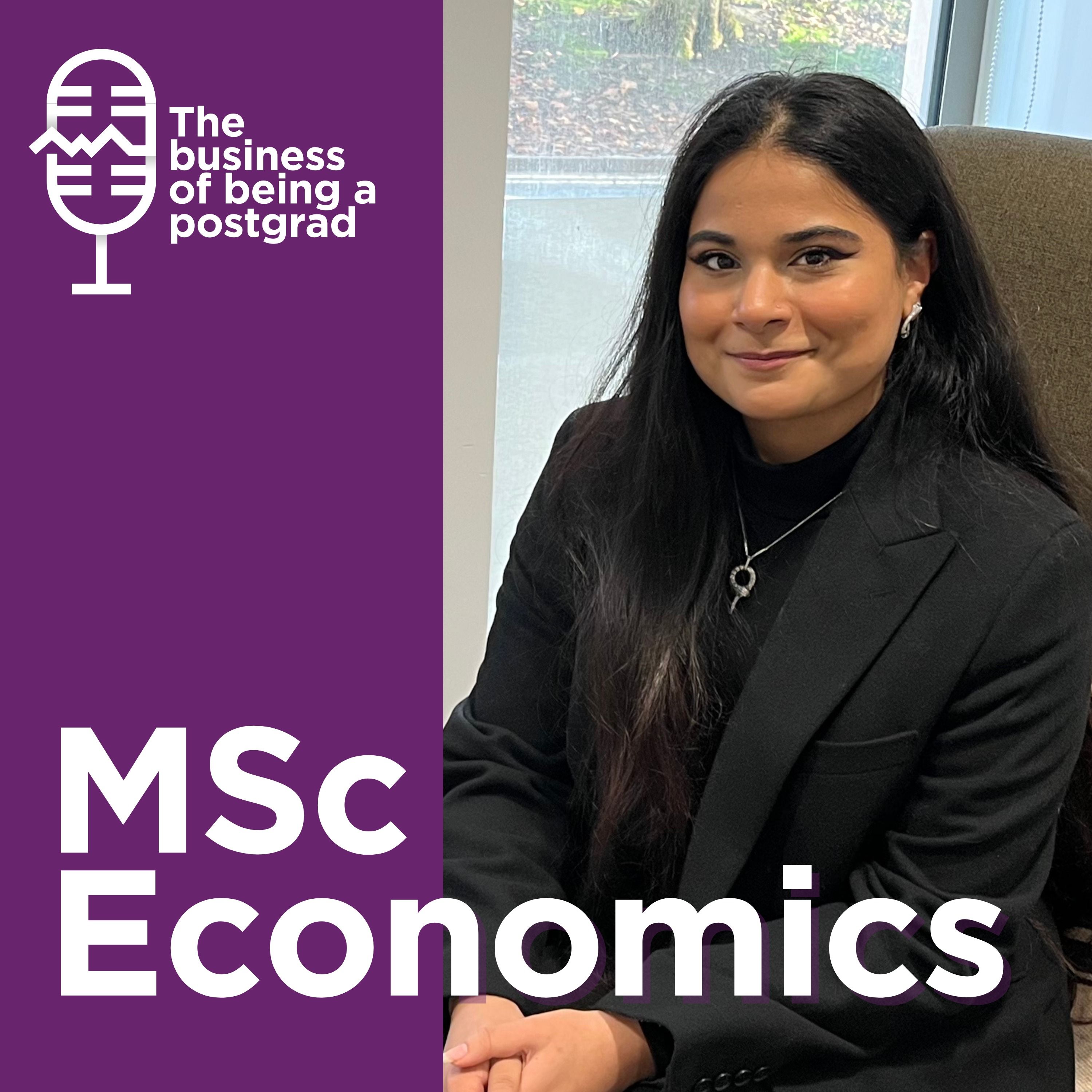
In this podcast episode, Tanvi, an MSc student in Environmental and Natural Resource Economics at Durham University, shares her journey from Bangkok to Hungary and now Durham. She discusses adapting to life in the UK, praising Durham's friendly atmosphere, scenic beauty, and collegiate system for fostering connections. Academically, Tanvi explains how her background in biology and experience as a UN climate ambassador led her to economics, seeing it as a practical bridge between science and policy. She highlights Durham's quantitative focus, supportive faculty, and collaborative learning environment as key strengths of her program.
Tanvi emphasizes the importance of balancing studies with career networking, noting active participation in recruitment events. She advises future students to engage with both sides of arguments in economics, enjoy Durham's community, and prepare for a post-grad life that integrates academic and professional growth. Looking ahead, she plans to pursue a role as a climate or sustainability finance analyst, leveraging her interdisciplinary skills to address global environmental challenges.
Welcome to the business of being a post-grad, where we share real stories, experiences and insights from post-graduate students here at Durham University Business School. Each episode explores the highs, the challenges and everything in between. Our conversations are split into three sections, life, learning and lessons. So, whether you're a considering post-graduate study, already on your journey, or simply curious about the people shaping the future of business, this podcast is your inside look. Hi, I'm John. In this episode of the business of being a post-grad, I sit down with Tanvi, an MSI environmental and natural resource economic student to hear about her journey from Bangkok to Hungary and now Durham. We discuss how our experiences at the UN Climate Ambassador and are passionate about quantity of economics guided her towards her dream programme. First up, life, your journey, your experiences and what made Durham feel right for you. Hi Tanvi, thank you for joining us sitting on the business of being a post-grad. Would you like to introduce yourself and tell us a bit about your background? Sure, hi, my name is Tanvi. I'm currently studying environmental and natural resource economics here at Durham Business School and I did my undergrad in Hungary at the University Debresson, I studied biology and I was raised in Bangkok, Thailand. Wow, so you've got lots of international experience. So, how have you adapted to life in the UK? Have you visited the UK before or? Yes, I had. My sister lives in London, actually. So, I visited the UK quite a few times. I've done a few summer programmes and different cities. So, I was quite familiar, I would say, with the country itself, but Durham has been a little bit different from my previous experiences. Could you share as to how? Well, for starters, it's extremely hilly, which is actually great, because I've gotten quite fit since getting here and the people are lovely. It's an extremely beautiful city. It's just, it's extraordinarily pleasant to walk to classes because you're just looking at the beautiful river and the trees and the cathedral, of course. It's wonderful here. And do you remember of a college? Yes, I am in Travelleon College and I live in college. Nice, and how has that experience been? It's been really nice. Everyone is super friendly. The porters, everybody, they just, they really go out of your way to make sure that, you know, you feel supported and cared for. And I've made so many friends in the most unexpected ways. Well, for example, one of my friends, I met while I was carrying some of my parcels back to my room, and I had too many, and they were going to fall, so she offered to help. And now, you know, we're attached with the hip. It's a nice interaction. Just to roll back a little bit and talk about your undergraduate in Hungary. How did you, how did you, how did you go from Bangkok to Hungary? That's a question I get asked quite often. So when I was younger, I was really obsessed with the Austro-Hungarian Empire. And I just always had a fascination with that region. And there was this amazing super old university that had a biology program in English. So I thought this was my time to study what I love, but also really experience a region that I'd been so curious about since I was a child. Wow, great. And yeah, what aspects of Durham have helped you kind of settle in and feel at home when I mentioned the collegiate system, but in terms of the city life or just your experience here so far? Well, I think the first thing is that people here are really, really friendly. Everyone's very smiley. You know, the next thing is I think joining a couple of societies really help. I think it's a very easy way to make friends. And then I think the overall structure of the fact that you will socialize, you know, with students in your program, with people in your college, and then with people in whatever societies you join, means that it's almost impossible not to have friends here. You will be social here, and you will learn so much. And in those conversations, one day you'll wake up and you'll realize that this place has become home. And do you mind sharing which societies you've joined? Quite a few. I've joined the Thai society. Very active, I believe, the Thai society. You are. They just celebrated one of our festivals called Sankran at the Durham Union. That was not of the union, sorry, the student union building. The orientation of all the student union. The student union. Yeah. And I actually need to sign up for a few more. I'm probably going to do the Durham Union. I used to debate when I was younger. I'd love to get back into that. And the wine society. Oh yeah, very nice, yeah. I know previously you were an EU climate ambassador. So great. Was that hungry? And then you still get as well. Do you have, I want to share any feedback about your experience doing those? Yeah. So while I was studying biology, I felt that I wanted to really look at what policymaking looked like, right? That's the direct application of science when it comes to environmental problems. So I started volunteering at the UN. I served as a youth delegate in several conferences, which was incredible. You know, I got to represent a lot of countries. I got to represent Hungary at the European Union. I've gotten to represent India and Thailand. And I think through this experience is the biggest takeaway that I have is that everybody's a human being might sound a bit silly, but sometimes when you're entering an organization that seems larger than life, you know, at the UN or these grand global institutions, you can feel quite afraid, particularly when you're younger. But when you realize that everybody is there trying to simply, you know, offer their position, you can get to the human side of things and really understand why somebody is representing a certain set of views. So it allows you to become more open-minded. And I think you will really appreciate the value of friendship when you're in spaces like this. Next, we're diving into learning. The classes experience and the skills that have really shaped your program so far. So your academic journey spans biology and renewable energy and complexity science. How do these disciplines influence your decision to pursue environmental and natural resource economics? It absolutely, you know, cuts right to the heart of why I wanted to do environmental economics. So I mentioned earlier that trying to understand the application of science got me into policy. And then after I worked at the UN, I realized that the problem with most environmental policies was that they're not financially attractive, right? And so for my undergrad thesis, I wrote about the economics of the EU's hydrogen economy. And that was a sort of turning point in my life because I realized I loved economics. It was so practical, it was so useful. And it was the best translation of science to actually induce change, right, in our world. And then after I started working, I actually told my boss that I wanted to do environmental economics and she would go out of her way to assign tasks to me that ensure that I learned as much as I could about the field. And over the one and a half years I spent working, I started developing an idea of what I wanted to do for my dissertation. I wanted to work on the climate discount rate problem. So when I started looking for master's programs, there were, you know, quite a few, but what stuck out to me about Durham's environmental and natural resource economics program was that it really focused on the quantitative side. And it trained you not just as an environmental economist, but as a true economist with a focus on the environment. That distinction is important because for my research, there's very few master's programs that offered that. So honestly, it was my dream program. So you've kind of talked about your expectations about coming into the program there. And how is the reality kind of matched up now that you've studied a few months here at Durham? Well, for starters, the subject that I thought would be the hardest turned out to be the easiest shout out to micro-micro-economics. And other than that, I think it's a little bit different than what I expected in the sense that I thought I would spend more hours studying every day than I do. But actually, the classes are so informative and our professors are so helpful. You know, you can always email them. You can always drop in during office hours. The amount of support actually allows you to focus on your academics, but also have space for personal life. And I think that that that is important because when you have a bit of time to yourself, you can really think about, you know, your dissertation, your next steps. So yeah. Yeah, great. So you touched there slightly on kind of like the day to day, but kind of walk us through the kind of structure of the course, like what does a week look like studying for you? All right. Well, for me, I have classes every day, but each week is a little bit different. Certain weeks we will have, you know, more seminars, we'll have more lectures, workshops. You will usually have either one to two classes a day. They usually appear at waterside. Sometimes they'll be at Millhill Lane. So you wake up in the morning, you usually, you know, review what's going to happen in your class. You go down to class. And then the classes themselves are structured. They're formal, but there's always space to ask questions. You're actively encouraged to ask questions. I think this bit is really important, but there's no such thing as a stupid question when you're in class. Just ask your professor. Go after him afterwards. And then we'll usually do like a study group sometimes in the evenings, especially if we have a formative or a summative do. We'll all put our brains together and work on it together. And that's something that's actually actively encouraged in our classes. We're encouraged to, you know, work with our peers, which is amazing. And yeah. And have you got any modules that are coming up and maybe next year and the next semester and the electives that you're looking forward to? Oh yes, I'm really looking forward to money and banking. I'm really interested in how central banks work and in monetary and fiscal policy. Just because I think for me personally, the angle of how climate change is a really big macro risk to our economy is what drove me into this program. So I'm really looking forward to that class. And you've touched on this briefly already in terms of the teaching style at the business school and your encouraged to participate and work together. So yeah, it sounds that you've got a lot of experience. You bring into the kind of classroom and the group discussions, but yeah, you enjoy that kind of group activity. Oh yes, it's really interesting because even though it is an economics program and by the way, even though I do environmental natural resource economics, all econ master students actually study together, which is amazing because there'll be some people doing behavioral economics. There'll be some people doing pure economics. And people come from really different backgrounds as people who've done maths and their undergrad physics, I did biology. And I think the perception is that it makes it harder, it makes it difficult, but actually everybody's unique perspective makes class discussions so much more interesting. The other day, we were in econometrics and we were learning about different types of randomness in data. And our professor mentioned something called brownie and motion. And so I had the opportunity to kind of lean back into my old STEM roots and talk about what brownie and motion was and how Einstein discovered it. But it's funny because you'd never think that would come up in a business school, but it did. So yeah, I think just the ability to really draw from all parts of your life and apply it to your classes is something that's very unique to an econ master's. Great. So yeah, thank you for sharing. It sounds like you're having a great time so far and as long as that's a lot to look forward to as well. Well, not exam season to test. That leads us into lessons where we talk about the key takeaways and advice for future post grads. So what's one thing that you wish you knew before you started the program? Two things. Sorry. That's okay. Number one, get good walking shoes. Number two, brush up on some philosophy before you start studying economics. Great. And kind of maybe what's the misconception that people often have about postgraduate study? I think people tend to assume that when you're a post grad student, you're going to be spending most of your time studying. But what's unique about being a post grad and how it feels different from being an undergrad is that you also need to keep an active focus on your career. So remember to socialize, remember to network, remember to put yourself, you know, out there and I would say start thinking earlier about how to connect your studies to the real world. That's going to make a difference. Have you attended any career fairs or networking sessions or anything since you've been here? Ready? So I would say it's even though I've only been in Durham for about three months, I think I've attended almost a dozen. Well, it's been quite hectic. I just had a recruiting event for Bloomberg about two weeks ago and then I had one for Bank of America. We had one for JP Morgan. I also went to the STEM career fair. There was one for finance business. I was super interesting. And a really unique mix of companies too, you know, like we had people from the Navy there. We had Deloitte there. It's a very interesting mix. So yeah, it's been quite busy in terms of recruiting events and career fairs and all that kind of stuff. And what's the most meaningful piece of a feedback that you've received from a lecturer so far? Or even a classmate maybe? A few days ago, I had a conversation with one of my professors who teaches us environmental and climate economics. And I was kind of launching my dissertation idea with him. And what I really liked about that conversation was, number one, I had intended to go in for like a 15 minute chat and it turned into an hour. And secondly, he both provided me with all of the constraints and all the things I would need to work on to make my idea feasible. But he was also actively encouraging me. So it was like there's a very practical support that felt very, very nice. Because I left that meeting, both feeling like, okay, I have to read, you know, X amount of papers and do this work. But I also felt encouraged. And I think to hear that from one of your professors is a great feeling. Thank you for sharing that. It sounds great to hear that you've been really well-supported. So your time at Durham, how is that so far strengthened your vision for addressing climate challenges globally, particularly Southeast Asia, if that's, you know, region you're looking to return to? I would say the heart of this problem comes down to how in economics we value and look at risk that's, that's all climate changes, right? It's the largest risk to our economy on a macro level. And I think kind of getting to just see what the mathematics of that looks like, it's given me a lot of insight on how, you know, policymakers and central bankers in the real world deal with it. And seeing as I have, you know, a background in both science, policy, and now, so lean on, it's like putting all the pieces of the puzzle together. And I can't give you all the answers yet, but I am feeling optimistic about what I could do with my degree, once I leave. And what advice would you give to students coming to Durham or particularly looking to study in the same field as yours? Number one would be to develop a habit of reading both sides of an argument, the joy of economics, particularly environmental economics, is that, yes, the math is there, but the math is just a language that expresses certain ideas about how the world should be governed or should not be governed. So you need to get comfortable with debating ideas whenever you write a formative, whenever you're solving your equations, it's just ideas. So get very comfortable reading both sides of an argument. And another piece of advice I'd give you that I did over the summer was because I had gone to an American school for most of my life, I brushed up on the basics of formal logic just so that I could structure my essays in a way that suited, you know, the academic style here at Durham. And that's been very helpful. So those are the two things. And what about socially kind of transitioning from a big city like Bangkok to a city like Durham? Any advice for a student in the same shoes? I would say enjoy the stillness over here, enjoy the nature because places like this that are so pristine and so lovely, they're quite rare in the world. And be friendly, go out of your way to say hello to people. I think sometimes we're all just a little bit two in our heads and we feel judged or we feel scared. Don't be scared, people here are amazing, they're lovely. And yeah. And just to finish things up, what's next for you after you graduate and what are you hoping to do? Well, I'm hoping to work as a climate or as a sustainability finance analyst. I'd love to kind of, you know, take everything I've learned about climate, use my econ degree, use my modules and money and banking, and just really put it to good use. Wow. So yeah, lots of exciting things on the horizon. So we've just got a quick by around to end things off here. So kind of I'll ask you a few questions and you just tell us the first thing that comes to your head. So we'll jump straight in, you'll go to Productivity Hack. Play the piano. Wow. One app you can't live without. Outlook. Tea coffee? Both. Both. Describe your research style in one word. Crazy. And what song is always on your study playlist? Anything by Bach. And one word to describe life as a student in Durham. Busy. Great. Well, thank you so much, Tammy, for joining us today on the podcast. It's been great to hear about your experience. Thank you for having me. Don't forget to subscribe. We've got plenty more stories coming your way.
Podcast Summary
Key Points:
Tanvi's international background includes being raised in Bangkok, studying biology in Hungary, and now pursuing a Master's in Environmental and Natural Resource Economics at Durham University.
She values Durham's friendly community, collegiate system, and societies for helping her settle in, and highlights the supportive academic environment with approachable professors and collaborative learning.
Her career path was shaped by UN climate ambassador experiences, leading her to economics as a practical tool for environmental policy, with a focus on quantitative analysis and climate risk.
Tanvi advises future students to balance academics with networking, engage with diverse perspectives, and enjoy Durham's community and natural setting.
Post-graduation, she aims to work as a climate or sustainability finance analyst, applying her interdisciplinary background to global climate challenges.
Summary:
In this podcast episode, Tanvi, an MSc student in Environmental and Natural Resource Economics at Durham University, shares her journey from Bangkok to Hungary and now Durham. She discusses adapting to life in the UK, praising Durham's friendly atmosphere, scenic beauty, and collegiate system for fostering connections. Academically, Tanvi explains how her background in biology and experience as a UN climate ambassador led her to economics, seeing it as a practical bridge between science and policy. She highlights Durham's quantitative focus, supportive faculty, and collaborative learning environment as key strengths of her program.
Tanvi emphasizes the importance of balancing studies with career networking, noting active participation in recruitment events. She advises future students to engage with both sides of arguments in economics, enjoy Durham's community, and prepare for a post-grad life that integrates academic and professional growth. Looking ahead, she plans to pursue a role as a climate or sustainability finance analyst, leveraging her interdisciplinary skills to address global environmental challenges.
FAQs
It shares real stories, experiences, and insights from post-graduate students at Durham University Business School, exploring the highs, challenges, and lessons of post-graduate life.
Enjoy the natural beauty and stillness of Durham, join societies to make friends easily, and be open and friendly as people are very welcoming and supportive.
Develop a habit of reading both sides of an argument to understand debates in economics, and brush up on formal logic to structure essays effectively for academic style.
The collegiate system provides a supportive community where porters and peers go out of their way to help, making it easy to socialize and feel at home through college life and societies.
Students can attend numerous career fairs and networking events with companies like Bloomberg, Bank of America, and JP Morgan, covering diverse fields from finance to STEM.
Many assume post-grads spend most time studying, but it's also crucial to focus on career networking and connecting studies to the real world from early on.
Chat with AI
Loading...
Pro features
Go deeper with this episode
Unlock creator-grade tools that turn any transcript into show notes and subtitle files.
 PodcastTranscript AI