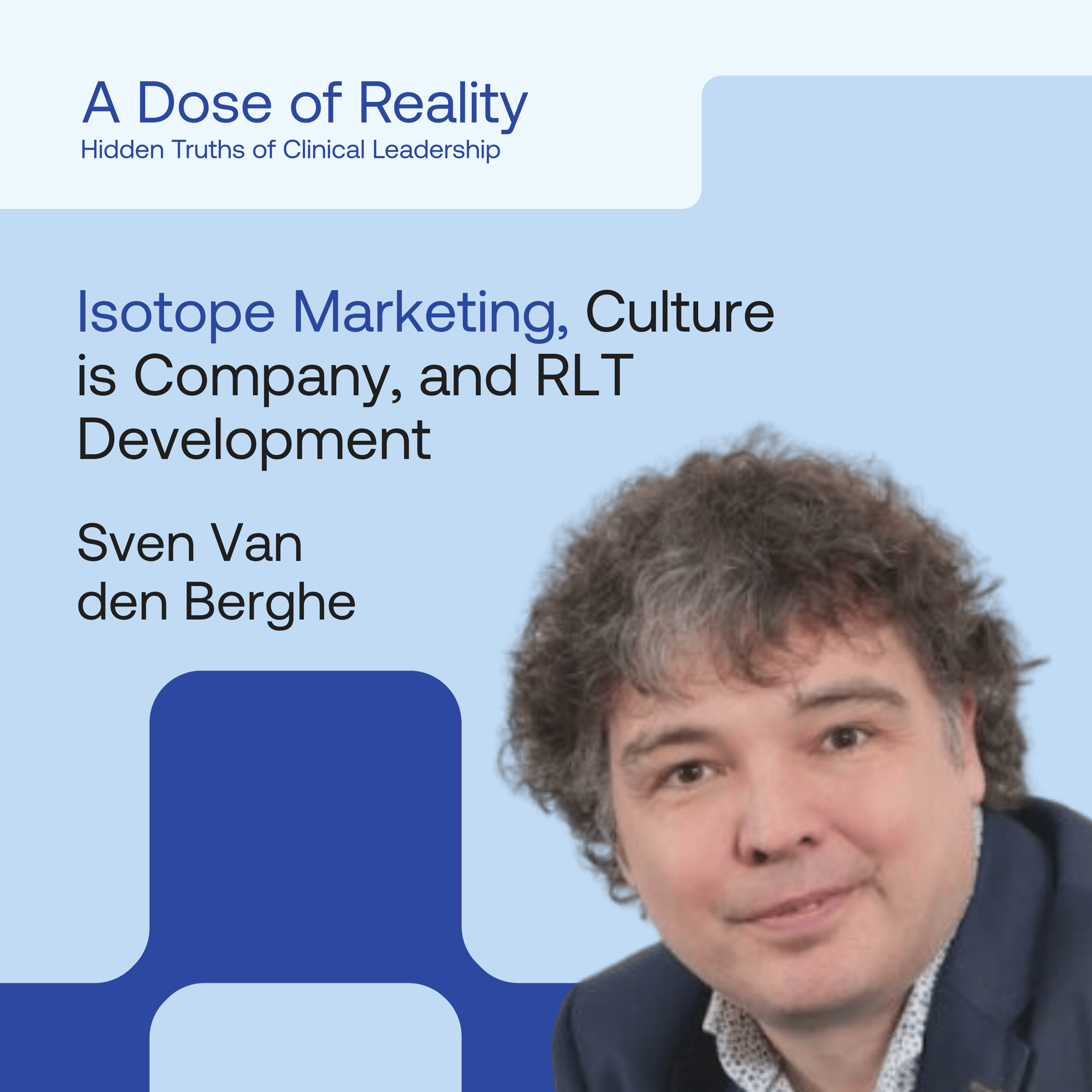
Sven Van den Berghe, CEO of Pantera on Overpromises in Isotope Marketing, Why Culture is the Company, and Discussions in RLT Development
from A Dose of Reality with Charles Spence
27m 26s
This podcast features Sven Van Den Berg, CEO of Pantera, discussing his career and industry insights. With a background in nuclear physics and over 25 years at the Belgian Nuclear Research Centre, his most challenging transition was moving to lead the startup Pantera, where initial governance clashes with larger founders were resolved by venture capital investors better suited to a startup model. He advises scientist-entrepreneurs to advocate for independent, agile governance and to build a core management team with diverse, complementary skills to foster a strong, trust-based culture. Van Den Berg criticizes industry misinformation, where companies make technically accurate but misleading claims about medical isotope production, harming sector credibility. Pantera aims to address Actinium-225 shortages by initially supplying it from a decay source and later scaling up via a novel method irradiating Radium-226 with photons, with a permitted facility construction beginning soon. He emphasizes that a company's culture, centered on genuine diversity of thought and consistent values, is fundamental to success.
[Music] In today's episode I am joined with Sven Van Den Berg, who is the CEO of Pantera, a Radio Isotope manufacturing and production company. Sven has a Masters in Physics and PhD in Material Sciences and Prior to becoming the CEO of Pantera, worked for 20 plus years at the Belgian Nuclear Research Centre, known as the SCK-CEN, eventually becoming the Institute Director. He's joined on this podcast today to share his journey in this field and also highlight some of the, let's say, misinformation, borderline bullshit at that as seen in this industry. Before we jump into all that, Sven, good to have you on here. Hey, glad to be here, Tully. You gave me lots of acronyms to work with on that introduction, so I really got to practice my ABC, so thank you very much for that. I'm going to jump into my first question. So Sven, why did you get into Nuclear Physics? It's a long story. I started already in my teen years, or I was, I would say I was a nerd before nerds, between fashionable, so I was already looking at physics and quantum physics and those kind of things when I was 16 years old. We'd need a lot of books about it and nuclear physics is just a very passionate area, so right after my studies after graduation, I decided to go to university and do nuclear physics there. And after that, it was just a story of continuing on with the stuff that I really loved, which are nuclear reactors. We go into your career within the industry, orange, you tight me all the way back. How did you secure your first job? Well, coming out of university, you have a choice to either start doing a job or you can do a PhD. And when you come out of the physics area, you're not an engineer, so typically a lot of the people coming out of that domain, or they do go for a PhD and you have a passion for research at that time, so that's what I decided to do as well. And of course, combining that with the nuclear area drove me to the SCKC and the Belgian Nuclear Research Center, because they have a PhD program and they have certain topics out every year. When I applied for one of those PhD positions, I was hired there and for four years, I did my PhD at SCK. And then for the next 25, I didn't leave there anymore. I grew my way through the ranks and eventually ended up as an institute director there, so that's been my first job and it's been my job until I became the CEO of Puntar. Hey, well, if it's not broken, don't fix it right. I love that. So in your 27 years of work experience, so first with the Nuclear Research Center and our Puntar, I'm sure it wasn't all easy. I'm sure you've seen some ups and downs, so it's been, well, I love that you're laughing already. What was the hardest or lowest point in your career? I guess that just evolves over time and if you'd asked me that just after my PhD, I'm sure I would have said my PhD is the worst thing, and oh my God, that was difficult. And of course, as you grow as a person, you see how relatively straightforward that was and that's the way things just develop. So I would say that the hardest point of my career so far was really when I made the decision to become the CEO of Puntar. It was the first time I headed out of that safe government organization based life where you're very well protected and things like that, and I moved out into the private company field. And that was a big step for me. And then as a startup and being with the founding companies with a lot of pressure to live there, that probably was one of the harder points of my career, especially because there was a lot of difference between how governance was being promoted by our founders and how we saw governance as what we needed as a startup, as a fast growing in the fast-paced, fast developing company. And our founders being large organizations having a different view on that. That was a very tough period. But once we had that funding round done that we completed last year, that brought in that vibe of venture capital investors were much more used to startup companies. And that really, I would say, fixed the governance and really made it into the greed adventure that we're in right now. And I'm sure you're not alone with those types of challenges. There's a lot of scientists who move into biotech, want to start their own venture. What advice would you give to scientists, entrepreneurs who might be going through saying similar that you went through? It's important to stick to your ideas about governance. When I started, you start doubting about that yourself. You're saying, okay, these big companies and big management, they are, they probably know better than I do. How do neat what type of governance we need and what type of governance really makes a success for a company. But that's really not always true. Building a sustainable governance there is what can lead to greatness in the end for your company. And that's not always given any more to large corporations that have been developing over time and CEOs that have been developing inside those environments. It's not the same as a startup. It's not the same as a spin off, definitely. So that's why a lot of spin off with a large part of this participation by their parents are struggling and sometimes even doomed. So one advice that I would give to any startup is try to convince your parents, try to convince those founders that having independent board members is vital for your progress. And that's not because they don't know how governance should be done is just that a startup requires a different type of governance than what they are used to. And I can totally imagine that if you launch a spin off with a person, especially in my case, a person that has never led a private company before that gives you some apprehension since you have a lot of expectations from that startup. But still it pays to stick to your guns and say, no, no, no, I strongly believe that the type of governance we need needs to give us a lot more ability to decide our own a lot more ability to move faster and is not the same one as the one that you need in a large corporation. And what was one of the so governance is one, what was another area that you had to learn on the job working academic research leadership is very different to private company leadership. So what were one or two key lessons that you've learned over the past three years. The thing obviously is that you need to take into account money a lot more. And that's not because we didn't do that in a government organization. It's just different. What we would call a business plan in within the SDK CN didn't even come close to what we needed to do for the fundraising or even within the governance of the startup before the fundraising was done. So in that sense, getting more informed on what a business plan really looks like. And especially in general, not just about the business aspects because I start out as a scientist, but you can start out as a businessman and having to learn the science on the other hand, is surrounding yourself with the right people. And there it is really important to establish that initial management in a way that you are complimentary that you really trust each other a lot and that you build this relationship from the very start in which you really have that distribution of roles where at the same time, you're also learning from each other. So getting that at the earliest point in the organization is really vital. And I was very fortunate to have found two people there, the CBO of Pantera and the CTO of Pantera today. Sami Bertras, our CTO and Christoph Malisas, our CBO. And we really felt each other directly. We almost, I wouldn't say finished each other sentences, but I would say nowadays we can do that probably. So it's really vital. And then from that, you can start building the culture of your organization because culture is not just an element. It is the element. If you don't build that, forget about it. Right, Hansen, so much to impact that culture. We're going to come on to certainly later on this podcast. But first thing we wanted to get off our chests then is the misinformation, borderline bullshit that needs to be corrected. Before we had this podcast, I asked you what would be one topic you'd like to discuss. And that is you often hear people intentionally confusing, maybe misleading, adding layers of complexity, but they really don't need to. Just as a kind of an outline, what I'll want to kind of borderline bullshit things that you think need to be corrected. As a field like this is growing and is reaching a point where it's got the attention of investors, it's got the attention of the general public, it's got the attention of politics. Then it's easy to say, hey, as scientists, you guys are not really that good at bringing those messages, at really reeling those investors in, reeling that public interest, reeling that political interest. And so let's put somebody on it with a little bit more marketing skills. And you get that tension between science, which definitely is not a belief system technology, which is not a belief system, it's really about delivering there and building on what the reality looks like, it's building the best model of reality that you can with marketing, which really goes for a belief system. It is about creating a belief system and a belief in a product or in a technology. And that creates often messages, which are referring to medical radioisotopes because it is a sexy topic, because it receives a lot
of attention from different stakeholders and because in some cases it can lead to access to funding. And not all of those claims are very true or they are just kept purposefully vague so that later on people can say, "Yeah, but we never said we would produce large amounts." Okay, but everybody knows that the implication, the thought pattern of the general public and politics is, if you're saying we're going to produce medical isotopes, it's supposed to be in large quantities. So that's an example of how the narrative is used in a way that's not always very honest, I would say. And so if a company does say, we can, yeah, of course we can produce medical isotopes and technically they can. Why is that a problem? Well, in the end, what you need is a company to produce medical isotopes if not just the technical ability to do, but it is the ability to do it very reliably, at a cost that is acceptable and compatible with the prices that can be asked for the drugs. And in quantities that are also reasonable in function of the number of patients that you need to help. So if either of those three things are not fulfilled, you're still producing medical isotopes so you're doing exactly what you claim to be doing, but it's not relevant. And especially if you're using public money to, but even if you're using an investor's money, that just ends up being a disappointment for those people that put money into it. And eventually those disappointments, they lead to people turning away from the entire area. It's just not a sustainable way of putting information out there. Well said, the other area we discussed is how other companies push down isotopes or other companies technologies in order to push theirs up. Again, give us some examples and why is that a problem? Well, it's a very natural thing to do and I will certainly not claim that I've not done it once or twice. It's not something we'll make our mistakes. But in general, isotope producers and those that are developing medical products based on those isotopes are doing this in function of helping patients. And so as long as whatever is told about isotope AB or C is in function of that and is just saying, oh, there's a benefit of this isotope in that area and there's a benefit of this isotope in that area. It makes perfect sense to me. But if you're starting to talk negatively about other isotopes just to make yours look better, that is just not what we all need. And especially if those those negative aspects of the other isotopes are again, part more of a marketing strategy than of a true scientific concern, especially if those are rumors that are out there but that have not been underpinned by any scientific studies. And there's about three isotopes today that a lot of attention is being spent on in the target that alpha therapy. It's a actinium 225 which Pantera wants to produce in large quantities led to 12 and as the time 211 and all three of them have a supporting group and people that have been investing in them. And that's great. In the end, we want to have multiple options for oncologists and for patients. But you also see a lot of people from one domain, one area, one supporting one isotope talking about the other isotope as if it has massive downsides. And so far, there is no indication that either of those three has such a massive downside that it needs to be stopped and any development needs to be stopped. So there's not really a reason to talk about that. I suppose for those who are just not always up to date in this, they're just going to get confused, turned off and not just not kind of create any action. Then neatly spend on to the next topic which is about you and your company without not the really long sales pitch. Give us the mini pitch. Tell me about Pantera and also the name. Is there a special meaning behind the name? You're talking about the one hour pitch. I suppose the exact same. Just the one hour. Let's make it. Let's start with the name. So we're a company that is about therapeutics and terranostics. So that's where you could say that there comes from. You could also refer it to the earth or to the terralis in terabytes, which is a reference to the Greek monster and the monster we're fighting is cancer. And then the pan that comes in front is like in pandemic and pantheon. It's just a way of making it all encompassing in that sense. We have an all encompassing that are put a aim. Our very first goal and we're fully focused on that is to produce actinium to two five two hundred and twenty five, which is an alpha emitting isotope very promising on which a lot of clinical studies are ongoing and which has the interest of a lot of large pharmaceutical companies today. Today there's very small quantities of actinium to two five available from specific sources, which are deep sources. So that means you have a radioactive product and it automatically by decay generates the actinium to two five. It would be great if those sources could simply be scaled up when patients become involved and when products become approved for the market. But unfortunately, there's not enough of that available. So to do that source, we will only be able to support the clinical trials. And today we also as pantera have such a source and are operating such a source. We've delivered our first actinium just a few weeks ago. I'll continue to deliver over the next weeks and ramping up that source. We have available thanks to our collaboration with terrap our isotopes, which is a Bill Gates company. So that's for the short term in the next five years that will be the basis on which we will provide actinium to the world. But in the meantime, we're also building a large factory based on a different principle, the radiation with high energy, photons, high energy light particles of radium to do six is a rare naturally radioactive isotope that is found together with uranium. And it just so happens that Belgium has a history associated to that isotope and has a unique quantity of that isotope in pure form available. So that gives us an enormous head start compared to other companies trying to do the same thing that amount of radium to stock of radium is available at SCKCN so at the Belgian nuclear research center, which is why they are one of our founders. And then on the other side, Belgium also has a world-renowned particle accelerator producer, IBA, INB, applications in the French speaking part of the country, which is our other founder and they have the ideal accelerator to produce that beam of energy, photons, high energy light particles with which we can radiate the radium to two six. So doing that, radiate that radium to two six with light particles transforms the radium to six into radium to two five, which then again by a natural process decays into actinium to two five. And with that process, we can actually produce hundreds of thousands of patient doses per year with a single accelerator. And we of course have the ability to also put in multiple accelerators. We will be launching the construction of our facility in September, so just a few months from now we have all the permits since one or two weeks ago we've received also our nuclear permit, which is a very big deal in Belgium because you need to have that approval before you can start the building, which means you build with confidence because everything has been reviewed already. And if you do things according to the plan you submitted, then normally there will be no issue starting up the facility, which of course is a big deal. So in that sense, that's what Pantera is about. That's what Pantera wants to do. And from 2029 onwards, we'll be there to provide the actinium to put into those radiopharmaceuticals for cancer patients. Exciting, very exciting times. As we all know, it's not just the product, but also the people behind it, culturally the sheer. It's important, but everyone has different definitions, different examples. First, he's spent how would you describe culture? Not necessarily a Pantera, but how would you describe it? Say a positive culture in general. What does that mean to you? It's I'm going to use some phrases that refer to some books that I really based myself on when thinking about culture and thinking about organizations. For me, culture is not just unimportant, at all. It is everything. It is your company. It starts with the why and the how much more than the what because it's about walking the talk. It's about using strengths and not about improving weaknesses. So in that sense, culture is really something you define from the very start of the company. It's not something you can allow to freely grow or organically grow. It's a choice you have to make. And especially if you make that choice in the why and the how, that becomes your measuring stick for everything you do after that. And the people you hire after that. It's not just where it's convenient or in your yearly report that those wise and hows come back. No, it needs to be part of everyday life in the company. You need to really walk that talk. And there's a lot of talk about diversity and in Pantera. We hold that very, very dearly. It's just a different kind of diversity than what people are used to. It's a diversity of opinion and diversity of character and not a diversity of sexes or other poor indicators, which people tend to try to use to accomplish the same thing. But in fact, they focus so hard on the numbers that they forget. It's all about diversity of opinion and diversity of character. And so we are using systems to try to define if we're heading into the right direction and whether we have that diversity, we're using systems like MBTI. You can use whatever you want and you can criticize each and every one of those. But in the end, it's just a way to define whether you have a diversity of opinions, rather than females and males or skin colors or whatever you want.
So in that sense, that's part of our culture. It's really important from the beginning, we even within the management, I explicitly hired a person not because it was an easy fit, but because he had a different view on things, had a much more, I would say, mathematical and ordered sense of approaching things. We don't need all extroverts, we need introverts. And so all of that is a combination of different characters. And in any culture in the end, trust is essential for speed. It's not trust that you can express. It's really a behavior. It's not a statement. It's present when integrity and intent are completely aligned when there's competence present and when results are being accomplished. And without those four, which are things that come out of the speed of trust of the Covey Foundation book, without those four, it's really impossible to get to that high level of trust that you need to achieve the speed of a startup company. And what follows from it is an appreciation and for what the others are capable of doing and eventually a joy of missing out, not a fear of missing out, with a joy of missing out. And most importantly, the ability to always assume good intent with the others because that's where so much time is lasting companies is people thinking. He said that, she said that, but what did she mean? What did he mean? What was behind it? Why did he do this? If you can just assume good intent, even if you don't understand the actions or the statements that were made or the actions that were taken, it's just assuming there was definitely a good intent there. I will go ask and I'll go see why that statement was made, why those actions were taken. It just creates such a higher speed in inside the company. So that's in the way in which I would say culture is a really important element from the very start. I love all those elements. The idea of someone sad of missing out, that they want to be part of everything in your company is great. How do you approach that then spend with selecting people during the interview process? 'Cause there's no way you can have enough time unless you have 50 interviews of people. There's just not enough resources and time to probe into every one of those elements of people. So obviously you have to make kind of concessions, you have to decide, okay, what are we gonna test here? So how do you approach that problem of, is this person going to be the right cultural fit for us? You're absolutely right. It's impossible to go through all of that and to assess all of that correctly. People are not themselves during an interview. It's fully understandable. You're trying in some way to sell yourself. You don't wanna do, make anything sound differently, but in the end you do, it's human. So in that sense, we are just doing interviews, just like any other company trying to assess but doing the best we can. What we do have is a principle that is a fail fast behind that and that comes from a book called Radical Cander. It's really about how cruel it is to keep people in a spot where they don't fit. It's cruel to them. It's cruel to the rest of the organization. It's cruel to the management. It doesn't have any good sides to it. Yes, people may be upset when you have to let them go after even a couple of weeks or months after you've hired them, but it's better to do it that way than to try to squeeze them into the organization and make other people work together with them where as they are not a fit to the culture, it's not something bad about them, it's not something bad about your organization, it's just not a fit between the two of them. And that's really something that when you have that proper culture, that organization will start to protect itself. And you need to allow it as a management to protect it. Because if you don't, that's when things go wrong. That's when you also see that you're not working that talk and you're not creating that culture properly. So yeah, the fail fast principle, it's tough because letting people go after a short time, it's not easy, but it is the right thing to do in my opinion. Hey, man. And then last question, so I don't want to be stealing too much of your time here and don't want to be taken away from producing that actinium for all the great companies out there. Recruiters, love them or hate them, we exist. What are some behaviors or activities that many of my colleagues do that you hate? Oh, you want the ones that I hate. Okay, there is one. And I think I will not be talking anything about a surprise, we're giving you a surprise by saying that some of the recruiters out there are really pushing very hard, sending a lot of CDs. Sometimes we simply don't look at them. But later on that person can send in their own CV or that CV can come across our desk in some other way. And then we can even get telephone calls of companies saying, hey, we sent you that CV, so now you're supposed to pay us. That's where I really draw the line and where I have to say that I'm really annoyed. And I'm sure not all companies work like that, but as we were seeing in the beginning, there is some bullshit in every domain and that just happens to be one that is in the domain of recruiting. And now we work with the recruiters for about, I would say, 20, 30% of our hiring and so far our experiences have been mostly positive so that's been good. - So it's always a great way to start relationship with threatening to sue someone from money, right? - That's right. - Hey, it's been an absolute pleasure. I think we've highlighted some, let's say, confusing tactics that exist between the fine line, that gray zone between science and marketing. I would have had a nice overview of where your company is today and what is the gonna be the future until 2029. And then of course, if any recruiters or aspiring recruiters are listening to this, perhaps not to start a relationship with, don't screw us over, please. - Yeah. (laughing) I love that. Last one before, let you go, Sven. What are you most grateful for in your 25 plus years in the industry? - Oh God, that's a tough one. What am I most grateful for? I would have to say that all of the chances I've had to travel and to meet other people within the SEK, CN organization, but also today within Pantera, it's just the people that make this happen. And you have such motivated and really passionate people in science and in technology, it's just a joy to work with these people and especially a lot of them are really very competent as well. Just making sure that those people get part of the reward and it's not just those that are able to stand up on stage and make a bit statement and do their big show because often that doesn't go together. I happen to be somebody that loves the stage and loves to stand there and make it a nice story, but I also make a point of addressing the crowd in such a way that I give credit to those people that are behind that and that give me the opportunity to tell that story and that's often and obviously not just me. - With that said, thanks very much for your time. It's a pleasure having you on here. It's been my pleasure, thanks, Jody. (upbeat music)
Podcast Summary
Key Points:
Sven Van Den Berg transitioned from a 25-year career at the Belgian Nuclear Research Centre (SCK-CEN) to become CEO of Pantera, a startup producing medical radioisotopes like Actinium-225.
The hardest career point was moving from a secure government role to a private startup, facing governance conflicts with larger founding companies until venture capital investment aligned the governance model.
Key advice for scientist-entrepreneurs includes insisting on independent governance suited for startups and building a complementary, trusting initial management team to establish a strong company culture.
A major industry issue is marketing misinformation, where companies make vague or technically true but commercially irrelevant claims about isotope production, risking investor and public disillusionment.
Pantera's strategy involves short-term Actinium-225 supply from a decay-based source and long-term, large-scale production using photon irradiation of Radium-226, with a facility construction starting in late 2024.
Company culture is foundational, defined by diversity of opinion and character, trust, and aligning actions with core values ("the why and the how") from the start.
Summary:
This podcast features Sven Van Den Berg, CEO of Pantera, discussing his career and industry insights. With a background in nuclear physics and over 25 years at the Belgian Nuclear Research Centre, his most challenging transition was moving to lead the startup Pantera, where initial governance clashes with larger founders were resolved by venture capital investors better suited to a startup model. He advises scientist-entrepreneurs to advocate for independent, agile governance and to build a core management team with diverse, complementary skills to foster a strong, trust-based culture.
Van Den Berg criticizes industry misinformation, where companies make technically accurate but misleading claims about medical isotope production, harming sector credibility. Pantera aims to address Actinium-225 shortages by initially supplying it from a decay source and later scaling up via a novel method irradiating Radium-226 with photons, with a permitted facility construction beginning soon. He emphasizes that a company's culture, centered on genuine diversity of thought and consistent values, is fundamental to success.
FAQs
Pantera is a radioisotope manufacturing company focused on producing actinium-225, an alpha-emitting isotope used in cancer therapeutics and theranostics. Their goal is to provide large-scale, reliable production to support clinical trials and patient treatments.
The hardest point was leaving the security of a government organization to lead a private startup, which involved governance conflicts with founders and adapting to the pressures of a fast-paced company. Securing venture capital funding later helped align governance with startup needs.
Stick to your ideas about governance and advocate for independent board members, as startups require different governance structures than large corporations. Building a sustainable governance model is crucial for long-term success.
He learned to prioritize financial planning and business strategies more intensely, and emphasized the importance of building a complementary management team early on. Establishing a strong, trust-based culture is essential for organizational growth.
Some companies make vague or misleading claims about producing medical isotopes, focusing on technical feasibility without addressing reliability, cost, or scale. This can mislead investors and the public, potentially harming the industry's credibility.
Negative marketing based on unsubstantiated claims can confuse stakeholders and undermine patient-focused progress. It's important to highlight the benefits of each isotope without spreading unscientific rumors, as multiple options are needed for effective cancer treatments.
Chat with AI
Loading...
Pro features
Go deeper with this episode
Unlock creator-grade tools that turn any transcript into show notes and subtitle files.
 PodcastTranscript AI