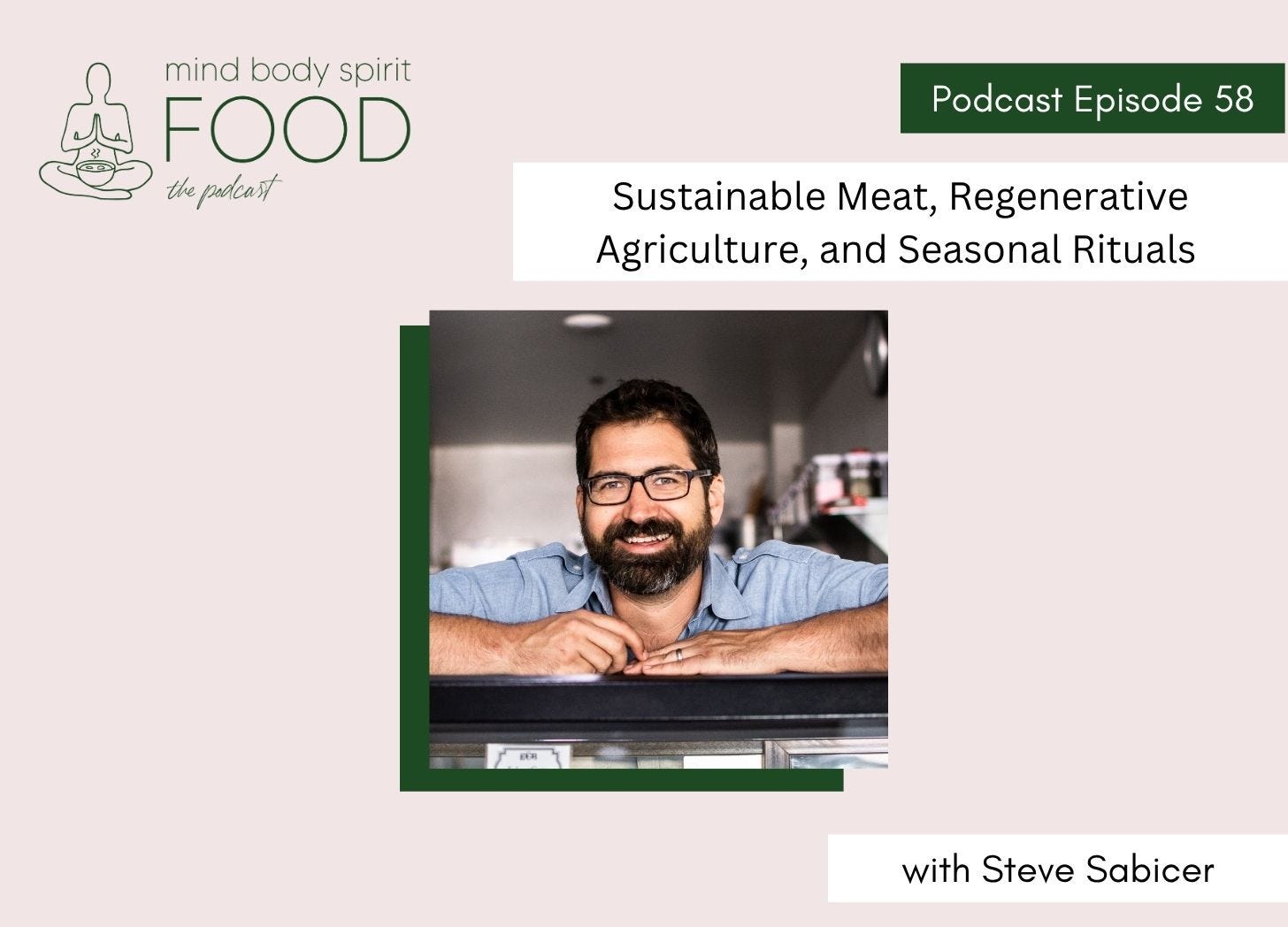
Sustainable Meat, Regenerative Agriculture, and Seasonal Rituals
48m 12s
In this podcast episode, host Nikki Sizemore and guest Steve Sabaker discuss sustainable meat consumption and holistic living. Sabaker, a former butcher, argues that responsibly raised meats, particularly grass-finished beef and lamb from regenerative agriculture, can be environmentally beneficial by sequestering carbon and rebuilding soil health. He emphasizes that the environmental impact depends on how animals are raised, not meat consumption itself. The conversation also covers practical advice for choosing quality meat, understanding labels, reducing waste, and stretching budgets. Additionally, Sabaker shares insights on incorporating small rituals, like using the medicine wheel, to achieve balance in mind, body, and spirit. The episode maintains a non-dogmatic tone, respecting both vegetarian and omnivorous diets while encouraging informed, sustainable choices.
Many of my friends are vegetarians. I'm totally open to however you put food into your body and if it's in the balanced and healthy way. I think we can all achieve that with meat or without. But if you're a vegetarian because of environmental reasons, there's some really compelling news out there, which is that responsibly raised meats, regenerative agriculture meats, and specifically grass-finished beef or grass-finished lamb, is some of the most environmentally responsible proteins you can put in your body. And this isn't just crazy, you know, butchery talk. It's clinical evidence. Welcome to Mind Body Spirit Food. I'm Nikki Sizemore, and in this podcast, we explore how food connects us and sometimes disconnects us to our minds, bodies, spirits, the earth, and our communities. This is a space dedicated to bringing more presence, intention, ease, and joy into the process of feeding ourselves. Let's dive in. [Music] Hello, my dears. Welcome back to the show. Today's episode weaves together two different threads. How we can eat meat more sustainably and joyfully, and how we can live in a way that feels more sustainable to our nervous systems. I'm joined by butcher-turned-writer Steve Sabaker, who's the publisher of the enlightened omnivore newsletter and podcast. His pathwines from being a latchkey kid watching PBS shows to working in healthcare PR, to running an artisanal whole animal butcher shop to now sharing grounded wisdom about regenerative agriculture and daily ritual in his newsletter. We talk about what better meat actually means in practice. And as I mentioned in this conversation, this is a non-dogmatic space. If you choose not to eat meat for any reason, I think that's great. I still think you're going to learn a lot from this conversation. But if you prefer, you can just jump ahead to about 35 minutes in when we switch course and start talking about ritual and the cycles that sustain us. Steve points out that it's not so much whether we eat meat, but it's how the meat is raised. We get into the environmental implications of meat, some of which are going to really surprise you. He describes the difference between grass, finished, beef, lamb, pasture, and chicken, and their implications for carbon emissions, soil health, and flavor. Steve also demystifies labels and offers practical, budget savvy tips for stretching more expensive pieces of meat and for reducing waste and why that's so important. We also get into life sustainability, the small rituals and cycles that help us find balance. Steve shares how he uses the medicine wheel in his life as a compass to help balance mind, body, spirit, and heart. And if you think this is all woo-woo, you're going to love hearing from Steve, who's really practical in his approach. I have to read you with this quote. He's learned to bring these ideas into his life, quote, "Without freaking my wife in KIDS out, "are getting too many eye rolls at the dinner table." You're going to learn so much in this conversation. I think you're going to be so inspired and come away with ideas for creating more sustainability within your life, and perhaps for supporting a more sustainable agricultural system. As always, you can support this show by sharing it with your friends, rate it on your podcast apps, and you can subscribe to the Mind Body Spirit Food newsletter on Substack. Be sure to hop over there. You can like the post, share the post. In the newsletter, I go deeper into some of these topics, and I share weekly new recipes, all of which are gluten-free. If you become a paid subscriber, paid subscriptions are so important. That's what funds this work. That's what makes all of this possible. This is a community-driven enterprise. I'm so grateful for the paid subscribers just a few bucks a month, and you get access to the full recipe archive, discounts on one-on-one sessions, and a whole bunch of other fun perks. Well, as but not least, my Mind Body Spirit Food cookbook is now available for pre-order. The book comes out in early January, but pre-orders are another great way to support this work. All right, my friends. Without further ado, let's get into the show. [BELL RINGING] Hi, Steve. I'm so excited for our chat today. Welcome to the show. Thanks so much for having me, Nicky. So I'm going to start by asking you the first question I ask all of my guests, and that is, what is your cultural upbringing, and how has that influenced your relationship to food? My ethnic background isn't all that interesting. My dad, his family is Czech, and Scotch Irish. My mom's side is mostly Irish and British. So a lot of Northwestern European white people, it didn't influence my food experience either. They didn't bring a culture of feed with them. What I think really influenced my relationship with food was, I grew up a military brat, and I was a latchkey kid. So I moved 10 times before I graduated from high school. And so I was in all these different places. I'm in a group in Guam, in Texas, in California, and sometimes back and forth, back and forth. And so, you know, Teriyaki chicken, and Mongolian barbecue, and pickled papaya, and coconuts off the street, literally growing in a front yard, when I was a little kid, and being exposed to a lot of Asian tradition, my comfort food when I was little, like when I was sick, my mom would make rice, and Teriyaki chicken, and put a big pad of butter in it. That was my comfort food. A little hybrid of Asian, honky cuisine there. But then, latchkey kid, growing up, I was never afraid of the kitchen. I was responsible for my snack when I got home. I made dinner at eight or nine. I was starting to cook. And so, it wasn't great food. I'll be honest. It was like, "Pop ramen." But my mom was kind of a health nut, too. So, we didn't have, you know, the lucky charms and the ho-hoes that my neighbors had. It was like, "We got these bags of generic puffed wheat cereal, and I had to like, doctor it up with sugar, and splices of banana, and anything to make it interesting." And then also, you know, like nachos. That was my go-to. I think I made nachos almost every day, because-- Nice. No potato chips, no like, you know, it was--Tortiachips were the junk food in our house, so I had to like, you know, I learned really quickly how to make things more palatable for my nine-year-old palate, you know. But that was my food experience when I was really little. And, you know, my mom cooked, and we cooked, but my sister and I, but it wasn't a passion for food. In fact, you know, the people around me probably saw food more like fuel. Well, okay, at least you were understanding what tasted good to you, which is great as a kid. What led you into the food world eventually? Like, how did that journey come about? Yeah, I mean, again, latch-key kid, I had a lot of time to watch TV, and I was like a PBS nerd. Yes, me too. Yeah, so, I mean, when my buddies were watching reading Rainbow and Square One TV, I was watching Yancan Cook and Jack Papan. Jack Papan was like my first idol, yes. I know, right? No, wait, there we go. So, I mean, this was before YouTube, where you could Google anything about how to make food. And I think I just subconsciously, over the years of watching PBS, I learned techniques without ever practicing them. Or I would pretend to make some of the things that were on the show. And so, like I said, I was super comfortable in the kitchen. I just had no orientation toward quality ingredients or technique. It really wasn't until college when I met my wife and her family's French. And I remember coming to visit her family, and the first time her mom asked me to make a salad. And I was like, "Sure, no problem. I can do that." And so, I put together the salad. And first of all, they only had a whole leaf lettuce. And I had to like, spin dry it. And then, break it apart with my hands, not cut it with a knife. And I was like, "Why would I do that?" And then I cut up some red peppers. I was like, "Red peppers." Wow, those were like expensive in the grocery store. We didn't have red peppers in my house. And she's like, "Yeah, wait, you've cut them too large." This is a salad. Like, who cares? No, here's the technique. She showed me how to julienne these red peppers. And then I went in the fridge and I went to go look for salad dressing. Because in my house, everybody had their salad. There were five bottles of salad dressing in my house. Friends. Creamed Italian, ran. You know, in the kitchen, open the fridge. There's no salad dressing. Oh, you guys are out of salad dressing. She looked at me like I was an alien. And she said, "I'll make the vinaigrette if you want." I was like, "What? You can make salad dressing?" The whole block. But I installed a little sponge. I was so enamored and so fascinated with this. It was like immediate.
I gotta learn more about this. And so as a young adult, I would just have people over all the time. I remember the first weekend, I got my first apartment and I lived in Washington, DC. I made lasagna and it literally, I found a joy of cooking cookbook in a thrift store and I opened it to lasagna and I was like, okay, 20 people coming over and I made the biggest, I went and bought the biggest pan I could find at a thrift store and I just filled it with lasagna. I mean, three boxes, noodles. - Oh my gosh. - People liked it. Like I don't know if it was the best lasagna, but I was just, like I said, fearless to try anything but weathely ignorant until just with practice, just with like mistakes. - You know, I have to stop you there because first of all, so funny, first of all, Jacques Papin, my idol. And when I was in culinary school, I went to the French culinary institute in the city and he was one of the deans at the time. And I got to watch him debone a chicken, an entire raw chicken in one minute. It was the most, one of the highlights of my life. And then he was one of the, when you have your final exam, you got to cook for a panel and he was on my panel. I know. - Oh no. - It was like a full circle moment, but then the salad thing, same thing I studied abroad in France and this just blew my mind. I actually have a recipe for it on my blog and in my upcoming book, my body spirit food because we make a version of the salad almost every single night and we make the salad dressing right in the bottom of the bowl, exactly the way my French mom wanted with lemon or vinegar, a crushed garlic clove, olive oil and maybe some d'john, honey if we're feeling American or wild 'cause she never did that. But it was a game changer, a way of making a salad. I was like, what? This, why is this so good? And we would eat the salad when I was in France as its own course. Like it was a special part of the meal. It wasn't the thing we had to choke down, which was what it was for me when I was growing up. But I love that all of these kind of experiences lead you on this journey of curiosity 'cause what I'm hearing is like, that love that word, fearless and curiosity. And in reading your bio, you sound like a very curious person because you've done a lot of things like a lot of us have. I think that's something that fuels my life as well. So you're a young adult, you're experimenting with food. Now how do you find butchery? - Yeah, well it was a little while later. I mean, I actually, I went into a career in healthcare public relations about as far away from cuisine as you could get. - Okay, this is so weird 'cause I did that too. That's a huge-- - Really? - Yes, only, I only lasted two years. I was like, this is literally, I hate this job more than I think, but that's just bizarre. Right, that was right after college before culinary school. Anyway, go on, lots of similarities. - I stuck it out a little longer. I did work in DC and public policy. And then in New York, I worked in agencies, PR agencies that worked with pharmaceutical companies. And then I went into medical device technology, worked inside a corporation. It was not fulfilling to me. It was really, I'm very thankful for that time 'cause it was really what my family needed at the time. And it was interesting. I can't really do anything if I'm not intellectually stimulated, but I didn't feel a passion for it. And so about 15 years in, I had this sputtering, third life crisis where it was, I mean, I was in my mid 30s and I basically was like, what am I gonna be when I grow up? And remember having dinner with some friends over too many bottles of wine. And literally at one point, I'm like standing up and everybody's sitting around and circling me. It's almost like a game of charades or something and they were like yelling out, I was like, what should I be? What should I do next? And they're like yelling at all these possibilities. It was like, would worker, high school teacher, zookeeper, work ranger. And I was like, and then one of my buddies was just like, butcher. And I was like, what? He was like butcher and everybody kind of giggled, but I was like, no, that, I was looking for something tangible. I was looking for something that I worked with my hands and I had already considered going to culinary school. But I had some really good advice from friends that said, look, if you're gonna go to culinary school, go work in a kitchen for at least a month because this is what you're gonna have as an option afterwards. Yeah. So, like any good student, this butcher seed was planted. And I was like, I need to do some research. And so I went and took a class at this great butcher shop that's no longer there called Heart and Trotter. There'll be a theme here of butcher shops no longer there. Down San Diego, these guys were a whole animal shop doing great work. I just took like a one night class that was really for their customers. It was like kind of more edgetainment than it was, you know, apprenticeship. But I loved it. Thought it was really interesting. I mean, there's almost like an anatomical, kind of medical field to it as well. You know, I had a culture of, went to high school in an agricultural community. Everybody I knew hunted. So I had like an orientation to seeing like a deer hanging in somebody's garage. And I wasn't squeamish about it. But then taking that class and then I found an old school butcher shop, like really a processing plant near my house. And the guy was like 85 years old. And he's like, come on in. You know, you're going to work for free for a day and we'll see if you're any good. And I literally spent the entire, I spent half the day wrapping me and the other half of the day grinding beef fat in a walk-in in like a 36 degree walk-in. And I was like, you know what? I think I can do this. Like I liked the old timey vibe of the guy. I was watching what they were doing. And I was like, I want to do that. But he was like, okay, if you want, he's like, good job today. If you want to stick around, it's going to be six months of wrapping meats until you can identify every cut. And then six months of grinding meat. And maybe you'll make sausage and then six months and then six months, you know, you like outlined this four year or anything. You know, at minimum wage. And I was like, I'm not going to be able to feed my family at all on that. So I finally found on the internet, an electric city butcher and my good friend Michael Puglisi founded this amazing store in Orange County, California. And it was this combination of the old world, charcuterie and artisanal approach to whole animal butchery with this modern contemporary value system of responsible sourcing and working with small farmers and running the place like a Michelin star restaurant. I mean, we were cutting the green tape when we were labeling things. We were, you know, I would dice onions and pick time for the sausage. - Wow. - He was like picking through my onions to make sure they were all the same size. And if there was a stem in the time, I got, you know, reprimanded. And I did a 10 week apprenticeship there, two nights a week or two days, 10 hour days, every week for 10 weeks. And I just fell in love with this attention to detail, the mise en place, the fact that everybody worked together to clean the place spotless at the end of the night. It was just this magical experience where I learned so much about cooking in addition to butcher. - Yeah. - And then I had to leave. I was like, okay, I gotta go do something else 'cause I can't, no. There's no job for me that's gonna pay the bills. But I couldn't get it out of my mind. Like the next six months, I tried all other kinds of things and I just kept coming back to how I felt in that shop. And so I went back, we worked out a deal that I could work full time. My wife was an amazing understanding person to be like, what are you doing? How are you gonna make this work? (laughs) And sooner or later, you know, I got more involved in the business. I saw the needs for marketing and business operations. And I bought into the business. I became a partner. - Mm-hmm. - It was an amazing group of folks that were working for us. And you know, within a couple of years, I was CEO. We opened another store. And I just, you know, is the best seven years I've ever had that really, really amazing time. - A lot of us meet eaters. I am a meat eater. I'm an omnivore, just like you. I kinda wanna get back to the sustainability part and the focus because I know that's a big focus of what you do within your newsletter as well. Let's talk about this. And I know that I'm gonna start by saying, for my listeners, this is a very non-dogmatic space. So for those of you out there listening who choose to be vegetarian or vegan, I applaud that choice for you. For those of us who choose to eat meat, I think there's this dilemma that we're often told or that we think we face of the environmental impact of eating meat and the joy we get and the sustenance we get for meeting meat. So I have some thoughts on this, but I know you have thoughts and much more direct experience about this. How do we make eating meat a sustainable practice? - Yeah, I mean, I get this a lot. And I mean, again, I'll say the same thing. I'm totally open to however you put food into your body and if it's in a balanced and healthy way. And I think we can all achieve that with meat or without. But if you're a vegetarian because of environmental reasons, there's some really compelling news out there, which is that responsibly raised meats, regenerative agriculture meats.
and specifically grass-finished beef or grass-finished lamb is some of the most environmentally responsible proteins you can put in your body. I mean, animals that graze on grass in nature are there to sequester carbon and rebuild soil. That's their job. They turn the grass into manure which then rebuilds the top soil so that more grass can grow. And they have this relationship that they've had for millions of years, you know, in North America, there were over a hundred million animals roaming around the prairie well before we were doing any agriculture. In fact, there were more animals on the land we live on now than there are today. And so I'm like, how can animals be bad for the environment? If there were more of them back in the day when everything was more balanced and there wasn't this climate change crisis, it's all about how we raise the animals. That's the problem, right? And so I'll give one more anecdote for this 'cause I know some people are like, well, hold on, you're a butcher and, you know, obviously, you've got to alter your motive. You know, I'm not selling meat anymore, but I do believe that this is real science. And it's that, you know, there was a study done years ago back in the fake meat movement, which is still, you know, kind of percolating, but when it was hot, one of the meat companies, one of the fake meat companies conducted a study to find out how much better they were for the environment than industrial-farmed animal proteins. And they hired this really respectable firm and they looked at all kinds of animal proteins. And they found that their fake meat captured about three pounds, or excuse me, produced about three pounds of carbon dioxide per one pound of their fake meat, which is actually pretty good carbon footprint because chicken is about the same. Pork is like six pounds and beef is like, in a current day to like 11 pounds of carbon dioxide per pound of beef. But what they also tested was grass-finished beef at this amazing plant white oak pastures. Will Harris, this folksy kind of foghorn-leghorn character from Georgia talks about it all the time. You can Google him from the animal internet. You probably know about all about him. And they found that this grass-finished beef that's being raised in Georgia actually sequesters three carbon dioxide per pound produced. Through this process I'm talking about, where it's converting all this grass that's naturally growing into manure, which is then seeping into the ground and then through the oxygen in the airs, pulling carbon as a carbon sink back into the ground, turning it into more soil, turning it into more grass, letting it be eaten this kind of constant cycle. And so basically what this study found was that you had to eat a pound of grass-finished beef, real beef to offset the environmental impact of this fake meat. - Whoa. - And that was where I was like, oh my God, like this is exactly what I believed in my heart of hearts, which is that if we rely on the natural function of the earth and rather these factory-formed extractive activities, I mean what we're really doing now and for the last 100 years in farming is we're extracting all of the carbon, all of the nutrients, all of the resources out of the earth and not giving anything back. Or we're turning all of that stuff that could go back into the system into poison by concentrating manure and dumping it into rivers or letting it off gas into methane and all these horrible things. Rather than just let what Mother Nature's been doing for a long time to produce all these beautiful animals and really replicate more of what's going on naturally rather than industrially. And so that's my soap box on that front. - Well, I'm gonna direct readers to my conversation with Liz Carlyle. She is an anthropologist and talks about the importance of carbon sequestering and how the land has shifted since Buffalo have stopped roaming and what a benefit they were and you can just get a lot more of the data in that episode. One argument I hear about this is about feeding the world. How can we feed the world in a way that we're using regenerative agriculture in this way? What are your thoughts on that? - I mean, right now in the US, we export a ton of food. Something like 40% of the food we grow is exported. So this is not an issue of supply or yield. In fact, most of the food we grow isn't even eaten by humans. It's either force fed to cattle and other livestock where it's turned into fuel as ethanol or into high fructose corn syrup or into a bunch of industrial products. I didn't know this until I met this great guy, Austin Ferrick, who wrote this book, "Barrons," which is a super cool book about how you basically the US food systems controlled by a handful of rubber-baron style privately owned companies that aren't even publicly owned. So we know next to nothing about how they operate and what their priorities are, but Austin's from Iowa. And he's like, "Oh, I remember when I was in college "in this girl from California who was going to school with us." She saw this beautiful field of corn and she ran out into the field and grabbed a kernel of corn and she started peeling it. We were like, "What are you doing?" She's like, "Wow." I'm gonna eat this fresh corn and they're like, "That's seed corn." Or that's fuel corn. That's inedible. You can't eat that corn. And that's what is growing on most of the country now because it gets a better profit margin than the corn that we eat, the sweet corn that we eat or the popcorn that we eat. The issue is not supply, but also the issue is not, even if we had a supply issue, we're also wasting a huge percentage of the food that we eat. And so, you know, 30 or 40% again, I haven't looked at the recent data, but the last time I looked at it, it's almost half of the food that we serve people is thrown away. And all that we cook at home, right? And so what I always tell people is, hey, if you want to eat more responsibly raised meats, like if we believe that that is a better thing and you know that it's gonna cost more, one of the ways you can stretch your dollar is by reducing your waste and using every part of the products you're buying. And for me, in a home kitchen, that's make your own bone broth, render and use your animal fats and buy larger cuts and with a 15 minute YouTube video or an email to me or a call to your book. And you can learn really quickly how to portion those to look just like grocery store steaks and chops and save you, you know, 30% on the cost. And so that's to address the food waste 'cause how many times do people throw away the bones after they roast a chicken or the skin because they don't like to eat it, you know, or you know, how many people are like, oh, this person didn't eat their whole steak, so I can't do anything with that. No, you can take all of the scraps off of your plate and turn them into broth. You're gonna boil it like all the bacteria is gonna be gone, you know, and you're gonna (buzzer) tons of nutrients, tons of collagen, tons of vitamins, and you're not gonna be buying stock from the store which comes in packaging and is, doesn't taste as good and doesn't have the same nutrient profile. So, you know, by a whole chicken, you're gonna get three meals out of it, you're gonna get broth and you're gonna get schmaltz, and I'll tell you, as you know, sauteing vegetables and chicken fat is, and times better than any oil you can get at the store. - You know, I have to call out, we have a local butcher, Marbled Meat Shop, which I know, first of all, I just have to give them props, it's an amazing, amazing store, owned by a husband and wife. I feel so lucky every single week that I get to shop there and by locally raised grass finished meats by people who are preparing food with a lot of consciousness, maybe isn't the right word, but with a lot of care. And that being said, these cuts of meat are more expensive, rightfully so, so in my family, we don't eat a lot of meat during the week. We save that budget four weekends when, because I love brazing, I love meat, but it is a matter of prioritizing where we put our dollars, and then those tips that you have for, you know, extending the life of a chicken. I mean, that's such a, I say that, and it's like very ironic because it's a dead chicken, but you know what I mean? Extending that meal into more than one, those are great tips. I know that you mentioned that a lot of these butcher shops are closed. I mean, I think we all know that. Do you have sources? Where do you source meat? - The double-edged sort of COVID for our industry meant that a lot of our ranchers and farmers had to start selling direct to their customers. And they did that by creating their own websites, their own shipping plans. And although that wasn't great for our business model, it does mean that you can get access on a national level to some of the best.
responsibly raised meats in the country. And California is doing a lot of that because we have mild winters, but there is great grass-finished meat all over the country. And you really have access to it by, you know, click of a website now. - Mm-hmm. - So I do buy in bulk meat from a handful of my old ranchers. And then like I said, there are, as much as I'm not a huge fan of places like Costco, they have been relatively open with me when I ask pointed questions to their, they actually have a butchery team, like they have a meat cutting team in every single store. And those guys, if you go up to them, you know, you knock on the window in the back, they're happy to talk to you. I get a lot of information that maybe the corporation doesn't want shared because these guys are like, oh yeah, I know where this is coming from or they can get you the brand. And so, you know, much of their stuff, especially these days, much of the grass finished affordable meats that you're gonna find in any grocery store is from Australia, which is crazy to me. - Oh, yeah. - But it is grass finished. And so if you want to support that marketplace rather than your dollars to go, and again, I'm just talking about beef right now. But, you know, that's another avenue is to look at the labels, you know, and so, you know, grass finished or 100% grass fed beef and lamb. Those are gonna be environmentally responsible. And probably the tastiest and certainly the highest nutritional value. And lower in fat too. Like-- - I wanted to ask about the nutrition. Yeah, do you have information about the benefits, perhaps, of grass finished or grass fed versus industrial? - Yeah, I mean, there's been a lot of studies. I mean, everybody would love to analyze this stuff, you know, and get cold hard facts. It's expensive to do. So, you know, most of the data is pretty circumstantial. But the baseline data is, yes, there are more nutrients in a lot of these grass finished products because they're getting the natural ration that their body was designed to consume. Like basically beef at the second half of their life are which they live about two years. Actually 14 to 16 months in conventional ranching. And for half of their life, they're fed a ration of corn and soy. And it's like candy. Like it's like feeding a cow candy because it's high in calories, it's quickly converted. And ranchers are paid by the weight. So they want these animals to grow quickly and get fat. And it's much fattier. And we've kind of trained the American palette on this high fat content beef. But if you've ever hunted game, or you've ever had bison or venison, or in France, the E-course, these meats are all super lean. They're very dark red and super lean. And if you look at grass finished beef, it is much lower in fat. And in some studies I've seen, it's about the same fat to protein ratio as boneless skinless chicken breast, if you can believe that. And so it's actually that lower fat content, lower saturated fat content is healthy and good for you. So, and I know of another company, Pasteur Bird Chicken, which is now a national brand, but we worked with them when they worked a single farm in Southern California and only had a few thousand chickens. And now they're massive, but they pasture raised their animals in a chicken tractor, which is basically like a big greenhouse on wheels that moves across the pasture. And the chickens are in the grass. And they're getting all the nutrient value from that grass and from the bugs and insects in the grass. And they've done studies on their website that show that they do have, you know, higher levels of amino acid and vitamins than any kind of store-bought chicken that's raised in factory farms. - Yeah, and at least for me, from a cook's standpoint, the flavor, I just prefer the flavor. There's so much more nuance to flavor. And instead of it just that slick fatiness, which can feel really good, but there's a depth to flavor to grass finished beef and to pasture chickens that I find really delicious. - Well, yeah, and that's, I mean, I buried the lead there. I mean, that was what really compelled us to focus on this market when we had the butcher shops. And products sold itself, people ate our meats and they didn't have to be convinced that these were different because they taste so much better. It's basic, not only you are what you eat, you know, so the fact that these animals are eating a healthier ration that is higher in nutrients, but it's also about time. I mean, animals that are responsibly raised in regenerative agriculture live longer than factory-farmed animals. And so they have more time to develop all those yummy flavors. And that's what makes the grass finished beef so rich and deep in flavor that you're talking about. And pork, I mean, if you've had heritage breed pork, that has been eating on, you know, some wild ration, you know, where they're out there rooting around and doing their porky pig behavior, as well as getting something like a slow growth feed like barley rather than corn and soy. One of our ranchers actually, they were close to an ice cream plant and a pork deeria and they would get all the stale tortillas and ice cream and that's one of these pigs for eating. Well, I mean, you know, that was unusual, but the ration is, you know, letting a pig, which is an omnivore, eat a more omnivorous diet, just builds amazing flavor profiles and letting them live a life that's 12 to 15 months rather than the six months that they live in a CAFO and a confined animal feed operation, where they never see the sun, they're never walking on soil and they may have, you know, 10 square feet of space. Like that affects the flavor of the food of the meat and we didn't have to convince people of that. They just bought the product and were sold when they took it home and cooked it. Well, I'm gonna switch courses a little bit here, but actually I think there's a tie in because we've been talking so much about sustainability and sustainability within me, but I also kind of want to talk about sustainability within life within our life as humans because the reason I found you on Substack and we've since become substack friends, which I love was through a newsletter you shared about the medicine wheel and how the medicine wheel is a tool, I love talking about tools that you use in your life to create a life that feels more sustainable for you and connected. I love for you to share what that is with the listeners. - Sure, and you know, this is a relatively recent thing that I've shared publicly, I've been writing about it. Like you said this year on Enlightened Omnivore. For me, the medicine wheel, what I'm referring to is it's an indigenous framework. It's found in many Native American cultures and traditions. And it's all about teaching balance through cycles, right? So you have the four cardinal directions, North, South, East, West, you have the four seasons, you have the four ways of being in these traditions, which are spirit, it sounds very familiar to you, right? It's mind, body, spirit and heart. I would put food in there too. It's not a logo, it's not a trend or some trendy tool, it's not a coaching device, it's a living compass. This is like, it just gives me a snapshot every day to reset my brain to think about, am I in balance? And so, I got familiar with the medicine wheel growing up in places like Southern California and Texas, where I had the opportunity to spend time with Native American communities. In my 20s and 30s, I got to travel a lot. And I spent time with indigenous communities around the world and many of them have a similar mindset or imagery or symbol. And then I read this book, The Medicine Bag, by Don Jose Ruiz. Have you heard of Don Jose Ruiz? He wrote the four agreements. It's an amazing book. The four agreements, everybody should read that book. I actually gave it to my daughter after she graduated high school and told her she's got to read this. And this weekend, I'm going to visit her for family weekend. She's like, I got a lot of thoughts on the book, Dad. Oh, yes. It's just a beautiful book that kind of, it's a beautiful book that encapsulates the four secrets to life. And this guy's amazing, it has amazing insight. And The Medicine Bag, it was just, it was a really simple, straightforward book that kind of outlined this symbol of The Medicine Wheel. And so, for me, it's like a modern day compass. And, you know, we're so focused as a society on our minds. If you think of those four quadrants, mine, heart, body, spirit, you know, efficiency, data, productivity, logic, like the mind drives everything. And, at least for me. And so, what I love is I get up in the morning and I'm like, okay, where am I at emotionally? Where am I at physically? Where am I at spiritually? And am I neglecting anything there? Because I know my mind is running a moment. You know, and I can't shut it off even when I'm going to bed. So, am I in balance? And so, I actually constructed a medicine wheel up in my cabin. I have a little cabin up in the Mojave Desert that I escape to to do a lot of my writing. I sit there and contemplate those.
four quadrants and I try to sit in the quadrant of the season. Which is beautiful because as I've been up there, I've had the place for a little over three years. I watch every sunset when I'm up there or excuse me, every sun rise. And you see the sun rise at different points during the year. I know this may sound really elementary to some people. Some people may not know that the sun actually moves, you know, throughout the year. But obviously we have longer days, we have shorter days, you know, longer days in the summer, shorter days in the winter. And the sun actually moves along the horizon. And I knew this intellectually, but I'd never actually witnessed it. But now that I get to sit on my porch and every week or two, I'm up there, I wake up in the morning and I can actually tell what time of year it is now, based on where it comes up on that horizon. That was a beautiful lesson in the seasonality of life. So, yeah. I want a whole new daily life, I don't know. I feel like the word compass has just resonated so deeply with me because I'm such a visual person, I'm a visual learner. And it's a way to orient my day and to sit with my day and to see what the quadrant actually look like. Because yeah, we like think, oh, sure, it's gonna be four equal quadrants. And it's, unless you are a very, very balanced person, I doubt most of us wake up that way. As a compass and there's gonna be times of the day and times of the year where some of that stuff gets like thrown off balance a little bit, but that's also part of the cycle. Like that's also part of the cyclical nature of the medicine wheel is it's a living organism, right? It's not a static thing that you have to achieve. It's just a compass. Like where am I? Okay. Wow, here I am. The spiritual part of myself feels really small or depleted. How can I nourish that a little bit more? Yeah, and so like for me, I'm pretty practical. So I'm like, okay, how do I take this kind of woo woo concept that I have really drawn to and apply it to my family and not like freak my wife and kids out or get a lot of eye rolls at the dinner table. Sure, yeah. So, I mean, for me, you know, we've created a couple of really beautiful traditions in our house around the seasons. And the kids are starting to see the patterns. And so like in the winter time, we do our, like a lot of people, we do our annual goals or you know, our New Year's resolutions. And we actually go up to the cabin and it's during the shortest day of the year or really close to the solstice. And we turn the power off. It's an off-grid cabin. And so I just turn the power off. There's no electricity. And the kids, the first time they were terrified by this idea 'cause the kids cold up there too. Yeah. And we just use candles, wood burning stove. The stove what runs on gas so it still works, but you gotta light it 'cause there's no pilot light. Like they just live in a different way in a different orientation. And the first time they went up the first night, they were like, we're not doing this. And nobody else knows how the system works. So I just turned it off anyway. (laughing) And by the next day, they were like, don't turn it on, dad. Don't turn it on. Like we wanna keep doing this. It really changed their mindset. And I found that was the first thing we did that I just was like, oh my God, we gotta come up with something like this every season. So in the spring, we plant the garden and we also buy house plants. And now my kids have house plants in their rooms. In the summer, we travel as a family and we explore one new place together. We kind of planned where we're gonna go and everybody has a perspective and it's a group decision. And in the fall, we have this tradition right around the fall equinox when the day and the night are the same length and we're shifting into the fall season. Sit around the table. Everybody shares something that they wanna release or give up or no longer be burdened with. They write it down on a piece of paper. Sometimes they share, sometimes they don't, but they all write it down. And then we take it out in the backyard. We go to that barrel composter. Everybody pops the piece of paper in the composter and we each spin it. - I love it. - And we just kind of spin it into oblivion, let it go back to the soil and become goodness for the next season. I love all of this so much. And what's interesting is these aren't things that are like wild and crazy, right? Like I do some of these things already with my family, but to put the intention of our ritual and you don't even have to tell your family that's what it is yet. I get what you're saying. Like don't make it too woo-woo for the teenagers. You'll get the eye roll. But it's like planning that summer trip together. Where are we gonna go? What are we gonna do? The four of us, we do the same thing. The summer garden. And then the releasing of things is, we have a wood burning stove and I just love that idea of like in the winter, like let's give something back or put it into the compost. And what a way to teach our kids about cycles. And I think for us to get comfortable with cycles too, because I think even as an adult, I forget sometimes that life is meant to live in cycles. And that some cycles will, they'll all look different. Nothing has to be continual and look the same. And to teach kids that is like so powerful, I love it. - Yeah, and how often do we try something new and then get distracted and forget about it? And so for me, I do that a lot. What I love about that seasonal cycle is that I can come back to it in another year. And the medicine will remind me, oh, maybe you should be thinking about your body again. Or, you know, weren't you talking about going to church more often, or, you know, hey, how are you really connecting with your family members? Have you reached out to your parents or to that uncle that was really important in your life? And so, you know, every year I get a reminder and I get another chance to try to be more committed to these things that I know are good for me. I'm not saying that you need to burn sage or, you know, there aren't incantations with this. It's all about reminders and a compass. It's about giving you a direction, keeping you in balance because that's for me. That's what resonates the most. Well, we're going to end there. I loved this conversation. And I'm going to actually have one more question for you, but it's a fun one. And it's how I close every episode. And that is, if it were your last meal on Earth, in this very moment, right now, what would you choose? Oh my gosh. Last meal. Well, I love braises. And we make, you know, braises and soups are like gold in my family. Amen. And then we're not in a real kick with lamb lately. So I think I would do probably like a lamb shank on a big pile of really buttery, cheesy mashed potatoes and some just barely steamed broccoli. Mm. You know, that thick, anxious, delicious sauce and then a huge glass of jigonde, southern French wine. It's like the best with lamb. So I think I'll get my meal. I will be there, but we won't make it your last meal on Earth. But thank you so much, Steve. It's been a joy to speak with you. Oh, thanks so much for having me, Nikki. Thank you so much for listening. If this work resonates with you in any way, you can support it by leaving a review or comment or sharing it with friends. Also, you can sign up for the newsletter, Mind Body Spirit Food. And by becoming a paid member for just $5 a month, you help fund this entire project. Thank you so much to all of you who are already subscribed, especially to those paid subscribers. This work could not happen without you. I'm Nikki Saismore, and as always, remember to nourish yourself with intention and love.
Podcast Summary
Key Points:
The podcast explores sustainable meat consumption and personal well-being, emphasizing that responsibly raised meats can be environmentally beneficial.
Grass-finished beef and lamb from regenerative agriculture help sequester carbon and improve soil health, contrasting with industrial farming.
Practical tips are offered for selecting quality meat, reducing waste, and incorporating mindful rituals to balance life.
The conversation advocates for a non-dogmatic approach to diet, respecting both plant-based and omnivorous choices.
Summary:
In this podcast episode, host Nikki Sizemore and guest Steve Sabaker discuss sustainable meat consumption and holistic living. Sabaker, a former butcher, argues that responsibly raised meats, particularly grass-finished beef and lamb from regenerative agriculture, can be environmentally beneficial by sequestering carbon and rebuilding soil health. He emphasizes that the environmental impact depends on how animals are raised, not meat consumption itself.
The conversation also covers practical advice for choosing quality meat, understanding labels, reducing waste, and stretching budgets. Additionally, Sabaker shares insights on incorporating small rituals, like using the medicine wheel, to achieve balance in mind, body, and spirit. The episode maintains a non-dogmatic tone, respecting both vegetarian and omnivorous diets while encouraging informed, sustainable choices.
FAQs
Responsibly raised meats, such as grass-finished beef or lamb, can be environmentally responsible because grazing animals help sequester carbon and rebuild soil health through natural cycles.
Regenerative agriculture uses grazing animals to convert grass into manure, which enriches topsoil, promotes grass growth, and supports carbon sequestration, mimicking natural ecosystems.
Grass-finished animals are raised on grass throughout their lives, which can reduce carbon emissions and improve soil health compared to grain-fed or industrially farmed meats.
You can stretch more expensive cuts of meat by using them in recipes that extend portions, reducing waste, and prioritizing quality over quantity when purchasing.
Plan meals to use all parts of the meat, store leftovers properly, and consider making broths or stocks from bones and scraps to minimize waste.
The podcast is non-dogmatic, respecting all dietary choices while providing information on sustainable meat options for those interested in environmental impacts.
Chat with AI
Loading...
Pro features
Go deeper with this episode
Unlock creator-grade tools that turn any transcript into show notes and subtitle files.
 PodcastTranscript AI