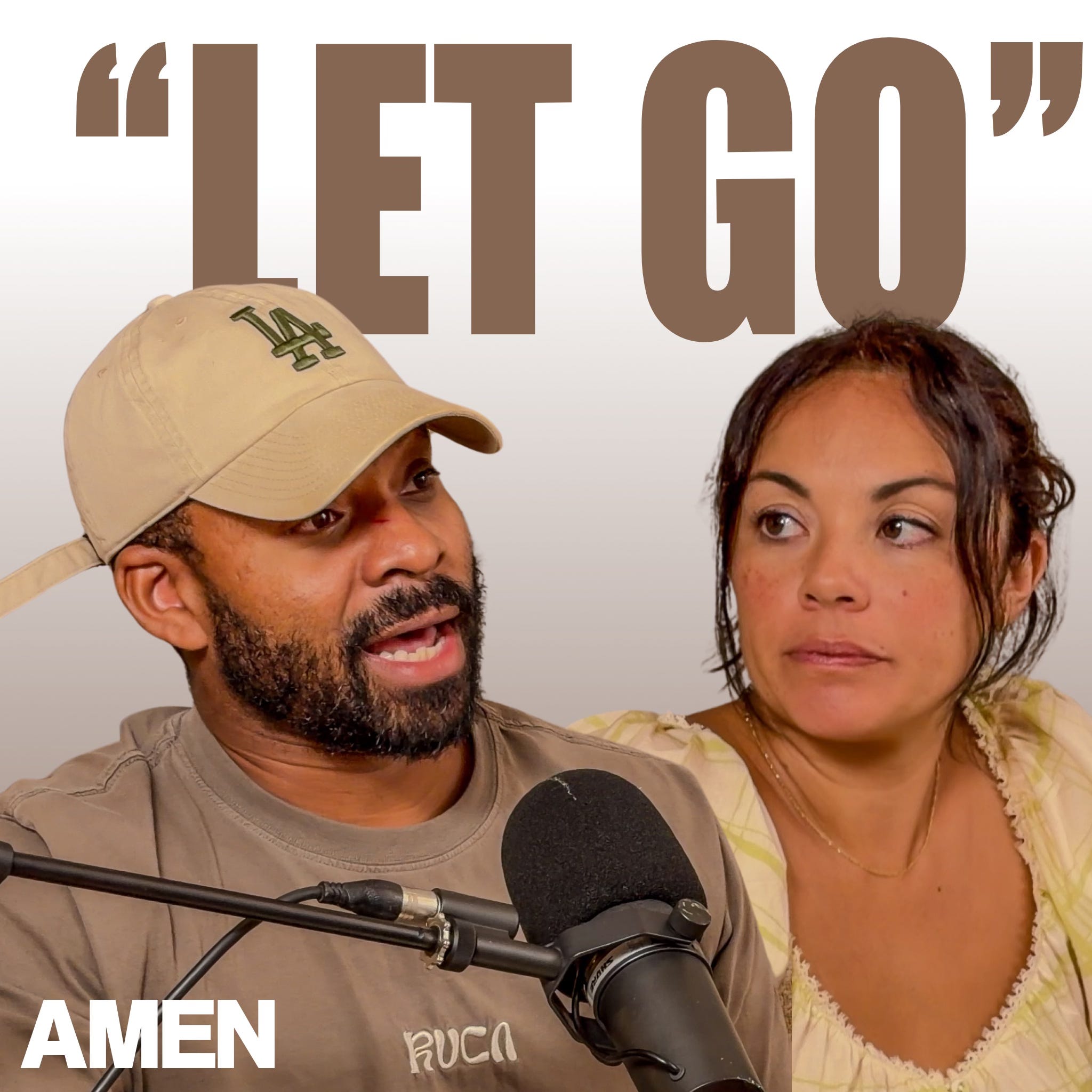
In this episode of the Amen Podcast, the hosts take a break from their study of Matthew to discuss the theme of surrender through the story of the rich young ruler from Mark 10:17-22. A young, wealthy, and morally upright man asks Jesus how to inherit eternal life. Jesus, knowing his heart, instructs him to sell his possessions, give to the poor, and follow Him. The man leaves saddened, unable to relinquish his wealth. The hosts explain that this story applies to all listeners, not just the wealthy, as everyone clings to something—such as status, acceptance, or desire—that hinders full surrender to God. Using the analogy of a monkey trap, where a monkey is caught because it won't let go of rice in a coconut, they illustrate how people hold onto "idols" (good things turned into ultimate things) out of a misguided belief that these provide security or salvation. Jesus emphasizes that eternal life is received through faith alone, not by works or self-righteousness. True freedom and salvation come from recognizing Christ as the supreme treasure and letting go of earthly attachments, a surrender made possible by trusting in God's love and grace demonstrated through the cross.
Hello, Han. Welcome back to Amen Podcast. I'm lookilinean here with my husband Alex. This week we're taking a break from our study through Matthew to talk about something we all struggle with, which is surrender. We're looking at the story of the rich young ruler from Matt Mark, excuse me, 10. This will be just a single episode and then next week's episode will jump back into Matthew 27. So a young man comes running to Jesus and asks what must I do to inherit eternal life? He's moral, religious, and doing everything right, but Jesus looks at him, loves him, and puts his finger on the one thing standing between him and the kingdom, which is his wealth. The guy walks away sad. Before we think this is just about rich people, Alex is going to show us why the story is actually about all of us, and we all have something we're clutching onto that we don't want to let go of. So grab your Bible and let's jump in. We are in Mark chapter 10 for looking at verses 17 through 22. Let's read. And as he was setting out on a journey, a man ran up to him and knelt before him and began asking him, "Good teacher, what shall I do to inherit eternal life?" And Jesus said to him, "Why do you call me good? No one is good except God alone." You know the commandments, do not murder, do not commit a jewel tree, do not steal, do not bear false witness, do not defraud, honor your father and mother. And he said to him, "Teacher, I have kept all these things from my youth up. And looking at him, Jesus loved him and said to him, "One thing you lack, go and sell all you possess and give to the poor, and you will have treasure in heaven." And come, follow me. But at these words, he was saddened, and he went away grieving for he was one who owned much property. Thank you, amen. There is an illustration that you might have heard before. It's called the monkey trap and in a certain jungle and a part in a different part of the world, there are hunters who hunt monkeys. And to catch them, they will hollow out a coconut and put rice inside. And along comes the monkey and not knowing, of course, that the coconut is chained down to something a faraway tree or a stump or something. It will reach his hand inside of the coconut, grab a hole to the rice, and it will not let go, even when the hunters show up to take it away. That is a good picture of us of this rich young ruler who are holding on to things that put us in danger. And it can be so simple. We just let go of those things. We can walk away into freedom. But the problem is we just don't let go. And so we'll use this illustration to kind of look at the story of this rich young ruler going up to Jesus, which is recorded in Luke. It's recorded in Matthew. So we know it actually happened. This rich young ruler is an actual person. Matthew calls him young and Luke and Mark focus on his wealth and his ability to rule. So he had some kind of position, maybe in the local courts, like a judge, maybe a local judge, but he was young. He was wealthy. And he had a lot of authority and influence. And we can find that correlation with us too. A lot of us, especially y'all who listen to the podcast, you guys are young. You most of you are in America. And so you are in the top 10% of wealth in the entire world. So you may not be a millionaire, but you are much more wealthy compared to the rest of the countries and rest of the world. And you have some sort of influence, you know, even if it's only just 25 followers or 30 followers, you have influence. You have a bit of ruling, maybe at your job or maybe in your social circle at your church. And so we're very, very related to this character that comes up to Jesus. And again, he's not just a character. He's an actual person. Look at verse 17. And as he was setting out on a journey, he ran up to him and knelt before him and began asking him, good teacher, what shall I do to inherit eternal life. So Jesus is setting out on a journey. This young man goes up to Jesus, kneels before him, showing humility, showing reverence, showing earnest. He's he wants to know very important question that many people asked, including rabbis and other parts of the gospel. You'll see rabbis and scribes asking the same question. For example, in the good Samaritan text, the scribes ask, what must we do to inherit eternal life? In the Bible, there's two ages. There's the age that we're in right now. And then there's the age to come. The age to come involves eternal life. And often asked in the Bible and still today, what do we got to do to get that? And that's what he's asking. And he comes up asking good teacher. Now, that was a normal way to address a rabbi in the first century to say good teacher is to say that you are highly respected and revered amongst everybody else in the first century. When a father would walk into his house, everyone in the family would stand up to honor and respect the father. The only time that the father would stand and reverence for someone else is if his son had become a rabbi. So there was a very high position to be a rabbi. And this man respected that. And so he comes in, kneels before Jesus and he calls him good teacher. Also to note, when you were to call someone good teacher, what you also expected sometimes was for them to call you good back. They say, "Hey, good teacher. Yes, my good man. You would expect it back. Safe to say he might have been expecting the same kind of response back from Jesus. But Jesus doesn't give him that." And so this young man is he's looking for something. He's looking for validation that he's doing good, that he's a good righteous Jewish man and he's going to get, he's going to go to heaven. He's looking for Jesus to make him feel better. Paddle him on the back, send him on his way. And for him to just, you know, feel a little bit better about himself, which we're all kind of looking for that same type of thing. Look at verse 18, "And Jesus said to him, "Why do you call me good? No one is good except God alone." Jesus says, "Jesus isn't saying I'm not God. He's saying, do you really understand that I'm God? Because if you're calling me good teacher, that isn't a phrase that we would just, that we throw around today. Like when people ask you, "Hey, how are you doing? You say good and you ask them back. How are you doing?" And they're like good. They wouldn't have done that in the first century. To say that you are good is to say that you are righteous, to say that you are holy. And so Jesus stops him and says, "Hey, let's not throw this around." You know, like other rabbis just accept that phrase good on themselves. While I am the only one, that's good because I am one with the Father and I am God, I don't think you really know that I'm God. And this is part of the need of surrender. Why we need to surrender to God is because he is good. And because he's good, he's the only way to eternal life. And eternal life isn't something that you do. It is something that you inherit. You inherit the kingdom of God. You inherit eternal life. But it's not something that you do to get that inheritance. And that's what he's going to find out. Jesus is stopping him and he's saying, "Hey, do you really understand that I'm good? Do you really understand that I'm the only way to eternal life?" And the answer is he doesn't. He doesn't. And we'll see that in his response after. He doesn't really surrender. Look at verse 19. Do you know the commandments? Here's Jesus setting up the trap. He knows that this young man thinks that he is good. He knows that this man is looking for a pat on the back. He knows that this young man has it all wrong. And thinks that salvation is something you can earn by doing. And so in verse 19, he says, "You know the commandments, do not murder, do not commit adultery, do not steal, do not bear false witness, do not defraud, honor your father and your mother." Jesus list, one, two, three, or one, two, three, four, five, six different commandments of the ten commandments. And there are specific six. They are the six that deal with our relation to people. So the ten commandments and all the law can be summed up in two things. Love God, love your neighbor. These six commandments that Jesus mentioned are the six commandments that have to do with loving thy neighbor. They are horizontal relationships, commandments. The vertical ones are the other four. Jesus leaves those out because he's setting up a trap. Going back to our illustration of the monkey, the monkey is trapped by the coconut, right? It's its paw is stuck inside this little hole of the coconut that is big enough to put his hand through, but not big enough to pull his fist out of. What is the coconut for our young man and our story? It is his self-righteousness. Jesus sets up the trap perfectly not to. He doesn't want to shame the young man. We'll see that later on in the text that he loves this young man. He wants to trap him to show him where freedom is.
He wants to chop him to show him where his mistake is. So he says, "Hey, you know the commandments. Just do these six commandments." Knowing that in verse 20, he will say, "Teacher, I have kept all these from my youth up. For a young Jewish man, 13 years old is typically when they become a man. And so he's saying, since before I was 13, I've been keeping these commandments." And that's exactly, he plays right into the trap Jesus sets for him. And verse 21, it says, "And looking at him, Jesus loved him and said to him, 'He's about to show him why he's trapped by the coconut of self-righteousness. What he's holding on to, that's got his spiritual fist stuck inside that self-righteousness that he cannot pull out of." And Jesus is doing this because he loves him. Our need to surrender is eternal life. We cannot get eternal life. Unless we get out of this trap of self-righteousness that you and I are in. We think we're good. We compare ourselves to others. And we say, "Oh, not as bad as this person. I've kept most of the commandments." And notice what Jesus doesn't do in verse 21. Jesus doesn't point out what he points out in Matthew chapter 5. You remember in Matthew chapter 5, when Jesus says, if you have anger in your heart towards someone, you have murdered, your guilty of murder. If you look at a woman with lust or look at anyone with lust, you have committed adultery. He doesn't do that. You know, he doesn't point out, "Oh, you think that you're good? Okay, here's why you're not going to the standard of God. He doesn't do that. Why?" The law was never meant to save us anyway. The law is meant to just point out our need. Point out that without a savior or trapped by our own self-righteousness. And so he doesn't do that. He looks at him with love and then it gets right to the rice. What is the rice that he's holding onto? What is the rice that's inside of his spiritual fist that's got him trapped inside of his self-righteousness? Just like the monkey in our illustration, verse 21, "One thing you lack." What is the one thing you lack? It's faith. The only thing that can save you is faith. The Bible teaches something called justification by faith alone. Ephesians tells us you are saved by grace through what? Faith. The only thing that makes you right with God, the only thing that can save you is faith. And faith is not something that you can get or muster up on your own. That's why it says you are saved by grace through faith. What is grace? Grace is getting something you do not deserve. What is the something that we do not deserve that saves us? Faith. You are saved by getting something you do not deserve. What is that? Faith. God gives you the faith to trust in Him, and that's what saves you. What makes us hold onto our rice and unable to pull out our fist from our self-righteousness that's got us trapped and waiting the hunter of death to come and snatch us is we're holding on to something and we're now holding on to our faith. It is faith that lets you let go of what you use to trust in and pull your hand out of self-righteousness. I cannot save myself. I'm nothing that I hold on to on this earth can save me. Faith is what pulls your hands out and walks away into freedom. Faith, that only one can save us and that is Jesus. So what is His rice? Might be different from yours, but what is He holding on to? It says go and sell all you possess and give to the poor and you will have treasure in heaven and then come follow me. Four things Jesus tells him to do. He says go sell, give and come follow. Those four things. What does He need to go and sell? His possessions. Wealth is His rice. He's trusting in. Wealth is the rice that He's holding on to. He's looking at wealth and saying this will save me. My money will save me. Not Christ will save me. Not faith in Christ will save me. This stuff that I have will save me. Now it may be different for you. You may be holding on to desire. You may be saying if I'm desirable, I'll be saved. You may be saying if I have status, I'll be saved. If I have fame, I'll be saved. If I have money, if I have a job, if people like me, if I have acceptance, I'll be saved. If I have love, I'll be saved. Love from people, I'll be saved. That's your rice you're holding on to. And you can't, unless you let go of that, you will not be able to pull your hand out of self-righteousness. Here's what I mean by that. Lust is just desire. That's gone bad. Greed is just wealth that's gone rotten. People pleasing is just status that's gone sour. You see that the problem itself is not lust, is not greed, it's not people pleasing, it's not popularity and fame. It's not any of those things. It's these good things that have gone bad. An idol is something that is good, that's become an ultimate thing. It's anything we look at and say, unless I have this, I cannot know myself, I cannot be happy, I will not be saved. That's an idol. Anything we look at for salvation, anything we look at for, happiness that you can only get from God, that's an idol. That's what this guy's problem was. That's you and I, that's you and I's problem. We hold onto stuff thinking, I do not know who I am without this thing. I will not have salvation unless I have this. What God is asking us to do is if you believe in the gospel, you can let go. He's not saying that you will be saved if you give all your stuff up and give it to the poor. No, there's salvation through one way and that is faith. There's justification by faith and faith alone. So what Christ is not saying is if you want to be saved, do something, give up your money, give up your possessions. That's not what he's saying. He's saying, if you can't give it up, you do not believe in the gospel. If you can't let go of your rice, what is your rice? The monkey doesn't let go of the rice because the monkey is saying to the rice, this rice will save me. The monkey's hungry and the monkey's thinking, in order for me to survive, I need this rice. The problem is the rice is stuck inside the coconut and it will not let go because it thinks this will save me. Even when the hunter comes with a net, even when the hunter comes with a knife with a machete to kill and eat and skin with the monkey, it will not let go of the rice. Why? If I have this rice, I'm safe and I am saved. It's as simple as letting go and walking away into freedom before it's too late. But the monkey will not let go because it doesn't believe there is freedom outside of the rice, outside of the coconut. You and I, we won't let go because we don't truly believe there is freedom in Christ. Well, Christ is saying, you will let go of it. If you believe there is freedom in me. If you believe that I am true wealth, I am true value. Look at Matthew chapter 13, 45 through 46. Again, the Kingdom of Heaven is like a merchant seeking fine pearls. And upon finding one pearl of great value, he went and sold all that he had and bought it. Look at Matthew chapter 13, verse 44, the Kingdom of Heaven is like a treasure hidden in the field which a man found and hid again and from joy over it, he goes and sells all he has and buys that field. Those are two parables Jesus gives about people who find who find the Kingdom of God. Not that the Kingdom of God is something that can be found, but that the Kingdom of God is something that you are invited into by Jesus finding you and pulling you into the Kingdom of God. And once they experience that, what do they do? They sell everything. There's nothing that they want to hold on to. There's a song by United Horsesuit called Nothing I Hold On To. And it sings that, there's nothing I hold on to. I will climb this mountain. Why? There's nothing in this world that I want to hold on to. When you really experience the gospel, when you really believe the gospel, when you really see what Christ has done for you, there is nothing that is more valuable than him. And so what you'll do is you'll let go of anything. What we do at church is we come to church every week and we act as if we have this position of surrender. And sometimes you'll sing songs at church that are about surrender. One of them is a song called Give Me Jesus. And we'll sing out, you can have all this world but give me Jesus. My question is, and what this text is questioning is, do we really believe that? Because if we do, we will climb this mountain with our hands wide open. There's nothing that we'll hold on to. There's nothing that is more valuable than him. Christ.
is the pearl of great value. And if we have him, there is nothing more valuable, there is no more riches that this world can give us. Instead, if we're being honest, when we sing that song, what we should say is, Jesus, you can have all that you have. Give me the world. Instead of you can have all this world, give me Jesus. If we're being honest, when we leave and jump in our cars and head back to our homes, what our heart is singing is, Jesus, God, you can have it all. Just give me the world. That's the real posture of our heart. If we cannot let go of our rice, and what is your rice, is it status, is it wealth, is it acceptance, is it desire, the need to be desired, the need to be praised. What is it? If you can't let go of it, you don't really believe. Do you believe that in Christ, you are more desired than any body on this earth could ever desire you? You are so desired that on the cross, when Christ could have let go of you, he decided, I'll take the wrath of God, but I will not let go of her. I will not let go of him, even if it cost me my life, I will not, I desire the church, I desire the elect, I desire you, I desire her, I desire him so much, I will not let go of you, even if it means I got to take the wrath of hell towards sin. I will not let go. Don't you see at the cross, you are more desired than anybody on this earth could ever desire you? At the cross, you are treated with more love, you're treated with more acceptance, you're treated with more value than you'll ever be treated anywhere else in this life. At the cross, because of what Christ did on the cross by pain, your debt, you have access to ultimate eternal riches at the cross. Arcee Sproul says, this man who will not let go is like a man who will not trade five cents for a billion dollars. And even that is a poor analogy, because Christ is infinitely eternally valuable. Whatever you're holding on to is less than five cents in comparison to the infinite inexhaustible eternal wealth of Christ. There is not anything more. John Calvin says, the rich man did not lack knowledge of the law, but he lacked the love of God. He could recite the commandments, but he could not surrender his treasure. He could not let go of it. And this is why he's trapped by his self-righteousness, because he knows scripture. He knows that Jesus is a good rabbi, but he can't do the one thing that's required of him. And that is surrender his treasure. If he did that, it would mean he knows Christ is the true treasure. He believes Christ is the true treasure. And that is what surrender is. Surrender is believing. If he believes in the gospel, he would have surrendered. Martin Lloyd Jones says, the look of love from Christ should have been enough, but the man looked at his possessions and loved them more than he loved the one who made them. He looked at his possessions and he loved what he had. He loved his stuff. He loved his rice. More than he loved the one who made the rice, the one who made his possessions. And so he would not let go and look at verse 22, but as these words, but at these words, he was saddened. At the words of Jesus, he was saddened and he went away grieving for he was one who owned much property. He had a lot of stuff. And so he walked away saddened. This Greek word for saddened is a word that means to become gloomy. It's a picture of this young man walking away from the sunshine, from the paradise of the presence of Christ into dark clouds, into gloominess. He left paradise and walked into a storm because he did not believe that Jesus left paradise to walk into our storm. If he really believed that the Son of God left heaven and came down, to walk into our storm, the storm of our sin, the storm of the wrath of God towards our sin because of his holy justice and righteousness. If he could see that, he would have stayed in paradise in the presence of Christ and he would have rejected the storm. He would have saw that there's more value in him than anywhere else. And with ease, I can give these things up. I know, you know, as you're gripping onto that rice, it seems it's so hard to let go of it. But the more you think about the freedom that you have in Christ, the easier it is to loosen your grip. And so the question is, what is that rice that you're holding onto? And ask God to give you the eyes to see and the ears to hear what the gospel is saying. True faith is found in the disciple who can say, I'll take the cross now and the crown later. I'll take whatever I got to lay down, whatever I got to lose, whatever I got to let go of, I'll do that because I believe there's a crown to be had. I believe that he loved me on the cross, that he did everything possible for me to have the crown. Don't you see that Jesus is the real, the ultimate, rich, wrong ruler who gave it all, who sold it all, who gave it all away. So we could have him as our treasure. He is the one that gave up everything so he could be our everything. And three days later after Jesus died, God rose in from the dead, that is our proof. That is our proof. And we give it all away. We let go of the rice. We pull ourselves out of that self-righteousness and say there's only one way I could be made righteous and that is by faith. There is true treasure. And don't miss that. Jesus says to this young man, hey, go sell all your possessions, give it to the poor and you'll have treasure in heaven and then come follow me. He's saying, I'm offering you more treasure. Not just treasure here on earth, but treasure for eternity. I'm offering you more. We so often think as we hold onto the rice that we're going to be getting less if we let go. But the amount of freedom outside of the coconut of self-righteousness is infinite. There is more God is asking us, not less. Do you really believe that? If you believe the gospel, if you see what he's done for you on the cross, you will believe that and with ease, you will let go. Not to say that you won't reach back into that coconut and hold onto that rice again at some point, but you as a Christian by faith, you'll always be able to say, okay, I see what I'm doing. I can let go and pull out of that again. Let's pray. Father, we thank you for this simple interaction that was recorded in three of the gospels that were so glad, glad was recorded, Lord, because we see ourselves in this passage. We pray that we are able to let go of our quote, unquote, rice and that we would know that there's justification by one way and that is by you. And eternal life is not something that we can add onto our life. It's something that we must experience and walk in now. And so give us the power to do that and give us the power to let go to see your love for us, to see your work finished for us on the cross and your name we pray. Amen. Amen. This is the part of the episode called after the amen where we ask you a question to help apply this message to your life. Our question for you is what are you holding on to? What are you holding on to? All ends are first and then it'll be your turn. I think for me right now, I guess, is comfort. I think that, yeah, I just really got as asking more of me in some ways, not like to gain his love or his affection or anything. I just think that like, yeah, I'm like, we talked about, I think a few weeks ago, like, where much is given, much is required, you know, and if you're faithful with little, he'll be faithful with much. And so I feel like just through our life, I feel like there's more that he is asking of me because he's given me the ability to do so, but I want to hold on to comfort because it's safe and it's easier
and it's not complete rejection of him 'cause it's not like I'm just not gonna follow him. It's like I'm just gonna keep doing the things I'm comfortable with, the things I already know, but I think he's asking me to do more. And I realized that it's, yeah, it's like, well basically I love the quotes that you shared because both of the quotes from John Calvin and Martin Lloyd-Jones were talking about, like basically for the young man, like the love of Christ kind of like not being enough. He loved his possessions more than he loved the Lord. And I think that in those moments when I don't want to give more to him, it's because I love my comfort more than I love him and he's done everything to prove that he is worthy of our love, trust worthy, and just like the love that we are seeking, you know? Like we love the things, we love certain things in our life because we think they'll love us back or they'll keep us safe or they'll give us what we need, but he has proven to be that through his death in resurrection and the amazing things that he has delivered us from or just transformed in our lives. And I know I've a believer has experienced that in some way. And so yeah, I think that part of it is like, I shared a Bible study that sometimes I feel like, like the Lord is asking me to pray for someone, like specifically in public. And I think that the reason why I don't do it sometimes is because of this comfort thing, like I don't want to make, if other person is uncomfortable, because sometimes it does. Sometimes it does make the other person uncomfortable, even a believer. Or I don't want to make people in public uncomfortable because there's going to be a lot of people who don't know God and they might not even know what prayer is. They might not even know why we're both closing our eyes and bowing our heads, you know? And I think that a reason why I want to seek that comfort is because I don't want to be inconvenienced or confronted, because I'm very like, I dislike confrontation. So it's like, well, someone could come up with me, they could ask me like, why, what if they come and like, come against us, you know? And really that's like, and then that's like really rooted at fear, you know, instead of faith, like faith that, if even if something happens good or bad from this, you know, like the Lord sees that and it's a part of His plan and He wants to do something in that moment for my good and His glory and that person's good in His glory or whatever it is. And it's a lack of faith, you know, because I'm trust, I'm fearful. So there's a lack of faith that He will give me the words that I need to say, like I think it's in all of the gospels, maybe like that verse about like not being afraid and of what you will say, like it'll be like the Holy Spirit speaking on your behalf, you know? And so yeah, it's just, it's fun to, I mean, I guess I don't know if fun is the right word, but it's to unpack this, to like see like, okay, why are we holding on to this? And then I think when, once you say it out loud, you realize, it's just, there's no reason to hold on to it. You know, like you have everything you need in Christ and He's with us and He wants to help us in our time of need. And so we don't have to fear, we don't have to worry, but living and walking by faith is really a joyful and an actual comforting, like I think my comfort will come for me. (laughs) Hold on to my comfort, but His life aligned to Him, abiding in Him is truly comforting. And that doesn't mean there won't be hard moments. And like you'll just always be like feeling this constant, joyous, like emotion, but you can still take comfort in knowing that He's with you at any time, regardless of what. You're experiencing. And so yeah, that was really good. - Yeah, thank you. - Thank you. - Thank you. I noticed that you have been stepping out of your comforts on a little bit though. Like Bible study is one of those examples. 'Cause I think it's hard, like I know it is hard to share. Vulnerably at house church, because house church is in our garage and Bible study is in our garage and like we're in our space. And we already feel very vulnerable because there's, it's in our home. And so you opening up the last couple of Bible studies and sharing has been really good in a way that you can definitely step out of the comfort zone. And yeah, I think it's all false security. That's what it is. It's just, there was no real security in His wealth. I mean, there's some kind of earthly security is no real security in our comfort that we long for or desire on earth that we long for. It's just false. It just makes us feel that way for a moment, but then we need more and more. And that's evident because he wouldn't even be coming up to Jesus and asking, what do I do for eternal life if he had the security of eternal life? All righty. - Yeah, I'm for it knowing what he would. - So he felt like there's something missing. You know, there's something, and he thought, maybe I can add on something else, but C.S. Lewis says that eternal life isn't something that you add onto your life is something that you experience now, that you take now. When you get saved, you don't add God onto your life. You don't add religiosity, you don't add spirituality on top of it. You die and you're born again into eternal life. And so eternal life starts the moment you trust in Jesus. - Mm-hmm. - Yeah. - Yeah, I think that's really cool. And I just mainly think like how you were saying, obviously he was searching for some sort of answer or some sort of like validation to know like whether, how, like if you'll certainly inherit eternal life. And I like how like in the scriptures, that's like that he, when Jesus tells him, like, don't you know that only God, it's God, only God alone is good. And I think that it's like, I think the reason why, or part of the reason why maybe he didn't, you know, surrender was because he didn't really know who Jesus was. And I think that it's easy to rely on podcasts, rely on on what you've been taught, maybe by your parents or in your church, even if it's a great church, or what you've heard about Jesus, or whatever, little reels you see on Instagram or TikToks you watch, but like experiencing him for yourself. Like that's when you will really know who he is and we experience him through prayer and through reading the word. That's when my life changed. I, you know, growing up in a Christian home, knowing, like, answering the questions in my head based on what I have learned or what I had heard my whole life. But it wasn't until I was like, I'm just gonna open the Bible every night before bed and just read. And then it wasn't just the first time that it happened, but it was like this repetition of reading the word every day that like my life truly changed. And I was able to have the strength to surrender. When I thought it was impossible, I thought I had to hold on to the things in my past life, to have security, to have purpose, to have meaning, to have value. But it wasn't until I got to know Jesus for myself. And I was also going to church, but reading your word, like just you and the Lord, like that is so important and you're missing out on something beautiful if you would rather just listen to a pastor, just rely on only going to church. And, you know, like we need to daily be eating of his word, you know, yeah. - Yep, exactly. And God was drawing you in that season of your life. And because he'd given you the faith, you sought him, like you went to your room and you sought him and you believed that you would find something. That's the difference is this guy in our story, he won't let go because he doesn't believe he'll find something outside of his wealth. He thinks this is all there is. And that's why we don't let go of our rice as we called it, or anything in our life because we think this is it. It doesn't get much better than this. There's no more outside of this. There's no more pleasure. There's no more riches. There's no more comfort. There's no more desire. There's no more status. There's no more higher I can go than this. I have to stay with this, but faith says no, there is. There's heaven. You know, there's literally the heavens, the limits, the sky's the limit beyond the sky. And so, yeah, that is the question is, what is your thing you're going on to? - Yeah. - What do you need a surrender? But also, do you believe that there's more? Do you really believe that there's more in Christ? So, we'd love you guys. Thank you for being here and supporting us. This past week was giving Tuesday. And so if you haven't had a chance to go to aimanpodcast.com to see what we do and see what we're about, very simply, we basically preach the gospel. with simple application.
And we've reached hundreds of countries. We've reached hundreds of thousands of people with this podcast and it's never changed since the start of it. It's always been the preaching of the good news. Exegetically, expository, verse by verse teaching. And for many of you who posted on your Spotify wrapped on your Instagram story, thank you or you might have seen us in your Spotify wrapped. Thank you for listening. We don't take it lightly. We know that there is literally millions of podcasts that you could be listening to. One, millions of different topics. But you choose to like, local audience saying, feed yourself the word by going to this podcast. And so we thank you guys so much. And we do not take it lightly. We every day we thank God for what we get to do. It's unreal that this is our full-time job and having six kids and one on the way who we're finding out the gender soon. So stay tuned for that. But having four boys, two girls, and then a big, you know, for our house, the big house church. It's not that many people, but it feels big 'cause there's a lot of people in a small space. Yeah. But doing all that and being able to just do this for work is a miracle. And we always want to be able to do this. We don't know what the future holds, but as of right now, you guys have made it possible just through your obedience in tithing to us or generosity in giving towards us. So thank you guys so much. And we still have need for more donors because things are always changing. We're always adding, you know, not always adding, but there's always stuff that needs to be done for house church and for our family. And so we just thank you guys. But if you'd like to go to aimandpodcast.com to support, you can do that. You can also, if you're on YouTube right now, you can see our store shop shelf at the bottom. You can pick up some merch. If you'd like to do that. And yeah, follow us on Instagram, like, subscribe, rate and review on that stuff. But most importantly, comment on Spotify and YouTube. What is something that you're holding on to? Let us know. Let's get a good conversation going there. And we love you guys. We'll see you in the next one. Until then, go out and be the church. - Amen.
Podcast Summary
Key Points:
The podcast discusses the biblical story of the rich young ruler (Mark 10
The story is framed as a lesson on surrender for everyone, using the analogy of a "monkey trap" where a monkey is caught because it won't release the rice in its fist, symbolizing how people cling to idols (like wealth, status, or desire) instead of trusting in God.
Jesus' interaction reveals that eternal life is inherited through faith and surrender to God alone, not through personal righteousness or good deeds, and that true freedom comes from letting go of earthly attachments to embrace Christ as the ultimate treasure.
Summary:
In this episode of the Amen Podcast, the hosts take a break from their study of Matthew to discuss the theme of surrender through the story of the rich young ruler from Mark 10:17-22. A young, wealthy, and morally upright man asks Jesus how to inherit eternal life. Jesus, knowing his heart, instructs him to sell his possessions, give to the poor, and follow Him.
The man leaves saddened, unable to relinquish his wealth. The hosts explain that this story applies to all listeners, not just the wealthy, as everyone clings to something—such as status, acceptance, or desire—that hinders full surrender to God. Using the analogy of a monkey trap, where a monkey is caught because it won't let go of rice in a coconut, they illustrate how people hold onto "idols" (good things turned into ultimate things) out of a misguided belief that these provide security or salvation.
Jesus emphasizes that eternal life is received through faith alone, not by works or self-righteousness. True freedom and salvation come from recognizing Christ as the supreme treasure and letting go of earthly attachments, a surrender made possible by trusting in God's love and grace demonstrated through the cross.
FAQs
The episode focuses on the concept of surrender, using the story of the rich young ruler from Mark 10 to illustrate how clinging to things like wealth or status can prevent spiritual freedom and eternal life.
He is a wealthy, influential young man who asks Jesus how to inherit eternal life. Jesus tells him to sell his possessions, give to the poor, and follow Him, but the man walks away sad, unwilling to let go of his wealth.
It symbolizes how people, like the rich young ruler, cling to things (like self-righteousness or material possessions) that trap them spiritually, preventing surrender and freedom in Christ.
Jesus highlights that only God is truly good, challenging the man to recognize Jesus' divine identity and understand that eternal life comes through faith in God, not just moral behavior.
He lacks faith—trusting in Christ alone for salvation rather than in his wealth or self-righteousness, which is the key to surrendering and inheriting eternal life.
It explains that many people today, especially in wealthy nations, similarly cling to idols like status, acceptance, or desire, which hinder true surrender and faith in Christ for salvation.
Chat with AI
Loading...
Pro features
Go deeper with this episode
Unlock creator-grade tools that turn any transcript into show notes and subtitle files.
 PodcastTranscript AI