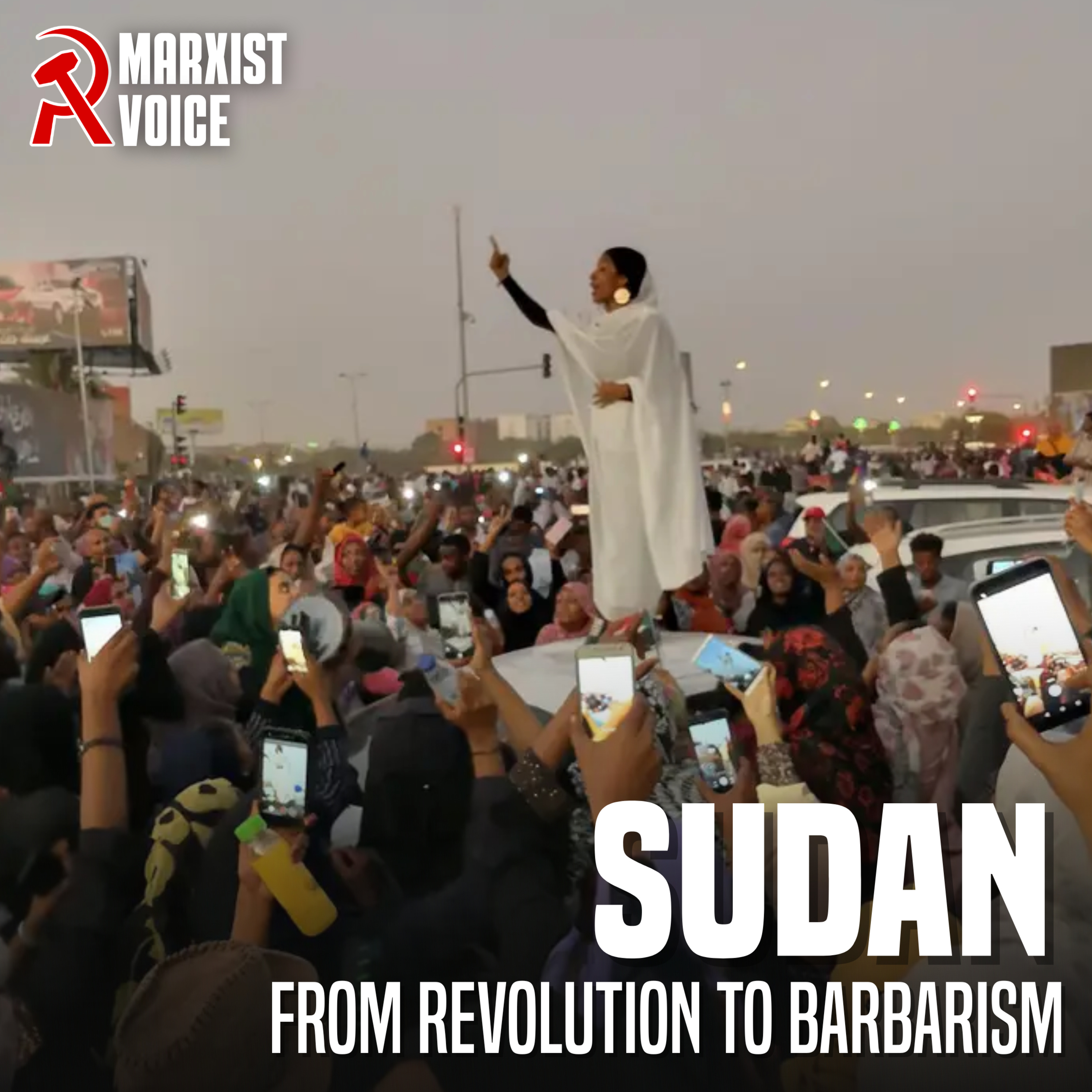
The speaker analyzes the 2019 Sudanese revolution, highlighting its initial heroism—epitomized by student Alah Salah—and its catastrophic aftermath: a civil war causing the worst humanitarian crisis on record. Two common reactions exist: starry-eyed celebration of the uprising’s bravery or despair at its failure. The speaker, as a Marxist, insists on understanding the defeat to draw lessons. The central failure was the demand for a civilian democratic government, which in Sudan historically leads to counterrevolution. Since independence, four attempts at bourgeois democracy ended with the military retaking power, as the comprador bourgeoisie, created by British imperialism, is too weak and dependent to rule democratically. In 2019, the masses showed revolutionary potential: protests sparked by food subsidies grew into mass occupations, women led a feminist uprising, and the regime split, forcing al-Bashir’s overthrow. Yet, leaders pushed for civilian rule, not workers’ power, enabling the military to reassert control. The speaker argues that a revolutionary party could have seized power, preventing the current disaster. Drawing lessons—rejecting liberal demands, understanding imperialism, and building class-conscious leadership—is essential to honor the revolution’s heroism and avoid repeating its tragedy.
Well, welcome, comrades. It's very, very happy to be speaking to you. Behind me, I've chosen as my background a picture of Alah Salah, who was this 22-year-old student who encapsulated the real, humiliant mood of the spring of 2019 during this revolution, which succeeded in toppling Alba Shia, this tyrannical dictator, who had ruled for 30 years, and this photo behind me actually went viral, and really captured the imagination of workers across the world, both of the immense role of women in the Sunni's revolution of the youth and the bravery and herrism of the workers who went out to fight against this monstrous regime. Now, when discussing the 2019 revolution, I think you end up with two broad reactions. I think on the one hand, there is kind of the starry-eyed reaction of analyzing these events. This was an incredible display of herrism. Sudan had been under a 30-year brutal dictatorship. It suffered civil wars. The country had been split into in 2011. It itself had been completely tumultuous. The people were starving, and yet they went out against the dictator who showed no remorse in the most massive killings imaginable. And, you know, she had many elements of her work as a state in embryo and much more. And there's a lot to say in that kind of analysis. I think there's the theory-eyed analysis where you look at, well, what has become? Today, in Sudan, the photos long behind me have long vanished. It has become the worst humanitarian disaster on record. The civil war threatens to further split the country on an east-west divide. Millions of starving, hundreds of thousands killed, rape is endemic or had run more port of one-year-olds. Children like babies being regularly raped and killed as genocide or militias go around. And, I think both of these are true, but I think as Marxists we need to go further. And we need to, you know, either weep nor cry, nor laugh. But understand what has taken place. That this is a catastrophic defeat of the working class, but we need to draw the lessons. And if we do not draw all of those lessons, it will be completely in vain. I was at a conference on Sudan a couple of weeks ago on it to prepare for this talk, a sense of what the wider left said. And yeah, I found very few people actually drawing the lessons. It really was one of those two responses. And I think this is what turns a tragedy into a crime. And so it's a major responsibility, I would say, on the comrades of this organization, in honor of the heroism of pursuing these revolution, to draw all of the lessons, to study these events fairly, which encapsulate what a revolution in the former colonial or ex-colonial world looks like in the world. And I think there are many lessons today, which still haven't been learned. I think people today still talk about the benefits of multi-polarity. People today still say all we can work with the liberals of the progressive bourgeoisie. People cry over when USA's and NGOs are being cut as if they are some great humanitarian organ, rather than tools of the imperialists. And people still put forward the call, even in that conference I attended, remain a lot of the left. And this was the far left, by the way, I won't name names, but I think people in Britain, you'll know who I'm talking to. They were still saying we need civilian government, a demand that was the undoing, and I'll go into this later of the board of this revolution. And fundamentally the lesson that has not been drawn is the demand of the need for building a revolutionary party. And those who do not carry out the study of these lessons really bring disgrace to what in Sudan is referred to as the glorious revolution, 2018, 2019. Most of the events happen in 2019, so I'm going to further to 2019 revolution. Now, given, apparently I've got 40 minutes, but there's still not enough time to explore all of those lessons. I'm going to focus on two, but there's much more to draw out. And even the article itself only often skims over a lot of these points because ultimately they have been proven in the past. I think, in common, it's all fine when reading about Sudan, if you've read a number of revolutions, is the familiarity? Is that precision that Marxist theory gives to be able to understand these events before they have taken place? So the two lessons I want to focus on actually is this kind of question of a democratic civilian government that got put forward very regularly. And this question of, well, could a revolutionary party have taken power? Let's actually apply our ideas and see, you know, this common phrase we use in the RCI, was that applicable in 2019? Now, this demand, starting with the first one, and this demand of the civilian government, what does a civilian government actually mean in this case? It's a civilian democratic government. In Marxist terms, we're talking about an establishment of a bourgeois democracy, something like that you have in the friendly European countries, a France of Britain, maybe even Canada or the United States. People were saying in Sudan, it has been ruled by firstly imperialists since 1899, simplifying a bit of a history before then. And then from 1956 onwards, there have been only a small number of years where the military have not directly ruled. So we can appreciate why many people would have said we need to remove a military and put forward a civilian government. But I would argue, and I think if you had come right to study the theory of the permanent revolution, which nearly last magazine was on, that the domination of imperialism in Sudan makes actually a civilian government without the overthrow of capitalism. And impossibility, it is not possible for the bourgeois to rule for democratic methods for a sustained period of time. And when such governments did emerge in Sudan due to the impact of imperialism, they were weak, they were divided, they were corrupt, and one way or another sought to hand power back to the military. And I would say the long revolutionary history of Sudan is a testament to this fact. Since 1956, it would have been four attempts at bourgeois democratic government. The first one was 1956 and 1958, just two years after independence, and the bourgeoisie was so divided between these different sectarian religious groups that they handed power back to the military. In 1964 to 1969, it was a revolution in 1964, it overthrew the military dictator then. And then the basically the army panicked. And again, you ended up with this democratic government which solved absolutely nothing over the first five years, and the military ended up taking power. In 1985, the military regime was overthrown, and once again, you saw within four years, the bourgeoisie had willingly held, well I would doubt you were willing to. They may quite differently, but I think if you read the history, it's quite clear, it was willingly. The bourgeoisie handed power back. And actually we saw a similar playbook in this respect in 2019 to 2021, that the military would come in in December 2021, January 2022, if the military would really secure their rule. So each of these was more about by revolutionary movement of the working class. Each of these movements saw the leadership of the working class schools for civilian rule and democratic elections. And each ended up with a brutal military dictatorship. Now why was this the case? Well, I think it's worth understanding that when capitalism was brought to Sudan by the British, they did not bring a prosperous middle class who occupied the Salons of France in 1785 and spent a lot of their time writing novels and all of this. Who fought for free trade, rule of law and industry to develop a prosperous nation state. This was not how capitalism entered Sudan. Instead it was brought monopoly capital, keen to extract as much wealth from the country as it could. Looking for control over the Nile, looking for control particularly extremely fertile areas of the South of the country, which it was actually the biggest irrigated area in all of East Africa and single biggest irrigated area in the world. And do it in the British transformation of the country, they transform tens of thousands of rural peasants into industrial workers. They divided up the population against each other in order to maintain power through the policy of a divide and rule. A policy which was so vicious and being dictive where they divided the country against Arabs and Africans, yeah Muslim Arabs and Africans in the South, which would lead to two civil wars from throughout the 20th century and ultimately the breakup of the country into South Sudan back. Ultimately lies with the British, no civil wars would kill millions of people. They divided them on the in Darfur, particularly an important area in the East.
in the west of the country, where they split Arab nomads against African pastoralists to the point that a genocide was carried out in 2003 to five and again another and has been a major part of the images where people may have seen about group called the RSF will go into more detail and the genocide they're currently carrying out. These policies were put in consciously by the British and there's an old saying in the in the Arab world and I think it applies very heavily to Sudan. They have two fish in the Tigris fighting for British were involved. On top of this, the British developed a thin layer of the administrative administrators and businessmen, Alvi existing aristocracy, to act as basically middlemen. The British they understood quite clearly that they were going to struggle to directly rule all of the world and so they relied on what we call a compredor bourgeoisie. B bourgeoisie with no independent existence apart from being the survival instruments of imperialism. The British actually had a policy for this they called it native administration get the different groups to rule against each other. In fact it's actually the one will come on to a lot of people who called for these liberals liberals in most comments. It was actually the same people who had initially been built for by the British, the same political parties all the way back in the 19, 19, 20s and so far. So the indigenous ruling class was therefore economically and politically dependent on the imperialists incapable of developing Sudanese capitalism is crushing them not least and therefore saw the state not as a tool for developing the nation in a progressive way but instead of extracting vast rents, virile, immense corruption. And this is a this is a story that you'll see throughout a lot of the world which was dominated. And for these reasons every time the Sudanese bourgeoisie found democratic power in its hands they showed themselves weak, divided, corrupt and most importantly terrified of the relatively developed proletariat who of course were being developed by modern industry. They saw they couldn't rule cut the country the country with head towards a socialist revolution. But this was even shown very close in the 1960s. The Sudanese Communist Party become the biggest Communist Party in all of Africa or second biggest Communist Party in all of Africa. Definitely one of most influential. They were so scared they had a pack power back to the military dictator. This exact same thing happened in 2019 to 2021. And this is what we mean when we say that the bourgeoisies are unable to develop society forward. And that if in a revolutionary situation you spend your time trying to establish a liberal democratic capitalism you are sowing the seeds for counter revolution. And this is what ended up taking place in 1989 and led to the emergence of albashir this 30 year long dictator. So that's pretty depressing. Was there an alternative? I would argue decisively yes. I would argue very clearly that in 2019 we saw a democratic work in state could have been established. And the reason it was not was nothing to do with the objective conditions was nothing to do with the heroism of the masses was nothing to do with the creativity that the masses showed. But was everything to do with the leadership who failed to absorb all of the lessons of the past and led the revolution to the feet. So I want to now start examining a little bit of the actual concrete events of 2019. Lenin often talks about four conditions for revolution and he says the first two. One that the ruling class can no longer develop society any way forward. For this this had been long being the case in Sudan. The ruling class had the economy was incomplete, freeful. In 2011 the split of Sudan into South Sudan as an independent nation basically took all of the oil. The country started plummeting down. They tried to find reserves via gold. The gold actually ended up being unable. It rather than being a centralized thing which the government could easily extract money off it became thousands of small minds. That's very close to the surface far away actually weakening the government further along. And then the global economic crisis did Sudan knew it no favors. By 2018 the entire economy was incomplete collapse and they were passing these conditions more and more onto the working class. The second condition Lenin highlights is that the ruling class becomes split. And if you're looking for a ruling class a split I would say the Sudan is a textbook definition. The ruling class was so split that not only had there been a obviously the military taking power in 1989. The military itself had split in 1999 when they had kicked the Islamists or the most radical Islamists out after hosting Osama bin Laden. And that the dictator Al-Bashir was so terrified that he was going to be coup because there was so many divisions within the ruling class that he said I've got brilliant idea guys. What if rather than having one military we have we have two they had to have three actually but we'll have two or three. And he develops to soon these armed forces which is the National Army. One of a few armies in the world which has the accolade of only ever being used against its own people. And the rapid support forces who I'll come come along a lot more to later. And the idea was by balancing off these armies he could try and stabilize the regime slightly. To add more to it he then started giving them huge amounts of government spending 60% of the state budget was given to keep them happy. And all of this created an immense explosive conditions for the action of the masses. And those conditions there were hints early hints beforehand. You saw this molecular process of revolution starting to take place in 2012. Back of the Arab Spring protesters went onto the streets. They were brutally shot down. In 2013 as the oil money dried up the workers once again went through hundreds, hundreds were killed and slaughtered. But the molecular process of revolution was happening. It was harder to detect you couldn't do opinion polls actually as we often quote today because of the jack boot of the military dictatorship. But this was starting to transform consciousness in people's minds. And it came to the surface in a very accidental way when in December 2019 a 2018 sorry a few dozen protesters under the leadership of a tiny union called the SPA went out on the question of food subsidies. This was a really pitiful protest in its own perspective as a starting point. I'm sure a comrades you know if it hadn't been to more of similar things. You've got like 12 people you know them all but then the police came along and they arrested everybody. And this had happened a few times. People thought that would be the end of it. But for whatever reason that acted as a spark and it suddenly unleashed a blaze. They were six days later new protests appeared but they were already more radical. They were shouting down with the rule of thieves. They burnt down government buildings and now suddenly demonstrations were spreading and spreading. On the 17th of January 2019 state security forces were now sent in to heavily repress the protesters. They grabbed women and children and elderly in the street. They would beat them up. They would shoot people. But that did not tame the masses as it had done in the past. On the funerals that took place, 5,000 people came out and they were shouting down, down, down with the government. The masses were losing their fear and there was nothing the regime could do to try and stop this. One particularly inspiring scene and I hope comrades maybe come in on this a little bit more was on the 8th of March. Tens of international working women's day. A day which was created by the second international to rally women to revolution and have been heavily twisted by the Liberals. The women workers of Sudan really took that spirit. They tens of thousands went out and they said this revolution is a women's revolution who would suffer against most extreme brutality. Women could be beaten up in the arrested for just the act of wearing trousers. They descended on cartoons, main prisons and forced the regime to release all female detainees. The masses started to take power in their hands. Their confidence was growing more and more and people were starting to realize. Sometimes the chapter comrades and they say, "Oh, what's necessary for a revolution?" They say, "Oh, do you think it's just you need to get bad?" It isn't a question of things going bad. Things in Sudan have been pretty bad since the last hundred years. It's difficult to point to a particularly good period. What is needed is not just things to be bad, but it's for the masses to understand their own strength. As that spring developed the masses were learning more and more. By the 6th of April 800,000 began marching. They were inspired
by those conic scenes of Egypt and Tahir Square just eight years earlier. They occupied the square and the military complex and they occupied the square outside the military complex and began setting up an encampment where they started running those streets themselves where they started all creating a city within a city. And this now was a direct challenge to the regime because the regime itself had looked at the events of the Arab Spring and the thought all that is not what we want to a bit happen to us. And here at this vital moment a classic dilemma approaches for the ruling class. To reform, give concessions but that would mean emboldening the revolution, that would mean giving the workers even greater sense of their confidence or to repress, but if they repress and the workers are going to be more determined than before. Both options are right, both options are wrong for the ruling class because once the force of the masses have moved very little they can do. Al-Bashir, the tyrannical dictator, leaned very much on the question of repression. He actually, he called his main cleric was about to issue a fatwa, calling for 30% of the revolutionaries to be killed and slaughtered. The military service and the ruling class understood this and they understood, well, if we do that, that's going to be the last move we ever do. And the revolution will become truly unstoppable. They panicked. And the two armies that Bashir based himself off trying to balance, they united and they overthrew him. And suddenly, Al-Bashir's 30 year dictatorship had come to an end. They then tried to quickly get in his vice president. They said, we'll put him as power. And then the protesters continued to march. They did not this organize. That's what the army had hoped. They said on the 8th, they had said full, that is all. On the 9th, they said full again. And the army realized the dangerous situation they were in and forced the, and then had to remove even the vice president. Now it was just the SAF and the RSF ruling directly and nakedly. This could have been the end of capitalism in Sudan. There is no reason why April could not have ended the revolution. You would see already this, and the events of April and the events of February 1917, there was a major parallel between them. The workers had set up their own organizations. The sit-in became the beating heart of the revolution. It organized classrooms to teach ideals and goals of the revolution. Workers managed day to day life. It became a cultural melting pot. They had big screens which would show messages of international solidarity during the day. And then during the night they would show the football and the paratory and all of this. Women and men were able to mingle and to discuss ideas. It was this liberatory sense here. And then if that was a heart, you would also see that the revolution was developing its arteries and its capillaries. These were the resistance committees. Each committee organized up to about 50 people. They democratically decided everything from organising local demonstrations. They quickly understood that if you just post on social media, also where the army found out. So what they would do, and this is one of the incredible things, they would organise demonstrations. But everyone would go into their friends houses or other workers houses, etc. or shops. And then the streets would be completely silent, one minute before the demonstration. And at the hour mark, someone would bang a big drum or make some noise or somehow. And suddenly the streets would flood. And so the armed forces had no way of combating us. And the resistance committees, there were huge numbers of them. Over 700 committees in Cartoum, over 3,000 across the country. Clearly they're a little bit heterogeneous. This isn't like an exact work estate. This is embryonic. This is a process that is developing. But in some places give a sense of how far that process went. You had distribution of fuel. Grocery markets where food was sold at cost. You had elements of workers management starting to appear. It wasn't the full fledged thing. I think in the article we discovered a worker state in Embria. But an Embria can go on become many great things if you play your card. So yeah, in April 2019, power could have been immediately handed to it. But the leadership, this union which had suddenly been thrust onto the string of events, was the group called the SPA. And they did not call for the seizure of power. They did not say all power to the resistance committees echoing Lenin in 1917. They instead set up effectively. They didn't call it this, but for simplicity. This is the factor where it was. A popular front with the Liberals. And not just the Liberat. I mean like all of the elements of the soon these anyone who was outside the army, which was called the Freedom Forces Coalition, the FF and the FFC. And this is what they did. So they created a popular front which of course involves so many different elements and failed to take this question of workers power. Now, as previously explained, the Liberals were not interested in democratic rule. So what did they then start to do? The FFC then start to say, let's do a deal. Let's do a deal with the regime. And they start trying to link up with the SAF and the RSF and they announce, guys, we've got it. We're going to have three years of military rule. The workers must disband, but then three years later, we will have elections and promise it will all be great. This was the picture of the FFC. This deal did not go down too well with the working class. In fact, the working class despises it. And immediately, the SPA was then forced into opposition by the movement of the workers. It was saying, what are you doing? Negotiating with peace people? They've done a deal behind your backs. And the SPA was forced to call a massive general strike, 28th of May. Now, I've read about many general strikes in the past. I haven't had yet the fortune of participating in them. But this is a general strike like it. It doesn't normally seem to do it correctly. This was of epic proportions. Observation in the capital was considered close to 100%. And it showed so clearly that not a wheel turned, not a light bulb flickers, not a telephone rings without the kind permission of the working class. In one area, the workers, they were setting up a picket line in dock workers. And they actually got one of those massive containers. And they thought, you know what, we've got why hold a picket, like people will get through, we go on the challenge, it's not worth the deal. We're having them doing a picket line, get the crane, lift up the container, yep, place it right over the entrance. And that will do us a picket line. This was the creativity. They were really taking power into our hands. And they said, all we are following the SPA. I think one quote I read this out really shows the power of the ideas. And their worker said, we reaffirm our readiness and responsiveness to all of the decisions by the SPA in the context of restoring full civil authority and sovereignty. And declare our readiness for civil disobedience and an open political strike until a handover of authority into civilian hands. And as we as previously said, the instructions are with the SPA and the deed is with us. I'll raise this question right, 28 May, if even this is a this is infected, the port workers, all the workers, even the civil service large parts of Vemeron strike, who actually holds power. There was no need. Why are they calling for negotiations? You have the power. It should have been taken. Again, and the worker said the deed is with you, the instructions are with us and the instructions did not come. The instructions were still to negotiate. This was a major mistake. Now, a revolutionary party would have campaigned ruthlessly on this issue of the seizure of power. And this is highlighting some of the role of revolutionary party. Lenin actually writes in April 1917, he says, this during the Russian Revolution, he says that revolutions do not be cheerleaders of the masses, been said Paul vinegar and bile and explain the truth. He actually says, explaining the mistakes of the petty bourgeois leadership may seem to be nothing more than propaganda work. But in reality is the most practical revolutionary work. For there is no advancing a revolution that has come to a standstill. There's chokes itself with phrases and keeps marking time, not because of external obstacles, but because not because of the violence of the bourgeoisie, but because of the unreasoning trust of the people. This was exactly sums up what was happening in Sudan, but there was no revolutionary party there. Many people doing all sorts of wonderful practical things. No one doing the necessary needs of exposing the propaganda work of the propaganda work of exposing the mistakes of the leadership. And so the initiative after the 28th of May passed once again to the counter-revolution. On June 3rd,
The RSF, the rapid support forces, mobilised outside the city, they brutally attacked, they shot, whipped and raped workers to death. They burnt the entire site to a crisp. It's smoke bellowing through the city, acting as an instinctive mark of the counter-revolution success across the city. The RSF then found out through Cartoon on motorbikes terrorising the workers. This was a counter-revolution in full advance. At this point it's worth taking a look. Who exactly were the RSF? They came from Defour, a very impoverished part of Sudan, which is historically split up into two main groups. You often find this in literature. There's African pastoralists and the Arab nomads. But interestingly, this actually isn't an ethnic nor religious division. In fact, if you were in Defour and you were looking around and you were trying to work out who's the African pastoralist and who's the Arab nomad, you'd really struggle. Instead, it's actually a historic relation based on property. The African pastoralists come from the tribes which controlled the land. They had the Dar, the homeland laid out before them. While the Arab nomads would go from land to land, asking the local pastoralists can we use your land to graze. This for centuries calls no problem because there was plenty of land in this area. Not that many people. This has radically changed. The Sahara has been advancing south due to climate change. The economic crisis has thrown the entire situation into crisis. And suddenly you have these Arab nomads have no form of existence. They are crushed. They have no way of living. And they have no way out. Now when a militia comes along, it says, look, you've got no way out in life. What do we offer you? We offer you money. We offer you women. We offer you a motorbike. All you got to do is go around with this machine gun, enforce what we tell you to do. There is many potential recruits to the RSF. This is the social base of the RSF. And this is precisely what made them such major reactionaries. They offered their services as gold miners, as protecting the gold mines, as security forces, as border guards, particularly for the EU. I don't know if anyone is able to come in on that. I think it is a very important exposure role here. And this is what led to their force. But what did? Now, was there any way to cut across this immense reactionary force? I would argue, yes. I'd argue again, less than 1917. What do you give to the peasantry who have no land? This was the only question. The RSF did offer something through the most reactionary and barbarous methods. The revolution could have argued for the giving of land to the peasants. They could have said to the arom- no, mad. Go back home. You will have plenty of land if you help us in the overthrow of this government. That could have broken the RSF along class lines. It's not baseball to what extent. And, you know, I'm happy to discuss that further. But that program wasn't even raised, because that program can never be acceptable to the liberals and the popular front who weren't even prepared to remove Sharia Law over that week. And so the RSF are whipped up into this reaction. They use against the revolution. June 3rd was the start of the terror. But it wasn't the defeat of the revolution. On the 30th of June, the masses once responded. One million workers marched. They chanted, the billet doesn't kill. What kills is one silence. Freedom, civilian rule for revolution had just begun. And with that immense show of force, even without a political program, they managed to brief her to scare the RSF off due to the power of the masses. But what you saw is, again, even with both slogans, still clinging to the liberals, still clinging to pacifism. And what you ended up seeing is, yeah, this, again, a number of chance where power could have passed to the workers. But power was missed. On July 9th, the popular front announced on the back of this mass movement that they had secured a deal. There will be a liberal prime minister, the guy called Abdallah Hamdok, who would oversee a coalition between the military and the popular front with elections in a few years. Many of the masses, by the way, saw this as a victory. And succeeded in and took this. What did Hamdok achieve? I go into the article, but I think of spelling out pretty clearly, not much. And then once the masses were demobilized, once they were disorientated, once they revolution had lost pace, the military comes in in January 2022 and they wrap the whole thing up. There's a number of different battles, even then it could have been changed. But time and time, again, on so many occasions, I haven't even, I mean, just listed a few. We could probably list even more. This is what the lack of leadership went to. So to start summing up, this January 2022 was the final defeat of the revolution. Sudan was once again under a boner partistic dictatorship. And the only question was, who would be the boner part? Albert Han, head of VSAF, or Hermetti, the head of the RSF? The two could not get along. Albert Han represented the SAF, represented the old state, the Cartoumian clique. They looked at the RSF and they basically saw them as rural hicks to fought their power. Hermetti, he said, well, I actually carried out the counter revolution. I should be the one at charge. And so they shook hands in front of each other whilst holding a knife between each other's backs and began looking for international support. The SAF connected with the Saudis who wanted to dominate the Red Sea and liked them as a continuation. The RSF shook hands with the UAE, who's been looking to expand their influence over East Africa, with their now the biggest investor, even overtaking China in East Africa. Once all of these parts we play, they had got their rival imperialist powers behind them. Once they were all in play on the 16th of April 2023. They each made their moves and the third soon these civil war began. It has been unfavorably deadly. And we will produce-- well, I'm hoping that we can produce an article that goes into a lot more of the details. We've already produced one. Torture, mass killings, execution, mass rape, by both sides. Let's be really clear, just for a second, the RSF are terrible. The SAF are also terrible. These are both counter revolutionary forces. We support neither. Lining up behind the RSF is the UAE, Chad, South Sudan, Libya, Kenya, Uganda, Ethiopia. Lining up behind the SAF is Saudi, Egypt, Pakistan, Turkey, Atreia, Eritrea, Qatar, Russia, Iran. The West, ironically, had actually tried to base itself on the revolution and the liberals and has actually been left without a horse in the game. The general interests of this civil war are arable land, which, as I've spoken about, it's massive in Sudan, particularly in the area. It's gold, it's control of a red sea. It's also prestige and a region that is continual in the termult. Who will-- if Saudi wins, they will be the dominant power. If the UAE wins, they'll be the dominant power. And they're fighting a number of other proxy wars, particularly in Yemen as well. None of these powers have permanent allies, all have permanent interests. And yeah, there's a lot taking place. There's been particularly deadly the working class-- we should say really quickly-- the working class has been pretty much liquidated. There is little chance without the impact of international revolution that the Sudanese workers will reestablish their power and influence, they have been home massively, massively defeated. In the country is now close to being torn apart. The RSF have secured control over Darfur, and the west of the country, which they did with the massacre of Elfashir, that is what they're representing militarily. The RSF is now based on ports who are down on the red sea, and they're slowly carving the country in two. I would say that it's likely to go to a division. But this has been the imperialist pouring-- yeah, horrific wars as a jockey for position. And in our era of revolution and counter revolution, a cleverer of opportunities for the imperialist aims to arise. And I want to end on this quote from a world perspective 2018, actually, because this is what we wrote then. This was eight years ago and a year before the revolution in Sudan. "Although a war of the lines of the first world war and the second world war is ruled out, under pressing conditions there will be constant small wars, all the time under which modern conditions are frightful enough. Iraq was a small war. Syria was a small war. The civil war in the Congo cost the lives of 5 million people and did not make the fruit pages of the newspapers. This kind of thing will happen again and again. This is what Lenin meant when he said that capitalism is horror without end. We wrote that in 2018. We can now add Libya, Tigray, Yemen, Gaza, South Sudan, where the general just announced yesterday, spare no one, the elderly children, birds, and leave no house standing and Sudan itself.
To my final point, the mole of revolution has been buried in Sudan, but is tunneling north. Within the next one to three decades, the colossal historic events that shook Sudan will take place in Europe, but world historic opportunity for the seizure of power by the workers in the advanced capitalist countries will come. Everything is going to turn on if that revolutionary party is ready, is our duty to learn the lessons, and only our forces can stop the global descent into barbarism. Thank you very much, comrades.
Podcast Summary
Key Points:
The 2019 Sudanese revolution toppled 30-year dictator Omar al-Bashir, but has since degenerated into a catastrophic civil war and humanitarian disaster, with millions starving and widespread atrocities.
The speaker argues that the revolution’s defeat stems from the working class’s failure to seize power, instead pursuing a civilian democratic government—a bourgeois demand that historically failed in Sudan due to imperialism’s dominance and the comprador bourgeoisie’s weakness.
Four prior attempts at bourgeois democratic rule in Sudan (1956–58, 1964–69, 1985–89, 2019–21) all ended with the bourgeoisie handing power back to the military, terrified of the revolutionary working class.
The speaker insists that a revolutionary party could have taken power in 2019, as objective conditions were ripe: the economy collapsed, the ruling class split, and the masses lost fear, showing immense heroism and self-organization.
Key lessons include rejecting calls for civilian government and multi-polarity, understanding imperialism’s role, and building a revolutionary party to avoid repeating past tragedies.
Summary:
The speaker analyzes the 2019 Sudanese revolution, highlighting its initial heroism—epitomized by student Alah Salah—and its catastrophic aftermath: a civil war causing the worst humanitarian crisis on record. Two common reactions exist: starry-eyed celebration of the uprising’s bravery or despair at its failure. The speaker, as a Marxist, insists on understanding the defeat to draw lessons.
The central failure was the demand for a civilian democratic government, which in Sudan historically leads to counterrevolution. Since independence, four attempts at bourgeois democracy ended with the military retaking power, as the comprador bourgeoisie, created by British imperialism, is too weak and dependent to rule democratically. In 2019, the masses showed revolutionary potential: protests sparked by food subsidies grew into mass occupations, women led a feminist uprising, and the regime split, forcing al-Bashir’s overthrow.
Yet, leaders pushed for civilian rule, not workers’ power, enabling the military to reassert control. The speaker argues that a revolutionary party could have seized power, preventing the current disaster. Drawing lessons—rejecting liberal demands, understanding imperialism, and building class-conscious leadership—is essential to honor the revolution’s heroism and avoid repeating its tragedy.
FAQs
It was a mass uprising that toppled the 30-year dictatorship of Omar al-Bashir, driven by economic collapse, brutal repression, and the heroism of workers and youth, particularly women.
The Sudanese bourgeoisie was weak, divided, and dependent on imperialism, unable to sustain democratic rule. Each attempt at civilian government since 1956 ended with the military retaking power, as seen in 2019-2021.
The revolution failed because leaders demanded a civilian government instead of building a revolutionary workers' party, which could have seized power and established a democratic workers' state.
British colonialism created a comprador bourgeoisie dependent on imperialism, incapable of developing capitalism. They used divide-and-rule policies, fostering ethnic conflicts and civil wars to maintain control.
Lenin's conditions were met: the ruling class could not develop society, was deeply split (even creating two armies), and the masses lost fear, sparked by protests over food subsidies in December 2018.
Women played a central role, exemplified on International Women's Day 2019 when tens of thousands protested, forcing the regime to release all female detainees, highlighting their bravery against brutal oppression.
Chat with AI
Loading...
Pro features
Go deeper with this episode
Unlock creator-grade tools that turn any transcript into show notes and subtitle files.
 PodcastTranscript AI