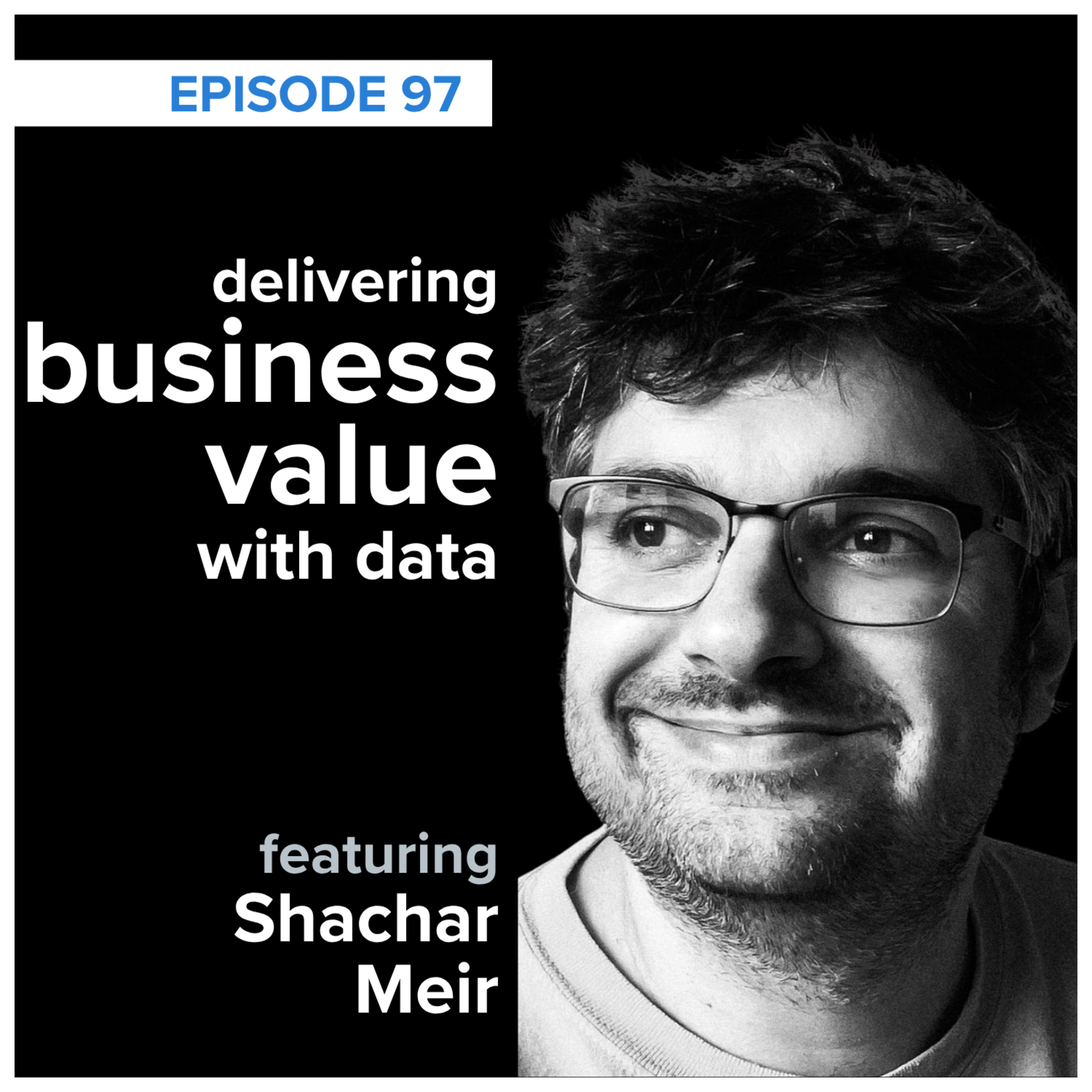
storytelling with data podcast: #97 delivering business value with data, with Shachar Meir
from storytelling with data podcast
54m 42s
In this podcast episode, Amy shares an early-career experience where she presented a pivot table to a marketing manager, only to realize she had overlooked the broader business goals. This highlights the importance of understanding audience context in data communication. Guest Shahar, a data executive with over 20 years of experience, discusses why many organizations struggle with data despite advanced tools. He attributes failures to people, processes, and culture—such as misaligned incentives, lack of data literacy, and trust issues—rather than technology. Shahar emphasizes that data professionals should focus on business outcomes, like optimizing marketing funnels, rather than just listing tools or tasks. He advises tailoring communication to non-technical stakeholders by speaking their language and addressing their priorities. On organizational structure, Shahar notes that centralized or decentralized models each have trade-offs, and the best approach depends on the team’s strengths and current business objectives. The episode underscores that successful data storytelling combines technical skills with audience awareness and strategic alignment.
Welcome to the Storytelling with Data Podcast, where listeners around the world learn to be better storytellers and presenters. We'll cover a wide range of topics that will help you effectively show and tell your data stories. So get ready to separate yourself from the mess of 3D-exploding pie charts and deliver knockout presentations. And with that, here's Amy. Hi everyone, welcome to the podcast. For those of you who have not heard by voice in a while, I'm Amy. I'm one of the data storytellers on the team at Storytelling with Data. Prior to joining the group, I held various roles in analytics. To be honest, this was not a career path that I set out upon, but rather one that I fell into after grad school because I had a quantitative background. Now, early in my career, I have a distinct memory of a really uncomfortable moment. I want you to imagine me sitting in a conference room, waiting for my marketing manager to arrive. And when she walks in, I get prepared to give an update on the latest campaign results. And to do this, I open up Excel and I start presenting a pivot table. Now, this may sound shocking to those of you listening, but in my defense, I had just transferred from the fraud analytics group. And in that department, they loved pivot tables. They appreciated the flexibility to dive in on the fly as we were talking and look at different aspects of the data. But see, I was new to the marketing organization, and I did not realize that my marketing manager would not appreciate a pivot table presentation. Now, my marketing manager was super kind and very patient with me. She actually allowed me to get through the whole spiel. When I went through each customer segment, I talked about the leads that were generated and how they were converted. And at the very end, I paused for any questions. And she was nice to thank me for all of the data and the rigorous review of the information and said, "I have one question, Amy. How does this fit into our overall conversion goals for the year?" And I froze. I realized that I had been in the weeds of the data. And so interested in all the aspects and findings that I never came up from error. I never really attached this to the overall business goals. And at this point, it prompted me to actually pause and ask questions, really get a better understanding of this new group that I was working with, their goals, what they are aiming for, also thinking about my audience. How did they like to be communicated to? What information would be helpful for them? So in today's episodes, we are going to talk about how to avoid uncomfortable situations like the one I just described. We're going to explore how we can make a business impact with data, which is something my guest today knows a lot about. I am very pleased to introduce the Harem Air, a data executive with over 20 years of experience, scaling data teams, driving growth for global organizations. So welcome to Hard the Podcast. Thanks for being here. Thank you so much, Amy. Thanks for having me. I really appreciate it, and I'm super excited about that. Yes, me as well. So we had a chat a few weeks back as you were preparing to give a presentation at a conference. And I was really fascinated by your background and your work in this space. Before we get into all those details in this episode, do you want to just take a moment here to introduce yourself and give those listening a sense of who you are and what you do? Yeah, absolutely. So my name is Shahar. I'm a data executive over 20 years of experience. I started my career as a DBA Oracle 9206 just to date myself for those here about that. And I transitioned to a team lead position very early on in my career. And I've always been in data leadership roles in different companies, both in scale apps and startups, as well as bigger companies such as PayPal and Meta. At Meta, I was London data engineering cyclead. I've grown the data engineering function in London from about four data engineers when I started to more than 200 at the peak. I've managed the data for a small portfolio of products in ads with the run rate of $7 billion a year. And in my very last role, I was the director of data engineering for all of Facebook Instagram and Messenger's trust and safety problems. And I left Meta two and a half years ago because I've realized that essentially over the past 20 years, I've seen a lot of companies that had a lot of data. They had good data teams. They had decent platforms and nothing was working. No one was was was happy. It was a complete disaster. So I took a step back and I asked myself, why is it that in 2023, we're still failing with our data, right? Because when I started my career, Oracle 9206 doing data was really hard setting up a database in a data center. And network and storage and operating system and backups and recoveries and all those things that you had to do. Even before you started putting data into your database. And today, whatever cloud platform you're on, three clicks and you get a data platform out of the box. So why are we still failing? And I've said it to myself as a goal to understand that. And I think I have the recipe. I think I have the playbooks. I know how to fix it. So I decided to take the leap and today I work with companies as an advisor and I help them win with their data. And I also help individuals with their career because I've been coaching and mentoring and growing data professionals for the past 20 years all the way from interns to senior executives. So growing people is something I'm very passionate about and I realize that helping companies and helping individuals are the two complementary things that I can do to help us help fix the industry. Wow, what an amazing journey and sounds like a big impact you've had in your various roles. So I'm super excited to share with our listeners the insights you have on how to win with data. So you talked about currently being an advisor helping organizations derive value from their data, from their tools, from their people. And obviously this comes from years of experience as a data executive, what you just mentioned. I'm curious, your approach here. Where you start with your clients, what are the biggest levers that you're seeing for companies these days? Right. So we have to take a step back and we have to understand why the companies fail with their data, right? And I think that my conclusion after doing the research is that it's not because of technology. And it's interesting that both data professionals and data leaders, when they get into a new role, one of the things they start doing is technology, right? They bring new tools, they start migration projects, they start modernization projects, they do all these things. But technology is not the problem. In most cases, it's because of in my playbook, it called it people process and culture. People is the people we have on board. It's our sponsors. It's our champions in their organization. It's data literacy and education. And how do you teach people how to work with your data? When I talk about processes, I talk about taxonomy and alignment and definitions and clarity, like what do we mean when we say customer? What do we mean when we say revenue? And it's so common that I go to companies and I work with them and they say these words. And you sit down in conversations. You hear people using the same words to describe completely different things. So this kind of alignment. And also creating processes that force people to use the right data at the right time in the right way. So things like business reviews and metric reviews and things like that to create a sort of cadence around the data. And culture for me is about two things. It's about trust in data, which is super, super important. And I think that people don't pay enough attention to trust. I talk to a lot of organizations where I speak with stakeholders and I ask them, "Tell me about your work and start uncovering problems." And then they're like, "Shahar, data is just no trustworthy. I have five different dashboards showing me revenue and numbers. And they all go in different directions. I don't know which one is right. I don't know which one to trust." So trust is a big, big, big problem. It takes a long time to earn trust and it's very easy to ruin trust and it wrote that. So it's something that data leaders need to be mindful of. So trust is one thing and incentives. And I see a lot of companies that say they want to be data driven and they're not. But then when they look at the incentive structure, it's very clear why they're not because they don't have to. And at Meta, for example, a lot of what you do is like your bonuses, your promotions, everything is tied to data in the end of the day, one way or another, right? You have to do the right things and it's expected that you will have data to prove that you're doing the right things in the right way that they're going to work, that you're not wasting time and that sort of stuff. So there's a big incentive for people all around the organization to be data driven. So I think this is my conclusion of why companies fail. Now, how do I work with companies? So I think there's two ways to think about it. Top down, which is when I work with data leaders and I do an assessment and I try to understand, okay, you're here today. You need to get here. These are the gaps and now let's put together a plan of how to get you from where you want to where you want to be. And I cover all these four pillars, which is technology people process culture. But when I work with individuals, it's it's a lot more nuanced because I think that even if you if you're an individual who works in a broken organization, so to speak, and you don't have the best champions, the best sponsors, you haven't invested much in data leaders, literacy, there's no alignment. There's still so many things that an individual can do to be much better with data. And again, it's not it's not about technology. It's about.
understanding the business context, identifying business problems, understanding what people are asking for versus what do they really need and what are the outcomes that we're trying to drive and how do we know that the things that we're building are going to help. And I think that I see a lot of people who do work, but I'm not sure that they achieve outcomes if that makes sense. And that's the thing I tried to break. Yeah, it makes total sense, right, making sure the data is having the impact on the business rather than just more data, more data, churning out numbers, what are we doing with that information? We touched on those contextual elements, understanding your audience, what they're trying to achieve, what are the overall goals and success for the organization as well as for that particular individual, which aligns pretty closely to something we talk about in our books, in our workshops, starting with considering the context, which is basically understanding your audience, what they care about and the message, what you're asking them to do. And I love that you're thinking about not just the technology, but people, processes, and culture because that actually has the big chunk of it. I'm curious, is there a certain org structure that you tend to recommend or have found successful? Like, does it help to have data people embedded in business teams or is it more beneficial to have it centralized? That's a great question. I would start by saying every org structure is bad, because organization structure puts boundaries and limitations, right? If you're centralized and you're too much in the technology and you're not exposed enough to the business, if you're in the business, then not enough standardization and all of that. So every org structure is essentially a trade-off. And it's a question of what are the things that you're trying to optimize at every given moment? And I think that if you look at every big company, what you would see is essentially a cycle of like Epson flows or you go centralized and then you decentralize and then you centralize again and then you decentralize. And if you look over a long period of time, you just see that they basically like the pendulum swings back and forth. And every new leader that comes, they say, okay, the data team is very close to the business, but they're not standardized and they're duplicating a lot of efforts and all of that, so I'm going to centralize. And then a few years later, somebody else comes in and they say, oh, but the data team has no business understanding, so we're going to decentralize them. In that sense, I think that no org structure is perfect. The question is, who are the people that I have and what are their strengths and weaknesses? Because I think that you have to design with what you have. You can't just come up with a theoretical imaginative org structure that works well in theory. But then when it comes to practice, it just doesn't work. So you have to work with the people you have. That's number one. And the second thing is understand the tradeoffs and decide what are you optimizing for at that given point in time. And that's part of what I do. And there are also all sorts of models in between their hybrid models and their guilds and their things. There's a lot of models in the end of the day. It's about having the right people and making sure that they're like the org structure is not standing in their way. All right. That's a good way of putting it. I like that. So there's many different models in which one you pick depends on the situation where you are in your journey, which makes absolute sense. I imagine as you're working with organizations that often your main point of contact or who you're working with is more in a technical space, the I/O, CTOs, perhaps. But you mention people in process is the foundational core of how you approach things. So I'm curious about the maybe less technically savvy audiences. How do you recommend telling the story of data to non-technical thought? It's a great question. And I want to tell you a story because I think that's the basis for the mistake that I see data professionals make all the time. So I think I told you this story, right? When we met in Austin, but a few years ago, I was interviewing a data engineer for Meta, perfectly nice guy. Like everything was fine. But when I asked to kick and you tell me about yourself, he said, yeah, I'm a data engineer. I use Spark, I use Scala, I use SQL. They basically just gave me a list of tools that they use. And there was, there's nothing surprising about this, right? This is a lot of the conversations with data professionals happened that way when you when you asked them to talk about what they do. And then they give you a long list of tools. But then that weekend, my daughter, she must have been about three years old and she, she had a lot of stuff in her room. So she didn't have a lot of space to play. And me and my wife, we wanted to build a cabinet so we can put all of her toys away nicely. So she has more floor space to play. And as I was building this cabinet, I was thinking about this interview that I've had. And something about it this time bothered me. And I didn't know why. And I kept thinking about it. And then I realized that saying I use Spark, I use Scala, I use SQL is the same as if you asked me, hey, Shahar, what did you do this weekend? And I say, I use the hammer, I use the screwdriver, I use nails, which of course I did, but that's not the point, right? That's not interesting. And I think that the the majority of data professionals, when you talk to them, that's that's how they describe the work. They like, they tell you about the tools that they use. The better ones, they would tell you, what is it that they do? Right? I build a dashboard, I build them, I work on this metric, I build a report, I do an analysis, which is the equivalent of me saying I build a cabinet. It doesn't, it talks about the what? It doesn't talk about the why. And the best ones, which is I in my experience, I don't know, less than 5 to 10% of data professionals, they actually talk about the why. So they talk about when when you ask them, what do you do? They say, oh, our marketing funnel is not optimized. We're spending too much money acquiring customers that have a very low lifetime value. And because of that, we're spending too much money and the the economics don't work. So I'm building this dashboard and segmenting the customers. So we can slice and dice and we can find pockets where we are spending too much money on acquiring customers and don't get the value and return. So we can optimize the marketing funnel. The output can still be a dashboard and the tools that you use can still be SQL, but the outcome is improving the marketing funnel. And I suspect in my experience, there are two reasons why data professionals don't talk about the work that way. One is because they're not mindful enough for this, but like they don't understand, right? Like they don't they don't think about it. They just describe what's easy to them. And the second reason is that in most cases, they don't know and they don't have enough business context. They don't have enough business understanding. They don't understand that part of the world. Now I would say if you want non technical operators to understand what you do and respect what you do, you need to speak their language. There's no other way. Like if you go to France and talk to them in English, you can you can you can say whatever you want. They may not understand you unless they also speak your language. So I think that you need to speak their language. So that they understand you and that's that's the biggest mistake that the professionals make. Yes. Like trying to communicate to a marketing manager with a pivot table, not necessarily a great approach if they are not very data driven or interested in those details. So the technical aspects work in some cases, but not others. And I think it's super helpful to be aware of who your audience is in the situation that you're facing because that drives so many of the choices that you make. The how you tell the story about the information, how you make it relatable, what level of detail you go into all of those aspects. And I think that you have to communicate with people in their own language and you have to tell them about what they care about. Right. So your CFO, when you tell them about the platform modernization and you tell them you're going to move from on-prem to cloud and you're going to be able to do these amazing things. They don't care about this. What do they care about? They care about costs. Right. So talk to them about the things that they care. So when I think about presenting something and it's storytelling, right. It's close by audience, what do they care about? What do they already know? What do I want them to know? These are the four things that I think of and I try to communicate that to them in their way and add context that they don't have, but talk about the things they care about. That's a great, great structure. I like the breakdown. You had mentioned folks like to talk about the skills they have in tools and technology in tools are one of the four pillars that you talked about. So tech, people, process, culture. So you do to some degree need tools to be able to execute and actually implement some of these strategies. I'm curious if there are common pitfalls you're seeing with the use of tools. Is it that folks have the tools they need? They just aren't using them well or other cases where folks don't have the tools that they need to be? Where do you find that balance? So I think that I'll start by saying tools are very important. I don't want anyone to think that the things they say imply that tools are not important. They are. I just think that being successful and having the right tools are two orthogonal things. So you can think of it as a quadrant and you can have the best tools and fail and you can have the worst tool and succeed and you can have the best tools and succeed and you can have the worst tool and fail and like all the options are on the table. I think that if you look at tools, many of them are, they provide very similar functionalities. We may have our preferences, like you might prefer a looker over a table or a power BI over something. Yes, it doesn't matter, but in the end of the day, you can build a dashboard, like a decent dashboard with all of them. So I think that tools are usually not the reason why people fail. It's because of how they use them. When it comes to the tools that you have, you need to use the tools to achieve a certain objective. And if the objective is to build a dashboard, then what is going to change? I remember one of the projects, one of the clients I worked with.
with, I helped them build the growth dashboards and when we presented the project to everyone, that was one of my very first projects. I said, "I have good news and bad news." But the good news is that you have an amazing growth dashboard right now and you can grow your flagship product. The bad news is that nothing is going to change as a result of having this dashboard. It will change if you use it. If you create a cadence around it, if you review it every single week, if you know how to scan the dashboard, how to find things and how to make decisions based of that and change your product roadmap as a result, and change your priorities. If you don't do these things, then just having a dashboard is not going to change anything. Yeah, absolutely. It's not necessarily the tool, but what you're doing with it, I think. In our workshops, we often say the process is tool-agnostic. In any tool, you can use to implement the strategy. It's just that you have to know the tool well enough to get the value out of it and implement these strategies. I was actually chatting with somebody the other day, a client that was struggling with just being overwhelmed with dashboards, as I think so many companies are these days because it's very easy to request a dashboard and another dashboard and another dashboard. But I don't think people are doing what you just suggested. Use the dashboard, get value out of it, or if it's not working, update the dashboard, refine the dashboard so that you can make the decisions that you need to achieve your goals and actually get value out of it. Do you work with your clients on that friend? Do you help them figure out how to actually get user adoption and get the data impact? Yeah, sometimes it depends on their problems, but yes, of course. I recently did a post on LinkedIn. I talk about these things a lot on LinkedIn. One of my recent posts was about the fact that building 600 dashboards is easy. Building six dashboards is hard. It's very, very easy and everybody falls into this trap of building another dashboard and another dashboard. I see teams that every task they get, they literally start a new dashboard. I'm like, this is crazy. What happens if you go down this path? What happens is you have too many, then these people leave and other people come and they get requests. They don't know that there's literally a dashboard that does exactly that. They build another one that is the same and they go stale and things, the underlying data changes and that you don't have the dashboard and some business logic is hidden in some of these dashboards and in some not so things become very reproducible. It erodes trust, which is one of the pillars I talked about earlier in culture. Your stakeholders, they don't trust you. They don't trust the data that you provide and over time they just give up. It creates a very vicious cycle and the way to break this cycle is actually to consolidate and to kill bad dashboards and to come up with a dashboard strategy and a structure and say, I remember when I joined trust and safety in meta. It was a very complicated space and it was an organization of probably two, three thousand people and I remember my manager at the time he said, I can run all of Facebook Instagram and Messenger's trust and safety problems with three dashboards, two loggers and three core datasets and that was mind blowing. Of course, we had more than that but all the facts and all the data, all the basic data you could answer pretty much most questions with those three dashboards. That's it. So he had a structure in mind and I think that organizations usually don't have this structure. They don't know what they're trying to achieve. So they keep building and building and building dashboards and they shoot themselves in a foot like that. Yeah, I've talked to a lot of groups that are struggling with having a huge backlog of dashboard requests. Everybody wants a dashboard for their data and they push back a little bit asking for more clarity on the business context, the outcome. What are you hoping to achieve? But that doesn't necessarily stop everybody from knocking on their door and essentially it feels like they're becoming data dashboard producers rather than partners. So if somebody is listening and is leading a group that is stuck in this more data as a service role and wants to become more of a partner with the business, do you have any tips for them? Yes, understand the business, understand their language, try to formulate the business, try to write a formula. So I think that this is probably one of the best exercises anyone can do is to try and describe their business in mathematical terms. Revenue equals what? What are the different components of revenue? So if it's e-commerce, for example, it's probably unit sold times average cost times margin. And if these are the components, minus returns maybe or something like that, right? Like you can add into that. But then when you have this conceptually out there, you can build a dashboard that basically shows you the top line revenue, the number of units sold, the margins, the price, and then break each one of them down into their components. So what is price made of? What is margin made of? So margin is made of your cost and then suppliers and the supply chain. So you can start listing everything out. But then what it does is when you look at the dashboard, it basically shows you the components of your business and then you can drill down into each and every one of them. But there's a structure that your business stakeholders understand. It's not just a random assortment and collection of widgets that have no relationship and nobody understands, right? And I think that's the key, like, trying to create a structure. Okay, so if you map out the business and somebody comes to you asking for a report or a dashboard that doesn't align with that, do you turn them away? Do you encourage them to rethink why they need that information? Or what do you do for the request that don't quite fit into that formula? Great question. And a lot of requests will not fit into that formula. I also think that a lot of data teams, their immediate response is building a dashboard and the dashboard is being used once or twice and then it's not relevant anymore. So for that to be a dashboard, it has to have longevity, right? It needs to be something that people are going to look at from now on for a very long time. Otherwise, it's just too much work for nothing, right? So if somebody would come to me and ask me a question and I feel like it's ad hoc, I would just run a query, I'll send them the reports in spreadsheet or whatever, like it doesn't have to be fancy. I'll provide the data, I'll help them. I'm not going to go out of my way and build that for that. When they ask me this, the same question for the third or fourth time, I'll start asking myself, okay, is there a pattern here? And by the way, this one person might be asking one question, a product manager and the person from the business is asking similar questions from a different angle and then somebody else. The trick is not to build one dashboard for each and every one of them, but to understand, okay, they're all looking at this one big thing from different angles and now I'm going to structure it for them. Because in the end of the day, the business, you have different operators asking different questions about the same things. It's still the same business. Yeah, so look for common denominators to build products that can meet a lot of audiences needs. Make sure that you aren't building a dashboard for everything, but thinking about whether it's a one-off request versus an ongoing request that needs more robust tooling behind it. The bar for introducing a new dashboard should be very, very high. Like if you're going to build a dashboard, you need to be able to justify that. And you need to be able to explain why does it not fit into one of the existing dashboards that you already have? And I think we talked about incentives, right? In culture, I think this is also something that's causing this, that in a lot of organizations, if you go and make changes to existing dashboards, then your work might seem invisible. In a way, if that makes sense, because people don't perceive that as doing work, whereas if you build a new dashboard, you can say, "Oh, I've built this," right? And you get rewarded for building. I don't think people should be rewarded for building dashboards. I think that the number of dashboards should be very limited. And I think that people should be rewarded for finding clever ways of adding things into existing dashboards and enhancing them and creating dashboards ecosystem that works for the business. Yeah, so it's less about measuring your value by X number of dashboards develop this quarter versus impact on business outcomes or in supporting decisions in different aspects that really essentially get down to that math equation that you talked about earlier. So it's not about just the producing bit, but more about the outcomes you're driving, right? Yeah, and I think that in many companies, people measure the impact by a weight of how many dashboards they produce, right? They put it on a scale and they're like, "Okay, I produce six and they're a big one, so I should be rewarded for that." And it's like the opposite. Well, I think it's something that's easier to count or easier to quantify and justify, but not necessarily moving the needle where you want it to be. So we've been talking about your top-down work with companies and you have these four pillars, tech, people, processes, culture. And so we talked about tech. It's not a certain set of tools, but really being thoughtful about how you use those tools. When you're working with people, it's really about getting clarity on what the goals are and understanding your audience and processes. We just talked about being thoughtful around building dashboards for dashboards, say, but really making sure you're gaining efficiencies by understanding questions, different groups may be having and not always trying to minimize the number of dashboards you're making. We haven't touched much on culture. You just talked about incentives, but you've mentioned a couple times trust. And trust is something that I've heard in a lot of workshops, where folks provide information and then people don't necessarily agree with outcomes because they don't trust the data or trust how it was brought together. What do folks in this situation need to do? This is a big topic for a lot of data professionals because I think that there's something very personal about it. They had the
I almost call it the psychology of data because I had a CEO that had built the startup and the company was Probably about seven or eight years old so you can imagine that this CEO had been operating in that way for a very long time In his defense he had very strong business sense like he would actually Feel the business and he would know what's happening and it was a very interesting dynamic that every time I presented him data that matched His instincts and his business sense. You would say, oh, that's great. Thank you so much for sharing this with me And when I share data that didn't that contradicted his business sense You would say, oh, I don't think your data is right. You may want to check that and I think that's a big problem Right and and I think we also have as data people we have to acknowledge the fact that not every Business operator wants data and not everybody wants the truth some people don't care about the fact They manage like some people in organizations. They manage perception or they operate by different standards And we also as much as we love our data We also have to we have to understand that sometimes that's not the most important thing and and companies need to optimize for different things And data people are not always sensible about that and they think we always need data No, we don't sometimes there are other things that are more important So I just wanted to say that now with this With this context in mind, I think that one of the best things you can do is find your sponsor Executive sponsor in the organization ideally that's the CEO But as I said if the CEO is coming from different background They're not very data savvy sometimes the CEO or the CFO or the CTO or the chief product like sometimes you have a Different sponsor find the most senior person who cares about data that you can work with they may not be like in your line of Command in your chain of command, but they will probably be your strongest and best ally in this journey use them to Build processes that create accountability around data like business reviews metric reviews things like that create a cadence where Every other week you go to the CEO office or the CEO office and and and people like you present the metrics and then the people around the business Need to explain different movements So if there's an uptick in customer support tickets customer support need to be able to explain why it happens now It could happen because of a product change that's causing a lot of friction to customers to users and then they They use support more but somebody needs to explain that and somebody needs to be who on the hook to fixing that and Having an executive sponsor helps you do that. So that's number one the second thing is find your Champions in the different groups, right? So I I had a client with the VP product the director of product and the product management Group would manager they were very non-data savvy. They didn't really care about that But I could find one product manager that was actually very very good. They love their dashboards They love their metrics and data. So I was like okay, I'm gonna work very closely with this guy That's my best friend because they're gonna help me make the change from within It's sometimes very difficult to make changes in other people's teams and cultures But when you have an agent Who can help you make the change that's a lot better? So find your champions and and then you have to build trust little by little So don't try to boil the ocean all at once try to choose small things that you can do like report a few a few metrics once a week Explain them maybe join the Sea level board meetings once a week for 10 minutes to give them a metrics update or things like that start small Create the curiosity reward that and keep growing from there. Those are all such great tips Starting small is something I think we forget about we try to do too much at once But there is a change management model where it's little small steps celebrate those wins and move on I also love the idea of Partnering getting an executive sponsor finding your champions. So really working with instead of thinking about working against though organization how can you work with them and Thinking about how it might not be data-driven or data focused at the beginning You have to meet people where they are and and then slowly build upon that I will also share something that I think not not enough data professionals do and met I once set up a meeting with the VP of ads I knew he was very data savvy Rob Goldman. I set up a meeting with him And I came into the meeting it was a 30 minutes one to one and I said I know you're very data savvy Can you show me how you look at your dashboards? It was like what what do you mean? And I said You look at dashboards, right? Can you show me how you do it? It was like Yeah, sure and he showed me he had a bookmark folder called important dashboards with like 20 or 30 different dashboards And he started going over them one by one. I was like, okay, where did you find them like how did you get them? I was like, I don't know every once in a while I ask a question somebody sends me a link to a dashboard and I'm like, oh, that's a cool dashboard So I keep it and I review some of them and there's these two or three that I like the most and the other ones I'll skim them every once in a while I'm like, okay, so data discovery is definitely a problem next and then we start looking at At some of the dashboards and he's like, okay, this metric is going up. This one's going down I don't understand that like I expect if this one goes up I expect them to go in the same direction So I'm like cool. What are you going to do about that? So that's a great question. I Happened to know that the director for this product is this person I spoke with them last week So I'm going to send them a message now with a screenshot and I'm not gonna ask them why is this happening? I'm like, okay, so why don't we just put the name of the accountable person next to every widget? So the people can know who to reach out to and these kind of things and you only get these ideas when you sit next to your users when next to your stakeholders and you look at how they use the product and I think that's too many data professionals missed that step They actually they build that but they throw it over the fence They close the jury ticket and and they're done and I think that's when people talk about data products I think that's exactly the kind of mindset that that is missing Think of it like a product right? Who are my users? What are the different archetypes of users? What do they need? What friction points do I have in my product? Like how do I make the product better for them over time? Not just being a dashboard factory and producing yet another dashboard and forgetting about it Yeah, I love that it's thinking about the end user of their experience and what they're going to be doing with it and Getting with that end in mind to drive it rather than checking another dashboard off your list, I guess I had a meeting with one of my data engineers at some point and and I asked them what can show me what you're working on and they said oh, I'm building this dashboard And I said okay, why are you building this and they said because my PM has asked me to and I'm like okay So hard they're gonna use it and they were like oh, I don't know and just building what they're asking me for And that's I think the worst mindset that every data professional can have and this is part of what I talked about in my talk in Texas in my $1 million data professional talk Which is if you're gonna be a person if you're gonna be an order-taker and somebody who just gets orders from the business and fulfills these orders then your job is at high risk right now You need to be opinionated you need to add value you cannot just be a person who just builds things because people ask them to That's not gonna be good enough And I think even more important as we have these more advancements in tooling and AI and other aspects if you can't Bring more value than just creating widgets. It is concerning for your career So we're shifting now into more of the work that you do with individuals So you talked about at the beginning how you work top-down with corporations looking at these different aspects and pillars So we've been talking about but you also spend a lot of time with individuals So working bottoms up and helping individuals help further their career And you mentioned this talk a million dollar data professional which is a provocative title So I would love to learn more about that I also know that you have a weekly course where you're trying to help folks make more of an impact within their data work And you're giving folks tools you want to talk at a high level these topics and who it's aimed at and the benefits that you're seeing come out of this As I said I've been growing and I've always had teams for the past 20 years So I've been growing and mentoring people and Data professionals all the way from interns to senior executives and I've noticed A lot of common patterns and reasons why people get stuck in their career while they fail why they are not achieving the impact that they can or they should achieve and that sort of stuff and There a lot of common patterns one is working with leadership the way they talk about the work and storytelling and building alliances and all of that understanding the business And in a bunch of other things and I I designed a short five-week email-based mini-course To address these topics so every week you get an email With three things a concept or an explanation of one of the ideas for why Data professionals get stuck and exercise that you need to do and a resource that helps you perform this exercise It can be a worksheet or or framework or something like that and the purpose of that is to push people out of their comfort zone And to push them to do something that they're not used to do and the Success of that is pretty much guaranteed because these are a lot of the very common reasons for why data professionals get stuck And I know from both from my teams over the years that I've used the same methods with and also with people who have done the mini-course that It's really helping them get unblocked and continue growing because all of a sudden they have New tools to understand the business a different way to think about the work a different way to find impact and all of that So so that's on on the mini-course. It's free for an example
now, career and block.chirhami.com and feel free to check it out. You can find it on my LinkedIn page. There's a link somewhere or my YouTube. There's a link somewhere. So I would highly recommend that. And I think that in some cases, these are things that people already know. They just need that extra push to get them out of the comfort zone and to start doing these things. So that's a many questions that one million data, one million dollar data professionals, they talk that I've given in day to day Texas. It's available on my YouTube. There's a live recording or idea of the session. And the idea behind that so when Lin asked me to come and speak, I started thinking about what am I going to talk about? And I've been reflecting on a lot of the mentoring conversations I've had recently and a lot of conversations I'm having with data leaders and with people in general. And I think that there's a lot of uncertainty and confusion right now in the world resulting from a lot of things, but essentially from three things. One is the general macroeconomic state geopolitical state. There's a lot of instability right now in the world. And macroeconomics companies are letting go a lot of people that's jamming the job market. It's impacting everything. The second thing is I think that the way we do our work changes post COVID and we went from global pandemic and everybody can work from home and remote work is the future and all of that to our companies basically telling us come back to the office five days a week, no more remote working with all trust employees anymore and all of that. And then layoffs and a lot of changes in the attitude towards and I feel like the contract between employers and their employees as employees is broken right? And if in the past they said we'll hire the best talent, we'll pay you, we'll take care of you and you just do your best work right now. It doesn't really feel like that. It feels like something is changing and I think that that's putting a lot of people over the edge. And the last thing is of course AI, which is changing and disruption disrupting the way we work. So there is a lot of uncertainty right now. And I've reflected on that and I realized that the best talk I can give is this one. I gave it a click baited title because I think that this is something that a lot of people need to think about right now because especially for data professionals, this is the opportunity of our lifetime, right? It's a big threat, but it's also the opportunity of a lifetime. And some data professionals with the right mindset will approach the current situation in the right way. We'll skyrocket and their career will explode. And for many others who are just other takeers and they just build dashboards because people ask them to all the produce yet and not the dashboard yet and not the dashboard. It's kind of like instead of jerty cat people will just give direct prompts to whatever BI tool that AI enabled BI tool and create their own dashboards because the value is just not there and their jobs will be eliminated. So I talked about these changes. I talked about the uncertainty and I explained why for data professionals, this is the biggest opportunity of our lifetime because just like we are confused and we feel this uncertainty, our executives feel the same confusion and uncertainty as well. So if you think of a CEO of a big company, they need to navigate these changes. They need to navigate their this formal. They need to make very big strategic decisions. Do I want to raise more money and keep growing or do I want to stay lean and focus? Do I want to double down or on AI or do I want to double down on my core business? Do I want to, how do I deal with all the competitors who vibed code my entire product in three weeks and what do I do with that? And there are a lot of big questions that they need to navigate. They're also confused and guess what data is something that creates clarity. So if you're a data professional who can understand what is needed, you can figure it out on your own, your self-directed, you can talk to business operators and technical operators and you're this kind of person, then like your growth is virtually unlimited right now. That's the way I see it. That sounds very inspiring and aspirational. I love it. I think you touch on something really important. It's how you frame it considering the business, your audience, and that's really the core of compelling storytelling. And I'm curious if you could share a couple of pivotal growth moments where storytelling has accelerated either your career personally or those individuals that you're working with, maybe to give folks a sense of what that looks like in the real world. Sure. So I have a bunch of stories here. Obviously, I've talked about company formulas. This is something that I've done quite a few times in the past and that's always been transformational for companies and for businesses. Seeing their entire business in one dashboard for the first time that actually makes sense. So I've worked on different products, different clients, different companies, and it's always been the same thing talking to a bunch of people and they're standing what the business looks like asking them, hey, can you please talk to me and explain to me how does this business work? And I've been getting a lot of pieces of the puzzle and you get a lot of different perspectives and point of views and then starting to formulate that and then presenting back to these people and saying, I think that the business works like that. It was literally like one paragraph with a bunch of equations that explain how the business works and I asked them, does that make sense to them? I'm missing anything. And they're like, no, that's perfect and then they went on and built the dashboard on top of that. So that's one example and it's about framing and storytelling because again, as I said for the first time, they see a coherent dashboard that really behaves like their entire business. The second example I can share is from a product I worked on at Meta. I worked with a product team. They were building a measurement solution, right? So they were trying to measure something in ads like one of the outcomes for advertisers in ads and they had errors in the measurement. The reason they had errors is because this measurement was estimated. It wasn't based on real data. It was an estimation that they were trying to come up with for the outcome and it was very noisy. So the team, basically a team of probably, I didn't know, 20, 30 engineers and data scientists and data engineers and product managers, they went on this path of trying to reduce the amount of error, the amount of noise in the measurement, which makes absolute sense because they're trying to build measurement. The measurement is noisy. So they weren't on this path of correcting that and I came in and I asked two questions. I said people, I know you're trying to reduce the error. Can we answer these two questions? How good can we get? Like what's the absolute best we can get with the signals that we have because this is an estimation, we're based on a certain signal like how good can we get and how much is good enough because if the best we can do is still not good enough for the advertisers and they're not going to use this product, well, they're going to use it but say it's incorrect and blame us for something, then is it actually worth investing all this time? And if we spend now two years getting it to as good as we get as good as we can and it's still not good enough, then we might as well stop now. We don't have to do it. And nobody could answer these two questions, but this kind of framing of how good we can get and how much is good enough really forced this discussion. And the last example I'll give maybe is it's not necessarily around data but it is around storytelling with executives and convincing people is around the PayPal and eBay split. So PayPal used to be an eBay company, it used to be part of eBay and it was the same servers, the same data warehouse, the same everything like these companies were literally connected. And then at some point there was a decision that the companies need to split and to become two independent companies, which is a very big thing if you think about it's a mess and there wasn't a lot of time to do it. And we had to get out of the data warehouse, so we had to set up a new data warehouse and move our data there and all of our processes there. And for very technical reasons, it was very difficult to run the same jobs in parallel and compare the results because if you get different data sets at different points in time and all of that and you cannot guarantee the sequence and that the input data will be the same. It was just too difficult. So they said given the time that we have it's just not something that we can do. So we'll migrate all the data and then at some point we'll just move all the processes to start working on the new data warehouse instead of the old one. So basically just move all the jobs into the new data warehouse and the project managers basically escalated that they felt bad about like they didn't feel good about this this plan. They said, oh, but why can we not just run everything in parallel and they they just didn't get it. It got escalated all the way to the chief risk officer that was part of the risk organ. These jobs were basically preventing losses. A lot of money was it was a very severe thing. So they said, okay, you have a meeting tomorrow with this chief risk officer in this project manager and a bunch of other VPs and you have to explain to the chief risk officer why we cannot do that. So thinking about how I'm going to explain that because I have 30 minutes, the chief risk officer was stressed out about the situation anyway and we have to pull off this split at a very short time period and now we're saying we cannot run jobs in parallel. So it's not a great situation and to kind of long story short I basically decided to go with the risk assessment framework with the risk assessment table where you list out all the different risks with the migration and then the likelihood and the severity of each and every one of them and I just showed all the different risks that we're looking at and I said, okay, the running jobs in parallel, right? What is the risk that we're trying to address? We're trying to check that the same software, the same database software, the exact same version with the exact same patches and everything. With the same input data will produce the same outputs. The risk is it won't. So
the exact same software database software using the same data, producing a different output. I said the severity of that is very, very high because it's going to score everything up. The likelihood of that, for me, is extremely low. Like I don't believe that's a thing, right? It's the same software. It's supposed to be very deterministic. You should be able to run the same query with the same input data and get the same result every single time. So I just don't think it's a big risk, right? The likelihood of that is nothing. And we have a bunch of other risks that we're dealing with that are much more severe and much more important to us. And we prioritize that. And the Chiffry's coffee is to look at that. And within 10 minutes, he was like, OK, I got it. I understand no further questions. Oh, good. I understand. So I think the story here is-- and the interesting thing about all these three examples, company formula, the two questions that gave them and the risk mitigation. Reason I chose these examples is because it's all about structuring the information in a way that is very easy and digestible for your target audience and something that they can immediately click with and understand and take action on. I think at the core of all of those, it was about partnering with the right people, asking smart questions to gain an understanding. So then you could frame things in the context that's going to make sense and resonate with them. So very great examples to share with our listeners. Thank you. Someone is listening right now and thinking, I'm stuck. I don't know how to do these things. Is there one small step they could do this week to move forward? Yes. First of all, take the career and blocking me, of course. Check out some of my other YouTube content because I talk about these things. Number one, second thing, try to understand the business and spend a lot of time really understanding your business stakeholders, understanding their job. What are they trying to achieve? What are they optimizing for? What does success mean for them? And then start thinking, how can you use your data to help them? I often ask, when I give public talks, I ask people who go to the office, who work from an office, who do you have lunch with? And many of them just have lunch with the data team members, right? And I ask them, when was the last time you had lunch with someone from sales or marketing? When was the last time you asked to shadow somebody from customer support and spend the day listening to customer support calls? When was the last time you asked to join sales conversations and see what they deal with? Or just take your laptop and instead of sitting next to your team, just find an empty desk in the marketing department, sit next to them and just listen to their conversations they're having. And I think that people just don't do it enough. They're just in their own silo, their own bubble, and do their own thing, hoping for the best, and hope is not strategy. So what I would say is go to your customer success team, so customer support team, ask to listen to calls, spend the whole day doing that. It will blow your mind. If you're not using your product, a lot of people they work in companies, they're not even using the products, right? So when I worked at PayPal, I tried to pay for everything online using PayPal, right? And I found bags and I found weird customer experiences and weird journeys and strange messaging and things like that. I didn't just complain about it. I went around and I tried to figure out who in this company, 15,000 people company, who is the person responsible for this feature? And I talked to them and I gave them the feedback and I asked why did we build it like that? And that's the only way, like getting out of your comfort zone and engaging with the business is the only way you can make yourself relevant and you can unlock your career. And my course is basically designed to help you do that. - Such fantastic tips. I love where you ended for stuff growth is uncomfortable, but productive discomfort, hopefully, and we'll pay off and benefit you. If you want to make a business impact, how can you understand the business better? Use your product. And if you want a true, be a true partner within your organization, think about reaching out, having a conversation, a quick cup of coffee or a lunch with somebody just to gain more understanding. So all of these are fantastic practical tips. People can look to implement. So thank you so much for sharing those. Unfortunately, that's all the time we have today. So I just like to say a big thank you to Shahar for being here and for this lovely conversation. I hope those listening also enjoyed the show. So until next time, goodbye. - Thank you.
Podcast Summary
Key Points:
Effective data storytelling requires understanding the audience's needs and business context, not just presenting data.
Common failures in data initiatives stem from issues in people, processes, and culture—not technology alone.
Data professionals should focus on business outcomes and communicate in non-technical language to drive impact.
Organizational structure for data teams should adapt to current goals and available talent, as no single model is perfect.
Summary:
In this podcast episode, Amy shares an early-career experience where she presented a pivot table to a marketing manager, only to realize she had overlooked the broader business goals. This highlights the importance of understanding audience context in data communication. Guest Shahar, a data executive with over 20 years of experience, discusses why many organizations struggle with data despite advanced tools.
He attributes failures to people, processes, and culture—such as misaligned incentives, lack of data literacy, and trust issues—rather than technology. Shahar emphasizes that data professionals should focus on business outcomes, like optimizing marketing funnels, rather than just listing tools or tasks. He advises tailoring communication to non-technical stakeholders by speaking their language and addressing their priorities.
On organizational structure, Shahar notes that centralized or decentralized models each have trade-offs, and the best approach depends on the team’s strengths and current business objectives. The episode underscores that successful data storytelling combines technical skills with audience awareness and strategic alignment.
FAQs
The podcast helps listeners become better storytellers and presenters by covering topics that enhance how they show and tell data stories effectively.
They often focus on the tools they use or the technical details, rather than explaining the business outcomes and why their work matters in terms the audience cares about.
Failure is typically due to issues in people, processes, and culture—such as lack of data literacy, misalignment on definitions, and insufficient trust in data—rather than technology alone.
They should speak the language of their audience, focus on business context and outcomes, and understand what stakeholders truly need rather than just what they ask for.
The four pillars are technology, people, processes, and culture, with a strong emphasis on the latter three as foundational to driving value from data.
She learned to always connect data insights to overall business goals and understand her audience's preferences to avoid getting lost in the details without providing relevant context.
Chat with AI
Loading...
Pro features
Go deeper with this episode
Unlock creator-grade tools that turn any transcript into show notes and subtitle files.
 PodcastTranscript AI