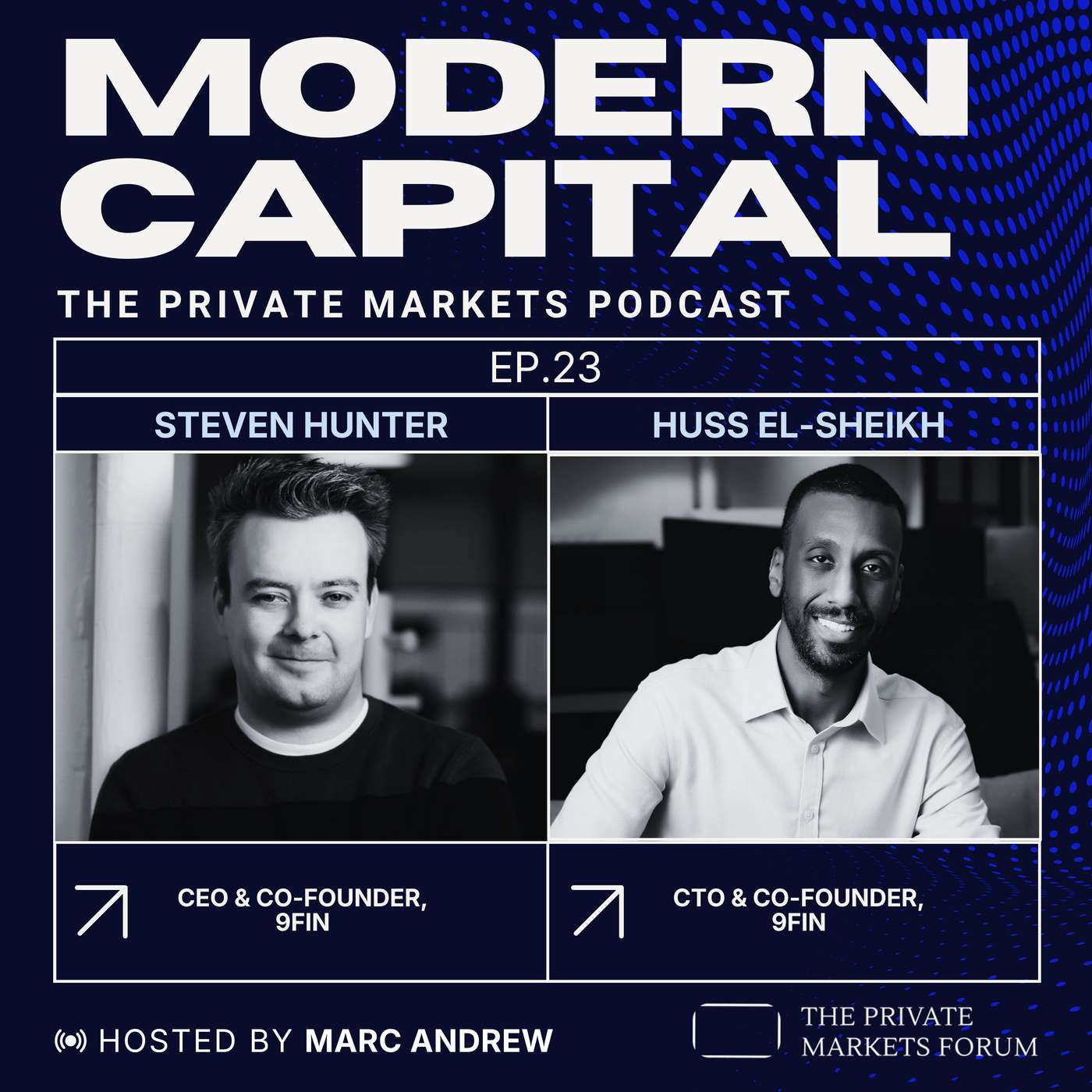
Steven Hunter & Huss El-Sheikh: Breaking Down the Silos in Credit Markets
65m 37s
Stephen Hunter and Hassel Shaikh, former bankers and university friends, founded Ninefin to address the fragmented and outdated information infrastructure of global credit markets. They observed that while the debt markets had grown to $145 trillion, the tools for accessing and analyzing data were archaic, relying on manual extraction from PDFs and clunky legacy systems. Ninefin began by using AI and computer vision to automate the extraction of financial data from bond and loan documents, quickly becoming a leader in speed and accuracy. Over time, the company expanded into providing news flow, analytics, and expert reporting, positioning itself as a hybrid technology and intelligence business. The founders discuss the blurring of traditional asset class boundaries, with private credit now competing directly with syndicated markets, and the rise of alternative asset managers resembling banks. They emphasize the importance of grounding AI outputs in verifiable, structured data and maintaining human oversight for judgment-based decisions. Ninefin recently raised $170 million to accelerate engineering investment, expand in the US, and develop AI agents that enhance workflow efficiency. Looking ahead, they see immense growth potential in credit markets, driven by financing needs for emerging technologies and industrial capital, and believe their platform can scale to a billion-dollar revenue business.
You used to have large private equity firms with small private credit arms attached.
Now you have private credit firms with small private equity arms attached.
That's the big change that we've seen in the last five years.
This is Modern Capital.
Conversations with the people accelerating the next generation of private markets.
I'm Mark Andrew.
The infrastructure of private markets is taking shape.
Let's unpack it.
For years, the credit markets ran on clean lines.
A bank loan was one thing.
A bond was another.
Private credit?
That set off to the side.
But those lines are gone.
Today, the global credit markets are rapidly becoming a single integrated market.
That's well over $100 trillion in scale.
And almost none of its infrastructure was built for what it has become.
My guests today are helping to build the information infrastructure of global credit markets.
Stephen Hunter and Hassel Shaikh met at university, became flatmates, and turned a shared frustration into Ninefin,
a company that first taught machines to read the world's credit documents.
Today, it's a billion-dollar business, and it's scaling fast.
This is a business story and a technology story.
It's about where credit goes next, and who is building the rails underneath it.
Please enjoy this conversation.
Stephen, Hassel, welcome to the Modern Capital Podcast.
Great to be here.
Thanks for having us.
Thanks, Bob.
I'm thrilled to have you both here.
This is a company founded by two gentlemen who were roommates in London, I understand,
and is today a billion-dollar company.
And so we're going to get into everything that Ninefin does and that Genesis story.
But Stephen, I want to start with you and a blog post you wrote when you announced your most recent round this year.
And I want to start by commenting that the credit markets in general are the story that they're a $145 trillion asset class
without significant infrastructure to match it.
Now, we talk a lot about private credit here, but the story of private credit really is the fact that it's becoming embedded in the broader financing landscape.
Talk to us about the debt markets as an introduction and what that $145 trillion amazing number consists of and what's broken.
Sure.
So I think there's a couple of different themes that underpin how we think about the market.
First is that the dominant theme for probably the last 20 years is private for longer or more private markets and less public markets,
whether it's number of listed equities, where people finance themselves, number of IPOs.
And so the trend is private.
And we see that continuing.
And the second piece is that the clear, distinct silos between the asset classes within private markets and in particular debt markets,
markets are completely breaking down.
So when I started my career in banking, you had very distinctive products that didn't overlap very much.
So you had a very boring bank loan product that was low leverage, low margin, that wasn't syndicated, that was clubby.
And you had a separate product, which was the unsecured bond market.
And then you had a typically covenanted loan product that was broadly syndicated.
And then you maybe had a mez team that did.
Funkier stuff.
And those three products were very distinct, didn't really overlap.
And now market participants effectively play across all of them.
And they're all very interchangeable.
You have floating rate bonds that are secured.
Your loans no longer have covenants or maintenance covenants.
You have new private credit teams who effectively do deals at the size and scale of the syndicated markets.
And then the interconnectivity of all these different markets is increasing.
So if you have a private credit deal that's done both by a bank.
Internally and by a third party private credit fund, that deal could then be packaged into a structured finance product sold as a first loss SRT, which is then bought by a credit hedge fund.
So they're all interconnected and everything is also being securitized in that market space.
So part of our thesis is not only are markets private for longer, but people don't want point solutions or siloed solutions for data workflows analytics.
And that's the theme that we really lean into from expanding our product capabilities from the various different debt asset classes.
And is this just the story of the evolution of the credit markets, this intricacy in this cross silo functionality, or is it something else that's driven bond markets into a far more varied experience?
Well, I think there's a couple of things that come together.
So bond markets historically were unsecured pre kind of crisis, especially within the leveraged finance space.
And then they kind of became secured afterwards.
You had.
Private equity sponsors who were doing again, private market deals typically, and they saw some of the benefits of having a floating rate instrument in the loan market, but they didn't really like the idea of having maintenance covenants and lots of restrictions.
And so, you know, let's do floating rate bond.
And then they decided, well, actually, you know, we like some of the bond dynamics.
Can we apply some of those in the loan market?
And so you have this like cross fertilization of the various different features of the markets, ultimately to service what the companies who are financing themselves want.
So.
These kind of clear lines were blurring.
And then also the teams between them and the flow of capital has been increasingly towards, you know, private markets and alternatives, rather than someone saying we have a specific mandate only for European unsecured bonds and ultimately a lot of insurance money and also third party and private money looking for a debt like risk profile and return and often having not as like strong a view on exactly which bucket they want to allocate against.
And.
We kind of joke that Warren Buffett figured it out like 40 years ago and the rest of the world's kind of catching up.
Having an insurance parent is a great business.
And then if you can allocate that capital and an asset manager underneath, that's where everyone else is now catching up in terms of his key insight, whether it's Apollo and Athene, whether it's KKR.
And that's ultimately everything is starting to look a little bit more like a private credit conglomerate or a bank.
And then the other piece that feeds into it is, you know, post the financial crisis.
No one wants to be a bank anymore.
But they'd quite like to get as close as possible in kind of the shadow banking world.
And that's why a lot of these firms that used to be private equity firms, we also joke, you know, you used to have large private equity firms with small private credit arms attached.
And that's the other big change that we've seen in the last five years.
OK, so let's step back.
You two gentlemen were both working in banking in London prior to starting Ninefin.
Hus, let's pull you in.
What was the genesis story?
I understand you were actually roommates.
And now you actually, one of you is commercial, Stephen.
Hus, you're the CTO.
How did two gentlemen with such diverse backgrounds or contextual strengths meet?
How were you living together?
And then how did the company get shaped?
We have to go back to even a few years, multiple years before Ninefin was even founded.
So where we met, we met at university or in college.
And it's coming up to 16 years.
Of knowing each other.
So Ninefin's only been around for nine and a half, 10.
So which college were you at?
We were at the University of Bristol in the southwest of England.
Very nice town.
We can recommend it a lot to anyone looking for places to go study.
But even weirder than that is I was studying engineering and Stephen was studying law.
So what on earth did two people need to cross paths?
And Stephen already mentioned the Great Fountain Crisis 2008.
That kind of shows up in the story again, because actually, I think a lot of people who got into finance in our area,
that was just a big global news story.
And ironically, it shone a really big light on the industry of banking and finance.
So I started in September 2008, when it was all kind of happening.
And where did you start, Hus?
Yeah, I started my degree in aeronautical engineering.
So kind of, I was just coming into undergraduate.
It was my first semester of my first, so I just began a period of being like quite shielded from what was happening on the outside world.
So it was quite a good environment to like be observing it and not be negatively.
I affected by it, but it just shone a big light on what's happening.
And that started to make me get interested in this financial markets world.
And I was kind of keeping tabs a minute.
So then we met, Stephen and I met three years later into my university degree.
Stephen's actually the year below me.
And then we both joined the finance society.
Many colleges have these kind of like finance society groups where kind of you collectively come with a group of people that are interested in this field and help each other with internship prep and applications.
And we actually joined the committee.
We were both new to the committee that particular year and our president at the time, a guy called Johnny, who actually is one of our first angel investors said, Oh, can you guys go to this event on behalf of the society?
I can't make this event.
That's where me and Stephen kind of met for the first time in late 2010.
We won the best news society award and yes, it was that joint interest in the financial markets world.
I saw it from a technically intriguing, from an engineering point of view.
So, okay, this is interesting.
This is interesting.
There's systems, there's stuff here.
I had done an internship at Deutsche Bank that summer, and I didn't realize that banks had these big technology and software arms.
I had no idea.
So then that was my world into that.
And I think, Stephen, I think for you, it was like kind of you were studying law.
So even you had a bit of a pivot from going down the law route into also going down the finance world as well, too, right?
For sure.
I enjoyed the numbers a little bit more than the letters and being closer to the kind of transactions themselves.
So pretty early on, I decided, you know what?
Law is a great.
academic degree, very interesting, but I'd actually prefer
ready to be closer to the numbers and work on the finance side of things.
Yeah. And so you become roommates in London, you're both working in banks. And I mean,
it's a remarkable set of academic experiences to carry aeronautical engineering, HUS in your case,
to bring a technical perspective, an engineering systems perspective, the legal perspective,
a commercial one, but interested in numbers. And so by now over the next, from 2010-ish to 2016,
I believe you're in London, both working at separate institutions?
Yeah, I was at Deutsche Bank, Stephen was at J.P. Morgan. Again, Stephen being behind us,
me and another good friend of ours, we went the year ahead to go to our jobs. He was at J.P.
Morgan and I was Deutsche Bank. And then we decided, look, we want to move to an apartment
that is a bit bigger. So we need someone else to come and take another room so we can go find
something that's a bit bigger. And we thought, oh, we know Stephen, he seems okay. So we asked
him and we knew he was incoming to J.P. Morgan back next year. I said, hey, Stephen, do you want
to come move in with us too? And then we can go look for bigger places. That really was,
it was very utilitarian. And we. We got on with each other. We all knew each other well. And yeah, we kind of set about
our graduate career paths, not really having any idea that we would do a company together.
Yeah, that was my next question, Hus. Was there talk of entrepreneurship,
starting something, given you were part of a society, you were thinking about
aspects of finance?
Yeah, I think that's kind of in both of our bloods kind of independently. We're kind of
noodling. And look, I'm not going to out Stephen here, but Stephen doesn't, isn't unfamiliar to
code and software from kind of doing websites when he was younger and that kind of thing. So like,
that world of building something, but we were all independently in our rooms, just working on
side projects and kind of, because also at this time as well too, big tech was happening. Like
meta, back then Facebook and the social network movie, so many cultural points had been happening
that actually probably subliminally put this stuff all in our head. And what do you do when you come
home from work to your roommates? You complain about work, right? It was like, this system is,
and not, you know, we really were like looking at,
this, this, this could be better. That could be better. Why does it take so long for that to
happen? Like, what is this paper-based process? This is ridiculous. This is crazy. And it was
kind of like multiple years of that before then kind of the idea of the actual frustration point
of like, can I get a central database of bond deals in Europe is kind of what Stephen's originally,
I mean, he said, like, why don't we go build that?
Well, I was going to go there actually, Stephen, you know, to walk us through what it,
what the typical financial analysts, they look like in your systems and the sources of
information way back in 2014, 15 and what the challenges were that made it so obvious to try
and start something. Sure. So, I mean, I felt like I'd been teleported back 30 years when I went to
work in debt markets. You know, Haas was saying we were kind of in the generation of technology,
big technology companies. You know, you had Uber, you had, you know, slick mobile apps,
you had the iPhone, you had like Facebook, WhatsApp, et cetera. And I went to work and,
you know, in order to get the price of a loan, you had to open up like Internet Explorer and
you had to open up a pop-up with a Java applet that showed you like maybe where the loan was
pricing. Maybe the data wasn't that accurate with a really clunky login system. And then to go and
get the financials in order to analyze the company's financials, you had to kind of dig
around, send an email around internally, see if anyone knew the company. You had to, you know,
you went to Bloomberg, but most of the companies are private and so there's no information there.
And it says financials are not available. Financials are available. It's just they've
got information barriers in order to get them. They're very unstructured because the companies are
private and have the best, you know, not as high quality disclosure. And then getting things like,
you know, the current company's capital structure was really painful and difficult. So to just
assemble the information that you needed to analyze a company and decide whether it could
do a financing deal, you probably needed 10, 15 different points of information,
four or five different legacy tools that were painful and clunky to use.
And speak a bit more to where that information resided, because most people understand private
company when private companies, when the information is available, they don't know
it's not available. It's simply not available. You're saying it did exist in certain portions.
And I know in the UK, the disclosure rules are a little different than the US,
but where did that information exist?
Sure. So whenever you do a bond deal or a loan deal,
the people who are lending you the money still expect you to report. It's just that in, you know,
for an IPO or a public equity deal, you have an S1 filing and then you have your ongoing 10Ks and
10Qs. In debt markets, you have exactly the same. It's just there's no Edgar SEC filing system where
you have to file them. And instead, everyone puts, you know, the initial offering prospectus for a
deal. The document exists. It's a thousand pages long and it's sent on an email distribution chain
to 400 market participants to look at. And then it lives in a shared drive somewhere. And then once
the company actually prices the deal, they still have to report, but they put it on some terrible
investor relations portal that they built themselves or on a data room that's really hard
and clunky to access. And they forget to send you an email when they put the results in there. And
then when you actually get the PDF document with the earnings, because they're not public,
the quality of the information is
much worse. It's much less standardized. You have to do a lot of work to get into something
that's useful. So the whole infrastructure of how companies do deals, how they report their
earnings, how news flow is disseminated is all really, really archaic. And that's what made it
painful to get the information you needed, whether you're in a bank or in a fund.
Has the source of that information changed over the last 10 to 12 years,
or is it still just as archaic as it used to be? There's just better extraction mechanism.
It's still pretty archaic. I think we've probably been a
force in terms of centralizing that information. So, you know, there is no, there was no Edgar SEC
filing equivalent system for debt markets. We kind of are that system now. So you can look up any
company, see its historical issuance, get the bond prospectus. You can get the company reporting if
you're entitled to it. We do it on a permission basis as well as for the more generally available
deals. So we've kind of built the infrastructure around the old kind of clunky workflow tools and
systems that people use in this market to get people what they need quicker and easier.
Okay. So you're at the kitchen table.
You're both complaining about the state of debt markets and the quality of information.
What was the genesis to starting a company and why the name 9Vin?
Sure. I don't know if Hass wants to cover the origins of the name, but basically the company
came from built up frustrations over various of these problems that we encountered in our
day-to-day work. And in particular within my part of debt markets, both on buy side and sell side.
And the challenge really was there were so many problems to solve,
access to data, extraction of that information, making it readily available. So we actually had
a ton of different potential problems to solve. And I think Hass and I have always noodled on
various side projects and ideas together. And we never really had the kind of clear conviction idea
where we thought we could really build a big business that was worth quitting your jobs over
and taking a lot of risk for until I kind of said, you know what, Hass, I think some of the stuff that
we're talking about here, this is a massive market. Okay. It's not as well known as the
stock market. It'll be harder to explain exactly what the heck it is that we do. But I think it's
we do to people, but there's really serious money here. And there's really serious problems and a
long list of them. And I think there's a complete absence of technology. And I think with technology,
we can build a massive business solving problems in this space. I think this is the one. And I
think we should go and do it together. And that's what kind of led the company. But Hass, I don't
know if you want to talk about the name. Yeah, I think kind of, well, the name was your idea,
but I will explain the story behind it. It was really funny. But like, I saw a set of problems
that were interesting to me when kind of student was explaining and showing me and talking to me
through it. Because I at that point, me and Deutsche Bank, I wasn't in debt, I was in equities,
I was actually in synthetic equities, I was in delta one derivatives trading technology. So
completely different world. There was a lot more, there is inherently a lot more technology in the
secondary side of things in markets and trading. But maybe even though it does appear complex on
the surface, and there's large amounts of money kind of involved, it's not that complex of a
system, you're kind of just tracking P&L and positions. And a lot of work was happening across
that moment to try and make their risk and P&L systems a lot more real time. Because what happened
during the GFC was that they weren't reporting on like an actual intraday basis, their exposures
to particular to equity risk and actually synthetic derivative equity risk. So a lot of projects in
the equity world were all similar around that, like real time reporting, trade capture, trade
reconciliation. But the problems that were being described in this debt land seemed a lot more like
deep and gnarly and difficult, like getting stuff out of documents. And remember, at that time,
this is this is 2016, right? OCR is not it's not what it is now, you can't just drop it into the
core, then it pulls everything out to PDFs. We had to invent our own computer vision and machine
learning kind of systems before they were the thing. And so I just found that set of problems
a lot more interesting, a lot more captivating. And before we realized that we would start this
together, another funny thing is that me and Stephen both went to like, like a
London tech jobs fair at the same time, he went hoping to go find a co founder to go and do this
business. And I went with him, oh, like, maybe I'll go to big tech, like, maybe I'll go, I will
need banking and go do tech in like a tech company. So just both of us in this like, conference venue,
just talking to people again, just not realizing that few months later that we would end up doing
it, doing it together. So there's all these kind of like, we kept on missing each other,
despite being in the same, like apartment. So the name, Stephen kind of comes into the
room, my, my, my room one day, and I'm like, busy doing, like trying to design a database model and
the schema and that kind of thing. I'm like, Okay, what do you want? He goes, Okay, I've been thinking
of like a, like a name, like goes, how about nine fin? And I go, Okay, like, not really super
engaged. But okay, like, it doesn't sound bad, but like nine fin and then he goes, Okay, like,
I think it's nine fin and then the.com is available and that kind of thing. But then he
comes back maybe a couple days later goes, Okay, I've been thinking about the name some more.
How can we
like make it work or how can we kind of have a story behind it so whenever i tell this story
i tell people there's two stories there's the marketing story and like the real story of how
it happened the real story is what i'm saying now but steven used to be into don't you know
domain shopping as well too when he was younger and like he knows you know four letter domain
starts with a number very high ranking always sorted first alphabetically so noodling around
things are thin that kind of completely makes sense you think of it that way
but the nine how could we how could we get the nine in there so you'll have to tell us where
this bright spark landed to steven but it was like we originated we do a lot more now but we
originated in leveraged finance so the fin is finance but there's nine letters in the word
leveraged so nine fin is just an abbreviation of leveraged finance so that's how we tell the story
and then the marketing reason is oh well we want to be because at one point steven also bought like
levfin.co.uk because but we never wanted to
brand ourselves that the exact asset class that we were doing because it puts us in a bit of a
pigeonhole so it's like well you know when you think of other storied brands and names and
they're like a name and they stand on their own so that's also why like we chose something that's
a bit more iconographic than or literal that's great it's a great name makes me think of
andreessen horowitz a16z there's a similarity there not a bad company to be in so my next
question was going to be and you hinted at the answer here i'm going to ask you a question
here huss that you know solving the information asymmetry or challenges in debt markets had a few
major incumbents to take on and so was it simply a question of the technology didn't exist yet
to solve the problems you were seeing and the technology needed to be invented and so that was
the company or was it also just the information products and i think you got there a little bit
speaking to ocr and so forth that you know in other words the question i'm asking is why were
those products not being solved by income
and what gap did you see i think with incumbents and in general is maybe the naivety of youth we
didn't we didn't know we just like here's the problem i couldn't find anything that could do
it so let's just go and make it and just articulate that problem again like the clear problem statement
to build a company around so it's this information gathering and centralization and actually not
only gathering structuring and making sense of it turning it into turning it into a structured
data model that can be stored queried retrieved or reasoned about by the company or the company
itself or by either a computer or by a person so we had to get about first of all securing access
to the source material which are thousand page offering documents that are just pdfs basically
and the workflow we're trying to solve and remove was the okay a new deal launches don't find a
thousand page pdf and just start control f-ing until you find the founder statements and then
you're typing them out manually into excel so that the so that when the analyst is starting their
role their their job they're
building the model of the company they're trying to get an understanding of what it's doing
we thought can we just have that ready a click so people can just get on with the task and maybe do
more than one company at once or go or go deeper so and this was always one of the aims but we had
found ourselves in like a funny position where we had already kind of quit our jobs it was early
november and it was like we had got the basics of a website like a web shell up pretty quickly like
something that you could do and then we had to start building the model of the company and we
had to start building the model of the company and we had to start building the model of the company
you can log into and it has a screen okay we set about now trying to populate the records on
on the database that were for deals so we wanted to pull out stuff like the revenue and the ebitda
and make it able to be downloadable in an excel format we kind of started typing them in by hand
it was okay this is gonna take a while and then we looked at some off-the-shelf ocr and it's an
optical character recognition or like pdf to text extraction tools and they were just full of error
and weren't working and things were being being scrambled up and won't be weren't being recognized
as numbers when you open them in excel so you kind of i kind of go to steven's like well we
got to solve this because we've already quit our jobs so we need to we need to solve this now and
we didn't have any money man because we didn't do any fundraising ordinarily incumbents now we know
they just threw people at the problem right they outsourced it they had big big sheds of people
just tied people's own up and that was a not the best model but that was a model that worked at
scale we didn't have that ability to immediately spin up two three hundred people at once so it's
right we have to find a technology solution to it because that's ultimately what will also make us
the best business but it's also i think it's the right thing to have done so i went away did some
research found some kind of found some ideas some theoretical ideas more in the signal processing
world from my background in engineering is right we can do something here around
deep neural networks were deranged back then before the ai
that we have now was called ai that was ai and it's worth pausing on this for a moment now you
your your application to a google residency at the time was ai powered financial data
ai generative ai caught the world by storm in 2022 i suppose it was but there was a lot of
application for ai and financial services prior to that of course did this initially start out as
an ai play i guess well we started using that label actually quite earlier surprised me when
i looked back we started using that in early 2017 which is when we applied for the google
engineering residency so i think it quickly became that it just became our whole identity as a company
not just our way to say an ai company but identity of using the best technology available to do the
best job and structuring the data to become usable for ai yeah i think structuring the data was
always yeah parts of the data model if you talk about the kitchen table the amount of times i
marched into the kitchen where steven normally sat because i was in my room doing my work i said hey
can you like tell me what the scheme is going to be can you tell me if this is a free text field or
if it's an integer and can it be null or empty that really was the hard yards that work there
between us like defining this and me coming back to him and saying you told me this couldn't be
null why is it null and then you're like oh well sometimes it could be null for this reason so
encoding all of that into a data model a data model that pretty much is still intact to this
day has become the best source material for this new wave of ai as well too we've just been able to
just accelerate off the back of that i think that's a really good point i think that's a really good
point there are a lot of companies who are ideological about being ai companies i think
we're ideological about being a technology company and using technology to solve the client's problem
whatever the best technology is and so when we started the company the data extraction piece
there wasn't really a technology for pdf mass processing of data extraction of financial
information from pdfs that was any good and so the incumbent solution was 5 000 people in india typing
it out which was slow it was expensive it was inaccurate and also you know if you want to
extract twice as many companies you twice as many people so the challenge of us not having any
capital being very early on was that we had to build technology to solve these problems which
you know us build from a like computer vision perspective but we didn't start out saying we're
starting a computer vision on a neural net company it was clients want highly accurate fast
information in a very important part of financial markets what's the best way to get it for them
and back then it was
computer vision some machine learning for mapping the statements now like some of that's lms and you
know what in five years now there will be different ai technologies and we will use those so i think
like we're not we very early on we're focused on technology being our big differentiator whereas
everyone else in the market was kind of very manual i think that's a really interesting point
because if many look at your business you know historically i think people recognized there are
technology businesses and then there are information services businesses or media businesses news
let's call them intelligence businesses today where if you define intelligence as something
that a professional is using in their workflow that's probably the difference between intelligence
and just general media information but you also have a ton of reporters on your staff you're
producing news do you still consider yourself simply a technology company or do you start
thinking about that cross-section of technology and intelligence and information and news
how do you how do you approach that it's a hybrid so when we started it was a very
much focused on engineering and data it was a pure data business extract the information and
the financial data and we got good traction from the financials product but we actually
uncovered some other areas of product market fit through extracting the financials which
led us down the path of doing research and intelligence as well so for example to get the
new financials on a brand new deal you need the offering prospectus to get the pro forma figures
you grab that and then we started to notice in these deals like some funky provisions
or just something that seemed like a bit of a risk that was kind of buried away in the documents
and so the first version of our kind of analytics product was i just send out a couple bullet points
on hey this looks a bit funky in this deal like straight after launch very fast and people were
like wow you were the first reporter steven that was me right and it was like they were like that's
amazing that's like no one else has spotted that you spotted it within 20 minutes of the deal
launching you got all the financials up on the platform that was never the initial product
similarly on monitoring
the other source of new financial information is reporting so we built tools to monitor
companies websites data rooms automatically for new information so we could get the financials
out that was never the product was the monitoring was to get the financials but then what the market
told us was your news flow is the fastest in the world about these companies and when we went into
some of the trading desks and we said you know our product try the news flow and the automated
news flow feed they're like oh we can't believe you'll be quicker than a bloomberg and a fact
said and the other media companies were like try it and within like two weeks they're like
Like, oh my goodness, you're way faster than everyone else.
else in the market we need this product so that was never meant to be the product but we tried to
automate as much as possible the news flow aggregation the new data monitoring and then we
added the journalistic side and the credit analyst side for stuff that was unautomatable like until
you have an optimist robot with an lm in its head that can go and take a source for coffee about a
deal that's being restructured there's no filing to scrape there's no website to monitor but that
information is still mission critical for decision making our market so you need that element of like
domain expertise in order to complete a kind of rounded platform offering and so was your speed
to market made possible by the technology husk that you had built to drive that document ingestion
or was it simply a focus on a specific niche in the market that the other major information
providers weren't yet covering at scale i think the focus on the depth of credit is a separate
point that steven should kind of mention because that is a really key differentiator but that
drive for speed that's like a company
value so we're just always trying to optimize and get things faster and i think we inadvertently
advertently maybe kind of inverted the order of things that incumbents did a lot of the journalistic
teams are at these incumbents actually were the ones that are responsible for monitoring a company
and just rewriting what the company already said in like a statement so we flipped that around such
that well let's build technology into our systems that can automate that and look to get the verbatim
of what the company said you don't need to do that you don't need to do that you don't need to do that
you don't need someone in the middle to retype it out just send it out this is this is what the
company said and what that did that was the start of our timeline so let's imagine now
some of our automated news picks up something interesting from a company filing or disclosure
that's what prompts our journalists to kind of go and oh there's something there i got a source in
that name and so it could just completely invert it and it means that like structurally you just
can't get faster than what we've done if you always have someone that is intermediate between
that information being there then you just won't be as quick this is a remarkable story but actually
that may hold inference on the future of media in general and the role of ai in newsrooms which
simplistically some characterize as ai replacing the journalists and in your case it amplified the
journalists and made it started providing intelligence on where the journalists should
dig deeper and drive coverage that's pretty much exactly what i did yeah they kind of were able to
monitor like some of the biggest users of my
our own team is like it keeps them in the flow of the market it keeps them aware of things
and then yeah like information that literally does not exist yet by definition is not inside
nlm it just isn't so it can only come from our team's hard work going out there and getting
that information it was also probably an observation in the market that when i was
on the buy side and sell side from the existing legacy incumbent players who didn't use flow
you would get so you'd get a you know a rewrite of a company's
earnings report or a press release and it would come out maybe an hour after the press release
had come out and i would say well i don't need you to rewrite the press release for me i can
read the press release myself and also that's like a terrible waste of human talent and like
brim par go and do like deep research or analysis or source-based journalism don't spend your time
rewriting press releases of stuff that's already there and our differentiation was we won't we'll
never do that we'll only write stuff that's unautomatable and we'll automate the rest we'll
just send you the press release earnings report faster than anyone else and we'll only write stuff that's
and you can read it because if you're reading a rewrite you haven't actually got anything new
they're new in news it's something you already know and so i find that very frustrating as well
but also from like an ability to attract talent from folks in this market as well as them being
able to use the platform all the time the pitch was aren't you fed up rewriting press releases
wouldn't you rather write stuff that's differentiated and sophisticated and source-based
and unautomatable and so i think if you know that proved probably more lucky than prescient but
now when you have the world of lm summarization
is a solved problem for a press release or earnings call and so a lot of legacy businesses
still have large teams of people doing that we don't and so if ai achieves maturity at any point
in the next number of years where do you see humans still being best at analysis and where
and how will they how will the humans what is the comparative advantage that human analysts will have
in working with the ai or alongside it so i think
for us for first of all the information it's non-automatable the kind of journalistic piece
that we were when we started to do more journalistic stuff people started to say oh
you kind of don't look like pure play software anymore maybe that's like a disadvantage now it's
a massive part of the mode we have like the largest best teams in the world of domain experts covering
these markets and that's very hard to replicate it's like a massive part of the business so that
is not susceptible to ai disruption until you have optimist robots with lms in their head
but the the
other kind of the way we see the kind of ai piece evolved i think even then by the way steven i think
the optimist robots will be put to work on certain tasks that achieve domain expertise and then that
domain expertise won't be replicable broadly that's very true i mean the and the other the
other piece where i think that or how it will evolve is replacing the mundane data tasks in
day-to-day of people's work i think from when i think about credit markets and analyzing a company
you know the company description in a credit memo very automatable
thinking about spreading the financials pretty automatable thinking about the extracting the
risk factors and putting them in the document absolutely fine that's automatable but looking
the management team in the eye and saying do i believe them do i think they're credible do i
believe their forecasts and the quality of earnings and their adjustments interrogating those and
actually thinking no i don't believe that that's not a reasonable adjustment or i don't like this
sector because or i don't like this particular management team those domain specialists are
going to have a very specific judgment based calls that i think is still quite hard for an
lm to get right and then also being like a supervisory layer like in our space there's
very limited tolerance for getting things wrong and it will improve but the amazing thing for lms
is there are high degree of hallucination still and they're very confident about being wrong which
is like the cardinal sin of working in finance like don't be confidently wrong footnote everything
no no to 100 accuracy 95% of the time you're going to be wrong and you're going to be wrong
95 97% is not good enough in our space people lose their jobs for that so i think that human
validation layer domain special special specialization is going to be very defensible
and important as as ai improves i think this is such an attribute of credit markets that judgment
element is still so big it's not that it isn't there in equities is that there's large parts of
equities trading businesses that don't rely on that it's systematic it's based on a very
particular discrete price signal and news and
sentiment and so much mark rowan recently said credit is a skill which is a great way of describing
it i think it's so and this kind of comes to light in some of our distressed and bankruptcy coverage
when something kind of goes into a potential distress situation or like lawyers getting
involved you don't know which way it's going to go and lms is not going to predict and it's so
dependent on the people it depends on the specific lawyer and the specific pe partner relationship
how it's going to go so you need to clear enough headspace in people's minds to be able to focus on
being in the moment of that and you need to give them good informations i i always say good decisions
come from good information give people the good information and then make the best judgment in the
moment if they still if they have to spend brain power deciphering the information then they've lost
time and they've lost advantage huss you are hard at work building agents i know you've you're
applying them across the platform in different ways how are you structuring agents and structuring
that verifiability to ensure that the information they're working on and that the ai is
providing both to your humans and potentially to the agents who are performing tasks is right
i think the number one thing is grounding it in high quality source data so all of our ai outputs
from any part of our platform is always cited and grounded in nine fin proprietary data or any
other data that's in our platform and that kind of comes from that deeply structured and labeled
and tagged up and the provenance is there and beyond the trailer is there then the buzzword
of the moment is human in the loop this is how we've always been from the beginning our
smes our experts who the very same people producing our expert legal reports or credit
reports are also kind of part of the product development team cycle in kind of their their
evaluation suites but they help us write an offer to help us judge and test the output of our systems
that they are getting the nuances right that they're getting the so what rights and kind of
surfacing out all those really nuanced details and we've had really good feedback on that right
you know we've had a gate the output that comes about yes isn't people oh wow
this is actually like the best of this type of credit ai output that i've seen and give us some
specific examples of the workflows that clients are using agents on or that you're using them on
internally i think one of the most popular products we released this year is the is the ai
test sheet so this is where you want to quickly get up to speed on the name if you just need like
a summary of like everything like you know give me even remind me of the business this description it's
operating locations it's kind of statement summary financials anything interesting in the management
questioning of the latest transcript that is what is essentially now an agent but it started off with
like a static feature like just hit a button and that just gets generated with you in seconds you
can read that on the taxi on the way to a client right before a pitch so that's like one of the
and all of those data points are synthesized from those multiple different structured data stores
online thing b
our financials database,
our earnings. call transcripts database our own reporting news than our instruments and our instruments database
yeah so ground it and make it make the original source numbers called a call uponable at any
moment so that everything could be validated and revalidated agents checking each other's work even
and so forth one question i didn't ask earlier by the way who quit first you had mentioned huss that
both of you had left your jobs but did either of you leave before the other and the other one felt
compelled yes there was steven this question there's a two-day gap between us joining the
official entity we actually resigned on the same day at exactly the same time that was a bit of a
coincidence accidents because like my manager was based in new york so i was always gonna have to do
mine in the afternoon i mean steven you you had to move your meeting from earlier in the morning to
the afternoon because you had three schedules so we actually ended up both quitting at the same
time but steven was two days over eager for me to to join an
incorporate the company yeah it was mostly admin of setting a company up and stuff like that but
we agreed like that we wanted to start the business together and then we decided you know we're going
to go and do it and then yeah we quit on basically the same day you've achieved a 1.3 billion pound
or dollar valuation now did you foresee it becoming a billion dollar company at the time
i think we've always been ambitious in terms of like the size and scale of business that we wanted
to build and you know when whenever we started off being like super niche so with european
high yield bond financial data you know that was very niche but i think all great businesses start
off in a niche and then expand so back then probably we didn't see it quite being that
scale but we did raise venture capital money and that was a deliberate choice we bootstrapped the
business but then we raised venture capital money and that has certain level of expectations for
how you build a business in terms of growth burn scale of outcome that's expected so you are kind
of expected to get to 100 million plus revenue or billion dollar plus outcome
if you're taking on board venture capital money that's kind of part of the deal so i think we were
ambitious we knew we could build a very big business i think now the exciting thing is we've
done that first journey to unicorn status but there's still so much more to go and the scope
and scale that we can get to next we probably never anticipated back when we were doing the
original finding of the company let's talk about that then and before we do you know that
mention of a niche i think is so powerful i remember ben gordon who's
a legendary venture investor speaking about make the fire burn and make it burn very hot in a small
narrow area before you try and expand the fire and i think so many entrepreneurs get that wrong
and the other element of that is that niche doesn't have to mean small it just needs to be
clear and have boundaries around it and so you found this niche in a narrow aspect of the credit
markets now you're growing by making the fire burn into a company adjacent areas but when you speak
steven to how big it could get talk to us about that you've already established that credit markets
in general are 100 billion dollars and you're growing by making the fire burn into a company
145 trillion. Is it effectively becoming an information source for that entire scale or is
it something beyond that even? When I think about the type of business we build, I think about,
first of all, it starts at like economics. Like what powers the world is actually not debt. It's
not stock markets, it's debt markets. Businesses generally raise lots of debt to buy other
businesses, to fund their growth, their expansion. And so that's like the underpinning of how global
capitalism works is actually debt funding. So we start off with like the world and capitalism
as a kind of like meta-tam, if you like, in terms of how people fund and grow it.
And then you kind of go to like, well, when you look at what are we trying to help our clients
do, we're helping them to win business or to save a lot of time. I mean, you think about the value
of that, the highest kind of compensated people tend to work within financial markets. So the
value of their time is larger than effectively any other market.
And in the decisions that they're making to win business in terms of fee generation,
you know, if you win a new mandate on a debt deal, it could be a 50 million fee event.
Spend a moment describing who your clients are. We haven't done that yet.
Sure. So you've got anyone who touches credit markets, but the typical kind of ICPs are the
investment banks. So within the investment banks, you have trading desks who trade the debt.
You have risk teams who are responsible for the bank's balance sheet. You have origination teams
who are out pitching for new business to try and advise bank issuers on transactions. And
very often, you have the risk teams who are responsible for the bank's balance sheet.
You have various other teams within the banks. Then you have asset management firms, hedge funds,
again, some who are starting to look like banks, but they will typically have, you know,
a CLO team or private credit team or some kind of asset management arm. Then you also have the
law firms and advisory firms. And so they're typically advising companies on issuing debt
or on restructuring and stressed. So those are the main buckets. Then also private equity to
an extent, and it's also a reasonably fast growing area. So those are the main kind of client types.
But for them, it's, you think about the banks, they make money through doing deals and getting
paid a percentage of the money. So they're not just doing it for the bank. They're doing it for
the manager of the deal. Trading desks is about making bid-ask spread between, in volatile times,
but between something that trades. Think about the asset managers, BIPs on AUM and the size and
scale. And you think about the law firms, again, as advisory fees. So we're helping with like
mission critical, multi-million dollar or billion dollar decisions. So the size of company and how
much we can charge for that value is going to be very significant. And then when you layer on top
the fact that all the debt markets are blurring and that private markets are booming relative to
the market that we can expand into, the challenge is which segments to tackle and in what order.
So we think you can build at least a billion dollar revenue business in this space.
And our objective is let's get there as fast as possible. And that's before we'd even contemplated
the kind of like agentic savings of helping people in terms of how they do their work.
That was just thinking about it as pure kind of licensing data and access to the platform. So
we're pretty bullish about the size and scale of business that we can build.
I love that. You know, I remember thinking,
back in 2022, when it seemed like unicorn billion dollar evaluations were a dime a dozen,
that a unicorn should really be a billion dollar revenue business, not just a valuation.
So that's a noble ambition. I remember thinking, seeing Shopify at the time, and that was one of
the few that had that moniker in Canada anyway. You know, you've had a very interesting perspective,
Stephen, and us on the evolution of credit markets over the last decade. And it seems like it's
really been the last couple of years when private credit has become such a dominant part of the
broader financial press, really.
I mean, it seems to have outsized rank among headlines and so forth. There's a lot of interest
in private credit. Obviously, we talk about it a lot. Where does private credit fit within the
broader credit markets today, Stephen? Does its growth commensurate with the attention it's
receiving? And why does it receive so much attention?
Sure. So, I mean, I think depending on how you size it, and a big part of private credit is,
well, how do we define what we mean by private credit? Is it just a company that's not a public
company that's borrowing money, in which case that covers a lot? Is it small scale, mid-cap,
direct lending that would have traditionally been done by banks, especially in Europe,
but that's now being done by funds? Is it ABF lending, or invoice financing, or SME financing?
So there's so many different ways to cut what people mean by private credit. Is it just that,
you know, the debt's tightly held by a couple of people and isn't broadly syndicated, or it isn't
a bond security that's listed on an exchange? But I think the key themes around in terms of
private credit are companies are staying private for longer, and the scale at which alternative asset
can deploy capital to lend to these companies has had a big step change in the past five years.
And before you leave that topic, I want to challenge you to define private credit.
Great question. I think about it as the kind of non, the opposite of equities, effectively.
Isn't it where the source of the funds is a fund managed by an alternative asset manager?
In other words, the source of the financing comes from a privately held fund?
I think you could probably even, I think a lot of it's labeling. So, for example, all of the banks,
are launching private credit strategies. And the question is, well, is it third-party capital that
you're managing, or is it your own capital? Because if it's your own capital. I've wondered about that, too. Is it like where JPMorgan Chase, who have declared they're doing
a $50 billion private credit strategy, are they setting up a fund to lend out of?
It depends on the bank, but I think part of it is relabeling of what is like lending. It's been
around for thousands of years. It's just who's on the other side of the lending. Is it a bank? Is it
a fund like Apollo or KKR? It's just lending. And I think it's just been packaged up in a slightly
different way. Well, and it's probably non-traded like a syndicate would be, right? It's yet anyway.
Sure. But I think if you look at, you know, the leveraged loan market when it started out,
I mean, you didn't have syndicated debt deals really historically until the early 2000s.
And people said it would never happen.
And they said it would never trade. And, oh, it'll only be clubby and no one will ever trade. And
like current incarnation of asset managers doing lending that banks typically would have done or
the capital markets typically would have done on a more, on an increasing scale, on a clubby basis,
I think 10 years from now, it starts to look all the same. It'll be traded. It'll be very similar
to the leveraged loan market. It'll have even more market participants. It'll be bigger in size and
scale. And also some of the folks we spoke to during our fundraise at times, we're also talking
about the concept of like equity, like a mix between debt and equity that, you know, actually
like with a lot of companies staying private for longer and people raising debt against the value
of their equity and private markets, maybe the lines even blur beyond the world of debt and to
things that are like, if you've got pref equity, that kind of looks a little bit like debt, right?
This is what many describe as quote unquote capital solutions. I mean, Apollo has it on
their website. Now there's a lot of firms marketing capital solutions, which strikes
me as sort of a hybrid like equity is as good a word term as any, I suppose.
I think it's, you know, is it, is it, has it got, has it got debt like characteristics? You know,
does it have a. Right. Preferred equity.
Appropriate amount of risk with a certain return profile. But it's, I think that the big changes
have been the amount of capital that's flown into this, into this space.
especially in a low rate environment that has a lower risk profile than pure equity the
proliferation of like alternative asset managers that start to look like banks and then also a
number of like macro economic events which basically shut down or made access to syndicated
markets more difficult russia ukraine being an obvious one that was really when we noticed oh
my goodness private credit is doing deals in a place that never used to be able to do deals
you couldn't do a billion dollar private credit deal in 2016 like what are some examples of that
steven so now if you look at start of my career private equity they would look at either broadly
syndicated bond market or bank loan and you needed to be of a certain scale and size so you need
really 50 million of earnings at least in order to access those markets if not go speak to your
local bank but what happened was you if you wanted to do a private credit deal with a smaller lender
that wasn't a bank
you could probably do earlier on but until you get up to 50 million earnings but they couldn't go
beyond that they couldn't go any bigger because of the size and scale of their funds so it was a
very clear delineation you either go banks and smaller funds early or you go syndicated markets
for size and scale but with the amount of capital that flowed in private equity increasingly turned
to the private credit markets for an alternative where they realized actually working with one
counterparty on a deal that's fully private has less press and noise around it can actually be a
great way to get a deal done and there's a lot of capital there and there's and that that's a great
option for us as well as looking at the syndicated markets and so like now about 50 it's by 50 50 split
on like private equity deals whether it's funded in private credit markets or in broadly syndicated
markets and historically private credit would have funded zero percent of mega cap or mid-cap
private equity deals so there's been a real change there between those those two markets
huss does private credit present unique challenges as far as the source of the data from a technology
perspective in other words if i think about a private credit deal in most cases the terms are
obviously private versus the source of information and bsl type structure being public information
do you have to be cognizant of sources of information and what can be shared or is it
basically every piece of data that hits the nine fin platform is by by the time it reaches you
public no we don't think of it kind of that plainly like there is information rights and they must be
respected at all times and we're very serious about we must yes exactly so how do you structure
that technologically so we have our systems kind of have the ability to permission and bits of data
you have to prove entitlement to be able to access that data and there's very different ways to do
that if you're a lender on the deal if you're one of the banks on the deal then those are ways those
are some ways to prove your involvement and then and then we have mechanisms in the in in the
software but not only kind of permission to do that but we have mechanisms in the in in the software
but not only kind of permission to do that but we have mechanisms in the in in the software but not
only kind of permission to do that but we have mechanisms in the in in the software but not only kind
of permission to do that but we have mechanisms in the in in the software but not only kind of permission
to do that but we have mechanisms in the in in the software but not only kind of permission to do that
but we have mechanisms in the in in the software but not only kind of permission to do that but we
also log an audit that you've been given the access because then that is something that's
really important for the compliance and surveillance function of our clients so
we also kind of give tools to a whole set of other users that aren't maybe the front of line
investment decision makers or the bankers but actually really really important uh compliance
and surveillance function as well too but are also part of these participants in this market ecosystem
and given what we're hearing about fable and its cyber security risks how real are those from your
perspective what have you learned from that and what have you learned from that and what have you
learned from that and what have you been seeing and is you know as you sort of implant guard rails
been seeing and is you know as you sort of implant guard rails around the ai is there a risk of of some
around the ai is there a risk of of some
around the ai is there a risk of of some of these ais been capable of just moving
of these ais been capable of just moving
of these ais been capable of just moving beyond those guard rails
beyond those guard rails
beyond those guard rails i think in general you know we saw quite
i think in general you know we saw quite
i think in general you know we saw quite recently the hugging face and open ai
recently the hugging face and open ai
recently the hugging face and open ai a model where like it broke out of its own
a model where like it broke out of its own
a model where like it broke out of its own exactly and this is a case where the open ai
exactly and this is a case where the open ai
exactly and this is a case where the open ai model escaped and started
model escaped and started
model escaped and started acting in non-permissioned ways through
acting in non-permissioned ways through
acting in non-permissioned ways through the hugging face models
the hugging face models
the hugging face models yeah so this is like if you are talking
yeah so this is like if you are talking
yeah so this is like if you are talking about a system escaping its own
about a system escaping its own
about a system escaping its own boundaries versus the constant awareness
boundaries versus the constant awareness
boundaries versus the constant awareness and constant building for security by
and constant building for security by
and constant building for security by design by kind of having the right
design by kind of having the right
design by kind of having the right accreditation to stop to an iso and kind
accreditation to stop to an iso and kind
accreditation to stop to an iso and kind of
of
of making sure you're building your systems
making sure you're building your systems
making sure you're building your systems in in information
in in information
in in information secure ways so we'll do that
secure ways so we'll do that
secure ways so we'll do that and then on the ai side of things but
and then on the ai side of things but
and then on the ai side of things but yeah it's kind of
yeah it's kind of
yeah it's kind of the risk of the ai models themselves so
the risk of the ai models themselves so
the risk of the ai models themselves so that's going to be probably a bit of
that's going to be probably a bit of
that's going to be probably a bit of like a wider industry question as you
like a wider industry question as you
like a wider industry question as you know if
know if
know if if if an ai function of some company
if if an ai function of some company
if if an ai function of some company chat is
chat is
chat is powerful enough to break out of the to
powerful enough to break out of the to
powerful enough to break out of the to break out of its controls and guardrails
break out of its controls and guardrails
break out of its controls and guardrails that's why kind of now increasingly
that's why kind of now increasingly
that's why kind of now increasingly important is the idea of like
important is the idea of like
important is the idea of like red teaming and pen testing against
red teaming and pen testing against
red teaming and pen testing against your actual
your actual
your actual ai invitation as well too and we do that
ai invitation as well too and we do that
ai invitation as well too and we do that as well too with like red teaming
as well too with like red teaming
as well too with like red teaming sessions where the team trying to make
sessions where the team trying to make
sessions where the team trying to make it do things that it's not supposed to
it do things that it's not supposed to
it do things that it's not supposed to and then we kind of that's all part of
and then we kind of that's all part of
and then we kind of that's all part of the evaluation speed as well too
the evaluation speed as well too
the evaluation speed as well too how do you personally stay up to speed
how do you personally stay up to speed
how do you personally stay up to speed on the pace of development and ai i think
on the pace of development and ai i think
on the pace of development and ai i think you just got to get involved and build
you just got to get involved and build
you just got to get involved and build join join the engineering team and and
join join the engineering team and and
join join the engineering team and and build it there there was a period where i
build it there there was a period where i
build it there there was a period where i felt like oh this is going maybe this
felt like oh this is going maybe this
felt like oh this is going maybe this has gotten away from me and i i'm just
has gotten away from me and i i'm just
has gotten away from me and i i'm just an executive now but actually
an executive now but actually
an executive now but actually kind of just got back in to with from
kind of just got back in to with from
the coding side from cursor and tools like that and just big user of chat gpt and claude and then
kind of actually no no this is this is this is not something that i'm behind on actually kind of
surfing to the front of the wave and starting to orchestrate multiple agents uh myself to do things
some of our engineers are running swarms of dozens of hundreds of patients and each time the email i
get from like the claude bill something going up and up and up but it's fun it's a fun time it's
really a fun time to be a technologist is that a risk for you right now i mean we hear about this
across different organizations around token spend are you racking up token bills it's not a concern
it's interesting to see it climb but it's not concerned for us because we have always and this
is a really great attribute of knife and engineering we've always been very efficient
with how we spend our computing resources i'm really wondering what these giant token
bills are happening is it just are people just leaving stuff on infinite loops and coming back to
like useless output
because where's the business return on that spend and output so
i've heard for example investment research can rack it up pretty quickly like some of the guys
at semi analysis who do the data center research were commenting on scale of spend when agents are
canvassing information for example and i wonder if that is like technically they're like
reprocessing the same like to get five insights out of a document they're reading the document
five times or searching the web in such a way or finding data web probably wouldn't be a big cause
of big cause of the spend that's kind of small bits of data but if you're repassing yeah if you're
repassing huge volumes over and over again like if every insight like gis data with maps yeah and for
some things that large language models are quite inefficient at doing if you just dump math
coordinates into a context window why don't you get your model to tool call a tool that knows
how to structurally pass geospatial data for the cost of a few kilobytes rather than let me put a
few hundred megabytes of just raw coordinate data and let that out and figure out it will i
missed what seamless and earlier it will always give you an answer it's it's it can never not give
you an answer and that's really something that people should be aware of it will always give you
an answer so with your latest round which was earlier this year 170 million what are those
resources being applied to what's the growth curve over the next couple of years sure so i think the
main priorities are around you know increased investment in park engineering i think there's
no one in the world that's spending more on debt markets and ai than us and we can't hire engineers
fast enough so we're growing and scaling because we've got a really ambitious product roadmap loads
of problems to solve and so huge huge investments in terms of r d we think it's like a big step
change moment and it would be criminal to be under invested at this time like i said it's
super exciting to be building and there's tons of opportunity and we want to go as fast as we can so
i accelerated investment r d the big one the other piece is you know just
scaling the business especially in the u.s it's our biggest potential market we've got we've done
really well here and we've got really great proof points of scaling so now it's like time to put foot
on the gas and then also just you know it felt like a good time to raise capital to give us
optionality for the future to go faster if we want to in other different areas different parts of
debt asset classes different parts of private markets and so you know we raised at a point
where we didn't need the capital and you had s p at record highs you had credit markets at record
heights and you know before we went out to raise we thought hey this is not a bad time to go put
some capital on the balance sheet because you don't know what's around the corner and hoss and i have
done this company for nearly a decade and we've seen the crypto boom we've seen the remote covet
boom we've seen like various like various different kind of crazy mac russia ukraine
you know svb collapsing like company ending type macro events and survived them all and so we said
like let's put some capital on the balance sheet as well as you know giving ourselves lots of
optionality to to fund the business we don't know what's going to happen with russia we don't know
what's going to happen with taiwan we don't know what's going to happen with trump and iran we don't
know what's going to happen with ai full stop and then some of those things actually as we were kind
of finalizing around started to unfold so you know but actually for us like you know sas apocalypse
was happening when we raised but we have actually like a great ai story and it's a great tailwind for
our business we didn't actually see much of an impact for us yeah you don't strike me as a sas
business i mean far more of an intelligence business and intelligence is what fuels ai
so you're almost a fuel for the modern era as much as sort of a when when that argument around
which which was wrong by the way and i think it's proven i just checked this morning by the way it's
sort of july when we're checking this and as a lark i bought a bit of workday equity like a month ago
because i figured no one's going to be outsourcing having been a power user of clode for some time no
one's outsourcing their payroll to clode and workday is up 50 in the last month just to give
you a sense so all of that private credits apocalypse nonsense is proving to be such
there's there's some cheap stuff out there i think like the the real
You know, we speak, actually,
She spoke to some folks who we used to work with.
And, you know, I think if you've got a simplistic feature set
for a product that's not mission critical,
that's a SaaS tool, that's challenged,
it's likely going to be challenged either by Claude
or by AI-native competitors who can build something better
and quicker and do it more cheaply and more effectively.
If you're mission critical in terms of someone's workflow,
you know, I think, yes, you'll potentially get more
AI-native competitors, but is your priority as a CEO
of a big institution for your team to be vibe coding UI
or to be rebuilding your Salesforce or, you know,
building CRM internally and maintaining it
or is it making investment decisions using judgment?
So I think, you know, yeah, there's a lot of stuff out there
where I think I'm pretty sure the longevity
of a lot of these businesses is assured to be a value issue.
And to your point on the broader credit markets
being what drives the global economy more so than equity,
you know, I step back and think of where
we're at in a cycle and it certainly seems to many
that we're very late stage in the credit cycle
and I'm not making any predictions,
but it's also remarkable to what extent
this entire burgeoning space of industrial capital
will require credit as much,
industrial capital companies or industrial companies,
the new industrial companies will require credit
just as much as they'll require equity.
By those, I mean, you know, everything from drones
to autonomous vehicles, to data centers,
unfortunately, to munitions, to autonomous boats,
and run down the list, biotech requiring incredible investments
and GLP-1s for Osempic, all of these things
are going to require immense amounts of capital,
immense amounts of credit, and they're going to scale
through, you know, new novel forms of asset backed finance
in such ways, right?
They'll finance their venture through equity
and then their growth through credit the same way Ford did.
And I mean, it's tens of trillions of dollars
of credit required.
And, you know, I noticed recently
the former CIO of Sixth Street, who I deeply respect,
Josh Easterly, was commenting on how, you know,
a lot of the origination is getting challenged.
Maybe too many deals are chasing too little credit
or vice versa, rather.
Too much credit is chasing too few deals.
And it seems to me like there's such demand
for credit markets over the next decade.
So it is a great place to be.
There's a whole wave of, like, private, late-stage
venture-backed startups that are doing things in hard tech,
so physical world things.
Yes. Yeah, that entire hard tech space
should scale through credit.
Credit more so than equity.
Yeah, because you can't just keep on equity
because then equity has implications
because if you own enough of it,
you must be involved in the governance
and the running of the company.
If you just need to finance an investment period
to give a payback, then the perfect instrument for that
is a debt obligation that you pay back to someone.
Easy, right?
Yeah, through a form of project finance, for example.
And these tools have been around forever.
They're just being applied to novel assets.
And I guess there'll be fits and starts
as we figure out these new collateral types.
But think of robotics as a service.
For example, I mean, humanoid robots,
as we talked about earlier, those optimist robots,
you know, there'll be a secondaries market for those
and they'll be collateralizable.
Yeah, and kind of has someone like Elon Musk
kind of done this by himself,
by the financing of his different companies
and just kind of lent himself the money
through the Twitter buyout exhibit.
Actually, that's what's funding.
So, like, in the absence of there being a way
for, like, privately held equity-backed company,
like, privately held equity-funded companies,
I think that's a good thing.
This mechanism will need to uncover itself soon.
Yeah, this is, I mean, shameless plug,
this is a topic that is,
the one topic that we cover at Private Markets Forum
that's not pure operations and infrastructure
of private markets,
although I would argue it's market structure,
is this burgeoning industrial capital for novel assets.
And I think, I just think it's a remarkable growth area.
Yeah, well, I think if you use a robot
or multiple robots for every human,
you know, similar to having car companies
finance themselves, right, it's all ADS.
So, you're going to have pools
of collateralized robot obligations.
And, you know, that's before you even think about,
are we going to build the infrastructure for Mars?
Like, not all that's coming from equities.
So, you know, there's, I don't know what base rate
we'll use for that, whether it'll be dollars
or something else, but there's going to be
no shortage of credit stuff to build the world
of the future in the next 30 to 50 years.
That $145 trillion, that strikes me as,
as we have this conversation, low.
$145 trillion in credit markets seems low.
And it sounds to me like it's going 10x
over the next 20 years.
I think it's only going one direction.
Yeah, no, there's no way.
There's no question.
And there will be fits and starts.
We will have retractions and so forth,
but it feels like we're at the beginning
of a massive technology super cycle,
not near its mid-stage.
Gentlemen, thank you for this conversation.
This has been a true joy and certainly fantastic
to hear some of the genesis stories
of two friends from college who have
not just started something,
but started something deeply successful
and is just starting its journey
into a major brand of financial information.
So, I've enjoyed it and I look forward
to future conversations in the future.
Thanks so much for having us, Mark.
Thanks, Mark.
Thanks for listening to Modern Capital.
The next generation of private markets
is being built right now.
And it's reshaping business, technology, and society.
I'm Mark Andrew.
Learn more about our work at the Private Markets Forum
and each of our upcoming events at private-markets.com.
See you next time.
♪♪♪
Podcast Summary
Key Points:
The credit markets are a $145 trillion asset class undergoing significant transformation, with traditional silos between bank loans, bonds, and private credit breaking down into an integrated market.
Ninefin, founded by Stephen Hunter and Hassel Shaikh, started as a solution to archaic information infrastructure in debt markets, using AI and machine learning to extract and structure data from complex financial documents.
The company evolved from a data extraction business into a hybrid technology and intelligence platform, offering faster news flow, financial analytics, and expert reporting.
Private credit has grown dramatically, now funding about 50% of mid-cap private equity deals, a shift from zero a decade ago, driven by increased capital and changing market dynamics.
Ninefin raised $170 million to scale its engineering efforts, expand in the US market, and build AI agents grounded in verifiable, structured data.
The founders emphasize the importance of human judgment in credit analysis, with AI handling mundane tasks while humans focus on nuanced decision-making and relationship-based insights.
The future of credit markets is expected to grow significantly, fueled by demand from hard tech, robotics, data centers, and other novel assets requiring debt financing.
Summary:
Stephen Hunter and Hassel Shaikh, former bankers and university friends, founded Ninefin to address the fragmented and outdated information infrastructure of global credit markets. They observed that while the debt markets had grown to $145 trillion, the tools for accessing and analyzing data were archaic, relying on manual extraction from PDFs and clunky legacy systems. Ninefin began by using AI and computer vision to automate the extraction of financial data from bond and loan documents, quickly becoming a leader in speed and accuracy.
Over time, the company expanded into providing news flow, analytics, and expert reporting, positioning itself as a hybrid technology and intelligence business. The founders discuss the blurring of traditional asset class boundaries, with private credit now competing directly with syndicated markets, and the rise of alternative asset managers resembling banks. They emphasize the importance of grounding AI outputs in verifiable, structured data and maintaining human oversight for judgment-based decisions.
Ninefin recently raised $170 million to accelerate engineering investment, expand in the US, and develop AI agents that enhance workflow efficiency. Looking ahead, they see immense growth potential in credit markets, driven by financing needs for emerging technologies and industrial capital, and believe their platform can scale to a billion-dollar revenue business.
FAQs
The main change is that large private equity firms with small private credit arms have transformed into private credit firms with small private equity arms. This reflects the blurring of traditional silos between debt asset classes.
Ninefin was founded by Stephen Hunter and Hassel Shaikh, who met at university and became flatmates in London. They were frustrated with the archaic, paper-based infrastructure of debt markets and decided to build technology to centralize and structure credit data.
The credit markets have grown and become integrated, but the infrastructure for accessing and analyzing data is outdated. Information is often in unstructured PDFs, shared via email, or on clunky portals, making it difficult for market participants to get timely, accurate data.
Ninefin uses AI, including computer vision and machine learning, to extract and structure data from documents like offering prospectuses and earnings reports. This enables faster, more accurate data delivery, and they also use AI agents to synthesize information for clients.
Ninefin's clients include investment banks (trading desks, risk teams, origination), asset managers and hedge funds, law firms, advisory firms, and private equity firms. They serve anyone who touches credit markets.
Ninefin has permission-based systems that require users to prove their entitlement (e.g., as a lender or bank on a deal) to access certain data. They also log audit trails for compliance and surveillance purposes.
Chat with AI
Loading...
Pro features
Go deeper with this episode
Unlock creator-grade tools that turn any transcript into show notes and subtitle files.
 PodcastTranscript AI