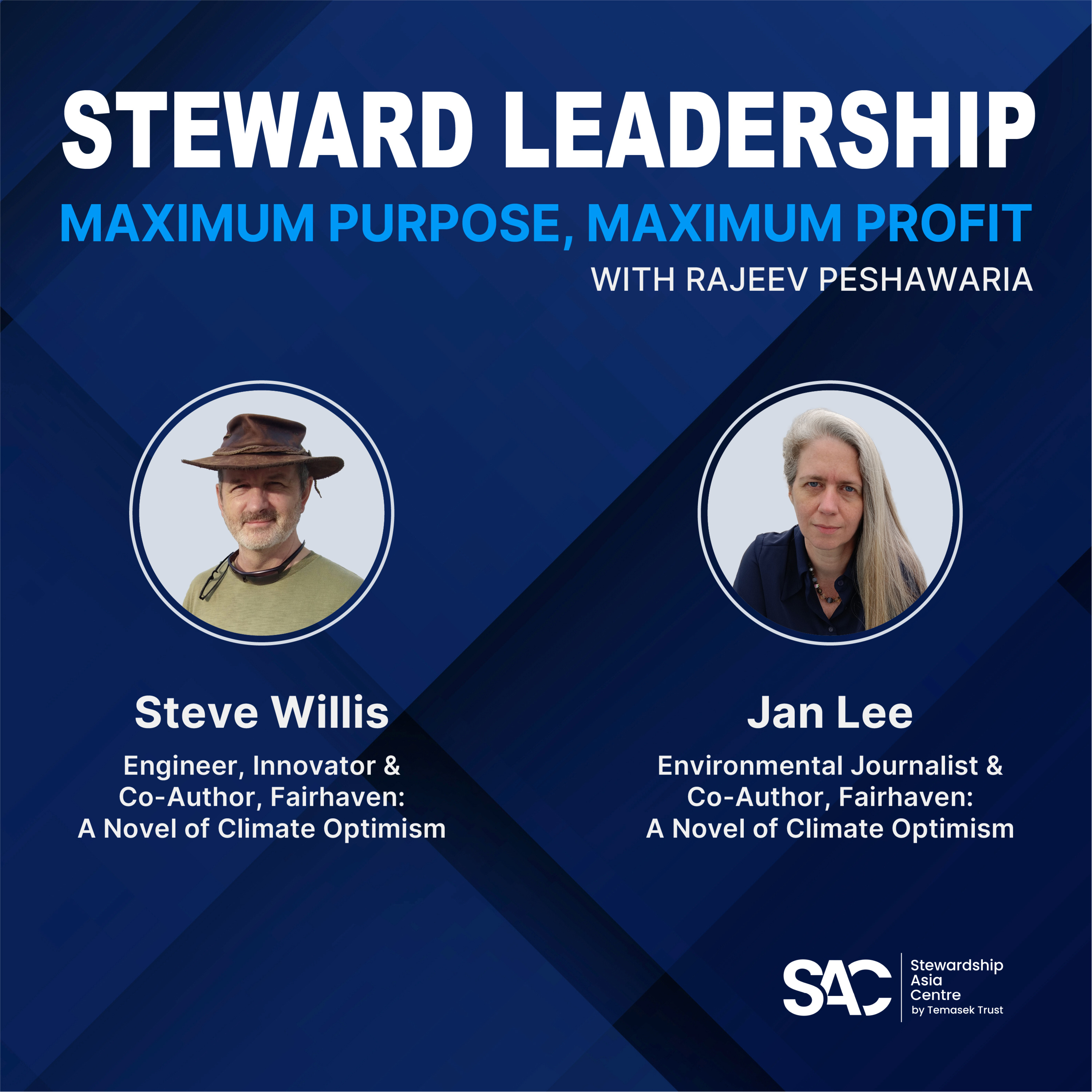
Steve Willis & Jan Lee on using fiction as a force for good
from Steward Leadership: Maximum Purpose, Maximum Profit
29m 4s
In this podcast episode, hosts Rajeev interview Jan Lee and Steve Willis, authors of the climate fiction novel "Fairhaven." The authors explain that they wrote the book to counter the prevalent cynicism and dystopian narratives around climate change, instead offering a hopeful, science-based vision of the future. Lee, a communicator, and Willis, an engineer, collaborated after connecting on LinkedIn. They emphasize that fiction is more accessible than technical reports, with the ultimate goal of adapting the story for Netflix to reach wider audiences. The novel features real, scalable solutions like Rigs to Reefs (transforming oil platforms into marine habitats) and Arctic re-freezing, both of which the authors have worked on practically. Willis notes that these projects require the logistical capabilities of oil and gas companies, which are well-positioned but slow to transition. The character Grace Chan embodies individual agency, while the setting in Penang, Malaysia, serves as a realistic, resilient location for a future climate hub. The authors argue that storytelling has historically influenced policy, citing "The Rain of Greed" and "The Day After" as examples. They conclude that optimism, defined as persistence and determination, is essential for motivating action and avoiding failure.
[MUSIC PLAYING] Hello, and welcome to another episode of Maximum Purpose, Maximum Profit Podcast. Today, I have with me two incredible people, Jan Lee and Steve Willis, authors of a fiction novel on climate call Fairhaven. I had such a good time reading this book that I invited both of them to have a chat, because this is yet another novel way of thinking about the crisis that we are going through. So Steve and Jan, welcome. Thank you very much. Very happy to be here. Nice to meet you, Rajeev. Wonderful. So let's go straight into it. I mean, Jan, your background is in communication. Steve, you're an engineer. What got you to write a fiction book a novel about climate and that to climate optimism? Do you want to go first, Jan? Yes. Well, I myself have been writing kind of a sideline in writing science fiction. So mostly short stories and a novel it hasn't been published yet. And one day in April of 2023, I got a LinkedIn message from this guy in Malaysia, who said that he'd been working on some climate short stories, and was I interested. And after a couple of words of exchange, he said the magic words, would you like to collaborate? Wonderful. So generally what you're hearing these days about climate is a lot of cynicism, a lot of negativity. But you came at it from a hopeful, better future approach. I've been working on solutions for many years. So what are the large scale climate solutions? And we've had some of them go through startups and some of them go through collaborations with companies. And we have a large collection of things that would probably work. And the biggest, most ambitious ones have really difficult to get over the hurdle. So we put them into climate fiction instead. So stories to inspire action and interest in engagement, rather than despair and despondency and relying down and having another donut. Most of the climate fiction you see that's out there nowadays is very dystopic. It shows a world where everything is failed and people are wandering around the wasteland like Mad Max. What we wanted to show was a way to visualize or envision the situation where these solutions actually work and where people are cooperating and looking towards this. Because if you can't imagine it, you can't do it. So you're both optimistic then. In the end, we will come out on the right end of this. Nobody knows yet. But if you think of it in a pessimistic way, well, that's sure not going to get you anywhere. So you better think of it in an optimistic way so that we have the possibility of getting there. Yeah. And for me, Rajiv, the word optimism is not fluffy bunnies and flowers. It's persistence, determination, and grit. And with that, you can do a whole load of things. If you give up, you've definitely failed. So the research behind the book, you talk about rigs to reef. If you talk about Arctic reef reef reef freezing, the research is solid. It's science-based. Then why write a fiction book? Because people read fiction. The brutal reality is that at the end of the day, people don't read white papers or reports or the IPCC website. But some people still do read fiction. And our long-term goal for Fairhaven is to get it all onto Netflix. So some people still read books. But an awful lot of people watch TV. So if we can make a TV series which shows people engaged and working on the climate crisis and making progress and a vision of a decent, livable future, you're going to get a lot more people engaged. And that's our ultimate goal. So talk to me a little bit more about the research, all these solutions that you talk about, some of which I just mentioned. Is this all real? What's the state of the art with them at this point? - Yep, absolutely. So the Rigs to Reefs, which is on the cover of the book. So here's my edition of it. There's the cover. - Here you go. - So Rigs to Reefs is a project that we have worked on in real life here in Malaysia and are still working on in real life. So the situation there is, I was working with a small company that had done a real Rigs to Reefs project on one of the islands in Malaysia, south of one of the islands in Malaysia. And they were looking for more business. And so well, if you can do Rigs to Reefs, the small scale, you can do a large scale. So we engaged with the oil companies and the Ministry of Agriculture and Development and Fisheries and so on, about getting permission to do this at a much larger scale. And got almost all the way through and then COVID arrived. So we clearly weren't going to be able to do in the COVID situation. So the project got parked and we did something else instead. But this last year or so, a lot more people have come back and said, how far did he get with that sea orchard project? Did you were you able to do it in real life? And Rigs to Reefs has been done in other places in the world, but usually it's done a fairly small, non-ambitious scale. And what we want to do here in the, you know, fabulous tropical waters of South East Asia is do it at the most ambitious scale that you can imagine. And so rather than having pokey little reef switch and make a nice dive side, but under a big marine habitat to square kilometre scale and much more ambitious areas where you restore the abundance of the sea and allow the fish to return. So you don't fish within your squares, you fish outside the squares, but you have lots of them across the sea bed. And then that would pull the population with the fish in the sea back up. And what about the re-freezing? So there are four teams in real life working on the re-freezing the Arctic project. And I've known them for several years. And one of them, they worked for years on no money, you know, funding themselves out of their own pocket. And it was quite a struggle they had, but they've done some good work up in Canada demonstrating the re-freezing. But I was speaking to the guy over the weekend, and he's got five million pounds from the UK government to do a much larger trial, which is fabulous news. So they are making progress. But of course, the reality is it needs to be done at, you know, ever larger scales. So the principle. - That was going to be my next question. Sorry, so you do believe that these are all scalable? - Oh, totally. - Yeah, yeah. Yeah, that's one of the requirements for going into the story is will it work? Will it work? Will it do a million tons? And is it a negative emission? And those are our parameters for a good startup and also for a good story to get into the book. - I'll just add to that as well. So beyond the research for the projects and say the scientific backing, we also did quite a lot of research and based on both of our experience working in large companies about how these things get funded, how the corporate decisions get made. You know, what does a meeting in a boardroom look like where these things or these types of projects are reviewed? Because we want to show that these things are not only technically feasible, but practically feasible, even within the circumstances we currently have in the corporate and policy world. - I'm very curious with what you just said. So you did a lot of research on how boardrooms really work. Give me the 30 second version of what you learned about how those kinds of decisions are made. - It is never a single person saying yes, let's go. There are always more people involved. The typical large company is not a monolith that says all acts as one. There are competing interests. There are endless series of meetings, there are review meetings and there are problems with projects along the way. The question is how can those be overcome? - Yeah, yeah, yeah. I'm really wondering if that is so much we can talk about on that a lot, but anyway. But listening to both of you, it sounds to me that the characters in the book were not all entirely fictional. They were based on real people in some cases, yeah? Often inspired by real people. Many of them are composites of people we know or have met in the course of the video. I think collectively we have quite a few decades working in Asia. - Steve, you are a director of Sequest Rate and the founder of Herculian Climate Solutions. Tell me a little bit about both of those. What do you do there and what's the current state of play? - Yeah, so Herculian Climate Solutions, we set up, me and my engineering friends, we set up just before COVID. And the purpose of that was to look for the multi-million-ton climate solutions. So what are they? Can we identify them? Can we either make start-ups or businesses out of them? And how do we bring them forward? So the three awkward questions, will it work? And is it a negative emission or from that process? So we would have an idea to walk around it fairly gently, do some BMAT calculations and work out where the thing was a good idea or not. And we have dozens and dozens of these on our list. So there's some great material that we can use. And we've had two go forward into our own start-ups. So one was related to Biochild, which has gone off into a different direction. and the other one became sequestrate. So sequestrate is CO2 mineral.
where you react CO2 with Olovene, which is a magnesium silicate mineral, and make a stable magnesium carbonate, which is a permanent store of CO2. So we got some money out of the UK, did some research here in Malaysia, but as with all of these startups, and particularly with the climate startups, it's very difficult to get through the next gates. So sadly that sequestrate as its original entity has died, and we're in the process of selling the IP to a different group in the UK, who are going to have another go through a different set of grants in the UK. So we're going to get some other funding. We're still involved as advisors to do that, and we're going to try and lasso us the project and get it through the set of gates, because it would work definitely. No, the key word is to give it another go, as you said. Wonderful. Let's talk about the traditional energy sector, fossil fuel companies. Of course, this whole conversation is about the fact that we need to turn the clock around and talk about renewables and all those sorts of things. But do you think the traditional oil companies, fossil fuel companies, will act fast enough, and what do you think is the biggest challenge in our way to getting cleaner? A lot of our book focuses not on what you might call the traditional solutions to climate change. So yes, I think everybody knows what you're looking at. We need to jump to renewables. Everyone knows that the fossil fuel companies need to turn around. I think what's not appreciated is how much desire there is internally within these large corporations to find a solution and a business model that will work in the next 50-100 years. So I don't think anybody has any illusions, even at the most senior levels of traditional companies, that business as usual will continue to be fine forever. I mean, every company, even the ones that have been for 100 or 200 years, have transformed over time. So the best leaders know that they need to transform that business. Are they moving fast enough? Are there any companies that you would name are doing more than others in getting to that future state? They're not moving fast enough. And to answer part of your previous question, the oil and gas companies are very well placed to do the two big solutions that are described within Fair Haven. So doing the Sea Orchards, the Rix to Rix project, obviously that's within their remit because they have the Rix. But they also have the experience offshore and the offshore supply vessels and the crews and the logistics. So if Ocean Orchards Sea Orchards is to be done at scale, the oil companies are brilliantly placed to do that. And they recognize that they need the blue carbon in order to be able to manage their own footprints. And doing Sea Orchards is a brilliant way of achieving that. And the re-freezing the Arctic project, again, is a project of logistics. So you need the right kind of ships, the right kind of crews, the right kind of organisation to go up into the Arctic into the thin sea ice, pump sea water under thin sea ice to make it into thick sea ice and then being able to manage all of that. And the oil company would be ideal. And speaking to the people within the oil companies, it's like, yeah, yeah, it kind of see that. And so you half persuade them and then they change the subject and they want to get on with the day job because the day job is prioritised that way. And it's quite difficult to change the whole feeling of the whole company. But I've been approached by quite a lot of people within the oil companies and they say, we've got a job. I want to get out of that and do this. And so there's definitely a recognition that they have the capability and experience and determination of will to do these huge projects. And that if they, you know, fixing the climate crisis, it's going to be massive project, that set up projects and who else can do massive projects other than the oil and gas industries, the construction industry, you know, it's got to be them. So it's really quite. Any particular leader that stands out in the industry that is doing more than others in this transition. I think most of the companies have not got to that tipping point just yet. So I don't think there's one I can name that say, like, oh, yeah, these guys are doing it well, which is by the way, why we also require the policy implementation. But in some places, we're finding that to be on the increase, just for example, I'm currently in Portugal where I've been for a short time, quite surprised to see the difference in, for example, the percentage of renewables that is powering the grid. And how that interacts with the number of, for example, electric vehicles on the road. So these are two simple, simple factors electric vehicles are not, you know, the sole answer. But it's very close to that tipping point. And so I'd be interested to see what other countries are doing at a policy level. So that combined with the individual will of some of the people working in the industry as you were saying, Steve, hopefully we'll get us closer. Okay. And that brings me to back to the book and the character of Grace Chan. Obviously, she is pivotal to the story. What were you trying to convey when you were revolving the book around this character of Grace Chan? How does that, were you trying to inspire individual action? What was behind that? Well, Grace Chan is kind of an every woman. You'll notice she's, she's from a complicated background. She's from, she's from Malaysia, which in a certain sense is the nexus of Asia. And you know, this, you know, where we see Southeast Asia, we see South Asia, we see East Asia coming, coming together. What we wanted to show is that although no one person can do it all, there is a role for everyone. And you'll see that many of the other characters in the book. We have HR directors. We have, you know, the guy operating the camera within a company. We have, you know, fishermen and even pirates all playing a role here. But then then somebody like Grace, I guess, takes a leadership role that becomes a multiplier effect and then brings a lot of people into the journey. So I get very good. Why penang? The story was set in penang and Southeast Asia. Was there a particular reason for that? Yeah, penang is a beautiful example of what could be done if you tried the most extreme solution. Hang already suffers from from flooding. So back in 2017, there was a large flood there. And sea level rise is certainly coming. And if you have a meter or two of sea level rise, it will lose a large chunk of penang state because it a lot of it's very low level. And the geographical locations also very unusual sea level large island off the coast and you have a coast next to it with a big mud flatten in between. And I remember going to penang many years ago and standing on the hill and looking at the bay and thinking, if I was a Dutchman 150 years ago, I'd put a die here and a die here and I drain the whole lot and do rice. It's perfect for it and it's like a Dutch technology, you know, 100 years old. And it's a way of also protecting all of those areas. So the Holland is still protected from sea level rise because of the digs that they built hundreds of years ago and continue to do so. We don't want to build dites and have rice there, but it is a way of protecting that area and providing a new piece of land 250 square kilometers as a land that can be defended for hundreds of years going forward. So you can have, you know, five to 10 meters of sea level rise. Yes, you can protect that. And you can have a new in effect capital city for Southeast Asia in an area where you can defend it on a still on the coast. So, you know, with a couple of meters of sea level rise, you know, Bangkok is massively effective. You've already lost Jakarta. Singapore is really struggling. You've lost a chunk of Kuala Lumpur in a big areas of Vietnam, a seriously affected Shanghai has got a bad flooding problem. So, you know, all of these big cities around Southeast Asia, you know, where are you going to go? So if you want a financial center, you know, when Singapore is under even more pressure, having a new place in Panang in Fairhaven where you can stand to defend it. You can go to the location, you're going to defend this one location. You can be there for the long term and you can run your big banks and your big NGOs and your big government organizations from there, including the ocean related things that we talk about later in the story. So, you know, a new place to operate from. And as a story, it's, it does two things, if you like. So, Panang is a lovely setting. It'd be a great place to do Netflix series because the food's good and the buildings are great. And it's really pretty. And you know, all of those things. It's exotic but not familiar. You know, so you've got this interesting mixture there. So it's an existing setting. And when you're writing a city, a city into a story, you've got the challenge of, am I going to do Sherlock Holmes and London? Or am I going to do Batman and Gotham City? And if I do Batman and Gotham City, I've got to imagine Batman and Gotham City and describe it in a book.
effectively. But if I do shellacomes in London, I can use London of that time, of that place, including the incidents that happened at that time. And it gives me a much more robust foundation to build from as a narrative. So it's a simplification in some ways from a storytelling point of view. And it allows a new thing to be built on top of something that's very familiar. I know we started with asking the question, why a fiction book. But you mentioned storytelling right now. So you've chosen a lot of people are coming at the problem of climate and nature from many different ways. The scientists are looking at scientific solutions. The bankers are looking at financial solutions. Storytelling. What role does storytelling play in getting us to that better future we all need? Something we have been doing a lot of research on is how storytelling has affected real life in the past and how it can be used as almost as a policy tool in the way that say, you know, research papers cannot. And so a couple of examples from the past one from Asia. We have the there's a book called The Rain of Greed, which was a very popular sort of slushy novel in the in the late 19th century, which was largely credited with creating the Philippines independence movement. There have been examples like, oh, let's say the one there is a made for TV movie called The Day After in the 1980s, which President Reagan saw and it was about a nuclear war and he saw that and we have in his diary, which is in the President Reagan Library, where he wrote in his diary that after he saw that movie, he had decided that he was going to do anything in his power to make it not a reality. So we have examples like this appearing again and again where fiction affects real life. And it's not and what we're hoping is that maybe not fair haven alone, but fair haven among the genre of climate fiction can change some minds at the working level and the high levels. Every each one of us have to do our bit and every drop makes the ocean absolutely. Have you engaged with any readers or have you come across somebody who read the book? And was inspired to do something and did it? Well, I can give an example just last week. One of our readers gotten touched with me and said that she was so full of ideas. She could hardly think straight because she wanted to go out and save the world. Now, that was last week. So I don't think she saved the world yet, but that was certainly one example. Another I'd say was a very hopeful one from our side is I read an excerpt of the book to the Sustainable Finance Initiative in Hong Kong. So that was a group of family offices and kind of a lot of second generation business leaders. And they came back to us about I think a couple of weeks later and asked for more and several of the investors asked us for specifically more details about the projects and how they could implement them in real life. So I mean, these things take time. I don't think there's anyone building from that group who's building sea orchards right now, but it looks like there's quite a quite a lot of movement in that direction. And now, very nice. Probably we don't need them to build exactly that thing. We want those people who are saying, okay, maybe the traditional way of doing business is not going to last forever. We have got to make this happen. What a great start using fiction and storytelling to inspire action, which is what you're trying to do. What are the plans after this initial book? Are you planning to write another one? Are you planning to create Steve? You mentioned Netflix? Is there a film in the making? Tell us where it goes from here. Clearly, this is the beginning and a fantastic one of that. But where do you go from here? So the plan is to write five books in the end with an art going out to 2062. And in 2062, for most of the issues to be mostly addressed and things to be mostly on track. So it won't be fluffy bunnies and all sorted out either. But it'll be a lot of hard work and a lot of interesting things to do to get to a point where it's in control. So that's the arc that we want to write. And at the moment, we're collecting together the ingredients to go into the story. So what are the various different solutions that need to be put in? So we've got some fantastic really, really strong solutions that can be deployed. So relatively straightforward things that could be used for marine crowd cloud brightening and other different approaches. So some great projects to add. So they're going to be put through the stories. We need to have the political background within the stories, adjusted as well so that it still hangs together plausibly. And as you say, like our magic one solution is to get the the whole lot onto Netflix and reach hundreds of millions of people because the that's the medium by which you contact a large population. Fantastic. Well, good luck with all of that because and do stay in touch with us because we have a similar mission here at Stewardship Asia Center where we like to highlight any stories that bring real action. So we will certainly stay in touch on that. Before I close, one actionable step or one advice that you might have for listeners on how ordinary people can contribute to a more sustainable future. I think look in your own sphere of influence. So if you are an HR director, if you are an HR manager, look for how do you hire the people who have a sustainability mindset in your company. If you are a technical person or a researcher, see how your research can change or can pivot towards something that will create a sustainable future. If you are a CEO, look at the business model of your company and how that will be viable or not viable in a few years and how you can make that difference. So it doesn't matter what job you're in, look to your own sphere of influence. Steve? And just polishing that last point about the CEO, the role of a CEO is to have a vision and strategy for the company. And the question should be, in 20 years time, what is your company going to be and it needs to become a climate solution, they need to transition to being a climate solution, not whatever it is that you're doing today. And the companies that become climate solutions will prevail and go forward into decades and the ones that do not will quietly disappear. And if we're going to resolve the climate crisis, it's going to be done via the root of companies. So one thing that's almost amusingly apparent as you're writing the stories is that a lot of the money that flows through the economy goes through companies at the end of the day. So jobs that are done on behalf of governments are done by companies. So all money is flying back and forth through companies. So if we're going to fix the climate crisis, by companies ultimately and the companies are the tools by which we'll do that job. Absolutely. And 69 of the top 100 economies in the world by size are companies not countries. It has to be the companies, right? And secondly, what I'm getting from you, your comment is, do it for your own good. If you want to survive because the average age of a business these days, according to McKinsey, is 18 years. But if you want your company to live for 100 years, 200 years, then do this for your own good because otherwise you won't survive. Excellent. Well, thank you very much for the view. It is amazing how you've chosen a medium-like fiction writing to bring attention to the most existential crisis of our times. And my friends, there you have it. Yet another way, as Jan was saying earlier, look at what your day job is. And now, she's a communications expert and she's using her communication skills to bring to light an important issue through fiction. And Steve, being an engineer, looking at the science of it, collaborating with her and together they are bringing awareness to something that is absolutely important. So she's absolutely right. Each one of us needs to ask ourselves the question is to what can I do? And when all of us do that, certainly we will see a better future ahead. Thank you very much for listening. I hope you enjoyed this conversation as much I enjoyed talking to the two of them. And stay tuned for other episodes of the maximum purpose, maximum profit show right here. This is Rajiv Pashavri assigning off. Thank you. Thanks very much.
Podcast Summary
Key Points:
The podcast discusses "Fairhaven," a climate fiction novel by Jan Lee and Steve Willis, which promotes climate optimism through storytelling.
The authors use fiction because people engage more with stories than with reports or white papers, aiming to inspire action rather than despair.
The book is based on real, scalable climate solutions like Rigs to Reefs (marine habitat restoration) and Arctic re-freezing, which the authors have worked on in real life.
The authors emphasize that optimism in climate action means persistence, determination, and grit, not blind positivity.
Large-scale solutions require involvement from oil and gas companies, which have the logistics and expertise for projects like Sea Orchards and Arctic re-freezing.
The character Grace Chan represents an "everywoman" showing how individuals can catalyze change, while the setting in Penang, Malaysia, highlights a plausible future hub for climate adaptation.
Storytelling is a powerful tool for policy change, as seen in historical examples like "The Rain of Greed" influencing the Philippines independence movement.
Summary:
" The authors explain that they wrote the book to counter the prevalent cynicism and dystopian narratives around climate change, instead offering a hopeful, science-based vision of the future. Lee, a communicator, and Willis, an engineer, collaborated after connecting on LinkedIn. They emphasize that fiction is more accessible than technical reports, with the ultimate goal of adapting the story for Netflix to reach wider audiences.
The novel features real, scalable solutions like Rigs to Reefs (transforming oil platforms into marine habitats) and Arctic re-freezing, both of which the authors have worked on practically. Willis notes that these projects require the logistical capabilities of oil and gas companies, which are well-positioned but slow to transition. The character Grace Chan embodies individual agency, while the setting in Penang, Malaysia, serves as a realistic, resilient location for a future climate hub.
The authors argue that storytelling has historically influenced policy, citing "The Rain of Greed" and "The Day After" as examples. They conclude that optimism, defined as persistence and determination, is essential for motivating action and avoiding failure.
FAQs
'Fairhaven' is a climate fiction novel by Jan Lee and Steve Willis that presents an optimistic, solutions-focused vision of the future, showcasing large-scale climate solutions like Rigs to Reefs and Arctic re-freezing through storytelling.
They wrote fiction because people engage more with stories than with white papers or reports, and their goal is to inspire action and interest in climate solutions rather than despair.
Yes, the solutions like Rigs to Reefs and Arctic re-freezing are based on real projects and research, with the authors having worked on them in real life or collaborated with experts.
Rigs to Reefs involves converting oil rigs into large-scale marine habitats to restore fish populations. The authors believe it is scalable, having worked on ambitious projects in Southeast Asia.
They define optimism as persistence, determination, and grit, not as naive positivity. They believe giving up ensures failure, so an optimistic mindset is essential for progress.
Grace Chan is an everywoman character from Malaysia who takes a leadership role, showing that everyone has a part in climate action and that individual efforts can have a multiplier effect.
Chat with AI
Loading...
Pro features
Go deeper with this episode
Unlock creator-grade tools that turn any transcript into show notes and subtitle files.
 PodcastTranscript AI