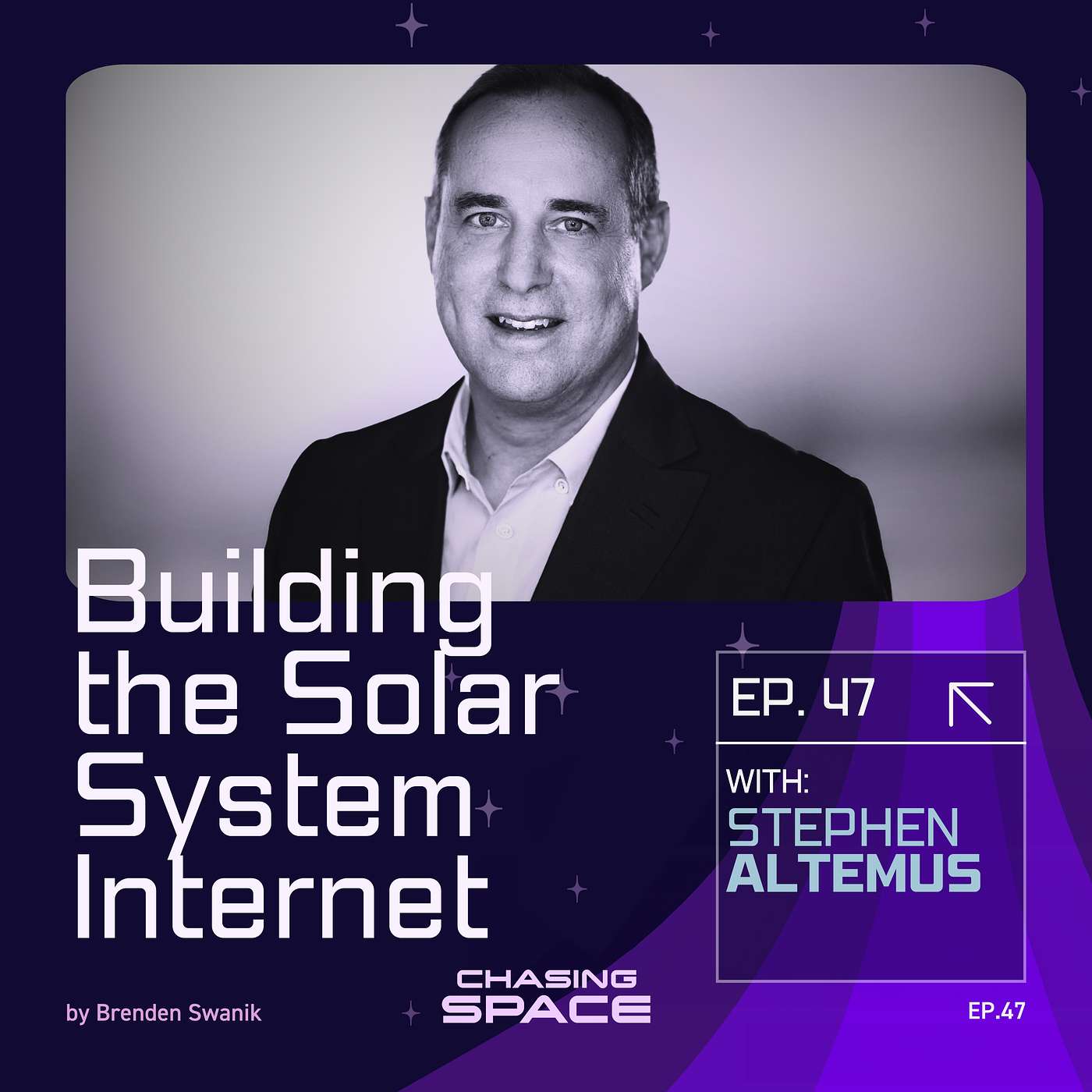
47. Stephen Altemus, President & CEO of Intuitive Machines
38m 37s
In this interview, host Brennan Swannick speaks with Steve Altemus, co-founder and CEO of Intuitive Machines. Altemus recounts his 25-year NASA career, which began after witnessing the Challenger disaster and included roles as a Space Shuttle Test Director and the leader of the forensic investigation into the Columbia disaster. This experience in managing complex engineering challenges was foundational. He left NASA in 2013 and co-founded Intuitive Machines following an inspiring dinner conversation, aiming to solve intractable problems. Under his leadership, the company adopted a philosophy of tackling the most difficult tasks first, successfully achieving the first commercial soft landing on the moon's south pole. Altemus explains that this lunar capability is a springboard for the company's broader vision: to become a space infrastructure service provider, building and operating interconnected systems like communications networks for cislunar space and beyond. The discussion highlights his journey from government service to entrepreneurial success, driven by bold thinking and a commitment to ambitious engineering.
[Music] Good morning everyone and happy Monday. Welcome back to episode 47 of Chasing Space. I'm your host, Brennan Swannick. And in an era like it has been in the last couple of weeks, it only makes sense to keep the lunar train rolling. Joining me today is Steve Altamiss, the co-founder, president, and CEO of Intuitive Machines. Prior to co-founding the company in 2013, Altamiss had a 25-year career at NASA, where he served in key roles including the Shuttle Test Director and the Director of Engineering at the Johnson Space Center. His most defining role was the Columbia Reconstruction Director from 2003 to 2006, leading the forensic discovery and reassembly of 85,000 pieces of debris to determine the cause of the disaster, which restored institutional confidence and enabled the agency's return to flight operations. Altamiss is driven by a philosophy of agile engineering and a force innovation to constructive, disruptive, commercial, and our prize. Please join me in welcoming Steve Altamiss. Well Steve, I'm against everything that's going on in the space industry and maybe just the aerospace and defense industry in general. It's an honor to have you on today. Thank you for joining us here. It's Pacing Space. Brennan, thanks for having me on. It's a pleasure to be here today and happy to talk with you. I'd like to start all the way back in the beginning. It seems like you grew up in a right, was it in Philadelphia or outside of Philadelphia? Yeah, I grew up in the suburbs of Philadelphia in a town called Naras Town, Pennsylvania. No kidding. Born in Bethlehem, Pennsylvania, moved to Naras Town and grew up as a young kid and outside the outskirts of Philadelphia from the northeast. I grew up right on the other side of the Betsy Ross Bridge on the Jersey side, so not too far. Oh wow. Seems like your childhood, oh yeah, it was awesome. Not a bird's fan unfortunately though. Oh no. It seems like you spent a lot of time. Maybe it seemed like a construction family, what seemed to be building an early fascination mechanics and technical systems, was space or aerospace on your mind at that point or you just fascinated in how things work together? I think I was born with the idea of how the curiosity of how things work. I remember early on my parents got me a book called How It Works. It was a book about internal combustion engines and a bunch of machines and things. I used to draw these Ruben Goldberg machines with the conveyor belts and put assembly together and things over multiple pages. So I was really curious about that. But I never really had a direct passion for space necessarily. I ended up working in construction as a laborer and a carpenter while I'd put myself through school. But I had this idea of becoming a pilot to fly airplanes. So I went to Embry Rittle, Aeronautical University, which is, you know, I didn't go to University of Scranton in Pennsylvania where my brother and sisters went. I went to an exotic university, Harvard of the skies, right? Embry Rittle, Aeronautical University. And it wasn't until my junior year, I was in engineering, Aeronautical Engineering, learning how to design airplanes. When I saw the orbiter challenger go up, the space shuttle. And as I was walking from my engineering school to the University Center, I saw it separate. The boosters go off in two directions and the orbiter break into pieces and fall back to Earth. And that really struck me as it was like right there because that's in Daytona Beach. Yeah. Yeah. And you could see the launch crystal clear from down at Cape Canaveral. And I saw it and it was really disturbing. And a little that I know that that was what would ignite my passion for NASA for space and drive my career in that direction. Well, it seems like coming right into NASA. You were working on the shuttle program, executing launch and landing countdowns, orbital convoy recovery operations upon touchdown. It seems like the dream job right out of Embry Rittle and looks like it was driven by the passion of what you saw when you're still at Daytona. How did you job in New Jersey, farming Dale New Jersey, working on helicopters after I graduated from Embry Rittle. I went back to the Northeast, American electronics laboratories and I put a mechanical systems on helicopters and in helicopters. Well, I ended up going to Boeing helicopters, Boeing Verteull. It was called in Philadelphia and worked there for just a short period of time before NASA called me and said, hey, you come down for an interview. And when I drove on the Kennedy Space Center and I looked around, drove across the causeway and got to climb through the aft compartment of an orbiter, I was hooked. I was definitely moving the Florida. And then to graduate up the career ladder to become a NASA test director, I got to drive the test team on processing the orbiter and putting it together and getting it ready for launch countdown and then eventually leading the launches of the space shuttle. And boy, I thought that was the greatest job ever and I never needed another job. That was it. I didn't want to be anywhere else but launching space shuttles. And that was kind of how it started. So it was very exciting. You know, when I left all my construction friends and family in Philadelphia area, they said, you're going to NASA. What do you know about the space shuttle? You're going to be back here in two months working construction again. And here I am, I don't know, 40 years later, having a pretty distinguished career in NASA and then moving on to build a company like intuitive machines and landing on the moon. Well, maybe if some of those folks back in Philly, the you matter looking for jobs, it can be some technicians at Intuitive. That's awesome. I think one of the more special roles and you let me know what your opinions are on this was in 2003 when you led the considered more forensic team to find the cause of the space shuttle Columbia disaster organizing, you know, 85,000 pieces and ultimately leading to what was the reopening of flights for the next eight and a half years before the shuttle program retired. Probably one of the most important moments in NASA's history, you had played a significant part in. I'd love to hear a little bit about that. Well, I would say that that was one of the most transformational periods of time in my life, actually and in my career. Launching space shuttles was exhilarating and then we lost one on landing base shuttle orbiter Columbia broke up in pieces over East Texas. And I was launching space shuttles at the time and they said, Steve, you have to stand and reserve to launch the return to flight orbiter. And we think that's going to take about two months and I said, you're kidding me, it's going to be two years before we're back to flight immediately. It's just such a heavy weight to lose the crew and lose an orbiter. And I said, look, you need to put me in the game. You need to help me help. And so I was asked to lead the reconstruction of all the debris. They'd bring the debris from wherever they found it in East Texas and they would truck it to Kennedy Space Center at the shuttle landing facility where I had a hangar, a massive aircraft hangar where we laid a grid on the floor, a two-dimensional grid and we would place the pieces of debris from the trucks. We'd say from process them, get them cleaned and then put them on the grid to where we see the parts of the orbiter take shape. You could just see it come to life as those 85,000 pieces started to populate the grid and we would search for forensic evidence of what brought down the shuttle Columbia and help inform the investigation as to the root cause of what happened. And that was a very, very challenging time. A lot of his ability. A lot of people would come to the hangar and tour the debris and look at it and try to understand what was going on. And out of that, I ended up being asked to move to Johnson Space Center after the accident and lead engineering for NASA Johnson Space Center, which is essentially human space flight programs. And I was able to contribute to the return to flight for the space shuttle to the assembly of the International Space Station to get it to complete to house nine-person crew and to begin the new moon program called Constellation, which was to take the base launch system SLS and the Orion capsule to the moon. And so that all came out of that accident, which it's kind of funny to talk about it in terms of catharsis. It was really cathartic when you're working on not shedding tears over the accident, but rooting out what was the root cause of the flight fail.
that you could then go put your minds to to go solve to get the shuttle flying again. So early on, I led a team of about 400 people to do that, and that's the mindset we had. We were helping to return the shuttle to flight by putting all this debris back together. Do you remember the moment that you figured out that it was that RCC panel 8 in the left wing? For the moment that maybe if a member of your team may have cracked what caused the incident? What was happening at the time, and this was really interesting because we worked with NTSB, National Transportation Safety Board, who helped us understand how to conduct an accident investigation from a debris standpoint. So I worked very closely with them. Clint Crookshanks was one of them that I became friendly with. And he says, "Don't postulate what you think brought the aircraft or spacecraft in this case down." He says, "Let the debris tell a story to you." And that was what we put in terms of discipline instead of trying to fit our theory to the debris. It's like the debris tell you what brought it down. So all these people from the investigation from around the country would come into the hangar with an idea that they knew what brought it down. Hey, you know, they had a breach in the plasma flash, the water tanks and the water tanks blew up. So get me all the water tanks. So we brought all the water tanks. They were all intact. Boom, that idea is shot down. Another one, a carrier panel from one of the wings fell off. And it was like, "Look at your feet." And they looked down, and there's the carrier panel laying there. It says, "Couldn't it fall off?" There was all these ideas. But we looked at the evidence. And what we found was we were able to totally reconstruct the right wing of the orbiter. Like there was a lot of debris from the right wing. Wow. But there was very little debris from the left wing. And the left wing had this build up of all these different metals that were molten, that were remelted from the wingspaar and the ribs of the skin. All of that was then deposited on the reinforced carbon-carbon leading edge in a little piece as we found. In layers, that were like you took a plasma torch to the left wing and you blew through all these different metals. And they got liquid and deposited on the inside of the wing. And we saw that. And so then we started to say, "This is where the hottest point of the entry of the plasma was. This is actually how it cut through the hydraulic lines for the control system, the wire harnesses that gave you all the instrumentation. If you recall all the instrumentation was going haywire, reported in mission control. We saw deposits of that material on the inside of the left wing." That's unbelievable. So that's when we knew we had a location and then what we did was we did a 3D reconstruction and three dimensions of that left wing. And you could actually see the visualization of the whole thing. And that was the answer. The left wing was pierced with a piece of foam, had a big hole in it and the plasma entered there and just burnt through. Steve, I got to say it's incredible how much detail you can provide on walking through that problem. So I appreciate that. I'm surprised it's still in my memory. I'll hop to top my head. It was everything else going on. Well, as you mentioned, you had an amazing career after that. Once you moved to Houston with the Johnson Space Center, I think it's the director of engineering. And then your final position as the deputy director of JSC, which is amazing. And then it seems like this is the area where back in 2013 you had the infamous dinner in Washington, DC with your, seemed like two co-founders and sketched out this idea of intuitive machines on a napkin. Can you tell me what the preliminary thought behind the company was at the time? Interesting dinner conversation. I was actually going to interview with an associate of mine who was asking me to be the head of a nuclear reactor company. To leave NASA and build a nuclear reactor, a small scale, high temperature gas reactor. So I was going to have a late interview about eight o'clock. But he says, why don't you come to dinner first? So we went to a little place to have dinner. And all I had was, he says, Steve, what are you passionate about? And I had been incubating this idea of forming my own company. And I said, you know, I want to build a billion dollar business that positively affects a billion people within ten years. And that was the extent of my business plan. I was very naive at the time coming from the government. I thought, but in hindsight it wasn't such a bad business plan. I said, you know, I really think that I can use my engineering skills from human spaceflight and solve some really intractable problems around the world. And I want to start in Texas, in Houston, in the energy sector, in medicine, and in aerospace. Because there's kind of a Zen Buddhist saying that says, you know, begin where you are. Start where you are, right? How do you take a thousand mile journey? Will you begin where you are? You take one step. And so I said, step outside the gate of Johnson Space Center and start this journey of forming a company. And he said, Steve, it would be a shame if the music in your head was never played. I think I'll back you to start your business and go. And we shook hands and that was it. I did go to the interview and did interview to be the president of that company. And in the end, he said, taking me home, he says, no, no, no, you got to start your own company. So that's awesome. From a napkin to the Nasdaq is the saying that we have. That's awesome. A lot has grown since 2013 from that napkin. You know, you've had multiple acquisitions. You've done multiple missions to the moon. It seems like intuitive is operating in every domain from the earth to the moon, which is pretty impressive in the amount of time that you've done it. I want to talk a little bit about how you take so many capabilities and loop them into one big operating company. And what your leadership ethos is and making that happen. Well, I would say, you know, one of the hardest things as the deputy director of Johnson Space Center, I had responsibility for about 12,000 people. And when you step outside of a Nasda space center and start your own company and you have six people in the company, it's a shock. And so it's quite humbling to go from a position like deputy director, Johnson Space Center to, whether you're CEO of a six person company, it's quite humbling. You have to do a lot yourself. But knowing how to manage a large complex organization was one of the skills that I gained at NASA. Studying every kind of engineering problem under the sun, you know, with the space shuttle, the space station, the constellation program, and all the technologies that go into it, that was a good proving ground. And then also I did an engineering think tank where I solved intractable problems with a team of people that would compete their solutions together. I took all of that, mixed it together, and formed into it in machines. So we knew how to do the hard things, the hard things in engineering. And we were bold enough to jump off into the abyss of starting a new company. So we had the entrepreneurial spirit. And so that was a recipe for success. And without the fear of thinking big, without with the ability or the actual encouragement from NASA in Houston Clear Lake to think about things like how do you move humans off the planet? I'll give you an example. We were selling the lunar gateway, a program that we architected while I was at NASA. We were selling it to the other space agencies around the world and we were in Paris speaking to them. And it was snowing in Paris. And there was a handful of us walking around after the meeting and we went by Notre Dame. And there's a full moon by Notre Dame, right? Beaming at us. And I turned to the team and I said, who else on earth do you think is thinking about putting a spacecraft 60,000 kilometers behind the moon? A spacecraft that could travel a million miles or a million kilometers out in a deep space. That was the gateway, right? And no one else in the world was probably thinking of it at the time. Yeah. We're unafraid. And so to carry that idea into a company that you are unafraid of thinking big and achieving big things, I think is the key to success. That it's not carefree, but it's you're not fretting over the small things. You're thinking big and allowing yourself to dream big and defy impossible. And that's how we ended up targeting the moon and going after landing on the moon. Intuitive has since grown to not just be what could be considered a lunar delivery service, but more of a. maybe build, connect, operate space infrastructure company. What does it mean to do? This is a novel term for people especially in the space industry where it's filled with small exquisite systems. What does it mean to be infrastructure as a service and space? Yeah, this is a fairly recent development. We did the hard things. We did the things to try to attempt to land on the South Pole of the Moon, which has never been done. Fixed price for less than $100 million in the time it takes you to get an undergraduate degree four years. And on the first shot, we landed on the South Pole of the Moon. And on the second shot, we mission, we landed closer to the South Pole of the Moon. So that is the starting point of building exquisite systems, one off first of a kind, and delivering it to the surface of the Moon. On the process of doing that, you have to orbit the Moon. And so we were able to convince ourselves that we should, we have to be able to get to the Moon so we needed a communications network. We needed a ground segment that could communicate as far out as the Moon. We needed a mission control, and we needed to be able to build a lander and fly. So we had a whole lunar program. If we could do that with a lander, we could certainly put satellites around the Moon. And we can begin to think about putting long-term assets on the Moon that would be operated autonomously through this network. And these ideas just kept expanding from the first landing. And if you can go all the way out to the Moon, you could certainly come back and do communications and navigation from the Moon back towards Earth. And you can do communications and navigations deeper in the space out towards Mars. And so this idea of building the systems delivering to space, connecting them into a network, and then operating them autonomously is kind of what we came up with. And that's now where we are today with elements of each going forward. You did the hardest things first. Yeah, absolutely. Somebody says, you know, why do we have to do things that are so hard all the time? You know, can we do something easy? Can we make cornflakes? Can we do something like that as a visit? Being the first commercial company to target a landing on a spot where known has attempted a landing before is no small feat. And doing it twice is impressive. Have your team gathered any valuable learnings when you're looking towards the future of maybe other potential temps or other technologies just from simply having that experience and GNC data of getting to the Moon? We've got incredible images of the South Pole of the Moon that have never been seen before. We've been closer to the South Pole and understand just the terrain, the canyons, the mountains, the boulders, the shadows, all of that we have never before seen pictures of. We see the effects of how to fly different laser sensors at the Moon successfully and unsuccessfully, different optical navigation algorithms. All of that flight control and navigation we now have some experience with. We have soil interaction experience. So it's just an incredible learning for us. We're on a journey that needs a regular cadence of missions to fly and learn and understand what it takes to actually exist on the Moon in some permanent sustained presence. Do you have any memorable moments from either landings when you're in the control room watching footage or watching GNC tracking data that that stuck out to you? Oh my God, yes. Well, for mission one, you know, just being in a control room and having been in a control room for a lot of my career at NASA, you know, we can be fairly steady rock, you know, steely eyed rocket scientists. But I'll tell you something when we fired the engine for descent and we're descending to the surface of the Moon and you suddenly get a drop of all the telemetry and you see nothing but silence. And there's a whole room of people behind the control room watching every expression on your face to see what's actually going on. But everything was essentially flat lined. All the graphs were flat. And then all of a sudden you saw a ping, ping where we had a carrier lock from one of our major antennas on Earth, the Gunhili Earth Station, 32 meter dish, picked up a signal from our lander on the South Pole of the Moon. When I saw that go ping, we all cheered. We knew we had made it to the surface and we were alive and functioning as a as a lander. What an incredible experience I will never ever forget that we did it. We did it. We did what we said we were going to do and we landed on the Moon and that lander will be there for a billion plus years. You look up at the Moon and it never looks the same because you've touched the surface of the Moon. Never forget it. It's good that you don't have your heart on your sleeve and you got that time in Mission Control. I'm sure if everyone's heart rates in that room are projected out to the world, it may be a different story. Successful or not, my heart rate would be up at least in Zone 3 watching that. So a lot of kudos to you. You're calm while your heart rate is raised. Yeah, just don't sweat through your shirt. You mentioned something interesting about this whole process of getting to the Moon and the comms needed. I think the other half of that is data of bridging Earth proximity, syslooner and all these different regions. There's infrastructure, but there's not much. Can you talk to our audience a little bit more about what exactly is the space data network and what the problems are that you're trying to solve with it? So what's emerging out of all of our thinking is we're building the solar system internet. We're building an internet for space service from space. You can understand most people can understand spaces involvement in our networks on Earth. Right? We bring down satellite data. We bring down radio data, broadband data, all to serve Earth. And we have an internet on Earth. And it's a fixed geometry basically where you're going from point to point to point. But what we have in space and what we're building in space is a space-based internet where the geometry is always moving. The planets are moving, the moon is moving, the Earth is moving, your satellites and spacecraft are moving. So in order to communicate and navigate in a geometry that's changing takes a special kind of internet protocol that we are now inventing and creating. That means you have to be tolerant of delays, of delays where it takes a half a second to send data to the moon. It takes 45 minutes to send a data packet to Mars. So your network has to be delayed tolerant. You have to be able to store data and forward it out to a moving spacecraft and then reassemble it. So you need a new protocol to bundle the data back together, apart and back together. So that's what we're building. That's what's unique. It's a brand new internet protocol for a space-based internet. It seems like a good comparison to bring it to the person that's not working in the aerospace industry as if you put a pair of headphones on and when you speak it tells back what you're saying, but four seconds later. So putting all those different notes together and still trying to have a coherent conversation is a little tricky. That's a good way to capture it, I think. That was something we used to do as kids. There was this app and you it'll play your voice back one second later and you try to form cohesive sentences. So I can't imagine doing that with billion dollar landers and entry vehicles and things that are a little bit more important than our hanging out with friends. So big year for into big last two years for intuitive machines, at least from an outward facing view over the public. You acquire kinetics for deep space navigation, land terrorist space systems for legacy satellite manufacturing. And we talked about the one company strategy, but just from your perspective as a leader, why is it so important to integrate all of these different capabilities into one vertical for the next generation of what you like to achieve and what does that kind of look like for you? Well, I'm very passionate about our workforce, our team, our people, the technicians, the machinists, the engineers, the scientists, the business people, the human resources people, the public affairs people. They're all contributing to a mission. If I can ignite their passion and give them purposeful work, mission driven purposeful work, we're achieving something greater than ourselves.
really does create a team, creates loyalty, and creates a fantastic company that can, what I say, defy the impossible. So I look at the capabilities that we acquired in Kinetics to do, do you know the people in Kinetics that now are in two of the machines, mechanics, we call them, have mounted a mission to every planet in the solar system except for Neptune. So we can say that we've done that in addition to landing on the moon. And then you look at Land Terrace, who built the 300 series, the 500 series, and the 1300 series satellite buses, who've put up collectively over 3,000 years of time in orbit with their family of satellites. At 99.99% operational availability. These are fantastic people that are a national asset out in Palo Alto, California and San Jose, California. When I walked around the factory, I was like, oh my goodness, this is just amazing. I want to put this all together to create this, build the systems we need and to live them the space, connect them into a network for navigations, communications, and operate systems in space to understand more in exploration, in science, in national security space. And so it's just a natural thing for me to put it all under one roof, quote, as one family of mission-driven, purposeful, mission-driven workforce doing purposeful work. And so, you know, it'll be some challenge to integrate them all and, you know, make their geographically separated. Sure. We live today where there's a lot of remote work and where there's people contributing from, you know, dispersed geographic locations. So I know we can do it. The key is inspiring them with a culture to remove your imposed constraints, to dream big, and to go to modify the impossible and go after your dreams. And I think they're motivated to all be won. I mean, it's been really successful so far in putting all the companies together. The natural next step is to put together an Neptune mission to complete the series. Once you do it, let me know. We'll come back on and talk it. That's pretty cool that they've hit all of them. And I would imagine that the one that they wouldn't have hit would have been Pluto, not Neptune, but Kudos to them. The mission to Pluto is New Horizons. Oh, yes, yes. You can go on online and you can actually see pictures of Pluto now. That is awesome. The last component while I'm still picking your brain about intuitive and leading such an awesome company is how intuitive has started to position themselves or has been positioning themselves as a national asset. You're selected about three-harris to build 18 spacecraft platforms for SDS Tronch III tracking layer. You're working in the Golden Dome architecture. Can you just speak to a little bit about how you see intuitive meshing into being an asset for the United States? Yeah, I think it came down to 2018, late 2017, early 2018, when the administration declared the moon of strategic interest. They said the United States needs to go back to the moon. We're in a space race with China. There's geopolitical interest to hold the high ground of the moon. Some of my associates from NASA that had left since then came knocking on the door of the company of intuitive machines and said, "You guys have to go bid on this. You are the best lunar lander company there is." By the way, we were a think tank. We weren't building lunar landers at the time. Athena wasn't sitting in the back room at the time when they. Yeah. It extends from the time at NASA when we were working on lunar landers, but they said, "You gotta go after this." So we went after it and we won. We won the clips, the commercial lunar payload service contract. Then we won four missions to the moon. Those four missions, we're going forward to reestablish the United States presence on the moon as pre-curse missions. I decided that this is the purposeful work that we need to do as a company to support the United States strategic goals and strategic objectives of returning to the moon. Everything else came out of that. Do the hard work first. All the capabilities that we gained in terms of the team, our ability to manufacture, invent, create, architect systems that could service not only NASA and the civil space sector, but the national security space sector and the commercial sector. So you'll see that we're moving towards a more balanced, diverse portfolio of work across civil, national security space and commercial space to serve as a company that is important for the United States and the U.S. economy. Well, it's absolutely contextually relevant now with the new executive orders coming out of the White House and administrator Isaac Mins, push for lunar infrastructure and change the Artemis program. It seems like the pieces are lining up. Yeah, it's a good time. It's a very exciting time in space right now and to be a space company, a commercial space company. And our idea is to think big or accepted. You know, you can go dream big and you can go invent things and you go try things. It's a great, great time to be alive and to be an aerospace engineer. You know, I have an opportunity in May to go back to my alma mater, Embry Riddle, Aronautical University and give the commencement address. Oh, that's awesome. 100th year. All right. I have this to go motivate them with that they are now in a time to go really commercialized space and make it the next frontier truly for the U.S. economy. Well, Steve, I hope my next question isn't a teaser for all the current Embry Riddle seniors, but we always love to ask our guests for a lot of our young listeners what one piece of advice is that you have for them. You've had an amazing career with NASA with intuitive machines starting it from a napkin to building something incredible. Do you have one piece of advice that sticks out for folks that may want to follow in your footsteps or work on the commercial space industry in general? One of the most compelling lessons I've learned in my career so far that I would want to communicate is that you, we all have the power within us to imagine our lives and our creations into existence. That if you can dream it, you can imagine it into existence and the whole of intuitive machines from a napkin from a career of experiences to a napkin was imagined into existence into what it is today just by the sheer will of believing in what you can do and who you are and collecting the people around you that can share in that dream. It's a very powerful thought to have. I'd leave you with that. Well, Steve, we're going to link a bunch of information about intuitive machines yourself and a bunch of other work surrounding the lunar economy and the show that's today. Can't thank you enough for coming on here and giving us your two cents. Well, hey, I appreciate it, Brendan. It was nice to talk to you and I appreciate everything you've done to do background work. Great questions, great discussion. [Music]
Podcast Summary
Key Points:
Steve Altemus, CEO of Intuitive Machines, had a 25-year NASA career, including key roles in the Space Shuttle program and leading the Columbia disaster reconstruction.
His passion for space was ignited by witnessing the Challenger disaster, and his NASA work culminated in roles like Deputy Director of Johnson Space Center.
He co-founded Intuitive Machines in 2013 after a dinner conversation, driven by a vision to build a billion-dollar business solving hard engineering problems.
The company's strategy involves "doing the hard things first," exemplified by becoming the first commercial entity to land on the lunar south pole.
Intuitive Machines is evolving from a lunar lander company into a broader space infrastructure provider, focusing on building, connecting, and operating assets like communication networks.
Summary:
In this interview, host Brennan Swannick speaks with Steve Altemus, co-founder and CEO of Intuitive Machines. Altemus recounts his 25-year NASA career, which began after witnessing the Challenger disaster and included roles as a Space Shuttle Test Director and the leader of the forensic investigation into the Columbia disaster. This experience in managing complex engineering challenges was foundational.
He left NASA in 2013 and co-founded Intuitive Machines following an inspiring dinner conversation, aiming to solve intractable problems. Under his leadership, the company adopted a philosophy of tackling the most difficult tasks first, successfully achieving the first commercial soft landing on the moon's south pole. Altemus explains that this lunar capability is a springboard for the company's broader vision: to become a space infrastructure service provider, building and operating interconnected systems like communications networks for cislunar space and beyond.
The discussion highlights his journey from government service to entrepreneurial success, driven by bold thinking and a commitment to ambitious engineering.
FAQs
His passion was ignited during his junior year at Embry-Riddle Aeronautical University when he witnessed the Space Shuttle Challenger disaster from Daytona Beach, which drove him toward a career at NASA.
He led the reconstruction team that analyzed 85,000 pieces of debris to determine the cause of the accident, which helped restore institutional confidence and enabled NASA's return to flight operations.
The company began from a dinner conversation in 2013 where Altamiss sketched the idea on a napkin, driven by his goal to build a billion-dollar business that positively impacts a billion people within ten years.
The company focuses on agile engineering and force innovation, tackling hard problems like lunar landings and expanding into building, connecting, and operating space infrastructure autonomously.
They successfully landed on the Moon's South Pole on their first attempt and repeated it on a second mission, becoming the first commercial company to achieve such landings.
He found it humbling to go from deputy director of Johnson Space Center to CEO of a six-person startup, but his NASA experience in managing complex engineering problems prepared him for entrepreneurship.
Chat with AI
Loading...
Pro features
Go deeper with this episode
Unlock creator-grade tools that turn any transcript into show notes and subtitle files.
 PodcastTranscript AI