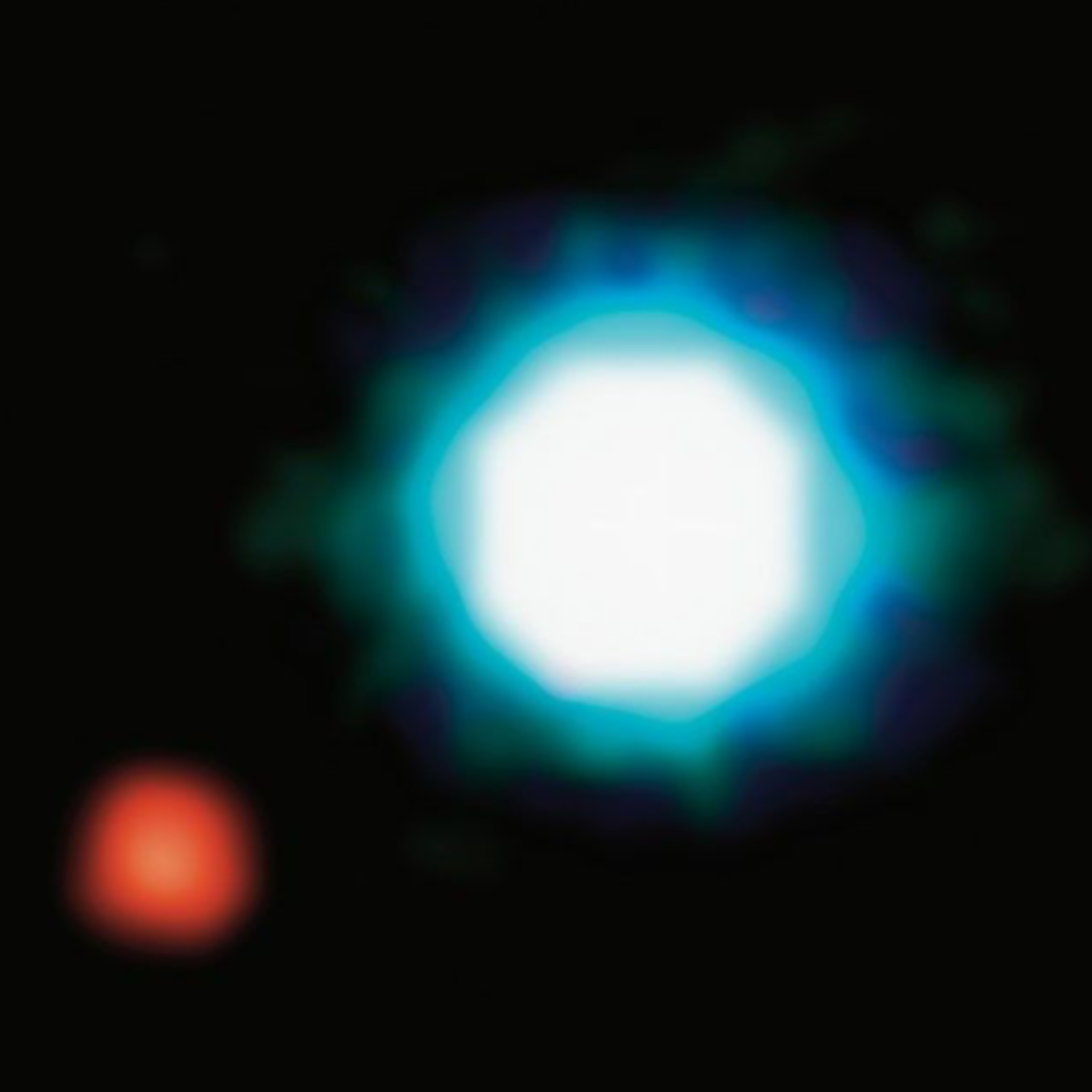
Starts With A Bang #121 - Direct exoplanet imaging
from Starts With A Bang podcast
95m 11s
The discussion centers on the study of exoplanet formation by observing young planetary systems in star-forming regions, rather than relying solely on our mature solar system as a model. While most known exoplanets are nearby, targeting young clusters allows astronomers to examine systems with protoplanetary disks, debris, and forming planets. Direct imaging techniques currently favor detecting young, massive gas giants at wide separations from their stars, as these planets emit detectable infrared radiation from their residual formation heat. Instruments like coronagraphs and integral field spectrographs, such as NIRSpec on the James Webb Space Telescope, are advancing the field by enhancing contrast and enabling spectroscopic analysis of planetary atmospheres. Despite challenges in imaging Earth-sized planets, ongoing technological developments aim to eventually observe rocky worlds in habitable zones, moving closer to answering fundamental questions about planetary origins and diversity.
When we look out at the universe, most of what we see is what's close by, what's present, what's right here in our cosmic backyard. If you look up at the night sky, there are thousands of stars visible to the naked eye, but all of them are present right here in our own Milky Way. When we look with our powerful telescopes, we can see galaxies from all across the universe, but so far, nearly all of the stars with planets that we found have been restricted to be the nearby ones, have been restricted to be the local ones. But if we look closely enough at the star-forming regions or the young star clusters found in our vicinity, we can find not only exoplanetary systems, but young exoplanetary systems, including ones with circumplanetary disks and with dusty debris and even with clouds. This gives us the opportunity to not just say, "What are these exoplanets doing? But what are they made out of? What are their atmospheres made out of? And what processes are occurring to either form or evaporate them or anything in between? Where are we in the hunt for knowing more about the planets that are forming right here in our cosmic backyard? Find out on this edition of the "Start with a Bang" podcast. [Music] What is it exactly that makes an exoplanet form, that makes a planet form around a star and what dictates the properties that it's going to have? These are questions that are very difficult to answer, but we can gain a fantastic window into how exoplanets form by looking at planets in various stages of formation around their stars. We can look at protoplanetary disks that are still forming planets. We can look at the young planets that exist in systems that still have persisting disks around them. And we can look at more evolved systems that have passed that stage that now have mature planets. To help us investigate this, I'm so pleased to welcome to the program Dr. Keelyn Hoek. Keelyn is a Ph.D. astronomer who specializes in these young exoplanetary systems and is currently a postdoctoral research associate at the Space Telescope Science Institute or STSCI in Maryland. Keelyn, I'm so pleased to have you here and welcome to the program. Hi, thanks so much for having me on. Yeah, I'm so excited to get to talk to you. I had the chance to meet you at the American Astronomical Society's summer meeting this past June in Anchorage, Alaska here in 2025. And when I think about exoplanets, right, because I'm a cosmology person by training, I'm always worried, oh man, the exoplanet people are going to be so mad at me if I get something right. When I think about how exoplanets form, I have this picture in my head of, okay, you're going to have some material that forms in a disc around a young protostar. And as the star turns on, there's going to be like a race where within the disc gravity is going to try and work to pull those heavy elements, those rocky materials, the stuff that makes up a planetary core together while the new bright shining star is working to photo evaporate or blow off all of that material. Is this a fair way to think about planet formation or am I just glossing over a ton of details that are actually very important to be considering? So I wouldn't say you're necessarily wrong, but I would say that there are many, many theories of planet formation. And we don't even necessarily know exactly how the planets in our own solar system have formed. So it depends on distance away from the star, how much mass is in the protoplanetary disc, how much mass was in whatever cloud your star was forming in. So there's tons of different ways to kind of create a different recipe, I would say, for making these objects. And also with objects like let's say the earth where we have a nice rocky ball with the gaseous atmosphere. We also have Jupiter where we don't necessarily even know if there's a solid core. So and those are both in the same solar system around the same star, conceivably born from the same protoplanetary disc. So you can see it kind of gets a bit complicated. So we don't necessarily know how the planet is formed in our own solar system, as an example for saying we want to figure out how planetary systems form, because although it's of immense interest to us, because we live on the earth in our solar system, we are stuck with this problem that we only came along 4.5 billion years after planet formation finished in our solar system. So we have today all we have left are the survivors are the long term survivors. And yet we know there were rogue planets out there in the universe from JWST. We learned that there are most likely free floating Jupiter's or even binary pairs of Jupiter mass planets that don't have any parent stars at all. So I think that when it comes to how planets form and what the properties of young planets are, our solar system is a terrible example. And instead if we wanted to learn about that, we should be looking at a young exoplanetary system. And if that was my goal, where are the places that I would look and what are the types of signatures I would look for in order to know, oh, this is a younger system than say our own solar system and we're looking at these exoplanets closer to when they were actually being formed. Yes, that's a really good point and with our particular field or I guess my particular field in direct imaging, we are mostly sensitive to the younger systems. And by younger we generally mean on order of tens to hundreds of million years. And I know that is different for all sorts of different fields in astronomy and science. But if you're looking for the younger systems and kind of like you suggested what you were saying, you really want to look in active star forming regions, which actually tend to be farther away from our own solar system, then we would imagine. So thank you have the Orion cluster and I think the talk that you saw me give at the press briefing, our object is in the upper scope star forming region, which is about 10, 15 million years old. And how you find the ages of these systems is by aging the entire system itself that can come from velocity measurements, that can come from measurements of different elements and abundances in the stars themselves. I'll be that's not my field of expertise, but it is a very important field in terms of benchmarking these signatures from the really young early forming planets. So if we can do this, right, you said we want to look in the star forming region. So if I look in a star forming region in general and I find say a cluster of stars, what I can do is I can say, oh, I have a lot of stars together and they all formed at roughly the same time. So because I'm an astronomer and I know how stars evolve, I can say, oh, let's see which stars are still left, right, because the highest mass ones are going to evolve and end their lives first. So I can say, oh, if I have enough stars in this region, I can say, well, which stars are still alive, which stars are burning, which stars are just evolving to become red giants now. And that's a good way to estimate the age of a star cluster for an individual star system that isn't found in a cluster. You probably have to use other methods, although you can probably place constraints by saying, okay, if I still have a proto planetary disk where I'm actively forming planets, that tells me my system is probably very young is probably, you know, 10, 20 million years old at the, at the oldest or younger than that. But if I have a debris disk around me, right, if I have like like Vega or formal how right where I don't have a proto planetary disk, but there's still a bunch of dusty debris in my system, maybe I'm, I'm a few hundred million years old. And that sounds like if you're interested in direct imaging, you'll probably, well, I'm sure you'll be able to see it.
want not the absolute youngest systems, but maybe more in that intermediate category. Because direct imaging, as I understand it, is very hard, especially if you're talking about a bright star, then you have to look farther away from it because the star's brightness will swamp any inner planets. And it's going to be a lot easier to find higher mass planets that are brighter, are more reflective, and that are easier to see compared to the brightness of their star. Because it's a challenge to see a faint thing like a planet that's reflecting starlight when it's very close to a bright thing like the bright star itself. Is that correct? Is maybe the debris disk stage of a solar system or a stellar system? The ones you would choose to target, and are you in particular either biased towards low mass stars or high mass planets? If direct imaging is your goal? So these are all very good questions. And I think what we're starting to see with James Webb especially is that our current theories and models of star and planet formation could possibly be wrong and have some wrong time skills in terms of thinking that a debris disk should be gone by a certain amount of time, or like a planet hosting a certain planetary disk that should go away after, you know, at like 10 million years. So I think that we're starting to see a lot of these things are way more complicated. And I like to say that in the era of JWST, we're in a data forward era. So in that kind of what I mean by that is the data are so good that they're constantly challenging our current atmospheric models and also just formation models in general. So now the models themselves and the theorists need to step up, take a look at the new data, and figure out what all those missing pieces are. And then in terms of looking for directly image planets or using direct imaging to find and look at these planets around other stars, we are indeed more sensitive to the larger Jupiter size planets that are about maybe 10 to 100 AU away from their star. This is because the star itself is going to be really, really bright. But the planets themselves, because they're Jupiter size planets and they're young, it's that thermal heat that they're emitting the light from that we're able to get our spectra from. So rather than the reflected light from the host star, they are making their own internal light as they kind of collapse in form. That's really cool. One of my favorite facts about the solar system is that we see visible light. So when we look at all of the planets that we see, we are seeing their reflected star light, seeing the light reflected from the sun off of the planet that comes back to our eyes. That's how we see the rocky planets. That's how we see the planets with thick atmospheres. And that's also how we see the gas giant worlds, including Jupiter. But if we weren't sensitive to visible light, if we were sensitive to that longer wavelength, lower temperature infrared light, then the primary source of light from Jupiter wouldn't be reflected sunlight. It would be the heat generated inside Jupiter's own core that we would actually see Jupiter as an emitter. And I ask you, when you want to look at an exoplanet, what the difference is in what you'll see if you're imaging a planet that is primarily reflecting star light versus a planet that is primarily emitting its own light. Is there a difference in the types of signatures from that planet or the types of planetary properties you'll be sensitive to between those two scenarios of reflected light from the parent star versus generated light from its own interior? Yeah, so this is actually something that they probably talked about at the Habitable World's Observatory Conference, I think two weeks ago at this point. We have never detected a planet in reflected light with direct imaging because it is so much harder to get that signal next to a super bright star. The other thing is for reflected light imaging of exoplanets, ideally you would want the surface to be bouncing the light back towards your detector, but that requires a very specific type of planet, so you're looking more for rocky surfaces or just a planet that has a surface in general. And with direct imaging at the moment, we are mostly sensitive to this Jupiter-sized planets. We're really trying to push down towards, I want to say, Saturn mass planets at this point. There's a lot of exciting maybe detections and a lot of different programs, so I'm excited to kind of keep up with that. But that is what we're pushing towards because if we're thinking about the ultimate question of are we alone, how did our own solar system form? You would want to observe and take photos of another Earth. And so when you would be doing that, you would be looking at older systems where the object already has a core, already has a surface. So it would have to be slightly older and looking at an Earth mass planet with direct imaging is something that we have not been able to do yet. Yeah, I mean, that sounds incredibly challenging, you know, as you say, there are like these multiple competing trade-offs, right? If you want a planet that's going to be more Earth-like, that means you probably want it to be more Earth-sized than say Jupiter-sized because it's much more likely to have a rocky surface and only a thin atmosphere if it's smaller and lower in mass as opposed to larger and heavier in mass and most likely puffier. You probably want one that's closer to its parent star than tens or even hundreds of times the Earth's undistanced because you want it to receive energy from its parent star, enough energy that maybe if it has the right properties for an atmosphere, it can have water in the liquid phase on its surface, whereas if you're too massive or too far away from the star, either you're going to, if you're too massive, you're going to have a thick atmosphere and that sunlight will never make it down to the surface. And if you are too far away, you're not going to get enough star light to be at a high enough temperature to have liquid water on your surface. So I think it's really important to point out you brought up the habitable world's observatory conference that what we are working on developing, one of the huge instruments we're working on developing is a superior coronagraph, which is the ability to block the light of a parent star and look for the light from objects around it. So with Hubble, we were able to do that with a relatively rudimentary coronagraph and we could see planets that were maybe 1% or even 0.1% as bright as the star itself. With JWST, we've gotten a lot better and we can see planets that are maybe 100,000th as bright as their parent star because you can block out that parent star and of course the farther away from the star you go, the easier it is to see. With the Nancy Grace Roman telescope, which is completed but hasn't launched yet, it's slated for launch next year and we're all hoping that it does. I know they've been working, especially in the coronagraph lab at JPL in Pasadena to vastly improve the performance of the coronagraph and they were hoping to get brightness contrasts or that's the ability to see a faint thing next to a bright thing of one part in 10 to the 7 or 1 part in 10 million and it looks like their coronagraph is exceeding that and that they're able to see planets that are hundreds of millions of times or maybe even up to a billion times fainter than their parent star. So I think when the habitable world's observatory comes online, we might finally get all the way there to the ability to see and directly image earth sized planets at earth like distances around sun like stars. But in this case, you know, that's not where we are if we want to do it today and we go with direct imaging, it sounds like we're stuck looking at gas giant planets that are significantly separated from their parent stars. Yes, that's kind of the current state of affairs. We are pushing.
for using instruments that do not have a coronagraph. So something that we have done with the James Webb Space Telescope, other than utilizing it for imaging faint things next to really big bright things, which was not what it was used for or intended for. I think JWST was intended for cosmology purposes and looking at faint puppy galaxies. So that's what these instruments were originally optimized for. The instrument that I use for the most part in trying to pioneer direct imaging of exoplanets with an instrument that was made to look at extended faint puppy things, we have kind of discovered that the near-spec integral field spectrograph, which is a very big word for taking an image and each pixel in that image gives you spectral information. And all spectral information, necessarily means, is that light coming from the object towards your detector and the atmosphere molecules that the light has to pass through, the light will get absorbed at different wavelengths. So that's kind of this spectra that we're talking about. So the near-spec integral field spectrograph rivals the near-cam image, which does have a coronagraph. So at least at about one arc second separation. So that's not necessarily the true separation between the objects, but just the separation on sky. At one arc second, near-cam and this integral field spectrograph, near-spec are hitting that same sensitivity. So what that means is that there may be a future instrument that doesn't necessarily need to even lock out the starlight of the host star. And we may be able to use advanced processing techniques to disentangle the light from the star and the planet itself, which is something that we are trying to do right now. That's a really fascinating technique to pioneer, and one I hadn't heard of before. So thank you for that and thank you, I guess, from our listeners out there who haven't heard that before, at least from me. Because that seems like it'd be really remarkable. One of the things I wonder about is how can we get so much information about a world located a thousand or more light years away, that is so small that even in our highest resolution telescopes, and even with our most prestigious and most vaunted observatories, they still only show up as one pixel on a direct image. How is it that using a technique like spectroscopy or to use the $6 word, I guess, the near field integral spectrograph? You're going to have to say it, I'm not going to get it right. How can we use that to get so much more information than you'd conventionally expect to be able to get just by imaging one pixel of an image? Yeah, so you can just call it the near spec instrument. That's what I call it because it's also all of these acronyms, or acronyms of other words, and sometimes acronyms of acronyms. But anyways, I always like to think back to the pale blue dot photo that Voyager took of Earth, and in that photo Earth is essentially just a little pixel. So, I mean, with the vast distances that we're pointing telescopes and cameras at, even Voyager itself could only get Earth as a single pixel. So just putting into context how difficult imaging these things are. So the near spec instrument, if you think about it, you take one slice of that data from the instrument. It essentially is a photograph. So it's one data point. How bright this thing is at this specific wavelength. And so that's what near cam does. There's different filters, but essentially, like I said, you're just pointing and shooting. You have your corona graph in the center blocking out your starlight, but you're getting one point brightness at the specific wavelength. If you use an imager with a corona graph at a couple different wavelengths, you can kind of piece together what the temperature brightness curve would look like. And then if you see any dips, you can kind of map what molecules might be causing those dips in this spectrum. But with an intercal field spectrograph, such as near spec, essentially you are getting a data point at these iterations at almost a thousand to 2000 of those little points at like all these little tiny wavelength, wavelength pieces. So essentially, you're just able to fill in those missing gaps that you get from this imager. And what that means is you're no longer sensitive to these more broad band features. You can see individual molecular lines. And what this why that is important is because you can get so much more information about the abundances of those molecules at this specific layer of the atmosphere. And kind of what we were talking about before when we started was how do we trace planet formation? How do we obtain information on how these objects have formed? And so what we're trying to do currently is use that spectral information. Those individual molecular lines that you can only get from a spectrograph to model them, find the abundances of these different molecules, and see if we can compare them to the host star to if they're still a disc around the planet or around the host star, maybe compared to the disc chemistry. And just see if we can map out where the object may have formed or how it may have formed either through just gravitational collapse of your disc around your star. And all the gas kind of coalesces together equally versus core accretion where you get the heavier things, accruing first, and then the lighter the lighter atmosphere kind of gets accreted afterwards. All of these things and all of these theories from the theorists. You can't really test unless you unless you go ahead and take those measurements and try them out. You know, that's really cool. I love the fact that we are living in a data driven era because for a long time, you know, when I was in graduate school, you know, back in the early 2000s, we talked about, oh yes, planets form through two scenarios. We have the core accretion scenario and we have the disc instability scenario. And that explains all the planets through those two mechanisms. And now we're learning actually in almost all cases, it looks like planets did form through the core accretion scenario. And there were really only a select few that are very distant from their parent star that are at all consistent with the disc instability scenario. And so what I was taught as like the cutting edge, we've moved so far beyond that that one of the reasons I love doing this podcast with people like you is I get to learn where the new frontiers are and what the new cutting edge is. So one of the things that I think a lot of our listeners have heard about is transit spectroscopy. That's totally different from the direct imaging spectroscopy you're talking about. In transit spectroscopy, what happens is you have a planet and it passes in front of its parent star relative to our line of sight. So the planet's disc actually passes across and blocks a part of the light from the star itself for a brief window of time. But while that happens, if that planet has an atmosphere, there's going to be a small amount of that starlight that actually filters through that atmosphere gets absorbed by whatever molecules are present and then that light comes to our eyes. How is direct imaging spectroscopy different to this transit spectroscopy and is there anything that we can learn from direct imaging spectroscopy that we can't learn from transit spectroscopy. Yeah, so there are two very different methods. Obviously the transit method has discovered thousands and thousands of exoplanets. The direct imaging method has maybe found I think upwards of 80 yet.
point with some of the new JATASD discoveries, but I would still ballpark it at probably 80 maybe less because some companions or candidates need to be followed up. But with transit spectroscopy you have a biased detection. So what that means is you are sensitive to essentially how long you're willing to stare at a star. So a lot of times the planets you tend to have with transit spectroscopy are much closer to the star are large Jupiter-esque size objects that will make that big dip as they go in front of the star. But that means that they're close to the star they're very hot and that can also introduce some effects of the star interacting with the planet itself. The ages of the transit except the transit discovered exoplanets as well tend to skew older as the older stars are not as active because solar activity is a really big issue with transit spectroscopy as if the star has a little flare up right when your planet or what you think is a planet is passing in front of the star could mess up your data or possibly mimic a planet signal things like that. And in transit spectroscopy you get a wider range of planets such as super-erves, rocky earths, the trappist one system that people keep trying to find atmospheres on. So that gives you a wider diversity of types of planets but again a lot of them are close to their star have to deal with interactions with the star tend to be older and it's therefore it's much harder I would say to look at transit spectroscopy and build an idea of planet formation from that. What's nice about direct imaging spectroscopy is that our objects and systems tend to be younger and we have a much higher signal to noise and higher resolution spectra than you're able to get from transit spectroscopy. So there's the word direct in front of imaging and I think that's also something really important to point out because transit spectroscopy is an indirect way of finding the exoplanet and also building and compiling the data to make spectra of the object. So you have to stare at a star and you look for that periodic dip and brightness that's again that indirect detection. You're looking at the star to detect the object going around you're not taking a photo of it and when you're put when you're kind of post-processing that data and mapping those different dips at the different wavelengths that's how you compile the spectra but again you have interpolations you have to go through a lot of processing to make that happen and that can introduce a lot of errors into your data. So if you compare a transit spectra with a direct imaging spectra you can really see the difference in sensitivity, signal to noise and resolution. So you can see the individual molecular features with direct imaging spectroscopy but you are also sensitive to the more broad band features with the transit spectra. So they both play a very important role but in terms of probably piecing together planet formation theories the directly imaged exoplanets and companions are going to be better suited for testing those theories. You know one of the things thank you for that answer one of the things I would imagine and I'm not sure if this is true is that with with transit spectroscopy you are getting a mix of the upper atmosphere that's very thin and and lower down into the atmosphere which is a little thicker although you'll probably get more absorption there and then if there are decks of clouds you might get some light that pierces through those cloud decks and tells you how thick the clouds are or how much light they absorb but that could also completely extinct your light because it could absorb it entirely with direct imaging I think you're much more likely to get a good probe of the planets you know layers of atmosphere all the way down to where it becomes completely opaque because you have this great source of infrared light this great source of heat coming from the planet itself and in order for that light to get out it has to radiate through all the different layers of atmosphere and so just like when we look at our sun we're not seeing you know the surface of the sun because the sun doesn't have a hard surface we're seeing a region of the sun called the photosphere where where all of the photons are escaping from the very outer edge of the photosphere and then thousands of miles down into the photosphere and then tens of thousands of miles down into the photosphere so for the sun it's not like it's just one black body it's actually the sum of many black bodies because it's all these different layers of the sun that emit light that gets out when we look at an exoplanet with direct imaging are we able to learn extra pieces of information about its planetary interior or at least about the various layers of its atmosphere as compared with a technique like transit spectroscopy so that's a really good question and with at least the near infrared spectroscopy with direct imaging and with in some cases transit you're mostly sensitive to the photosphere just like you said with our sun but depending on the wavelength range you're obtaining data from that wavelength range and those molecular features will map to different levels in the atmosphere so to really probe all different atmospheric heights you would want to get UV visible near infrared and mid infrared spectra of these companions to really look at as much of the atmospheric layers as you can so because there's also that wavelength range dependence that does impact the transit spectra as well but the transit spectra because of the eclipse and the transmission spectra and all the different techniques that they've been so innovative in creating so we can obtain information on the atmospheres of the planets there's a lot more complex things happening with that data that you have to do to make sure what molecule you're seeing is from what pressure and scale height well that's pretty interesting you know I understand with what you're doing because you're relying on light produced by the planet itself rather than reflected starlight getting something like an ultraviolet spectra or a visible light spectra of of a planet that's radiating at lower temperatures right that's not radiating at thousands or tens of thousands of degrees but rather is radiating at at hundreds of Kelvin you know maybe maybe as low as 200 Kelvin for for these cooler planets I would think that you can get not only mirror infrared spectra of them but with an instrument like the mid-infrared instrument or mirror aboard JWST that you would be able to get mid-infrared spectra as well and because we know that different molecules atoms ions and compounds absorb or emit light at different sets of wavelengths I would think that if you got high enough resolution spectra in both near infrared and mid-infrared wavelengths that you could start to not only characterize the atmosphere and its composition of one of these exoplanets but that you can also start probing what types of clouds it has and what types of composition those clouds have you know we we hear all the time about like oh hot exoplanet has diamond rain or is raining you know aluminum crystals or some some weird things like that and it seems to me that if you could get this near infrared and mid-infrared spectra together you might be able to detect this on not just hot exoplanets that are transiting in front of their stars but possibly for these cold exoplanets that are a great distance away from their stars do you have do you have thoughts about that yeah Mary is an incredible instrument we have done some
some near infrared spectroscopy for both transits and direct imaging from the ground using a variety of amazing ground based telescopes. But the mid infrared has always been that one way of length range we really can't do unprecedented levels from the Earth due to the brightness of Earth's atmosphere. So, Neary has been just creating a lot of challenges I would say for the modelers and theorists. Not just because of the wavelength range being very sensitive to clouds and dusty particles, but just due to the amazing sensitivity at that range to possibly detect if there's something orbiting the thing you're looking at, or you can detect, as Mary has been amazing at detecting just disks in general. And a lot of those disks that were detecting are made of those same silicate, dusty material. So, Mary not only has found direct detections of clouds on a substellar companion, so that means that the companion is a little bit on that border of deuterium burning or not. The field is very, there's always a hot debate in the field about what you want to call an exoplanet versus a brown door versus a substellar companion, but that can be for maybe another part of the conversation. But Mary has found that first direct detection of clouds on a substellar companion, that would be VHS-256B. We were the ability to name these exoplanets was taken away from us, which is why the planets don't have any sexy names. Just the phone number of the host are in a little B, or C, or whatever letter next to it. But this object showed that that silicate dip, which we've really only seen in isolated brown dwarfs, or isolated substellar objects. And being able to see that for the first time with a companion, so a companion that's rotating and orbiting a star system is absolutely incredible. And in the case of VHS-1256B, this object is about, I wanna say, on order of 100 million years old, it's very widely separated from its host system, but the host system are low mass end-warf stars, and it's actually a binary system of two end-warfs orbiting one another, and then you have VHS kind of at, on order of 100, or more a U rotating around, that system. And VHS-1256B had similar, a similar cloud feature to ones that we've seen with the Spitzer Space Telescope that has looked at the isolated brown dwarfs that I mentioned before. But now, using Meary to look at closer in companions or companions and exoplanets that are next to main sequence stars, we are now seeing for the first time a weird, a weirder, I would say, feature that might point towards a more distinct class of clouds. And that would be the discovery of silicate clouds on the exoplanet WISIS-1C. So this exoplanet was, it was part of a cycle one program that I applied for, proposed for, even before the James Webb Space Telescope launched. I was just a grad student at the time. And the system had just been discovered. It was 16 million years old. There were two planets. The intermost planet WISIS-1B, it goes B to C based on discovery and not distance from the star, which I think is going to get really hectic in the next 20 or so years, as we get better, have better detections and things. But the intermost planet is about 14 Jupiter masses and 160 AU from the host star. And its host star is the lowest mass star to have multiple directly imaged companions at one solar mass. It is a solar type star as well. So it's the closest solar analog that we have at the moment with multiple exoplanets imaged with direct imaging. And so we wanted to point the near spec integral field spectrograph at the system, get both planets in the field of view. And then we also wanted to go for Meary to look at the clouds. And so the program was accepted in cycle 1, which is really exciting. And we had no idea how the instrument, how the telescope, anything was going to perform. And even though the data were really nasty when they came down and it took a very long time to clean the data up, we were able to see that same silicate feature that you saw in VHS 1236B. But the feature was actually shifted to redder wavelengths. And so what that means is that the clouds that we're seeing, that are causing that absorption dip, are inherently different than the clouds we're seeing in sub-stellar companions and/or just free-floating ground dwarfs. And this has been a theory that we've had for a long time. Mark Marley has a old-- I want to say a chatbook chapter on direct imaging and how when you have these isolated ground dwarfs and low mass objects, and then you compare them to the spectra of directly image companions. If they're at that same temperature, the directly image companions tend to still have clouds and clouds impacting their spectra compared to an isolated object. So indirectly, there has been longstanding theories that directly image objects or exoplanets might have different clouds than, let's say, those brown dwarfs. And I think that with JWST, Mary in particular, that is what we are starting to see. Mary was also really amazing with the transit spectroscopy as well. Mary has detected a similar dip in a large amount of exoplanets that they've looked at with Mary in transit spectroscopy. However, you just can't get the same level of detail from those detections as you can with the directly image spectra. You know, this is really fascinating. There are a lot of things you brought up that I think are worth following up on. The first one is you talked about like, OK, we have brown dwarfs, and then we have super-duper planets. And we have substellar objects. And where do you draw the line between them? And for someone like me, I sometimes paint with broad strokes. And I just think of them all as failed stars, which is somewhat correct, but also is maybe unfairly maligned. All of them as failures when, in fact, these are incredibly interesting astronomical objects. I like the notion that if one of these brown dwarfs or heavy substellar objects forms in isolation, it's going to have different properties than if it forms as part of a larger planetary system. And I think that when you start thinking about how these star systems come to be, some of them are going to be, oh, we had a central star system that was either a singlet or a binary or maybe even a more rich multi-star system that are all relatively close together. And then it's possible that you can gravitationally capture a passing object. And that would create this class of objects that we call wide binaries. Or I guess if there's more than two stars in there, they could be very wide multi-star systems. But those are often talking about separations of many thousands or even tens of thousands of astronomical units, where one astronomical unit is the Earth's sun distance. For these direct imaging, I'll call them planets at this point, that are only maybe 100 or a few hundred AU away. That's not really a good explanation. It looks like no, these formed within the stellar system along with their parent star. Can you maybe elaborate for us a little bit as to why you might expect the composition of an isolated brown dwarf's atmosphere to differ from the composition or properties of a similarly masked object that formed as part of a richer stellar system that has one or more full-blown central star shining? Yeah. So everything is more complicated than we like to imagine. But we always have to start somewhere. And these things, we know that they most likely form via that gravitational-- kind of like what you're saying-- the gravitational pull of material and the kind of angular things happening that causes everything to kind of--
the collapse in and flatten out and that's where you get your disc. We are fairly confident in just the broad idea of that. But that starting material is the only material you have to form whatever object you're forming. And so an isolated round dwarf maybe formed from a just pocket of random nebulous cloud somewhere that just happened to have the right density at the right moment to trigger that gravitational collapse. And then so that would depend on where that cloud was, what was in the interstellar medium nearby, things like that versus let's say you have an active star forming region. And let's say that in that active star forming region you have those big stars that keep going boom and then shocking and creating and spreading out higher metalicity molecules and things like that into the local area that your star is going to be born from. And therefore that extra processed material is inherently going to make the star different than that isolated round dwarf. But it's also going to make all that material that kind of splays out to create the prototype planetary disc. It's going to make that material also very different, maybe more enriched in metals, things like that. And if your planets are forming from that disc that has the more processed material from the star forming region, processed material from just the gravitational collapse of the forming of the literal host star, you're going to have just different building blocks essentially that are going to have different interactions with each other that some that we may not even know about right now. The idea that isolated round dwarfs and giant exoplanets have different clouds makes sense if their building blocks are different. But do we know the actual chemical and atmospheric processes that are causing this? No, we don't quite know that yet. You know, I think that's really fascinating because when I was a grad student in astronomy, I learned that there are two questions that you can always ask at the end of any talk if you want to sound smart even if you know nothing about what's going on. And one is you can ask what is the effect of dust? And the other is what is the effect of the environment? And it sounds like that second question really holds all the answers to why would an object that forms of the same mass either in isolation or in the outer reaches of a stellar system with a dominant set of stars in that system, I think that's likely where you look for the answers to this. I'm really curious about when you talked about silicate, silicate is a very, very general class of materials. When you're saying we're seeing the first detection of silicate clouds with the mid-infrared absorption features that are showing up in some of these sub-stellar objects that are at maybe 100 or so AeU from their parent star or stars, you've mentioned that these might be different from the silicates we're seeing in transit spectroscopy. Is there something special that you've seen in the detection of silicates around these sub-stellar objects that are located maybe at twice the distance of our solar systems kuiper belt from the Sun? Yeah, so there have been a couple of papers out. I believe I'm on one of them of the that same kind of cloud silicate cloud detection with myri but for transiting objects. And with the myri detections, you tend to get differences in the structures of the silicates themselves. That means amorphous work versus crystalline. So that is just kind of how they attacked to one another essentially and not drastically impacts their spectral shape. And the trend I have seen so far and again this is still we're in the date more data driven realm of JVST. We're still in the first few years post launch and first data sets of JVST and I am hesitant to believe very small error bars essentially detections of things but a lot of these transit the transit clouds that they've seen with silicates tend to have that crystalline structure according to their best fit models. And with these isolated brand dwarfs and these exoplanets that we're seeing with that same kind of absorption feature in that same wave like range essentially just higher SNR and higher resolution. We're seeing the best fits looking more amorphous. And that is kind of strange. We would expect more crystalline clouds based on atmospheric parameters that we have obtained using models using atmospheric models on ground base data. But now we're starting again to see that we may not have had the full picture and that essentially is something I just keep repeating to people is that we're seeing a lot of these great detections and I think we should stick with the word detections for now because we don't have all of the answers yet. We have to go back look at our models we have to go back and look at the different atmospheric processes you would expect to have in different environments. I was trying to think of one thing. Oh the other thing about the differences between let's say the directly image companions that are farther away from their star and the transiting companions that are really close to their star. With the first or second cycle of data bus T the transiting community discovered photo chemistry effects on their spectra which is literally the radiation from the host star interacting with the atmosphere of their planet. And some of these effects can mimic bright absorption features of really strange molecules that we've been looking for and things like that. But now we officially have this better framework of looking at the transits spectra and looking for these tracers of photo chemistry that we can then remove and see what's left. You know I think that's really exciting you know you're talking about what are the quantitative differences that show up in these spectra and what when we factor in what we know about their environments what can we learn about what's going on. I think an aspect that you didn't mention that I'd love your opinion on is rather than and I'm a theorist so no disin theorist here but you know there's always a limit to what you can learn from theoretical modeling especially when you're doing your modeling based on you know limited amounts of data that you've acquired that that have been used to validate your model. So if I say oh I want to know what types of clouds get synthesized right even if I can model what are the raw materials of the planet made out of and what are the energy conditions both internally and externally. I wouldn't want to trust that to a theorist. I wouldn't want to just rely on theoretically what should I form. What I would want to do is I would want to say well look we want the observers like you to go out and measure them in this environment and to give us back as much information as we can about what you're seeing and show me what it's consistent with and what it's not consistent with but I would think another part of the equation that's very important would be hey we have labs here on earth that can vary the composition the pressure and the temperature conditions that synthesis events can occur under and so if we can use laboratory analysis to determine under these conditions of temperature and pressure and raw ingredients here are the types of materials we wind up with is that an additional piece of information we can fold into the equation to get much better understandings of what types of precipitates form in the atmospheres of these exoplanets. So you brought up a very good point I also I never dis theorist I just acknowledge that they're very much needed right now.
And I'm willing to give them whatever they need essentially, but you're hitting a lot of important things that I believe are kind of impacting academia as time goes on. I feel that as time goes on, the newer grad students, newer PhDs are becoming hyper-hyper-focused in their specialties. And that's awesome and great. We get a lot of innovative, innovative things in that way, but we're starting to lose sight of the multidisciplinary approach. And that would mean observers of exoplanets talking to people who primarily observe discs, all of us communicating with people who research and have data on the interstellar dust that's just floating around in between all of these systems, or the planetary scientists who are looking at meteorites and looking at actual controls and little fingerprints of the formation of our own solar system. We need to collaborate more and provide some sort of, I don't want to say a database, just be more collaborative in general because we need all of those missing little data pieces to give to theorists and also to just think about what makes sense and where we can fold some of this knowledge in to have a broader picture. And one of the things you mentioned was laboratory measurements. And there is a lovely woman, her name is Dr. Sarah Moran. She is now on the East Coast, she was in Arizona for a while. And her research involves using laboratory equipment to measure these factual features of silicates, but rather than just imagining that a silicate can either be crystalline or amorphous, she is trying all sorts of different types of connections. So they're called polymorphs. And you can have basically a lot of different ways of attaching all the different silicate particles together. But what we're seeing and what she's seeing in particular as she kind of goes through these measurements is that with certain polymorphs, if you stack them a certain way, it can smooth the feature out and make it seem like your clouds are made of amorphous silicates versus crystalline silicates. But if you stack everything together, you get to, like I said, you get to smooth that feature out. So do we actually know if we're seeing crystalline or amorphous features or are we neglecting in entire, all of these different types of structures that you can have with dust? And her paper was actually, I think, called neglected polymorphs, which I thought was very cute. But yeah, a lot of these things all kind of need to come together and to push ourselves forward rather than kind of hunkering down and doing it all by ourselves and all of our different little niches. You know, I think that's such an important point because as you brought up it with a great example of Sarah Moran's work is that there are so many different factors that go into any of these physical processes and the deeper we look into it, the better the data we acquire about it, the more of these different aspects we need to fold in in order to get a complete comprehensive robust picture of what's actually going on. Something you brought up earlier that I thought was a remarkable point is that you were able as a graduate student, you know, maybe about five years ago, you were able to submit and have a proposal accepted to observe on the new flagship NASA observatory that was still upcoming, which was JWST. And that proposal was approved and you got JWST observation time as a graduate student to use this flagship observatory to perform really interesting cutting edge science. I think making these flagship observatories, and even if you feel it was used like, oh, this purpose was cosmological or its purpose was to see the first galaxies and that's really what it was about. I want you to know it was explicitly built to be a multipurpose observatory that the people who designed and built the instruments and who optimized them, who calibrated them, who worked on the instrument teams, they had a real strong vested interest in making sure that this was of as broad utility as possible that it could serve as much of the astronomy community knowing how diverse and how variously specialized we are as possible. I kind of wanted as an early career researcher yourself, I wanted to ask you what you sort of felt the importance was of fostering not just the education of early career scientists, but of enabling them to have access to these novel tools themselves to participate in leading these new research frontiers themselves. How has that affected you and how important would you like the next generation that's coming up now, how important would you like to emphasize to them that the ability to do this actually is? Yeah, there's a lot of questions in there and a lot of good things and a lot of bad things. So I would say proposing as a grad student to use this telescope that hadn't even been launched yet was definitely an experience. I was very lucky to have two wonderful co-PhD advisors that supported me along the way of cultivating a team and writing a proposal to you stuff that we don't even know if it would work. It was, I think in cycle one, eight percent of the accepted programs were led and had PIs that were grad students. I'm not sure what that number is now in the following cycles as the telescope gets more and more over, over subscribed essentially. And one thing you can notice as a trend is that the majority of the high impact papers and results coming from the web across all realms of science that the web is being used for, they're all being led by early career researchers. And there's a reason for that, the reason being that as an early career researcher your time is 100 percent focused on research, at least as a postdoc and in some cases as a grad student if you don't have teaching and class responsibilities. And what that means is that the early career researchers tend to be the ones that are pushing the innovation and are pushing the limits of what this data can do because they have the time. And they also are younger, have new ideas, things like that. And we wouldn't have a lot of these results without early career people working on them. And I think that early career people being heavily involved in any early vision, data, all across the board is necessary if we want to have that innovation and have these creative minds kind of coming together. And something that we're starting to see nowadays is that the academic, the academic pyramid scheme was never supposed, was never long term. It was never going to work long term. It's just the way it has always been done and was never necessarily changed. But what we're seeing now is that if we put a lot of our hopes and funding opportunities for our research in the hands of federal grants, which it's been forever, I know a lot of other countries, their federal grant support research and that's where a lot of the money for research comes from and innovation. What we're seeing at least here in the United States with the lack of federal funding or the threat of removal of federal funding for science across the board is showing, is accentuating those cracks in the academic system. So we're producing more PhDs than there are post-doctoral positions. we're now having more post-docs than their own.
our permanent jobs or faculty, right? 'Cause universities aren't necessarily the same as these like huge conglomerate businesses. You can't expect a university to expand forever and just keep creating more and more job opportunities. So as soon as the federal funding is kind of threatened in a way, the people that get forgotten about are these post-docs, because it's two to four year positions where you're expected to produce and work on as much research as you possibly can to get yourself set up for a job where you're essentially waiting for an opening where university has more money and wants to bring in someone new or for someone to die or retire. But with what's happening right now, you have a lot of universities canceling fellowships or canceling post-doctoral fellowships. A lot of universities aren't even going to be accepting a new class of grad students this year. And it's what, and you have some fellowships that are changing their rules to only allow for recent PhD graduates to apply to them. And if it's on this two to four year timeline and time scale, that is very much tied to the federal government and to the changing of which party is in power and what things are happening. And so this year, I've had the director and a lot of people basically tell me that if the budget goes through that they will, we will just be losing an entire generation of scientists. But this blame I firmly believe is not solely on the federal government. It is on the academic machine. They have known this problem, this has been a problem for many years. They know the job market is getting worse and worse. They know the opportunities for younger people to get involved with these new programs and this new data from this amazing telescope are dwindling. And now without this threat of no federal funding or minimal federal funding, they are throwing up their hands and trying to protect what they can. But this is basically a giant red flag that, hey, we gotta do something, we gotta do something else. And the people in power, the people sitting at the top of that academic pyramid essentially are failing the entire generation of scientists, the early career people that are like trying to make a name for themselves. And only to make a name for themselves, so they can continue to do science. You have to learn how to market yourself in a way just so you can continue to keep pushing the boundary of human knowledge. And we're witnessing everything crumbling down when those little tiny issues, those problems, those cracks that trend, all of it has been around. We've seen it. We've known about it. And now it's here and no one's doing anything about it. And I'm just a postdoc, one person. I don't know how to change the academic machine, but what I do employer from this younger generation is to keep fighting and that there's always another way. This system is broken and we're seeing how broken it is now. We can rebuild it in a way that allows for everyone to continue to do science and to continue to push the ideas that we have about our universe. And are we alone and answer a lot of these questions that we've thought about thousands of years? Sorry to go off on a tangent there. I'm very upset about the state of affairs. And I've been trying to talk to a lot of higher ups that NASA and in positions of power. And pleading with them, is there any way we can do slap a band-aid on it or something to give postdocs just another chance? Because there's my postdoc is ending in September. I know a lot of people have positions that are ending in September with just a tiny bit of hope that maybe the job market will be OK for them. And if it's not, a lot of them have to go do something else. And I'm sorry, but industry-- I love a lot of academics like to say, just go into industry. I don't think industry wants this right now. And our critical thinking skills are not necessarily well utilized at the moment outside of academia. So you're setting up a lot of people to fail. And I wish I had more answers. But I wish I was properly prepared for what I was getting myself into when I was younger. If someone told me that it was going to be hard and that you'd have to fight for it, I would do it. I would know. I was ready to go. But when I was younger, they were so excited that a woman with colored hair tattoos really wanted to do science, really wanted to do physics. And they supported me all the way up until grad school. And I realized that not that they lied to me, but it was kind of a lie by omission in a way where the support just absolutely drops off, especially for women in minorities. Yeah, I mean, I know there are probably a lot of listeners out there who are hearing what you're saying and saying, oh, this is just some disgruntled worker out there. And I want people to know that what Keelin is saying is not unique to her. And it's certainly a very widespread sediment that I've heard repeatedly over the years, but especially here in 2025 from early career researchers at the assistant professor, at the postdoctoral, at the graduate student, at the postback laureate stage of their careers. This is a common sentiment that what we were told were the obstacles we were going to face in the environment we were coming into. It omitted a lot of difficulties and a lot of problems. I was told that 33% of my admitting graduate class when I was a grad student would be gone after two years. And that was true. But I wasn't told that less than 10% of any admitted grad class would still be active and in the field 10 years later. That was not information that was passed on to me. The rate at which graduate students wind up becoming tenured professors was not shared with me even though we have data on that. And it's in the single digits of percent. It's somewhere around two or three percent of incoming grad students wind up with permanent science positions down the road. And so this has been a problem for a long time, but it's been dramatically compounded by what everyone has been calling across a wide variety of scientific fields and extinction level event for science, what has been happening here in 2025 in the United States as far as federal funding goes, as far as federal support for university research goes, as far as support for researchers across the board, but especially for early career researchers, including grants from the NSF, from NASA, and from various other institutions across the country. It's all evaporating. It's all disappearing. And the despair you hear is not just, oh, like here are people who are not going to make it because they don't have the chops to do it or they don't have the merits to do it. These are eminently qualified, talented, smart people with their own unique skills and perspectives. No, you can't outsource what they're doing to AI, just like you can't outsource the community expertise to AI that's not going to work, that's not how shared knowledge and collaborative efforts works. This is a big problem and we're accelerating it with the way we are as a nation and as a world, valuing or devaluing the enterprise of science itself. Keel and I think you're right to be upset. And I'd like to ask you because I know this is something you've thought about assuming that the current system as it is got burned down entirely. And you had the opportunity to rebuild it from scratch. What are some of the things you would like to see put into place that would be a very different way of doing business as far as science who gets to do it and science funding goes? Do you have any ideas for if you had the power to make some sweeping changes, what types of changes do you think would lead to a better healthier and more realistic?
the resilient system for scientists to come up and participate. What would that look like? Yeah, it's so complex because academic system is so old, essentially. So I have a couple of ideas. And one of the ideas I have been trying to get in contact with a couple of different foundations that have funded major fellowships. I know the, it's called the Simons. Simons Foundation founded by Jim Simons, who just passed away recently. That's correct. Yeah, yeah. They fund the 51 Pegaside B fellowship, which was named after the first exoplanet ever discovered. And so just I've been trying to communicate with some more senior folks who may have connections at foundations like the Simons Foundation. And this would just again just be putting a bandaid on it. But I think a big pot of money, essentially, for I would say displaced postdocs in particular across all science fields, honestly, because of the war that we're seeing on science. We're all in that same academic machine and sphere just with different flares, actually. But this program would be for postdocs who need another year to try the job market again due to extenuating circumstances. And it would just be a way for them to apply for funding that could be sent to whatever their institution they're currently at to extend their fellowship or their postdoc position for one more year and give them another shot. So for people who don't know what I say as the job market every year in the fall, around September, October is when a lot of these postdoctoral faculty, professor, full scientists, permanent staff positions are usually opening. And as a postdoc or even a graduating PhD, it's an important time to pay attention to the job postings, apply to as many as you can. In some cases are ones that you want. And because, like I were saying, those numbers are dwindling, which has been a known problem for a very long time. And how they're dwindling even more due to changes in requirements, the 51-PIG-B fellowship actually changed its requirements where you can only apply to it if you've got your PhD this year or the year prior. So anyone who's looking for that second postdoc position, which actually was the majority of people who got this fellowship or second, it would be their second round of being a postdoc. They're cutting all of them out and making this fellowship more for strictly early, early career researchers. But you're taking away a lot of opportunities for postdocs to try again or try to stay in the field until they can find a permanent position. So the idea being here would just be giving them that extra year, not uprooting them or anything just another year to continue doing their research. And continue trying to try out the job market one more time. And I don't necessarily have any ideas on the limitations of that or anything, but just some way to keep these postdocs who have made it through grad school because grad school is not easy. And there's a lot of positive changes that have been made, but it is still not easy. And a lot of people leave. In my graduating class, we had the highest amount of women in an incoming class, which was 6 out of 20, and three of them left before I defended and got my PhD. And additionally, a lot of other people also didn't make it. And so when you get to this stage, this postdoc stage where you're in, you have no job security, no nothing, you're moving, place to place wherever you can get a position, it is just a very stressful time. But it's also the most important time for not only you, but also the entire scientific community because postdocs are the ones who are making these big discoveries, not only for science, but also for themselves and trying to get themselves these upper level positions. Ideally, I would like to see a different framework for science in general. I don't think there should just be a one track all the way up to being a professor or a scientist with mission responsibilities. I think there's a lot of space for other ways to keep people doing research and collaborating, maybe even putting exoplanet people in a disc department or planetary centers, like bringing in some people who work on the ISM, or I just think there are other ways we can structure this academic machine that really enables science and creative people to stay in the field and make it less cutthroat. There's no reason. At this point in time, there is zero reason that we should first of all be going hungry because our salaries haven't been raised in years to account for inflation. We shouldn't be stressed out about where we should be year to year. We have some people who want to plan to have families who want to move, who want to get married, and a lot of these things get put on pause just for the uncertainty of where we're going to be in the next year. I feel that with the large amount of people that we are encouraging and that are going into these STEM fields that are going to grad school, I can change things. We saw with the UC, the University of California strikes and demands. Finally, we're able to increase their stipend for more livable wage, especially in California, one of the most expensive states to live in. If we band together and really push, we can make these small changes. You have to let people know that you have to encourage people in a way, almost prior to them getting burnt out with all of the work you have to do to stay in grad school. I think one of the things that the academic machine prays on is just how burnt out it makes you and how isolated it makes you over time. That's just how it continues on and then that competitiveness of there's very few faculty positions or very few positions right at the top of that pyramid. Then you get competitive with your peers and there's less collaboration. What we have set up right now is not conducive to good science ethically. I have a hard time disagreeing with all the things you've said, but I do want to point out that there are some really good things too that have come out of this environment and I'm not just talking about you, Keelan. I'm talking about all of our colleagues and all of our acquaintances and friends who we work with, no matter what the job market is, you have achieved something that means something. You have earned your PhD. You are a participating scientist in the community who has increased human knowledge. You have shown yourself to be a person of excellence and competence in this field as well as someone who's been resilient and able to overcome adversity. I'm not so much worried about what's going to happen to you or someone in your shoes. You're smart, you're capable, you're adaptable, you're going to be fine even if the journey is rough and terrible and you have to wind up doing something other than being an academic in the United States. What I'm more worried about is the future of science on the world stage in this country in particular. I'm worried that a country that doesn't invest in basic science or the education of its populace is dooming itself to stagnation the same way that 1930s Germany doomed itself to that. I'm worried that a country that relies on the ultra wealthy for capricious funding. You mentioned the Simon's Foundation and there are others out there. There's Cavley. But you can count them on one, maybe two hands. There are not very many foundations or billionaires who choose to invest in this philanthropically. That is how you wound up with the academic ivory tower in the first place. I think unless you have this be a public good where funding is guaranteed regardless of ups and downs, the way it is in say the European Union, I think we are just going to worry every year, every funding cycle, every budget bill about the future of science and scientists in this country. I see a path forward.
but I think it might take something revolutionary to bring it about. Otherwise, the types of discoveries you've been making and the types of contributions that you and people like you have been making to the field, they're still gonna happen. They just will happen later and likely elsewhere rather than here. And that's not something I wanna see at all. I wanna see science be accessible to everyone who has the ability and the willingness to go and learn how to do it. Keelan, this has been a fascinating and far-ranging conversation. And before we close things out, I'd like to ask you if you have any final thoughts you'd like to share with our listeners out there. - Yeah, we've really talked to a lot of things, the good, the bad, and the very ugly. But what I do wanna say and share with your listeners and your audience is that there are a lot of good people in science. You are also a good person in science. Science doesn't really allow for a lot of celebration of your successes and your degrees and your discoveries. And you really need to celebrate those little tiny wins along the way 'cause it is a lot of rejection. But you can make positive change and we have seen positive changes happen. And don't just give up when things get really, really gnarly because there's always space for you. There will always be another option. There will always be another way. There will always be some chance encounter with someone that may give you a new idea to go off and explore. And that's kind of some of the advice I wish I had gotten when I first entered into the field. - I think that's really good advice. When you encounter an obstacle that you can't get past, that doesn't mean it's the end of the road. It means it's an opportunity for you to figure out what new or different direction you're gonna take your next step in. You don't need to know what your final destination is going to be in order to take that next step. You just need to be brave enough to point yourself in that direction and go for it. So thank you, Keelan, for such an enlightening set of conversations with us. And thank you out there for listening and tuning in. The starts with a bank podcast is only made possible to the generous donations of our Patreon supporters. And I'd like to thank everyone who supports us at the $5 a month level and above. Thanks go too. Jeff Bonwick, Rob Hanson, Bob Case, Amir Kumar, Aaron Weiss, Dominic Turpin, Jeffery Marachini, John Methott, John Van Belaguy, and Matt Conroe, Pete Smoyer, Seagreen Mango, Stefan Berniger, William Blair, Amir Asasnik, Bennish Tech LLC, Brian Terry, Chad Marler, David Charney, David Hibits, David Wallick, George Church, John Cousera, Joseph Dvorak, Kiliopu, Laird Whitehill, Mark Armstrong, Matt Glasser, Patrick Dennis, Paul Maritz, Pedro Texera, Rafael Wojcic, Randall Sleemack, Sean Foley, Steve Guderian, Steven Silver, Adrian Griffiths, Alan Parique, Andres Chovineck, Andy Nual, Anthony Vandermood, Arnufo Zepetta, Ben Head, Bob Shire, Brainwise, Brent Minder, Cameron Sowers, Carl Iting's Casey Haskins, Dan Steeleyn, Dana Bridges, Dave T. David Gilton, and David Wolf, Diana Nevin's Eric Zetterbaum, Flo Frazier Cain, Gadget Rex, Herolamo Castaldo, Glenn McDavid, James Bryson Hyatt, James Nance, Jason Lutrell, Jason McCamble, Javier Zazo, Johnny Jacob, Jingleheimer Schmitt, Kellen Stevens, Kelly Kudrick, Lockwood Carlson, Mark Blur, Mark Langston, Mark Van Coey, Matt Reno, Michael Hall, Michael Procoto, Michael Savuto, Mike Mays, Naked Bunny with a whip, Nathan Hannon, Neil Flood, Owen Mann, Pam Harris, Paul Lester, Pavel Zuzelski, Phil Hallenborg, Philip Francis, Rich Wigel, Richard Schwartz, Robert Thibodeau, Ron Lyle, Rushing Shaw, Steve Nordhoff, Stuart Lending, Terry McKeehan, Tom Van Scotter, Tomas All, Tomas Walgren, Wayne Pierckarski, Weller Tractor Salvage, William Van Dinhuvel, and Young Co-S. Thanks to all of you for tuning in, and we'll see you back here next time. For more, starts with a bang. (upbeat music) (upbeat music) [BLANK_AUDIO]
Podcast Summary
Key Points:
Most observable exoplanets are nearby, but studying young star-forming regions allows investigation of planetary systems in earlier stages of formation.
Direct imaging is currently best suited for detecting young, massive gas giants (Jupiter-sized) at large orbital distances, as they emit their own infrared light from formation heat.
Advanced instruments like coronagraphs and integral field spectrographs (e.g., JWST's NIRSpec) are improving the ability to separate faint planetary light from bright starlight and analyze atmospheric composition.
Understanding planet formation is complex, as our own solar system is a limited example; observing diverse young exoplanetary systems provides better insights.
Future telescopes aim to directly image Earth-like planets, but current technology focuses on gas giants due to brightness and contrast challenges.
Summary:
The discussion centers on the study of exoplanet formation by observing young planetary systems in star-forming regions, rather than relying solely on our mature solar system as a model. While most known exoplanets are nearby, targeting young clusters allows astronomers to examine systems with protoplanetary disks, debris, and forming planets. Direct imaging techniques currently favor detecting young, massive gas giants at wide separations from their stars, as these planets emit detectable infrared radiation from their residual formation heat.
Instruments like coronagraphs and integral field spectrographs, such as NIRSpec on the James Webb Space Telescope, are advancing the field by enhancing contrast and enabling spectroscopic analysis of planetary atmospheres. Despite challenges in imaging Earth-sized planets, ongoing technological developments aim to eventually observe rocky worlds in habitable zones, moving closer to answering fundamental questions about planetary origins and diversity.
FAQs
Most exoplanets found so far are nearby because our detection methods, like direct imaging, are currently more sensitive to closer, brighter systems within our own Milky Way galaxy.
Young exoplanetary systems are best found in active star-forming regions or young star clusters, such as the Orion cluster or the Upper Scorpius region, which are typically tens to hundreds of millions of years old.
Ages can be estimated by analyzing star clusters, where stars form at roughly the same time, or by examining features like protoplanetary disks (indicating youth) or debris disks (indicating older systems).
Direct imaging is most sensitive to large, young Jupiter-sized planets that are far from their star (e.g., 10-100 AU), as they emit their own thermal infrared light, making them easier to distinguish from the bright host star.
Reflected light comes from starlight bouncing off a planet's surface or atmosphere, while emitted light is generated by the planet's own internal heat. Direct imaging currently detects emitted light from young gas giants, as reflected light is much fainter and harder to separate from the star.
Spectroscopy analyzes light at different wavelengths to reveal atmospheric composition, temperature, and molecular signatures, even when the planet appears as just a single pixel in an image.
Chat with AI
Loading...
Pro features
Go deeper with this episode
Unlock creator-grade tools that turn any transcript into show notes and subtitle files.
 PodcastTranscript AI