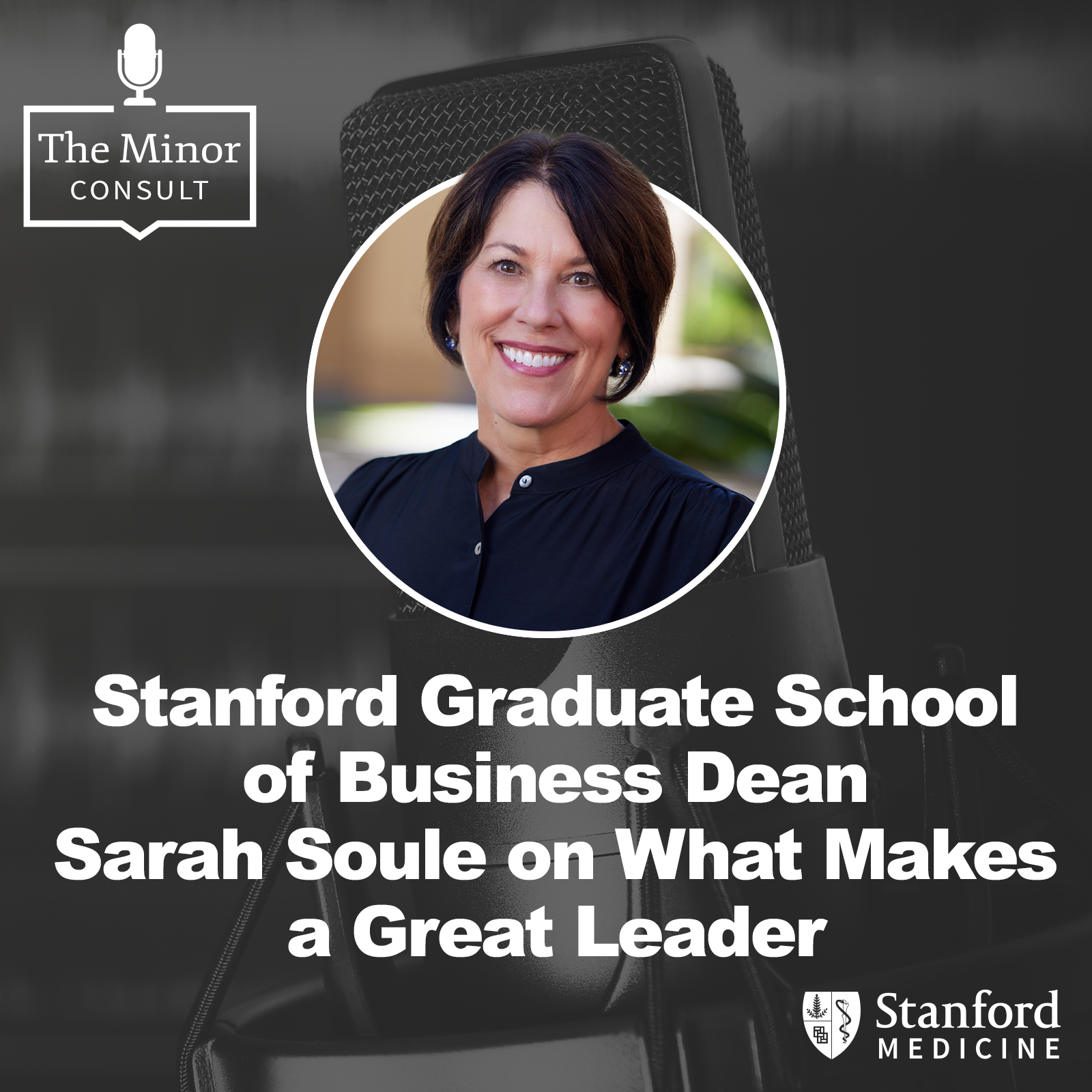
[Music] Welcome to the Minor Console, where I speak with leaders shaping our world in diverse ways. Today, I'm thrilled to be joined by Sarah Sewell, Dean of the Stanford Graduate School of Business. Sarah started her tenure as Dean last summer and begins as the Stanford Graduate School of Business is celebrating its centennial, a milestone that she sees as both a tremendous opportunity and a great responsibility. She's an accomplished sociologist, researcher, and professor, the author of two books, and she serves on the editorial boards of Stanford University Press and Cambridge University Press. Sarah has been a faculty member of the Graduate School of Business since 2008, teaching organizational behavior, as well as serving as Associate Dean for Academic Affairs before her appointment as Dean. Sarah, thank you very much for being here today. Well, thanks, Lloyd. I'm really happy to be here. Great. Well, I've read that you chose to study sociology for your doctorate and your research, because you wanted to focus on observing humans and the human condition. How did you come to this decision and how is this translated to your focus on business? Well, thanks, Lloyd. That's a great question. And thanks for indulging me with such an interesting question, too. I was one of those students who took classes quite literally all over the university when I was an undergrad. It was very curious. I took so many classes that I think the university stopped giving me credit for them. So anything from philosophy, to lots of calculus, and statistics, to Japanese, to Asian religions, to even modern dance, actually. And eventually I discovered that I was really, as you said, drawn towards the social sciences, in part because I was so interested in the human condition. And in particular, I was really taken with this idea that humans are both beneficiaries and victims of their environment. And I was sort of thinking of the analogy of a leaf floating down the stream on the currents. But I was also, I would say, more interested in how human beings aren't just victims or beneficiaries of their environment, but also have the ability and often the courage to try to change the environment. And that's what drew me to being very interested in political and social movements, and thinking about how these might impact, in particular, business organizations, universities, and so on. And it was that interest that eventually landed me in a business school, both because I was interested in the kind of way in which we can think about social movements and political movements with an organizational lens. But also the practical idea that, in fact, what human beings do is sometimes change their organizations and their organizational context. And so that's, I think, why a business school was appealing because of that practical nature. But I'll also add, because of this interdisciplinary nature of, particularly the Stanford Graduate School of Business, being somebody who's so curious about so many disciplines, it was just a natural fit. Indeed, and maybe could you describe some of the movements that you've studied and how those relate to both what you teach and also what you see in terms of trends in business today and the impact of social political movements and how business leaders and other leaders can understand that impact and use it constructively. Sure, sure. So one of the projects that I started very, very early on, and in fact landed me and my then PhD student, whose professor at the Kellogg School of Management now, and landed him in a business school too, was a kind of historical project looking at outside protest events. And what I mean by that is street protest events that were targeting corporate in particular publicly traded firms all over the United States. So it was many different movements from labor to civil rights to women's issues, environmental issues and so on. And what we found in that paper and probably what set us on this course for both of us sending up in business schools was that we could use the modeling techniques from our colleagues in finance to look at what the effect of a protest event was in this historical period on the stock price returns of those organizations. And what we found was that with many different windows of time protest actually really did have negative abnormal stock price returns and that led us on a whole lot of a number of other related projects, but some of which looked at the effects of boycotts on stock price returns that looked at the effects of boycotts on actual actual policy changes. But then eventually more recently looking at how leaders corporate leaders might think about responding rhetorically to various kinds of outsider protest movements. So there's some sort of general ideas of what the research program has looked like over the years. And it's wonderful and you of course study organizational theory, organizational behavior. How has your work both your scholarship and also your work in the teaching arena, your interaction with corporate leaders. How has that shaped your thinking about what defines a successful corporate culture, business culture. Yes, great. I'll talk about two different things that I think we've both looked at in the literature but also taught a lot about. And the first is that when we think about strong organizational or corporate culture, and I say organizational because I think that this applies to the kinds of organizations that you and I lead as well. And that is that strong culture is it's more about the strength of the culture than it is the content of the culture. And what I mean by that is when we look at the kind of benefits of having a strong culture, it matters less about the kind of what we might think about in terms of the content in terms of what the values are in terms of how those values play out in everyday interactions and more about the strength. And I'll give you a classic example that I often teach about and that is the difference between two well known companies in the United States at least Amazon and Zappos, which interestingly was acquired by Amazon some years ago. But when you look at the kind of culture that the two leaders of those organizations tried to create, they're very different in terms of content. The Amazon culture was designed specifically to be sort of more competitive, quantitative, hard driving. And the Zappos culture was designed to be happy and sort of softer and much more geared towards getting the Zappos employees to be happy. In fact, the founder wrote a book called Delivering Happiness, which was as much about what they were trying to do in terms of customer satisfaction as what they were trying to do internally. Now what's interesting about this is both are considered very strong cultures. The leaders did everything they could to enforce a strong culture. In both cases, these organizations were about driving the best possible customer experience and both were very successful. But the content, the values, the way that these values played out in everyday interactions was really very different. But again, same kinds of results, but very different culture and the results were driven by the strength, not just the content. So that's one kind of, I think, lesson. A second one that I think is really important that I get asked a lot is, so how do you change culture if you've inherited a culture perhaps that you want to change? And of course, this is one of the most difficult things in organizational behavior. But one of the things that we've written about in some of our work and the title of that work is cultural change requires a movement, not a mandate. And is this idea that leaders, it's very difficult for leaders to come in and mandate a cultural change. What they need to do is to enable some experiments to happen around change within the organization. They need to pick people within the organization who they see as carriers of culture. And as these experiments play out, when there's a win, then the leader and the people in the organization who have carried out these experiments are able to tell that story and then diffuse kind of an energy around a new type of culture. And so when we think about how to change culture, it really is about enabling and talking about the behaviors that we hope will happen in the organization and then allowing both a bottom up but an enabled top down kind of cultural change as well. So that's a couple of ideas. Absolutely. So 100 years at the Stanford GSB, magnificent achievement for the school and of course its impact is enormous, probably immeasurable. But what do you think characterizes a Stanford GSB MBA alum? This is such a great idea and I've been thinking a lot, a great question I mean and I've been thinking a lot about this question Lloyd because as I've been, I've had this question.
wonderful opportunity because of the centennial to go out and talk to a lot of alums, and I ask them that question. And what's been both gratifying, but I think also very interesting to me, is that they tend to gravitate towards a number of different characteristics. And these characteristics line up perfectly with some research and some work that a colleague and I undertook about a decade ago. And what that work was was trying to kind of codify or at least write a book about, we haven't written the book yet, but I hope we will, about what the GSB leadership model really is. And what I've been hearing from these alums lines up really pretty closely with this leadership model, which has five kind of basic competencies. And the first of these is self-awareness, an ability to know one's own values and how those values are driving one's behaviors, what motivates somebody to lead in the way that they're leading a sort of sense of or knowledge of one's biases. And you know, again, strengths and weaknesses as well. And not just understanding oneself and reflecting a lot on oneself, but being intentional about understanding how other people perceive them as well. So sort of an internal and external self-awareness. A second competency that we talk a lot about is the ability to take the perspective of other people to understand that others are experiencing any given situation in a very different way, probably than oneself is, to actively ask questions about and listen well and listen carefully to other people's perspectives and to bring those perspectives into one's decision making. A third is communications. And oftentimes, you know, we talk about this in terms of holistic communications, not just what one says or what one writes, but also one's nonverbal kinds of behaviors and ways in which they communicate nonverbaly and every kind of instance of communication. And then finally, one that I think we often don't think about when we think about communications, but listening. The ability to really actively and deeply and listen to other people, something that's so important in medicine, of course, too. So those are typically when we talk about the leadership model, we talk about those first three as kind of very much part of personal leadership. But there are two more that I think are really important. And one is that at the GSB, over the last certainly since I've been here for which, you know, it's been 17 years now, we spent a lot of time on data, analytics, and making decisions based in critical thinking and the observation of other people and poking holes in our biases and so and poking holes in our decisions so that we can uncover our own biases in decision making. So that's been I think very important as well. And the final comes back to the first question that you asked me Lloyd about the human condition and how I answered that. And that is this deep understanding that as leaders, we are embedded in a very complicated, multifaceted, and multi-layered environment or context. And so being aware that this this context that we lead in is complicated, and multi-layered and multifaceted is important, but it's not enough. Our leaders, people who are trained at the GSB are very good at navigating this, but they're also good at changing the context, having the courage and the optimism to change the context when it needs to be changed. So when we talk about leadership, we do talk about it in this embedded way that leaders, you know, at a most basic level, have to be aware of their organizational and team culture. But of course, they also have to be aware of industry dynamics of the competitive landscape, but also the political and economic environment in which they lead the global political and economic environment as well. And again, understanding that these are rarely aligned and understanding the need to navigate and sometimes the need to try to change the context is another facet of this leadership model. And so I've loved talking to our alums and now our students who have come back to campus about their experience because it is gratifying to me to know that it really does line up with this work that we did to try to kind of codify the leadership model. So that's a wonderful description of if you will, the GSB approach to or the GSB study of effective leadership, I'm wondering when I think of the GSB and when the GSB has talked about around the world, the word that oftentimes comes up is entrepreneurialism or entrepreneurship. How does that relate to and how does being a successful entrepreneur, of course, it's closely related to those leadership traits and attributes and approaches that you just described. But is there something in addition to it that makes a successful entrepreneur and how do you approach teaching that at the GSB? Yes, absolutely. I mean, I think this is another piece of what we do at the GSB is instill for lack of a better term an entrepreneurial mindset. So even if our students don't become founders, we find that they're very likely to become entrepreneurs at their organization to make positive change in various ways, to think very in a very entrepreneurial way about how they approach problems, for example, some of our alums who have gone into investing do so with a very entrepreneurial mindset and approach and end up creating new ways of investing because of that. But some of the things I think that we instill in them first and foremost is a growth mindset and resilience and grit, which I think are important and will become increasingly important as we think about AI and some of the ways in which that will change organizations. I think it's also a sense of courage and optimism that comes into a more entrepreneurial mindset. And the final thing that I'll say that's very important to the GSB and to what the GSB is, is the community. And one of the things that has struck me as I've had this wonderful opportunity to talk to alums all over the world is this community. So a lot of times people here, this almost an adage that people go to business school for the network, that's not the case at the GSB. If they think that when they get there, they leave with a community. And there's something that I think is particularly profound about that. And when I've talked to these alumni over their life, you know, alumni at different stages of their lives, it may at the beginning feel more like a network. People are using the community for help with career advice, job transitions, seeking investment. But very rapidly, they discover that the community helps them as they perhaps struggle with whatever life throws at them, challenges raising children, elder care issues, things related to even struggles in their job. And that's been one of the things to me that has been so striking about spending so much time with our alums and our current students is that there's something about this community that supports our students, both when they're entrepreneurs, but then I think throughout their life course. Many successful businesses, of course, have come out of the GSB either directly at the time students or professors were involved with the GSB or afterwards. What are some of the examples that are most meaningful to you? And I know this is like choosing, you know, your favorite child, but anyway, just maybe looking at different genre, different approaches, the examples that stand out in your mind. That's great. And it is a little bit like picking some of my, you know, picking my favorite children and there are so many. And so many of these events, I feel like I could, you know, sort of just point out at the events and name different kinds of companies that have been creative. But I'll give you a couple because I think, you know, I think the vision behind some of these that all maybe will become sort of obvious. I mean, perhaps one of the most iconic is Phil Knight, who in a paper at the GSB for a class had a bold sort of idea, a crazy idea, if you will, that running shoes could carry more than runners, they could carry dreams. And that idea, of course, became Nike, one of the most iconic companies that has come out of the GSB. And I had the incredible honor of interviewing Phil Knight a couple of weeks ago and hearing the story. And so that may be why that one is so salient right now. Another that's salient right now because I'll have the opportunity to talk with this founder in a couple of weeks is Eric Yuan, who of course, many of us know Eric and know that this, this dream to be able to create seamless connection between people across continents became Zoom, which of course for many of us was a savior and some of our darkest and and and scariest days during the COVID-19 pandemic. Another that I'll mention, maybe that's just top of mind because
an undergraduate student just mentioned this to me the other day is DoorDash and thinking about this idea that we need help to scale small businesses and that food delivery could become a way to create opportunity for people was of course the idea behind the founders of DoorDash and Tony Shoe being one of them one of our GSB companies so those are just three that I'm maybe naming because of the recent CFX but I think we're sort of bold ideas incubated at the GSB and then carried forward from the GSB. That's wonderful. So you became Dean just a few months ago of course you know the school because you've been a faculty member you've been a leader in the school. What's your vision for the future of the school? Where would you like the school to see the school be 10, 15 years from now and and what are some early thoughts about about the initiatives that you'll want to pioneer and further as Dean. Yes yes well and it is early and but I will I'll say that I'm in a unique position because of course our past Dean is now the president of Stanford University John Leven and he had started a number of very interesting initiatives that I care deeply about and I was part of that Dean's team and so I have this wonderful opportunity to shape some of those initiatives. I'll mention a couple of them and then I'll talk about a few other things that are on my mind at the moment. So you know one of these initiatives had with it's our investing initiative and this comes from you know you mentioned Lloyd that we often think of the Stanford GSB as the place where entrepreneurs go. It turns out it's also the place where some really pretty amazing investors go and many years ago we developed a Center for Entrepreneurial Studies which of course is iconic and very popular amongst the students and amongst our faculty and our alums but we have this idea that you know about the same proportion of each class goes into investing and we should really have not just an initiative but hopefully eventually a center on investing at the school to honor the people who have contributed in terms of the faculty side and the teaching and lecturer side as well as these wonderful alums who have been created within the GSB so that's one of them. Another is one that is it was has been sort of talked about around campus as the business government and society initiative. Very important and but is being in the who are in the middle of of of of creating an institute that will be referred to I think along the lines of the Institute on Leadership at Stanford for a changing world is how we're talking about it now. So some of the core ideas that were incubated and thought about under the initiative of the business government and society how do we think about training our students so that they can navigate that complex environment that I had spoken about before. So those are a couple of wonderful little small beginning initiative seeds that I was that I was given by President Levin but a couple of others that I've been thinking a lot about. One is thinking about AI not surprisingly and thinking about what the Stanford and the Stanford Graduate School of Business point of view will be on AI. So I'm envisioning so so we have an initiative right now which is a very applied initiative for our students who are very excited about getting some practical skills that they can use as they as they graduate and go on to lead organizations but another piece of that is thinking about how AI is changing everything in organizations and the future of work and an initiative that I've begun to think about and try to get a gin up some excitement amongst the faculty and students and alums is an AI initiative and it may be loosely called the AI powered organization and the future of work. Sure. Thinking about how our as a business school and a school of leadership what our strong point of view is going to be on AI. So that's another piece that I've been thinking a lot about too. It's hard to have any conversation today. One wouldn't want to have any conversation today without bringing up the topic of AI. Absolutely. And it's enormous disruption. How do you think because education in your school also I think they're parallels in medical education in what you were just talking about of how the opportunities that you offer your students. A lot of that is dependent upon interactions. Interactions the students with each other you talked about building a community. Of course that community also includes the faculty and the staff at the GSB that are extraordinarily dedicated to the students to the scholarship of business education to the top of scholarly activities that you mentioned. Where do you see the place for AI in that continuum or in those processes given that a lot of these skills and attributes that you've spoken to eloquently about developing might be characterized, perhaps a misnomer, but characterized as softer skills and other skills. They really get at the core of what it is to be a human as we've traditionally thought of humans. Just curious how you see AI related to those processes. Yes, I love that. So and I love the question because this is very much top of mind. I'm doing a number of or hosting a number of small dinners with students to kind of get their point of view on this. And of course I've been talking to our faculty and staff as well. So I think there's a couple of ways to think about this. And one is of course on the research side. And thinking about how our faculty have pretty rapidly been adopting various techniques and tools from the around AI in their research. And also how other faculty are studying AI as a subject that needs to be studied and thought about in terms of the organization in terms of organizations and leadership. So one piece of it is of course research both as a subject but then also as a tool and so that's been that's very exciting to watch develop and we'll continue to do everything we can to support those kinds of research activities. On the teaching side similarly there's a couple of ways to think about it. I mean one is in terms of content. So we have a number of courses now that are designed to teach students about how and where the opportunities are for AI and various functions of organization, marketing, HR, etc. So that's one piece of it. But then there's also thinking about the pedagogy and how we can bring AI tools in to enhance learning. I learned the other day about a chatbot that one of our faculty members developed which essentially you can type in questions about management and it will go through the latest in management research to help you answer the questions that you might have. So I probably should have typed in the question you had about organizational culture and put that in and seen what the AI chatbot would have discovered. So there's ways to think about both the pedagogy and also the content. So I think there's a lot of opportunities there. But one that I think we all should be doing is not just asking the questions, these kinds of obvious questions, but also digging into the ethics and asking the question of not just how, but when should we be using AI? And what are the implications of AI? So that's that's I think one piece of what we're grappling with right now at the GSB. And then as you said too, one of the things that I'm keen on is thinking in a very deliberate way about what we do in terms of our leadership training. How and when is it going to be useful to bring AI into what we do in terms of our leadership classes and so on as well. Maybe one additional question on your field of scholarship or organizational behavior or organizational culture. Of course, since the pandemic we've moved during the pandemic, we moved to an entirely remote work environment in many industries, many businesses, many institutions, not all, but many most. And then we've sort of migrated to a hybrid environment. Of course, you have scholars in your school that have studied and written a lot about that. And now as we're having this conversation today, a nationally known business leader, Jamie Diamond has announced that when JP Morgan opens its wonderful new headquarters in New York, everyone will be in the office working. Where do you see this continuum going perhaps? And as a scholar of organizational culture, how does one develop organizational culture if you're not actually interacting physically in some sense in front of or with colleagues? And you talked about the building, the community that's so vital to the educational experience at the GSB.
And of course, that had to be somewhat disrupted during COVID. But I'm just curious where you see this movement going because it seems like we move from a very far extreme of being entirely remote, hybrid, which on both sides of the aisle, people seem to criticize. And now some businesses going back to, okay, you know, the pandemic's over, we're back in work and that's gonna be the best for our people and for our company. - Yeah, so those are, I wish I had really precise answers to all of that. But I'll give a few reflections. I mean, and again, the research on this, and you hinted at this, is really quite literally all over the place. So we have some folks at Stanford, who seem to show that at least in terms of productivity, remote workers can be more productive. I'm thinking here of Nick Bloom and thinking about a certain type of organization and a certain type of task. And I think that's probably part of what's so important, right? Is it probably depends a lot on what the task is that people are doing. But then there's of course research that shows or purports that, and also conducted here at Stanford, that some kinds of activities are clearly better in person than online. And I'm thinking about a study by my colleague, Jonathan Lavov, that showed that brainstorming, brainstorming in particular, is much better done in person. And so, one answer to the question is, we need to be more sophisticated about how we think about what the tasks are and where they can be, and should be conducted. And so that does sort of lean towards thinking hybrid is probably okay, but you've got to be, pretty sophisticated about when people need to be together. And for what activities they need to be together physically, I mean, and what things are okay to do, either remotely or on Zoom or some other video or phone service. So I think we need to be, I think these statements about, it's either this or that. I think we can be more sophisticated as people who conduct research and who wanna use that research to help drive our organizations. I think we can do that. I'll also just say one final thing about that. One of the things that we often talk about and seems to be shown in at least some research, I'm not sure how, if this was just sort of some survey data, is that the morale of people who are able to work in a hybrid way is, tends to be higher. However, one of the things that I think we need to also ask is how about those that are in person when some of their colleagues are able to work remotely or in a hybrid fashion? What's their morale? Because I think sometimes there's probably some tensions there that we probably need to address at least as leaders that we need to look at both sides of that equation too. So. - Sarah, you're a trailblazer in your scholarship and your leadership and you are also the first woman to be the dean of the GSB in the 100 year history. What are your thoughts about that? And how do you see your role as a role model for other women who are building their careers in professions and activities that haven't been as representative of women in the past? - Well, first of all, it's a huge honor. And to have this during the centennial has been, very emotional and sometimes I think the gravity of this didn't hit me at first, but it has now begun to hit me. And I think I joke sometimes and say, "Well, look, my goal is to not be the last." So that's I think a meta goal. But one of the things that I think I get asked a lot is what some advice you might have. And I'm going to give a couple of thoughts on this. And one came from some years ago when I was an associate dean, I went to a convening that was kind of build as, future potential women leaders of business schools, something like that. And there was some content and lots of great advice from people who women who were college presidents or deans. And one piece of advice that really struck me was the advice of saying yes. So oftentimes women are told women academics, at least are told to say no, because they need to be focusing on the research so they can go on and get tenure. And so I want to sort of say no. And one of the leaders said, no, actually the answer should be yes to the question to do more because of both the serendipity and the learning. And you never know what's going to happen when you say yes. So I put that piece of advice stuck with me. I think a second thing I'll say is, I benefited throughout my career, research career, teaching career, leadership career through networks, advice networks, and through being clear that there's a couple of functions that our networks could have. And certainly we all, I hope, are lucky enough to have mentors who will help us, but also sponsors too. People who will put our names in for different kinds of assignments or leadership roles. And being clear that both of those are important to anybody, not just women leaders, but I think anybody and being clear that we all need advice and support, but we also need people who are going to promote us and to suggest us for different kinds of assignments and asking for both of those kinds of people in our network, I think, is another piece of advice. - That's wonderful advice. Sarah, I'd like to close with two questions that I asked each of my guests. And the first is, what are the most important qualities for a leader today? - I think I would say curiosity and generosity. And I'll say why. I mean, just really quickly why. I mean, I think about this, that curiosity drives excellence. When we're curious, when we're asking questions, when we're learning, I think we drive organizational excellence as well as team excellence and excellence in ourselves. And I think generosity is so important for community, being able to share our ideas, our knowledge, but also to give one another grace, particularly in times when I think we all need a little bit of grace. Generosity is also good for organizations and I think for leaders too. And finally, what gives you hope for the future? - You know what gives me the most hope for the future is looking at the students at Stanford, not just at the GSB, but at Stanford. I'll focus on the GSB because as I said, I've been having these small group dinners, their ideas. Some of their ideas, which may seem as wild and improbable and crazy as film nights ideas, those I think are going to be the ideas that once refined are going to continue to change lives, change organizations and change the world. - Fantastic. Sarah, thank you so much for joining me today. And thank you for joining the minor consult with me, Stanford School of Medicine Dean Lloyd Minor. I hope you enjoyed today's discussion with Sarah Soule, Dean of the Stanford Graduate School of Business. Please send your questions by email to the minor
[email protected] and check out our website, theminorconcil.com, for updates, episodes and more. To get the latest episodes of the minor consult, subscribe on Apple Podcasts, Spotify, or wherever you listen. Thank you so much for joining me today. I look forward to our next episode. Until then, stay safe, stay well, and be kind. (upbeat music) [Music]
 PodcastTranscript AI