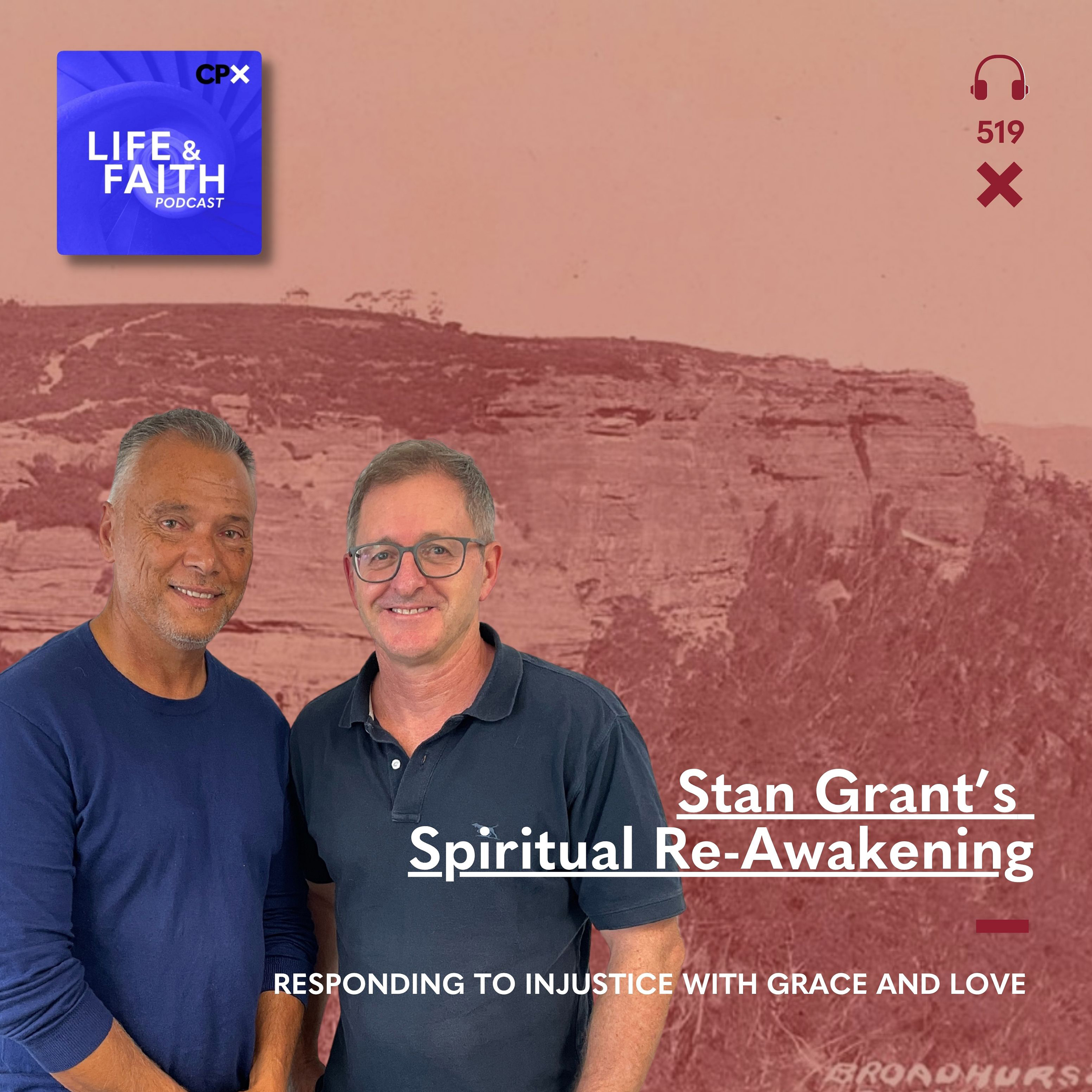
In a podcast episode, Stan Grant discusses the significance of truth and love, reflecting on his past approach of speaking truth without love. Grant shares the toll his journalism career took on his mental health due to covering conflicts worldwide. He narrates personal experiences of feeling close to God and emphasizes the need for openness to divine presence. Grant recounts his father's life story marked by violence and history, noting how love ultimately saved him. He describes his father's transformation over time, showcasing the power of forgiveness and reconciliation. Grant's reflections intertwine themes of spirituality, love, forgiveness, and the impact of personal and collective histories on shaping identities and relationships.
Transcription
8020 Words, 42889 Characters
You used to think that truth was the thing you needed, but in fact, truth without love becomes another weapon.
That's a radical thing to say.
Yeah, and I had to recognise in myself that I had spoken truth without love.
I had come to the truth through politics and through justice and some envases.
You know, they are words of the middle region.
They're a high words. God, love, grace, forgiveness.
And I did not water the ground with love and grace.
This is Life and Faith, a podcast where we seek to elevate the conversation about the things that matter,
or should matter, deeply human questions about meaning, purpose and hope.
No matter what you believe, we hope you'll join us exploring the complexities, the struggles and the joys of life and faith.
Welcome to Life and Faith from CPX. I'm Simon Smart.
In a decades-long career as a journalist and foreign correspondent, Stan Grant saw more than his fair share of conflict and chaos.
It took its toll on him.
And as a waradry man, he has had to wrestle with identity, belonging and who we all are as a people in 21st century Australia.
He went through a period of angst and anger and he would say some bitterness as he and his family, his people, confronted injustice, prejudice and a history of oppression, violence and dispossession.
But through a serious spiritual reawakening, Grant has found a different way to be.
Today on Life and Faith, he describes the shape of that spiritual life and the surprising ways it has impacted him and how he sees the world and his place in it.
Stan Grant has a PhD in theology and is the author of several books.
His latest is Murray Yang, Song of Time.
He came into the CPX studio to talk about that book and the many different things that have made him who he is today.
Stan Grant, so great to have you in. Thanks for coming.
It's a pleasure.
Now you had been a journalist for decades, travelling the world as you say in your book and reporting on the worst of humanity.
You say redeemed by the best of humanity.
But what did that career in journalism teach you about human nature?
That we're better than our worst, I think, fundamentally.
If I didn't believe that, I don't know that I could have kept doing it for as long as I did.
And still do to some extent.
I'm still sort of active in some ways in media and journalism and I write for the Saturday paper and write a column.
But, you know, it takes an enormous toll on you when you're confronted by the worst of the world.
And I covered wars, natural disasters, revolutions, conflicts, terrorism all around the world.
And you see what human beings at their worst are capable of and we are capable of horrendous things.
And people who would ordinarily think of themselves as good are capable of ordinary things.
People who love their children and care for their parents are capable of killing the parents and children of others very, very easily.
And we delude ourselves if we think that we're not capable too.
And in the middle of that, I saw a human spirit and a spark of, I think, what we are at essence, which is good.
In war, you see people who've lost all sense of certainty, lost their place in the world.
And you'll see in that something that gets them up the next day.
Something to hold on to and small acts of generosity and grace and kindness that shine through in the horror.
When you watch television news or when you read the news and you think about these places that are war-torn,
you miss the fact that there are real people living real lives there.
And war is not constant bombardment.
It is violent, but it is sporadic and explosive and spectacular.
And then in the midst of that, people are doing the things we ordinarily do.
Taking kids to school if they still can, working if they still can.
People have to navigate the trials and tribulations of everyday life.
And in the midst of all of that, I see the potential for something to redeem us from our worst.
And that is that as human beings, I still cling to the idea that there is a fundamental goodness to us
and is the absence of that goodness where we see the horror.
Tell me about the impact it has on you as a person. It must take a toll.
Oh, terrible. And you don't realise it.
You know, it's the old story of the frog in the boiling water.
You warm the water slowly and the frog doesn't even know the water is getting warm.
And it did take an enormous toll on me.
You know, people should not be exposed to those things
and not be exposed to those things for the length of time that I was.
You know, soldiers will do tours of duty, two, three,
but to do 10, 15, 20 in multiple war zones, months at a time,
it grinds you down. You become dead to the world.
That becomes normal. And that happened to me. Two things happen.
One is it's very difficult to come back when you're experiencing life in extremis.
And then you come back to the everyday. Everything's a catastrophe.
So if I opened the fridge and there was no milk in the fridge
and the shop's 200 metres away to go and buy more milk, it would be a disaster.
It would ruin my day.
Everything was raised to the level of catastrophe because I was adrenalised,
overstimulated and catastrophised.
And that when that becomes your daily life,
when the eggs and bacon you eat in the morning are a prelude to the disaster,
the bomb, the explosion, the dead bodies you're going to see later in the day,
when everything is folded into catastrophe, you can't separate the two things.
And when the catastrophe becomes normal, the second thing is that you crave it.
It gives you life meaning.
Because everything else must feel insignificant.
And as a journalist, I was working at my best in the worst.
I was working the longest hours.
I was working with no sleep.
I was operating at maximum capacity.
You know, I say to people that imagine playing an AFL or an NRL Grand Final,
playing a state of origin game, but not playing three, not playing one match,
but playing it every single day or every hour of every day.
Your capacities are superhuman. And I felt as if I was superhuman in those circumstances.
And what I was reporting on gave my life that energy and purpose and meaning.
And to come back to the everyday was impossible.
And you don't realise that it's happening.
And my wife said to me, we were living in Beijing at the time.
And I would travel into Afghanistan a lot, into Pakistan.
I'd spent time in Iraq.
And she said to me one day, you know, your eyes have turned black.
Your eyes have turned black.
And she would say to me, all the joy has gone out of your life.
You can't keep going on like this.
And I remember saying to her, you don't know what you're talking about.
You don't know what life is.
You don't know what the real world is.
The world I was reporting on was not the real world.
The real world is buying milk.
The real world is dropping your kids off to school.
The real world is watching television with your wife or your husband.
The real world is taking a dog for a walk.
I got to the point where I could not separate those realities and walking the dog.
I remember when I really reached a point that I realized that things had reached just this crisis point.
When walking the dog and apologizing for people listening to this because these are very hard things.
And looking at the leash and seeing a noose and imagining myself hanging, imagining myself dead.
My wife, I wasn't aware of this, but she'd already put things in place for what to do if I committed suicide.
That's how bad it was.
And it took her love and patience and kindness and ultimately intervention and the support of people I worked for.
I was working for CNN at the time and wonderful doctors who I went to see to drag me out of that.
To help me find a way through that and to come back to myself and realize that the world was not that dark place.
But it takes a terrible toll on you.
Two of my closest friends that I worked with are no longer with us.
Another one of my friends that I worked with very closely had a similar breakdown and has not really recovered.
As for me, I live with it every day.
I factor things into my life to take care of myself.
I try to avoid the things that are going to trigger those emotions again.
I'm hyper-vigilant.
I try to bring routine into my sleep and my exercise and all the things I have to do to regulate my moods, to attend to my mental health and to keep those demons at bay.
Because once you have seen them, you don't stop seeing them.
Now just jumping in.
If the issues discussed here raise particular concerns for you.
You can seek help at LifeLine 13 11 14.
You can get support there or at beyondblue.org.au.
Their number to call is 1322 46 36.
I'll put those links in the show notes as well.
Now back to the interview.
You talk about in the opening of your book how after a very long time where God felt distant from you, you now feel his presence very closely.
And a sense of seeing him or feeling that presence.
Idi Amir walking the dog in the stars even.
There's this sense of that presence now.
Yeah.
I'd grown distant from God, I think, rather than God growing distant from me.
God is always there.
And I grew up with a very profound faith.
And as an Aboriginal person, you know, the divine, the mysterious, the supernatural, the mystery of creation.
The mystery of God was ever present, ever present.
And you know, we were growing up in Aboriginal community and an Aboriginal Christian community.
Several of my uncles were pastors in the church on the mission that I came from.
And it was part of the experience of being Aboriginal.
Some people see these things as being contradictory or in conflict in some way.
That Christianity is an imported colonizing religion.
In fact, it was the fulfillment of who I was and who we were.
And that's only deepened as I've gotten older.
And it was always there.
I always had a sense of a very personal relationship to God that I experienced through my country and my family, kinship, culture.
But of course, you know, you go out into the world and you experience things and you think you're a bit smarter than God.
You've got God worked out.
So I've got all the answers. He doesn't.
I go out and I see the ugliness of the world and I'm consumed by these things of evil that become more real than grace and love and kindness and goodness.
And it was through that experience and coming back to a sense of what gives my life purpose and meaning beyond the worst of us, which is that it is real and God is real.
And the presence of Christ is real.
And, you know, I make no apologies.
I don't try to sort of avoid this.
It is a presence and I have felt the presence of Christ in a very, very real way.
I have felt that presence and it is the thing that sustains me and has brought me back to my relationship with God and my relationship to myself.
And the people around me and the way I see the world as the image of God rather than the worst that we're capable of doing to each other.
You have and you recount this in the book where you have several experiences where you feel really close to God, where Jesus becomes real to you in ways that you hadn't before and found yourself being more open to this.
And I wonder if there is a need for a certain openness in order to see and feel and experience God.
There's a line in a U2 song that talks about a place that has to be believed to be seen.
I think it's a really clever, interesting line.
Yeah, you know, and we know that Paul talks about the thing seen and unseen and that the unseen is true.
It is real as well. You don't have to see that.
You don't have to cognize that.
You know, I think one of the great follies of modernity and it really begins with this is Descartes idea of, you know, cogito ugo sum, that I think therefore I am.
We do not think ourselves into existence, but in that act of thinking ourselves into existence, we think God out of existence.
We might turn God into something that we can control or we can imagine or we banish God to the nether regions of the universe and God loses his imminence and transcendence.
I think we have to be open to the truth that we don't see, that we can't rationalize.
And I've had several moments where that has become visible, apparent, real to me.
I just told you about a couple of them. A few years ago, my uncle passed away.
My dad's brother, who was very much like another father to me and in my culture, my father's brothers are my fathers.
They occupy different parental roles and he passed away and it was during COVID.
And there were limits on who could go to the funeral and my auntie rang me up and said my uncle had always said that he wanted me to deliver his eulogy.
So it was just my auntie, his immediate son and daughter and their partners and their children and me.
And I was there representing all the rest of the family and it was during COVID and I had to get permission to drive to the town where he was from.
I drove down there and I parked the car and I went for a run and I wasn't thinking about where I was going and the run led me down past the church that he went to.
I then ran down by the river and I stopped in this one place and I felt this incredible presence.
And I told my auntie and she said that that's where he fished and I felt him there and I felt him calling me back to where I was from, calling me back home.
I had another experience where I was in Canberra, one bitterly cold winter night and walking along feeling terribly important, you know, television suit on and people recognizing you in the street.
And there was a man I thought begging and he had, you know, tattered clothes, matted hair, the toe of his shoes were torn open, his hands were red-wrapped as a very, very cold Canberra night.
And I reached into my pocket and I had $10 in my pocket and I just threw it on the ground as I went by.
Went through the door into the shopping mall and the door was open behind me and I heard a voice and he called me by name.
He said, "Stan." And I turned and I looked at him and he said, "Don't forget, you can forgive yourself too." Wow.
And I thought, "Who are you? Who are you?" And immediately I realized that I had been called back to my humanity.
This man's life was not worth $10. I didn't stop and speak to him. I did not put my hand on him.
He was just another beggar who I could toss money to on my way past and he called me to my own reckoning, my own forgiveness of my sins.
And I tell you, I went to the door, I looked around and he was gone, gone, entirely gone.
It put me in mind of the story, what's his name? St. Martin's. It's Martin of Tours.
You know the story in France where he was riding back at night and there was a homeless person, a beggar who asked for warmth and he tore his jacket in half and gave half his coat.
And he got back and then he sees the figure of Christ with half his coat. You know, I think those things are real.
And I think there are moments when Christ makes himself known to us. And if we turn away from that, if we don't heed that, if we are not open to that, we're lost and we stay lost.
And I had been lost for a very long time.
You're listening to Life and Faith and I'm speaking with journalist and theologian, Stan Grant, about his book Murray Yang, Song of Time.
Sprinkled throughout the book are portraits of Stan's dad. Stan's dad has clearly been a huge presence in his life and he writes very movingly about him.
Here is Stan reading from the book.
"Dad has had an uncomplicated relationship with God. He would always say to me he was a simple man. God was real. That's all he needed to know.
My family is spiritual. That's the first thing, the most important thing to know about us.
Being Wiradjuri, being in country, in place, means being with God. I hear some people now talk about country as if it were God. And that's the wrong way around. That's not what dad taught me.
Country is God's gift to us. God brings country to life.
When I sit on country, it isn't the rocks and the trees that speak to me. It is God in the rocks and the trees.
Too many people put a big burden on country. They want country to heal them. Country can't take any more of their pain. But God can. God can take it all.
That's the lesson of dad's life. We are saved by God in the country that God gave us."
At one point in the book you say that your dad's body is like a storybook. It's very violent. Storybook including police beatings and so on.
Your dad says too that almost every bone in his body has been broken. At some point. How do you see, as you say here, that hate had toughened him but love had saved him?
My mother was the love that saved him. And the hatred of our history had brutalised him. And he was hard to know. He was spiky.
There was a volatility around my father. Not that it manifested in a violence towards us. But there was a deep well of hurt. There was a pain that could not be touched.
And I was aware of that from a very young age. I was aware that I was around someone who bristled with the pain of history.
And it was written on his body. And there's a knife wound in his shoulder the size of a 50% piece. There's tattoos up his arms and across his chest.
You know, almost every bone in his body has been broken. He has endured beatings at the hands of police.
He worked incredibly hard just to put food on the table for us. We were poor. We were itinerant. We moved from town to town.
Dad worked in saw mills. The tips of three of his fingers had been cut off. He's a heroic figure. But he was exhausted. He was black. He'd been beaten and it was hard to know.
And part of the reconciliation of this book, it's a prayer to two fathers. It's a prayer to my heavenly father and a prayer to my earthly father.
That's what the book is. And through the prayers to two fathers, I find a reconciliation of history and a reconciliation of love with my father.
The book never set out to write about my dad. That was an accident, but a beautiful accident because the book is also a meditation on time.
Time is a recurring theme that runs through the book. And by writing about my father in memory at each of the sections of my dad is a discreet memory of my father.
I'm reaching across time. I'm snatching him out of history to bring him closer to God and to love.
And you know, one of the beautiful things about my dad is that as he's aged, he could put down the weapons. He could put down the armor.
He was able to, he was celebrated for the very thing that he was reviled for, which was our culture.
He helped to save our language. He wrote with a linguist friend of his. They wrote the first dictionary of Wiradjuri language.
He set up language centers. He set up a Wiradjuri language and culture program, postgraduate program with Charles Dirt University.
He was awarded a few years ago at the National NAIDOC Awards for the Lifetime Achievement Award. He's heroic and he has left such a legacy and a gift.
And as he's aged and he's very infirm now and he needs a lot of help just doing things. He's only awake for a few hours a day, you know, but we still have him.
And when I'm around him now, he has no need of that armor. And he's been able to soften into the love, especially of my mother,
who is the one that could always melt his heart with a touch. She could take away all the pain of history and to see him now and to see them both now
and to see that they fought those battles and that they're in a place of grace. It really brings what the book is about together.
That it is grace. It is love. It is peace. It is forgiveness. It is putting down the weapons. It is not holding onto the wounds of history.
It is finding a way to live with each other and they embody that.
Dad taught me that we are responsible, not only for ourselves, but for others too. He meant whatever happens, good or evil, we are complicit.
To Dad, this is the essence of being Wiradjuri. It is the full measure of what it means to say, "I am from here. This is where I belong."
Through God, we find ourselves in each other. Whatever happens in our country happens to us all. We eat and drink from the earth and waters.
This is how God settles into our souls. In the good times, this is easy. But what happens when things go wrong?
What is Dad telling me? He is saying that I must love those without love for me.
If I fail that, I have failed my people, my home and God. I have to think about this. Am I to love those who have hurt me?
Am I responsible for the hatred in their hearts? And the answer is yes. I am implicated.
Such evil is possible in our world because we have put it there. We have failed to defeat it.
I have gone so wrong in seeking to confront evil without love. I had thought that speaking the truth was enough.
But without love, the truth becomes another weapon. We have tried the truth without love and evil triumphs.
If this came from someone other than Dad, then perhaps it would not ring true, but this is my Father speaking.
And if He did not believe this, if He did not live this, He would never have survived. The darkness of the world would have killed Him.
You have this lovely sentence in the book that says, "God re-enchanted my buradjury soul." How did God do that?
Every time I go to Mass, I feel fulfilled as a buradjury person. You read the Bible. We know there are many rooms in the Father's house.
There is room for us all from our cultural traditions, our backgrounds. But in that body of Christ, we also become one, no Jew, no Gentile.
That we become one in the presence and the body of Christ in the church. And that is the fulfillment for me of being a First Nations person, a buradjury person.
It is not that I go to church to be seen as a buradjury person, to be celebrated as a buradjury person, recognized as a buradjury person.
I go there to be fulfilled in the presence of others, to bring myself in union with them, to be closer to God.
I am fulfilled in that. That's what enchants my buradjury soul.
I am very interested in that because, as you said earlier, for a lot of people, it would be very confusing to them that so many Aboriginal people are Christian when it doesn't fit the narrative.
And some of the real things too, of course, of very regrettable experiences that are tied into the Christian church too.
But somehow or other, and your book really brings this out, and there's a line used from the Pope who says that a lot of tribal cultures are expectant cultures.
They're looking for the light of Christ.
And this is the beauty of what Pope Benedict says, and he says that Christ waits for us.
He waits to receive our culture, our love, our grace, that in those that we are fulfilled, Christ needs us to be fulfilled as we need Him.
He is human and divine. He walked among us. He suffered as we suffer.
It is the union of us with God that fulfills us.
And I don't think that that should be in any way antithetical to our culture.
And it's not a syncretism either. It's not something that is syncretic.
We're not looking to fashion Christianity in the image of our culture.
It is Christian, and that is part of, that's the essence of the Christian experience, is that we find a one in the many.
We come to it with our difference, and we become one in the presence.
So I don't go to church. I'm not a Christian to be an Aboriginal person.
I'm an Aboriginal person who is a Christian.
And so I don't think those things are at all at odds or contradictory.
I think also we confuse what people do, what politics does, what the church does with Christ and with God.
And you know, I always say God did not arrive on the first fleet.
And because the people who came here with the Bible in their hand could not see God when God appeared in front of them,
in us, on the land that God had given us, that they could not see that, is their failure, not ours.
I want to ask you about forgiveness, because as an Indigenous man you are painfully aware of crimes committed against your people.
And Christian faith calls you towards forgiveness and a breaking of the cycle of vengeance and resentment.
And you write about this in the book.
But is this even possible, Stan?
Like how do you begin that process?
I love what Miroslav Wolf, who I don't know whether you've interviewed him.
Yeah, we have for sure.
Wonderful Miroslav.
He was one of the examiners of my PhD actually, so I was very honoured with that.
And he invited me over to give an electorate Yale Divinity School about 18 months ago, which was a wonderful experience.
And Miroslav has done so much work around this idea.
Jürgen Moltmann, who is his great teacher as well.
You know, these are people who live through enormous rupture in our world.
Moltmann, of course, served in the Nazi army.
He wore the Nazi insignia as a young man and was a prisoner of war at the end of the war.
And had to come to terms with the potential for his own complicity in the horrors of the Shoah.
Miroslav through the wars of Yugoslavia.
And Miroslav was famously asked as a Croatian, can you embrace a Chetnik, a Serbian nationalist fighter?
And he said, no.
But as a Christian, I must.
How do we get from no to I must?
And I confront the same things.
And I know that there is a deep human impulse in me to rise to anger, to embrace a righteousness in the face of the worst of that history, to hold people to account.
And believe me, it can burn in you and it has burned in me.
I don't like where it leads in me.
I've come to not trust myself around history.
I don't like what it does to me.
And history is not the measure of us.
And what does Christ do?
He releases us from history.
I mean, Hegel talks about an end of history.
Christ is the end of history.
And yet we put him on the cross every day.
We persecute him again and again and again for the crimes that we commit.
And I know that when I hold a resentment in my heart, when I rise to anger at the injustice that's been visited on us, I'm putting Christ back on that cross.
He died to end that.
And that doesn't mean that there is not justice.
He calls us to justice.
That does not mean that there is not truth.
He calls us to truth.
But we come to truth and justice through grace and love.
We don't come to it through resentment.
John Nietzsche talked about the man of Byzantium, the man who always returns to the wound.
It's the source of identity.
I have been that man of Byzantium.
I've been the resentful person.
I know where that leads and it doesn't lead to good places.
Forgiveness is not easy.
But it's what we can build a world on.
Christ's last prayer.
Father, forgive them.
They know not what they do.
He gives us a template for peace.
A way to live with the horrors that we are capable of.
Forgiveness also asks something of the perpetrator.
That they humble themselves before that forgiveness.
That there is a repentance that is not obligatory,
but offered through the humility of accepting the forgiveness of the person that you have damaged.
This is essential for me.
As I have explored all of these things and I've asked those questions
and I've read the great thinkers and the great writers about this,
it leads me back to that one thing I said before.
It is the only thing we can build a world on.
You have this lovely line in your book.
I think building off some of Miroslav Wolf's work.
You used to think that truth was the thing you needed,
but in fact the truth without love becomes another weapon.
Paul says it's plain and simple.
He's read a lot of weddings, but perhaps not applied to this kind of thing,
but that's a radical thing to say.
I had to recognise in myself that I had spoken truth without love.
One of the dangers when you emerge from a history like mine,
and I'm not talking about history.
I'm talking about my parents, my grandparents, people I know and love.
When I was a boy, I touched the hand of my great-grandmother,
who touched the hand of her parents, who touched the hand of their parents
who were here before white people came.
So it's a touch away.
This is not something relegated to the dusty shelves of a history,
of a library, such a book and a library.
This is real. It is alive.
They are scars on the bodies of the people I love,
and so it is ever-present.
And there is a danger when you have proximity to such suffering
and the harsh truths to become proud of the truth.
And I had to recognise, particularly after the year of referendum
and the voice debate, that in seeking to speak the truth
of the suffering of my people, I had not watered the ground with enough grace and love.
I had come to the truth through politics and through justice and Simone Weil says,
you know, they are words of the middle region.
There are higher words, God, love, grace, forgiveness.
And I did not water the ground with love and grace.
And of course, when you do that, when you speak truth without love,
you haven't prepared the other person to hear the truth.
And when the other person responds defensively or ignorantly or with hostility,
I would then see that as they are failing and not mine.
And I had to accept that a lot of it was mine,
and to learn to speak the truth with a humility and a grace and a love,
and that grace and love and kindness foregrounds the truth.
And without that, I don't think there's any way of being able to speak to each other.
Have you seen any of that enacted in a way that's helped?
All the time.
Now, I don't know whether it's me, probably it is.
You know, God works through you and, you know, I think it's changed, particularly post referendum.
I've been called back to that place of grace and peace and kindness
in the face of a great unkindness and in opening myself to that, in humbling myself.
I've been able to meet people in you.
And it's amazing, you know, that when you meet people with a smile,
when you meet people not as avatars of history, but as people who inhabit their own histories,
all of our ancestors' journeys have brought us here.
All of our stories are stories of pain and joy and triumph and tears.
We are human.
And I had a beautiful experience just this year on Australia Day.
Australia Day has always been a day that I've tried to avoid for two reasons.
One, I've never been one for the protest because I don't trust noise.
I don't trust the crowds.
It is not my disposition, protest.
But I've stayed away from the celebration of the day because I know what comes with that day
and I've wanted to avoid it.
This year, I was asked to be an ambassador at some events in the little village
and the couple of villages around where I have my property in the Snowy Valley.
And it was extraordinary.
You know, I went there to practice generosity, grace and love on this day.
And, you know, I turned up at the little park
and there are Australian flags and Aboriginal flags and Torres Strait Islander flags,
a sausage sizzle and lamingtons and a raggedy man got up and gave a welcome.
No one resented it.
No one hated it.
That's what politicians say.
No one was embarrassed to celebrate Australia Day.
That's what politicians say.
No one was celebrating the first fleet.
That's what politicians say.
They were there in gratitude for each other.
On land that is a land of my ancestors.
That now is a land of the ancestors of others who've buried their own people in that land.
And I stood there with such an overwhelming sense of gratitude.
Grateful that I could stand in that place with those people.
Grateful that we had this day to open ourselves to each other.
And grateful that we handed out awards to people who do the little things,
who pick up kids and drive them to school in the school bus,
who sweep the streets, who tend to the aged and the sick,
who coach the local football teams.
Simple things that we all do that we should be grateful for.
And it was really amazing to be there with a mind and a heart of gratitude
in the land that God gave us in the presence of Christ
and to meet others and be grateful.
Because I don't think we live in history.
I think we are too small for history.
I think we live in the everyday, in the little things.
And I found myself in the little things.
Not on Australia Day.
I found myself in the company of other people on this land who I call my own.
It was a beautiful experience.
I would never have experienced that had I not gone through the catharsis
of opening myself to others and putting aside the pride of truth
for the humility of love and forgiveness.
This is Life in Faith and I'm speaking with Stan Grant
about his latest book, 'Murrayang Song of Time'.
This book speaks into the human interest in transcendence
and a sense that our lives are so much more than what we can simply see and touch and measure.
And Grant has some incisive things to say about how we in the West
have tried to shake that off with not great results.
One of the big things in your book is to draw lessons
from modernity and where we've found ourselves in the 21st century.
And this kind of loss of transcendence.
We talked about this a little bit in mystery.
But also the sense of wonder.
Like, somehow or other, we seem to have lost that, haven't we?
And we've placed it with what?
-Scientism? -Yes.
The idea that science has all the answers.
I love what Werner Heisenberg, Nobel Prize winning physicist,
who is one of the founding fathers of quantum physics,
and he said the first sip of the cup of science will make you an atheist,
but God waits at the bottom of the glass.
Because there are mysteries that science cannot resolve.
And when you get into the world of quantum physics,
you find that it is all mysterious.
It is called, what do the Einstein call it?
Spooky science at a distance.
It is spooky.
It is, you know, things like entanglement,
the idea that particles separated in space,
that the observation of one can immediately affect the nature of the other.
That's a deeply sacred idea.
So, you know, I don't see these things at all as being in competition.
I think that they are part of the wonder of the universe that we inhabit.
And I think it also comes from a lack of understanding about what God is.
If you want to turn God into what Richard Dawkins called the flying spaghetti monster,
well, I don't believe in that God either.
You know, the new atheists knew nothing of theology.
They turned God into a straw man.
I mean, it's very easy to mock the flying spaghetti monster.
It's very easy to mock the idea of some bearded God in the heavens
who's pulling the strings of our existence.
But I love what Thomas Aquinas said, what is God God is Ipsum Essay,
the act of existence, the act of existence.
Aboriginal people lived for thousands of years in a oneness with the act of existence.
It's a very modern thing.
It's a very Western thing to ask the question, does God exist?
And that is fundamentally the question that ignites the Western mind.
And look, I'm not criticizing the West.
I am in and of the West.
We are all captured in that Cartesian duality.
We are all part of the Nietzschean death of God experiment.
We are formed out of that in the same way that Judeo-Christianity
may form the sort of moral contours of the West.
The West is a philosophical project, is a death of God project.
It is an end of nature.
It is a triumph over nature project.
The great Western thinkers have all pursued this to its logical or illogical ends.
David Hume, Emmanuel Kant, Hegel, Nietzsche, in 20th century Martin Heidegger,
who explored the idea of the abyss, of the nihilism at the heart of the Western project,
that if you have removed God, if you have, as Nietzsche said,
and raised the horizon, then what is left, and if the world is merely what we can imagine,
if it is the measure of our technology, if it is the measure of our so-called progress,
if the human being is the limit of the world, then we ultimately see the limit of the human.
And that is the engine of Western philosophy.
And this is what we wrestle with.
We're always locked in that relationship between the divine, the tingling things that we know as a human being,
and the harsh rational reality of the scientific world that we inhabit.
How do people recapture wonder and awe?
I think they do it every day in ways they're not even aware of.
I split my time between a place we're fortunate to have on the beach here in Sydney
and a property that we have in the country.
I get up every morning and I go for an early morning walk.
That is my sacred time, and it's my time of prayer and meditation and contemplation.
And to be there at the beginning of a new day and to see the sun rise
and to experience the possibility of a hope of welcoming a day with cheer.
And I see people out all the time.
They're out craving the same thing.
They're looking for the same thing, particularly here in the city.
I walk down along the beach and I go along the cliff top.
And there's lots of young people out, and they're out there for something.
The sunrise, the communion to be with each other.
Sadly, they have their mobile phones with them.
And they're trying to reduce this to an image, to a Facebook post,
to something that can tell others that they experienced this,
and we're alive because we've captured it in this photograph.
But the yearning is there.
And I think the yearning is there with all of us.
It's there in the time we spend with loved ones.
It's there when we listen to music.
It's there in literature.
The wonderful thing about engaging with the written word with stories
is that they open the possibility for us of finding ourselves in the other,
in the imaginative capacity of being alive, of being a human being.
You know, when I read Dostoevsky, I'm reading an aboriginal writer,
because I'm reading him.
You know, I read James Joyce, when I read Toni Morrison,
when I read Simon Vague, when I read these people,
I am having something of myself reflected back in through their lives.
And that I think we participate, and this is a critical word, I think.
Again, Aquinas talks about this.
It is the participation in God.
It's not thinking about God.
It's not trying to create God in our own image.
God is experienced in the participation of the wonder of the universe.
And art, particularly film, music, literature, art is a portal to that wonder.
It's down to you, Sans, as we do here a little bit.
A bit of a turn, a bit of a turn in that people are perhaps looking again
at faith and spirituality, maybe Christianity,
because they're not finding satisfying answers to their questions,
to that yearning that you spoke about earlier.
I think so. I mean, you'd be familiar with Justin Brialy, of course,
and he does, you know, the surprising rebirth in the interest of God.
We've had him on the podcast.
It's something that I think is being experienced.
And let's be clear, we're talking about the West,
because in Africa, in Latin America, in China,
China has more Christians than America, numerically.
In Korea, probably the single most Christian nation on the earth,
in terms of the numbers now and percentage-wise of population.
And, you know, it is in the West that we've seen this decline.
And I think in the West, we are reaching a point where we've hit the limits
of rationality and reason.
The Cartesian project, the Enlightenment project is hitting its limits.
We know that we live in a world of abundance,
a world of incredible possibility.
Materially, we've never had it so good.
We live longer, we are richer than our ancestors could ever have imagined.
And yet there is something missing.
There is the God-shaped hole.
There is a yearning for something else that science and economics
and politics and history can't give us.
So I think people are reaching for that.
It can lead to some dangerous places.
One of the things that worries me about the sort of resurgence of Christianity,
particularly cultural Christianity, which Richard Dawkins even now says he belongs to.
Cultural Christianity, isn't it lovely to go and visit these old churches in England
because it's such an important part of who we are and our identity.
What worries me about that, it is potentially hijacked for nefarious purposes.
It is not the job of Christianity to prop up the rotting carcass of Western civilization.
If Western civilization will rise and fall on its merits,
yes, the Judeo-Christian heritage is part of the foundation,
the moral contour, as I said before, of the West.
But the death of God project of the West is also very real.
That's what lands us here.
I see the potential for Christianity to be hijacked by political actors
for their own political purposes, be that on the left or the right.
And that's not what this is about.
You render unto Caesar what is Caesar's and unto God what is God's.
And I think if we confuse those things,
you know, Ion Hersey-Ali, who is famously a member of the New Atheists,
has recently professed her belief or conversion to Christianity.
I have no reason to doubt the sincerity of her personal belief.
That's between her and God.
But I will say this.
When she spoke about it, and whenever I hear her speaking about it,
it's always about the defense of Western civilization.
It's always about politics.
Jesus barely writes a mention that troubles me when I see the potential
for political motives to insinuate themselves into this yearning
for something that is greater than politics,
that it does go to something at the core of our being,
which is that we are not fully human until we are one with God.
You've been listening to Life and Faith with me, Simon Smart.
Stan Grant's latest book is Murray Yang's Song of Time.
It's in all good bookstores and is an amazing book.
And this feels like the appropriate moment to tell our Life and Faith listeners
that Stan Grant has agreed to deliver the Richard Johnson lecture in 2025.
That will be in October this year.
Details to follow soon, but we thought you'd like to know that
and to look forward to it.
Think of friends you can invite to this year's lecture.
It will be another great night.
Stan Grant will be picking up on some of the themes we've been talking about today,
particularly the idea of forgiveness and loving an oppressor.
It should be fascinating.
Please send this episode on to someone you think might appreciate it.
Let's get Life and Faith out to more people.
Thanks for listening.
Next time.
The whole notion of time as a kind of resource that you need to use
is premised on this notion that there is you and then there is like time.
Podcast Summary
Key Points:
Stan Grant reflects on truth, love, and spirituality in a podcast episode.
Grant discusses his career as a journalist and the impact of covering conflicts on his mental health.
Grant shares personal experiences of feeling close to God and moments of spiritual awakening, emphasizing the importance of openness to divine presence.
Grant recounts his father's life story, highlighting the impact of history, love, and forgiveness on his father's journey.
Summary:
In a podcast episode, Stan Grant discusses the significance of truth and love, reflecting on his past approach of speaking truth without love. Grant shares the toll his journalism career took on his mental health due to covering conflicts worldwide. He narrates personal experiences of feeling close to God and emphasizes the need for openness to divine presence.
Grant recounts his father's life story marked by violence and history, noting how love ultimately saved him. He describes his father's transformation over time, showcasing the power of forgiveness and reconciliation. Grant's reflections intertwine themes of spirituality, love, forgiveness, and the impact of personal and collective histories on shaping identities and relationships.
FAQs
Stan Grant talks about his personal experiences, his relationship with his dad, and reflections on spirituality and reconciliation in his book 'Murray Yang, Song of Time'.
Stan Grant described how his journalism career, covering wars and conflicts, took a toll on his mental health, leading to significant challenges and struggles.
Stan Grant rediscovered his faith and spirituality through a serious spiritual reawakening, experiencing the presence of God and Christ in his life.
Country and spirituality play a significant role in Stan Grant's life, with a deep connection to his Aboriginal heritage and beliefs.
Stan Grant describes how love saved his father, while the hatred of history toughened him, leading to a complex and challenging relationship.
The theme of time is a recurring motif in Stan Grant's book 'Murray Yang, Song of Time', reflecting on memories, reconciliation, and relationships.
Chat with AI
Loading...
Pro features
Go deeper with this episode
Unlock creator-grade tools that turn any transcript into show notes and subtitle files.
 PodcastTranscript AI