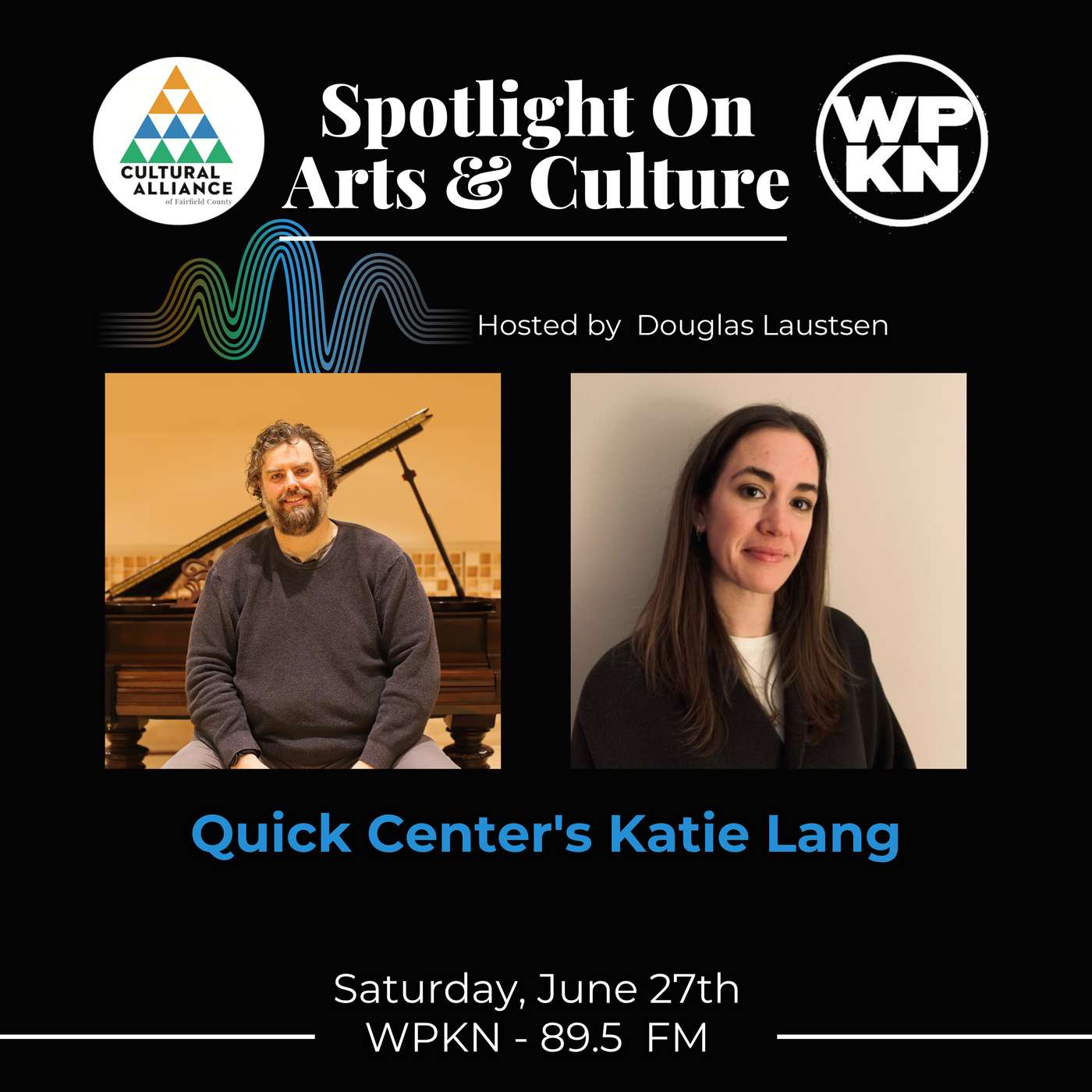
Spotlight on... The Quick Center's Arts For All Program
24m 27s
Katie Lang, Manager of Engagement Initiatives at the Quick Center for the Arts at Fairfield University, shares insights into the center’s transformative Arts for All Program, designed to expand access to the arts for marginalized and underserved youth across Fairfield County. The program features diverse initiatives such as school-based workshops, a three-year music partnership with the Regional Center for the Arts, and a year-long circus program for youth in a juvenile detention center—where the focus on movement, risk-taking, and social emotional learning fosters self-worth and engagement. Artists are carefully selected and trained, with some having personal ties to incarceration, ensuring cultural relevance and empathy. The work is deeply rooted in Jesuit values of social justice and holistic education, recognizing the arts as essential to mind, body, and soul. Lang emphasizes the importance of consistency, community listening, and creating meaningful connections between classroom learning and live performance experiences at the Quick Center. A key goal is to close the access gap by bringing artists into classrooms and students into performance spaces, ensuring that residents of Fairfield County experience world-class arts within their own communities. The program also seeks expanded funding and volunteer support, including local artists and grant writers, to grow and sustain these vital initiatives. Ultimately, the work reflects a powerful vision: that every individual—especially those historically excluded—has a right and a place to tell their story through the arts.
Welcome to Spotlight on Arts and Culture from the Cultural Alliance of Fairfield County.
This is the second episode of our new season.
I'm your host, Douglas Lostin, the Executive Director for the Cultural Alliance.
On this show, we put a spotlight on the many amazing individuals and organizations we're
making the cultural landscape of Fairfield County vibrant.
Today, we're going to hear from Katie Lang, the Manager of Engagement Initiatives for
the Quick Center for the Arts at Fairfield University, where we'll be focusing on their
Arts for All Program.
As you'll hear, I was very impressed by their ability to build deep relationships with
the people they're working with, the ways they use the arts to support youth development,
and the way they're building bridges across these subcommunities that make up Fairfield County.
This method of engagement is not easy or glamorous, but it is incredibly important.
I want to thank Katie for taking the time to share about the work.
Before we get into that, I want to let you know that you can find out more information
about us at www.culturalaliancefc.org.
Here you can take a look at our FC Buzz Events calendar, learn about our work, and much,
much more.
If this is your first time listening to the podcast, you can subscribe at cafc.transistor.fm.
And now, let's join Katie Lang.
I'm joined here now with Katie Lang from the Quick Center for the Arts at Fairfield University.
Thank you for joining me today.
Thank you for having me.
Can you tell us a little bit about your background and how you got to the quick?
Yep.
It goes way back to my childhood.
I'm a child of the performing arts.
My parents were huge patrons of the arts, so I grew up doing choir playing the Obo, but
my tune with Star Wars Dance.
And I was really fortunate enough to have an incredible teacher, and she was the head
of education at New York City Center.
So she would take the train out, teach us contemporary dance, but also bring us into
the city in which I was really blown away by what I was able to view, see, and it kind
of cracked my heart and mind wide open as it relates to all the different voices and
excellency of humans telling their story for me, Arts.
But also how important it is that people have that access, not just the people who can
afford it, people have the opportunity, time.
So her role there was bringing the arts into all public schools throughout Fiberos, New
York City.
So that's where I really got a taste of how important access is.
And with that, I was looking to go to college for dance.
And also with a focus on reaching out to the community.
So I was accepted to the most incredible dance program at Arizona State University, and
one of the reasons why I wanted to go there with working with incredible artists, but also
their repertoire theater was based on a commitment to the community.
So we would go out, we would go out into the community, we worked with two schools.
One was primarily a magnet school for immigrant children, and at that time, it's no longer
Phoenix, actually had a school system for the unhoused.
So we would go in and using improvisational techniques and kind of contemporary dance,
building stories, their stories to perform their stories.
And that's the type of work I focused on.
And so as a dance studies major, you know, and my focus was on community building through
the performance.
So, and that's been my north star, my goal, my heart's work, because I felt almost embarrassed
that I had so much access and so much support for my family to go out and do this work.
And when I came to the quick, Laurie Jones, that's her heart work too.
And she came through it through a different way.
She grew up not having access, and the only access she had was because her dad was a
fan teacher.
And the arts transformed her life too.
So now we're in this, you know, community, Fairfield University sits in Fairfield, Connecticut
where access is high, even in the public school system, my children receive an enormous
amount of access to all the arts.
And then I'm sitting, you know, a mile away from a city that has no access.
And as a mother, I just, it's, it's incredible to me that these two communities can sit side
by side. So it's been really exciting to come to the quick and not only have these high
caliber artists, high caliber lectures, that voice, all the voices within the community,
some that are heard, some that are not heard, and so we're excited to bring it to the whole.
But alongside these high caliber performance, also bring access to the arts to the community
around us.
And through the quick center, which most people know as a presenting institution, what are
some examples of how you are doing that in the broader community, providing the arts
role?
Absolutely.
So there's all these different veins in which we provide opportunity.
The low hanging fruit is almost all of our performers.
We write into the contract that they need to do one to two educational workshops within
schools.
And so working with the Bridgeport Public School system, we try to figure out what's that
best, what would be the best class to do a workshop.
So it could be a lecture demonstration.
We had some incredible chamber musicians that would do a lecture demonstration to a music
class.
We also have dancers just do a movement workshop within the class.
Theater makers, doing writing workshops, those type of experience, and those are kind
of the one-offs.
But it's also important for us not to have just one-offs, to have consistency.
So we have two long term programs.
One is with the Regional Center for the Arts.
That's a school that's located in Trumball in the quarter of Bridgeport.
We do one-offs with them, but we're also doing a three-year music program with them in
which each year we bring a high caliber musician to work with the music department.
But more so to see how these artistic experiences provide them opportunities to grow and be
college educated.
And the one that's close to my heart is with the juvenile detention center.
We are doing a year-long circus programs.
We did with the boys who are sentenced the longest.
So they're in there for about 16 months and we go in every other week to do circus programming.
We also provide camp experiences for them because within the juvenile detention center
Bridgeport Public School is their education.
But when they go on break, they're kind of scrambling for programming just to keep the
boys engaged.
So we do spring breaks with them and summer breaks with them again with circus.
And the reason why we picked circus is that we did these kind of one-offs with them and
we really found that they enjoyed circus because they're children and they get to move,
they get to be silly.
It's also kind of high risk so they're able to take these risks and fail in a very comforting
manner.
And you know, these boys are quite physically talented.
So it's a way for them to, you know, doing something out of their comfort zone but still
feel pride within doing it.
It's really interesting and so you're providing them a camp experience in this center.
What sort of, you know, preparation have you gone through with the teacher and artist
that are doing these programs with them?
Because it is a very unique experience for any artist to go through on many different
levels.
Exactly.
So we'll have certain artists, so we started actually with not circus.
It was two musicians who were previously incarcerated.
So that was a natural fit because they had been in that, they had been in juvenile so that
was just easy for us to do like a low-hanging fruit.
Again with another musician, she does work in particular with incursorated population.
With circus artists, the one-offs, again because of the nature of their art form, they're
kind of like, "I'll do anything," you know, and then because the type of circus that
Laurie who runs the Quick Center programs is high caliber and high risk.
So they're generally open to it just because they're natural and I don't want to say it's
risky.
I want to be very careful with that.
They're just more open to every type of experience.
But the local circus artist that we have in there on a daily basis, she actually has
her master's in type of social emotional learning.
So a lot of her work is social justice driven.
She, at one point, had a stint in juvenile attention.
So she is there, yes, to teach circus skills, but it rooted within social emotional learning.
And yeah, the vulnerability that circus work has both in the physical sense of like, even
someone just being on stilts and like the risk there, but also the vulnerability of putting
yourself out there, one's itself, I think, really well to social emotional learning that
some arts might not work, if just in a different lens, right?
And also on the flip side, a large part of the work that I do and try to develop the relationships
is just listening.
And so. um. There's an amazing, I mean, everyone inside of that detention center truly is there for those
children. While it does feel upsetting because you see these children and they have to be separated,
they have very strict rules. They're also supported by amazing teachers. Mrs. Nolan, their English
teacher is just incredible with them. Their principal, Katisha Howard is again just incredible,
then also all the guards have quite a close relationship with these boys. And even the program
coordinators, Sammy and Melissa, all the whole crew, it's quite incredible. I'm also, so that being
said, I'm also like, what do you need? So one thing that was important to them is they wanted a
Christmas concert. And so we have a huge glee club on campus. And so every year, too, like I'll go
to the glee club and saying kind of talk through what they're going to walk into, what they're going
to experience. But also just, they just sing Christmas music to them, because again, they're just
children. And then the program coordinators will provide cookies. So it's also those little things,
yeah, so I just try to listen to like, what do you need? So right now they need an art therapist.
I'm trying to find an art therapist locally for them because the visual arts is something that they're
lacking too in that space. And for the youth in the program, do you have any stories about
how some of the youth were impacted by this and what benefits they experienced?
Absolutely. Well, actually, it's funny. Our last class is next Wednesday. And I kind of,
I'm going to have kind of more pointed because it's hard to get funding. And so we're trying to
do that storybuilding, but I think it's, it's taking them out of their day. A lot of them
are dealing with mental issues, ADHD. And this is something that takes them out of their regular
programming and allowing them to be a kid and then to work on these skills. And then also to
find pride. Every time one of their, either the person who oversees them all or a new guard walks
into the space, they immediately walk over. But hey, look at what I'm doing. Like, can you do it?
And then we also try to provide them teaching moments. So a new guard will come in and then we'll say,
hey, XYZ, why don't you show them how to do the Diablo? You know, like how do you pick it up?
You know, do you want to get on the hoverboard? So it's really a moment of you're doing something
incredible. And they feel it and you can see it. Sometimes we ask reflections, you know, and they
said, you know, this really got me out of my head. I was having really bad day and it's turned it
around. You know, but they're also 14 year old, 13 year old, they have to know boys. They can be
cranky. They can, you know, as a mother of a 14 year old boy, sometimes it's like pulling tea,
you know, to try to start getting them engaged. But once we get loose, we get going. You can see
that pride come to them. And for any of the teachers that you worked with in the program,
were they surprised by any parts of the experience? Yes. For example, sometimes they'll just come out,
like the internal dialogue comes out in those moments. When we had, again, there was this project
we've been working with, again, with an incarcerated woman who now does music within
jails across the country, when she came and told her story, the inner dialogue about how they feel
and what they are impassioned and how they want to write was like, wow, I've never even seen
that boy talk as much. Or, you know, and just even not even within the juvenile detention center,
like I said, we've brought this group owls to, and there are this contemporary chamber music
to a middle school music classroom. The teacher came over to me and she's like, I have never seen
that student talk as much in that whole time that she's been here than what she did.
Again, I think introducing new concepts, new people at the very highest level
is really incredible for these individuals who don't see it on a day to day basis and it sparks
something within their identity or their personhood, which is why I'm so impassioned about the
performance. There are so many people, both who are arts workers and people who are not, who
will come up to me and speak fondly about an experience similar to what you're providing in any
of these contexts. And it's incredible how deep these opportunities can go when
structured in the right way and when artists are prepared for it and know how to
occupy that space. Yes. Because they are youth, they are sometimes cranky 13-year-olds or cranky
eight-year-olds. Exactly. But these experiences that are just even just one-off can be much more
than transactional or much more than a blip. They can have really lasting impressions and
turn people into lifelong lovers or lifelong practitioners of the arts. And this program I gather
has grown over the years and have been involved. Do you see any future plans for this work or
are you looking to do it in different places? Are you looking to do in different ways or go deeper
again? I have to give credit. So when Laurie Jones came to the Quick Center, there was no
really educational work. So shout out to Laurie for growing it and over the past 12 years it's
really grown. And we're both quite ambitious because this is we believe where the work really lies.
And so yes, we would like to bring as many artistic experiences, both short term and long term
to as many people who need it as possible. I think what's been really great the past few years
is that I have the bandwidth to build and debuts on the grounds. Laurie has the passion,
along with our great development officer Marie-Lar, they have been really able to secure and grow
the funding for it. And there's a real appetite for people to actually fund this work as well.
I think we all wake up and there's just so much bad news all the time and this is where some of
our funders really feel like they can do the small change locally. So yes, we want to grow our
relationship within, Rachel Center for the Arts for this long-term planning. We want to definitely
keep engaged with the juvenile detention center. What are other art programs we can bring to them?
We would love to bring things like improvisation acting to them because again that helps thinking
on your feet and then in that moment can you make a good choice versus that unfortunate choice.
Again, they're looking for visual arts. I'm trying to make those connections within the community
and again just bringing as many artists to as many people when they come visit us at the quick.
And another thing we've learned these past two years is just access to the quick,
you know, closing that loop. It'd be amazing to bring the artists into the classroom but then
bring the artists to the quick, bring the students to the quick center. So we realize that is a bus.
A bus is $165. So again, really trying to grow donors because for a lot of people in Fairfield
County, $165 is a night out for them. So imagine what you can do, bringing those children,
having that experience within the classroom and then seeing these humans do incredible,
incredible things on the stage and knowing that you belong in that theater, you belong in that
theater too. So I think that's really important because, you know, there's a perception.
I imagine there are a lot of art field trips that are still focused on going down into the city
because we are so close to the city. But there's truly world, you know, world class defining art
happening, you know, it's happening right here. And it's something that students, if they are
living in Fairfield, living in Bridgeport, living anywhere within this county, need to have that
experience and realize that these things are also happening right in their backyard. And it is a
thing they can go do when they become a ticket buying audience member, recognizing that that is
something that exists in our community. And that's also one thing we're really conscious of.
I mean, anytime I want to see an artistic experience in New York City, I'm like, oh my god,
those tickets are so expensive. So for us, we keep fighting to have reasonable ticket prices. And
that is the commitment Fairfield University has to the Quick Center to help us subsidize so that these
experiences are for the whole community, not just for the ones with means. I think it's really admirable
that Fairfield University is doing this. I think I just want to drill down a little bit more into
why they have this whole holistic view of the programming arts and education and they are
channeling it through the Quick Center. Why is this something now?
at the university values, your team
in the broader university as well.
- So Fairfield University is a Jesuit education.
And so the Jesuit's belief is in social justice education.
It means providing education for the whole body.
So that means performing arts, the visual arts,
a liberal arts education is vital to your mind, body, and soul.
And so it's been, as a person who's not religious anymore,
it's been incredible to see the Jesuit mission and commitment.
We often hear from the Jesuit priests
that one of God's greatest gifts he has given
is the gift of creativity.
And it's really about connecting everyone,
and everyone matters.
Everyone in this community matters.
And so it's a perfect alignment with the performing arts
because it's a place for everybody to tell their story,
their path and their commitment.
So it's interesting.
I serve on a board of New England Arts presenters,
which is presenters within New England.
And so many of them, whether at a university
or just a nonprofit community theater
is struggling with universities saying no,
lack of funding, and yet we're here at this special time
where the universe is actually investing in the arts.
So it feels a very weird bubble special time.
So we feel lucky.
- And just to say like,
I am glad that you exist in our community.
- Thank you.
- And that you all are seeing that Jesuit mission
can be applied to working with these youth
who are often not in the spotlight
and are often left behind in various ways
and that you're giving them these opportunities
to have pride, to be kids, so they're still kids.
And find ways for them to learn how to express themselves
in responsible ways.
And so really want to thank you for everything you are all doing.
And for someone who is also moved by this,
is there a way they can get involved,
a way they can support the work?
- Yes, so again, if you have a talent and a need,
we're also looking for more local artists
so we can provide more consistent opportunities
with all of our community partners.
And again, if you would like to donate no gift is too small.
We have a section for arts for all on our website,
quickcenter, you can just type in quickcenter.com,
arts for all and you'll find the webpage there.
Or just if you are also know of opportunities for funding.
So if you are a great grant writer,
if you can research where to find those resources for us,
we welcome any type of help in any area
you can touch with helping that.
- Thank you.
- Thank you.
(upbeat music)
- Thanks again to Katie Lang,
Manager of Engagement Initiatives
for the Quick Center for the Arts at Fairfield University,
discussing the Arts for All Program.
You can find out more at quickcenter.fairfield.edu.
Spotlight on Arts and Culture is a podcast partnership
with WPKN, 89.5 FM in Bridgeport.
Streaming online at WPKN.org and via our free listening apps.
The on-air version of the show currently airs
the fourth Saturday of every month at 7 a.m.,
if you're along the Gold Coast.
That's all for today, Save Our Credits.
Our team includes myself, Douglas Loston, the executive director,
Merissa Govin, our administrative assistant,
our incredible board of directors
and over 300 members who make Fairfield County
a wonderful place to live and explore.
The music you have been hearing underneath my voice
is performed by Darwin Shen,
recently recognized as Fairfield County's
most voracious foodie.
To learn more about the Arts and Culture
within Fairfield County,
please visit culturalaliancefc.org
and to subscribe to this podcast,
head to cafc.transistor.fm.
Thanks for listening.
Podcast Summary
Key Points:
Katie Lang, Manager of Engagement Initiatives at the Quick Center for the Arts, leads community-based arts programs focused on youth development and inclusive access to the arts.
The Quick Center’s Arts for All Program includes educational workshops, long-term music and circus programs for students in public schools and a juvenile detention center, emphasizing emotional growth and cultural connection.
The initiative is grounded in Jesuit values of social justice and holistic education, fostering pride, self-expression, and community belonging among underserved youth through accessible, artist-led experiences.
Summary:
Katie Lang, Manager of Engagement Initiatives at the Quick Center for the Arts at Fairfield University, shares insights into the center’s transformative Arts for All Program, designed to expand access to the arts for marginalized and underserved youth across Fairfield County. The program features diverse initiatives such as school-based workshops, a three-year music partnership with the Regional Center for the Arts, and a year-long circus program for youth in a juvenile detention center—where the focus on movement, risk-taking, and social emotional learning fosters self-worth and engagement. Artists are carefully selected and trained, with some having personal ties to incarceration, ensuring cultural relevance and empathy.
The work is deeply rooted in Jesuit values of social justice and holistic education, recognizing the arts as essential to mind, body, and soul. Lang emphasizes the importance of consistency, community listening, and creating meaningful connections between classroom learning and live performance experiences at the Quick Center. A key goal is to close the access gap by bringing artists into classrooms and students into performance spaces, ensuring that residents of Fairfield County experience world-class arts within their own communities.
The program also seeks expanded funding and volunteer support, including local artists and grant writers, to grow and sustain these vital initiatives. Ultimately, the work reflects a powerful vision: that every individual—especially those historically excluded—has a right and a place to tell their story through the arts.
FAQs
The Arts for All Program provides accessible, community-based arts experiences for underserved populations, including students in public schools and juvenile detention centers, through workshops, long-term programs, and circus-based activities.
The center runs a year-long circus program for youth in the detention center, offering weekly sessions and summer camps to build confidence, physical skills, and emotional resilience in a safe, joyful environment.
They provide diverse workshops including music lectures, movement classes, theater writing sessions, and dance demonstrations tailored to specific grade levels and student needs.
Artists are trained in social-emotional learning and community engagement, with some having personal experience with incarceration or marginalized communities, ensuring culturally responsive and sensitive programming.
It bridges access gaps by bringing high-quality, world-class arts experiences to students and communities that may not otherwise have access, fostering inclusion, pride, and lifelong engagement with the arts.
As a Jesuit institution, Fairfield University emphasizes social justice and holistic education, providing financial support to subsidize affordable ticket prices and ensure arts experiences are accessible to all community members.
Chat with AI
Loading...
Pro features
Go deeper with this episode
Unlock creator-grade tools that turn any transcript into show notes and subtitle files.
 PodcastTranscript AI