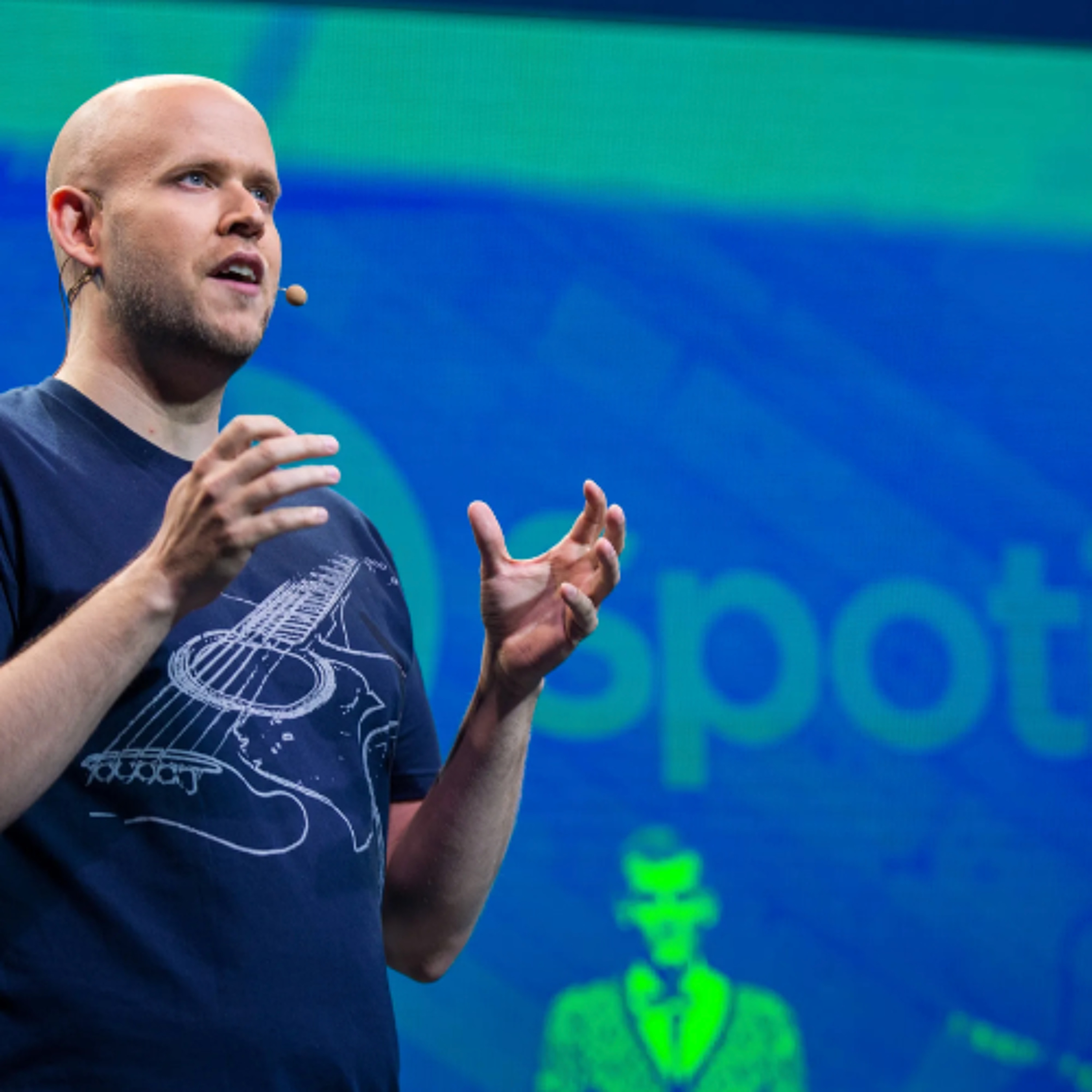
The podcast episode examines the history and impact of Spotify, challenging the origin myth promoted by its founders, Daniel Ek and Martin Lorentzon. While portrayed as music-loving saviors of the industry from piracy, their backgrounds were in ad tech, and the choice to stream music was partly driven by lower costs compared to video. Spotify's launch was enabled not by disrupting major labels but through licensing deals that gave labels significant equity and control. The discussion highlights how Spotify's practices, like using low-royalty stock music and payola-like "Discovery Mode," prioritize profit over fair artist compensation. Furthermore, the platform's data-driven model is criticized for degrading listener habits and undermining musical culture and community. The conversation situates Spotify's emergence within Sweden's specific context of high piracy and strong social welfare systems, which provided a testing ground. Ultimately, the episode critiques Spotify's role in the music ecosystem and explores growing resistance from artists and listeners seeking alternatives.
(upbeat music) - Hello and welcome to another episode of Politics, Theory, Other. My name is Alex Doherty and my guest today is Liz Pelley. In 2006, the Music Streaming Service Spotify founded by Swedish entrepreneurs Daniel Ek and Martin Lorenzon was launched in the context of widespread music piracy and file sharing and declining profits for the music majors. Presenting themselves first and foremost as music fans who were intent on saving the music industry and creating a seamless listener experience for users, Spotify has since gone on to become the dominant music streaming platform, fire-oclipsing any of its rivals and making Ek and Lorenz on billionaires. While initially lauded by the music press and tech media, Spotify's reputation has significantly declined as understanding of how little most musicians receive from streaming has become more widespread and as Spotify has courted controversy by populating some of its playlists with so-called perfect fit content. Stock music produced for Spotify in order to reduce the amount of royalties the company pays to rights holders and by introducing discovery mode, a program that increases the prominence of artists tracks on Spotify playlists in return for a reduced royalty rate. What many critics have described as a modern-day version of the Payola radio scandals. My guest today, Liz Pelley has done more than most to bring to light practices such as these and to challenge the myth-making that Spotify's founders have engaged in in order to portray the company as being on the side of musicians and music fans. We spoke about the early years of Spotify as it emerged in the context of mass file sharing and as the major music labels were coming to see Sweden as a lost market, making it ripe as a site for experimentation with streaming. We went on to talk about how Spotify is shaping the user habits of listeners and about the damaging consequences of data-facation of music, both for listeners and for musicians. Finally, we chatted about the inspiring efforts to challenge the dominance of Spotify that have emerged in recent years as both musicians and listeners seek to find ways to create music communities and to preserve and curate music history. Practices that Spotify's dominance has severely eroded. If you find today's interview useful, then please consider becoming a five-pound patron of the podcast. The show depends entirely upon listener support and as well as keeping PTO going. You'll also get access to bonus content such as the recent listener questions episode with Richard Seymour. You can support the show in pounds or whatever your local currency happens to be and you can pledge any amount you choose. Go to patreon.com/polthereother to sign up. Liz Pelle is a journalist living in New York. Her essays and reporting have appeared in the baffler where she is a contributing editor, as well as in NPR, Rolling Stone and Pitchfork, amongst other outlets. Liz teaches in the recorded music program at New York University and is also the co-host of the podcast Critical Listening, build as sharp takes on music technology and culture industry hell. Her book, "Mood Machine," the rise of Spotify and the cost of the perfect playlist was published earlier this year. (upbeat music) So Liz, we're speaking only a week or so after the announcement was made that Daniel Eck, one of the two co-founders of Spotify along with Martin Lawrence on, is standing down as the CEO of the company. And so this is perhaps a particularly good moment to consider the history of Spotify founded back in 2006 and which has since made "Eck and Lawrence" and "Billionaires" many times over. And you write in the introduction to your book that in my writing and reporting, I've been driven by a deep impulse toward demystification towards shedding light on the inner workings of streaming companies and debunking the myths they perpetuate. Now, "Mithmaking" and a pretty economical approach to the truth is something that Spotify's founders have indulged in throughout the course of the company's existence. And you show in the book how that includes the stories that Eck and Lawrence and have told about the genesis of Spotify. And one of those stories is that they were music fans first of foremost and that they were on this mission to rescue the music industry at a time when piracy was perceived to be threatening the livelihoods of musicians and the bottom lines with the major record labels perhaps a bit more pertinently. We'll talk a bit about the significance of piracy and especially in Sweden to the history of Spotify in a moment. But first, can you say a bit about what we know about Eck and Lawrence's relationship to music and why we should be a bit skeptical about their claims about wanting to save the music industry in the early 2000s? - Yeah, I think something that is important to remember is that both Eck and Lawrence's backgrounds before starting Spotify were in advertising. They worked in ad tech. They met when Daniel Eck pitched Martin Lawrence in an idea for a ad tech product that he unsuccessfully pitched to him. I think that's important because they have kind of done some PR work over the years, especially in the early years to brand themselves as music lovers and to talk about especially with Eck to talk about his relationship with music growing up. And one thing that I did when I was reporting the book was I went to Sweden to try to do some interviews. And in addition to, on the one occasion, when I was able to track down a source who had grown up on the same block as Daniel Eck to ask if he remembered him being a particularly musical child and this person saying to me, no, I remember him being into computers, actually. I also asked people with information about how public education and especially access to public music education works in Sweden. Some questions about Daniel Eck's claims to being interested in music as a kid and something that I heard a few times was, yeah, well, you know, it wouldn't have been unusual for anyone growing up where he grew up to have access to like robust music education as a young person or for music to be part of your lives because many people growing up where he grew up had access to that type of public music education. - Yeah, I mean, that's an interesting point. That isn't it because I suppose Spotify in some ways is such an emblematic product of the neoliberal tech platform era, but clearly, Eck was a beneficiary of Swedish social democracy, right? - Yeah, there's some interesting examples of that too, kind of like woven through this book, both in terms of like the type of public music education that exists in Sweden and how that has impacted the music industry there, perhaps even influenced the music tech industry there. Also, the way in which access to the internet was treated as a public good a bit earlier than, well, some parts of the world has never been treated as a public good, but, you know, early on and maybe, you know, that's part of the reason why Piracy was so rampant there because of public broadband, even other examples to like, you know, Spotify's a company that really prides itself on the benefits that it offers to employees like a really good parental leave program and some of the Swedish sources who I interviewed for the book told me, yeah, you know, well, that's like very standard and Sweden and all those Spotify's are really anti-labor company. It's like thanks to the Swedish labor movement that that is something that they basically have to offer their employees. - And just going back to that point about the decision to focus on music streaming, is it right to say that that was really driven by the perception, if not necessarily the reality that this would be cheaper than doing video content or going into the space of something like a Netflix that the music was a cheaper option? - Yeah, so if you look at some of the early patents or Spotify or even uni-reviews with the executives from early on in the company's history, it's pretty clear that when Eck and Lawrence and were developing this idea that eventually became Spotify, it was an idea for a product that would, you know, deliver a streamable library of media, you know, free streaming media and then the business model would be ads. So it was like, you'd have access to the free media and then it would, the business model, the revenue source would be advertising 'cause that's their background was. But these early patents and these early interviews reveal that it wasn't necessarily given that the media would be music. You know, there's even this early interview with Martin Lawrence and where he says, we knew the revenue source should be advertising because that was my background, but we weren't sure what the traffic source was going to be. Would it be music, would it be film, would it be product search, would it be audio books? So I think in the early years, Spotify was kind of this, idea for an ad tech product, sort of like in search of a consumer base, or in search of like a type of media that it would provide. And on one hand, I think the weak status of the music business and Sweden in particular because of how popular piracy was there, probably presented itself as a kind of interesting business opportunity to them. And then, you know, some of this interviews with early employees also seem to suggest that maybe the reason why they were interested in music was because of the file size on the idea that just getting a beta product off the ground for a music streaming service would be easier than like a video streaming service, for example. - On the topic of file size, I don't think it's something that's mentioned in the book, but it occurred to me when I was thinking around what you're describing in terms of Echin Lorenzon's self-patrial as music fans and being preoccupied with providing the best kind of listening experience possible is that until earlier this year, and in contrast to a lot of other streaming services, Spotify didn't offer a high resolution audio version of the platform. And so since 2006, and, you know, for virtually the entirety of the company's existence, they've been serving up worse than CD audio quality to their listeners, which seems peculiar behavior, right? If, you know, music is their priority. As I say, it's not particularly in the book, but I just wonder if that's something that you thought about as well. - Yeah, it's something that I've thought about. I think it just demonstrates the commitment to cost saving, or maybe just the extent to which music really is not a priority for this company, especially in recent years, you know, with the entry into the podcast marketplace and audio books, right now they seem really focused on video. I think it kind of shows the feeling about music to this company, yeah. So yeah, I would attribute it to cost probably. - Another aspect of Echin Lawrentson's myth making regarding those early years of the company is in their description of themselves as disruptors as being people who were subverting what was business as usual. I mean, at one point in the book, he quotes Eck, you know, rather laughably describing himself in Lawrentson as punks. And if not always saying it out loud, they certainly gave the impression that the company's streaming service was fundamentally on the side of music fans and kind of in opposition to the major record labels of the era, who were widely and accurately perceived have engaged in price gouging in the pre-streaming era. I sort of imagine that anyone who's unfamiliar with the history might assume that following Spotify's emergence as this first genuinely successful streaming company that the major labels only then and only very reluctantly adjusted to this new world of streaming audio. But you show in the book that the story of the relationship between Spotify and the music majors is much more complicated and ambiguous than that. So can you talk about the roles of the three major labels, Warner Music Group, Sony Music Entertainment and the Universal Music Group in the emergence of Spotify and music streaming more generally? - Yeah, and is it interesting relationship to look at because even now I think a question that sometimes comes up is this question of who really holds the power in the music business, is it the major record labels or is it the tech company is? And I think that there's arguments on both sides or different ways that you look at it. The truth is that both the major labels and the tech companies have way too much power and influence over the music industry for all types of artists. But yeah, so for in order for a company like Spotify to exist or in order for a music streaming app where you open your phone can think of any song from across the history of popular recorded music, type it in, hit play and it to just start instantly streaming. Like for that whole arrangement to even be possible requires that streaming companies strike licensing deals with the rights holders who own the rights to the music. So the people who own the copyrights or are in control of them. So Sony Universal and Warner own the rights to 70% of the recorded music market. So that puts them in an incredible negotiating position when it comes to hashing out these licensing deals with streaming companies and all sorts of tech companies that they might be licensing their music to. In the case of Spotify, that meant that when they were working on their first products, their first version of the app, they had to sign these deals with Sony Universal and Warner. And the major labels were able to get for themselves, things like these really big advances, contractual influence over how the platforms evolved and they also got equity in the company. So when Spotify launched, it was almost 18% owned by the three major labels. And it wasn't just the major labels to the Merlin network. So Merlin is this independent. Yeah, that represents thousands of independent record labels and they also had a much smaller but not insignificant equity stake in Spotify. And would it be your sense that the role of the majors at the time of Spotify's launch when they owned 18% of the company? Do you think that was very little understood at the time? And that Spotify was seen more in the lineage of piracy and of Napster and that sort of thing? It's not that like it wasn't public information because digging back into the music press and music business press from around the time, like, you know, there are articles that can be dug up announcing these license deals and things like that. But in terms of the average music consumer, even like the average independent musician or independent record label perspective, I think that there was just speaking to artists and labels who experienced the shift to streaming firsthand. It definitely seems like there were some gaps in understanding and information that people had at the time. I think that, you know, because even for independent record labels, the hit from the era of piracy had been so stark and like definitely lots of different perspectives from all different sides on the impact of file sharing or piracy or the free circulation of music in the late 90s or early 2000s. Like opinion is sort of remains split on the cultural impact of that time period on music. But yeah, even some independent record labels, you know, reported that being really financially devastating. So I think there was kind of like a willingness to sort of experiment with whatever potential possibilities could contribute to the financial sustainability of even the independent music ecosystem. Something that was really interesting to the story of why the major record labels were interested in streaming is something that at least in the music business press and like different books that have been written over the years had sort of been charted out. Like obviously the major labels were interested in streaming. They owned a significant percentage to these companies and the major labels had actually all tried to start their own streaming companies for years before Spotify arrived. There was definitely extent to which the entire streaming model was really like designed by the major labels in partnership with these tech companies. But the question of like, why did independent labels embrace this model and why did independent artists agree to sign up for this system that really wasn't built for them? That was something that I really wanted to explore in the book to try to offer an independent music perspective on this because I feel like oftentimes the perspectives and independent musicians and the independent music community, whatever that might mean. It's also like a very kind of a word that hit in some ways to many feels increasingly meaningless because it means so many different things. But that I mean like non-major label music essentially. So that was something I tried to like chart out in the book and something that came up that was really interesting was this idea that in the mid 2000s, independent record labels, especially the bigger independent record labels really kind of like prided themselves to being more open to new technologies in a way that the major labels weren't. They kind of saw the major labels as these really sort of archaic, like duck in the past sort of entities and the major. Yeah, they just wanted to keep us buying CDs and they were happy with the status quo and that kind of narrative. Yeah, totally. And like in the era where you know, there was still some more techno optimism or this idea that the platform. Yeah, you know, like this idea that the platform economy was actually potentially going to like democratize culture and so that artists would be able to have these more like direct lines of communication with their audiences and sell their music directly. Like there was some more optimism about, you know, what was possible and this was also like the era of the music blog boom where there is, you know, the free circulation of music in the post-pires era was sort of like leading to a lot of grassroots enthusiasm around like sharing and writing about music and it was just a really different music media ecosystem and I don't know if many people in the independent music world really had the ability to predict how negatively streaming would suck energy out of that more grassroots ecosystem that was brewing online. Yes, yes, and I suppose it wasn't necessarily inevitable things went the way they did and that was in some way just a reflection of the bounce forces at the time. Just going back to Sweden. So the fact that Spotify merges in Sweden, you're explaining the book that that's absolutely not an accident and that Sweden was particularly first our ground for experimenting with streaming and it was an environment where the music majors were more sanguine about engaging in that than they might have been in other territories in particular the United States where copyright law is particularly fierce. Could you expand on that a little bit? Yeah, and I have to shout out to the Swedish journalists and academics and musicians who I interviewed from a book about this who were really helpful and sort of piecing together the Swedish context for the emergence of Spotify in Sweden. So in Sweden, there was the Pirate Bay. So by the time that the Pirate Bay file sharing site popped up, the music business had already spent years trying to like stamp out Napster and Kazan all these other file sharing, line wire, all these other file sharing sites. I've never heard of them. I've certainly never used them. I did. I'm so reason why I am a lifelong music person. Because of being introduced to a lot of music that I would have never heard of from Napster. But yeah, it wasn't just that file sharing was incredibly popular there that it remained popular at a time when like the music business had already spent so many years trying to stamp out Napster. But it also was politicized in a different way. So there was a Pirate Party in Sweden so like a political party that was kind of built around an agenda of advancing piracy as something that was positive for society. And I think that maybe because of the social, political and economic conditions of a country like Sweden, there also seems to just be like a different kind of understanding of the impact of piracy on culture. And it seems like even lawmakers were kind of considering this perspective of like, oh, well, maybe it isn't necessarily like automatically a net bad for society that there is more free circulation of music and there's something that was like playing out and debated publicly in a different way. So because of the sort of like persistence of the piracy culture, according to sources I interviewed from my book, The Music Business started to perceive Sweden as being a lost market. They would never be able to sell music to people in Sweden again. - So you have to do something else. - Yeah, and so one of the sources I interviewed from my book, This Person, Rasmussen Fleischer, the writer and one of the co-authors of this book, Spotify, Tare Down. He also was part of this group called Pirate Baron which means the Bureau of Piracy and different people from that group went on to form the Pirate Bay. But something that I thought was really interesting is like Pirate Baron was this kind of lobbying group that popped up in response to the anti-Pirate Baron, anti-Piracy Bureau. And there's actually, they were kind of like a public lobbying group when they were like, okay, if there's an anti-Piracy lobbying group in Sweden, we're the Pirate lobbying group. Like we're anti-Pirate Baron, okay, we're just Pirate Baron. And I thought that was like so interesting and telling of the environment there for piracy culture. And something else that I also lately have been really reflecting on too is just how the extent to which like the music business and the film industry even really just normalize this idea of even thinking of the free circulation of music as piracy and how that's a very kind of political decision to refer to it as piracy instead of file sharing. - Yeah, or decommodification of some sort. Which obviously would need to go along with ensuring that musicians were remunerated, but yeah. - Yeah, yeah, absolutely. I just think like even today, there's lots of different reasons why artists might choose to freely share their music. And I think it kind of comes down to like, yeah, issues of some of the similar issues of consent that we hear being discussed in the context of AI now. And like you mentioned, it's also really connected to the need for a stronger music labor movement. Yeah, lots of interesting similarities to issues that artists are still contending with today. - Just on the pirate bay. I mean, is it correct to say that initially Spotify was actually populated with pirated tracks that they'd taken from sources like the pirate bay and that those tracks remained on Spotify the years after the launch? - Yeah, it's interesting. So this point that yes, Spotify's beta product was built with the tracks that the people working at Spotify had on their computers. Oftentimes pirated tracks and I think I include this in my book, but digging through music press and tech press about this at the time. It actually was the same writer who I mentioned just before Rasmus Fleischer, who saw one of his bands tracks that had only ever been on the pirate bay on Spotify. And there's like an interview at this website called Torrent Freak from around the time where he started to explain that that was how he realized that they had gotten their music from Pirate Bay that they used to build their beta product with. I think it was until 2009 that some of those tracks actually still remained on the app when they did something called the big clean where they wiped out all of the pirated tracks and made sure that it was only the tracks that they had actually licensed that were on the app. So there definitely is, yeah, that's like an interesting part of the connection. I'm not sure though that it necessarily says much about Spotify being aligned with the Pirate scene. I think that something I try to make clear in the book is that I think that Spotify tried to position itself as growing out of piracy culture when it was convenient as a marketing tactic because piracy was incredibly popular in Sweden and then tried to align itself with the music business as something that was going to solve the problem of piracy when it was selling itself to the music industry. There were some star engineers who they hired early on who came from the Pirate scene who helped build out the product. So there was a connection there. And yeah, after the book I interviewed one of the founders of Pirate Bay who talked about how in the early days, the people who are part of the piracy scene in Stockholm like thought like, oh yeah, like maybe this will be cool. There's people who work there. They're using pirated music. I think the quote in the book is but then we realized they were just advertising guys trying to figure out like how to make money off of music. - Yeah, with great success. - Yeah. - So in the third chapter of the book, you describe how the experience of using Spotify was initially centered on the search bar function and that listeners would generally just use search to find the specific artist they wanted to listen to. And of course that's how many people continue to primarily use the platform to this day. But you describe how the company then moved increasingly towards curation and the production of playlists which Spotify described as mixed tapes. And that this was because after conducting research on its users, Spotify came to recognize that there were huge numbers of people who were using music at music. That's telling, telling the state. There isn't, that there were huge numbers of people who were using music to soundtrack their daily activities, whether that be working, studying, cooking, exercising or even sleeping as you describe in the book, rather than using the platform for more focused listening. And then off the back of that research, they developed this concept that you write about of lean back listening. Can you explain what their idea of lean back listening was exactly and how its promotion then led to the prioritization of certain kinds of music over others? Yeah, and I should clarify that the streaming industry didn't necessarily invent the concept of lean back listening or passive listening or sometimes the industry calls it like functional listening. But it definitely really champions this way of thinking about the relationship with music as a way of sort of like boosting user engagement on the platform. Just to also make a connection back to something I was mentioning earlier about wanting to kind of like focus on the impact on independent music. I think something that is interesting to understand to about a company like Spotify is that in the early years, they had no problem attracting what the tech industry calls like early adopter users, but like music enthusiasts. Like their initial user base was people who were really into independent music, who were really like curious listeners, who were the kind of people who were interested in seeking out independent music. And so it was really interesting looking at some of like the early ways in which Spotify was characterized from a music press because I remember coming across this early enemy article, so like UK Music Magazine that was kind of talking about Spotify and being like, but it's not just the top 40 hits that you'll find on this. You'll also find, you know, looking for and it's your record from K Records or 4AD, like looking for that metal record that you thought you'd never be able to find any rest. Naming these kind of touch points of independent music that a deep head of independent music might be looking for. And so that was kind of like those sorts of people were, in some ways some of the early target consumers. And then at a certain point after they launched the United States in 2011 and they were trying to grow their numbers, you know, like other tech companies, like the first decade of Spotify's trajectory was really just focused on growth, trying to get as many users as possible without necessarily thinking about sustainability or profitability. They needed to move past those kind of like early adopter, voracious, curious music listening type users and think about how to reach the more mass mainstream general audience. So according to some of the, yeah, research and interviews that I did for the book, while in the early years, there was much more of a focus on search bar, less focus on curation, this shift towards more curation, towards more playlist, more personalization, was part of a general strategizing to bring more, quote unquote lean back listeners onto the platform. And like you mentioned earlier, there was at least this like one moment in 2012, where they commissioned a research agency to interview Spotify users about how they were actually using the app. And that seems to have been part of shaping the direction towards this like quote unquote music for every mood and moment direction that they started going in towards the end of 2012, early 2013. And I think in terms of defying what lean back listening is, you know, it's just kind of this kind of idea that in the streaming era, there's this new sort of music listener who has been shaped to is not necessarily using the search bar to look for an artist or an album that they might be interested in. But instead is content to just find a mood or an activity or a playlist, you know, now they could be called vibes and just like click play on it and let it roll on the background. And you know, potentially eventually shift into auto play. And you know, maybe they're just not even looking at specific mood and vibe playlists anymore, but they're just like opening Spotify and hitting play on a daily mix or like on AIDJ or something like that. Yeah, we might come back to AIDJ there in a moment. One of the sort of intriguing aspects of the effect of these chill playlists that you describe is that some musicians found that individual tracks that critics hadn't particularly cared for, that the musicians themselves had seen as, you know, of little significance, you know, an obscure B side, for instance, might suddenly appear on such a playlist and get millions of streams right because the tracking question fit that model of music that was easily digestible and that listeners would be disinclined to skip. Yeah, it's super interesting and like even talking to some artists for whom that happened, you know, this track and their discography that they would have never expected to be the runaway viral hit or whatever now is all of a sudden like the track that they are paying their rent off over something and they're like the thing that I think it reveals is that if you talk to artists like that, they'll usually just say I have no idea why this happened, you know, I've tried to figure it out. I can't get any info about, you know, it just kind of shows how I think for a lot of artists in the streaming era, something you hear is that like the ability to make any sort of living off of your music just feels like playing the lottery because there's so much power in the hands of these platforms that determine, you know, what tracks succeed and which ones get buried. And it's a lot of algorithmic mysteriousness, whether that be thinking about why a track gets added to popular Spotify playlist or why something goes viral on TikTok or Reels or like whatever. And it's just it all just reveals, you know, what we see playing out like all across the platform economy, which is these platforms have way too much power and influence over how artists are able to piece together semblance of a living. On TikTok and Instagram Reels, would it be right to say that you perceive the sort of eventual goal of the lean back listening mentality to be something like TikTok where the user is not actually choosing the content at all really. Instead, they're simply deciding whether to linger on what's being served up by the algorithm, which then of course trains the algorithm to provide you with more of the same material or to skip which deprioritizes that content and means you see less of it. Is that kind of the goal that Spotify is looking towards? Yeah, so there's a chapter in the book called self-driving music that kind of tries to sort of chart this out over the course of the platforms, you know, history to date. So in early interviews with playlist executives and strategists, you know, there's a couple of different, like, interesting connected threads that come up, like one being that Gustav Soderstrom. So the longtime head of product at Spotify, and now incoming co-CEO of the company, you know, right around the time that they went public on the stock exchange in 2018, he did this presentation. I think it was like for investors or potential shareholders or something where he talked about the Spotify goal being self-driving music. So this idea that like you could just open the app and through the power of data, the music will self-organize. They'll be able to deliver the perfect recommendation at the perfect moment every time someone opens that. That's kind of the phrase that the higher up executives use like perfect, perfect recommendation at the perfect moment every time kind of thing. But I also refer back to another early playlist strategist, Spotify, talking about how, you know, the whole goal of the app is that there's just one button and you for the user just be able to open the app, press one button. And based on data, always get the right recommendation. And I do think that those AIDJ and then also this playlist that they have called day lists, they introduce both of them kind of around the same time, they both sort of fulfill, you know, they're like, fulfill his purpose or show like how they're trying to evolve the product like in the direction of that goal. I think it has, you know, a lot of consequences, obviously for artists who just like continue to sort of be like mystified into some power in terms of the relationship with the users or fans that are interested in their music. But also, I think has consequences for listeners who are just repeatedly being nudged to care less and less about music, you know, like it's not just that of these apps make it easier to not have to think about music, which is what they do. But they're also, yeah, conditioning to people to just care less about music in some ways. And I think that kind of plays out now with what we're seeing with AI also. It's interesting. I would certainly class myself in the category of very enthusiastic music fan, but I've noticed some of these effects upon myself. I mean, I, I used into relatively recently the discover weekly part of the Spotify interface, which serves you up in you playlist every week of stuff, sort of based on your prior listening. And I have noticed that I will find things on that playlist that I, you know, I very much like and I'm sort of glad that I've come across them. And I will absolutely rinse some of those individual tracks, you know, it will occasionally provide me with something that I really, really love. And strangely, I will find that I will not then go and investigate the musician in question. I won't find out about them. I won't find out about their context. And that perhaps brings us back to AI DJ launches in 2023. I'm sort of curious. I mean, I, I don't know, you know, what your thoughts are. I sort of wonder about how many people are actually using AI DJ because it is deeply irritating to actually listen to this pretend DJ talking to you. But the way it works is that it provides listeners with an AI generated playlist, this pretend DJ talks to you between the tracks. And it does seem to really exemplify a form of listening that is highly sobsistic, where the user's own relationship to music is prioritized over learning anything about musicians or the history of particular genres. Because instead of providing historical detail and context, the DJ instead simply says things to you like, you know, these are tracks that you were really vibing with in 2020. And this kind of thing, it's all about your own history with it. So could you talk a bit more about AI DJ and also perhaps Spotify wrapped the end of year, personalized listening review that is coming up and is the biggest day in Spotify's calendar. Because both of these things seem to really foster this tendency towards preoccupation with one's own habits of listening to, you know, to the exclusion of a lot of other other context. It's interesting that you bring up AI DJ in comparison to discover weekly because I will say, you know, something that is pretty interesting is that even though I do think that discover weekly sort of played a role in kind of conditioning listeners to embrace algorithmic music recommendation and a time when maybe it wasn't as familiar to the average music, streaming user, something interesting about to discover weekly is that it did have baked into what it was was that it was recommending and is it still exists recommending users music that they hadn't heard before based on, you know, people who liked this also like this, so like people who listen to music that you listen to, there's here's someone who is mostly interested in music that you like. Here's some stuff from their catalog that you haven't heard yet. And we're only gonna show you like stuff that you've never listened to before. That is so different than something like AI DJ, which is mostly playing you stuff from your own listening history. And that is really connected to your taste profile. There's like a small moment in the book where I kind of, yeah, make this point that in like 2019, 2020 discovery on the app started to be sideline for this project of made for you playlist. And I think that at first glance, a discovery playlist versus a made for you playlist, because they're both algorithmic playlists can seem like the same thing, but they're actually super different. One is using algorithmic recommendation to try to introduce you to something that you've never heard before. And one is using algorithmic recommendation to play you stuff that you've listened to before. And that seems to be in some way like an impact of maybe like TikTok on Spotify, you know, like as TikTok was becoming really popular. And there started to be sort of more like algorithmic recommendation and using behavioral data that was, you know, even just TikTok revolving around a for you page. The the language of like made for you playlist seems to be kind of like an outgrowth of that being something that was really normalized as like a daily part of social media users routine. The AI DJ playlist or AI DJ, it's not even really a playlist, it's like a recommendation product, I guess. Because it's not presenting you with the playlist in real time, right? Yeah, so like, you know, there's no way to kind of like look at the playlist of tracks, it's really more like a recommendation taught. Like what I talked about earlier, it's like a big blue button on the app that you would just hit play on. And basically what it's doing is like, you know, the way that Spotify makes algorithmic recommendations in part is there's this layered system where there's like types of data that they collect about music, they collect data, both on like you the listener and listening patterns and your behavioral data. And then there's data about the music itself, there's like data about what music sounds like, there's what they call cultural data, that's about like how people discuss music online. So playlist titles are like a big source of training data in that type of text based data that they're using to understand music, I guess. So there's like this data. And then there's recommendation models that they use making that data. And then there's recommendation products that they make using those those models that are based on that data. So AI DJs are repackaging of recommendation models that already exist in other parts of the app for other things. So when you're listening to AI DJ, oftentimes, it'll be like, here's some tracks from your, you know, release radar playlist this week and release radar is this algorithmic playlist that exists elsewhere in the app or maybe it'll be like, here's some tracks you were listening to a lot in 2020, which like, you know, there's also this thing called repeat rewinds that they have. So it's kind of like an concept of algorithmic recommendation that exists elsewhere on the app. Or they might be like, you know, now we're going to do a deep dive into and they'll name some sort of weird made up micro genre name, where somewhere else on the app, there might be like a niche mix that you could find that recommends you music within that weird made up micro genre name that is related to your taste profile. So it's kind of like AI DJs, like this repackaging of blocks of recommendations, drawing from all these other places on the app, where they're algorithmically recommending music. And then between those blocks, this AI generated voice trained on one of their employees will say things like, you know, like, here's some tracks you're listening to a lot in 2022, I really feel like you're going to see yourself in this kind of thing, you know, and it's all about how does this block of tracks that you're about to hear like relate to you as a listener, how does it relate to your taste profile, which taste profile is the phrase that Spotify uses internally to refer to basically like all of the data that has on you as a listener and how that data is like bucketed in different ways. And that's so different than like, you know, if you turn on the radio and you are listening to a DJ, choosing tracks or playing tracks and explaining them to you, I listen to WKCR, the Columbia University radio station, my house a lot. And when you're listening to WKCR, the DJ getting on air between the tracks isn't telling you, here's how the tracks relate to you, they're telling you, here's who's playing on the track, here's what record label it's from, this is the year was made, this is who's playing on it, if it's a contemporary show, they're telling you this person's playing at Union pool this weekend, and you know, this part, you know, there's like information, and they're expressing their genuine enthusiasm as well, right, which can be infectious and charming and so on. Yeah, totally. And I think like, you know, one of the starkest differences to me between listening to the radio and listening to a DJ is that a huge part of the, from my perspective, like value that comes from listening to FM radio is listening to something that really like roots you in a sense of place. Like I mentioned, you know, listening to independent college community FM radio where I live in New York is a way of finding out about shows that are happening, like, you know, the other day I was listening to KCR and someone was talking about a track that they were playing and they were like, I just picked this up from record grounds last weekend. And they're like shouting out local record stores where they buy records and, you know, and some of this stuff is really obvious, but it also is what is lost when like, you know, their music listeners are kind of nudged in a direction to just listen to this very like placeless algorithmic feeds of nothingness. From the description of AIDJ versus discover weekly, that can perhaps make discover weekly seem a much more sort of innocent and straightforwardly positive thing. But I'm not sure if this is a phenomenon that you describe specifically regarding discover weekly, but it's something you certainly talk about regarding Spotify playlist more generally. And this is something that I, you know, having read the book and then sort of, you know, using the discover weekly function was that it's clearly serving me up with stuff that only expresses a portion of what my taste in music is, right? It's giving me more of the stuff that is like other stuff that I listen to repeatedly that stuff has, you know, strong hooks, melodically strong. It's not serving me up, you know, the equivalent of, I don't know, like the drift by Scott Walker or something. It's not a tonal. It's not difficult. It's not that in that area. And so that, yeah, seems to suggest the way in which the logic of the algorithm can be quite subtly insidious with things like discover weekly. I don't know if you have sort of further thoughts on that. Yeah, when I think of discover weekly is something that I think of as what I said earlier, it's just that I think about this moment when music listeners, internet users were sort of like conditions to embrace in some ways like a form of consumer AI in their lives for perhaps one of the first times. I mean, to me, it feels like a very early example of AI driven recommendation being positioned as because I remember years and years ago when I was writing about music streaming and I was first getting involved in kind of like the field of tech criticism, something that I would hear often when people are talking about like the consequences of algorithms, they would be like, yeah, you know, hear all of the harms of algorithms in our society. But then there's stuff like Spotify and like music recommendation algorithms, like, okay, we can agree there's some good uses of algorithms. And it's kind of like tossed away as, oh, it's just music, you know, oh, it's it's harmless kind of thing. But I do think that that whole attitude in some ways laid the path for what we're seeing now, which is this like all of these different ways in which users and people in their everyday lives are embracing different forms of algorithmic decision making AI driven decision making relying on corporate tech platforms to make decisions for them that really like aren't just tedious tasks that you want to automate out of your everyday workload, but also like these types of decisions that add a lot of meaning and value to your life, like learning about music or thinking about what music you might want to listen to on a Sunday morning when you're like drinking coffee or something, you know, maybe we don't have time to go into this. But yeah, I sort of wonder to the extent to which the playlists and things like AI DJ are also having a damaging effect on music journalism, which we know is in a bad state as it is. But you know, the people turn to the algorithms rather than people who are experts and can provide more value and, you know, when it comes to context and so on. Let's turn to one of the most notorious things Spotify has done with its playlist. So you describe how starting in 2016 some musicians started to notice the tracks that had previously been included in some of Spotify's most popular playlists were being removed and replaced with stock music, which the company referred to internally as perfect fit content or PFC. Much of it produced for Spotify by two companies in particular, Epidemic Sound and Firefly Entertainment. Can you talk about the PFC phenomenon and why Spotify started to increasingly populate its playlists with this material? So it's pretty interesting because when I started working on my book, I kind of thought that this was old news. Like in the music business for years and in the music business trade press, there had been articles reporting on like rumors that Spotify was filling its most popular playlists for studying and relaxing and, you know, sleeping with quote unquote fake artists. What wasn't known until I started kind of like digging into this was that, yeah, while the public caused these artists fake artists, Spotify actually had like an internal name for them. Like you mentioned perfect fit content. And this really is a cost-saving strategy for them. So basically, you know, Spotify, like I mentioned earlier, has license deals in place with major labels with Merlin Group with distribution companies. And they also have license deals in place with these music production companies who in turn hire these session players and musicians looking for side gigs to crank out music, specifically tailored to these certain moods and playlists. And then those artists, you know, are paid by the production companies. Maybe they retain some royalty rights, but in many cases, it's a sort of like buyout deal where they're getting a flat fee in exchange for their work. And then those production companies, you know, provide the material to Spotify, just like any other rights holder would, but because of the way that Spotify describes this material internally, which is they describe it as music commission for certain moods and playlists with improved margins, you know that this is like a cost-saving measure for them where they're paying at a different rate than they would, you know, if the music was licensed through different rights holders. And why does Spotify employ a tactic like this? Because they pass along 70% of their revenue to rights holders per the terms of their contracts. Their biggest expense is the amount of money that they spend paying for royalties, paying royalties to to write tolders. So any way in which they can like chip away at that or have a small sliver of stream share, you know, going to music that they pay less for is something that is appealing to them because it sees money. So it kind of requires a bit of an understanding of how streaming royalties work, I think, to like fully understand why this strategy is appealing for them, even if the percentage of total streams on the platform going to PFC is quite small, because, you know, the streaming model pays artists not per stream, not directly. They streaming services pay rights holders according to this really complicated revenue share model called pro rata, where a record label or distribution company or any kind of rights holder is getting paid a percentage of like the full royalty pot that's according to stream share. So like if your universal music group and your catalog was 20% of the streams on Spotify in a royalty period, you would get 20% of the eligible royalty pool. Of course, all of the contracts that rights holders have with streaming companies are highly secretive and they all define what the eligible royalty pool is differently. But the idea, there's like a pretty basic understanding that Spotify like keeps 30% of its revenue, 70% of it gets passed along to the music business, like around 52% of it goes to record labels and then there's a percentage of it that goes to publishing industry. And then yeah, they pay the rights holders, they provide like a report that says how many streams went to which artists and then the labels or the distribution company is then like issue payments to artists based on their own contracts with those artists based on, you know, how many streams that artist got during that period. So there's like all these different factors that influence how much artists might be getting paid. But because it is this reality where rights holders are getting paid according to essentially like market share. In some ways, the story of streaming economics is this kind of story of the fight for market share, the fight for stream share. So Spotify could cut into that stream share even just a little bit. You know, this is something that Spotify will say oftentimes in response to articles covering this phenomenon. It's like, oh, well, the amount, the number of streams going to PFC content, it's a very small percentage of overall stream share. But very small percentage of stream share doesn't really tell you much. Like, you know, in the, in 2023, the entire genres of classical and jazz music had less than 2% of total streams on platform. It's really distorting to look at things through like what percentage of total streams that this account for. Spotify says that, you know, PFC streams are a small percentage of total stream share. But if you're like a jazz classical, if I hip hop beatmaker or ambient musician who has been displaced from these playlists or has like, does not get the opportunity to be on these playlists, it doesn't seem like a small inconsequential practice. And it would be your view that the presence of PFC tracks on playlist at all, that the emergence of this stock music produced for Spotify by the companies like epidemic and firefly, that this was smoothed by the prior development of the mood based playlist and lean back listening, which we've talked about, which cultivated this form of engagement with music, where the artists themselves have been de-prioritized. And so, if you don't really, you know, care that much, what you're listening to, so long as it sort of fits with your mood or whatever activity you're doing, you know, why are you going to care whether this is, you know, a quote, quote, real artist or not? Yeah, I think that that has like always been the consequence of shaping user behavior around playlists and discovery products and the power of that relationship being in the hand of the platform, right? Like, the example I've given for years is, you know, if you have a user base or even like, if you have one Spotify user who comes to the platform every day to hit play on a playlist called like Bossa Nova Dinner, and they listen to it every night while they're chopping onions or whatever, it doesn't matter to that person, what's on that playlist? If artists that are on that playlist decide to like leave because their boycotting Spotify over unfair royalty payments, if they decide that they're moving to a different platform, like if the user is going there every night to hit play on this playlist and not thinking about what artists are on it, then it doesn't matter. It can be filled with PFC or whatever. It has start consequences for now, like what we're seeing with generative AI too, and it is like complicated because although there are many users who have been conditioned at this point to think more about like playlists and moves and vibes than about artists, I also think that there are many users who want to know if what they're listening to is a real artist or if it's stock music or if it's AI generated in track, and it has opens up all of these different conversations now that there's like so much generative AI music on these platforms that Spotify and the major labels are now like engaged in deals to create generative AI tools within Spotify, so just like a few weeks ago Spotify and the major record labels announced that they had designed a licensing agreement to start building generative AI tools within Spotify, so you know that's going to have like all sorts of related consequences for this reality that there are a lot of users over the years that have been kind of like nudged to completely devalue artists or it consequences for the way in which the role of the artist has really been devalued by this model already. And in terms of the value or otherwise of the PFC content or indeed music produced by AI, does it follow from your argument that that material has no musical value because even if music is produced in a more sort of factory style presumably it doesn't then necessarily follow that the people making that music when it comes to PFC have no pride in what they're doing and aren't being creative and after all there's historically been plenty of sort of production line elements to pop music going back to you know Motown and the Bill building and beyond which in those cases certainly didn't negate the artistry of the musicians evolved and the music they created or do you think those are the wrong wrong questions to be asking about PFC in a way? No I think that was why it was important to me when I was reporting out that piece of the story to talk to musicians who had been hired by PFC companies so there's this chapter of the book where I like interview a number of musicians who were doing that work and I think that part of the reason why that was important to me was to show that this wasn't a practice of filling playlists with generative AI music that was playing out although it had consequences and certainly set the stage for environment where users or conditions to not care or maybe not just not realize when a playlist or footage generative AI music but also to show like that one they're working musicians for whom the economy of making and releasing art has become so grim that these are the types of opportunities that they're turning to as a certain other way to make some bit of income that can supplement their other work to be a working gigging musician like other freelance work in the year 2025 or 2023 when I was reporting it means like having many many many different revenue streams that you're using to kind of like cobble together living not on like being a freelance writer. Yeah so I wanted to kind of like show that those artists also that they're like labor implications for this practice for those artists also and the the perspectives that I heard from those musicians were varied you know for the most part I heard complaints over how uncreative the work of making this was and how it was really more like being commissioned for an advertising project than it was making music and I think that this was important this was a really important distinction for me because the reporting also reveals that something internally that would be get said at Spotify was this idea that like you know these artists or artists is just like any other artist and they're just choosing to sell their art in a different way or they're just choosing to monetize their art in a different way. Musicians have always used pseudonyms like this is just part of like the you know this is what the executives would supposedly say like you know like this is just part of like the long lineage of like artists using pseudonyms like artists releasing work in different ways blah blah blah but then actually talking to the artists were doing this work they say actually no this is not really like making and releasing art this is like being hired for an advertising spot or this is more like you know also some of them compared to there's actually a long running really shady practice within like the realm of making music for advertising which is the practice of making sound alike which you know is like when an advertising company doesn't feel like paying an artist the fee that they charge to license their music for an ad so they go to a session musician and they say hey can you just make a song that sounds like this one that is just different enough that we won't get sued but so that we don't have to actually pay for it and obviously there's all sorts of ways in which that dynamic is now being automated and replicated through generative AI with a lot of implications for musicians who make income through sync through making music for like films and advertisements and things like that being I think one of like the most stark ways in which generative AI is going to impact working musicians for many of whom having their music synced is like one of the only revenue sources that they have right now or one of the only like meaningful ones. I mean just on that argument that you describe as being put forward by people from Spotify that musicians always use pseudonyms I mean that really downplays some of what was going on right. I mean you have this hilarious example in the book of an artist called F Cat that appeared on various Spotify, Spotify playlist with Five Fly Entertainment generally listed as the label and F Cat had this you know not just a pseudonym in terms of the name they had this elaborate and as it turned out entirely fictitious biography right. Yeah you know it's so interesting too because we saw this example this past summer right of this someone who made this AI-generated band called the Velvet Sundown and all the tracks were made using generative AI and they had some generative AI photos and a generative AI made band bio and this became the huge viral story. There are examples for years and years of artificial music in one way or another that doesn't represent something like too dissimilar from from that but people responded really really strongly to the Velvet Sundown saga and something that I keep wondering is like where people responding really strongly to the artifice of the Velvet Sundown saga because of the AI-generated music and because of the AI-generated band bio or was it the photos and I think that like in some ways yes like you know the X-Fat examples with Firefly like that wouldn't have been to my knowledge generative AI music but still like you know music release with a fake band bio and I think there's something about generative AI-band photos that seem to like affect people even more than the idea of quote-unquote fake music or quote-unquote like fake band bio for some reason and that I think reveals something something kind of interesting about a broader societal relationship to audio and maybe like media literacy around audio culture or something. I mean just on FKAT I mean I'll just read a little bit from the book just because I just think it's very funny of this fictitious bio so you know these were in fact some Swedish musicians were working for Firefly Entertainment to produce this content for Spotify and the description is the you know the fictitious bio is FKAT is a classically trained Icelandic beatmaker who graduated from the Reykjavik music conservatory and then joined the Lofi Rockers crew presumably also something that doesn't exist in 2017 and released music only unlimited edition cassettes until 2019 it's all just so well shit I mean you sort of have to admire the elaborateness of it in a way. You've mentioned already the fact that so many musicians are forced into various side hustles including working on PFC content. I think the direct financial impact of Spotify on artists is maybe reasonably well known you know one of the more well-known aspects of Spotify that people are aware of and which has encouraged you know sort of greater criticism of Spotify and got more people thinking about moving away from the platform but there are other effects many of which I had no idea about until I read the book and one of the things that's sort of influencing how musicians are making a living on Spotify while making a living or not in fact is Spotify for Artists a project that Spotify launched in 2013 first as a standalone website and then by 2016 with an app and you describe in the book how Spotify for Artists sells musicians on the dataification of their work and encourages them to lean into the production of music that is successful on Spotify or music that they've already made that has done well on the platform rather than perhaps being driven by more intrinsic values you know their own interests their own creativity. Now obviously in some sense this is not a fully novel development right artists have always had some data on how successful their music is in terms of sales or presence of radio playlists and musicians trying to use Spotify artists to get a hit record wouldn't be the first people to be producing music that is primarily driven by commercial rather than artistic considerations so can you explain why you think there is something quite novel and especially penicious about Spotify for Artists? I think one is that Spotify for Artists clearly seems to be part of like a broader crisis PR strategy for the company right like you know an attempt to sort of put forward this idea that the playlist is doing something for like providing something valuable to artists. I also think that while there has always been like an access to data that musicians have it's just on such like a more granular level now and it's so non-stop that musicians are like kind of always just sort of like drowning in information about this really specific idea of the success of their work you know like whether it be play counts or monthly active users just completely a meaningless number that for some reason has so much influence over certain corners of the music business you know being able to see like what playlists people added their user playlists people added their music to which tracks are doing well like which tracks have high skip rates like this kind of stuff this is like a lot of data and I definitely have heard over the years from musicians about how just insidious and harmful that feels just constantly being like confronted with that data but also like the ways in which the music business has like really started to rely on that data like even independent music venues that you would think would operate with like more of kind of a good community minded ethos like increasingly are looking at not just like Spotify plays and monthly active users like Instagram follow our accounts and things to determine who gets booked which I think is super harmful because there are some artists for whom you know one like maybe like social media is just something they're not good at but that doesn't really necessarily reflect like what their draw in their hometown might be or how involved in their local music scene they might be and also some artists whose work just does not elicit like replay streams artists who make really long tracks or who maybe release records where it's just one really long a side one really long b-side like that is music that is like not going to be popular on streaming according to the metrics that a streaming company has decided are even worth collecting and then probably most glaring is also just the reality that Spotify for artists is also like where Spotify sells musicians advertising and promotional opportunities quote unquote promotional opportunities so the Spotify for artists hub also being like where artists get sold on banner ads and like front page shelf placements and this thing called marty which is basically like you know if you have ever opened Spotify and there's like a pop up that's like you hear this musician you like has a new record out click here to stream it if you click that like musicians actually get charged per click through and they get charged way more than they would receive from a stream and then also you know Spotify for artists is also the sort of like hub through which artists are sold on discovery mode which is the kind of most I think controversial and also consequential of the artist-facing cost-saving initiatives that Spotify has launched in recent years that being like a program where artists and labels are encouraged to accept a 30% royalty reduction in exchange for algorithmic promotion and this has been compared to the paeola scandals which began in the 1950s where payments were made to DJs or radio stations in order to put a particular artist music on the area in return for for cash and similar scandals of periodically occurred around radio but you see that this is kind of comparable right yeah artists advocates were like really quick when this first got announced to compare it to paeola although I've been told to refer to it as a paeola like practice because there's a legal definition of paeola that it doesn't necessarily fit like paeola is a legal term oh in the United States it's like a legal term that specifically refers to FM radio and similar laws don't regulations don't apply to digital platforms and there's also this big difference whereas paeola was this kind of like shady practice that was happening in the shadows discovery mode is part of Spotify's business model like you can google Spotify discovery mode and find explainers on their website so it's like in some ways it is quite different but there also are similarities in that the reason why paeola was outlawed in the US in part had to do with the way in which it was deceptive to the public and I think that this is like one of the things that really connects the issue of discovery mode with the issue of TFC which is that these are both cost saving initiatives that impact what a user sees when they open the app and in both cases you could have a user opening Spotify going to a playlist like daily mix or whatever being recommended music that is being recommended due to some sort of pre-existing commercial deal but it's not labeled they have no idea that what they're being recommended is you know what they're being recommended because of some sort of cost saving program so I think that that area is where like there's some similarity when I was reading the section of the book on discovery mode I kept imagining that I would get to the point where you would say you know this sort of program was sort of semi covert and that at some point it was drawn to the attention of everyone through through the media and Spotify cancelled it but no it's it's ongoing completely brazen and out in the open yeah I mean one of the reasons why they can kind of get away with continuing to run this program is because when labels enroll tracks I mean it's mostly targeted independent record labels right when independent labels enroll their tracks into discovery mode they see bumps and streams but then once you stop participating in it like does the bump in streams continue open question I think in some ways they've kind of like cornered a lot of independent artists into and labels into embracing this but it's kind of just a way of saying like independent artists will be paid 30% less thank you take it or leave it which also tracks with like I'm sure you saw headlines oh it's mentioned in the book you know that a couple years ago there's this other policy implemented whereby Spotify decided that it was demonetizing tracks on all tracks on the platform that got a thousand streams or less than a year and this I think is similarly like you know there's certain types of artists and write tolders record labels that get viewed as like partners of Spotify and then there's certain artists and labels and write tolders that get viewed as like customers and I think that these are all programs that kind to like really aim to like demonetize that class of artists that is more like a customer when it was first introduced this like demonetization of tracks with a thousand streams or less the narrative in the public was oh well you know if you're getting a thousand streams or less on a track in a year that's the equivalent of like a cup of coffee like this isn't really going to make a big impact but actually it's cumulative and it's across catalogs and across discographies and label catalogs too and I'm you know already anecdotally this year since the book came out I have heard stories from people at independent record labels saying that there are labels that have had to like layoff staff because of what a big hit they have taken from this change and I don't feel like actually like people are talking about that quite enough like the real impact that this is having on independent music scenes. You describe some interesting examples there of stuff that is a thousand streams or lower and some of that stuff is is obviously not going to be music that people are going to you know most people obviously are going to listen to it at all and not many people are going to listen to it often but example you give is you know sounds of the office from I forget which decade I don't know if it was like the 30s or all the 40s or something but but something that is interesting specific that someone could make you solve in a certain setting and yeah it seems sad that a quirky corner of Spotify like that yeah gets demonetized. Yeah so the record that you're referring to is a record from Smithsonian Folkway is just a label with like a kind of like deep like educational and archival mission so record label dedicated to folk music from America and around the world and that is you know at the time of the interview that I did with them a couple of years ago it was positions to be seeing a sizable percentage of their catalog demonetized and the point that was made in that interview that I thought was super interesting was that you know this policy to demonetize tracks with a thousand streams or less was partially a policy that was about kind of like punishing bad actors and scammers and AI fraudsters and sort of demonetizing AI spam from the perspective of a label like Smithsonian Folkways like they were sort of raising like the extent to which it prohibits them being able to be responsible stewards of an archive interacting with platforms that see their music as their material as on par with AI scammers or how does that impact their ability to even just like do their jobs. Like the other tech platforms, Spotify is in the business of collecting huge amounts of data on their users and that's not used solely to train the algorithms it's also sold that data to other businesses. Now I would imagine that most people would think that the data Spotify's acquiring is relatively innocent you know of kind of fairly limited value because at least one would assume the data being captured is confined to listening habits whereas data from something like Facebook say would seem to capture a much more rounded picture of a person's life you know their relationships their work their purchasing habits and so on. But you show in the book that in fact the data Spotify captures is being used in some quite pricing and troubling ways. Could you touch on that aspect in the book a little bit. Something that was a really interesting takeaway that came from some of the conversations that I had arounding like Spotify's data collection practices as it relates to sort of like broader conversations around surveillance and invasive privacy issues. One was this idea that like you know it's really important to remember that any platform that collects data on users there's a strong likelihood that data isn't just staying with that platform that it is being sold off into the world of data brokerage and then you being used to in collaboration with data from other platforms to paint like a more robust picture on you as a consumer. So I think like that's kind of important to remember that like it's because yeah like I mentioned earlier I think with music there's this tendency to be like oh it's just music like whatever but it's not just music and the the data doesn't necessarily just stay with Spotify. You know even years and years and years ago well like 2019 I had a piece out in the baffler that covered and sort of Spotify's deal with this really quite large marketing firm called WPP where they were selling their moon data to them. You know this is an example like there's all sorts of like partnerships with different data brokers and advertising companies and things like that. Then the other thing is just like that I think is important is you know because you know we do like live in an era of like mass surveillance where like data collected from tech companies is often used against vulnerable populations is like I think people shouldn't just think of their relationship with you know surveillance technology with data collection platforms is an individual context. If caring about issues of surveillance and privacy are important to you like on a more general level then you should think of this as a collective issue not an individual one and endeavor to avoid platforms that invasively collect all of this data on users without fully disclosing like what they're doing with that with that data. You know I think it's also just kind of like a shifting of how people think about their relationship with data collection platforms and quote unquote big tech. You mentioned in the book that it's possible to request one's data from Spotify and describe what you found when you did so. I actually did the same thing recently and it was actually earlier today when my data became available because it takes a little time to. Oh great, great timing. Yeah and so I had a look through and one of the pages of the data is titled "Inferences" so this is things they're gleaning about you from your usage of the platform and maybe not things that terribly certain about and in your case you described some things that were just completely off-base and they've got wrong but looking through my data you know it's plenty they got right and one thing I saw which was interesting and obviously has a clear sort of utility for advertising is that they described me as a loyal Apple user because I've been using a Mac for quite a long time and I use an iPhone and I've replaced an iPhone a couple of times and so presumably you know that's something that can be used by Apple to you know they'll see me as someone that you should market towards more aggressively and maybe you know if you're Samsung you're like oh you don't bother with that person and so yeah it was surprising to see just how much detail was in there that wasn't actually about music could you say something on what you found looking at your data? Yeah I don't use Spotify very often so the data that I got back I think was like very tailored towards the listening that I was doing is researching research for my book so it was like I was tagged as like an enthusiastic mood listener and a mindfulness speaker and a soothing sound playlist listener right no no correct to the corporation or anything like that it also said like heartbreak playlist listener or something like you know like you're like pretty funny it is just interesting to like remember the ways in which Spotify is really engaged in these traditional forms of audience segmentation for the purposes of selling advertisements advertising has never been like an incredibly large part of their business but I think it is about 13% of the business and they aim to grow it I think in interview at some point this year someone from Spotify said that they hope to grow the advertising business to 20% so you know they're very much like engaged in the business of targeting users according to their behavioral data in order to sell you advertising and even if you're a premium user there are different ways in which advertisements seep their way into the product sometimes under the banner of like announcements instead of advertisement or especially in the podcasting side of things like you know one of the benefits of podcasting to Spotify as it's a way then which they can kind of like embed their ad products into the premium user experience which they can't do with music for premium users so yeah I think with the surveillance related aspect there are non-negotiable like clear issues of surveillance and privacy with platforms that collect so much data on their users and then are engaged in the market data brokers and stuff but I do think that they're also if you look at the language they use when selling their advertising products to advertisers there are also clear ways in which they overhype their ability to like know no people better than they know themselves and things like that all of these like goofy lines they've used over the years the more they stream the more we learn kind of thing like on one hand true and not to be taken lightly on the other hand there are clearly ways in which they're like oversell their capabilities years ago there was this like video ad that was an advertisement for Spotify's advertising products that had a picture of someone at their home listening to Spotify and they're like so like you know locked in in a moment of connection with who they are as a person that when the ad pops up they're so moved by the advertisement that they just pull their credit card out right away and start typing in their credit card number to buy something online like there's clearly an extent to which this is just kind of them kind of trying to like sell ads yes yeah yeah it's interesting isn't it because I suppose we tend to think about the manipulative nature of these platforms or say the advertising industry in general is targeted at ordinary consumers but obviously they pray on other companies in a similar way I mean maybe pray isn't the right word exactly but they certainly use similar techniques to to hook them into their their eco sphere finally in the last traps of the book you write about how musicians and listeners are increasingly trying to resist Spotify and other streaming platforms and are trying to develop alternatives that both better serve listeners but also offer better terms to musicians and crucially these alternatives typically seek to foster more community and have a greater focus on the careful curation of music history although you do talk about some organizing efforts in the book to get better terms for musicians some of what's happening has occurred since you wrote the book I mean you know we've seen this so called death to Spotify movement emerge and it seems to me that even just this year in the book came out I believe in January at years and we're seeing much more vocal criticism of Spotify than we'd see even back back then and there's more organizing more artists seems to be boycotting the platform and so on so yeah can you talk about these efforts to find alternatives to Spotify or to try and change the practices of the company and and the things there that you find particularly inspiring it's worth pointing out that I think a lot of artists were galvanized this year to reconsider their relationship with Spotify after this news broke that you know back in the spring that Daniel Eck who had led a round of investment for several hundred thousand euro into this AI military company Helsing which yeah he also is the chairman of the board of is that a German company is that correct yeah the German military AI company and he'd been invested in that company for years you know I write about it briefly in my book I think it was 2021 I think is when his investment company first invested into Helsing he has been you know a public advocate for government spending more money on military AI tech in my book I even quote like this op ed that he co-authored in politico a few years ago where he was like using all this buzzy tech industry language to pressure European governments to spend more money on partnering with AI military based companies you know AI based military companies so it's not necessarily new but I just think that in the current like political landscape it just sort of struck struck people in a different way when this investment got announced so that was a really galvanizing moment for a lot of artists I think and then you had examples of artists not necessarily like pop level mainstream artists but artists with influence over independent music culture like Dierhoff Shushu King Gizzard the Span in Australia Godspeed you black emperor you sort of like lifer indie artists sort of loudly removing their music from in some cases Spotify but in some cases just streaming in general in general and encouraging their fans to you know by their music in some cases on band camp in some cases directly from them some artists offering their music for free this year also like in addition to all of these artists boycotting Spotify there also was the reintroduction of the living wage for musicians act to this bill that the union of musicians and allied workers they helped author the bill and it was introduced in congress by congresswoman Rashida Talib a couple years ago and she reintroduced that bill in u.s congress in september I think that that sort of like contributed to a lot of the momentum amongst musician organizers as well and then you have like a whole constellation of alternative platforms emerging too that I think have like generated a lot of interest in this conversation about not just boycotting streaming companies but like where do you where do you go next so and interestingly a lot of these platforms build themselves not as alternatives to Spotify but actually it's alternatives to band camp so like two big ones being this platform called subvert.fm which is like a positioning itself as like a cooperative alternative to band camp is this partly because band camp was bought out right yeah it's like partially because band camp was bought out first by epic games and then epic games sold it to this company called song trader so I think it's to like artists independent record labels watching band camp being kind of like tossed around like this you know just asset between these different media corporations and then also there was like a whole like union busting campaign also a band camp where they had employees who were really involved in union efforts laid off so that was like I feel like those are like two of the main reasons why people are are searching for alternatives to band camp that feel like more durable like I think part of it is that independent music has become so reliant on band camp you know like band camp really props up a lot of independent record labels revenues like a considerable share of how a lot of independent record labels sustain their operations so that all being wrapped up in one company just like it's not healthy for music culture to be completely tied up in Spotify it's also not sustainable for the operations of an independent record label to be entirely dependent on anyone tech company even if that's band camp so I think that's partially driving it so yeah you have these like cooperative alternatives like one is called subvert.fm there's also this cooperative called merlot which grew out of people who used to be involved in this cooperative called resonate which is really like the first music streaming cooperative it started in 2015 and that cooperative had like a long run actually of maybe being like a little bit too ahead of its time to really generate like mass enthusiasm but some of the resonate people are working on this thing called merlot now there's also one called tone.audio that is people involved in independent record labels starting so there's like a few different cooperative alternatives then you also have a platform like nino protocol which is not cooperatively run but is really focused on like editorial and is run by people with deep roots in like experimental music and has some sort of like underpinning of blockchain you have to you know disclosure but I think the editorial stuff they're doing has really drawn a lot of interest from a lot of people in the independent music world so do you have these these platforms that I think have formed this like really in some ways compelling vision of like an independent digital music landscape where maybe there will be like real alternatives to some of these corporate platforms you also talk about some initiatives that are focused on public libraries which I thought was particularly exciting because obviously libraries are not internet based you know places you can go venues places where talks can happen and all this sort of thing could you say a little bit finally just on the these library based interventions in streaming yeah I'm glad that you brought that up because that's what the next thing that I was going to say is that you know although there are all of these cooperative alternatives and like independent companies or other tech platforms popping up like the thing that personally is the the most exciting to me is this model of public library run music streaming programs I think that public libraries have always played an important role in making music more accessible in music education like while I was working on the book and also I wrote an article a few years ago that came out before the book called library streaming where I interviewed 18 or 20 librarians people involved in public library run music streaming initiatives and I heard from so many people involved in the world of music about how when they were growing up a huge part of their personal music education was going to the public library taking out a stack of CDs bringing them home ripping them to their computer I'm sharing them with friends and then they'd return them and take out another stack and how that was really important that was the same for me I used to go to the library that was attached to my college when I was 16 17 18 and one thing with that is that it would allow you to because CDs were expensive it would allow you to sort of experiment it would allow you to try something like I don't know if I like this and then you try it and indeed you do and then maybe you go and buy a CD or record or whatever but without that you don't have the opportunity yeah yeah totally like so I think the library is always pretty really important role something I always try to say when talking about streaming is like I'm not someone who thinks that universal access to music is the problem I'm like pro universal access to music I just think that there are different ways in which you can envision it and the library is just about like the best model I could possibly think of as a way of truly actually democratizing access to music truly making music access more universal but in a way that connects people with local cultural institutions and like grounds them in their local community you know it's not that with a lot of these local music streaming programs that are popping up that you necessarily even need to like go to the library physically to take music out but you do have to like you know have a library card be plugged in with the resources that your library is offering digitally it does sort of like connect you to the understanding that the public library is an incredibly important resource to defend especially at a time when library funding is being cut and libraries are under right-wing attacks in all different sorts of ways for bookbams funding cuts actually libraries have long been really supportive of music and where I live in New York you know we have like the local public library has like an instrument lending library and they're recording studios I think there's even electronic music production kits that you can take out of the library you know there's like all sorts of different ways in which library support music and it kind of I think these library streaming initiatives help to sort of like strengthen those connections between like libraries and music scenes at best like something I also say is that if this idea is interesting to you and you have a local public library that has decided to experiment with this like you have to use it because if you don't use it it signals to the library that no one cares and they could lose their funding I just did a talk in Wisconsin a few weeks ago and in my book I talk about how Wisconsin was one of the public libraries that had decided to fund a local music streaming program and I sadly learned when I was in Wisconsin to my book talk at the library that the library had decided to stop funding it because no one was using it so I do think that there's like you know issues to be worked out with local music scenes or maybe even having the information that these things exist and music communities like tapping in and helping shake them because what yeah one of the things that I write about in the books that I think is like most incredible about this model is that many of these publicly funded local music streaming programs that libraries have lost are like very local music focused like they're not necessarily you know Spotify for the library although there are things like I mean I don't know what it's like in the UK but in the US there's two one is called hoopla and one is called free goal and many libraries offer patrons access to these streaming platforms that are basically just like Spotify for the library where you could listen to like pop music and classic classic records and things like that but the local music ones are often public archives of local music, current local music and they're paying artists a small stipend to license their music and they're bringing in like local curators people embedded in the local music scene to go through submissions to help curate the service to put together playlists to put on events and it's just an example of like what could digital tools look like if they're actually shaped by the people who rely on them if they're actually was some sort of sense of like a democratic decision-making process or democratic participatory influence over the digital tools that we use so I think that it's like a model that has incredible potential if music scenes see them as valuable for more than just like the financial benefit they might get from them and if libraries stay funded well enough to be able to continue providing them. Yeah support your local library everyone um yeah you've been listening to politics theory other if you've been enjoying PTO and finding it useful then please do consider becoming a five pound supporter on patreon. The show depends entirely on listener support and if you sign up you can access bonus content including listener questions episodes with PTO guests go to patreon.com forward slash poll theory other to sign up. The show's music and graphic design is produced by Planet B productions thanks is ever for listening I'll be back soon.
Podcast Summary
Key Points:
Spotify was founded in 2006 by Daniel Ek and Martin Lorentzon, who presented themselves as music fans aiming to save the industry from piracy, though their backgrounds were in advertising technology.
The company's rise was facilitated by strategic licensing deals and equity stakes given to major record labels (Sony, Universal, Warner), which own 70% of the music market, challenging the narrative of Spotify as an independent disruptor.
Spotify's business practices, such as using "perfect fit" stock music and "Discovery Mode" (which reduces artist royalties for playlist prominence), have drawn criticism for exploiting musicians and listeners.
The platform's dominance has contributed to the datafication of music, eroding music communities and history, while paying most artists very little.
Sweden's social democratic context, including widespread public broadband and music education, along with rampant piracy, created a unique environment for Spotify's experimental launch.
Summary:
The podcast episode examines the history and impact of Spotify, challenging the origin myth promoted by its founders, Daniel Ek and Martin Lorentzon. While portrayed as music-loving saviors of the industry from piracy, their backgrounds were in ad tech, and the choice to stream music was partly driven by lower costs compared to video. Spotify's launch was enabled not by disrupting major labels but through licensing deals that gave labels significant equity and control.
The discussion highlights how Spotify's practices, like using low-royalty stock music and payola-like "Discovery Mode," prioritize profit over fair artist compensation. Furthermore, the platform's data-driven model is criticized for degrading listener habits and undermining musical culture and community. The conversation situates Spotify's emergence within Sweden's specific context of high piracy and strong social welfare systems, which provided a testing ground.
Ultimately, the episode critiques Spotify's role in the music ecosystem and explores growing resistance from artists and listeners seeking alternatives.
FAQs
Spotify's founders, Daniel Ek and Martin Lorentzon, came from advertising backgrounds, not music. Their early focus was on creating an ad-supported streaming platform, with music chosen partly due to smaller file sizes and market conditions, rather than a primary passion for saving the industry.
The three major labels (Universal, Sony, Warner) owned about 18% of Spotify at launch through licensing deals, giving them significant equity and contractual influence. This partnership was crucial for Spotify's access to music catalogs and shaped the streaming model from the start.
Sweden had widespread internet access and rampant music piracy (e.g., The Pirate Bay), making it a 'lost market' for labels. This created a unique environment for experimenting with streaming as an alternative, with less resistance from copyright holders compared to places like the U.S.
Spotify pays very low royalties to most artists and has introduced controversial features like 'Discovery Mode,' which reduces royalty rates for playlist promotion. Critics argue this exploits musicians and erodes music community and history by prioritizing data-driven curation over artistic value.
Spotify has expanded into podcasts, audiobooks, and video, reflecting a shift away from a sole focus on music. This diversification, along with cost-saving measures like delayed high-quality audio options, indicates music is not always the company's top priority.
Piracy created a crisis for the music industry, leading labels to seek new revenue models. Streaming was positioned as a legal alternative to file-sharing, with Spotify leveraging Sweden's piracy-heavy environment to test and launch its service with label backing.
Chat with AI
Loading...
Pro features
Go deeper with this episode
Unlock creator-grade tools that turn any transcript into show notes and subtitle files.
 PodcastTranscript AI