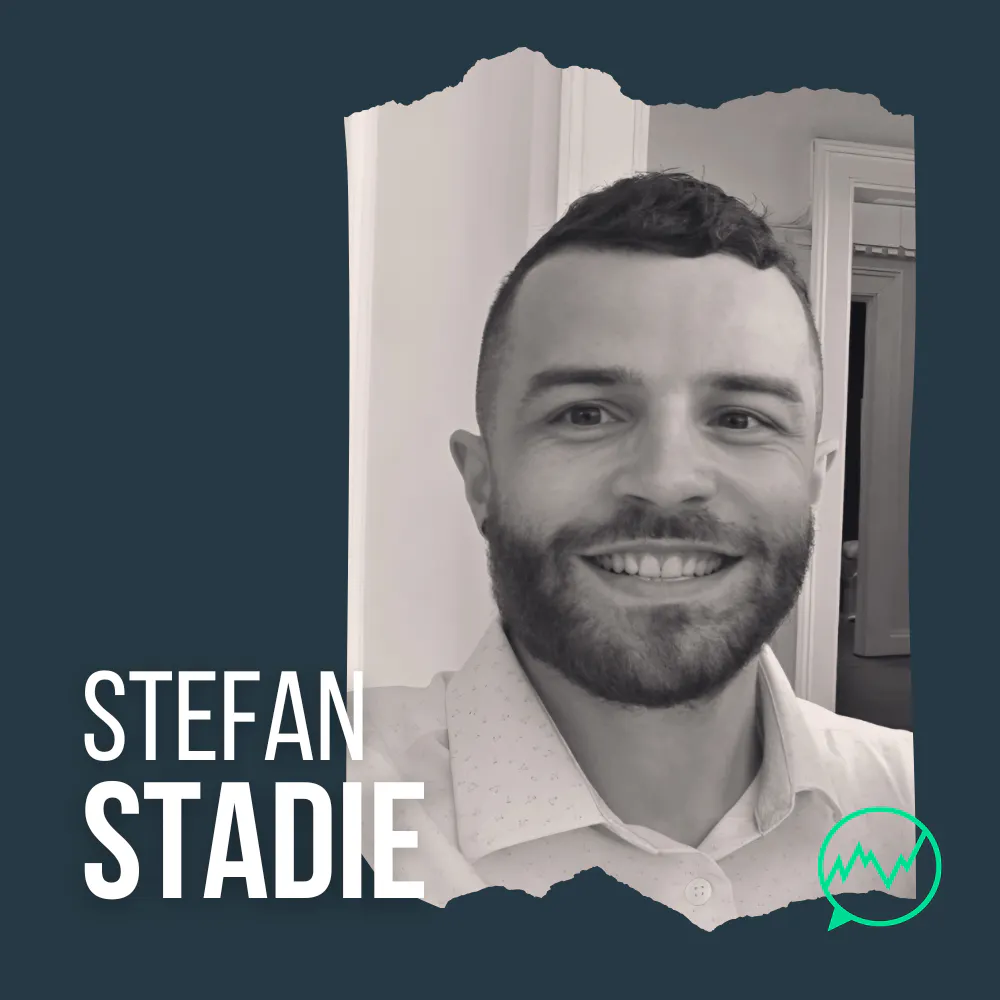
Sports Betting and Prediction Markets - Through a Trading Lens
76m 43s
The transcription features the final episode hosted by Tessa Dow and Ian Cox on Chat with Traders, where they announce their departure and introduce guest Stefan Stady. Stefan shares his journey from an oil and gas background to full-time trading in 2019, initially focusing on swing trading biotech stocks. He learned through self-study, citing Nate from Investors Underground as a key influence. Stefan emphasizes that his early mistakes involved trading too large—risking over 10% of his account per trade—before adopting a disciplined approach based on pre-planned stops and reverse position sizing. He transitioned to short selling around late 2020, finding it more aligned with his personality and market structure analysis. By waiting for liquidity events (e.g., earnings reports) to exhaust themselves, he identifies short opportunities with cleaner moves. Stefan also entered sports betting after regulatory changes in Canada and the US, using tools like Odds Jam to spot mispricings and execute arbitrage strategies, often hedging against liquid markets. He notes that these opportunities arise from rapid news (e.g., player injuries) causing price discrepancies. The episode concludes with an ad for Trade the Pool, a platform offering up to $200,000 in buying power without personal capital, targeting disciplined traders. Overall, the conversation underscores the importance of discipline, risk management, and adapting strategies across different markets.
What would your trading look like if capital wasn't the constraint? That's the reality for most traders. It's not skill holding them back. It's size. Trade the pool changes that. Step into the US equity markets with up to $200,000 in buying power without committing your own capital. Full access to stocks and ETFs longer short executed with the precision and freedom serious traders expect. Your performance is measured by one standard discipline risk management and consistent execution. Meet that standard and you operate at scale. No subscriptions, no ongoing obligations, just a clear path forward. For those ready to trade beyond limitations, this is the next level. Trading in the financial markets involves a risk of loss. Podcast episodes and other content produced by chat with traders are for informational or educational purposes only and do not constitute trading or investment recommendations or advice. Computer screen would have like 20 plus tabs open. I would have all these different sportsbooks and like I said, I had the scanner, the odd-sham scanner. Basically, I would just be looking for mispricing. I would be logged into every account and there were certain times of day where there was higher liquidity. Just like with stock markets, like near the close, you're going to have higher liquidity and you're the open. You're going to have higher liquidity with sports. You want to be right near the event start time. That essentially is the liquidity event. You'll see prices starting to move as we draw close to the sporting event. Then if you have some kind of information that comes out that moves prices, that's when I would swoop in and I'd be like, okay, something happened here. We just saw a huge reprise on this team. Basically, I would take as much liquidity as they would possibly allow me exactly like I would max it out essentially. Markets, speculation and risk. This is the Chatwood Traders podcast. Hey, you're turning into Chatwood Traders episode 320 and this is Tessa Dow. I have with me right now my co-host Ian Cox. Ian, how are you? Doing great. Thank you. Another interesting day in the markets. Yeah. Well, before we get into today's episode, we wanted to actually take a minute or two to share something. This will be our last episode hosting Chatwood Traders and it's honestly been a big part of my life over the past few years sitting in on these conversations, working behind the scenes and putting together the introductions for each episode. Those were always something I really enjoyed and it gave me a chance to slow things down and really think about who we were talking to and why their story mattered. To everyone who's listened over time, whether it's been for years or your newer to the show, thank you. It really means a lot to us. Ian, working with you has been great. The way you show up for these interviews every single time, the level of thought you put into them, it's a big reason the show is what it is. Yeah, I appreciate that and the same to you. It's been great working together. Yes. We've had a lot of very interesting guests on the show in the last number of years. A wide variety from day trading all the way to prediction markets, psychology and macroeconomics and I know I've personally benefited immensely from getting a variety of perspectives on the markets. I've learned a lot during my time here and I appreciate the richness that all are guests shared with us. To everyone listening, thank you very much for spending time with us. We've covered a lot over the years. The show is in a great place and at the same time there's an exciting new chapter ahead. And that's the main thing. Chowatraiders isn't going anywhere. The show is in good hands and what's coming next is going to take it even further. That starts with a new host stepping in the next episode and you'll hear from him then. You know, every host brings a different lens and that's what keeps the show like this fresh and evolving and I have a lot of confidence in him taking what's been built here and really pushing it forward. So definitely stay tuned. And as for me, I'll be focusing more on my trading and if you're interested, you can find me on tessa.dow.com. And Ian, if you ever decide to put something out there, I know people would definitely want to follow along. Yeah, well, we'll see about that. Yeah. All right. Well, without further ado, now let's get into today's episode. If markets are really just expressions of crowd behavior and liquidity, doesn't matter whether you're trading stocks, sports or prediction markets. In today's episode, Ian speaks with Stefan Stady, a trader whose works spans both financial markets and the growing world of sports and prediction markets. He's a professional sports trader at Ciro's sports, specializing in market structure, arbitrage and market making while also actively trading equities on the side. He's been trading full time since 2019, starting in equities and learning like most traders do through experience and mistakes, eventually refining his approach toward more structured, process driven trading, moving beyond purely directional bets. Now, what makes this conversation interesting is the crossover, but also the level he operates at. Stefan is active across multiple markets on a daily basis, working in fast-moving, highly competitive environments where precision and discipline matter a lot. At the core of his approach is a focus on liquidity, psychology and price discovery and applying that same lens across different markets. What I got from this conversation too is that it's not about prediction or opinion. It's about recognizing where real opportunities show up. We also get into how his approach evolved from more traditional directional trading into exploiting mispricing and capturing opportunities through arbitrage and market making, how inefficiencies show up across completely different markets and why some of these newer arenas may still offer opportunities that are harder to find in traditional equities. He also shares what it actually looks like day to day, managing multiple markets at once, staying disciplined when things are moving fast and dealing with a psychological side of trading when results don't always line up in the short term. And throughout the conversation, there's a perspective that might change how you think about markets and where to look for opportunity. We hope you enjoy this episode. Ladies and gentlemen, we're so pleased to welcome Steppen Stady from Calgary, Canada. Well, I'd like to welcome you to chat with traders. Thank you very much. I'm very happy to be here and talk about trading with you guys. Great. Tell us a little bit about your upbringing in Calgary and how did you first get introduced to the financial markets. Yeah, so born and raised in Calgary, I've lived here my entire life. My family no longer lives here. They moved out of the states, but yeah, growing up here in Calgary, I always was just very into business and from an early age, very interested in stock markets and just like finance and trading. So eventually, I ended up going to college at state. We ended up taking in oil and gas management certificate. And that actually broke me into the oil and gas industry. So I was working as a pipeline scheduler there. And we worked very closely with there was like a trading group, a crude oil trading group. And I became very interested just in the market dynamics and how crude oil markets worked. And that was where I first was introduced to the concept of risk management and just commodities and commodity trading in general. So that was where I really first got started. And yeah, I started just trading oil and gas company stocks on the side got super into it and I kind of snowballed into just a love of of trainings. That was where I very first started off. Yeah. Oh wow. You're the first petroleum engineer I've had on the show and I was just curious. Could you share with us back in early 2020 during the COVID time? How was it possible that crude oil could go to a negative price? I don't ever recall that happening in the history of this planet. How on earth was that possible? Yeah, definitely. So by 2020, I actually left the oil and gas industry. I left there in 2019 to trade full time for myself. I wanted to do swing trading. So at that point, I was full on, body, urine, swing trading. And I distinctly remember oil going to negative prices and just being like very shocked because this was something we'd never seen before. But essentially, there was just so much fear in the market that people wouldn't be using oil to get around and transport themselves. So there's just all this uncertainty, which there often is in markets in times of panic, especially during the COVID crash. And it took down oil with it. Obviously got a huge rebound. But yeah, we saw some negative prices there that I think a lot of people capitalized on.
Were you fortunate enough to capitalize on any of that or how did you feel during that time? Regarding crew. Yeah, unfortunately no, I actually took a step back at that time because I was about a year into my My trading journey and the COVID crash was happening I was like man like this is something I've never seen before on this this scale or this magnitude So I actually ended up like really stepping back and just trying to learn at that point so yeah, I wouldn't say wouldn't say I was super Heavy into the oil markets at that time more just kind of like observing this was about a year into my my full-time trading career Yeah, what were some of the trades that you made prior to going full-time as a full-time trader? Yeah, so There was a mini crash early 2019 end of 2018 and I remember just trading the rebound off of that swing trading a lot of biotech stocks and I was able to make a lot of money very quickly just trading the rebound on that So that was kind of what what pushed me to want to do that full-time Yeah, that was kind of like my push out of the door of oil and gas, but yeah, I'd been And playing around with like IPO's and and whatnot prior to that and yeah It's so common for many traders when they first start off to blow up one or multiple accounts How did you do in that regard? Yeah, for sure. So I never actually blew up an account which is really good Definitely the the first mistakes that I was making those just trading too large of size not realizing That you know your your your risk should be based on levels on charts and your position size and should actually be your risk um, you know, I would just have like a standard position size that I would enter with So as I grew as a trader, I realized that everything you want to do is based on your position size Essentially always using stock losses of course. Yeah, definitely the biggest mistake was trading too big early It helped us understand what was too big for you percentage wise like on each trade and then what did you adjust it to? north of 10% unfortunately But I would I would use 10% essentially of my trading account on a position Not realizing that the real key is the position sizing itself and you need to do a backwards calculation Now that's what I do. I say hey my risk is x If that's the case then I need to do a reverse calculation to figure out what that risk level is and then I will size based on that And when I enter the trade everything will be pre-planned my my exit is pre-planned My stop is pre-planned And basically just following my my plan to an absolute tea Complete discipline never never break those rules essentially Yeah Okay, so it's 2020 and you're looking at the the market meltdown and crude oil go negative Did you get into any particular or what trading did you do during the COVID crash and then the immediate rebound right afterwards? Um, I did some I did have some short positions on I think sp Not not the sp excel the uh the inverse Spy ETF um, so I had some scalps on the way down on that and then after that the rebound Turn remember this is quite a while ago I just crypto biotex of course. Yeah So throughout this process did you just learn everything by yourself or did you have any mentors uh kind of what was your process to Develop cultivate your uh your knowledge. Yeah, I actually really leaned in on you to to learn a lot um Nate from investors underground. I've watched his channel relentlessly Just trying to learn I really love his like swing trading But like intraday momentum style as well. So I learned a lot from him Yeah, I used to watch all kinds of forex channels and eventually yeah, I ended up just settling in on On stock trading and that's what I really loved and when I yeah first started I was all basically long bias trading and now it's much different almost everything I do is Short selling essentially. Yeah, so that so everything has changed dramatically since since then Oh, well, uh, when did you first start getting into short selling and why? Yeah, I would say uh probably late 2020 I just started to realize that there's a lot more edge at least for what I was trying to do in short selling you can kind of go against the crowd more Um, it fits my personality a lot more to do I can just Especially now like I can just see relative volume and I can see liquidity events A lot more clearly. I felt that with longs. I was always getting chopped out quite a lot Just the nature of how long bias trades move There's just they're very trappy. I find but with uh With short selling and especially swinging short you just get a lot cleaner moves at least in my opinion if you have market structure In the right place um if you can combine like I said relative volume plus a liquidity event plus Uh, resistance levels on higher time frames What what a liquidity event to describe that Yeah, so basically if a company comes out uh, then they have some kind of news it can be earnings report It can be You know if an oil company discovers a new oil field or if it's a new partnership or something like that Essentially what that does is it drives in a lot of demand for that stocks. You'll see it in the volume Um, and that says hey new buyers are coming in And what I'll basically do is I'll wait for that event to exhaust itself and I'll wait for the backside and then I'll take a short position Rather than trying to anticipate like oh, I think this is gonna go like when I was early on in my career It was a lot more about anticipation like oh, I think this company is gonna do this. I think this company is gonna do this Which should drive it up and it like I said it just ended up in a lot of chop Um, so finally I started to realize that if I just have the patience and the discipline I can actually wait for the event to come to me So I can I can find these things after they've happened and it's very counterintuitive You know, especially trying to short sell until like say you have a company that has a fantastic earnings report It's very difficult to sell Like a stock when when they're having that kind of good news But that's where the edge is is you gotta go against the crowd. You just don't want to be too early of course So there's very specific criteria Did you end up shorting any of the mean stocks in the in the frenzy the run up in 2021? No, I wasn't quite there yet like those those were very volatile I think I probably would have got blown out if I did I yeah, I was not Was not quite at that point yet if that was today I for sure would be shorting those absolutely um oh At that time Not quit Uh-huh is that because of all the experience and knowledge if you accumulated since then that you'd have You'd have more confidence to take on shorts of these parabolic Movers That's exactly it. Yeah my strategy now is essentially shorting parabolic Moves and liquidity events so I think I would be a lot more confident doing that now And just knowing what the signs of a top are Knowing when the move is getting exhausted knowing when buyers are getting emotional Yeah, and we see that a lot in crypto you know like we see these Oh, yeah, yeah So what are you when you go short? Are you looking to just uh Scalpel few bucks on the downside intraday or you look into hold for maybe weeks or months um yeah my shorts are usually Between a day and I would say not more than a couple weeks. Yeah, yeah I'm not necessarily looking to scalp I'm definitely looking for like the meat of the move So tell us how you How you transitioned to the predictive markets um why get involved in such isn't it just all gambling? That's what they say Yeah, so obviously I was that you know trading stocks full time and then we had new regulation here in Canada and the US where Sports betting became a lot easier for people To access especially not in in physical You know casinos and whatnot now you could do this online So I had some friends that reached out to me and they're like hey you should try this out like there's all these kind of bonuses and perks that you can get for signing up and I have always really like sports So I was into it and I was like oh you know what like this looks like free money like these companies are giving you Hundreds of dollars to to sign up and and and use their platform So I kind of got into that played around a little bit and then it evolved into something where I realized I was like Hey, there's there's actually an edge here like There's a very big disconnect between all these different providers with the markets that they're offering and you can actually Go in there and you can use arbitrage strategies or you can use Evie plus strategies, which is expected value Which basically means that the price is way off market so it's like if you're if you're buying a stock say Google's trading at I think they did it or I don't know if they did a reverse split or not uh a couple hundred bucks and uh
you're able to get this for $150. That's essentially what I was doing with sports. You'd have a market price, you'd have liquid markets, where price was very firm, and then you might see an outlier price that was way different from market. So I would take that price, and then I would either hedge it out or arbitrage it out on a liquid exchange, and then you could essentially guarantee a profit on the difference. Explain how would you find these outlier prices? Why would they even exist if you have a liquid market? How would you even encounter that? Yeah, so I actually stumbled across this tool called odds jam, which is essentially a screener. It's almost like a trading screen, but it's for sports. So it would actually show you in real time, like, hey, these odds are moving, these odds are misaligned, and if you're fast enough, you can go and you can actually take those prices when they're mispriced, and then you can hedge them out against liquid markets. And the reason that these would come up, especially, I'll use NBA as an example, very volatile pricing in NBA, by the way, because there's just so many superstars and lineup changes. So if you're coming near game time and say a team like the Milwaukee box, say they're superstar, Janice and Ted Akumpo is sitting out as soon as that news breaks. The price is going to start moving rapidly. Like, as soon as that news is confirmed, price will start moving rapidly. You'll get sports books that aren't quite keeping up with that. And this was very prevalent early on, like a few years ago. They've definitely tightened up a little more with the arbitrage. It's definitely tougher to do now, but yeah, you would see just massive price discrepancies that you could take advantage of. And I would just do that over and over and over. And yeah, I started to get really good at it. Did you have a lot of knowledge of professional sports and the peculiarities of these teams prior to getting into this, or and how much do you have to study now? Ever watch a stock rip and think, I could have nailed that if I had real capital. The truth is many capable traders never reached their potential, not due to lack of skill, but lack of scale. Trade the pool was built to solve exactly that. A firm design for serious individuals who will access to the US equity markets with meaningful buying power, up to $200,000 without committing their own capital. Get access to virtually every stock in ETF. Go longer short freely with the flexibility professional traders expect. You're evaluated on one thing, your ability to manage risk and execute with consistency. Meet the standard and you trade at scale. No subscriptions, no ongoing commitments. Whether you're still refining your strategy, a trader with experience who hasn't yet broken through, or a seasoned professional simply looking for more capital. Trade the pool is built to meet you where you are and take you that next step further. The markets have evolved. Access has evolved. Now, so has the way traders operate within them. Trade the pool. Yeah, absolutely a huge sports fan. So I was very, very much knew how the games work and the intricacies of of all the the rules and everything, but definitely still learning curve. Like even to this day, I'm still learning quite a bit. And I actually do work at a sports book now. So I've actually joined to the other side essentially. I basically told them like, hey, this is what I've been doing for the last few years. They've really clapped down on me. They don't like what I'm doing. And the sports book is really interested in that. They were like, they're like, oh, that's like the kind of thing that we want on our side. So I ended up joining them now. I'm a senior trader at Kiro Sports, which is a micro betting sports company. You mentioned that you got banned or blocked previously. I mean, what why was that and how did that occur? Yeah. So I've been banned and limited from 20 plus retail sports books. We'll call them things like places like that 365, a fan duel, etc. And I had a pretty good run there. Like I was doing a lot of arbitrage. I was moving a lot of volume. And eventually they just came to a point where they're like, hey, like whatever you're doing, we don't like the nature of your business, which is fair because I would come in and I was basically just taking risk free profits from them like every month. Never really, but honestly, because arbitrage is a type of trading that is very low risk. And it's not super high reward, but you repeat that over and over again. And you can, you know, if you make your 5% on an arbitrage trade and you're moving, and basically you're taking two sides of the same event. So you're covering your risk entirely, right? If you have a sporting event, you have teammate versus team B. If I bet on both sides and they're mispriced, like I can't lose, right? Give us an example of what would be a typical amount that you would, how much capital you would put up and then what would be your expected return on that arbitrage event. And did you encounter many issues with liquidity? Well, liquidity was a huge issue. Absolutely. When I first started off, I would say some of the first arbitrage trades I did, I would usually put like a couple hundred dollars on each side just as I was kind of figuring it out, you know, you make five, 10, some percent on that and you're probably, you're locking in, you know, 20 dollars, whatever per trade. And over time, yeah, I just, I started increasing that amount. And I think that's the reason that these books let me, well, bet, but I call it trading because I'm trading against them, right? It's arbitrage. My risk is completely managed. I started off slow with these guys and slowly increased my size. And then I think one day they just realized they're like, whoa, like, what is this guy doing over here? He's taking these, he's getting these insane prices that are far off market. He's beating us consistently. And it all kind of happened at once. All these different sports books message me sent me an email and they were like, we don't want like the nature of your business anymore. We're going to. But would you, I mean, you talk about, you say that there's like multiple different sports books out there, but were you trading on all of them at the same time? Or were you choosing one at a time? And then when you get kicked off of that one, then you move to the next one and so on. I was doing them all at once. Yeah. I would have, oh, you want a computer screen would have like 20 plus tabs open. I would have all these different sports books. And like I said, I had the scanner, the odd-sham scanner. So basically, I would just be looking for mispricing. I would be logged into every account. And there were certain times of day where there was higher liquidity, just like with stock markets, like near the close, you're going to have higher liquidity and you're the open, you're going to have higher liquidity with sports. So you'll see prices starting to move as we draw close to the sporting event. And then if you have some kind of information that comes out that moves prices, that's when I would swoop in. And I'd be like, okay, something happened here. I'm going to go into the soft book, which you know, that 365 or whatever. And basically, I would take as much liquidity as they would possibly allow me. Like, yeah, exactly. Like I would max it out essentially. And then I would just start charging. So you mentioned these outfits kind of kicking you off their site. It couldn't you, many people have heard about the phenomenal rise of the polymarkets and all the different types of things that you can bet on there, including sports. At that point, could you just switch over to the polymarkets and then use like a crypto wallet so you could be totally anonymous and no one could theoretically kick you out? Yeah, absolutely could. Yeah. And that's actually what I do now. That's how I got around all of these is I'm on polymarket. I'm on bet openly. I'm on pinnacle, which is a well-known liquid exchange that doesn't ban sharp bettors because they actually use our action and our liquidity to shape their markets. So they're they're known as like the the pinnacle of prices essentially. If you're getting pinnacle prices, you're essentially you're in a good spot because they're so sharp and so quick and they have global liquidity and they allow sharp actions. So their lines are usually very close to the truth. Yeah. So before you were, it sounds like you were playing against the house. Is that accurate? And then now who would you be playing against? Polymarkets is just a middleman. Is that correct? That's exactly. Yeah. So I used to be playing against the house and now it's pure to pure. So anytime that you see markets posted on polymarket or bet openly, etc. It's most likely going to be another person or it could be a small entity. I mean, it could be a large entity, but typically you're you're betting or you're trading against
other people, like you said, it's very anonymous. And if people don't like the prices that they're getting from you, then they can just back off and they don't have to continue playing that game essentially. So there's always new liquidity that's coming into the market in the form of different players, really. So that's where I am. I'm on the open exchanges. And then so how are prices actually set on the polymarkets? I mean, like say if you see an odds of something being priced at 30 cents on a yes, that's some event it's going to occur or happen. How did that price, how did it get to that price and how does that, how and when does that price change up or down? Yeah, so typically there will be an opening price, which is a soft price, typically model driven. There's many different companies that model these sporting events, Kirill, which I work for now, they model everything like very intensively using all kinds of statistics and machine learning and whatnot. So basically, yeah, there'll be these soft lines that first come out and then as people start to bet or trade on these markets, the line starts to move towards the true probability. So if a line is posted a day before the event, it'll be beatable per se. Now you'll only have an edge if you actually have a model and you actually really truly know what you're doing. So I'm not trying to like, I'm not trying to beat these models or anything. I'm just taking the pricing discrepancy is and I'm using it against the market. If I see differences in prices between different exchanges, all, you know, hedge them out against each other, all arbitrage them. I'll take an early position if prices starting to move in one direction and then I can cover it later on closer to the event, but yeah, it's sharp. I'm sorry, it's shaped by liquidity of the participants, yeah, just like stocks, basically, you're bidding and you're selling got your bid and your ask, it's not a lot different than that. Really, you've got, hey, I think, I think this should be valued at this price. So there's however many dollars on the bid and however many dollars in the offer, you've got a spread just like just like in stock trading within sports, you have spreads between buying and the selling price. So, so yeah, what I do now actually is a little bit of market making so I'll take both sides and essentially try and capture the spread. Given that you used to work in the crude oil industry, do you ever place any trades on oil? Yeah, I'm actually in a fairly large swing position right now on a long crude. Just a couple of days ago, actually, when we initially had the news of the Iran war starting, I kind of sat back and I was like, hey, let's see what the market does here. Let's see, obviously, everyone's watching crude oil, they're watching gold, they're watching silver. Working in oil and gas, I was like, okay, there's going to be an opportunity here. I'm not going to rush into anything. We're just going to watch this if it happens and a few days after the initial bomb started hitting Iran and refinery started getting hit, the straight of hormones started closing down. We saw huge price movement in crude oil, WTI, I think it went from $80 or $90 US of barrel all the way up to about 120. So at this point, I'm just watching. And anyways, we get a huge sales candle on the daily, the daily chart and crude comes all the way back down to about 90. So basically just this very ugly kind of obvious selling event. So I did add up actually shorting oil that day and I held my short for a couple days covered that. And yeah, we've started to see a rebound and I've decided to take a longer term position on the rebound. Interesting. So in your view, that huge sell-off day that we had with the really long wick and huge volume, was that? Isn't that a topping sign for you like the top is in? That's exactly it. Yeah, that's in my short selling. That's essentially exactly what I'm looking for is I'm looking for those topping wicks, those blow off moves, huge volume. I'll start looking at like the five minute charts, the hourly charts and see like what happened within that wick. Did we see a huge parabolic within that wick and we see an obvious seller come in and you know, did we see the highest volume at the top of the move. Typically that would be an indication of a top. So yeah, I ended up taking a short there held that for a couple days and then obviously with the news that's been going on in the Middle East. I think we probably continue higher. In my opinion, that was a little bit pulled back on the wheel. Okay, so your bullish for now. Absolutely. At this point, I'm in a longer term position on oil, I would say. So one thing I noticed, I've been using the Jupiter exchange to for predictive markets and I've noticed that the volume on many of these things. Many of these contracts are sometimes going to be pretty low and since you're in a market making, I mean, what happens when. If if a user enters the market and people have placed their trays, they have to enter the market during a quiet time. Yeah, relatively. And then how do they get their order filled if they don't come in right at the time when all this, all these transactions, all this volume is going on. How do they get filled? Are there regular market makers assigned to these things or is it just anyone can be a market maker? In sports specifically, yeah, anyone can be a market maker. You're competing with other people's offer the best price. There's low actual liquidity, but yeah, you're coming in and you need to enter a position or get out and then the liquidity is not quite there. So as a market maker's thrive is when when people to start hitting the bit in the offer. So is there a way that one can see when is it optimum time to enter a market to pick up on like, okay, right now is where getting a lot of volume. I should get a better fill if I enter now. Is there any tools to show like say other than maybe sports if it's any other type of market, maybe crude oil market. When is a good time to get in due to liquidity at that particular time. Typically, the open and the close I would say would have the highest liquidity and especially in sports, the close is that like hour before the event usually starts and you'll usually have a lot better chance of getting filled out of better price. So that's when I that's when a lot of my trades actually fill is I'd say like an hour before events or during events. I'll also make markets during live sports events, which is almost like the equivalent of day trading in a way. It's a lot faster and you're you're doing it based on what's happening on a minute by minute basis. So when you are acting as a market maker, can you give us an example kind of what you're targeted kind of percentage range that you're targeting for each transaction or are we talking about like maybe less than a percent for each round trip transaction that you're targeting or is it go higher than that. Yeah, it's in the minimum is about 3% but there are also fees that the exchange charges, which is about 1 to 2%. So minimum 3%, ideally 5 plus percent. Sometimes you get about 10% if you're if you're really on top of it and someone's left out maybe a stalemarkit and you can take someone else's stalemarkit based on things that are changing essentially related to that event such as injury news or some kind of details that come out that were not previously known and now they're known. And now price is struggling to kind of find okay like it's a discovery phase essentially we move into a short term discovery phase. So as a market maker are you just putting in order a limit order at the bid and maybe one at the ask and then waiting to get filled is that. Yeah, basically what I'm doing is I'm referencing sharp liquid markets like I talked about earlier like pinnacle bookmaker. That online and these are these are sharp marketplaces where they're accepting large orders from known profitable better known as sharps. So I'll be using them as kind of like a reference to what the width of the market should be and then I'll set my own markets outside of those prices. So say there's a really tight market on. So you've got the Calgary flames playing the Dallas stars and you've got the plane you say you've got the odds of the event are basically 50 for each team to win. You've got the odds at minus one 10 on one side minus 110 American odds on the other side so I'll basically be setting my market just outside of those ranges. So I'll be offering the flames at minus one 15 while we're offering the Dallas stars at minus one 15 and people will come in and they'll hit both sides of that. And then those actually offset each other so you're you're basically you're making the spread essentially. And they come and they hit your your beds and your your ass
because it's a sudden surge of liquidity that kind of wipes out the other market makers, and then you're the next one in the spot to collect this inflow of liquidity. Is that accurate? - Typically, yeah, or in some tighter markets, it can just get very competitive. So, you'll start bidding against other people like, oh, this person's offering the best price. I'm willing to go a little bit better than that. I, of course, have ranges where I won't go beyond that. I don't want to put myself in a negative EV situation, but if there's still a lot of room in that market for profitability, I will outbid people, and I'll just be on it like a hawk, and it can be quite competitive. And other times, it's not super competitive. Other times, people don't even go near the markets that I'm working in, and they just kind of leave me alone. From the documents that you shared with us, it appeared on your calendar, multi-month calendar of performance, that you seem to be active almost every day in the markets. Is that accurate? Did I read that right? - Absolutely. Ever since I really started getting into the sports market, making specifically around the beginning of January, and you had the NFL playoffs happening back then, which is super liquid events. You had the NCAA, which is the college football championship happening. It's very liquid. You've got NBA, you've got NHL, college basketball. All these things are happening at once. You've got tennis. Basically, there's just all these different liquidity events happening. I just started getting really into it basically every day. I'll make markets wherever I am. I'll be on an airplane making markets if I have Wi-Fi access. - Wow. How often do you actually take a directional position on a sports event or any polymarkets? You feel so confident, and you're not just making a market in it. You're actually going long or short, so to speak. - Absolutely. Every day, essentially. If I find mispricings that are just absolutely way off market, I will take directional positions every day, absolutely. I'm probably all together and probably doing around 25 markets or directional positions per day. - More on day. - Yes. There's so many events. You can have multi-type positions within one event, like within an NBA game. You could have a position on who's going to win. What's the spread? is essentially the volatility of that event. You can make markets on what will the total points in the game be? How many points will an individual player get? You can imagine these huge sporting events. There's just so much opportunity for me to make four markets within one single event if the opportunity's there. I never force anything, but if it comes to me, I'm not going to say no. Wow. Your knowledge of these sports events must be very deep to be able to play all these variations and themes on this. The term I heard the term come up called Parles. Is that accurate? What is that, if I have that word correctly? Because they talk about how gamblers are public is getting sucked into these micro-bets that where they don't really know what they're doing and it's just providing more just a greater likelihood of them losing money. I'm really glad you brought this up, actually, because I think a lot of sports betters and sports traders will be very familiar with that term. I think a lot of people are using Parles. It's almost like a leveraged way to make a lot of return with just a tiny bit of stake. The sports books aren't going to say this, but I will never take Parles first of all because they're some of the most negative e-v transactions you can possibly take. They are some of the most profitable for the books, which is great. If people wanted to do Parles, that's fantastic. There is some bench there. I don't really go near that. What I do do is I'll actually do reverse Parles. I will actually sell Parles, which is exactly what I'm doing with the market making. I'm just giving out juiced prices and I'm just combining it into a slate and I'll actually sell people Parles, absolutely. Because the probability of a positive outcome is very, very high. I mean, you're picking the. Exactly. If I could fill out your lines up, I'll take it for sure. Supposedly in 2024, I read that Americans wagered $150 billion on sports. Are we shifting to a time when everything can be a market? I mean, they're talking about the explosive rise of polymarkets and all she and how it's a new form of. They don't even call it gambling. Anymore. You just call it trade. Tracer thoughts on that. You're absolutely right. It's a little scary and I do think it is going in that direction where everything is tradable. Everything is quantifiable. No. You can trade or you can bet on pretty much anything you can think of now from political events, of course sporting events, the price of Bitcoin on polymarket. You can trade whether that's going to go up or down. Yeah, it's basically just derivatives and it's unregulated, which makes it kind of scary. Polymarket is known for some insider trading, which you don't want to get caught on the wrong side of that. So then I imagine you and you would probably advise anyone getting into this to what maybe not enter any market that could be insider trading that could have that. I mean, obviously crude oil market. You're not going to have insider trading much on that or the older could have to. But yeah, whatever. I mean, unless you are really sharp and able to follow the liquidity and maybe get on the sharp side, which might be the insider side, but I don't know for sure which side would be the insider side. So I would certainly recommend against that if you're just looking for entertainment purposes, absolutely go for it. Take your bet. Do what you want. Don't put your life savings on whether some president's going to get overthrown in a country unless you actually know what's going going on. That brings that's a good segue because I noticed in some of you of the markets that I look at, to me, it appears that there's quite a bit of dumb money involved. And I don't know what you experienced. Like, for example, one of the polymarket spets is who will be president of Venezuela at the end of 2026. And they have a list of the current vice president, current president, and then a couple candidates. And Nicholas Maduro, the former dictator who is kidnapped and brought back to the US, is on there. And actually, they had the bet at the time that I placed it was one could make 10% on their money between now and the end of the year. If as long as Maduro doesn't come back to be president of Venezuela. And to me, that seems like a total easy money that's dumb money throwing money at Maduro. I don't know what are your thoughts on, have you seen that before? I've seen that kind of thing before. And there's also another very popular market on polymarket that is Will Jesus Christ return. Yes, in 2026. Exactly. Another one was aliens. Will the government reveal that aliens exist? And I mean, many of these seems like it's a can't lose, perhaps. Seemingly, now the one thing with polymarket is it all depends on how they settle that event. With aliens, you could bet that aliens will not return that there will not be evidence. But if a government comes out and they say, hey, we have this conclusive evidence of unidentified objects or some kind of communication with outside life forms, the market may resolve as yes. So that's why I would just would not touch that. There always is a chance that you could lose on those things, which is why I just don't touch it really. Interesting. So it sounds like then that it's critical to look at the specific language used in how a contract gets resolved. Exactly. You want to be super familiar with the resolution of those absolutely because if they interpret it differently than you do, even with the Jesus Christ returning thing, it's hard to say. Like, I don't know what kind of event might trigger the answer to be yes on that. And suddenly, everyone that's poured their life savings into no, maybe on the wrong side. And there's not a ton of regulation around polymarket. So you're not going to be protected by the SEC or general laws and rules.
that typically are around financial market, it's been sports markets. At least with those, you have a lot more regulation. Polymarket is just so unregulated. Then it has its place. You of course can make money and have edge there, but I'm approaching it very cautiously for sure. - How have your returns being a market maker and or being going directional in the polymarkets and compared with your stock trading? And do you see any similarities between each of those? - Huge similarities for sure. Definitely more profitable in the market making. Also that seems to be just where my mind really clicks with how everything works there. And sports betting and sports trading is in its infancy in my opinion, compared to financial markets, financial markets, have really shaped and evolved over so many years and they become so efficient and hard to beat just with the invention of, you know, you've got algorithms in there. With sports very much in its infancy, just shown by the fact that there's so many fragmented odds all over the place. It hasn't really come to this like, this one exchange yet where everything is agreed upon like all of these, these are the odds for this event, et cetera. And I think we're getting there. I think places like Polymarket and whatnot are taking us there. But as far as similarities, yeah, you see liquidity is the huge one. You wanna get into events where there's high liquidity to get in and out of positions easier. You see a motion in financial markets and sports markets. And you can imagine in sports markets how much emotion there is behind the money that's pouring in. So that's where I've really created an edge. It's just, you've got emotional betters that need to make quick decisions and they might be making a wrong decision and they might take or make a price that is no longer the real price very quickly, especially if you're in a live event. Someone's watching a college basketball game. They're like, oh, I'm watching my team go on a 10 point run here. This is a no-brainer that they're gonna win this game. I'm gonna put out a spread bet. I'm gonna put out plus five and a half because my team's up. But their team was actually the underdog to begin. So their price that they're offering against the market at that time may be incorrect. And since the price is always moving, it may be correct when they post that price. But within 30 seconds, their price could be completely wrong. And I'll come in and loop that price. Or I'll come make a completely new price if it's out like half a night. And NBA game or something. And I notice that the true odds are like game total over 2.19 and a half. But the market is saying you can offer an under 2.25 and a half at the same price. That difference is pure edge. That's a huge difference. 2.19 and a half versus 2.25 and a half. That's a difference. Interesting. So it sounds like you have to be really on top of all these different games that are going on that things could be changing as right as you're getting something from the refrigerator to eat or whatever. How much time do you spend and how focused you need to be to keep track? And I mean, how do you keep track of all these different games going on and these events? You have to be laser focused, I imagine. This is Kevin. We hope you're enjoying this episode so far. If you are, take a second to leave a comment. We read them all and truly care about what you think. And if you haven't yet subscribed to our email list, visit chatwithtraders.com and click subscribe. So we can keep you posted on information that matters. Now, back to the chat with our guest. - Yeah, absolutely do. Yeah, and that's kind of what I learned from working at Kiro is we would be trading multiple events at the same time. So it made me realize that you need to focus on the most important ones, again, the most liquid events at any given time. And if I'm gonna leave the screen and I'm gonna go get a snack or I'm gonna take a break, I'm taking down all my markets. I'm not leaving the things up to get a sniper taken by people. And essentially, what I do is I have my screen up here and I'll have different references up all over the place. I can have draft games on one screen, pinnacle on the other, bet openly on my phone and basically I'm looking at all these exchanges and I'm looking for one of them to post a large price discrepancy and then that's when I'll swoop in and be like, okay, like this is off market. There's an edge here and you're right, it happens very quickly, it's very competitive but you can find mispriceings. And if I'm sitting here and I'm just watching the odds for five different basketball games at once, like there's a chance that one of them will have a misprice event every half hour or so. - So it sounds like then you're active in both the, if we could call it the centralized traditional betting markets and the decentralized markets, like polymarket, where you can connect with your crypto wallet and polymarket acts as an intermediary but you also are primarily active in the traditional gambling market, is that accurate? - Yeah, I would say most of the volume I do is on the peer-to-peer market. So not the, just because I am, like we talked about earlier, limited at a lot of the traditional sports books, which are known as the soft books because they're not quite as accommodating to sharp money, they're just trying to make money on the spread or on what we might call dumb money, whose people placing a lot of parlay is and not really caring about what price they take at any given time, for me everything is about, it's not about trying to predict what will happen, it's never about, it's never about my opinion or my bias, it's always about price, it's always, hey, this price is right in front of me right now, I can see that that's misprice from the market. Yes, it's true that I don't like this team but I'm gonna, I'm gonna place a wager or market and then to win because it's so far from what the true market price should be right now. And of course nothing's ever guaranteed, like you're not guaranteed that it's gonna win per se. But yeah, your position sizing would be a lot more like options contracts essentially. - Mm-hmm, there's a philosophy in Silicon Valley that says, if you aggregate enough skin in the game, meaning enough players, enough people who actually will put money into a prediction, then you create the most accurate predictor of the future. What are your thoughts on that? And do you see yourself as a market maker, as a truth seeker or just a liquidity provider? - I would say I'm more just looking for discrepancies. I'm very much just trading the markets that are in front of me rather than trying to model or predict anything so I'm definitely more, I approach it from a trading lens. Yeah, I'm just looking where the liquidity is and trying to take advantage of disconnects in the market. - So I also heard that data collected from defyoasis.eth shows that through late 2025, 70% of polymarket users have realized losses while only 30% are in profit. Since it's appeared appear, why is the house by the market makers winning so consistently? I mean, who shouldn't it be equal? I mean, for every winner, there's a loser. - I mean, those odds are actually quite good. 'Cause I mean, typically with trading, you get like five percent or less of people are actually making money. So that's pretty solid. And I think that that's because it is a lot of just peer to peer and it's kind of like dumb money versus dumb money. But of course, there's smart money in there as well. So I think it's inevitable that people will lose less money but still very difficult to make money in those markets. And I did wanna touch on your question that you asked earlier about with the high liquidity being a predictor of events actually happening and the more liquidity that comes into markets, the better it is at seeking the truth. And I think that's absolutely completely true. I mean, anytime that you've got low liquidity, you've got less conviction behind what's actually happening. And when you have higher liquidity, I mean, you have more participants. You've got more people that are informed joining that market. And I think the aggregate of all of that volume gives a very clear indication of what the true odds might be. So volume is just so important in any trading market because of that. Yeah. So I remember years ago how different people in the stock market were make references to the madness of crowds with people, when the public invests in the stock market and the crazy things that can happen. And now with the polymarkets or the predictive markets, I hear people say the reverse, the wisdom of the crowd. If you get enough people putting money on that.
Can both be true? I mean, what are your thoughts on that about the wisdom of the crowds of events? Turning out to be true of enough people bet on them? I mean, with stock trading, of course, you're going to get the types of things like pump and dumps. You're going to have those crowds that are rushing in without you know, knowing the full story that's actually behind what they're doing. With polymarket, the edge is actually in the spread. So even if the crowd is right as an aggregate, if you're still taking one side of the market, you may be very close to being right or breaking even, but you're still going to slowly lose money because of that spread. So the truth lives in between that spread and with stock markets. I mean, that's quite different because it's the reasoning that stocks move in the first place, which can be full mo or it can be newsletters coming out, which are promoting false information. So it has a lot to do with the reason for entering in the first place. So I also heard that draft kings have launched their own prediction markets. With more participants offering predictive markets, do you think that benefits your typical user or? I don't think there's a benefit per se. I think it just offers more ways for the average person to lose money. It's kind of like sports betting. I mean, it'll be good in general to have more liquidity and so that we can have a better picture of what the true odds of these events really are because if you have again, polymarket showing one thing and you have draft king showing another, one of them is right. One of them is wrong. How do we get to that place where we figure out which side is the right side and we figure that out by bringing in more and more liquidity, more informed traders and betters. If someone knows something or information changes, that can shape the line in real time and we can get closer to the truth. What are your thoughts on the gamification tactics? In old days, when you go to the casino, it takes time to go up to the place to get your chips and it takes some, there's a time lag between the time that you enter the casino to get your chips at the time. You start gambling, which allows the frontal cortex to maybe interrupt the pattern and say, "Hey, wait a minute, should I really be here?" Whereas with these new gamification on your phone and the reduced friction to get involved, what are your thoughts on? It doesn't this turn into an easy drug that's difficult to break away from? Absolutely. It's definitely a benefit to the big companies that are offering these types of markets, these sports betting companies. Obviously, they're very well positioned to take advantage of this new revolution that we're in here. It definitely can be an issue for people though. I would say, if you're treating it more like gambling, you might want to step back and think, "What am I really doing here? Do I actually have an edge?" Or, "Am I just becoming a part of this product that's being offered and being sold hope?" Or, "Am I able to manage this?" I have a set amount that I'm betting per week. I do my partly is, but I expect to lose money over the long term, which I think is a safer approach for most people. But if you go in there and you just start firing away massive beds thinking that you can make a living off of this, just think hard and deep about what it is that you're really doing, who you're betting against, what are their motives, and be honest with yourself, do I really have an edge here? Or do I really know what I'm doing? Or are these sports books just slowly taking money from me? Or other people? So then what would your advice then be for a new people entering predictive markets in general? Whether they're sports or whether they're, I mean, what would you suggest? Always start small. You never want to go in guns blazing, deposit a little bit of money. You'll notice with polymarket even when you make your deposits, there's a huge amount that comes off of your initial deposit just in transaction fees. Just getting money into polymarket. So you're already down once you've, once you've started on polymarket because of those things, right? So you're already kind of in the red, which is fine. It's nothing major, but yeah, start small and track everything. See if you truly have an edge. And it takes time to really build an edge. I mean, I used to a couple of years ago, I was trying to do my own modeling of sporting events and player props. And I couldn't quite get there to an edge place that I needed to be at. So I moved over into market making. Then I started using sharper models from you know, bigger exchanges and more liquid books. And that's when I really started to find more success and stability. Because making sports models is actually quite difficult. For you, what do you consider to be a good return in the stock market based on all your trading in the past? And what would you consider to be a decent return equivalent return in making markets in the polymarkets? What is that difference for you? Absolutely. Yeah. I think I think a pretty common benchmark for stock trading is if you can beat the S&P 500, I think that's very much agreed upon. If you can make 10% a year, that's fantastic. Obviously, it depends how much you're trading, what kind of trading you're doing, how long you've been trading for what instruments you're trading, whether it's options or just straight, straight stock. So I think if you can make 10% plus in stock markets, I think you're ahead of the game in sports markets. I think it's a lot higher just because of how much more edge that exists in those markets and how much more fragmented it is as far as percentage wise, when I was doing arbitrage, I was making probably at least 100% per year. And it's just because you're you're aggregating everything. You're you're rolling it over so quickly, right? Like the events are happening so quick, they're resolving so quickly with stock trading. It's a lot slower. It's a lot. I mean, unless of course you're scalping or you're you're doing day trading, but I never magnetized much towards those first sports though, the edge just compounds super quickly. So I heard that the addiction markets are forecasted to reach a $1 trillion valuation by 2030. Does the truth machine, so I speak, call that get more accurate, the bigger it gets, or does the incentive to manipulate it becomes so high that the data becomes useless? I think they become accurate, but I think that insider trading will not go away. So I think that will always be there. But overall, the money really is made in the spread. So companies and people are incentivized to find that true value and then just add on to each side. Essentially what we'd call a vigor, a sure vague in sports, which is you're making people think that they're getting a fair price, but whether they're taking side A or side B, they are slowly losing money over time. Even if on the short term, it looks like they're making money, they should be slowly losing money because they're getting underpaid when they win, and they're overpaying when they lose. So there will always be an edge to the bigger players, but more volume, always good for getting more accurate markets. If you're trading in a very ill-equid market, you're going to get a lot more chop and you're going to get, it's going to be a lot less accurate, just like with if you're stock trading and you're trading in something that's only trading 50,000 shares a day, like you're going to get absolutely destroyed on the spread and slippage. So looking at the future, if you could short current gambling boom in America, would you? Or is this a new permanent reality of the 21st century economy? If I could short it? Yeah. Yeah, I would not be getting in front of that freight train. I would not be shorting that. I think this industry has already proven that it's growing rapidly and it seems like it's in the first stages, really, just just shown by, like I always come back to comparing sports markets to stock markets. All the time I'm thinking, man, these sports markets, they're so similar to stock markets, but they're so far behind in just the mechanics of how they work, how fragmented it is, how much edge exists there. I just can't imagine these slowing down anytime soon. And it's just become so normalized for people to bet from their phones and to how this liquidity and especially polymarket, like I don't know, people maybe they don't think they're gambling there. Maybe I mean, some people really are trading there, but it's just another platform, essentially for most people for gambling. So to wrap things up, what do you struggle with most?
in the stock market and in the prediction markets. Psychology and variance, short-term variance can really mess with you. You can have an edge long-term, but on any given day, your edge might not play out exactly as you think it will. Even if you're taking absolutely fantastic trades, getting fantastic prices. So the most important thing for me is process and discipline and every day coming in with that same clean slate and knowing that what I have produces an edge in the long term, so just making sure that I never focus on the results of one single day and trying to zoom out and look at the aggregate results. I think he is one of the biggest troubles. The psychology, of course, you know, everyone gets fear and euphoria and greed in stocks, in sports. Just don't make emotional decisions. If you're trading sports, like things move very fast, just step back, take a breath. Look at what's in front of you. If you're going to trade sports, I would recommend doing a lot of it at intermissions, pregame, half time, don't do it while things are moving wildly. Like if there's no stoppage in play, you're going to get absolutely smoked. If you're putting out a spread and things are hot, like you're going to get absolutely smoked, which is what I try and be on the opposite side of essentially. I'll see people putting on stale spreads and they'll essentially just eat those up. Well, great advice. What are you most looking forward to? Just continuing to enjoy this journey and I just love sports. So I just get so excited about like, oh, you know, March madness is coming up. I know everyone's going to watch basketball. Everyone's going to be enjoying these games. You know, the NHL playoffs are coming up. It's just like this seasonal cycle, especially for sports. And I just love how serious people take it and how great it is to watch and to trade these. And knowing that the liquidity just keeps coming back because Super Bowl will happen again next year. The NBA championships will happen. FIFA World Cup will be happening this year. People will be trading and betting on those events like it's just it's just it's going to happen. Whether it's new people coming in or whether it's people that have been doing this for a long time. That's what excites me is just knowing that there's always more opportunities. And I can always reinvent myself. You know, I can start making markets for player props. If one thing's not working, I can focus on another thing. There's all kinds of you can really dive in and find different niches within each game. You can find all markets and trades and on probably market all kinds of different events. So you can find something you like. You can get very informed about it. And if you have an edge, I mean, exploit it. Wow, fantastic. Thanks for coming on chat with traders and sharing all this fascinating information on in this field. Yeah, it's been a lot of fun. I'm glad you guys brought me on. I think it's really, really neat how all these different markets tie together. And just in the last couple of years realizing that they're so similar. It's just such an eye opening event for me. So being able to take what I learned from stock trading and then turn that into arbitrage and then eventually start working as an actual trader on the side of the sports books was just. It was kind of a no brainer path for me and it's been a lot of fun and very interesting. I just everything is a trade for me. Great. How can our listeners get in touch with you? Best way to get in touch with me. Probably X, which formerly Twitter. My handle is at bronze beard with two D's. You can find me on threads under the same handle. But X is probably the best way. I'm not super active on there, but definitely check it. You've reached the end of this episode of chat with traders. But rest assured, there are more episodes loaded with real market insight and zero hype on the way soon. So to stay updated with each great new release, subscribe to the podcast and iTunes. And we'd love it if you leave a rating and review. We'll catch you next time on chat with traders. [Music]
Podcast Summary
Key Points:
The hosts announce their departure from Chat with Traders, expressing gratitude to listeners and confidence in the show's future with a new host.
The episode features Stefan Stady, a professional sports trader and equities trader, who discusses his career trajectory from oil and gas to full-time trading.
Stefan emphasizes the importance of risk management, position sizing, and discipline, noting his early mistake of risking over 10% of his account per trade.
He transitioned from long-biased trading to short selling, focusing on liquidity events and exhaustion of buying pressure for cleaner moves.
Stefan entered predictive markets (sports betting) after Canadian and US regulation changes, exploiting arbitrage and mispricing using tools like Odds Jam.
He describes how mispricings occur due to rapid news (e.g., player injuries) and slow updates from sportsbooks, allowing arbitrage opportunities.
The ad highlights "Trade the Pool," a service offering up to $200,000 in buying power without personal capital, targeting disciplined traders.
Summary:
The transcription features the final episode hosted by Tessa Dow and Ian Cox on Chat with Traders, where they announce their departure and introduce guest Stefan Stady. Stefan shares his journey from an oil and gas background to full-time trading in 2019, initially focusing on swing trading biotech stocks. He learned through self-study, citing Nate from Investors Underground as a key influence.
Stefan emphasizes that his early mistakes involved trading too large—risking over 10% of his account per trade—before adopting a disciplined approach based on pre-planned stops and reverse position sizing. He transitioned to short selling around late 2020, finding it more aligned with his personality and market structure analysis. , earnings reports) to exhaust themselves, he identifies short opportunities with cleaner moves.
Stefan also entered sports betting after regulatory changes in Canada and the US, using tools like Odds Jam to spot mispricings and execute arbitrage strategies, often hedging against liquid markets. , player injuries) causing price discrepancies. The episode concludes with an ad for Trade the Pool, a platform offering up to $200,000 in buying power without personal capital, targeting disciplined traders.
Overall, the conversation underscores the importance of discipline, risk management, and adapting strategies across different markets.
FAQs
Trade the Pool allows traders to access up to $200,000 in buying power in US equity markets without committing their own capital, focusing on stocks and ETFs. Performance is measured by discipline, risk management, and consistent execution, with no subscriptions or ongoing obligations.
Stefan started by trading oil and gas company stocks while working as a pipeline scheduler in Calgary. He later left the oil and gas industry in 2019 to trade full-time, focusing initially on swing trading.
His biggest mistake was trading too large of a position size, sometimes using over 10% of his account on a single trade, without properly calculating risk based on levels and stop losses.
After sports betting became legal in Canada and the US, Stefan started using tools like odds jam to find mispriced odds. He would take outlier prices and hedge them against liquid markets to guarantee profits.
Stefan shorts parabolic moves and liquidity events, such as news-driven volume spikes. He waits for the event to exhaust before entering a short position, targeting moves lasting from a day to a couple of weeks.
He found short selling offers cleaner moves and less choppiness, fits his personality better, and allows him to go against the crowd. He uses relative volume, liquidity events, and resistance levels for edge.
Chat with AI
Loading...
Pro features
Go deeper with this episode
Unlock creator-grade tools that turn any transcript into show notes and subtitle files.
 PodcastTranscript AI