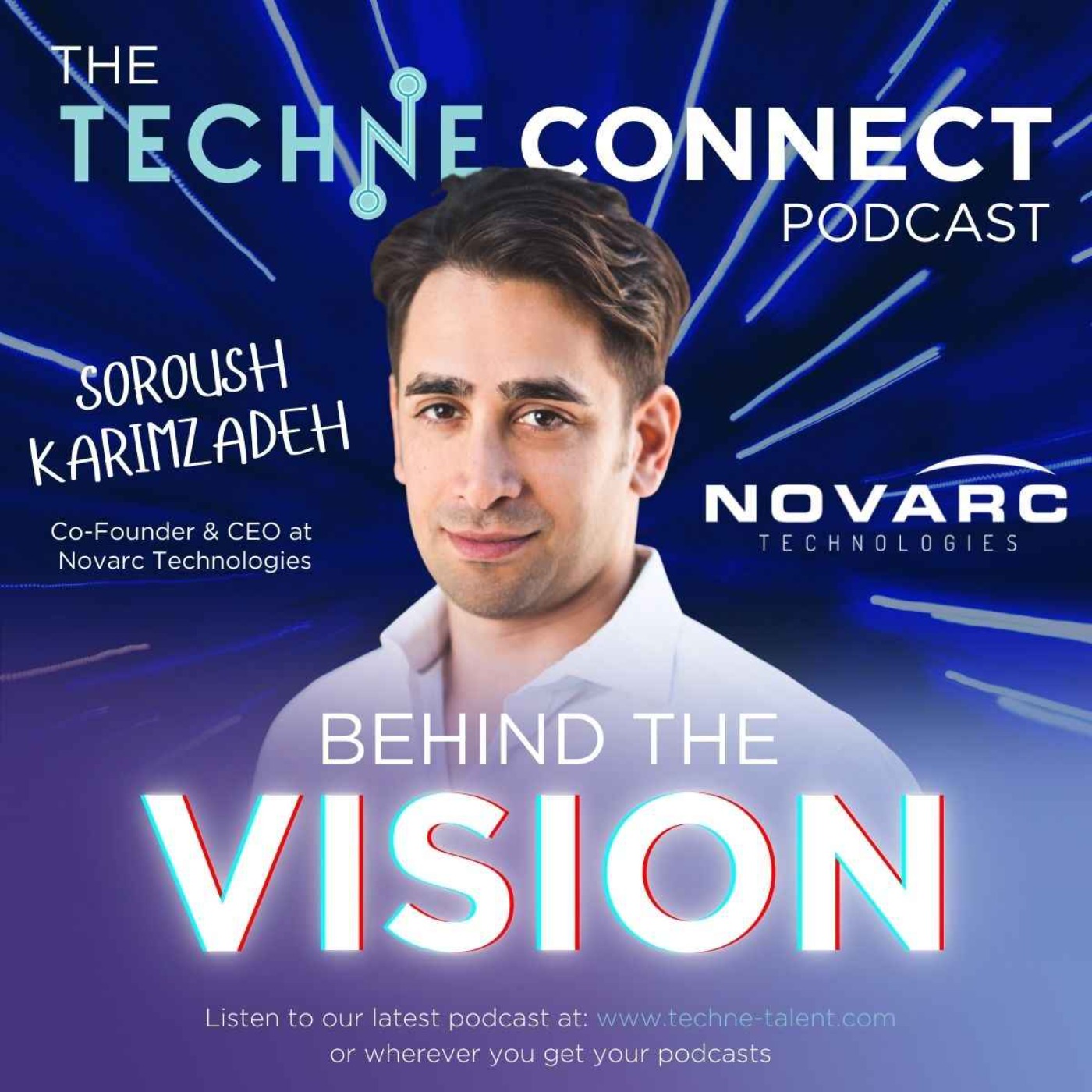
Soroush Karimzadeh, Co-Founder & CEO of Novarc Technologies
from The Techne Connect
36m 12s
In this podcast, Sir Rouch, co-founder and CEO of Novak Technologies, discusses his journey in revolutionizing the welding industry through autonomous AI and robotic solutions. He highlights a critical talent shortage in welding as skilled baby boomers retire and younger generations shy away from manual labor, making automation essential. Novak specializes in pipe welding, an area once 95% manual, and uses cobots to enhance productivity and weld quality. Automation also opens doors for diverse talent, including women and older workers, by reducing physical demands. Sir Rouch’s entrepreneurial path began with a university vision board, but he faced harsh realities like assembling desks on a shoestring budget, long hours, and personal sacrifices. He emphasizes the importance of resilience and quickly achieving product-market fit with a minimum viable product within months, as robotics development often takes longer than expected. Reliability is key—Novak’s 4x growth in repeat customers over two years proves that dependable solutions drive success. For aspiring entrepreneurs, Sir Rouch advises focusing on impact over money, being prepared for setbacks, and understanding that true automation can transform industries while allowing humans to focus on tasks that cannot be automated.
Welcome to the Technique & Act podcast, where we go behind the tech and ahead of the cut. Each week we talk with the innovators shaping the future of automotive, motorsport, space, defence, aviation, energy and beyond. Whether you're an aspiring engineer, a tech enthusiast or looking for your next career move, you're in the right place. Our technique talent, we don't just share these stories, we can make ambitious people with opportunities in the very industries we feature. So let's get into it. Hi guys, back for another episode of Behind the Vision, from the Technique & Act podcast series joined by very special guests Sir Rouch. Co-founder and CEO of Novak Technologies. How you do Sir Rouch? Pretty good, pretty good. Thanks so much for having me. No, not a problem. Thanks for jumping on and now taking time out as a founder and CEO of a robotics company in its senses. You know, you don't have to be doing it, so I do appreciate you time coming on and speaking to me. It's a pleasure. I guess for the first point of call would be for those that don't actually know yourself or Novak, you give us a one-liner on obviously you and the company. So my name is Sir Rouch Gems at a Co-founder of Novak Technologies. Novak is a pioneer in the field of autonomous welding. We develop, we deploy and body AI solutions that can really have an impact in our customers' bottom line by automating their welding needs through increasing productivity and improving the world quality. Love it. Perfect. It's interesting that we've decided to do this podcast with yourself to be honest because my background in recruitment is actually from structural steel and welding as well. So very familiar, familiar with the Migg and Tig welders and how difficult AI to find beyond it. So yeah, very, very invested in my previous life. Good stuff, I guess. In terms of, I want to make sure that it's not too intense straight away where we're talking about robotics and welding immediately. You know, I want to make sure that you're almost humanized a little bit more. So what do you do outside of work? What keeps you busy beyond just Novak? So yeah, just, I tell Novak I'm a father of two. Moise actually, so five and seven and they keep me busy and of course my wife oversees it all but I try to help them as well as I can have to work. It's exactly the same boat there. Yeah, exactly. Yeah. Also try to be active outdoors and indoors so it's follow some of my passions throughout climbing, you know, playing soccer, volleyball, from time to time, beautiful Vancouver. We have also skiing of course here in grass grinds so try to be, you know, as active as possible when I can. Yeah, nice. Do you have a soccer team? No, well, I used to have one. It's a good question. I used to be a role in my grid. I haven't followed him for many years now. Ever since I came to North America. Are you a fan of Barcelona? No, no, no, I'm a huge Liverpool fan but it seems every time we draw a rail Madrid in the Champions League they just wiped the floor with us and I'm over it. You want to pick a different team? No, no, no, never. Yeah, really, really good in itself. Obviously, yeah, I'm on exactly the same journey as you obviously a few years behind. I know exactly how much time it takes to try to find that time after work to be able to help out the misses as well. Yeah, I usually come home to a very irritated baby. It's very difficult. It's also very important I think. Yeah, it's a decent, exciting journey. Yeah, 100%. I'm excited to see how it goes to be honest. It's the best thing I've ever done. But yeah, sleep this night, it's all fun. I guess jumping into obviously into your journey and your background, your professional life. Could you give us a quick overview of where you've come from, what you've been doing and how you've ended up founded and being CEO of NOBA. Absolutely. I started my. I can go back to when I was in high school. I got super interested in field of engineering, but partially because of the fact that both my parents were engineers and what I really liked about engineering is that you would be applying math and physics to solve practical problems and develop a solution as a real impact. So that picked my interest. I started moving my electrical engineering and built in my bachelor's. I specialised in electrical engineering and control systems and industrial automation. After I graduated, I did my math series of applied science in the same field. I'm working on solutions for polypaper industry. Once I got graduate from a master applied science at EVC, I started working for fears. I really wanted to get some real work experience. So I worked in engineering consulting and mining and oil and gas. And that kind of got me exposed to what it really means to deploy industrial automated industrial solutions to factory floors, how people interact with them, how does the business think about deploying such assets. I was really training ground and after that, I started my MBA. I wanted to pivot to finance. So I started doing my MBA part-time as I was working after I graduated. I was. I mean, it says a very important point in my career where I wanted to pivot to a different industry potentially. So after a careful consideration of different options and including the career paths and finance, I decided to actually start no work with my co-founders given that it was pretty close to home for me. It was about industrial automation. We had a vision of automating park welding in a different way through co-bots and this kind of lend itself very well to what I learned in the business school and my engineering track prior to that. So it's been 13 years now. It's been a lots of ups and downs, but happy to see no work as successful as in yesterday. Love it. Love it. It's probably one of my favorite parts of the robotics industry to be fair is obviously industrial automation. I genuinely think it's probably the part of the industry that's going to absolutely explode at the moment. Obviously it's been around for a reasonable amount of time, so it's not really a new thing, but there's always new ways of kind of adopting industrial automation. Again, from my background as well in terms of steelwork, welded. I learned very quickly that robotic welders and welders are not the same thing. I remember speaking to a client about they were looking for about 10 robotic welders or something. I sent them over, 10 guys that I thought they could definitely do the job. They got 15 years of making tick welding experience for the client to turn around and tell me how wrong I was, not so politely. So yeah, that combination of kind of industrial automation and welding is obviously quite close to me as well because it combines my, I guess my past to do with recruitment, to be honest, I think it's probably my favorite part of the industry, but in terms of obviously the steelwork of welding as well, really, really close to me. I think it's really interesting in that sense. Why the welding side, why the kind of the pipe welding, what was the reason behind focusing on that? Yeah, so welding is an industry you had absolutely on nails. It's been struggling to recruit new talent and there's been great welders in the industry for a long time. We have generation of baby boomers retiring, the new generation, the millennials and Gen Zs. They don't necessarily sold on starting or staying on track of their career paths in manual welding, but they see the, and I'll also see the feature in automation. So with average age of welders rising, the mixture of welders that we're facing, the industry as a whole is trying to automate anything that can be automated. Obviously we need every human welder we can get our hands on just because of the dimension. This is very difficult welds in difficult positions and humans are uniquely positioned to do that, but it's just a question is we can't chain them fast enough and recruit fast enough to meet the demand. So naturally there's been a significant push towards industrial automation within welding, both by tech companies and investors to help with this bottleneck for a manufacturing world. So when we started like it's no more, we started with very niche of pipe welding and the vision there was let's see if you can do this better and address it properly because this was one of the longstanding issues in the welding world, pipe welding for 95% of more of it was done manually by hand globally and we saw a way to solve this problem a unique way and an innovative way to solve it using our school welding robot. And we can talk about the journey after that, but those are the main reasons we started. Of course, cells are supported by the fact that it's focused on reshoring work, there's focus on more prefabrications of doing more welding in the factory rather than in the field, just to control the costs and to control the weld quality. So all that just means there's just more and more demand in factory floors for welding and automated welding. I like it. Yeah, picking a niche out of a struggling market, an agent talent pool really. I think it yeah, it touches on a conversation I was having with Theo Nash yesterday, they over at Monday and he's very, very smart 24 year old CEO and I was felt very intimidated speaking to him, but you know that he said the exactly the same thing that in a sense that upskilling via, you know, if you're looking at the younger generation, they're looking at the opportunity to be able to come and explore an industry that not necessarily is trying to do things with their hands, it's not like the sexy job anymore, it's always kind of software engineering that has been the sexy job, but when you implement robotics or automation into something that is technically like non-sexy, it then becomes like an admirable job, like a job that people want to do, so I completely catch your drift there. I'm kind of the, I guess upskilling from their side, I think, is the key one. Absolutely. That's the innovation perspective. I like how to do that as well, that at least when we're looking at how automation has been helping, for example, women to take on more roles in the welding industry. One of things that's worth noting is that with automation we can attract new talent that's otherwise maybe seeing welding, manual welding is dull, dirty, dangerous, or just heavy on the body. Maybe not suitable, some people might think for women, or maybe old seniors or people who are in their 60s, but with automation that barrier is removed, so you can bring new talent in industry who would never maybe think about welding as a career path and get them
more involved with what we need to do. - Yeah, I couldn't agree more on that sense. I think that a lot of women, a little scared, a little intimidated by, especially the construction industry as a whole, but particularly those kind of blue collar positions, and it shouldn't be that way, in my opinion. I think that it needs to be opened up a lot more because there's so many talented women engineers that I know personally as well, but the ones that we speak to on the podcast, we've actually got a dedicated podcast, a lady that's just come in called Molly, that's basically doing a behind the influence podcasts that's tailored towards women in engineering. I think there's something that we're technically believing. - That was very interesting. - Yeah, 100%. I want to touch a little bit more on your entrepreneurial journey, as well as for Ruch, obviously it's one thing, working with in robotics, but founding and being a CEO of a company, co-founder and being a CEO of a company that you so heavily involved in. What was that kind of early influence for yourself where you realized, okay, I wanna go into entrepreneurship, I wanna kind of build my own business. What was that moment like? - So that moment probably started when I was in first grade of university, and we were looking at creating a vision board for our careers, and on that board, I remember, I said a goal in 10 years, I would like to start my own company with a founding team or without. And I think that setting that vision was important for myself. I had it in writing with a lot more detailed than I shared, but I think that was a starting moment of it. The first few years of course was very difficult. Finishing business school, you think everything about how to run a business. And the first thing you start doing it, you realize there's a major reality gap there, especially as a startup when you don't have any funding, and you're trying to get it ground up, running. It's the reality of the fact that people involved, especially the founders have to wear multiple hats as something you were probably not expecting. I mean, I remember first day we were assembling like key out desks for our office, 200 square foot space, and I was thinking, "I just finished buying BLA, and I don't know if I should be spending my time assembling desks." But that's kind of the first week. It just tells you that you need every ounce of, so that equity can get your hands on and you get every ounce of passion. And the first few years, we were on a shoe string budget, really very limited access to funding, very limited run away, and we had an ambitious goal to disrupt the welding industry. So if you imagine for a company based in Vancouver, trying to sell automated pipe welding solutions that our customers can rely on 24/7, was at all orders. To get to that point, it took us a few years for we can establish our name in the industry, but after that, I think we have been now being able to, when the trust of our customers that our solutions can be used, we have a 4x rise in our repeat customer base, or the last two years, so just to speak more volumes to the fact that our customers have seen the impact of our solutions on their floor. Yeah, congratulations on that as well. But I think it's, you mentioned a word then, I think it's reliably, and I think that's a part of the industry that isn't yet solved in a sense, because getting something to work 100% at the time is the only way that you guarantee repeat customers. So obviously props to you. I think that's where a lot of the newer parts of robotics industry really, I guess, hasn't figured out. Yeah, I think industrial automation is definitely the one that has, or it's very, very close to doing it. But I think that, yeah, all the parts of the industry, that's where it comes from, is that repeat customer, and it all generates down to reliability in my opinion. Doesn't matter how cool, how cool the tech is, if you're selling to a customer, they're only going to come back, if it works, 100% of the time. And if it doesn't, there's at least direct feedback, because they're going to come back to you straight away, if they've paid for something and say, yeah, this doesn't work. Straight away, that direct feedback's obviously important, as well, so no one will be there. I've got off on a tangent, but that reliability side, I think is something that the industry needs more of. In a sense of personal sacrifices, I know that obviously there's going to be probably quite a few when you're setting up your own business. What did you have to give up, or what did you have to change? That's a pretty good question. I mean, you are to get a degree running your own business and say, you understand this. It's a lot of sacrifice that it takes from the founders. And it's not just the founders, but any early employees. I mean, wearing multiple haunts is one of them staying up late or starting working on 12, 16 hour days in normal weekends. Probably you want to see a lot of the weekends. I sometimes tell my team like you got to, and they want to start their own business, that looking back like many founders, we might reconsider starting your business because of the level of pain. And there's no good amount of money that would justify somebody for going the opportunity cost of the days you would lose or opportunities, relationships, you would lose. And so if somebody's just motivated by money, I encourage them to rethink this. I think for us, it's about impact. It's about the purpose that drives us and for us is building a better world through automation. We think the true automation, there's a lot that can begin in terms of productivity, in terms of better, more efficient ways of doing things, more abundance as we want to call it these days. And humans can then take on things that cannot be automated. I think there's many fields like that. So driven by that, I think we went through many difficulties, including, for example, like pandemic, which was difficult here for us, including the supply chain disruption, including many years of limited access to institutional funding, having to maybe for grow payroll for a few months, two or two, make the ends meet for the company, maybe borrowing from your family to the ultimate payrolls. Those are some of the things that you would be looking into when you need to build a company. And you should be just prepared for it. So that resilience, you've been able to pivot fast, being able to withstand, hard-just, be able to think under feet, and pivot as fast as you can. And adapt really is some of the key elements that's required. Yeah, a little bit perfect. I think that kind of overview on the resilience side as well, that constantly, potentially even getting not back over and over again, I think is something that you need to be prepared for when you are setting up. Because it's not going to be a business for everyone. It's whether you get an iPhone or a Samsung or a Google Pixel. It's not for everyone in the sense of whether it's just, as a phone or whether it's, I'm sure, in terms of competition, as well, it's not going to be the right solution for everyone. So finding out where you fit in the market and being prepared to, I guess, maybe be not back more times than you are not back, I think, is key. I know it's definitely key for my job anyway. [LAUGHTER] In terms, I want to kind of bring it back a little bit towards the robotics industry. I mean, do you think that there's anything you've learned since being in robotics? Do you think there's anything you do differently, anything you change? Is there any advice that you'd give to the younger generation that's considering a career in robotics? This is the golden moment for robotics and physically, I, of course, so we're just at the beginning of it. So I think there's a lot of opportunities for new entrepreneurs and founders to come in and make a real positive impact. Now, going back, if I had to apply some lessons I learned or some of the lessons I carried, for robotics companies, many of them come up with their innovative solutions. They get a nice, you know, interest from social media, maybe if it's a cool video, our cool demonstration. But I think where many of them kind of struggle after that would be to go to the product market to try and understand where their solutions actually can deliver value to customers. So getting to that moment as fast as possible I think is one of the main important lessons learned. So building a minimum viable product that can actually do something in the first three months, six months, really, it's going to be a make or break moment for a company. The longer that becomes, yes, we can raise money to keep it going. But at some point there's going to be a sweet moment that whether somebody is willing to pay money in exchange for what the robotics solution would look like. So identifying the product market field and things are the main things that the new entrepreneur would want to have on the radar. The second thing I would say is that it usually takes lessons I learned is that it usually takes longer in terms of development time that we anticipate because you're trying to develop us. We talked about a reliable solution for customers and it's hardware and software. So that naturally means there's hardware development cycles required and you're dealing with physical world and supply chains and procurements and assembling things and tolerances. So to add software to it and test everything as a system just requires additional time compared to safe it was pure software. I think we come in to it being founders and being very ambitious. We go after the moon and kind of, well, maybe over-promise our deadlines to our customers or investors. So just being aware of that I think is positive for new founders as they come into industry. One of the things that really helped Novark along the way was working with the strategic partners that we have to identify that product market fit to test our products. So for example in that Vancouver here, we partner up with C-SPAN, one of the major shipyards on the West Coast, sunny in 2017. They have multi-year contracts with the Government of Canada to build ships and one of the main trades is required to build these ships as well-linked. So they do a ton of well-linked and our proximity to C-SPAN, our relationship with C-SPAN was an example, was a training ground really to to prove our solutions and develop them. There's a saying in industry that any good well-linked company comes from the grounds of a shipyard. So it speaks volumes into how important having a strategic partner is for, I mean, depends on the field, but it's a welding at the C-SPAN has been very instrumental in our success. So I think in the later stages of the company, when the company has achieved more product market fit, [BLANK_AUDIO]
to achieve the strategic partners or customers. The name of Playbook becomes more universal, like there's already a significant body of knowledge in literature around how to scale a company, what it takes to find the right people and the right seats, how to build business processes, how to simplify those processes, what sort of KPIs you wanna be applying. And it is true that robotics and hardware might need, might have its own tweaks and we can get into that if you're interested, but overall, I feel like the Playbook, once you have achieved revenue, it's rather developed. I think many companies in a later stage, the struggle with getting to profitability. So I'm happy to say no of our cast, I've been able to achieve that on this. So we are a business unit and that's a significant milestone for a company that started like 12 years ago in the field of robotics. So, and I think getting to that level of profitability, something that many of our peers maybe are lacking. - I completely agree with you. And I think that kind of product markets is something that a lot of early stage companies don't really consider. They don't look at the problem that they're trying to solve, they think that the technology is enough. And that's probably why it doesn't lead to profitability, I think, because a lot of very, very smart people, a lot of clever people will come straight out university or the development technology at university, think it's enough to build a business around and then very quickly realise that it's not something that the world needs or wants at the moment. And I think it's a shame really because it's a lot of time invested and it does just end up being good technology or cool technology. I don't think that they really think around the problem they're trying to solve, the fit in the market, like you say. And it's a shame, but I think that the ones that do obviously make it through the kind of, through the battlefield, I guess, of start of companies and come out the other side. I think it is testament to show that the product that they are working on is needed. So, yeah, props to you guys at No Bar, to be honest, that's what I'm trying to say. - We've been quite lucky, I believe. - Sorry, one last thing I think it's important to mention here is the fact that building a team early on, a team of co-founders and the early core team is very important to this success. I mean, what we know about robotics and AI, physical AI is a multi-disciplinary, not including the applications, for example, for No Bar, we got welding as well, so we got, and what really makes No Bar, it's how we combine, say, vision, AI, welding and robotics, develop a solution. And to achieve that, of course, we have seven different disciplines that have to work together as a team on an uncertain project. So, being able to benefit from other people as a team member who brings skills that you don't have is very important. I think for founders and founding teams, something that we learned as well along the way and benefited from, but I'm not saying we're perfect at it, and we're augmenting the team with the right talent. It's early on, I think, is very important. And it's gonna help a lot with finding the product market fit and everything else we talked about. - Yeah, absolutely. We're doing a lot of work with a couple of companies over in Munich doing exactly that, to be honest, is building up that early stage R&D team, that kind of, yeah, like you say, the founding teams where their input is important from the start and like it's crucial to being able to build a successful company and having the right people in there. There's something that we believe really heavily in a technique is not finding the best person on the market. It's finding the best person that's right for your business 'cause not everyone is gonna be right, not everyone's gonna be a fit, and you have to have that when you're at the start. I think it's so, so crucial. But yeah, just testament to you guys as well, to be honest, I think it's, things incredible. Yeah, when you actually find that kind of click and you find that team that works, I think is really what I'm trying to say. It brings me on really nicely, to be honest, into the industry perspective of robotics for yourself. How do you think that robotics is gonna change? How do you think it's gonna evolve over the next five, 10, 15, 20 years? - Yeah, great question. As I mentioned in the beginning of that enormous change in human civilization, where actually automation can have a much more meaningful impact. I mean, if you go back, automation has been around since 1950s, and even probably earlier, but it hasn't really been able to apply on a wide basis in our daily lives. I may be oversimplifying it, but what I'm trying to get to is that there's a lot more room for growth for automation, whether it's on day to day life or on industrial manufacturing side. We see, of course, the rise of human oil, it's very topical these days. We see a rise of AI, but I do think that in the next five, 10 years, we'll see a lot more in terms of applications where customers would make sense for them to deploy automation. Also see the other side of that coin, too many companies will try to attempt to develop solutions for the markets, but they probably will struggle to find that go to market or find that go to market at the price point where customers are willing to really take on those solutions. So I think it's a lot there. I think it's going to be a very positive growth phase for the industry as a whole, but I think some of the numbers and timelines they're given are also over optimistic. I think it will take some time for these, as you mentioned, these customers, these companies to establish reliable solutions that usually comes with a few more cycles of deployment, testing, learning from the field, before you have a hard-run solution that you can really scale. So, and that's just a nature of it as good as any company is. I think there's always lessons learned that need to be applied for a mature product to come to life in us three, even in the software world to some degree. But software is a little bit more forgiving in that you can actually deploy, fix it as faster compared to a hardware. So the closest thing I would say maybe to this change is coming in terms of software and hardware system, probably would be automotive industry, if you look at two combustion engines and how automotive industry really rise from the early moments of it to what it is today. If you think of a car as a mix of software and hardware, it's to get to a scale of hundreds of thousands of, or millions of cars being deployed every year that work reliably for people. It took a long time and it wasn't just about, of course, the development or the R&D, a lot of it had to do with the supply chain and manufacturing processes and the support side of things as well that takes time naturally for it to come to life. So, when the good news is that there's already a good person of that, how to scale it globally. But the difficulty is going to be now finding the people, building these teams, being a process of building these companies that can actually achieve that level of scale. - It's a good thing to have that. - Yeah, completely agree with you, Dan. We all kind of know how the automotive industry, well, we definitely know how the automotive industry of technology is currently doing, it's not in the best shape. But it also made us realize that a lot of very, very skilled engineers have a lot of very transferable skills for robotics coming from the automotive industry as well. It's one of the main reasons why I actually became to techniques because we were born from the automotive industry. So, there was transferables and there's parallels between that and automation and robotics. And obviously AI has been introduced in a sense as well. I think that gets kind of overlooked by a lot of robotics companies as well as the transferables from adjacent industries, whether that's defense, aerospace, space, automotive, clean energy. I think there's so many, so many really skilled engineers in those sectors of the globe really that could have a very successful career in robotics, in my opinion. In a sense of obviously, customers that are going to be adopted in a lot more automation. I might be able to dig out a list of clients that I had at my last, let's just have a send them over to you if you want to. - Yeah, I'm going to give them a nice one. (laughing) - Mainly all around Dallas and North Carolina way, that kind of side, East Coast Central States. But yeah, I'll dig them out for you and send them over. In case you want to talk to your boss. - Thank you, appreciate that. - Obviously with the industry evolving and it's evolving at a rapid rate at the moment, let's be real. With that evolution coming quickly, which kind of skill sets do you think are going to be really, really important for the evolution of robotics? Which ones are the hardest to find now? Which ones are going to be really, really important and the industry needs more of? - So we talk about a few of them. You mentioned like engineers, we'll have the experience of working in hardware and software systems. I think that's very key, of course. I would challenge everyone to see how they can gain more productivity by developing their own AI agents. I think it's a skill that we need to learn. Let's call it LLM competency or LLM agents competency, I should say. So I think that being able to not only be good engineer, but also see how you can benefit from the latest and greatest in AI is an important skill that can really make an impact. Other fields, of course, that would be, for example, a Novart we're always keen to, our tour team would be welding technologists, robotic welding engineers who have the experience of running robots on factory floors before welding applications. And they see how some of the problems there and they have a passion to develop solutions can fix some of the long-standing issues in a robotic welding. These people usually are, as we know, because of their welding automation needs, they're an item, but we do need them also on the solution side trying to solve some of the long-standing issues other than just running those robotic cells. And of course, in the last one, it's probably also as important with the people who have actually scaled businesses in hardware and software, whether it's automotive or robotics or other in parallel industries. I think they bring a lot of foresight to a lot of hard lessons learned that can be applied in safe companies, a ton of capital and resources by not repeating some of the mistakes or leveraging some of the best practices that they really helps companies scale. - You agree with you, Darren, ascent. And I might be able to help you out on those kind of robotic welding engineers to be honest. - There'll be a struggle in this sense, but yeah, definitely. (laughs) In terms of obviously maybe in the host of the podcasts, you're also, is your platform to be able to speak directly to the listeners about anything that you're passionate about within robotics, anything that you think doesn't get enough time in the limelight, anything that you think is genuine,
really important for for listeners to hear. Yeah, absolutely so I think Novark has been at the forefront of autonomous well-link since 2017. We're very proud of the impact that we've had. One thing that I'm super excited about is launch of our NOBI platform with autonomy solutions coming this year that will provide solution to one of the longest standing problems in well-link which is adaptive well-link. But for the first time we're giving eyes to well-link robots just like humans so they can see and react in real time to different well scenarios as they come up without any prior scanning requirements. And that's significant. Dollar saves from our customers in terms of rework and terms of productivity gains. And of course this is a we've been only able to achieve this by building a culture of a players in the company and this has been of course reinforced with the recent higher of our CTO, Donato, Montarari who joined us with the decades of experience in developing automated solutions for industrial applications. So we've got a super exciting roadmap in front of us to get a super excited team. There's building on these solutions and we can't wait for 2026 to unfold. Perfect, yeah. I guess it brings me on really nicely to the last part of the podcast obviously. I want to talk a little bit more about Novark, about what's exciting about you guys. I want to really pick your brain on what it is you'd like to personally spotlight about about Novark. Why are you the company that can that should be considered? Sounds good, so I mean other than being the main headquarters being in beautiful British Columbia and Vancouver and all the mountains that we can offer to our employees. Novark, I believe, is a unique opportunity for engines who are looking to start their careers or looking to change their career paths to robotics and AI and physical AI. We have one of the things we offer of course is the cross-training. We have engineers who get exposed to welding and they really love what they learn about welding or AI. We have welders who want to learn about AI and engineering so that cross-pollination of information and opportunities is something that's very unique about Novark. Being able to work with the team of eight players in these cross-discipliner teams that can actually deliver solutions to customers and see the fruits of their hard work and when customers give us a really high score on our NPS or come back with testimonials in the case studies. The thing is a unique opportunity for among other robotics companies. Novark is way advanced in a journey and now we can actually, we have fast deployments to customers and people can actually see the results of their work. So I think that's what sets us apart from other companies in the field of robotics. And of course, as I mentioned, we have the leadership team that has been working really hard to get to this point with the company and being able to learn from some of the best in the industry. And so people who have actually been able to scale having access to their coaching, having access to their advice as people in the company grow and evolve and try to change their career paths. I think that's something that sets us apart from other opportunities that people are considering. Yeah, I love it, to be honest. I think that almost like we've mentioned a couple of times that upskilling of almost blue collar workers or that ability for automation to not replace people's jobs but to upskill them anyway. And I think you're one of the only companies that have come across that actually offer that as a part of the job is being able to upskill themselves. I think there's a lot of fear going around that, obviously, about replacement of jobs due to automation and robotics. So to hear it in a sense where it's actually encouraging people to upskill themselves. But directly with help, I think, is commendable again. Maybe to add to that, I want to highlight Novart also provides annual budget for every employee to take to advance their career paths. And it could be courses that we'd be signing up for conference that would be going to this is paid by Novart and it tells you, into your point, about the emphasis on upskilling and training for our employees and making sure as a company grows, they grow with it too. Amazing, amazing. Yeah, you haven't got any jobs going by the way, have you? Yeah. You haven't, you always have. Yeah, it brings, again, I'm joking, but that kind of brings me on really well to the last part of the podcast. I want to, obviously, say in terms of open positions that you guys have now and in the future, what are you looking for from candidates, what profiles, what skill sets, where should they be applying, what positions are you looking for at the moment? Yeah, maybe it's worth highlighting our core values. So we set our core values around smart humble and hungry. I think these are core traits that we expect from team players that are going to be joining the company. It's these three important traits kind of sets you up very nicely, to be able to work with others. But whatever you go, I think we could reach our company, but for Novart, I think the importance of these three are paramount. In terms of kind of roles we're expecting to hire in the company, of course, we're always looking for top-talented engineering, NAI, and software development in welding. We can get enough of them, so if anybody's interested or passionate about any of these fields and wants to join a winning team, I think Novart would be a very nice platform and to develop their careers in Novart and grow with the company as we move forward. Love it. Any welders in my network that are interested in upskilling themselves, get your réservé over to Sir Rooch. Last thing from my side, obviously, is to thank you for your time. I know it's very difficult for a busy man like yourself to take, and now two hours out of your time to speak to me about the robotics industry and entrepreneurship as well, in a sense. I think that, yeah, obviously, the advice, the insight, the importance of both sides, I think is really, really useful for young engineers, but also the entrepreneurs that are thinking about making that jump and becoming an entrepreneur themselves. I think there's going to be a lot of good coming from this episode, so again, thanks for your time. That's what's left for me to do. Of course, it's been a pleasure and looking forward to working with you, Adam, the future and technique. It's been very, you mentioned the time, but I feel like this is my opportunity to give back to the community, to the engineering community, to the founding community on the entrepreneurship circle. So, that's a 20 degree that my objective would be achieved if hopefully it inspires the engineers to start their companies or engineers looking to join or successful robotics companies to come and join us. And happy to share if anybody is interested to learn more. Thank you to Connect on LinkedIn, and if you're interested, if anybody of the audience is interested to join Novark, we do have our career portals on our website, Novarktech.com, available, feel free to browse through it and let us know if you're interested. Perfect. It's the point of the podcast's inspiration, I guess. But again, thanks for your time, Swish, we'll keep in touch and all the best. Thanks again. Of course. Pleasure. Thank you. Thanks for listening to the Technic Connect podcast, where ambition meets invention. If today's episode inspires you, speak to Technic Talent about opportunities across automotive, defence, space, aviation, energy and more. And don't forget to subscribe wherever you get your podcasts, follow us on Instagram @Techny_Talent and connect us on LinkedIn @Technitalent. And we'll catch you in the next episode.
Podcast Summary
Key Points:
Sir Rouch is co-founder and CEO of Novak Technologies, a pioneer in autonomous welding using AI and robotics to boost productivity and weld quality.
The welding industry faces a talent shortage as baby boomers retire and younger generations prefer automation over manual welding; Novak focuses on pipe welding, which was 95% manual.
Novak’s automation attracts new talent, including women and older workers, by removing physical barriers and making welding careers more accessible.
Sir Rouch’s entrepreneurial journey began with a vision board in university; he faced challenges like limited funding, long hours, and wearing multiple hats early on.
Key lessons for robotics entrepreneurs
Reliability is critical for customer retention; Novak’s repeat customer base grew 4x in two years due to dependable solutions.
Summary:
In this podcast, Sir Rouch, co-founder and CEO of Novak Technologies, discusses his journey in revolutionizing the welding industry through autonomous AI and robotic solutions. He highlights a critical talent shortage in welding as skilled baby boomers retire and younger generations shy away from manual labor, making automation essential. Novak specializes in pipe welding, an area once 95% manual, and uses cobots to enhance productivity and weld quality.
Automation also opens doors for diverse talent, including women and older workers, by reducing physical demands. Sir Rouch’s entrepreneurial path began with a university vision board, but he faced harsh realities like assembling desks on a shoestring budget, long hours, and personal sacrifices. He emphasizes the importance of resilience and quickly achieving product-market fit with a minimum viable product within months, as robotics development often takes longer than expected.
Reliability is key—Novak’s 4x growth in repeat customers over two years proves that dependable solutions drive success. For aspiring entrepreneurs, Sir Rouch advises focusing on impact over money, being prepared for setbacks, and understanding that true automation can transform industries while allowing humans to focus on tasks that cannot be automated.
FAQs
Novarc Technologies is a pioneer in autonomous welding, developing and deploying AI solutions to automate welding needs, increasing productivity and improving weld quality.
Pipe welding was historically 95% manual, with a retiring workforce and difficulty recruiting new talent. Novarc saw an opportunity to automate this niche innovatively.
He set a goal in first-year university to start his own company within 10 years, driven by a desire to make an impact through automation.
Early challenges included limited funding, wearing multiple hats, long hours, and struggles like the pandemic and supply chain disruptions, requiring resilience and adaptability.
Automation removes barriers like physical strain, making welding accessible to women, seniors, and others who might avoid manual welding, thus broadening the talent pool.
He advises focusing on product-market fit quickly by building a minimum viable product in 3–6 months, and understanding that development often takes longer than anticipated.
Chat with AI
Loading...
Pro features
Go deeper with this episode
Unlock creator-grade tools that turn any transcript into show notes and subtitle files.
 PodcastTranscript AI