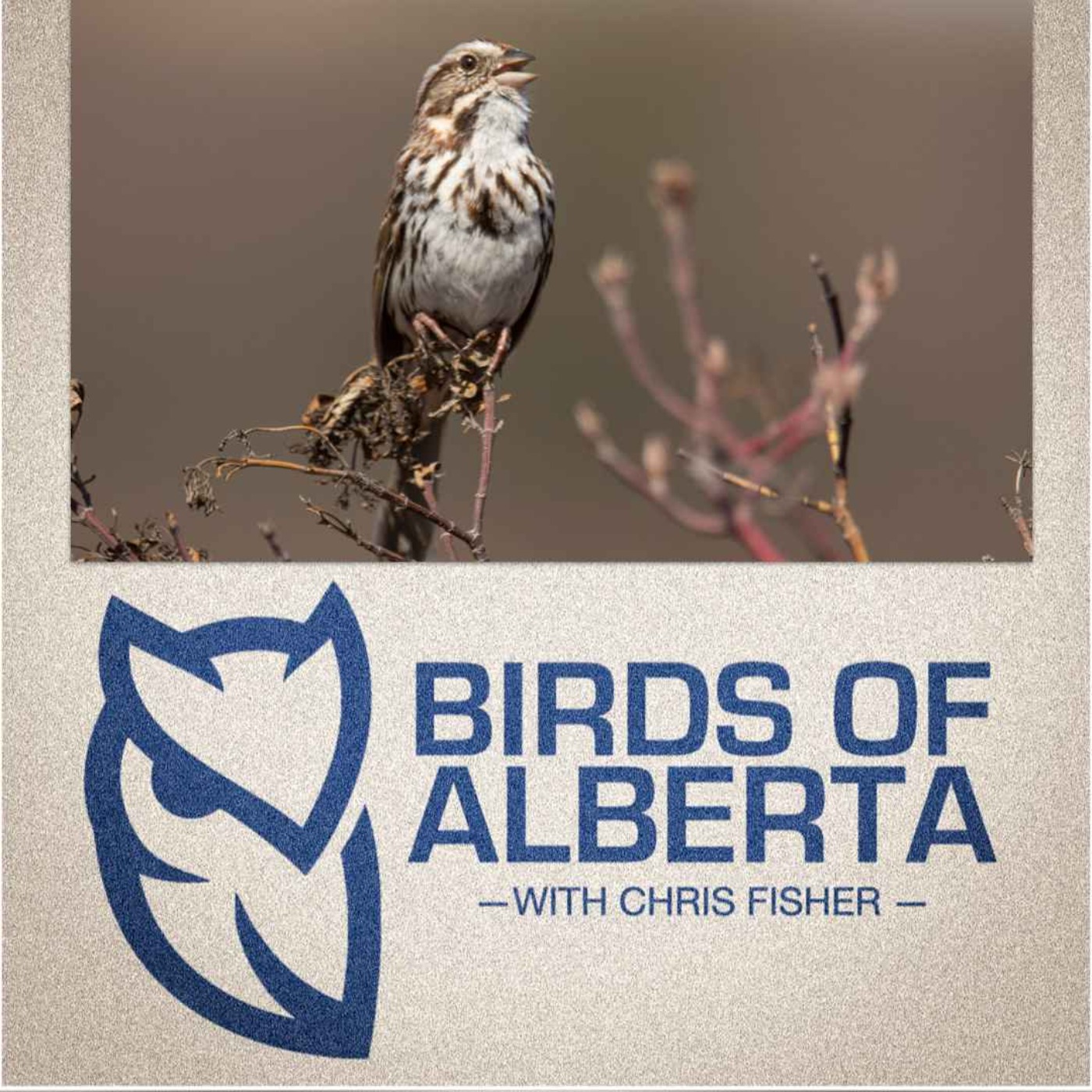
The podcast focuses on the Song Sparrow, a beloved bird in Alberta whose three-note song heralds spring. Its melodious and complex vocalizations are not instinctual but learned, with males crafting diverse repertoires to attract females, who favor mates with more varied songs. The bird's identification relies on its song, often remembered with mnemonic phrases like "hip, hip, hooray." Research notes that birds use absolute pitch, unlike humans, aiding their communication. Across Alberta, subspecies vary in plumage, from reddish-brown in eastern regions to paler versions migrating from the north. Despite Alberta's urbanization, the Song Sparrow remains a familiar presence in river parks, embodying both scientific intrigue and artistic beauty in its enduring song.
Welcome to the Birds of Albert, a podcast I'm Chris Fisher, co-author of the best-selling field guidebirds of Albert. Now, there are many things in life that I fail to fully appreciate, you know, such as the brush strokes of impressionist painters, the chord progression, resolution of classical music, the architectural importance of the keystone, or even how tough it is to directly drill under one of Albert's major rivers. But when I walk along a trail just about anywhere in Albert in mid-April, my ears seize hold of a series of notes, even though it has been more than ten months since the last time I heard them ring out. It's a little like being able to recite every last word from the top tunes from your high school days, even decades, even many decades after the songs were a hit. And while everyone's earworm playlist is a big different, I suppose my skill, my super power, if you will. And that of many other of our naturalists is that we can know this comforting springbird song in just three notes. We know it like the familiar voice of a friend because that is what it is. It's a song that tops the charts on Albert's summer soundtrack every May, and even though most Albertans know nothing about the singer itself, they know that the song means that the spring is here again. And so too is one of the most musical of our birds of Alberta, this song Sparrow. Sparrow is very important and significant bird of Alberta. It's a song that is very important in our city. As far as Sparrow's goes, it's a fairly big Sparrow, heavily streaked bird with a slightly longer tail than most. But if you're not familiar with our many Sparrow's, these identification tips perhaps are not very, very helpful. The classic pose of the song Sparrow is quite frankly of the male in spring, perched way up high, likely in an older or a willow. And up there he arches his head back with his tiny little crest raised, his beak opened, and he's singing out his song as if his whole world depends on it. And in a way, it sort of does. This Sparrow is really a Sparrow with a voice like Freddie Mercury. It is extraordinarily well-named because it is the Sparrow of Song. It's Latin name Melo Spiza Melodia. The Melodius Sparrow reinforces this. Even its French name, Bruxante Chanta, singer as well in the Spanish name Cantor, reinforces the fact that this Sparrow is famous for one thing, and that is its great ability to sing. And when it comes to bird songs, we often incorporate mononics, which are words put in place of the music so that we have shorthands to figure out what bird we hear off in the distance. Perhaps the most popular one for the song Sparrow is hip, hip, hip, hooray boys. The spring is here again. In some books you'll see it written out also as Mades, Mades, Mades. Put on your T. Kettle, Kettle, Kettle, Kettle, Kettle, which doesn't really ring very much like the previous one. An older one that we see now and then is Match, Match, Match. Pick Beatles off. The water is hot. Well, maybe not all these mononics ring the same way, but they all start with those three lone solitary notes that are very, very distinctive. So let's have a listen to what it actually sounds like, the voice, the song of the song Sparrow. [birds chirping] Well, those mononic devices are quite helpful, particularly keeping in mind those first three notes. Sometimes two, sometimes four. But those first three hip, hip, hips are very, very helpful in identifying the voice of this particular bird. And it's very difficult to otherwise describe it. It's a midpoint Sparrow, not only in song, but also in habitat choice as well. Typically the Sparrow's in Alberta that favor more open country. Those like the Savannah Sparrow, the best for Sparrow, or even the Clay Colored Sparrow, they tend to hang out in more open countries. They're buzzier qualities in shorter songs. And then those Sparrow's that tend to hang out in more forested areas, things like the Chippin Sparrow or Dark Eye Junkos, Lincoln Sparrow's or even White Throated Sparrow's. Those voices tend to be a little bit more trilly than the classic combination voice, quite frankly, of the song Sparrow that incorporates pretty much everything into its vocal repertoire. [birds chirping] Song Sparrow's don't come to their musical excellence by instinct alone. It takes a little bit of work in that work begins when they are still in the nest, hearing the songs of their father, and starting to imitate it, but not only being influenced by that male, but other males that are in adjacent territories. And they will incorporate elements of multiple songs into a repertoire of their own. And this really demonstrates a pretty sophisticated learning ability for these little birds that highlights an ability for them to combinatorially create a vocal repertoire and communication system that will be to their great advantage throughout their adult life. The beauty and complexity of the song Sparrow is certainly something that we all appreciate, but probably to appreciate it fully one has to hear the world like a bird here's the world. And that is a little bit different than the way humans perceive sounds. You see, we're pretty good at identifying relative pitch to recognize things like tone sequences and scales and chords. And for that reason, we're able to transpose very well. Even young children can transpose tunes from one key to another quite effectively. All birds, no matter how musical they are, don't do this very well at all. Decades of research have led researchers to conclude that unlike humans, the birds are really, really good at using absolute pitch, which means that they can easily identify and remember the true notes, the true tone, the true pitch of notes. They have a great ability at that and really not very good at transposing chord progressions as we can. So really when you think about birds, think of them very agile in tone and melody. And that is a very, very effective way particularly for birds like song Sparrow's to get up high and project and make sure that they are heard in a beautiful way over great distances. Singing and song is just such a very important component for most of the species of birds in Alberta, probably a quick discussion on the difference between song and calls. All notes are heard year round. They can be used for various alarm type of behaviors but also contact calls, those sort of things. The songs really serve two primary purposes. It's typically the male that produces the song, but not always. But typically it's the male and the male is trying to attract a female onto his territory and also send the other males in adjacent territories into a jealous fit and send them packing. But it isn't the competing males that are driving the company.
complexity and beauty of the song, Sparrow song. It is in fact the females because the females seem to be attracted not only to the song, but how many new combinations of the song are included. And while when we hear hip hip hip, the spring is here again boys, we only tend to hear it in one way. But researchers have been analyzing the precise order of every note and trill and buzz in those songs. And it has shown that over a half hour period of time the males will belt up to 8 to 12 different versions of that song. Never repeating the exact same thing and that playlist, that diverse playlist that keeps changing over time, seems to be the thing that attracts the females and demonstrates the breeding capacity of the males perched up high in those willows belting out their songs. And so we likely have the female song Sparrow's to truly and genuinely thank for the wonderful songs that we hear from the males every spring for the females. I suppose size really does matter, but it is the size of the males vocal repertoire that makes all the difference in wooing mates for this particular group. Well, obviously it is the song of the song Sparrow that takes center stage when thinking about the bird, but here in Alberta we have other very interesting components to deal with when discussing this particular bird. It has a range that spans most of North America and like many other wide ranging species, there are a whole bunch of subpopulation subspecies that look and sound a little bit different from each other populating the various areas of the continent and like many species, many of those subspecies come together right here in Alberta. The most common of the subspecies is kind of an eastern subspecies. It's the one that we see most often out on the plains and in the Aspen Parkland, the Boreal Forests, called the eastern subspecies. It's kind of a reddish brown bird with that big dark central breast spot. We see them and hear them quite commonly throughout the province. However, we rarely do get them in our backyard feeders. They tend to come through in migration, but when they do tend to come through they seem to head right to their breeding grounds rather than stopping in our backyard, which does encourage us to go and see them. If we want to make a little bit bigger of a trip and see a different looking song sparrow here in the province, just head to the mountains and in similar sort of open country, and there's not a lot of it in the mountains, but head out to open marsh country where you have a few of willows and alders surrounding these wetlands. Places like the cave in basin, marsh in Bant, is good for song sparrows. They'll kind of sound the same, but when you get your binoculars on them you'll see that instead of reddish brown, they're little red heads. Their plumage is very, very different and they represent a western species, a subspecies of song sparrows that ranges from the Rocky Mountains all the way to the coast and they look very, very unique. In migration for several years, particularly in the fall, I look forward to seeing a much paler version of the song sparrow coming through usually in late September or early October. The only time we see them, they're much paler and they don't have any hints of red in their plumage as well. And I'm not particularly certain where they are nesting. It's a bit of a mystery, but clearly it is north, probably in the northwest territories all the way up to the tree line, this paler subspecies. Nests and does use Alberta in its north and southbound migration and thrills us with a slightly different looking bird. Well, it's probably certainly not a recipe for commercial success to do two sparrow episodes within the first 15 episodes of this podcast. I promise you I'll move on to flash your birds in a bit. But, you know, the song sparrow is such an important voice. It plays in the background of the province just as it's resurrecting itself from the depths of our winter hibernation. We certainly recognize its value now and probably have always, you know, salt and milk in their classic book The Birds of Alberta, which was last printed in 1976, wrote that words do little justice to a song which is so well known and so well loved throughout much of Alberta. That's a perfectly fine descriptor of the song sparrow and maybe a little bit truer as they were better known in the 50s, 60s and even 70s as we were a little bit more of a rural province than as opposed to now when most of us do live in urban areas. However, even here a walk along our river parks will turn up the tune of a song sparrow or two. When you hear it and remark on how beautiful it is, you may ask yourself why is their song so good. You know, maybe it's the type of habitat they live in, these open woodlands, maybe they somehow inform the quality of the notes that there's something about these, these open auditoriums that make demands on their instruments or maybe it's their audience. The choosy females picking males with ever more complex and diverse songs. I don't know, but down the endless road of research papers, there must be a science behind it all. But this is a song sparrow after all. There is also no doubt an art to the music. With art, everyone interprets it in my ears, a song through their own ears, their own lenses and their own experiences. And that payoff is always very personal. And how could there be any more accessible artistry than that of the song sparrow among all the wonders that we have with our birds of Alberta?
Podcast Summary
Key Points:
The Song Sparrow is a culturally and ecologically significant bird in Alberta, recognized by its distinctive three-note song that signals spring.
Its song is complex and learned, with males developing varied repertoires to attract females, who select mates based on song diversity and complexity.
The bird exhibits subspecies variation across Alberta, with differences in plumage between eastern, western, and northern populations.
Research highlights birds' use of absolute pitch, contrasting with human relative pitch perception, aiding their long-distance communication.
The Song Sparrow symbolizes the arrival of spring and represents accessible natural artistry, appreciated across urban and rural landscapes.
Summary:
The podcast focuses on the Song Sparrow, a beloved bird in Alberta whose three-note song heralds spring. Its melodious and complex vocalizations are not instinctual but learned, with males crafting diverse repertoires to attract females, who favor mates with more varied songs. " Research notes that birds use absolute pitch, unlike humans, aiding their communication.
Across Alberta, subspecies vary in plumage, from reddish-brown in eastern regions to paler versions migrating from the north. Despite Alberta's urbanization, the Song Sparrow remains a familiar presence in river parks, embodying both scientific intrigue and artistic beauty in its enduring song.
FAQs
The Song Sparrow is a melodious bird known for its distinctive spring song, which signals the arrival of spring in Alberta. It is culturally and ecologically important, often heard in various habitats across the province.
The Song Sparrow's song typically starts with three clear, repeated notes, often remembered as 'hip, hip, hip, hooray boys, spring is here again.' These initial notes are key to recognizing the bird's vocalization.
Popular mnemonics include 'hip, hip, hip, hooray boys, spring is here again' and 'maids, maids, maids, put on your tea kettle, kettle, kettle.' These phrases help birdwatchers recall the bird's unique tune.
Song Sparrows learn their songs by listening to their fathers and neighboring males during early development. They combine elements from multiple songs to create a diverse repertoire, showcasing advanced learning abilities.
Songs are primarily used by males to attract mates and defend territories, while calls serve year-round functions like alarms or contact. Songs are more complex and often seasonal, tied to breeding behaviors.
Yes, Alberta hosts multiple subspecies, including a common reddish-brown eastern type and a western subspecies with grayer plumage in mountain areas. A paler subspecies also migrates through in fall, likely nesting farther north.
Chat with AI
Loading...
Pro features
Go deeper with this episode
Unlock creator-grade tools that turn any transcript into show notes and subtitle files.
 PodcastTranscript AI