The rise of online permit systems in popular wilderness areas like the John Muir Trail and Snowmass Lake reflects growing concerns over overcrowding and the loss of solitude. While the Wilderness Act mandates untrammeled, primitive recreation, modern permit systems are designed to control access and preserve natural conditions. However, these systems often exclude marginalized groups who face barriers to technology, affordability, or time to plan trips. Cultural assumptions about solitude—rooted in Western ideals of isolation—are challenged by diverse experiences of nature, such as connection with landscape through conversation or shared presence. Research indicates that crowding is more influenced by human behavior than by visitor numbers, suggesting that behavioral policies like quiet zones or campsite spacing could be more effective and equitable than permits. Additionally, historical eugenics movements shaped early conservation, and today’s exclusionary practices risk repeating those biases. While permits reduce pressure on specific sites, they also limit spontaneity and can alienate those who value shared experiences over solitude. Ultimately, the debate centers on balancing access, environmental protection, and cultural diversity—highlighting that wilderness is not just a space for solitude, but a shared human experience shaped by culture, equity, and evolving values.
(phone ringing)
- Hello.
- Morning.
(phone ringing)
- You have a good place?
- Yes, but it wasn't, it wasn't long enough.
- My best friend Holly and I wanted to hike
the John Muir Trail in California, Sierra Nevada.
- The tickets go on sale at 70 at my time.
- Let's do it.
- This is how a lot of overnight trips
and wilderness begin these days.
Mums in advance on a computer.
- Specifically on the federal government's
recreation reservation website.
- Okay, so you wanna log in to rec.gov
and go to explore available permits.
- I'm not putting that away.
- And then, so the day that's about to go on sale
is July 30th, and then for two people,
it feels kind of like getting concert tickets
because the most popular trails get snapped up immediately.
And the John Muir Trail is incredibly popular.
- Okay, wait, but it's about to turn seven.
So like this is serious business.
Like as soon as it turns seven,
it's gonna be wild.
- The pun was not intentional, I'm very sorry.
- And then, like once it's in your cart, don't let it go.
(laughing)
- Okay, it's gonna be in three, two, one.
- Ready?
- Not to be like back in my day, but back in my day.
And we're not talking about that long ago.
Our backpacking trips didn't start like this.
Only some of the most popular wilderness areas
required permits.
Places like Yosemite or Olympic National Park.
We just show up at the Ranger Station,
the day we wanted to start our hike
with a few trip options in mind,
see which permits were available
and set out on the trail.
Lessor visited wilderness areas
we'd go right to the trailhead,
fill out a form to register ourselves and be on our way.
On those trails, we'd maybe see a few people
camping at the same lake as us,
but we would also find stretches of trail
where we'd be by ourselves.
Now, with more people visiting wilderness areas,
it seems like solitude is harder to come by.
It certainly feels that way,
having this set in alarm to snatch up this permit months
in advance.
And opportunities for solitude
is something that's required in the wilderness act.
So land managers have started switching
to these permits reserved ahead of time online
as a way to control the numbers.
But these permits have trade-offs.
I might get my solitude experience,
but at what cost?
At best, permits are annoying to get.
And at worst, they can end up excluding people
who already have a hard time getting into wilderness.
What do we do about these trade-offs?
And is everyone seeking solitude in the wilderness anyway?
(upbeat music)
This is How Wild, a podcast about wilderness,
how it's changing, and what that says about us as humans.
Episode four, solitude.
(upbeat music)
I'm just standing in the woods,
talking to myself.
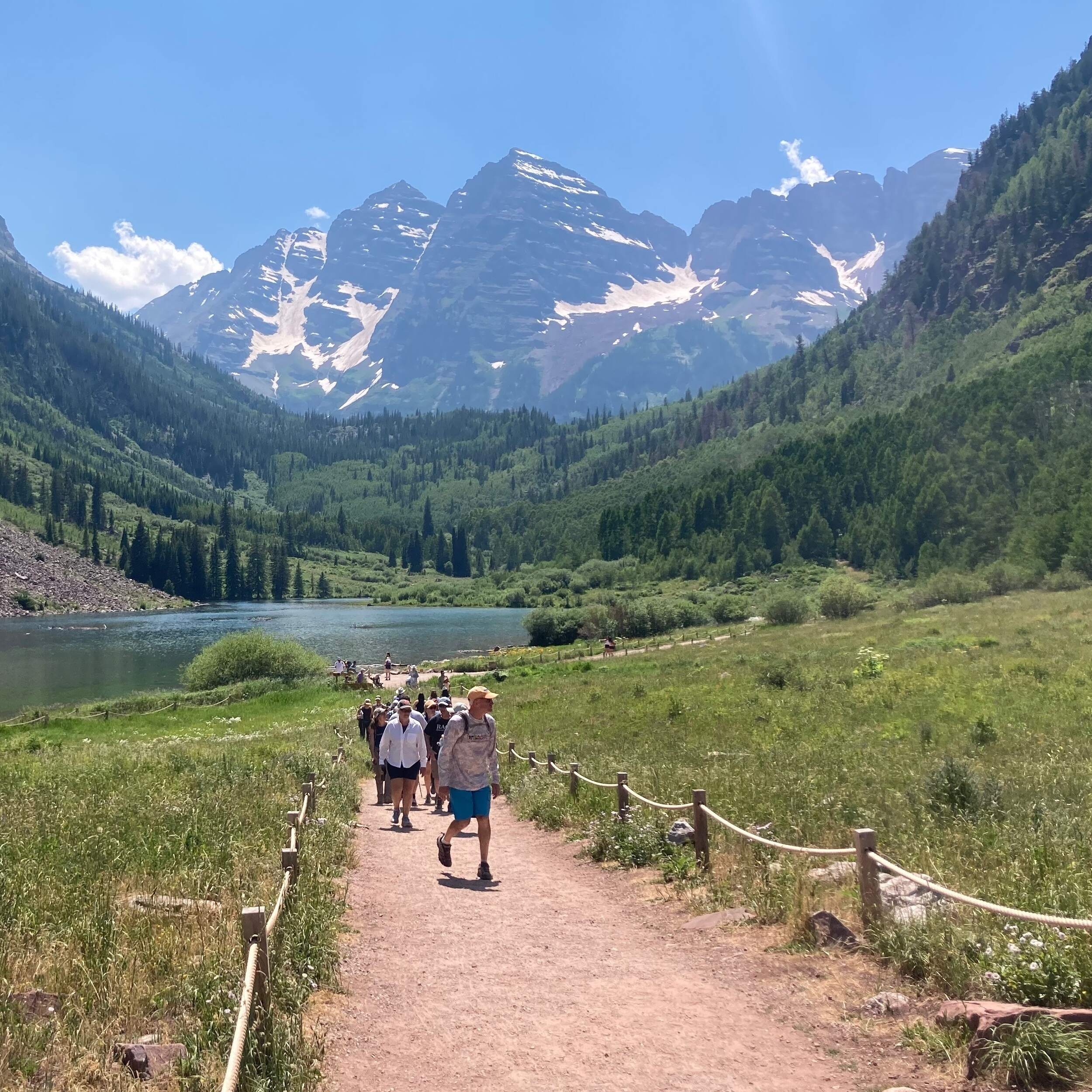
It's the summer of 2023,
and I'm at a trailhead entrance
to the Maroon Bell's Snowmass Wilderness
in the White River National Forest,
outside Aspen, Colorado.
It's beautiful here, there's Aspen.
There's a creek, there's birds singing.
The Maroon Bells get their name
from these dramatic reddish purple mountains.
The high alpine meadows here are gorgeous in the summer.
In the fall, the Aspen turns stunning gold.
Gonna bother back-backers.
The opposite of solitude is a journalist bothering you.
We're only about a four hour drive from Denver,
and this is a really popular place for tourists.
People come to day hike,
but there's also a famous backpacking route
called the Four Pass Loop.
- Hi. - Hello.
- Welcome to the wilderness.
- I finally get my first backpackers.
- Doing a story about the new permit system here?
- Oh yeah, can I ask you all a couple questions about it?
- This year, for the first time,
a permit is required to hike the loop.
- Where are you heading now?
- We're heading up to Snowmass Mountain.
So going up to the lake and camping there.
- I wanted to come here because a few summers before,
Holly and I hiked from this trailhead to Snowmass Lake,
where these people are headed.
And I was shocked at how many people were there.
And remember, I'm from California,
where most of our trails are pretty busy.
These four hikers are from the Denver area.
- And so do you all the permit?
- Yes.
- Did you log on like at 8am, the six months before kind of thing?
- 100%, we had it in our calendars,
everybody's on their computer, 8am, here we go.
- Hammond, I did the four pass loop last year
before we, you know, the permit.
- And what was your experience like doing the four pass loop
without a permit?
- Perfect.
(laughing)
- Yeah, it was great up until the lake.
The lake was a bit of a shit show
'cause there was 10,000 people there.
I mean, there were people who couldn't find
camping spots at the lake.
So I dig the permit from that,
just to kind of thin the herd a little bit.
But then it's kind of a pain in the ass
'cause you have to be very specific
at which we can you want.
- Have a great time, good luck, something.
- We've got more backpackers to bug already.
- And with KLW Public Radio,
which is in San Francisco.
So I'm just interviewing people
about their experiences with permits.
- Quickly.
- Yes, quickly.
- These three guys live in town's nearby
and grew up hiking here.
- How do you feel about the permit system?
- Maybe it's a necessary evil.
It's probably a good thing,
but it's a challenge to see these areas
that are beginning really crowded
and people from California coming out
and enjoying all this stuff
that we used to feel like was just our own.
- Fair enough, point taken.
Anyone else?
- Nope, I'm ready to start walking.
- Cool.
- Bye guys, thanks so much.
- Remember, under the Wilderness Act,
capital W Wilderness areas like this one
have to be untramult, undeveloped, natural,
and have opportunities for solitude
and primitive, unconfined recreation.
And when I say Wilderness Act, what that means is,
it's a law.
Congress passed it, the president signed it.
So land managers who take care of these places
have to make sure that the Wilderness areas meet that law.
When Holly and I were up at Snowmass Lake last year,
where there were so many people
we couldn't find a flat place to camp,
a person could say there wasn't an opportunity for solitude,
that the area was out of compliance
with the Wilderness Act.
To ensure solitude, land managers tend to all reach
for the same tool in their tool belt,
and that's permits.
- Or how to leave our message
for the closing of the snow signal.
- Later that morning, I head out with the district's
Wilderness and Trails Program Manager, Katie Nelson,
to check people's permits and answer questions
about the new system.
We're on the trail that's the main on ramp
to the four pass loop.
It's a sunny summer day, and the trail is crowded with hikers,
starting and finishing their trips.
- But does the challenge of stopping people?
I'm usually so hungry.
I've been thinking about hamburgers for like two days.
- Katie is a consummate Wilderness Ranger.
Like as we're hiking at a clip,
she scoops down to pick up trash on the trail
and then pockets it without missing a step.
- Could you just pick up trash?
- Yeah.
- Her green forest service uniform kind of makes her a magnet.
- Hey, do you know how long the scenic loop is?
- I mean, do you have a recommendation
between like scenic loop crater lake?
Well, it depends on how long you want to be out.
- How much longer is that for me?
It was probably like that.
- That would have left a bottle to be just taken.
- The water bottle?
- Yeah, it's on the ground.
- She remains good-natured about all of it.
How's your day, Ben?
What's the highlight?
- Even though she's in the midst
of what is arguably one of the hardest things
for a Wilderness area to do,
change a longstanding policy.
We get to a big wooden sign on the trail.
- These are our new trail head access signs.
With some, I think, pretty cool updates,
including the information about the permit system
in English and Spanish.
- Katie and her team have been doing a lot of work
to get ready for this moment.
Setting up the website, creating a welcome video
and sharing info with local groups.
- Hi. - How are you?
- Oh, pretty good.
- Looks like you had an adventure.
- Oh, I hope.
- Yeah, I heard you Katie, Emma Ranger here.
- Hey, thank you.
- Yeah, where'd you guys go?
- There, how are you doing, Ben?
- Can't bat Snowmass Lake.
- And then we camped at East Fork.
- Okay. - So we had two nights, three days hiking.
- Did you do the Fort Pass Loop?
- Okay. - Fort Pass Loop.
And how was the permit system for you?
- I just got lucky last week
and somebody canceled their Snowmass Lake.
- How was Snowmass Lake?
How did the crowds compare last time to this time?
- I don't think it was as crowded.
- So that's a good thing.
But yeah, there were two surface poopers on Snowmass Lake.
- Well, Mary, who's up there?
- He says surface pooper,
which I guess means someone who didn't bury their poop
properly, which is what you're supposed to do.
I don't know if surface poopers is a technical term.
I've never heard it before.
- I was able to rebury one of them,
but the other one, it was like, oh God, you know,
I really don't feel like picking up
somebody else's toilet paper.
- Snowmass is really heavily impacted.
So I'm really curious to see with the permit system
if we see any changes.
- Slide.
- Ranger Katie says this is the reality
of these popular wilderness areas right now.
There's just a ton of people visiting.
- You know, the four past loop is a trip.
You know, we talk to people today
and it's like the first trip they want to do
or people that it's their lifetime trip.
And there's a reason why it's so popular.
And it's because it's stunningly beautiful.
[BLANK_AUDIO]
world class. I think that's the, I don't know, the tension, right, of an incredibly popular place
and there's a certain kind of limit to the ability of the landscape to withstand that.
The decision to require permits here didn't come easily. Katie says, "World Artist
Managers Before Her" have been documenting an increase in visitation for decades. That's a trend
across wilderness areas in general. Katie's team began exploring the possibility of implementing
a permit system and solicited feedback from the public. What we kind of heard through is, like,
hurry up for a service, like, please, like the Mirrenbalsnames wilderness is, like, begging
for some, some protection, right? People weren't just concerned about the lack of solitude.
Katie says this goes beyond that. Solitude or not, the resource impacts are unacceptable,
right? Like, we've seen campsites grow and grow over time and we've seen the vegetation
become denuded. We literally have a place people call the poop willows. I remember this from my
trip with Holly. There was a stretch of willows along the lake that clearly everyone had been
using for a bathroom. Super gross. Land managers talk about something called carrying capacity.
It means the number of people that can be on a piece of land before the land becomes degraded.
In the case of a place like Snowmass Lake, there's just only so many flat open spots for people
to set up tents. If there's too many campers, people start spreading out and camping on
places they shouldn't, which can kill plants in the process. So, land managers use permits to
ensure the natural conditions that are required in wilderness while also making sure people have
opportunities for solitude. But what is solitude exactly? I mean, it has a definition, you know,
see Miriam Webster, but the feeling of solitude, that's going to differ from person to person.
Solitude of a hundred years ago might be different than solitude of a hundred years in the future
and right, like solitude for me might look very different for you, for them. And whether or not you
even value solitude and what you perceive as crowded can often be cultural. Solitude invokes loneliness
for me because, I mean, let's face it, I'm from India and there are a lot of people there. This is
a partner, Roger Gopal. She consults environmental organizations on diversity, equity, and inclusion
justice work. And I just think of being alone and for me, it's not a positive feeling. I kind of
want to be with other people. A partner's family version of camping was 25 or 30 of her family members,
renting vans or RVs and caravanning out to a group site at a national park. When we were a family
camping, like our neighboring campers would stare us down, like they were pissed. They were like
not happy that there was a huge group of Indian people. The smells were probably one piece
to eat, cooked a lot of Indians food, we were loud, laughing. And so that was my cultural experience
growing up. Those camping trips were transformative for our partner and she wanted more. Later,
she became a guide for the National Outdoor Leadership School or Noles, the org that helped develop
what led to the leave-no-trace ethic, like pack out your waist and let nature sounds prevail.
And on trips, she taught those principles to kids. Telling kids from similar community-oriented
cultures that they have to stay quiet didn't felt right for me. A lot of times the kids were
loud because they were just excited to be in a beautiful place. So this goes back to the question
of who decided what's the appropriate way to experience nature? Because if it is a group
of immigrants or people of color who are engaging in these places in a way that doesn't
feel like the right way, like not solitude, loud, there's automatically assumption that they're not
treating the place well. The quote-unquote right way to be in wilderness, what we've been calling the
John Mirror version that a lot of people have adopted, is you should be alone in nature and be quiet,
contemplative. You hear a lot of people say that nature is their church.
I think it makes me laugh, frankly, that's like first of all, like I don't know if people have been
to like a Hindu temple, for example. I mean it is loud. So like that doesn't translate
to me. I get to exclude even saying church, like excludes so many of us who are not Christian
and who don't go to Christian churches. It's not wrong to call nature your church,
but the language we use to talk about wilderness reveals the culture it came from, right?
As Americans or settlers were colonizing, usually we have tales of like the first few people who
went and did the thing and usually they're alone, like living in a cabin and those stories and
those people were glorified. And so that that became how we need to connect with nature.
She says, think about the book Walden. That we, you know, ever a lot of us were assigned.
I was assigned in California schools for sure. Henry David Theraugh's book.
The famous book from the 1850s was about a guy living a simple life connected to nature
in a cabin on Walden pond in Massachusetts. But the way he writes makes you think he was actually
living very, you know, in solitude, but he wasn't. He actually had neighbors. There was a community
of freed African Americans who were also living there. So from early on solitude is a story more than
it's an actual reality. And that story goes in some dark directions. That's after a quick break.
You see the headlines every summer. Articles about the overcrowding in wilderness, how we're loving
our parks to death. A partner, Roger Gopel says those worries unfortunately have some very dark
roots. It starts with this idea of purity of nature. It was the early 1900s and some of the key
figures in the conservation movement like Teddy Roosevelt who championed the national parks,
Gifford Pinchot who led the forest service also believed in eugenics, the practice of promoting
certain human traits in the gene pool. In this case, what we're talking about is promoting whiteness
by making sure white people only reproduce with other white people or promoting able bodiedness
by discouraging people with disabilities from having kids, discouraging or even sometimes
forcibly sterilizing them. These eugenicists were also against immigration. They wanted to ban
immigrants from countries which would come and muddy the gene pool of the US supposedly.
At this time, the US was passing a bunch of super restrictive immigration laws. They were really
concerned around establishing a natural order and eliminating what they determined or deemed was
unnatural. This all weirdly extended to the environment. They wanted to maintain the natural
order with an animals and plants as well. These guys were super into saving the white race and
saving California Redwoods, saving them for white people. Why am I telling you this? Because today,
when we worry about overcrowding in wilderness and loving our parks to death, we have to be careful
we don't make the same mistakes as in the past, when some conservationists only worried about
overcrowding by certain groups of people. This is an ancient history by the way. As recently as
the 1990s, the Sierra Club was advocating for anti-immigration policies. Why was an environmental
group getting involved in the immigration debate? Because it was framed like this. More people coming
into this country means more people having an impact on the land. Ergo, we should restrict people
from coming into this country. A part of us today, when people complain that these places are too
crowded, but it seems like a natural thing to do is let's just restrict access. Let's just increase
fees. Let's just have really complex online reservation processes that a whole bunch of people
can't access. The takeaway from this story should absolutely not be supporting permits in wilderness
makes you racist. But what I'm trying to bring up is why did solitude become a value in wilderness
in the first place? And how does this focus on solitude or the supposed lack of solitude end up
restricting who gets to come to these wilderness areas? Yeah, we don't really have evidence to
support that there's less opportunities for solitude because solitude is an normative thing.
This is Will Rice. He's an assistant professor of wildland management at the University of Montana.
He's done research to show that when people talk about the feeling of solitude and wilderness,
it's based on a lot of factors. Whether or not you can hear other people, whether you can
spread out and go somewhere else. And it's this whole kind of soup of things that end up
becoming this concept we call solitude. So even if the number of people visiting a wilderness
area is increasing, Will says it doesn't necessarily mean solitude is on the decline. Will,
and others research has shown that a big factor that contributes to whether you feel like the trail
is crowded has to do with the behavior of other people you run into on the trail. And that's
good news in a way because laymanagers can address these issues and say, hey, it's actually about
the behavior of people. It's about the noise people are making. It's about the distance they're
camping from one another. Those things managers can run with, right? They can build campsite areas
that are further apart. They can use signage that ask people to be more quiet or not litter.
I mean, there's a really dark side to this as well. We've already talked about how people can
police each other's behavior on the trail. And it often falls along racial lines. There's one
study that shows white people are more likely to feel comfortable with the amount of people on the
the trail if the other people are all.
also white. Plus, Will says when people perceive trails to be overcrowded, that's what leads
to permit systems. Will did research on campgrounds that require advanced reservations online,
and what he found is those reservations often end up favoring people who are higher income
and white. That's because those people are more likely to be able to plan their vacations
in advance, and they're more likely to be tech savvy enough to navigate these online
systems, and have fast enough internet to snatch up the campsite at exactly the moment
it becomes available. Plus, these reservations usually come with fees, so they have to be
able to afford them. The trade-off of permits is why Will says we have to be careful about
this claim that we're loving our parks to death. Death is final. There's no coming back.
I mean, loving our parks to death, I think it's just too strong of a word that really scares
people, and as soon as we start talking about, hey, these things are gonna die if we don't
do something, we start pointing fingers at who's the problem, and all of a sudden, that's
when we start talking about things like Bluetooth speakers and large group sizes and those
sorts of things, and that's somewhat dangerous narrative when it comes to the ability to
use that to exclude people from our parks. It's that same conversation I have with myself,
I'm like, this is really hard stuff. I literally lose sleep over it because I'm like,
the public trust me to protect this place, and I understand what it takes.
Back on the trail, Ranger Katie says another trade-off she loses sleep over is introducing
permits means Rangers have to enforce them. Us approaching someone in the wilderness
in uniform impacts them, right? Like, especially if you say, I am going into the mountains to just
unload the pressure of the world. I'm out here, I'm unplugged, like I've forgotten about
the world, and here's a uniform. After weighing all these factors for years, Katie Nelson and
her team decided that permits for a charismatic place like Snowmass Lake was the best option.
After Holly and I camped there, we left the popular trail and headed out on a lesser-used
route. After a night spent camping near the poop willows, we saw no one for 24 hours.
So we got our solitude experience. But what's better for the wilderness itself? Is it worse
to have a bunch of people concentrated at one lake, where people are camping on top of
grasses and killing them in the process? Or is it worse to have people spread out, disperse
their impact? So have less of an impact on one place, but a little impact all over the
place. There's more science needed to figure this out.
The concept of public lands is like in these places, people are part of it. I don't know
it's right or wrong, it's just like that's what we've done here. We accept that people
are going to be in these spaces, and so then how do you do that? How do you have people
on the landscape and think about wildlife? How do you have people on the landscape and
think about water quality and think about all these things you've identified? I will
just be the first day like I think it's imperfect. When I'm back alone I run into some hikers
who are just finishing a backpacking trip. Welcome home. Can I ask you about your trip?
Raina and Ethan are just coming back from camping at Snowmass Lake. What do you think? Beautiful,
gorgeous, high elevation, hard to breathe. Rain is from the east coast, Nathan's from Colorado.
So you'd been a snowmess before? How did it compare before the permits to now?
Yeah, definitely a different kind of system. When I first came up here a couple of years
back, I felt more crowded. They originally got permits to do a longer hike, but when they
were up there and realized there was still snow on the mountain passes, they decided to
change their plans. So that was the one downside for me for the permit system is if you are
up there and due to something you need to change your plans, it's just one thing kind of
inhibiting you from doing that. I do like the feeling of solitude. I think it's a little
bit of a conundrum too because the permit system allows the trail system to be a little less
crowded, that you know, snowmess lake to not be maybe a complete zoo, but part of solitude
for me too is kind of autonomy and the ability to make decisions on the fly. And you know
the downside with the permit system is really it's harder to do that. Yeah, he was upset about it.
Do you want to say more? Yeah, I mean it is it's something I go back and forth on because
I see a lot of you know disrespect or just maybe people not being thoughtful of being in nature.
So I in a lot of ways I'm for the permit system because I just don't know how else to fix that.
These places are getting love to death, but it is there's a loss for me too of being.
I think it's a hard transition for you because you are used to just being able to go anywhere at
any time. Yeah. Unrestricted. Yeah. That's what's always kind of appealed about the west to me is
you know the wilderness is the wilderness and you go out and choose your own adventure, but
kind of feels when you book a permit almost like booking a hotel sometimes. So, uh,
but say happy.
Like Nathan, I'm having a grapple with this. If I really believe in these places as being for everyone,
those of us that were used to fewer people need to get used to sharing.
I also think about something a partner Roger Gopal said to me that she's not seeking solitude in
wilderness. She's seeking connection with the trees, the mountains, the creeks and lakes.
She almost thinks about them as other people. And sometimes even if I'm like technically alone,
I'll talk to them. And so it never really feels like I'm in solitude. You know, the
I'm in conversation with with everything that's around me. And usually I like to be with other people
as well. My loved ones. I think about Holly. My main experience in wilderness isn't total solitude.
It's with her on her trips every year. There's a way to connect and deepen our friendship.
Okay. I got one. Yeah. I think I yes, I got one. I'm like still in denial about it. Okay.
Proceed to cart. Oh my god. Is this actually going to work? Yeah. Oh my god. Okay. Payment confirmed,
receipt generated order complete. Oh my god. Oh my god. I'm about seriously. Yeah. We have a permit.
Amazing. Yeah. Amazing. How many years have we been talking about this permit? Yeah. I know. I can't
believe it. I really was, um, doubtful. I mean, you saw how fast it went. I know.
Ha ha ha ha ha.
The wilderness act says wilderness is a place for primitive recreation,
but how primitive are our backpacking trips if we bring our phones with us on the trail?
That's on the next episode of How Wild. Make sure your phone is charged.
How Wild is created and executive produced by me, Merce Ortega Welch. It's edited by Lisa
Morehouse, additional editing and sound designed by Gabe Graben, partnership building by Shrine Ado,
fact checking by Marker Mayo. It's produced in partnership with KALW Public Media
and distributed by NPR and made possible with support from California Humanities,
a partner of the NEH. This podcast is produced in Oakland, California on the unceded and
sustral homeland of the Alonigh. Learn more about the Indigenous communities where you live at native-land.ca
The state of the union is not good. The energy crisis has developed into a money crisis.
Politics. Yeah, we know. It's a lot and it's everywhere. Your phone, your feed,
your dinner table and probably your blood pressure.
The politics is also the human story behind the headlines. Our hopes, disagreements,
choices and visions for what comes next. This fall, the American storytelling collection
brings together six podcasts from the NPR network that take a closer look at the people,
power, conflicts and turning points behind American politics from every angle.
It's going to be carpet bombing, take no prisoners, you name total warfare.
You'll hear it in a show called The Speaker, tracing the course of Nancy Pelosi's rise from
local volunteer to national power broker to lightning rod of American politics.
We had a pretty bitter content to stand off at this hour. Hit the head, knock down, drag out of there.
You'll sense the real stakes in a show called "Landslide," detailing the most
razor-closed presidential primary race in history and the way it reshaped political parties
thereafter.
"So, 19th Amendment was staked."
"Uh-huh, yeah, I think so."
The sounds of the "Extremely American" podcast where they tackle how extremist movements
still shape America today.
We would not have one Democrat president in the last 50 years if only they could go.
But the series is about politics in our backyards, too.
Take a podcast like "Swing State of the Union," a show exploring the hot-button issues in
Wisconsin and how they're motivating voters nationwide.
"There's lots of money at stake, and if you get in the game, the AI data-centered game
before you're a competitor, you're going to be in a better position."
And scandalized, we're unpacking political scandals from history to learn more about
what happened.
If you were to pay me, is there any way the media can find out where it came from and
how much?
How the scandals aftermath changed American politics, and what on earth they were thinking.
"I'm probably never ever going to see a story like this again."
In a whole other country, a podcast traveling the bumpy roads of West Texas to explore the
shocking, almost mythic story of the Republic of Texas, a real secessionist nation in the
Lone Star State.
All of the shows in the collection reached beyond the headlines.
To explore how political action is the messy, deeply human business of deciding how we
want to live together.
So take a breath, hear the stories behind the soundbikes.
After all, it's human to get political.
Listen to all the shows now by searching American storytelling from NPR on the NPR app
or on Apple Podcasts.
Podcast Summary
Key Points:
Online permit systems for popular wilderness trails, like the John Muir Trail and the Four Pass Loop, are now required to manage overcrowding and preserve solitude.
These systems, while intended to protect natural conditions and enforce the Wilderness Act’s requirement for untrammeled recreation, often disproportionately favor wealthy, tech-savvy, and white visitors.
The concept of solitude is culturally biased, rooted in Western ideals of isolation and quiet contemplation, and may exclude diverse cultural experiences of connection with nature.
Research shows that trail crowding is more about human behavior—like noise and distance between campsites—than actual population density, suggesting behavioral management could be more effective than permits.
The permit system creates trade-offs
Historical eugenics and exclusionary conservation ideologies have shaped modern wilderness policies, risking the same racial and social biases in current access restrictions.
Some hikers value connection with nature over solitude, seeing the wilderness as a space for shared experience and dialogue with the environment.
There is growing scientific need to evaluate whether dispersed, low-impact use is better for ecosystems than concentrated, permitted use.
Summary:
The rise of online permit systems in popular wilderness areas like the John Muir Trail and Snowmass Lake reflects growing concerns over overcrowding and the loss of solitude. While the Wilderness Act mandates untrammeled, primitive recreation, modern permit systems are designed to control access and preserve natural conditions. However, these systems often exclude marginalized groups who face barriers to technology, affordability, or time to plan trips.
Cultural assumptions about solitude—rooted in Western ideals of isolation—are challenged by diverse experiences of nature, such as connection with landscape through conversation or shared presence. Research indicates that crowding is more influenced by human behavior than by visitor numbers, suggesting that behavioral policies like quiet zones or campsite spacing could be more effective and equitable than permits. Additionally, historical eugenics movements shaped early conservation, and today’s exclusionary practices risk repeating those biases.
While permits reduce pressure on specific sites, they also limit spontaneity and can alienate those who value shared experiences over solitude. Ultimately, the debate centers on balancing access, environmental protection, and cultural diversity—highlighting that wilderness is not just a space for solitude, but a shared human experience shaped by culture, equity, and evolving values.
FAQs
Permits help control visitor numbers to protect natural conditions, preserve solitude, and prevent overuse that can degrade ecosystems and vegetation.
Permits can improve solitude by limiting crowds, but they may also reduce flexibility and autonomy, especially when hikers are restricted from changing plans on the fly.
No — they often favor higher-income, tech-savvy, and white visitors who can afford fees, plan in advance, and navigate online systems efficiently, potentially excluding others.
Yes — the Wilderness Act mandates that designated wilderness areas offer opportunities for solitude and primitive recreation, which is why permits are used as a management tool.
Trade-offs include reduced flexibility for hikers, potential exclusion of marginalized groups, increased enforcement demands, and a shift from organic, spontaneous outdoor experiences.
Yes — what one person sees as solitude, another might see as connection or community, and cultural backgrounds greatly influence how people experience and value nature.
Chat with AI
Loading...
Pro features
Go deeper with this episode
Unlock creator-grade tools that turn any transcript into show notes and subtitle files.
 PodcastTranscript AI