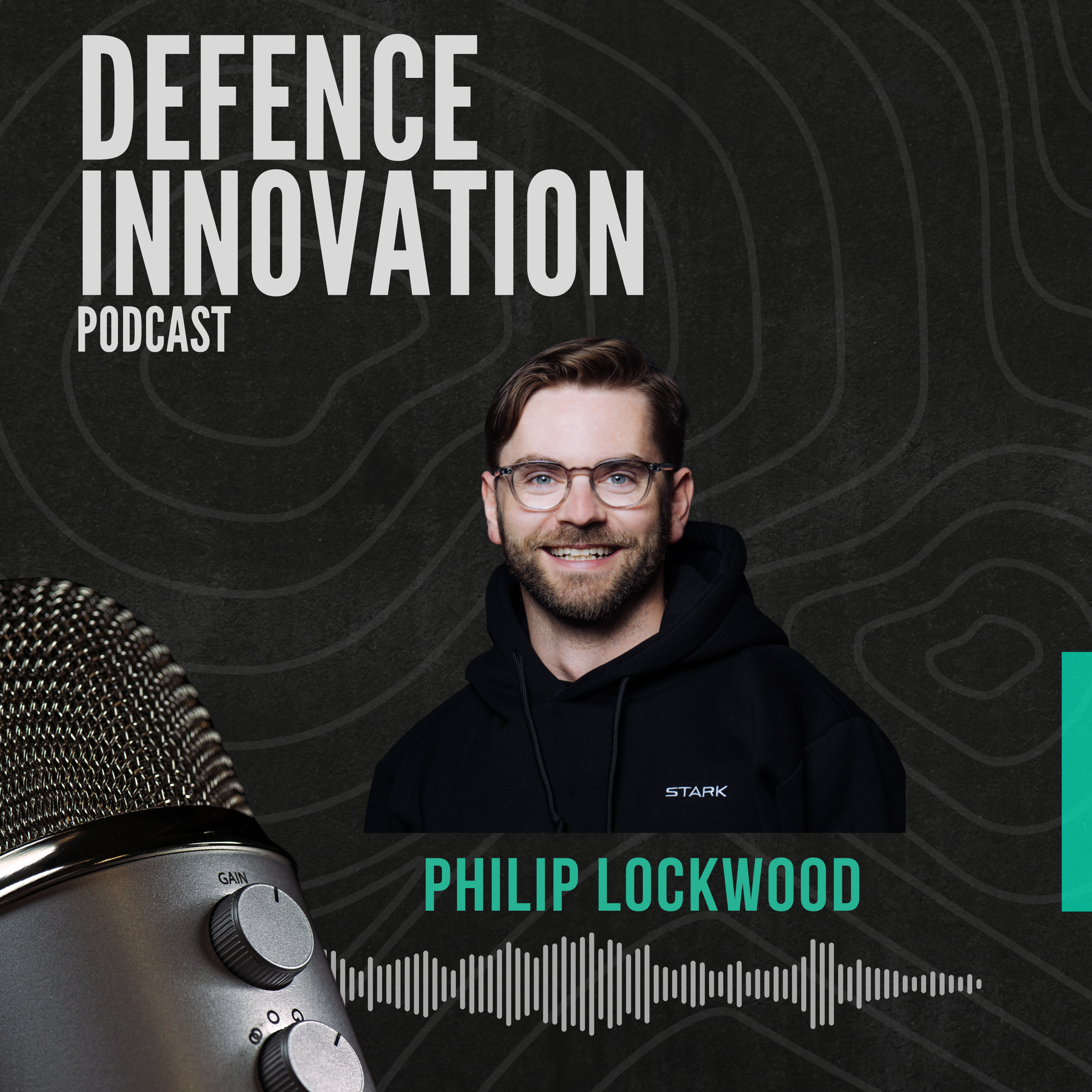
Software defined defence: How STARK is shaping multi-domain operations - With Philip Lockwood
from Defence Innovation Podcast
55m 2s
Phil Lockwood shares his diverse journey from Canadian military special operations to corporate law, NATO's innovation unit, and now Stark, a defense tech startup. His path was shaped by a family interest in futurism and technology, and a pivotal moment—the loss of a friend in Afghanistan—that drove him to work in defense policy and innovation. He emphasizes the critical gap between commercial tech development and defense needs, as R&D funding has shifted away from military contexts. Key technologies he focuses on include artificial intelligence, autonomy, quantum sensing, and mosaic warfare, which aims to decentralize battlefield decision-making to avoid cognitive overload and enhance resilience. He explains that quantum sensing could transform anti-submarine warfare, while mosaic warfare distributes sensors and effectors to reduce reliance on vulnerable high-value assets. The challenge lies in ensuring autonomous systems act reliably, akin to human concepts like commander's intent. Phil stresses that these technologies are not yet fully realized but are trending toward solving major defense capability gaps, particularly for NATO. His ADHD-fueled career path reflects a consistent drive to bridge operational experience with policy and innovation, aiming to keep democracies secure in a time of heightened threats.
[MUSIC] Phil, thank you so much for taking the time. I've been looking forward to this conversation for quite some time. As we always do it when we start our conversations, please give us a short introduction. Who are you and how did you end up here? >> Amazing. Hey, Jonas, it's a pleasure to be on. I've also been really looking forward to a good conversation here on a rainy Friday afternoon in London. Who is Phil? I am originally from Canada, but I happen to also have passports from the UK and the US and Ukrainian and Polish heritage. On a sense, I feel very NATO, very transatlantic in that regard. My dad's from the UK and my mom is Canadian-born, but with Polish-Ukrainian heritage. I have been in London for just a short period of time because right now, I work for a very fast-growing defense technology startup called Stark. What does that mean? It means I am Phil Lockwood. I am not Tony Stark. I am not Ironman in any sense of the word. But I have a pretty exciting job, I think nonetheless in being able to help this company look at the NATO alliance and think about what are the types of technologies and capabilities that we can develop to help Phil really critical capability gaps that the NATO alliance has right now in a time of very distinct threat, particularly on our Eastern funk, but I think just in general across the globe. So I work with Stark on our technology roadmap. I also look at our overall growth and our global expansion across various markets. And so it's been a really interesting journey being with this company. Before that, I used to be at NATO headquarters where I ran the NATO innovation unit. I'll probably get into that at some point. And I have also been a corporate lawyer on both sides of the ocean. And before that, I was in the Canadian military doing a bunch of different tasks, primarily in the special duties, special operations community. So I'd love to ride away dig into the technologies, but let's park this for a second there. We'll get into it in a second. But I'm always curious to understand what the golden threat is through people's lives and different, very different stages in your case, certainly. When you're military, lawyer, NATO, and now one of the fastest growing, if not the fastest growing, the defense tech startups in Europe, would you think is the golden threat? Yeah, I think, I mean, first of all, to be clear, I have ADHD. And so this is, I think one of those don't try this at home kinds of career paths. It doesn't always make sense, even in my brain, depending on what's going on with the hamster wheel. But I think there's a few pieces. You know, one, we were chatting about our parents a little bit earlier on. And I remember as a kid being really inspired by my father, my uncle, my grandfather, all of whom were futurists in a sense and really liked to use new innovative technologies and to think about what was on the cutting edge and what was on the horizon. Really big sci-fi fans. And so kind of being in that atmosphere always made me think about the possibility of innovation of mankind. We can really do extraordinary things. And I think you even look back to folks like Jules Verne and the Nautilus, as an example, to the sea or the fact that, you know, today companies are building high energy lasers to shoot down drones. And it's like you go back to Star Wars from the 1970s and we're thinking about shooting down droids. I think that's really exciting. So I think my whole life I'd been interested in technology and what that can offer in various landscapes. And that was something I dealt with in my military career quite a bit. What I was interested in as a lawyer and then obviously my time at NATO and after. I take the other one though was I also came from a family that had military heritage and I was always interested in the military and defense. And I was lucky enough to grow up in Canada, which is this amazingly stable country, I think, compared to the rest of the world. And a peace loving country that has opened its doors to people from around the world to go and find a home, regardless of what's going on in the chaos that the world around. And so called me really altruistic, but I think admiring the fact that I lived in a country that could provide that stability and admiring that it was the military and democracies that was able to provide that environment always inspired me to do the same. And so I was 16 when I joined the Army Reserves in Canada. And I've always been interested in defense and I've wanted to do that personally as a career. And that really solidified itself in 20 years old. And I was in university at the time, wasn't sure if I was going to go down the defense road where I was actually thinking about maybe music as a career path. And I lost a good friend of mine in the military who was killed in action overseas in Afghanistan. And when that happened, I'd been pretty close with this father who was also in the military with me. That could have made my mind of actually, if I want to go around for the rest of the world, I'd like to be doing things to help people safe and to work in the military environment. That's been the common thread. The path to law and all that was more because I had been a military operator on the ground and had seen working in the capability I was in, the impact of senior decision makers and policy makers in capital, writing things, putting on certain obligations that didn't make sense in the operational context of environment. In other words, people were making decisions about the safety and security of our soldiers, our forces, and also those of our allies, without ever having an understanding of what it might be like to get shot at. And yeah, that really inspired me to go and do policy work. And I went to law school because I wanted to try and being more of an operator's perspective to policy making and policy work in the long term. A little bit of a roundabout path, but that really got me into that space. I think this is something which is not only a problem I'd say within a military context or the fence context. I feel like there's lots of detachment when it comes to operating in whatever fields and people making policies for it. If it's ESG or sustainability stuff or defense or you name it, there's a massive detachment. And I always find it absolutely unbelievably important when people which ever actually have operational experience make their way in that room because you bring completely different perspectives. I see that myself often as well. On a completely different level, for example, someone who has been a mechanic is by design a better engineer than someone who has just been studying engineering because they have no idea how it works. Obviously, after that introduction part, I have to ask, music. So are you playing an instrument? Because you said, you said, think about a music career. Tell me a little bit of that. Yeah, hidden. Secret that I don't get into a lot these days in this world, but I grew up with a mom who's a music teacher and then under music school. And so I grew up playing lots of instruments. In fact, I actually joined the military in the first place because I was playing in band with some folks who were older than me. And one of them joined the Army Reserves band. And she spent the summer doing that while still in high school. She got really fit. She could do a lot of pushups. I could not do a lot of pushups at that time. And she got paid really well. It's like, I got to find a summer job. I could go and do that. And so I got down to the recruiting office in the armories. And the problem was, you know, a 16 year old boy, I get there and I see the band's been doing their thing with their instruments. And I played like a euphonium, which was like a small tuba. But then I saw the soldiers coming through all with their helmets and their scram on it. And they've got their machine guns and their rifles. Then they're looking absolutely badass. And so I'm like, one, the other, I could tell people I'm joining the military to play a tuba or I can tell people that I'm joining the Army and I get to shoot a machine gun. Here we go. Yeah, went straight to that, which was interesting. But no, I studied music and undergrad. And I was focusing on that pretty heavily my first couple of years. And then kind of had this moment where my friend passed away. And that really shifted things for me. But I played classical piano and drums and a bunch of jazz on trombone and various other things. So yeah, still have a piano. When I joined NATO, my piano took about like nine months to arrive. Then it was in pieces. And it took another like 18 months for them to find parts of my piano on various sides of the Atlantic Ocean. So it took a hot second to get it back. But yeah, it's here. Still do it. Phenomenal, Phenomenal. I think that's always really, really cool. If you have a passion, you can keep developing. And it's also a bit of balance of life, isn't it? If you have this escape and music is always a special, a special one I feel like. Huge distress. Cool. Huge distresser, absolutely. I obviously have to jump on to the all bits of technology you mentioned. I always like to say to, you know, when we have these conversations, what an unbelievable exciting time we're living in when it comes to technology. And, you know, the speed of technology we're experiencing is bloody exciting. And I can absolutely identify with what you said earlier. You know, all of these new technologies coming in. Now, I obviously have to ask you, now, what are the wide spots? You see what are the wide spots you are working on? Please, let's now go down all of these rabbit holes. I want to hear all of the details. OK, overview of all of this. Back up a little bit. And just I'm going to put this all in the context of warfare and the military is supposed to just tech for tech sake. When I was at NATO, I joined because Allied had the state agreed that for a host of technologies that were up and coming and probably game changing to society, the Alliance didn't understand what they were, what to do with them, what are adversaries we're doing with them. And so decided to create this unit, which was a great experience because as someone who's in NATO,
pretty curious, I had a chance to go and learn a lot about various things. And so these were artificial intelligence and autonomy and quantum technologies and biotech and energy storage batteries and all of these sorts of things. I think just to start, this was back in 2019-2020. At this time, sometime between the mid-90s and the early thousands across the Alliance, and depends on which country we're talking about, the bulk of R&D funding stopped being generated by defense and started to be generated primarily more by commercially focused companies, banks, the big tech companies, etc. And what that meant was that people were now trying to solve problems for broader society. They weren't trying to solve problems like, you know, the internet was originally Arpanette and it came from DARPA and DOD and they weren't trying to solve that problem. They were trying to solve the problems of like aspects of healthcare or transmission of data of health records in the United States because that's just absolute chaos. And so there's a discussion of how do we incentivize these amazing engineers, these amazing scientists to go and start solving problems in the defense world? Or how do we take these technologies that haven't really been created thinking about defense challenges and how do we get them incentivized to start to work with us? Because this was also just after kind of the project Maven Katastier Field with USDOD, now DOW and Google where Google's engineer is basically walked off the job and said, "Absolutely not. We're not touching defense." So there's, yeah, just this recognition that defense was very out of touch with what is the cutting edge. But there's a recognition that some of these technologies have tremendous opportunities. You think about quantum, you know, outside of the critical importance of cryptography, there's also quantum communications and quantum sensing, which is something that could threaten, you know, the viability of every submarine underwater today, if we ever are able to harness the true power of quantum sensing technologies for underwater detection. Because that could make obsolete literally, I think I was just looking the other day, sorry, there's a bit of attention. But I think outside of the United States, the major anti-submarine warfare entries in the alliance spend over 200 billion euros just in the last five years alone on anti-submarine warfare. Imagine if in like six, seven years we have quantum sensing to such a degree where the ocean is basically like daylight for us. It's a remarkable change. And so kind of going back to your question overall on these technologies. I mean, at the end of the day, there's another really interesting paper that came out in 2019 that I've been personally very influenced by and that came out of DARPA gain and it's this concept of the mosaic warfare. And it's this shift away from network centric warfare, which is something that allied militaries have really focused heavily on, which is centralized decision making where we have, you know, amazing network technologies and we're trying to basically aggregate all of this information of command and control of where forces are located on the battlefield, whether they're blue forces, red forces, what assets we have, how things are moving to be able to analyze and to allow the commander at the center of the battlefield to go and make decisions. Network centric warfare at high level from our layperson, really DARPA came out and said there's this thing called mosaic warfare and they use this idea of a mosaic. If you if you look at it, you've got a mosaic, which is a whole series of, I don't know, 200 tiles and on the 200 tiles, you can see an image. If you remove a bunch of the tiles, you can still figure out the image. I think on their paper, it's a fighter plane. You can still tell it's an F-22. But you've removed certain key components and it's this idea of disaggregating or actually distributing information and decision making down to forward levels and to allow man to non-man teaming and to basically look at the battlefield as just a whole series of sensors which gather information and affectors that either make decisions or take action upon that information. And so I really think about this in the context of the internet because if you could imagine what would happen if we had a centralized internet versus the distributed one that we have where bits can, packets can flow kind of anywhere, whatever the shortest course of direction is. If we can push decision making out across the battlefield, that's really quite extraordinary. And we don't need a centralized command node, but we can speed up the pace of decision making and we can basically manage to have these sensors and affectors working alongside. And if you lose the sensor or if you lose an effector, if you lose nodes or tiles within this mosaic, that's fine. You've got plenty of other tiles that can go and take the place. Conversely, if we talk about kind of classic military technologies or military capabilities, these assets, if we lose an aircraft carrier or if we lose a frigate or if we lose, you know, our F-22, F-35, stiff gen fighter, sick gen fighter, once those come out, we're losing a really tremendous part of our battlefield capability. Whereas if we can distribute sensors and affectors in a way that's more cost effective, that's great. So what does that really mean? I think that means that critical technologies for us are artificial intelligence, autonomy, obviously both on the hardware and software side, which is basically the AI aspects of this network communications and our ability to master the electromagnetic spectrum and to be able to communicate across various nodes. These are really the cutting edge, I think, of where we're at. Maybe I'll stop there. I could go on in a couple of ways. No, I think that's a fantastic overview. What I always see as a challenge as well is if you centralize too large over package, it's a massive problem by now is cognitive overload, isn't it? Not only with the fight themselves, but also the decision makers which move fighters or assets around. So I haven't read the paper though, but I will definitely afterwards. But this structure, as it makes a whole lot of a sense to me, I'm just wondering how do you, how, well, everyone will have to have some information about the overall mission goals and then decide on their own macro level in the best interest of these overarching mission goals I assume. But yeah, I guess it's always a balance saying act, isn't it? Between just enough information and not too much that people blow up to say. Totally. And I think we will get to understand that, just to be clear, the technology isn't out there from an autonomy standpoint for decision making at the forward edge and real distribution of decision making amongst unmanned systems and platforms. There's no one who has solved that particular problem. That's where we're heading and where we're trending. And I have the utmost confidence that that's going to be solved. Whether it's going to be solved first by us or by the red team, it's a different story. But I think we will learn as we implement more of these systems and sensors, we will learn about what kinds of information needs to be pushed up the various tactical echelons from the two level all the way up to the divisional level at the tactical or even further up to operational or strategic control for defense ministers or the four stars who run the various military forces. I think that it will be there's nothing new under the sun, right? So in NATO orders, we follow this framework called Smask situation mission execution, service and support command and and signals. And within the mission orders framework when you're giving orders to military forces under execution, the first thing one of the first things that you talk about is something called commanders intent. And it's this idea of ensuring that the people who are following orders understand what what you as the mission lead want to accomplish. But then the commanders intent is what what is the commander above the mission lead intent. And you might go one, two, three, however many layers up to make sure that they understand what is it that we're actually trying to accomplish. But they Iraq and Afghanistan was in nearly 2000 knots. And so we talked about this in the context of like the strategic corporal. So like empowering the individual humans that were at the fore and entered the battlefield to go and make decisions that the commander doesn't need to know just to be able to take that initiative and do things. We're we are doing now and we will continue to do at greater scales the exact same thing just with machines. We have to have the assurance that those machines will go and do what we say they will do. And we have to have insurance about how they will act and decide and then review that and review the information that's passed up. But you know, at the end of the day, a battle group commander or a brigade commander for one of NATO's forward land forces on the eastern flank, who's a Colonel or a one star doesn't need to know about every single ISR drone that's out there and what it's targeting packages or dictating needs to know the machine needs to know the broader the broader elements because things get pushed up by bit because that that cognitive overload is you talked about is is super super real, especially given the scope of information that's generated on today's battlefields. If you look at what's going on with Ukraine and the team that created Delta as an example, they're their digital backbone. It's extraordinary. I would I would wager that on any individual day in the Ukraine conflict, you were generating more information than all of the paperwork that you would see maybe over the Christopher World War 2. I wouldn't be shocked by that given the amount of the senseless that we're talking about. Yeah, yeah, yeah. And then, you know, this is the reality on the one side and then on the other side, I have conversations with militaries and they are telling me that they are currently working on improving their processes of transferring data from pieces of paper into a digital system where they still collate data and information on paper and now they want to bring this together to then put it into a digital system and I'm like, guys, why go to the photo digital to the paper in the first plays. Yeah, I know, just just the processes we have. Like, no, you need
rethink the processes. I mean, you're just not, you're not going to be fast enough in many of these instances. 100%. Just on that point for one quick sec, I actually feel like we kind of deride that and I make sort of that all the time just as an aside. It's kind of a little bit like the US healthcare system, which is an utter mess. I lived in the States for a number of years. And so I got to see all the individual paperwork that was hard paper and the fact that there's no centralized healthcare system that digitizes all of that. Then I moved to Belgium, which was amazing country is so forward leaning when it comes to healthcare. We're doing the same thing with the military. I think that step towards digitization is actually maybe the hardest step. I think once we get there, things become a lot easier, but until we've completed this digital transformation and I have come up with the general framework for this and have actually affected that we're going to be in trouble and we're not there. I mean, to be clear, I know the folks who were working on NATO's digital transformation and that the me seemed like a challenge too far. I like to solve hard problems. That was a problem I never wanted to tackle. Yeah, yeah, yeah, 100%. All right. So at this point, I feel like after we started with an overview on technology and you mentioned specifically, I autonomy and communication. I think it is about time that you give a little bit of an overview of what Stark actually does for the few people who have not heard of Stark before. Absolutely. Happy to start with a really extraordinary, very fast growing company here in Europe that is looking to build. Software defined hardware for the days battlefield, which is the future battlefield, the battlefield, the future we think that that's already here. So what does that mean? We were created last year in response to specific requests from the armed forces of Ukraine and also the German Bundeswehr to the team of engineers to be able to build an autonomous strike drone, one way effector, a lot of different names for that for deployment in Ukraine, something that would be AI enabled so it would be able to leverage AI where the communication between the human operator and the drone might fail because obviously Ukraine, we have this horribly polluted electromagnetic spectrum, a lot of electronic warfare, degrees communications. And so if we can get the strike drone to do more of that on its own, it increases the fidelity of mission success. So our job was to go and build a medium range strike drone that was capable of hitting key targets quite far behind the line of contact. And Stark was able to do that really quickly and really effectively within three or four months of our first employees coming online, we had a prototype that we were flying in Ukraine and then continued doing that for months on end fast forward. We've now had contracts from NATO nations and we have been flying that drone, which is called vertus in Ukraine all summer long and having operational impact and taking out key targets on the Russian side. And so the company was created with that as our first product, but out of that, that viewpoint of vision and we'll maybe get into a little bit later on kind of the why Stark was created specifically, but it was there to be the first real venture back startup in Europe that was focused on defense systems, whether those are weapons systems or sensing systems or platforms or networks. The goal was this is a company that is geared entirely for defense and just defense is no dual use, no nothing is our customers are the military forces of the NATO Alliance and that's that's kind of that. And so Stark is also really interesting on the startups. It's again, I don't try this at home. We believe in building multiple products in fact multiple product families at the same time because we want to solve problems for allied forces across operational domains. And so that means we're not just building, loitering munitions, we are building different types of capabilities and products for land, for air, for the maritime domains. In fact, just last week we announced the launch of our maritime division with two different unmanned surface vessels. So maritime drones, drone boats for intensive purposes. So Stark is building a variety of different hardware, hardware capabilities, unmanned systems across operational domains. We're building strike platforms and ISR platforms and we do all that is a vertically integrated company. In other words, we do all the software ourselves. What does that look like? We kind of have two elements we call it manurva as a whole. So we have manurva edge, which is the autonomy on the platform itself. Also the onboard AI and the software for various aspects of the systems functioning. And then we also do manurva frontline, which is the digital backbone to link all these different capabilities together and is focused on unmanned systems and doing mission control, a command and control. So that is also a multi-domain platform. And so by virtue of having drones that fly and drones that float, we have a system that can connect those types of systems together and then allow operators to engage in various tasks. So yeah, Stark is ultimately building a wide variety of products. We have probably over a dozen underway right now, probably about a half dozen or so at a TRL 7 or so mark. TRL 7 is technology readiness level seven. So we're in prototype stage and really testing them alongside operators. Fantastic. How many people are you guys with in stock by now? So we are, it's really hard to tell because I think a couple of times a month we've got the welcome the new, you know, 50 joiners, 30 joiners, whatever it is. And so it's really hard to keep track. I think there was an article that just came out that said that we had like 300 and 30, 900% growth in the last year, but we're probably somewhere definitely over about 250 people. I also love that you say, you know, we're working on a variety of different products because I mean, I had these conversations with investors and stuff for a long time. Isn't it funny because these sees what they want from a startup is usually you guys need to focus. It's really focused 100%. Yeah, yeah, but I couple of years ago I started playing around with investors because really annoyed me, you know, because we also developed multiple different product ranges and all that stuff. And I said, well, let's just do a short thought experiment. Yeah. So you get your money from LPs which spread their money across a whole range of different things. You then take that money and spread it across a whole range of different startups, which magic rule financial rule appears here all of a sudden that all of a sudden are from the level of one startup focus magically appears and needs to be done. You know, it goes against all rules of what we know of investing and diversification and all that stuff. And funny enough. Yeah, I think it speaks funny enough. Most don't really. I mean, of course they say, it's difficult to to make one product work. Yeah, I get it. But if you have five products in your and your bucket, the chance of one work and really well is just simply larger. But anyway, that's that's just one one thing I can relate with personally very well. So two points on that. The first one is so focus has to happen somewhere. And even at start, we're kind of like, well, let's just push focus down and we'll go and talk to certain teams within certain kind of product divisions or product that like this is your focus. But even then it's it's hard to do that. And sometimes there's just so many interesting problems to solve and we want to take a stab at various ones. We're still early enough that we're also still finding our way. We have some key products like Curtis, like the vessels that we unveiled during rep miss that obviously we're focusing really heavily on with our customer engagement. But that focus. Yeah. And so there's focus there, but also I think by diversifying that enables us to think better across domains and to think about how these products work across domains. And our ambition is to be one of the worst words out there, but to be a prime contractor, we want to be a company that directly engages with customers, both actual operators as well as the acquisition and procurement teams that are responsible for purchasing. And we want to be there helping them solve problems and a world of mosaic warfare in a world of another buzzword multi domain operations. If you just are building one product in one area, it's really hard to actually act as an overall partner to the end user. Yeah, it couldn't couldn't agree more with what you just said, you know, the more you understand the better you understand the complexities, especially in such a complex and critical system like defense. And also the customer customer engagement thing is really really critical that you do this and you do this with your operators. And I know you guys are putting a lot of effort and also being in Ukraine, testing in Ukraine, which you already mentioned, which is something I think cannot be set often enough. If you do not engage in what is going on in reality today, you know, you have no chance to withstand the challenges which are ever evolving and this so quickly nowadays. So you need this constant exchange of information of what is going on, what are the new adjustments and also really doing this in a proper way. And I'm sure you think about that a lot is don't just solve today's problem, something I feel so frustrated by, you know, you need to solve tomorrow's problems because get us what? If the drone is flying two kilometers high today in two weeks time, it will be throughout flying three kilometers. If this is how it can outmaneuver your air defense. So it is it is a really, really complex overall system. I feel like and it's hard to grasp sometimes. There's also I mean from an investment risk perspective, there's also a diversification like it does.
defense is a very complicated and tricky world. And especially given the stage we're at right now as a company, getting a feel for different markets and getting exposure and getting chance to see traction, we're lucky enough to have raised enough capital and to also have enough experts on our team across various functions to be able to do this and pursue this. And that's actually for me a really big de-risking in the defense space. And quite frankly, most companies don't have the luxury of doing that. Yeah, it's a challenge. It is a challenge, but I think this is the way to go. Only if you get the best people for a specific field. And this is how you win or have a chance in making it through multiple of these subdomains. I'd love to jump a little bit back to what you said earlier. So earlier you said you work on AI and Abled systems. Can you maybe specify a little bit or you said, you know, autonomous software defined hardware? Can you maybe define what AI and Abled means for everyone listening in? Sure. So there's a number of ways in which it plays into effect. But I think the idea is there's a host. When we are talking about the sheer number of sensors on the battlefield or even within an individual autonomous platform, so an unmanned platform, there's usually multiple sensors or reasonably high quality sensors. So commercial technology and commercial electronics got into such a point in our society that we're able to build these types of platforms reasonably quickly. By leveraging AI at the edge or embedding AI into the hardware itself, we are then able to outsource decision making to that hardware, which can then go and take a number of actions that make it more effective for an ultimate operator. And you don't have the cognitive overload of the operator who has to process and inject and direct every single thing that the system has to do. So let's put it into something that's easy to understand and use navigation as a case. So any kind of unmanned system, whether it's a UAV unmanned aircraft system or unmanned ground vehicle or an unmanned surface vessel on the water, we need them to be able to travel certain distances and to go from one location to another to navigate. How we can do that without having a human with a map and a cut bus there on board, yes, to say, hey, go left, right, whatever, is by using onboard sensors, which are typically cameras, but also other systems. So inertial navigation systems, we might be measuring barometric pressure, temperature, all these sorts of things to get an idea of where is this object in time and space. And then from there to instruct the propulsion system and the navigation system on board to go and say, hey, you need to make adjustments to continue on this particular course you're heading. And by virtue of doing that, we then have an unmanned system that is capable of traveling on its own and we don't have to have a human who is actually making that AI travel. In other words, you don't need to have an FPV drone with an individual with goggles and a mask steering the drone and saying, here's where we go. Because if we do that, I think I read a statmos recently, don't know if it's true, but something to the effect of about 100,000 FPV drone operators in Ukraine. That's a lot of people. And if we think about NATO forces as an example, we do not have 100,000 FPV drone operators. No work flows. And the time it takes for human to learn how to do that really effectively is quite significant in terms of training. So if we can leverage AI on board to do the navigation and to do most of the movements and the decision-making on board through the sensor data that's picked up, that's amazing. And because of the ease of access to high quality compute systems at low cost that we can place on these systems, then we're in a really good place. At least to start. It doesn't mean that it's solved. Just we're getting better at it. This is exactly what I just wanted to ask. Like, you know, if you would have to write it or give some kind of feeling, where are we there today? Ooh, I think it depends on operational domain. So I think we're in a pretty good place when we are flying UAS over land in particular, because you can use cartography and you can use a computer vision to be able to navigate reasonably effectively. So that's awesome. When we talk about the maritime domain, for example, that's really complicated, because if you don't have a C short reference, ocean water generally looks about the same. It's kind of a blue, green, dark, whatever. I mean, maybe when you're on a Caribbean beach, it's a little different, but when you're out to sea, it's really different. And you've got challenges. So what about navigation by the night sky? How is sailors did back in the day? That's awesome if you can see the stars, but what if it's not nighttime and what if there's cloud cover as there often tends to be when you don't want it to be there? So how do we navigate when you think about currents, you think about waves, et cetera? And it's further along there, and people haven't come up with concrete solutions for that. And there's different things you can do. There's theories about tapping into the Earth's natural magnetic layer and magnetism to go and measure that and then to use basically complex trigonometry. We've got lots of satellites in space. So what about Doppler frequency calculations to be able to go and identify position and navigation timing? There's again, this is another place where quantum sensing come into play. So technologies are definitely emerging, but we haven't solved this problem necessarily. I'd love to ask a little bit of a wild question. So when I'm hearing software defined, but also hardware, in this very complex environment, we're finding ourselves today. I almost ask myself, where are we right now? Who follows what? Is it software that follows hardware? Is it follows software? It's like almost a chicken egg problem, isn't it? Or in my head, at least. And I'd love to get your insights, where are we there today? Because software's getting more and more powerful. For example, Flowiancible is known to be an advocate for, don't bloody underestimate hardware. It's a pretty good hardware. It's hard. So I'd love to have your point of view there. It can't be an either or question, just to be really clear. It's all very important. But it is interesting because there are some companies out there that take a software first approach to solving problems in the defense space. We know who some of those are. But then there's companies like quantum systems and Flowian's approach of hardware as hard and let's get after it. I think companies can have a spike on either one. I think it tends to be that companies don't spike on both. I actually really think about it as three legs to stool rather than two. And I think that there's still slightly separate from each other. And so I think of the three pillars here as a pillar of software. I think we have a pillar of hardware. So hardware, R&D and development and mechanical engineering and electrical engineering, et cetera. And then we have a third period, a pillar that we can't forget about. The people who are subject matter experts in those first two pillars are not subject matter experts. And that's in the world of production. And that itself can be subdivided into manufacturing itself and supply chain and the act of supplying all of the components and systems that are necessary for the end products for production purposes. And in today's day and age, the whole idea of this mosaic warfare concept that we've been talking about is to be able to have networks of massive amounts of systems where we're less focused on having dominance than any one system over an adversarial system. But we're actually looking at dominance through aggregation and through the attribibility. So can we lose that system from an economic perspective and are we causing a greater harm? Then them, we're looking at it from a lethality perspective. We're looking at it from an information collection perspective. Can we win the information war? And so if we can't produce these systems in mass at lower costs, then we're in the same boat that we were in with regards to building nuclear submarines that take seven, eight years, whatever it might be. And so I think that it's all three pillars have to be running. Software is really important. And there are some companies that will have business cases just on building software that's really critical and that then has to get integrated for everything else. For a company like Stark, who is trying to be vertically integrated and to produce both platforms in that digital backbone, we have to be good at all three of those pillars. Yeah. I love that you build this on three pillars and when it comes to manufacturing and supply chain, you know, I have a recent obsession when it comes to supply chains and really understanding approaches around supply chains because bloody hell, it is a complicated process, especially in a European context where other nations are in so much control when it comes to our resources, but also the industry to make these raw materials usable. So I'd love to hear your take on supply chains there. If it didn't come through earlier, I'm kind of a jack of all trades master of all nine. My spikes might be in music and law and whatever. OK. All that is to be said, I think I know enough about supply chains to make myself dangerous. And for folks out there who are listening, who are supply chain gurus, please forgive me and dance. When I was at NATO, we'd done some investigations into supply chains, war drone components. And we were really concerned about what we saw there. At the end of the day, this is an area that China has dominated for a really long time because part of the whole idea was to outsource manufacturing. This was on stage earlier this week with someone who used to work at Apple. And they talked about how Apple learned very quickly on outsource the manufacturing, get it over to China, focus on the aspects of hardware here and do that. And that's all fine. But now it's biting as in the ass of how much we've outsource to China and how much we've relied
on them with regards to the raw materials, rare earth metals, etc. that are really critical for components. I still don't know the answer to whether we'd be able to find alternatives to certain Chinese, certain rare earth metals that are found as far as I know, primarily or only in China, that we use for motors for drones. That's a really major concern. And it can't be from my perspective of the fact that we don't have access to the raw materials anywhere across the NATO Alliance or her allies. When you look at the high north, for example, I think that's another reason why we're going to see very contest in space in the Arctic because the sheer amount of raw materials there that are really critical for our supply chain and now with global warming and the Arctic becoming a little less inhospitable, we have an ability to extract that, which is critical, but also not something that's going to be solved overnight and is something that I think should be keeping us up at night. If we're thinking about the potential for a threat or another global war could be within the next couple of years or so. So if that's the case, we haven't had the time to really diversify our supply chain into bolstered organically on our own. I think that's something that we're working to do dramatically. Obviously, this is something that Stark cares about a lot and is putting quite a bit of time and money into, but it's also something that Stark can't solve on its own. This is where public private partnerships are absolutely critical and it has to be fostered together with industry working competitors and allies alike working together to ensure that we're able to maneuver this. All they've been stopped there. You know, I'm still surprised today that we don't really have national stockpiles of critical raw materials. How's that a thing? I mean, you know, it's not, I'm not asking for a question, I have a fun answer there, but we have centralized gas, we have energy, storages and all of these things, but when it comes to pretty grow materials, it's not really. And if then, you know, very small. So I guess it's just my way of saying, "Hey, everyone in charge, we need to move quickly on supply chains and ensuring that we stay in control of our own manufacturing because manufacturing and deterrence by production, I think is pretty critical for the next couple of years." Totally. That reminded me a little bit, by the way, of one thing I'd love to just touch on, which is allied nations or allied leaders or subject matter experts that look at what's going on in the Ukraine cons, like to say, that's not how we would fight and that's not how we would work. And so let's ignore some of these lessons. And one of the areas in which I've heard that the most is in the context of Taiwan. And if there was an invasion of Taiwan by China, because what I hear from some of these folks is we can't learn, we really need to be very careful. Or in some cases, Ukraine is just a red herring when it comes to Taiwan, because Ukraine has an ability to produce components and to be able to manufacture autonomous systems at scale because it has a supply chain that's less threatened or it basically has land borders to Europe that allow it to gain access to a lot of components and whatnot that's necessary. And so in the case of Taiwan, which is an island, where are things that, and just to be clear, Taiwan wasn't my daily wicket. NATO, it's not my daily wicket now. So I don't know the extent to which they'd been stockpiling, but I really hope so. And I know that there are a lot of folks who are thinking about resupplied to Taiwan from a naval route perspective because that would be really critical to their capacity to, to, to slide up protracted campaign. It's something which we all should put an extreme amount of effort into this. But I would love to talk about two almost final points being aware of the time, although I'd love to, to continue chatting with you about. So two things, I guess. I'd, I'd love to hear your thoughts on, and you know, feel free to, to shoot out stuff, which is maybe a little bit unconventional or is not, is outside of the ordinary when it comes to expectations. Where's the industry going over the next five to ten years? And what do you think we would be, what is your forecast of things? We would be surprised about today. Okay. So where's the industry going to in the next five years? I think that much sooner than five years, we are going to be in a position where all of the debates about lethal autonomous weapon systems will be more or less solved or concluded by at least within the NATO Alliance and, and her partners. Because I think that in the very short term, we are going to move away from this idea of humans in the loop when it comes to AI and weapon systems. And I think that we're going to have to shove off of humans in the loop for all the reasons that we talked about in terms of overload or the ability of the human to decide or the fact that we're just not going to be able to communicate with the systems. And we are absolutely in a place where the technology will be there or is already there to be able to provide assurance of autonomous systems to identify a target, to make a decision to act and respect that target, and then to take the effect, even at a lethal perspective. And I think we have to do that because our adversaries and competitors are also working on this and that will be accessible to them and they will not hesitate to do that and they will probably do that at much lower levels of assurance than we currently have or we would be comfortable with. And so for us as an Alliance and certainly for Stark as a company, we are looking very heavily at how do we, from the very beginning of developing our products, how do we responsibly develop that and think about AI assurance across all aspects? Because what I think we'll get to is the commander becoming comfortable with the idea of certain targeting framework has been uploaded into the platform into the system. The commander is comfortable with the system then making the decision to act, including the use of lethal force under preset conditions. This is something that we've done for a really long time, by the way, when we were in Afghanistan or Iraq, we created what we call kill boxes all the time. So particular areas and if something happened in that area, if you spotted an adversary in that area, you wouldn't have to wait for them to fire at you first. It was just no go and execute on that contact. The same thing will happen with AI and I think that will happen very, very soon. And I think it has to because again, this idea of mass is really critical to be able to overwhelm our adversary with mass and we can't do that on a one-to-one ratio of our operators to individual systems. So it's really, really critical that we solved the assurance, the responsible aspects of that, and become comfortable with that all the way to the highest levels of decision makers, including at the political level, and also for our societies to become aware of this. Because I think the idea of killer robots is scary. I'm not really excited for a future where we have a Terminator robot and Arnold Schwarzenegger coming back or actually whoever the guy was that played the Terminator in the second movie that was like unkillable just to be very clear. We're nowhere close to that. And since yesterday, we don't have generally AI. I think we're probably still always off of that. I'm a little more skeptical. But I do think we're going to be in position where Tata systems will be doing more decision-making at the edge and respect to that. Fantastic. What is your take on the Dronwall? Yes. And the Dronwall, I like it. I think that it's easy to make fun of as a-- we have a wall. People think of a fence. And there's a whole bunch of autonomous systems or counter-UAS systems that are there. I was actually really lucky last month to get out to Lithuania for the pilot of Task Force X, which is kind of the innovative component of the Eastern flanked the Turnsline. So this is coming from NATO-Lancom and from US Army Europe, General Donacuse, the four-star. And it's this idea of how are we going to ensure the Turnsline on our Eastern flank against Russia? And in particular, with the focus on our forward land forces, to the nine, I guess they're soon going to be brigades. They run from, I think it should be Finland all the way down south. I think this goes back to everything we've been saying. Mand-unman teaming, decision-making at the edge, distributing out warfare, and learning how to do that effectively. We need massive amounts of unmanned systems on the flank. And we also need to be able to figure out how to counter unmanned systems effectively. Not sure if the answer, by the way, to that is interceptor drones, either piloted by a person or piloted by AI with a kinetic edge. But we'll see what happens on that front. Yeah, the fact of the matter, though, is we need a variety of offensive and defensive tools, both leveraging the existing capabilities that we do have. But then there's also a massive gap in terms of the number of systems that we have. It changes from nation to nation what you would outfit a brigade with in terms of unmanned systems. But often we're talking in single digits or small double digits. That is not how a brigade in Ukraine or a Russian-equivalent fights at all today. A gain that goes to that mass, a spattle mass question. We really need to get prepared for that. So that means getting more of these systems to these brigades and learning about how they fight and learning how to integrate them and learning by doing it. As many exercises as we possibly can, we can't send NATO brigades to Ukraine, but we can't exercise the shit out of them within the eastern flank and the training areas, etc. You know, it's more than 4,000 kilometers of border, with NATO and Russia. And I mean, the challenges I see there, I mean, the first thing is building up this so-called drone wall. And I think almost the bigger challenge is keeping it up. Because imagine you need to buy all of these systems, you need to fit millions and millions of sensors and then you need
to keep up to the ever evolving and changing threats. So, you know, it's gonna be an unbelievable task, you know, however, the solution for that looks like. You know, the longer I think about it, the more I'm like, "Honey moly, there is a very, very big task to keep up any kind of defenses in that." - It's huge because there's this transition, and sort of interrupt, but there's this transition from peacetime to wartime that could happen like this. I mean, most likely we will see Russian forces massing and we'll have an idea and we'll be able to start to get ready. It probably will not be a surprise on the day. We'll probably know within a window of weeks or maybe even months. We don't know more than that, though, necessarily. And we need to think about our civilian regulations that dictate what we can fly or not fly when it comes to unmanned systems or how we use them and how we can make sure that they're not interfering with this training and exercises that are necessary to learn. We also need to think about our procurement programs and policies where too many nations still think about it as in the amount of countries that have asked us about life cycle storage for our unmanned systems, for our gluttering emissions. And they're like, "Yeah, can you store that battery for more than five years? Like, what about 10 years?" Are you absolutely nuts? You think this system's gonna be relevant in 10 years? What a waste of your taxpayers' funding, like that's absolutely not. This is, the load of emissions unmanned systems in general are changing and evolving so quickly that I think we need to think about procurement processes where it's more along the lines of, like, let's provide some assurance that supply chain that we have to bolster long-term. So they know there's gonna be orders in the long-term, can spoil up higher people who are securing their jobs. Yes, absolutely. So have a long-term, you know, maybe it's a 10-year framework contract, but then you have deliveries every couple of years. And we also have to be willing to throw away systems that we might not have used because they're there for deterrence rather than just defense. And then we need to figure out-- And training. And training. And training. And training also provides deterrence in a sense because brushless, he says using things, China. He says using things, Ronvie those using things. They're party non-state actors. He is working with this and they say, "Oh, that's really interesting." Or that's, yeah, makes this thing twice. So there's a lot that has to happen here. I'm optimistic overall though that we'll solve it. And it's mostly just because it's existential right now. And I think it's not because people realize that. I almost see contracts work along the lines of almost a framework contract slash framework contract slash service agreement where-- Yeah, exactly. --customer buys a service, which might, in that case, be defense of that certain area against certain, different defined threats. And it just been an evolving story which, you know, I just think we need to be more flexible to come close to reality. But, you know, that is-- Tronjes is a service now. It's, yeah. There you go. Tronjes is a service. Perfect. Mega. OK, fantastic. I think that was great. What I always like to ask at the end is, if our listeners take away one thing of the entire conversation with just had, what would be the one thing you want to give them? I mean, it really depends on the list there. I hope that there's a few here. If it's a procurement acquisition specialist, it's to think about what we just talked about there. And let's iterate and evolve on the frameworks so that we can produce systems that continue to be fit for purposes. So anything that we can do to make sure that our procurement programs are adaptable and they evolve with time so that we're changing, we're very comfortable with changing the requirements of the contract. I think is really huge. If you're in the political landscape, then anything you can do to tackle supply chain assurance, whether that's from stockpiling or looking at new bold ways of public private partnerships to provide that long-term assurance for the supply chain for the most critical components. I think same thing if you're a venture investor. I think, yes, look at peer defense companies and drone companies and all that. I know there's lots of companies that are playing in the space. Please do support them. But also, please look very heavily at the companies that are making components because I think that's actually going to be where there's going to be major wins in the future. So maybe I'll throw those three out and that's it for the day. Phil, thank you so much for taking the time. I really, really enjoyed it. Back at ya. I guess we have to do a second episode at some point to extend on all of that. We'll see how it goes. You can call me out in 12 months when not every drone is at Terminator level and saying, "I'll be back." And we don't have the drone test service yet. But that's on me. No, Phil, thank you so much. We really appreciate it. Thank you. Awesome. Jonas, this was great.
Podcast Summary
Key Points:
Phil Lockwood, a Canadian with UK, US, Ukrainian, and Polish heritage, currently works for Stark, a fast-growing defense tech startup in London, focusing on technology roadmaps and global expansion.
His career spans military service (Canadian special operations), corporate law, NATO (where he ran the innovation unit), and now defense tech.
A common thread is his passion for technology and defense, inspired by his family's futurist mindset and a personal loss of a friend in Afghanistan that solidified his commitment to security.
He highlights a shift in R&D from defense to commercial sectors, creating a gap in solving defense-specific problems with cutting-edge technologies like AI, autonomy, quantum, and biotech.
Key technologies include quantum sensing (potentially revolutionizing anti-submarine warfare) and mosaic warfare, which distributes decision-making across sensors and effectors to enhance resilience and speed.
Challenges include cognitive overload in centralized command and the need to ensure autonomous systems act reliably, drawing parallels to human concepts like commander's intent.
Summary:
Phil Lockwood shares his diverse journey from Canadian military special operations to corporate law, NATO's innovation unit, and now Stark, a defense tech startup. His path was shaped by a family interest in futurism and technology, and a pivotal moment—the loss of a friend in Afghanistan—that drove him to work in defense policy and innovation. He emphasizes the critical gap between commercial tech development and defense needs, as R&D funding has shifted away from military contexts.
Key technologies he focuses on include artificial intelligence, autonomy, quantum sensing, and mosaic warfare, which aims to decentralize battlefield decision-making to avoid cognitive overload and enhance resilience. He explains that quantum sensing could transform anti-submarine warfare, while mosaic warfare distributes sensors and effectors to reduce reliance on vulnerable high-value assets. The challenge lies in ensuring autonomous systems act reliably, akin to human concepts like commander's intent.
Phil stresses that these technologies are not yet fully realized but are trending toward solving major defense capability gaps, particularly for NATO. His ADHD-fueled career path reflects a consistent drive to bridge operational experience with policy and innovation, aiming to keep democracies secure in a time of heightened threats.
FAQs
Phil Lockwood is originally from Canada with UK, US, Ukrainian, and Polish heritage. He works for a defense tech startup called Stark, previously ran the NATO innovation unit, was a corporate lawyer, and served in the Canadian military in special operations.
A passion for technology and defense, inspired by his family's futurist interests and a desire to keep people safe after losing a friend in Afghanistan. His legal and policy work aimed to bring an operator's perspective to decision-making.
Mosaic warfare is a DARPA concept shifting away from centralized network-centric warfare to a distributed model. It uses many sensors and effectors as tiles in a mosaic, allowing decision-making to be pushed forward and making the battlefield resilient to losing individual nodes.
Critical technologies include artificial intelligence, autonomy, network communications, and mastering the electromagnetic spectrum. These enable distributed decision-making and man-machine teaming.
Since the mid-90s, most R&D funding shifted from defense to commercial sectors. This means defense must now incentivize engineers and scientists to work on military challenges, as technologies are no longer designed with defense in mind.
Quantum sensing could make the ocean transparent, threatening the viability of all submarines. NATO allies have spent over 200 billion euros on anti-submarine warfare in the last five years, so this technology could be a game-changer.
Chat with AI
Loading...
Pro features
Go deeper with this episode
Unlock creator-grade tools that turn any transcript into show notes and subtitle files.
 PodcastTranscript AI