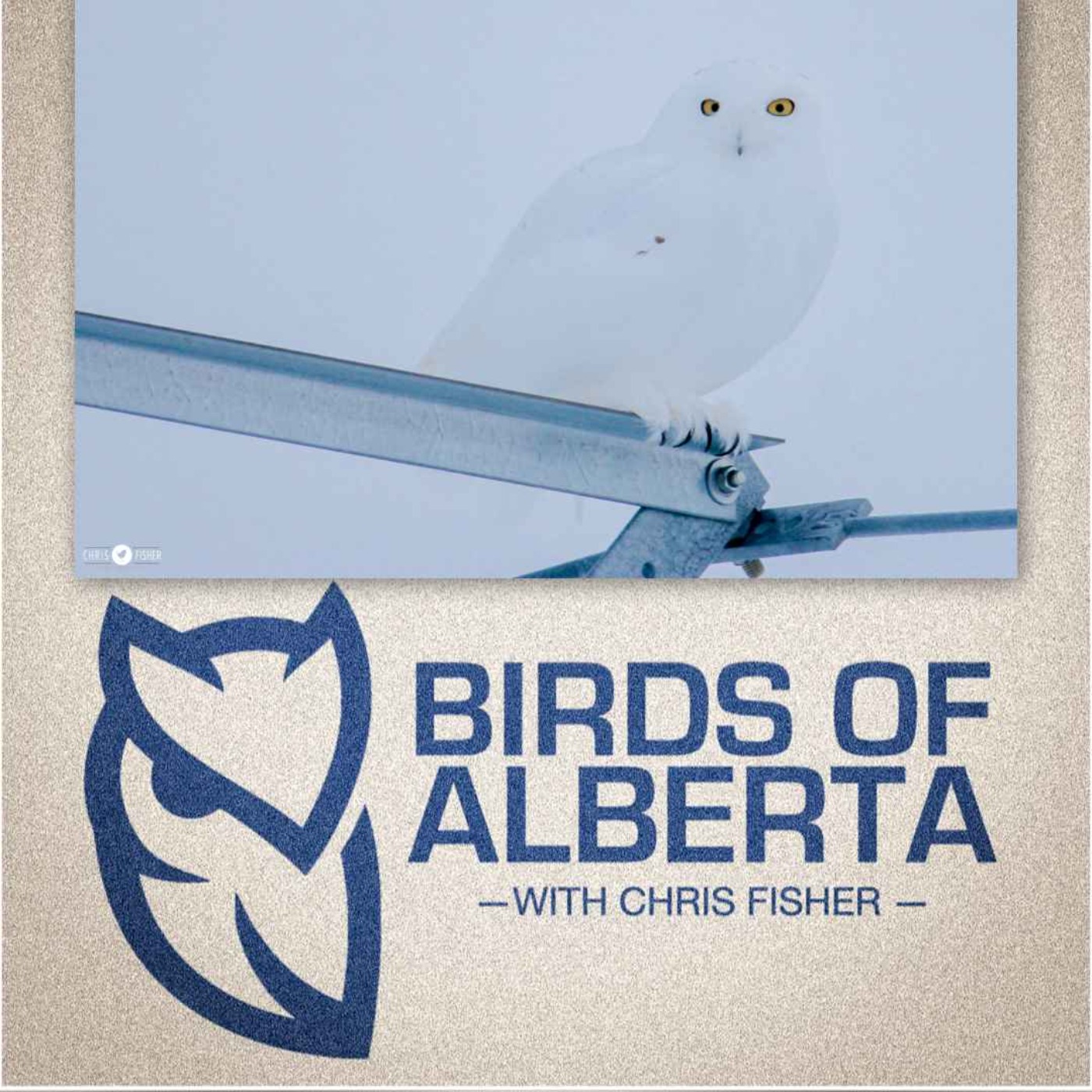
The podcast describes Alberta's birdlife as explosively abundant in spring but sparse in winter, highlighting the Snowy Owl as a key species during the cold months. Snowy Owls are large, white raptors that winter in Alberta's open, treeless plains, often seen perched on power poles. They exhibit sexual dimorphism, with females being slightly larger and darker for camouflage during nesting in the Arctic. These owls hunt visually, preying on small mammals and birds in agricultural fields. Culturally, they hold a special place as symbols of resilience in Alberta's harsh winters, inspiring birdwatchers despite challenges like urban expansion and disturbance from human activities. The host emphasizes ethical observation, such as avoiding baiting and minimizing disruptions, to protect these iconic birds during their energetically demanding winter season.
Welcome to the Birds of Alberta podcast. I'm Chris Fisher, co-author of the best selling field guide, Birds of Albert. Now for an own so short period of time in Alberta, we are a land of plenty. Hundreds of millions of birds burst onto our provincial scene in the month of May and make short work of doubling up their numbers before the start of the Canada Day long weekend are unofficial official start date for the summer. Now in this brief and glorious sprint, every tree in the province is touched by a bird and our open prairie skies are alive with invisible, though incandescent zones. But for all this explosive growth over the seven weeks of spring, for the remaining 45 weeks of the year, it is a slowly ke bird life. It's like a tire faded to go flat before arriving at that distant prairie town. So for people who observe the natural world, I know it can be a bit distressing because by the summer solace, the momentum of spring has already started to reverse. It seems as though there is an unrelenting plucking of our bird life over the coming months as we watch millions of birds leaving starting with the shorebirds and floor warblers sparrows. In water birds, they all depart. Finally, as the the freezing of our slews happens in late October, well, they convince us that the last summer raptors and waterfowler about to leave as well, leaving us alone to deal with the winter, with our dry skin, running noses, and watery eyes. Now these gray days of November forces all that check into our wintery 12-step program so that we can actually survive the cold and the dark. Through it, well, we're all inevitably my great from sense of powerless and then resolved to acceptance, with some of us even starting to embrace our coldest lifeless season. But there is also something that helps us burning folks through to the inevitable February freeze. And while these birds are small in numbers compared to the bounty of June, these solitary birds are not short on significance. It is a bird of Alberta, like none other, and it acts as our antidote to the gravity of winter. It is our snowy owl. Now really the first thing to talk about when discussing snowy owls is their near unique appearance. They are one of our largest owls and of course they are white. Adult males are almost pure white, whereas the adult females retain a little bit of dark or brown barring and spotting throughout their bodies and younger individuals, both males and females. Well, almost look like they're wearing a sweater vest of dark, so they are in fact more dark than they are like. But the story really isn't quite that easy to discern as adult and subadult males will look very, very similar. So it is pretty tricky to tell them apart when they're seen against the lone prairie snows. There is a difference in size between adult males and adult females, like with most raptors, birds of prey. The female snowy owl is slightly larger than the male snowy owl, and it's thought like another owl, this is due to the male being the provisional, the one who's going out hunting during the nesting season, and the female does most of the incubation, so a larger body size for the female would have an advantage. And you can tell the relative body size, of course when they perch side by side, but that never happens all too frequently in nature, much more so in the artificial intelligence image producing world where you see snowy owls often portrayed side by side. If you would see two owl side by side in nature, you'd be able to see the larger one would likely be the female, but oftentimes they are seen individually, but fortunately they're often seen in similar places, such as Power Poles. Now Power Poles themselves are greatly variable in their dimensions and their diameter. However, if you think of the average power line in Alberta with the cross arms, those cross arms are always made up of four by four pieces of wood or pieces of PVC piping, so you will have a consistent size to compare your snowy owls from one sight to the next. Now the reason there may be sexually dimorphism, which is just a fancy term, meaning that the two genders appear a little bit different, which is a very common thing in all of birth, but with snowy owls the female will have a little bit more dark barring and coloration, and it is proposed that the reason for that, which makes a lot of sense, because the female does most of the incubation on the treeless Arctic tundra, which is snow-free during the summer months. She is better to camouflage into the tundra by having a little bit more dark plumage, whereas the male does very little incubation, so doesn't need to be camouflaged. In fact, the all-white nature of a mature adult male snowy owl may be a signal to the females that he is ready to go and he is a fit male, and that also may serve as that exact same signal to other males that the gleaming white status of an all-white mature male snowy owl is not to be trifled with, and they would be in fact a very good breeder. Now the snowy owls of course are a winter bird here in Alberta, where they tend to hang out in treeless areas. Most of the birds that's been the winter in Alberta are destined to breed up in the Arctic islands of Nunevut and the Northwest territories. They of course breed across northern Canada, well into Alaska and all across the Arctic region of the entire world, also in Russia and Scandinavia, as well they are the provincial bird of Quebec, of course, and they're fairly well-known and probably should be known, particularly in Alberta by their inictite name, which is Uqpik, which is a wonderful representation of the bird for northern peoples, and of course the Nate, the school the Northern Albert Institute of Technology, has had Uqpik and a logo of an owl as logo for their sports teams for decades and decades, and it is a wonderful tribute to the northern heritage of this particular bird. Well it's kind of appropriate that there is a nice connection between Alberta and their northern. Breeding grounds not only in their name but their habitat preference as well for they nest on the Arctic tundra, and in the winter well they come on down to the Prairie tundra in our treeless areas of Prairie Alberta. For many Albertans, seeing a snowy owl is a pretty big deal so they head out in the country to find them. Previously there would have been small numbers within the current limits of our large cities like Edmonton in Calgary, however, owing to urban expansion into the surrounding agricultural lands. Well, snowy owls are a few and far between even on Christmas bird counts. There hasn't been a record of a snowy owl. In the Calgary, Christmas bird count, oh so for another five years or so, same facts are holding true in Edmonton. Going back 50 years you would have always picked up a couple of snowy owls on the outskirts of Edmonton in Calgary but those times have long since passed. So if you are heading out looking for snowy owls you tend to head east of the Queen Elizabeth Highway Highway number two that essentially divides uh, uh, birda into western and eastern areas. They like the eastern areas just a little bit more not to say that. You can't find the occasional snowy owl west of Highway two but your chats is our best east and you go to flat areas and hear a little bit glaciology comes in nice and handy for the flatest areas of Prairie Alberta are generally formed where there used to be post glacial lakes. So we all know that glaciars covered Alberta when they receded they left all this. Meltwater behind and they formed huge huge lakes and the basins of those lakes would be very very flat and eventually all that water disappeared leaving very prime and flat.
agricultural lands and if you want to go see snowy owls, well this is where you go. So places well north, north of Edmonton kind of in the Bonacore area, the River Camar area, tends to be pretty good for snowy owls and if you're in the Calgary area, we'll have no tobysica or byscares when most famous places and certainly places to the south and east of left bridge and your warner are usually pretty good for snowy owls but of course the further south you go in Alberta generally the fewer snowy owls you see since they are coming down from the Arctic, they will stop in at convenient and best overwintering areas in central Alberta and then they start pedering out as you head your way south. Ness snowy owls are in Alberta during the winter months for really one reason and that is to feed and to hunt and unlike some of our forest owls which really rely on deeper snow cover, they're hunting the mice and voles that are hanging out in what's called the subnivian layer, that insulate of layer below the snow blanket and above the ground, snowy owls aren't really doing that for those forest owls are mostly auditory hunters, snowy owls are mostly visual hunters so they want to see their prey and that's why they're hanging out in these wide, open often cultivated fields and why you wouldn't think there's a lot of wildlife like mice and voles and birds and cultivated areas particularly in the wintertime, there are in fact some, the waste grain in our wheat lands and even the canola crops provide a little bit of high nutrient food for things like metal voles and deer mice which are active above the snow in these areas throughout the winter months and also things like great parches those introduce game birds that are frequently found in prairie regions of crop lands in Alberta are very very common visual prey items that snowy owls will be looking for as they perch up high on those power poles and it is from these high purchase that these owls are most frequently hunting in a strategy called, well a wallop hunting method which is a pretty good description of what it is they just basically spot the prey running around on the snow or through the stubble fields and they'll just fly on down and right before they strike the little unsuspected vol they will throw their talons their feet way forward almost matching the the area around their face trusting their feet all the way forward and just a walloping the poor unsuspected prey and obviously snatching something as small as a mouse is no problem for them but they'll even prey on like I mentioned these larger parteries or even ducks that are feeding in these waste grain fields and they can strike them very very hard and pretty much kill them instantly they'll often carry the prey off back to a perch or to a rise in the field and there they will consume their prey. So seeing a snowy owl hunting is a pretty cool thing well in fact seen in a snowy owl during the winter months is a really cool thing and that's really why they are such a popular bird among bird watchers to head on out and observe during our long cold winter months there's a great romanticism involved with them it's been boosted recently well not so recently I suppose by by a headwick from the Harry Potter books and movies of course that was a snowy owl that made our desire to see snowy owls even so much more and they are fairly conspicuous on the landscape particularly when there is not a lot of snow cover such as what happens in the Chinook Zone in southern Alberta so you can go out on a on an afternoon drive east of Calgary into the flat lands into the agricultural areas and have a reasonable chance of seeing one I've seen as many as 27 in a day which was an unusually high number in a record number probably for the rest of my life there tends to be a lot of focus going into the winter months of nature photographers and bird watchers heading out to see snowy owls and I think as a result of that because much of our birding intensity is focused on snowy owls from November through March that we need to be a little bit cautious with the growing popularity of birdwatching I observe what's called what I call the one bump rule meaning that as I pull up to a snowy owl if it's perched alongside the road sure I'll try to take a photograph of it or watch it through my binoculars but if it does fly or bump from its perch I'll no longer bother it you know the winter months are pretty tough for snowy owls those who banned them report that most of the birds are in fairly poor condition meaning they don't have a lot of fat and even a lot times their musculature is worn out so they need to focus all their energy on hunting these mice and voles and other critters that quite frankly aren't all that common in this part of the world so hunting is a very tough strategy for them in the winter months here and any time that we bump them or force them to fly off and expand energy is not really much to their benefit. Now well maybe because of this great affection that we have for snowy owls and the fact that they are a very common destination bird for so many owl burdens that there's become quite a spirited defense of them not only certainly from potential people who who will multiple bump them from perch to perch to perch in order to get a good picture but much more controversial would be the practice of baiting owls which is well quite frankly going to a pet store binds some mice and throwing some mice on the road close to snowy also that'll come and pluck it off this was a practice fairly common in the last century quite frankly when the birding pressure was not nearly as fierce as it currently is the best practice now is not to do that in fact it is very much discouraged by even government officials who know a great deal about it but it still occurs in some far flung places of prairie can in fact you can still see some tours being offered in central Saskatchewan by tour groups that promise amazing photographs of snowy owls owing to baiting them and it's thought that well it's not any good for owls the truth of the matter is this does have them attracted to road sides looking for handouts and the combination of road sides and snowy owls is not a good thing for they do get walloped by cars because they do tend to fly across road sides when they do their hunting dives from those powerful so anything we can do for keeping them from road sides is probably something that we could do for our friends the snowy owls so snowy owls well they hold a real special place in this province among birders is they represent a singular focus among Albertans from December through February go on any of our provincial bird forms online birding groups like Alberta birds on Facebook during these winter months and you'll see once snowy owl photo after another and another and another as you scroll through the days and weeks and to be honest with you as much as I enjoy snowy owls and I really really do it's it's almost to the point is enough already on those birding forms everyone's posting pictures of the same snowy owls stay after day but this owl enthusiasm that we see is if nothing else an indication of the desire to connect in person with these iconic birds and it isn't just about how cute the bird is it is undeniably beautiful or how rough and tough and tooth and claw they are there's something else going on here see when you go out looking for one of these white birds on a winter road you generally come back with something just a bit more than a bird saying every bird or a non bird in the province has has at least one snowy owl story winter country drives are part of our collective memories whether it's going to visit grandma the family farm on Christmas day or or driving your kids to some far off hockey rink in the small rural town
or having a job site visit and concert champion or cold deal. Now I think these birds have become symbols of hope and resilience for us. Now it can be pretty bleak in Albert from November to March. There isn't really anything green out there and hours, compasses, who drive these lonely country roads and only living things to catch your eye or sad, steamy cattle and a little magpie. But then perhaps maybe once a winter, we can spot that one thing that counterbalances the dark and empty of winter. It's a snowy out as if crafted from the snow itself. It sits like a white flame atop a power pole. And there's something in that bird. There's something that fans are optimistic embers. Keeping our birding passion alive and actually acknowledging our shared kinship that informs a stubborn and proud winter culture that we have here in Alberta. So we owls are a needed symbol for us and in this unique way, snowy owls play an outsized role among all the birds of Alberta.
Podcast Summary
Key Points:
Alberta experiences a dramatic influx of birds in spring, followed by a decline, making winter birdwatching sparse.
The Snowy Owl is a significant winter bird in Alberta, known for its size, white plumage, and sexual dimorphism (females are larger and darker).
They winter in treeless, flat agricultural areas of Alberta, often perching on power poles to visually hunt prey like voles and game birds.
Snowy Owls are culturally iconic, symbolizing hope and resilience during bleak winters, but they face pressures from birdwatchers and habitat loss.
Responsible observation practices, like the "one bump rule," are encouraged to avoid stressing the owls, especially given their challenging winter survival.
Summary:
The podcast describes Alberta's birdlife as explosively abundant in spring but sparse in winter, highlighting the Snowy Owl as a key species during the cold months. Snowy Owls are large, white raptors that winter in Alberta's open, treeless plains, often seen perched on power poles. They exhibit sexual dimorphism, with females being slightly larger and darker for camouflage during nesting in the Arctic.
These owls hunt visually, preying on small mammals and birds in agricultural fields. Culturally, they hold a special place as symbols of resilience in Alberta's harsh winters, inspiring birdwatchers despite challenges like urban expansion and disturbance from human activities. The host emphasizes ethical observation, such as avoiding baiting and minimizing disruptions, to protect these iconic birds during their energetically demanding winter season.
FAQs
Snowy owls are winter birds in Alberta, typically present from December through February, as they migrate south from their Arctic breeding grounds.
Look for snowy owls in flat, treeless areas east of Highway 2, such as north of Edmonton near Bonnyville or east of Calgary in regions like Strathmore, as they prefer open agricultural fields.
Adult males are almost pure white, while females have darker barring and spotting. Females are also slightly larger, though this is hard to discern unless they are seen side by side.
They primarily hunt small mammals like mice and voles, as well as birds such as gray partridges, using a visual hunting strategy from high perches like power poles.
Winter is tough for snowy owls, as they often have low fat reserves and need to conserve energy for hunting. Disturbing them can cause unnecessary stress and energy expenditure.
If a snowy owl flies away or 'bumps' from its perch after you approach, you should not pursue it further to avoid additional disturbance during the critical winter months.
Chat with AI
Loading...
Pro features
Go deeper with this episode
Unlock creator-grade tools that turn any transcript into show notes and subtitle files.
 PodcastTranscript AI