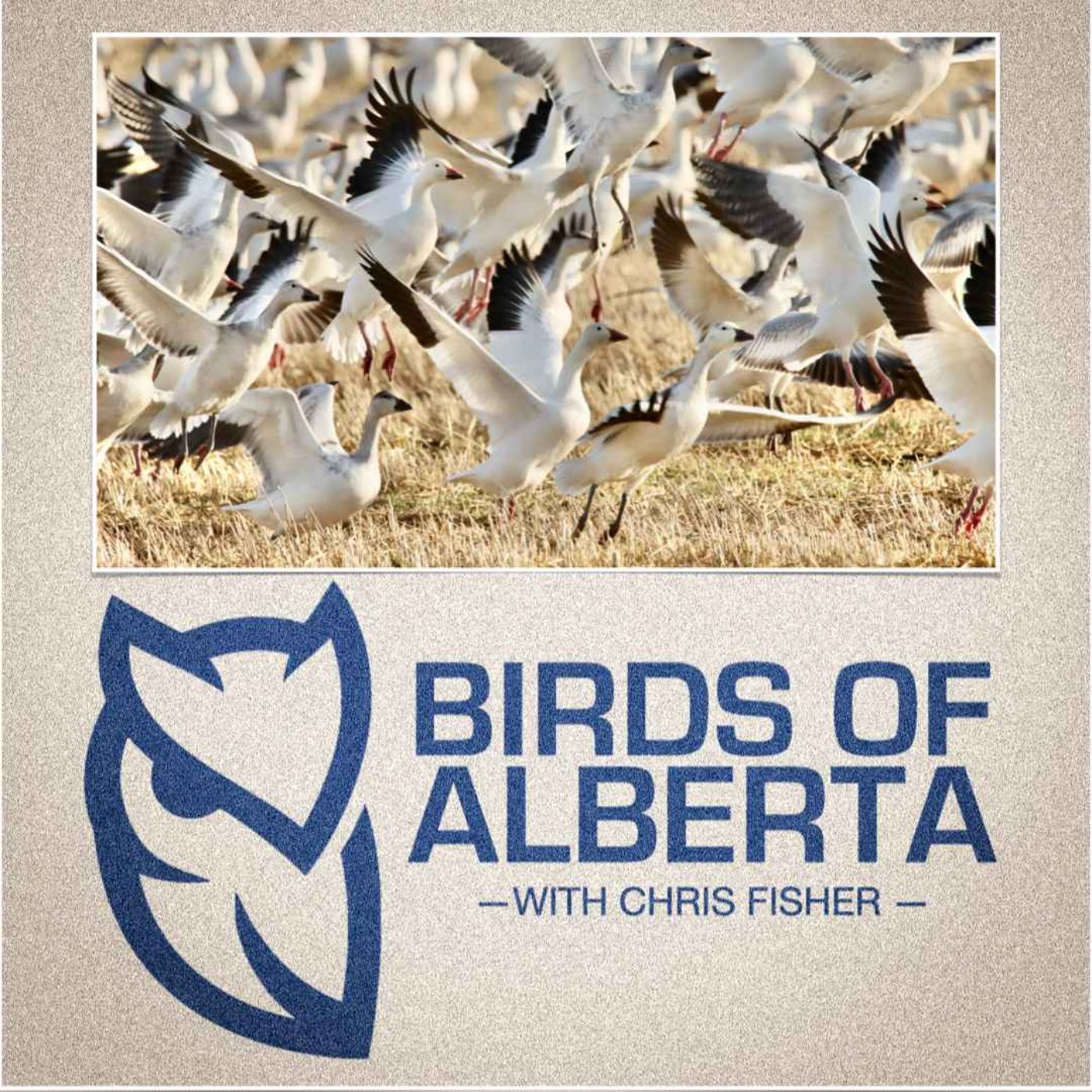
The transcription discusses the cultural and natural significance of snow geese in Alberta, centered on the Snowgoose Festival in Toefield. Historically, Beaver Hills Lake has been a key site for birdwatchers, and despite drought conditions in the 1990s, the area's legacy continued through events like the festival, which started in 1993 and recently resumed after a hiatus. Snow geese, with populations migrating through Alberta in spring and fall, inspire conservation efforts, such as the Migratory Bird Convention Act, and educational initiatives like the Snowgoose Chase, which introduces inner-city children to wildlife. Their numbers have grown due to reduced hunting and abundant grain from farming, though recent declines are linked to Arctic breeding challenges. The spectacle of tens of thousands of geese taking flight is a defining natural experience in Alberta, now even tracked by weather radar, symbolizing the transition between seasons and highlighting their enduring impact on the region's natural history.
Welcome to the Birds of Albert a podcast. I'm Chris Fisher, co-author of the best selling field guide, Birds of Albert. Now, you would think it would be next to impossible to get a bunch of fully grown adults, any of them seniors, to make an hour long drive in the early hours of Alberta Spring to ride a school bus. But for many years, the last week in April, there was a nature festival in the small central Alberta town at Ophiel, and that attracted thousands of people to see tens of thousands of birds. The community arena and curly ranks were converted to exhibition spaces where nature groups and businesses set up, but the real attraction resided out of town in the fields surrounding nearby Beaver Hills Lake. Now, historically, Beaver Hills Lake, about an hour east of Edmonton, has had a long close association with nature, with many of our most prominent provincial naturalists, fine-tuning their birding experiences and expertise at this very prairie wetland. Legendary binocular bros, such as Robert Lister and William Rowan, well they first extolled the wonders of the lake, followed later years by by Dick Decker and Edgar T. Jones and countless other banders and volunteers who have spent time on the sub-shore at the Beaver Hills bird observatory. But in the 1990s, folks were not visiting for bird-like on the lake. That's a good thing too, as the mighty Beaver Hills Lake, as it now appears on Google Maps, was reduced by drought to a wet stain surrounded by alkaline flats. But the legacy of the former times continued to pulse through the collective memory of bird migration and the surrounding fields continued to hold something very special. So, on to buses, people poured, bouncing along, bumping back roads, and challenged the guests' back alignments, and whenever birds were spotted along the route, volunteer guide would do their very best to point out and explain the sighting. Even though those in the back of the bus would be deaf to the story and blind to the sight, thanks to fogged in school bus windows. But when the target of the chase was found, the buses would stop and discourage the road weary crews into the cold April winds and view the resting flocks. And there, and there, through runny eyes and drippy noses, thousands of Albertans met one of the great spectacles of our natural world, and a genuine showcase among all the birds of Alberta, the remarkable staging of the snow geese. Well, snow geese, of course, stage and flocks numbering in the tens of thousands all along the great plains in both the spring and fall migration and and Paul John's guard, who is regarded as the godfather of great plains or mythology, described it perfectly and poetically. You see in 1974, he published an entire book on snow geese called Song of the North Wind. And in this following short excer, he describes the significance of the snow geese to his childhood in North Dakota. It probably says more to us about the birds than the contents of the rest of his 119 pages combined. This annual spring ritual of meeting the geese on their return from the south was more important to me than the opening day of the hunting season, the beginning of summer vacation, or even the arrival of Christmas. The spring return of the geese represented my epiphany, a manifestation of gods I could see here and nearly touch as they streamed into the marsh a few feet above the tips of the cat tails and fragments. By evening, I would be wet, cold and exhausted, from waiting through icy waters and crawling through mud and snow. But during the drive home my ears would resound with the cries of the wild geese. When I closed my eyes that night, I saw them still. Their strong wings flashing in the sunlight, their immaculate bodies projected against the azure sky. They were my criterion of beauty, my definition of wildness, my vision of paradise. I had little idea of where they had come from, even less conception of where they were headed. I knew only that I must be there to see them to become a vicarious part of something I couldn't begin to understand, but which to me represented the primordial energy of life. So that very spirit that Paul John's Garden described of snow geese was alive not only in North Dakota, but in the fields that surround Beaver Hills Lake near Toefield, Alberta. And that is precisely why in 1993 the Canadian Wildlife Service in conjunction with the town and other organizations decided to start up the Snowgoose Festival. Taking the lead for the Canadian Wildlife Service was the head of CWS at the time, Jerry McKeeading, who assigned Jeff Holroyd a legendary biologist in Alberta. And Jerry Beersbergen, who really was the lead-do, who handled all the organization. He being a bird migration biologist for CWS at that time. And Beersbergen, of course, well known, to handle things with his characteristic smile and good humor. So that first year of 1993 saw over 6,000 people make their way to Toefield to attend the festival. And it continued to be quite successful for a number of years, not only Canadian Wildlife Service and other organizations, but many, many volunteers, including yours truly, who served as a nature guide on the buses for several years, as well as dozens of other area naturalists in the Edmonton area. Now the festival lost a little bit of momentum in the early 2000s. In fact, lost support from the Canadian Wildlife Service after the retirement of Jerry McKeeading. And then ultimately took a 20-year hiatus. But I'm very happy to see that the legendary Snowgoose Festival at Toefield has made a comeback and that in 2023 and 2024, the festival has been once again a big success to the town of Toefield in late April. And no surprise, a somewhat grayer Jeff Holroyd, who's now retired from CWS, but just as busy as ever. He was once again front and center and making it happen 30 years after the initial efforts were made in 1993. So the masses of Snowgoose in and around Toefield not only set the stage for the Snowgoose Festival, but also set the stage for something truly remarkable in natural history lore in the province of Albert. And that was something called the Snowgoose Chase, which was the inspiration and driving passion of a friend of mine, Bob Parsons, and the Snowgoose Chase involved taking inner city school kids out to the region around Toefield to experience not only the masses of geese, but there were also opportunities to get the kids feet wet in ponds and visit a farmer to to pet feed and frankly test the patience of the many cows cats. Chickens and dogs that the kids would eventually meet. And really I've been fortunate to meet some of these kids decades later. And it is very clear that that day with Bob in the farmlands around Toefield was not only a singular circumstance, but also a formative circumstance in their appreciation of both rural life, but also wildlife here in Alberta. And I'm very happy to see the back in 2015. The inaugural Edmonton Nature Club Great, Great Owl Outstanding Service Award was given to Bob Parsons for his many many years of passion and drive to bring all these inner city school kids out to experience the wonders of the beaver. Hill Lake area. So not only do Snowgeese have a tremendous responsibility and role in in developing an appreciation for the masses for wildlife. They actually have a role in the conservation ethic that has evolved over the past century or so in North America. You see the the rise and and more importantly the fall of waterfile numbers in particular. Snowgeese and and other geese which occurred in the late 1800s in the early part of the 20th century really precipitated some of the very first legislative acts. The Migratory Bird Convention Act which is really the cornerstone of bird conservation not only here in Canada, but in the United States and Mexico was first put in place in about 1917 and its role was to take care of the problems associated with declining waterfile populations which were very stark at that particular time. We also can look to the very first wildlife area that was enacted anywhere in North America neighboring Saskatchewan. 1887 saw the establishment of last mountain lake national wildlife area. It's still there to this very day in central Saskatchewan and it was put in place and enacted by the Parliament of Canada in order to protect migratory birds and snow geese in particular. So snow geese don't actually nest in Alberta even though they have a big impression on the Alberta landscape they actually nest in the Arctic. There are three distinct populations that can be found migrating through Alberta both in spring and fall and from west to east it's the Rangel Island population which is in fact located in Russia of all places but if you trace a line up the Pacific coast through Alaska you end up in Siberia and that's the route that most of those birds go up and down but they spill over into Alberta every now and then. The bulk of the population that's seen in Alberta is made up of the Western Arctic population nesting in the Western Arctic Islands and the mid continental population which is really the largest population of snow geese in North America. Numbering about five million although the numbers have gone up and unfortunately down in the last decade or so. So as a result of the movements of these particular birds we end up seeing hundreds of thousands of birds flying back and forth through Alberta. In the spring time they come up from overwintering areas where they are feeding in rice fields and other waste grain in the United States. Well fed they are rather more deliberate to get to their breeding ground so they don't stage in Alberta quite as long as they do in the fall. For in the fall they are returning and of course the population is much larger because you have all the young of the year who have hatched out and making the trip for the first time. The interesting thing about the fall migration it is more prolonged but when you think of flying from the open Arctic across the boreal forest well there's not a lot of places to stop in forest landscapes so it is really the northern most agricultural fields that these snow geese really really descend on in huge numbers usually in late September and early October and they will feed in these areas just as the grain is being harvested. They always go into fields that have already been harvested and they need to fatten up for that trip from the Arctic tundra is very consumptive of their energy so they'll be typically feeding on wheat occasionally barley and certainly if there's pea fields they love those areas as well and they view Alberta as a bit of a pit stop not only in the northern most regions of the agricultural areas of Alberta but then they will hopscotch down through the province eventually leaving the province by early November and they'll return once again to the same fields picking up the very last of the waste grain when they return in mid April. There's almost no doubt that we see more snow geese flying through Alberta now than that were present even a hundred years ago there's a whole bunch of reasons for that there of course was a lot of hunting pressure on these populations both on their migratory roots but also on their wintering grounds in the early years of the 20th century but legislation has curtailed a lot of that and good sound management by wildlife organizations in groups such as Ducks on Limit it is really enhanced these populations so they grew and grew through the 20th century it's also must be said that the farming practices the abundance of grain high protein grain on both their wintering grounds and their migratory grounds really benefited these populations and allowed the populations to grow quite a bit. Now unfortunately in the last ten years it seems that the population has declined just a little bit and it's not due to hunting pressure even though hunting regulations were eased about a dozen or so years ago to kind of take care of some of the larger flocks that were being seen seems that the recent declines are owing to productivity on the breeding grounds up in the Arctic above the tree line it seems that the geese are arriving at these breeding grounds earlier than they had historically these breeding grounds have all been studied since the 1950s of course owing to the economic importance of these populations so with the earlier arrival it does seem to be that more nests are failing because of spring rains and spring snows and that the young that do hatch are hatching in advance of the abundance of vegetation that hits later in the summer season so the young are not as in good shape because they're hatching out just a little bit earlier so the population particularly in the mid-continental population in North America has dipped a little bit over the last ten years but still it's possible to see flocks in Alberta numbering in the tens of thousands and over the course of the fall migration a vigilant observer can certainly easily see hundreds of thousands of these birds as they pass through the province so the spectacle of snow geese is is is really a group of fair snow goose itself is fairly easy to identify it's a goose a little smaller than a can of goose but it is snowy white except for its all black wing tips the bill is orange with a nice little black grin that it has as if they were eating black relicrish as an old mentor used to describe it but individually as impressive as they are it fails to compare to a mass of snow geese that lifts off one of these fields here in Alberta where you get you know five ten forty thousand of these birds lifting in unison the the cacophony is near deafening you almost feel it in your chest and you just click away with your camera randomly hoping to catch a bit of the action but the photos never quite do it justice for there is a whole bunch of action happens and the sound is very mesmerizing these flocks in fact are so large that something new a novel has begin to transpire among the bird following crowd weather radar you see weather radar not only tracks the cloud cover that we see in Alberta some of the meteorological funnatics and bird watchers have recently discovered that weather stations are actually picking up some of the largest flocks of snow geese and noticing their movements both in this early morning hours and late evening as they fly from typically wetlands into agricultural areas to feed in the morning and evening hours and also when these flocks decide to head north or south to continue their migration all these movements are being picked up by satellite imagery and the connection to snow geese and weather extend obviously right into the their name it's a good name I suppose owing to their all-white image and the fact that when large flocks come together in a field it does look at a distance like a large patch of snow certainly when a flock this large will take to the air of the the black and white commotion also takes on another stony connotation perhaps a snowstorm and well even perhaps a reference to TV snow although that one that one probably dates me and all those that also recognize that amelog pull but to me it isn't the snowy look that I think of as the greatest meteorological connection but rather their appearance on the margins of our snowy seasons you see snow geese are a pretty meaningful part of our province just when the first grass and then the last holds of the winter snow is occur on our fields and ponds they are they are the pace car that leads us into and out of our season of snow simply put snow geese are exceptional birds and and those of us lucky enough to experience their erratic cacophony the longer member this snowy showy spectacle that is frankly unmatched by any of our other birds of Alberta
Podcast Summary
Key Points:
The Snowgoose Festival in Toefield, Alberta, attracted thousands to witness massive snow goose migrations, reviving a community tradition after a 20-year hiatus.
Snow geese have significant ecological and cultural impact, inspiring conservation laws like the Migratory Bird Convention Act and educational programs like the Snowgoose Chase for inner-city youth.
Populations have fluctuated due to historical hunting, modern farming practices, and recent Arctic breeding challenges, but they remain a spectacular natural phenomenon in Alberta.
Technological advances, such as weather radar, now track these large flocks, enhancing our understanding of their migratory patterns.
Summary:
The transcription discusses the cultural and natural significance of snow geese in Alberta, centered on the Snowgoose Festival in Toefield. Historically, Beaver Hills Lake has been a key site for birdwatchers, and despite drought conditions in the 1990s, the area's legacy continued through events like the festival, which started in 1993 and recently resumed after a hiatus. Snow geese, with populations migrating through Alberta in spring and fall, inspire conservation efforts, such as the Migratory Bird Convention Act, and educational initiatives like the Snowgoose Chase, which introduces inner-city children to wildlife.
Their numbers have grown due to reduced hunting and abundant grain from farming, though recent declines are linked to Arctic breeding challenges. The spectacle of tens of thousands of geese taking flight is a defining natural experience in Alberta, now even tracked by weather radar, symbolizing the transition between seasons and highlighting their enduring impact on the region's natural history.
FAQs
The Snowgoose Festival is an annual nature event held in Toefield, Alberta, centered around viewing massive flocks of snow geese. It began in 1993 and attracts thousands of visitors to the Beaver Hills Lake area in late April.
Snow geese are a major migratory spectacle in Alberta, with flocks numbering in the tens of thousands. Their presence has inspired conservation efforts, festivals, and educational programs, contributing to the province's wildlife appreciation and conservation ethic.
Snow geese nest in the Arctic, not in Alberta. Three populations migrate through Alberta: the Wrangel Island (Russia), Western Arctic, and mid-continental populations, with the latter being the largest, numbering around five million birds.
Declining waterfowl numbers, including snow geese, in the late 1800s and early 1900s led to key legislation like the Migratory Bird Convention Act (1917). This established protections and helped recover populations, shaping modern bird conservation.
In spring, snow geese migrate north from U.S. wintering grounds, staging briefly in Alberta. In fall, they return in larger numbers, feeding heavily on waste grain in northern agricultural fields from late September to early November before continuing south.
Populations grew in the 20th century due to reduced hunting and abundant agricultural grain. Recently, numbers have dipped slightly due to breeding issues in the Arctic, such as earlier arrival leading to nest failures from harsh spring weather.
Chat with AI
Loading...
Pro features
Go deeper with this episode
Unlock creator-grade tools that turn any transcript into show notes and subtitle files.
 PodcastTranscript AI