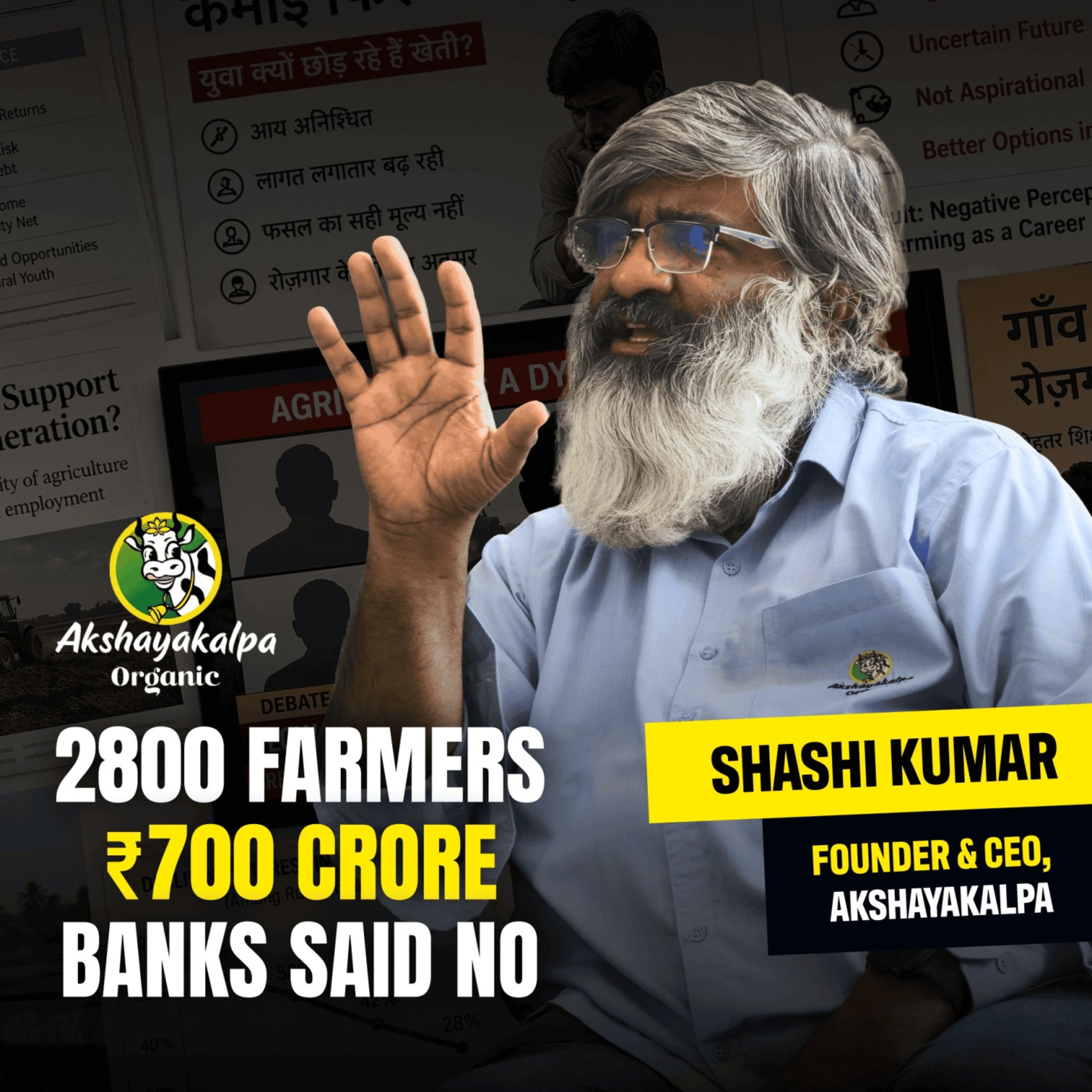
Six Times They Almost Shut Down; Today It Makes ₹60 Crore Every Month | Akshayakalpa CEO - Shashi Kumar
from Prime Venture Partners Podcast
1h 27m 21s
India’s agriculture sector faces a deep crisis: a rapidly aging farming population, lack of youth interest, and negative cultural perceptions of farming as a low-income, unprofitable occupation. Akshikalpa addresses this by creating a transformative, sustainable farming model rooted in local ecological knowledge, not just technology. The organization works with 2,800 farmers across 2800 villages, offering comprehensive, doorstep services in agronomy, veterinary care, and soil management. This support has dramatically improved farmers’ incomes—rising from an average of ₹10,000 to ₹50,000 per month—while enabling diversification into dairy, beekeeping, poultry, and mushrooms. Success hinges on cultural sensitivity, regional adaptation to 15 distinct agro-climatic zones, and the creation of role models who demonstrate farming as a profitable, dignified livelihood. Akshikalpa’s approach shifts farming from a subsistence activity to a viable, entrepreneurial venture, with women and youth increasingly participating. The model prioritizes organic, chemical-free production, emphasizing food safety and nutritional value. Despite initial skepticism, the company has achieved profitability without debt, supported by strong market traction and direct consumer engagement. Akshikalpa challenges the prevailing investor bias in agriculture, arguing that true value lies in supporting the farmer—not just selling inputs or post-harvest services. By empowering farmers with income, dignity, and modern practices, Akshikalpa redefines the future of farming in India as inclusive, sustainable, and culturally rooted.
What has been the disaster between agriculture and agriculture?
I'm extremely critical of investors because
there's a lot of people who are trying to find some bloody [bleep]
If you become a graduate, okay?
And you want to become an engineer, you want to become a doctor,
you want to become a lawyer, or you want to become a new profession,
you want to choose.
But there's no aspiration to become a farmer.
There's no farming school in India, can you believe it?
Tell me one example of positive talking about farming.
Only thing we talk about farming is negativity.
I have a great example of farmer.
Bob in a farming family.
Family is still farming.
My father is an island farmer,
but he never wanted me to be a farmer.
Can you leave at 7000 rupees a month in this world?
See, you need to really understand we have a resource constraints.
Land is fixed.
Land is not infinite.
And resources here has not access to their fixed.
So within that,
only way we can make progressist attitude.
2,800 farmers enabling 700 crores of business.
Before joining Akshikalpa,
they are earning every much 10,000 rupees.
And after joining Akshikalpa,
the average earning went to 5,000 rupees.
We paid out 128,000 rupees a second average
every month for each farming family.
Their land-rolling is average to acres.
So this is what, okay,
is, I believe, transformative.
Young people staying in farming
and women staying in farming
and their earnings substantial.
The lifetimes have changed.
They're able to spend their children to best possible schools.
Housing has changed.
They're able to take care of their parents very well.
They're able to live as good a life as a city villa.
Okay, it's not different.
So that is what has changed the far being married.
So Akshikalpa manages 29,000 animals.
Packed and packed on a hard management system.
Tomorrow I can tell the American how.
They have to tomorrow I can tell the American how.
Okay, and we can try every aspect of the animals.
First many years we reached the revenue of 2019 financial
where we executed with 30 crores.
So, in agriculture,
any entrepreneurial needs to remember
is value of the agriculture is created
at the farm by the farmer.
If all the bees dies in this world,
actually we die.
Okay, if we die,
all the bees actually flourish.
Welcome to the Prime Minister partners podcast today.
We have an exciting guest with us and today's episode.
We have a thus Sushikuma who's a founder and CEO of Akshikalpa.
India's first certified organic dairy enterprise.
All of us at prime are huge and loyal customers of Akshikalpa.
In fact, on our lunch tables,
you'll see at least six to eight buttermilk glasses floating
in every day.
So, with that, we're really excited to have you on your show.
Learn everything there is about the space,
about Akshikalpa and your journey.
Thank you so much for being here.
Thank you Jerome for the invitation.
Yes, yes.
So, I would like to start off with a very, very basic question.
So, if for all those who don't know Akshikalpa,
if you were to explain Akshikalpa to a 10 year old,
what would you say?
Interesting.
Okay, I never thought like that, let me attempt.
That's the purpose.
See, daily we are eating food.
The food is grown by people, some farmers.
Those farmers in India, they are aging fast.
For example, they are a 10 year old boy.
And you know, the people who are producing food,
they are 52 years of age.
If you take our age of all the people in the country,
it is 30 years.
So, we are young nation, but we are aging farmers.
What we are trying to do in Akshikalpa is people like you,
10 year old, 15 year old, 20 year old,
can they take interesting farm and understand farming a little bit?
And can you, who are the ultimate ideas to get you into farming?
So, this is how you explain Akshikalpa to a 10 year old?
Okay, very interesting.
So, now you see, the average age of farmers is 52.
And the larger goal for Akshikalpa is to kind of get young people into farming.
So, if they have to get into farming,
can you tell us what does farming in India look like today?
So, see that.
Just an example of farming is, see I have a great example of farming.
Now, born in a farming family, the family is still farming.
My father is an ardent farmer,
but he never wanted me to be a farmer.
So, any boy or a girl who is born in villages today,
what parents say is, study well, get out of farm.
My father detective to me, and the day as born, only computation used to have is,
how well you are studying, what is your marks?
All his pain is, he hid from us of doing farming, not being successful, not adding money.
And very hard life, nobody respects.
So, that kind of a life, they don't want to see mother children.
So, what's happening in farming in India today is,
all the young population in villages, they are getting educated,
and they are moving out of farm.
So, that is a situation of farming in India.
And people who are producing food, they are aging very fast,
and the young nation of 30 years.
So, that's a situation of farming in India.
Got it.
And now that you know, because you've laid this out in that sense,
so, should young people, because you're singing,
you want young people to be in farming,
does it go against education?
So, what do you kind of recommend or say this?
How do I, how should one young person think about it?
See, the way the farming is imagined in India is wrong.
Farming is not imagined as a profession of choice.
For example, if you become a graduate, okay?
And you want to become an engineer, you want to become a doctor,
you want to become a lawyer, or you want to become any profession,
you want to choose.
So, that is the biggest challenge right now.
The question is, how do you solve it?
And also, you need to understand who is the farmer.
So, there's no farming school in India.
Can you believe it?
We have a virtual university, they teach crops.
They don't teach farming.
Farming is very different.
See, for example, the moment you see a plant,
you should have a muzzle memory to how to react.
The moment you see a soil, you should have a muzzle memory to how to react.
If you work, build a muzzle memory, then only farming, okay, becomes viable.
It is taught from, for example, my farming background is,
my grandfather taught to my father, my father taught to us.
It is passed on from generations to generations to generations.
Croping is not farming, okay?
The farming relies a lot of things.
Farming is culture.
For example, if you go to Chengalpet, don't ask them to grow banana.
They don't know.
They're baddies.
See, if you go to Tiptoor and ask them to grow baddies,
they're coconut.
Okay, this culture, which has been built in, then people.
Okay, can build that ecology.
Ecology constructs a lot of things, including ourselves, soil, the tree.
Okay, the animal, the species, everything determines farming.
So, in our intro to India, what happens is, we mistake, okay?
Crop knowledge as farming.
Oh, you put this crop, you spray this much.
Okay, you put this one, no.
That is just maybe 1% of farming.
In your farm, if you go, let me say another 3 acres line, farmer clearly knows.
In this farmer, this grows.
This doesn't grow.
This doesn't grow.
He clearly knows.
Okay, for example, in, for example, in our local language in Canada, we call call a key.
Call a key is when a rain happens, okay, in a farm.
All the water accumulates in one part.
That's where this collective means when the accumulate water accumulation happens,
most of the nutrients are actually there.
Because topsile is gone there, farmer knows what to grow in the area where water stands, you know.
So, the aggressive luminosity don't teach the beach plots.
So, this is the status of what is happening.
Okay, people getting out of farming is becoming reality.
And the young people are not getting back to farming.
The primary reason of the way farmer is underserved is not from economics point of view.
Farm in is always understood from a livelihood point of view.
Which is a way of life.
It's a culture.
Now, the way of life on the culture has been turned into the market facing activities.
So, how do you adapt yourself into that propagation is very key.
It is start thinking, farming as a vocation, farming as a means to be netting money.
So, if you don't solve the problem, young people don't come on.
There's no incentive for them to come in in a modern setup.
You can argue, "Oh, culture, how can you forget of?"
Of course, it's a culture.
In the context of a culture, how do you care?
the end people stay in the soil. So, it will be difficult. And second problem is, now for example,
if you are a farmer, you struggle to get married. So, how do you take the opportunity to next level?
Nobody knows. So, therefore, young people are not being born in farming families anymore.
So, who will take this legacy forward? And will machines take over?
Will line consolidation happen? Will the crop rates take over? So, we don't know. So, in
India, it is totally fragmented system, two acres, three acres, one acre, five acres, which is very common.
Now, how do we manage in between, okay, these dynamics? Third and important point is policy.
See, the data says, very obvious. Data is very clear in farming. 15% of GDP comes from agriculture.
60% of people are dependent on agriculture. Government, the way they see it is very different.
The policy makers just took out the data. So, therefore, there are a lot of people in farming,
remove them, put it to service sector. Okay, make them come to the cities.
What is happening is, we are unknowingly removing young people from farming.
Who are the people who remove to service sector? Not the 40-year-old, not the 50-year-old, not the 60-year-old,
right? Or a girl? People who get into this on young people in the 20s, early 20s, early 30s.
Who are these big workers by the way? You structurally removed farmers. Most of the
big workers are farmers, are migrant labor. They've got to be big working because
you removed from farming ecosystem by policy and you created this and people ended up here.
So, therefore, unknowingly by policy removing young people in farming. So, that's all this agriculture
is now, if you want to set a baseline for, where is the agriculture? There's no money. It is not
profitable. Young people are getting out of farming and we don't understand culture, which is a
cultural aspect is getting translated into, we need to now go to market because a lot of people
want to buy, a lot of people don't want to farm. Now, how do you, how do you adjust to a dynamic of
what you call, okay, cultural aspects getting turned into market facing realities? It's very,
very important. That was just like a very compelling argument. So, what is possibly the protection
solution that is? Is Akshay Kalpa, Parkofrit, like is that what kind of native start Akshay Kalpa?
So, if you get Kadaf. Yeah, so, this is a crazy thought, okay, way back in 2010,
we thought, is it possible to engage year people in farming? That was the thought, okay.
So, what is the fundamental problem of engaging young people in farming? The fundamentally
believed its economies. So, it's not money, it's the economics, they need to make money,
and we should make a real sense. So, last 16 years, what we are done is this, very,
very simple, okay. It's not a very complicated matter, but very focused way we have exhibited.
Last 16 years, we have worked with 2800 farmers, that's it, okay. Not thousands, okay, maybe
2000 be the first thing to say, it is thousands, okay. So, not 30,000, 40,000, billion, no. What we have
been is, our age of an Akshay Kalpa farmer is 32, okay. How do that? 1200 are women farmers.
At an hour, we lost financial year, at an average, we paid out 128,000 to pay second
average, every month, the each farming family. So, this is what, okay, is, I believe, transmitting. Young people staying in farming,
and women staying in farming, and their earnings substantial, the lifestimes have changed,
they're able to send their children to best possible schools. Housing has changed, they're
able to take care of their parents very well. They're able to live as would a life as a city
weller, okay, if not different. So, that is what has changed the farming narrative.
So, what we do is go very deep in farming, and we have built India's biggest agricultural
extension team. Akshay Kalpa works like a university. So, there is no sales target for these people.
Every morning, six o'clock, you get up, you are on the bike,
moving from farm to farm to farm, understand these problems, and there is a services team
which delivers services, agronomies the service, soil management the service, veterinary,
para veterinary refutation, okay, mechanical services, anything and everything farm or needs
that is doorstep service or service. And we don't even sell one to be to farms,
and we provide banking as a service, we provide market as a service. The whatever it needs,
okay, to become an entrepreneurial, okay, in its journey in a three acre supply, that's what we do.
And these forms have become extremely diversified. We integrated, okay, daily, we integrated a
back-up poll tree, we integrated banana, we integrated beekeeping, integrated mushrooms, okay, we integrated
modules, okay, and likewise, we diversified the farms, and so that is risk in the farm actually reduced.
So, all the modern, what we call market principles, you can apply, we have applied risk, we have bought
it down, we have diversified, so that is risk actually is spread, and we have ensured is income,
okay, is going up, at least inflation adjusted every year, five to seven percent,
and the same, see, you need to really understand, yes, the resource constraints, land is fixed,
land is not infinite, and resources, yes, not access, they are fixed. So, within that,
only way we can make progressives, how productively you can do farm, how we can diversify,
this is what actually them parameter. For me, this is a learning, okay, and we keep saying that we
need to double farm, it is possible, and some data, when British government became a shareholder
actually, BIA is an investor in actual power, in 2022, they met 498 farmers face-to-face,
six months they took, they did a lot of assessment, okay, data is, of course, we were saying the
same thing, of course, they paid some consulting for little bit money to do that, then a lot of money,
okay, so, and data is starting, before joining Akshikal Pa, they are earning every month 10% rupees,
and after joining Akshikal Pa, the average earning 95% rupees, a cohort, which is less than 1.5 years,
operating at 60,000 rupees, okay, 1.5 to 3 years, operates at 95,000, okay, above 1.5 to,
and above, it is operating at around 25,000 to first. Amazing data, okay, but it's a very focused
program, lot of intensive program, 500 people in agriculture extension, actually there were
1,700 people organization, out of that 500 people working at agriculture extension,
like any such program at the university program. I think it would be just the economic
liberation, we're talking more, or does this phenomenon, right, another, I write a bunch of
questions, but so you're working with 2800 farmers, roughly what are the number of farmers in the
country, so how does this kind of get built at scale, or as there it, I mean, should there be another
100 Akshikal Pa, how do you kind of think of it? See, the problem is enormous, okay, given if you
take diary farmers, 80 million diary farmers, didn't it, in Dakota, 8 crores, yes, okay, diary farmers,
okay, doing diary, the question is, how do we change this, can we, can Akshikal Pa influence
all of it, my answer is no, so the way what we are doing is, these 2800 farmers,
they're in 2800 villages, we don't work more than one farmer in a village, that's it,
now what we have done is, that farmer has become a role model for the creation,
others have copied what is good for them, rather than we, dealing descriptive,
therefore a lot of good practices this farmer is doing, they're copied, for example,
almost all the villages where we are, right now people make silages for, okay, they're diary,
and a lot of people are taken back at Poltee, and I can see already everybody has 20, 30, 40,
50, 100 bananas occurs in their farm, you need not have a monoculture of banana growing thousands
and thousands, 40, 50, 60, 70, they've found that itself is adding to income, okay, daily you can
harvest on bunch and sunlight for a thousand to piece, it's possible, it's worse, what's problem
with, there's no problem, okay, so these practices now, we see a lot of people are now doing
trenching, bundling and edging on soil management, a lot of people are making manure, when you're making
was forgotten, okay, in the, in the meary of subsidies, and when you're making this forgotten odd in
India, and it is kinds, when you're making these signs, we need to get the signs back to farm,
They are saying this will far but in a village they copy it.
What is good for them to copy it?
So, the way we are working to your question is,
can a sugar puzzle all of it know?
We, our job, I believe, is setting up role models.
Why I say this role modeling is critical is,
you ask me now, because why I became an engineer?
I became an engineer because my father saw a very good engineer
in Bangalore making money.
For him, that money making engineering Bangalore was a role model.
You like it or not.
Then when I was born, only thing he kept with it,
he became like an engineer, except.
Therefore, farming, what it makes is,
it needs a positive spin.
And every village needs a role model.
Positive talking about farming.
You tell me one example of positive talking about farming.
Only thing we talk about farming is negative.
And, that is ingrained in people thinking in villages.
Oh, it work out of the life.
So, in Canada, there is a same thing.
Farming means non-saya, means saaya,
Manaya Rella saaya, or Rella saaya.
Means, everybody dies if you do farming.
I will die.
You will die.
My family will die.
My entire village will die.
That is the kind of negativity which is there in farming today.
It has to change.
So, therefore, the con transfer,
it means 80 million dairy farmers.
It is not possible.
It is not my mind.
My mind is, get the positive stories out there.
And every village should look up to that guy.
Saying that day is making money.
Looking after his children very well.
His family is very well off.
Yes, money in his bank account is moving in a car.
And he is taking care of all his requirements.
That is not.
So, that is the kind of solution what we are looking at.
That is the purpose in it.
Shaky Bose setup.
Wonderful.
Got it.
So, there are 2,800 villages.
Would love to know how did these villages get paid?
How do you kind of pick farmers?
Because I remember to start about 7 lakh villages in a day.
So, I do need one per each of the 7 lakhs.
But would love to know how do you pick 2,800 and what is it in the process like?
So, initially when we started 2010, we were also aimless.
We thought, 27 people 5 we pro.
What they will be thinking we can imagine.
All crazy thoughts.
Without technology we will transform agriculture.
My foot, nothing will happen like that.
Agriculture actually gets solved at the ground level.
Action, we realize.
Then when we started making all of farmers.
One cohort, which came to our mind was a lot of cab drivers in Bangalore.
They have two acres, three acres by the acres of land.
And their age and parents are looking after the land using Bangalore driving the cab.
Likewise, the car told of these car drivers.
And these car drivers are scattered.
And then we thought, why not go after these car drivers and work with them.
That's how this entire work started.
Informing with cab drivers.
Since they were scattered, they were in each village.
And we happen to work, they get to know this village.
But over a period of time we realize, I can't solve village problems.
So, when we get into a village level, village level mass programs.
There are a lot of dynamics involved.
There are politics involved.
There is a jealousy involved.
There is an interpersonal issue.
We thought, we don't want the get into solving those.
What we need to solve is pick the most entrepreneurial farmer.
In the village and start working, move from village to village to village to village.
It is exactly how the Japanese started.
And the process, what we also realize, there are a lot of cultural nuances.
If you, for example, we have addictive closer in the Connecticut.
As a different cultural nuance than general particular served in Tamil Nadu.
And Rangarini may be negative closer.
Okay, in Telangada.
So, therefore, we started moving our work to various aggro climatic regions.
So, actually, the entire India is divided into 15 regions.
Okay, and we are now three regions.
One is in Titu.
Okay, another is in Chindapattu.
Third one is Rangarini may be negative.
So, now we are trying to grow by aggro climatic region by region, trying to prove the model.
So, there are two important aspects.
Setting role modeling, we must not be able to touch on some of the lake villages.
Okay, and it will spread.
Okay, positivity when it is spread.
But we need to build a model in different climatic conditions, aggro climatic conditions.
So, therefore, we are moving from one climatic condition to other climatic conditions.
Uh, slowly, okay.
Last 16 years, we are moved into three aggro climatic conditions.
And also nearby markets, okay, where market access was required.
So, roughly around all the 2800 are in these three geographies.
Three clusters.
Three clusters.
What are these 15?
I was just curious because I would love for like even the audience to know.
Yeah, it's amazing, okay.
Uh, maybe what has been the disaster between aggro climatic regions?
We believe what happening Punjab will work in Tamil Nadu.
It is not true.
Okay, that's where the problem.
That NPK culture, okay.
I will have NPK.
Okay, nitrogen, possibly some potash.
Okay, I will add this.
Okay, and I will solve this problem.
That thought process is the bane of the problem.
So, what is the 15 aggro climatic conditions?
For example, tip two is a net soil.
Summary millimeter supply.
And there is no canalification.
Okay, predominantly coconut.
Okay, I've sprayed sandy lumi soils.
What can I do?
Right.
Using that as a climate commission, culture is a lot.
Slowly over a period of 200, 300, 500,000 years.
Culture is a lot.
People only know that.
For example, tip two area without coconut,
they don't know what to do.
Okay, so coconut became a predominant crop.
Cash Tom.
So they grow milk.
Raggi.
Staple apricot and stainless.
Little will be vegetable to eat for the insects.
Okay, likewise they evolve their culture.
So this is one aggro climatic condition.
Next one is, for example, if you did channel Kato,
whether on the count log.
Okay, 1,400 millimeters of drying.
Cash and dogs.
Okay, it's October, November, December, January.
It drains pores.
After once it pours,
they know even water to drink.
Can you believe it our management systems?
So in that kind of way, we need to learn to manage horses.
And culturally they learn to grow paddy.
Okay, other than paddy, they don't know anything.
So that is little bit of a clay soil.
Water doesn't percure it.
The studies are new and small amount of rain.
It looks like a flood.
Then that water flows off.
Okay, there's no seepage of water possible because the lands are clay.
And we are being growing paddy for the ages.
All the salts that come up, water percolation stop.
It's sealed water percation.
So it's okay water.
Now, for example, now, it's a peak of summer death.
Okay, June, you don't get ingaro.
So moonwari you don't get.
Okay, ingaro, okay, starting September,
you'll get rain there.
Okay.
And till then it's almost bad and there's no water.
So we need to learn how to manage the pattern.
Come to Radarari Madhyam Megad.
Okay, deciduous environment.
Okay, there's a mixture of clay soil,
okay, black autumn soil and red sanded homie soil.
And extreme heat, okay, in summers.
Okay, heat can go up to fortify it to 50.
Okay, all the heats coming from north to flames.
Okay, leading that.
So how do you manage agronomy there?
So likewise, if you go to let me say,
Darjeaning, very different agronomy.
If you go to Himatana Pradesh, different agronomy,
go to Punjab.
There are two extreme severe,
money severe winter.
Okay, there is a severe summer.
So how do you manage?
So likewise, there are 15 classifications in India.
Okay, and those 15 classifications
needs to be understood in a stand-alone manner.
What we have been is we are trying to apply a first principle,
called NPK principles,
saying that this will solve everything.
No, actually it won't solve.
Locally, you need to adapt a lot of things.
We fundamentally believe putting, okay, NPK,
we'll solve all the issues.
History is a severe bullet.
There's no silver bullet.
Silver bullet is you go in there
and understanding those local problems,
providing solutions locally to it.
Okay, so what does it need?
For example,
if I go to Changle Petro and try to grow,
okay, let me say Millets there.
You don't want it.
So I just became,
yes, because I grew Millets in Tipto,
I can't grow in Millets there.
I need to customize there.
What is that crop, staple crop,
okay, for local people?
Okay, we need to be very understood.
Okay, that's soil.
What to do with that soil?
And totally depleted.
Okay, one data is dummy.
It's government data.
I'm not making of this data.
Government says,
soil organic carbon in arable lands,
lands where cultivation apples,
okay, is 0.4 percent in India.
1970, it was 0.73 percent.
73 percent.
You know,
classification of the
desert is if the soil organic is 0.5% to declare land as a desert.
Technically what dormitory selling is, all the airable lines in India, they are deserts.
Until you poor, well sorry, until you poor lot of things from outside to inside,
farming is not viable. So, we have got into that stage, you know. So, what this makes is
customization, okay. See, now the dormitory didn't realize, okay. They put in KVK,
Krishwizh Nama Kendra's, Iwali Thalapur technical asset, Krishwizh Nama Kendra's,
they are the root cause of the problem. They didn't customize, they just tried to copy a KVK culture
and they didn't do outreach, okay. And they are busy in subsidy programs, okay.
And have absolutely a lap of understanding of culture. When farming comes, culture comes first,
then you go on into it. So, then nothing happened, you go to a Punjab culture,
it's very different culture than Tamil Nadu, you know. So, how do we marry that entire spectrum?
You go to Gujarat, culture is very different. Go to Mathis, it's extremely different,
hilly culture, okay. Very different culture, you know. If you don't understand culture,
you don't understand agriculture, sorry, that's how it is. So, it's for you, bring about culture as a
key piece. I would love to know how we view used culture in Akshay Kalpar in the last 16 years.
So, this is also for us, it's a learning, okay. Not that we knew day one, okay. It didn't happen
like we knew it day one. Slowly we learned, okay. That for example, it was extremely difficult to
teach growing maize to promote agriculture. Maze is an amazing crop for dying. So, we need to make
silages, we need maize. So, we learned why they're not able to grow because they don't know, they're
not being growing. So, then we need to get the agronomy into them first, agronomies, agriculture
and economics. So, what is the economics of growing, okay. I'll say maize. So, you need to go on
manually, this one to your culture, okay. So, for me, without understanding that, and if I push
bulldoze, hey, do it, it will not work. They will rebel. So, that's the fundamental aspect of
a culture. You can't push things through. We need to take them into confidence, okay, before
actually anything changes. Second aspect, I tell you, cultural elements, cows are always tied and
tethered. They're tied and tethered, okay, with the nuso, and this one, they're tied and tethered.
The moment you ask them to remove that, they will rebel. Say, no, we don't know to manage, okay,
without tying and tethering. So, there's one cultural nuance. Any diary person knows every serious
diary person, cows should not be tied. So, that's a cultural element, you know. So, then we need to
go slowly, and do one or two demonstrations, get them there, and see the thing is happening,
and everything is perfectly fine. Only thing is it has reduced the labor, it has reduced the stress
on the animal, milk here has gone up. So, we started relating these cultural changes to economics.
So, therefore, slowly these changes started happening, started growing maize, we started making
their silages, okay, we started rising, amazing calves, we stopped tying and tethering, okay, animals,
and which we told, you know, hand milking is bad, okay, and this is, it's also can harm
unless, okay, and also the milk can be extremely bad, they don't believe, because
traditionally they had an hang milking, okay. Now, when we bought mechanization, 100%
farms are mechanized now, or shit apart, it has reduced drudgery of milking, you know, milking
5 cows can be extremely difficult, you should see my mother's hand, okay, our hands also
can see, so to be able to say see here, so this is milking hand, okay, so we have been milking
from kids, okay, and the hands actually become very rough, okay, very difficult, and my mother's
is extremely rough, she panned one field here, you know, so that's a kind of pain they undergo,
they don't understand, they do it because without that they're dying, okay, so these are the cultural
aspects, okay, into how do we change this culture and bring economic sense into what they're doing,
it becomes very, very, very important, and I can't stress this anymore, okay, it's a huge impact.
Well, I had several questions, but I'm going to start with one thing, why did you start,
did you start with dairy, and why dairy, and what is that? Good question, okay, so we want to do
farming intervention, we didn't want to do dairy intervention, okay, then we went and started
asking what is the biggest problem for a farmer's face in cash flows, so then we thought let us do
dairy in an organized manner, okay, and so that he makes lot of money, and then he will allow us to
intervene in various aspects, for example, actually we started day one, we can go into farmers saying
that let's do soil management, there is too trenching and blending, so we raised and as you told
Tata Bhai Bhai, thank you, in front of you, they'll sell banyasak, kutko, channa githerasa, they'll tell,
okay, koffia is the sad, then after you have good past, it doesn't know, okay, what is it,
talking, you want to do soil management, and struggling with my docks, okay, waiting,
that a daughter just come home, I need to buy a rissari, so the, you know, those are real problems,
you know, you can't really say their mom, their mom, okay, so we understood that we need to solve
the cash problem first, so then what we did was we got into dairy with lot of science,
I'm duck to dairy with a minimal investment, okay, where is he making money,
animal, so God into animal sciences, okay, and God into hard management, God the best of the technology
possible, today I can say, so Akshaturpur manages 20,000, 29,000 animals, tagged and tried on a
hard management system, tomorrow I can tell the American how, day after tomorrow I can tell the
American how, okay, and we can try every aspect of the animal now, we got into the God signs to
apartment, they started seeing, okay, a lot of upswing in their fortunes, okay, but people
who are earning 2,000, 3,000 in dairy, they started having 50,000, 60,000, 80,000, 100,000,
they started having, that's the change, then once we did that, then got the positive spin,
then we told we want to do trenching now, there'd be, we want, we told initial phases when we told,
we want to do beekeeping for pollination, they told what the heck, who cares pollination, then we
got beekeeping, once this economics is solved, we got into beekeeping, we told, hey, you know, honey,
okay, then also in the process we started teaching them how to make manure at a scale,
each of the Akshaturpur farmer makes 200 to 300 tons of manure every year, in a beautiful
manner, okay, and that's sounds, okay, we have ordered a state of like MPK, you can say,
17, 17, 17, 15%, remaining of thing is filler, we are able to tell at that precision,
like a chemical company can tell and sell their way, farmer can make their manure,
but in the process we realize, for example, it is lacking phosphorus, it's lacking
nitrogen, then we needed access to chip and poof, for that one we introduced, we needed 5 to 10
kgs of chicken poof every month, okay, for manure making, then we introduced back-up poultry,
so the back-up poultry itself has become a business now, okay, for the farmer,
so likewise, okay, these interventions started with dairy because we solved the cash,
then we started solving all the perivaly problems using that cash, till you solve that cash problem,
you will not listen to it, there's no reason why you should listen to it, because it's a livelihood
question, you know, if something mistake happens, even he's okay, using chemicals and growing,
what's wrong, because under the day he has to survive, so how do you change that mentality,
that's the reason that dairy became central, dairy give, we can give two beautiful outputs,
one is market-facing milk, second thing is soil-facing dung, dung, it makes sense, not a great manure,
we need to do a lot of value addition to dung and create manure, so that's very, very important,
a lot of people don't know, they just pile up the gung, they think it's a manure, it is now dung,
with the agricultural waste, tree-dremings, polarized waste, in a one-nice-to-five ratio by volume,
one, one category of, okay, dung, and five categories of, okay, polarized agricultural waste,
you need to put it in a heat, it is called indoor method, okay, and in that indoor method,
you can make amazing amount of manure anywhere between 45 days to 90 days, beautiful,
that you're going to, you know where the indoor method is documented, none of the books in India,
it's a book written in 1930, it had a book called "An Agricultural Testimen Tag by Thor",
he has gone and documented entire agricultural practices in India,
wow, the view to the world is this, this is a foreigner, okay, and came to India,
and traveled throughout India in '30s, and documented our agricultural practices,
I underpercent believe, nobody has read that book, amazing book, it's really available,
an agricultural testimony can just download and read it, and in that one indoor method is documented,
indoor method of manure mating is documented, and he has gone there, okay,
and he has written sketches, how they do it, all they do it,
beautiful menu you can make. So likewise what I'm trying to say is diary we started and started
with various interventions using diary. That's a primary reason, cash show. And then getting into
positives from a diversification using diary. God. And how did the products come by today because
they all use architecture company products today. Today we can tell us how many products
that I've checked up ahead. How does the origin of products look like? See, yeah. All the products,
okay, whatever we are farming, they become products. Okay, we farm well. So it is appropriate.
Okay, we do little bit of vegetables. It become a product. We do little bit of honey. It became a
product. We do little bit of a backyard poultry. It become a egg. Okay, we do little bit of a mushroom.
If we can make a mushroom, we do little bit of a banana that become this one. Likewise,
they started putting the products together. So therefore, actually, if you find it is a little bit
with nothing is grown, keeping market in mind. Can you believe it? It is always kept in mind of
ecology in mind. In this ecology, what you can grow and only that one we commercialized.
We're in both that one and say, "Oh, a lot of demand for milk." Okay, for example,
in India, there's a lot of money to be running short of life. I mean, it's fine. That's what our
capacity is. That's it. You you resigned to that fact that you can only do that much. And if you push
agonist, okay, the what is possible, ecological limit of a of a line or a farmer, then you start
seeing the problems. Got it. And what is the scale today in terms of the number of products?
If you're comfortable sharing? Yeah, yeah, yeah. So, so option will power my initial stages with
structure. So first nine years of our journey, we didn't know the market. Okay, and a lot of people
thought we had foods. Okay, we kept on doing farming farming farming. We wanted to make the farmer
unit economics work. There was a first nine years of journey. There's not much focus on the market.
Okay, so though by limping the lot of issues, okay, in the process, for example, to first nine years,
six times close to bankruptcy. Okay, and we kept on farming farming farming a lot of focus on
farming. Maybe that is helping us now. Okay, product to gain very simple, okay, milk was a
may product. Other than that, we couldn't go anything in the first nine years. And post nine years,
okay, slowly we diversified. Okay, in terms of we added it to put up a key. Okay, we added it
would have occurred like a simple products, not very complicated. And we have taken a line that
will not make any product sugar added. We are not make any product, okay, which is a preservative
added or any e numbers added. So akshatapa as we mind so simple in terms of the market outline.
First nine years, we reached the revenue of 2019 financially where we existed with 30 crores,
okay, revenue. But it took nine years, okay, to reach there. But okay, that time somebody took a
betas, okay, that is, but it was low capital. But I don't know why they invested. Okay, business
model was not proven. We were seen steadily. There is no chance that we would have scaled anything.
So they took a betas, okay, till 2019, only capital we rise was 1.4 crores. That's it. We were
debt free. Can you believe it? That's the frugality at which we ran the business. Okay, okay, and we
had no debts. We were profitable and until 2019 and that's the only way we could have survived.
And we kept our somewhere in 2015-16, I gave up on money rise. Okay, nobody understood us. Okay,
they think we are doing something which is not required. We have no market focus. I also didn't know
how to tell, okay, I don't know how to market because the product itself is not ready. What will
you market? Okay, and we are still struggling. But some may 2019, they took a betas, I think that
changed the way the company operates. Okay, we were able to make lot more farmers, including
we were able to push the economics of a faru, it will be higher because we were able to diversify
and give added access. And again, of course, 2022, British government invested. We think
government zero that invested. And of course, a 91-par market invested. And Singapore government
really impact the investor. So all of it happened. Okay, actually, by reach that 60 crores of monthly
revenues now. Okay, and we are a profitable company. Okay, and that is something. Only you are in
three markets, Pandora Chennai and Ayurveda. Of course, recently we went to Pune and Mumbai.
So that is a scale at which we operate. And nobody gave us a chance. I guess, I didn't give a
chance to myself. I thought, okay, we are dead. 2016. Keep running. Don't get into decks.
Don't get into trouble. Don't get into any other things. We keep selling $23,000 to some milk,
what we are selling. And that's our life. That's it. Okay, we got into, okay, that model of operations.
Wonderful. That's that's that's really touching to view of the story. So today in terms of the
numbers, the tons of breaders of milk you sell today, any any volume of that or the number of packets,
etc. across these. Yes. So actual part, two thousand eight hundred farmers today produce
two point two last leaders of milk utility. Okay, and just to give you an example, if you're supposed
to do conventional daily, you need 100,000 farmers. You that each self is indication of efficiency
at which the farms operate. Okay, and of course, this is around 70% up is a liquid will and 30%
goes into a product making. So that's how, okay, right now, I'll check up by use.
Slowly 15% of our revenues is non-day, you know, a little bit of a eight, a little bit of a
vegetables, okay, a little bit of mushrooms. That's exactly how it has spanned out.
And how does, say, for example, because you said all your farmers at Abbas, uh, 2000 engine
farmers across villages, how does the supply chain work, right? And he's overseeing different
parts of his southern India. So, the real what we work is we, we, we, if you would operate
extremely efficiently, we working clusters, we don't work throughout India. Okay. One cluster
is in tip two. Okay, if you keep tip two, there's a center 50 kilometer radius, we were
not open. Who to channel pit to? Okay, keep channel pit as a center. Madhavan the commercial center.
We working 10 kilometers and radius. Right. We go to Ravaradi, Meghu Mega District,
Jetchalla around the Jetchalla. We work around 15 kilometer radius. So, therefore, we're able to
deliver world-class services to farmers. At any point of time on the pipe, we are read enough
hours. So that's how the entire supply chain has been built. Extremely flow cursed clusters.
It takes time to put clusters together. Each cluster, okay, takes around seven years to put
together. Okay. Okay. For example, uh, channel pit to cluster, they started voting in 2019.
So, we were able to do procurement in 2025. So, it takes huge gestation to put the clusters together.
Right. And then do you foresee going to different parts of the country of you kind of want to
make it more concentrated in the current clusters? Well, the way we are thinking right now is
we need to, okay, expand to, let me say, Maharashtra and prove this modeling Maharashtra. We
started working in 2023, okay, and agriculture extension Maharashtra, okay, in and around
shoe, in and around high, in and like that, etc. All of it, okay. And the Mumbai Pune market also
recently we entered. So, therefore, we open a cluster and link the Pune market. So, that's exactly.
To start a procurement in Mumbai, okay, Maharashtra, it will be 2031. So, six to seven years is
required. So, there is a gestation of going into farming and making it work. That's the time it takes.
Correct. And also as a follow-up, right? See, you've gone into markets already. How do customers
find you? And how does customer retention happen free? Because at least at prime and people
have heard, I spoke to a couple of customers before this podcast, everybody is a very loyal customer.
So, how do you find your customers and how do they retain? So, just a little on that.
So, there's a very interesting journey, you know. See, first liter of milk, we saw it in
February 11th, 2012, February 11th, to shoot off Park in January, on Kemi and my pro-founded
Dr. Janicelle is two and so little job arts, 18 retours of milk resort. Okay, that's the starting
journey of this all. In the process, we started explaining what is organic milk. People started
asking questions. We explained a lot of people had a lot of questions. Then what we told was, hey,
you know, okay, why don't you just come down and meet some of our farmers. That's exactly what the
that the customer loved Germany started there. You know, just to give an example, the scale at which
these are happening, in the year 2526, 45,000 unique customers have visited our farmers. Can you
believe it? Wow. Okay. So, there is our biggest discovery moves. Okay. But of course, various
channels eat the product is available or direct channels there. So, at any point of time, 140,000
all the customers set a month. Okay. So, that is a way, 40% of our enemies come there
from your direct channel. Wow. Okay. And we are successfully competing in a skew common.
Yes. So, our direct channel is growing. So, therefore, okay, all the assumptions that
that the activity wants 10 minutes.
delivery. I don't believe. If you need a good food, you need to make an attempt. Okay,
not that you think can be delivered in 10 minutes. So, I think customers understand that, okay.
And 40% of revenues, okay, come from QCAR, and their own 30% comes from retail. So, that's how,
okay, the split is. Very, very, very interesting. And like, also, yeah, actually my colleague at this
question, your price is relatively higher with respect to the other products in the market.
So, how are you competing on that? What is your thought on the premium price?
See, the one philosophy is, any good produce, okay, cost money. And we are about used to
substandard products. And we need to really elevate the quality of our products. They will
be expensive and see. Our food is extremely cheap in India, okay. For various reasons, okay. And,
how many she bothered about, okay, offered us a movement? How many have bothered about antibiotics
in that? We just make it delivered. It's a wide liquid. And you need to really make an attempt
to understand. So, I believe gone up the days where you have money, you can buy through,
okay, and people are conscious. And if they see a value, they are willing to pay. So, therefore,
so, the way I, the way you look at pricing is, it's not a market play, it's a value play.
And if you can deliver that value to your customer, I think customer is willing to pay,
for example, 50% of our customers, okay, they buy conventional milk for them,
they buy actual to upper milk for the child. Can you believe it? Okay, that's, that's the cohort.
So, therefore, they need to see a value, okay. They are extremely finicky about what
child is eating. And that's the, that's the path. They want to become future ambassadors for
good food. So, that's exactly how this, this will actually pan out in my opinion, in the country.
So, therefore, pricing is a, is a moving point. There'll be, okay, accessibility issues,
due to pricing. I am not discounting that about, but if you, if you put a value proposition
with pricing, you will not be able to deliver good food. I guarantee you, okay, for example,
you can go and tell, I test my milk. What do you mean by to test your milk? And you don't know
what happened in the farm. You don't know what cowie ate. You don't know how cow was looked after.
It's where the milk is coming from. You don't know how the veterinary care was given to that cow.
How much stress that cow is under what you test? Oh, give me a drink, okay. So, everybody has to
test, okay, without testing, you can't go to market. First, you need to go step back and really go
to the farming. You need to fix farming systems. Right now, there are no systems. So, therefore,
we are very confident. We are in the journey of fixing farming systems. I think the paying
customer will see a value for himself. If not for anybody else, for their family, in the
product value proposition. No, that's, that's wonderful. And what do you think is the biggest myth
around organic products? How do you define organic? Because, actually, Kalpa is known for that.
And, how do you kind of differentiate between organic and possibly the milk around?
So, before that, okay, I had one.
What we call the economy of market, okay, what they do? A food, which is fully laden with chemicals.
You need not label it as a chemical food. But a food, okay, which is, for example,
most safest to eat, you're supposed to write as organic. And you need to prove that, okay,
that it is, okay, contains no traces of chemicals, okay? That's the department at which we operate,
you know, with a cheap chemical sprayed and dumped on it. And you're allowing people to eat food
and organic, as a means, is a process. A lot of people don't understand organic produce, okay?
Organic, will not look good, okay? And you take vegetables, okay? It looks extremely bad,
okay? And but the process is extremely safe. There's no chemicals used. There's no
chemical fertilizers used, okay? Soil is taken here and food is beautitious. And since a lot of
pest, for example, all the vegetables we grow, 30% actually just goes based, because we don't know
how to control it. So this mangoes is a lot of mangoes are growing ways, because spongey tissue is
sure. We don't know how to handle spongey tissues, okay? And similarly, okay, with milk, okay?
The way I define organic is, can you be very cognizant of a fact that what we need to eat needs to
be extremely nutritious and safe. To make extremely nutritious and safe, what you need to do
in the backhand. So for me, that is organic, okay? The process in which you take care of soy to produce
good food. The process you need to take care of an animal to produce good food. The process you
need to take care of your poverty to produce good eggs. The process you need to really kill your land,
for example, land-tilling and land-cluing as a lot of difference. The moment you close the land,
okay, one feet deep, all the funky networks get disturbed. Fungi cannot survive sunlight,
because they can't photos and this is, they stop you should get applied. In such a way,
okay, that they exchange sugars and they give nutrients to farmers that apply it, okay?
They apply it gives them, okay, the nutrients, okay, sugars and Fungi gives the nutrients.
This is exactly how the relationship works. The moment you close, close one feet and just turn the
soy like this and that Fungi is tech. So we are conscious of flowing versus killing. We are conscious
of seeds. We are conscious of how the animals are taken care. So with all these combinations,
you can, can you produce the food? In my opinion, possible. We used to just do this a hundred years
back. But yeah, what happened? What happened in the process just deep, no? So in my opinion,
that's how I define organic as comes you must lead to understand that one from the process point of
you and what is good for them. What is good for them is not what good looks good. What is good for
them is what is new tissue. Again, it would also kind of look good, okay, if it is taken care properly.
But you need to really bother about what is good for you and be aware of the pumps as it is for.
And then how have you seen change in consumers and customers in India or in the markets to operate,
but how their awareness for healthy food, organic products, how has that changed? Is that like
on the positive or what what is your sex? So this extremely organic market in India is extremely
stupid. A lot of people don't understand, okay. Again, levels of extremely low, okay. And you
know where is the most organic business in India? It is exports. And we as Indians use our land
and produce some of the amazing food we export because others want it. Yes, okay. And we need to
our consumers lead to make an attempt to support our farmers. This point in exporting it, you know,
our nation needs good food, okay, as simple as that. Awareness is extremely poor and a lot of
articulations, okay, on, okay, organic. How should I know it's organic? Just vote to your farmer
with steam now. How many times we have made an attempt to go to your farmer and visit?
You have got 52 weeks, okay. Now you have one week you take off.
So, so my opinion at least from a consumer point of view is this awareness is extremely
challenging, okay. And all the businesses are great, okay, keeping export orientation in mind.
That's not good for the nation. And I'm using my soil, my resources, my reason to produce good food
for somebody else. Okay, let's feed our population, feed our population and with good food, okay.
So that it can change the positive spin on the health side.
God, I think that's, that's very critical. So, so you didn't mention about investors,
right? When you went about investing, you, you know, the usual tech, let's founder,
also you're a techie who became a agro-based founder. What was the initial
feedback? How did you go about fundraising? At this point, you see in capitalized, well capitalized,
about what does the JD Bin life with respect to fundraisers? So, in Indian ecosystem now,
see, the farming is three, okay, interesting game blocks. One is called as an agri tech.
Then it's actual farm, then post harvest. So, in India, there are a lot of investors investing
in agri tech. So what is agri tech? It would be seed, it would be manure, it would be spray,
it could be drought, it could be AI, or it could be anything, okay, do with agri tech,
okay, tractor, okay, or improve variety of seeds or anything can be agri tech, okay.
And post harvest is when the farmer produces something, you buy and create markets.
Okay, there's a lot of investments happening on this side and this side. Zero investment
What is called as farmer?
Akshay Kapa, in that sense, it is lucky that we are able to capitalize.
Others is a decked up story.
So, understanding of that middle piece in India is extremely poor.
So, I give a simple example.
A kind to company who sells a tractor to farmer.
Will it ensure farmer makes money? No.
A seed company who sells a seed to farmer, will they ensure farmer makes money? No.
A manure company who sells manure to farmer, will they make farm money? Absolutely not.
So, therefore, there is a most risk case piece.
Nobody wants, but everybody is taking money out.
You know, the acreage takes takes of the money.
The moment you sell a tractor, you are taking money out, you are sucking money out.
The moment you sold a seed, you are taking money out.
The moment you are selling, okay, all the shit, okay, which farmer doesn't need.
Actually, you are taking money out.
And what is the post I was doing? You are negotiating you at a gun point, okay.
And buying at the cheapest price possible, you negotiate him and squeeze him out,
and you create your damn markets.
In that middle piece, the most risk case piece, why do you take out money in this one?
There is no support system exists in India, okay.
You must have an understanding of that piece is extremely pathetic.
Believe me, the duds don't get it, okay.
And there are no investments that have happened just to prove that this is, okay.
I am extremely critical of investors because those are the people who have been,
times, bloody f***ing don't line into the middle piece.
So, the question is, what is happening in this piece?
And nobody is willing to take a risk, you know.
The thing it is, I agree, it is now.
After post I was, you create a boredom, you store it.
And you lend to a company, we are actually storing that.
And that company lends it to far, but was stored there for years.
Can you believe it?
Those are the models we think is agree culture, it is not.
Please lend and make money.
Also, please lend into, okay, this middle piece, which is the most.
So, at least my 16 years journey had given up.
I am saying enough of you, you asked me this question, okay.
First of all, I could, I could mobilize you on a single rupee of, okay.
I institution on one, okay.
They invested in us, okay.
Investments happen because there is a market traction.
And not because we are doing good farming, okay.
Can you believe it?
So, therefore, companies like us can know the supply if there is a market.
And let us remove the market, okay.
Let us assume I am able to make a reduced risk in this one.
And I am able to work with farmers and make this work, okay.
Then also investments won't happen.
Because it is huge gestation, 30 years, maybe 50 years, maybe 100 years.
I don't know, because nobody knows, this is proven, okay.
So, there is a status of lending in farming and agriculture in India.
Even commercial banks.
18% manate by government is fooled by 18 to 36% lending, okay.
And that KCC, they do all stupidity.
You say it's a credit card for kissons, okay, for farmers, okay.
Farmers don't understand it's damn credit card, okay.
They need to take that money and put that on back.
They don't understand.
Once they take KCC money, they never return.
Okay.
Then several percent becomes 12%.
12% becomes 14%.
And then exploited, we never explain the product picking problem.
And KCC we told is a good medium, okay.
Give a credit card in farmer by default.
It's a very good intervention, but you never understood the instrument.
Most of the kissons are defaults.
Can you believe it?
It is the lowest interest possible.
But that KCC I become defaults.
And most of the, for example, SHG, JLG, lending.
See the department.
If, let me say, okay, she is listening, you are listening.
Okay, let us assume you are a member of a self-help group, okay.
Women self-help group.
You actually borrow from two self-help groups.
It is to know.
It's like you borrow from two bands.
And one doesn't know the is borrow from others.
And what happens to the financial discipline?
So there are various things that have happened like this.
And microphone has screwed up, okay.
That middle piece lending could be because they became greedy.
And publics are good at this one.
So this is what might be on investors, okay.
I think I missed anybody.
But, okay, I just thought I should tell you.
You asked me.
I told you.
So I think I struck the knife called in some sense.
No, I didn't mean to --
No, but it was a very effort to understand it.
Because you spent 16 years in this.
So the middle piece, I have two questions rather.
So it's love him.
A, if a young person or a founder wants to start in this space.
Because you spend 16 years.
Where should they look at?
Because the opportunity is large, right?
From a market side is where.
And what are some tips you have?
And two also for investors.
Because possibly there is a lack of awareness, right?
Just to understand the market.
Because investors typically come in when the market is big.
And if it can possibly help them return money
from their investors.
So one for founders, young people.
And because how can young people think about
British businesses in this middle piece?
And for investors, what is the missing piece?
Like, what is the lack of awareness
that can positively bridge by your experience?
So I can do an example from basic hour experience, okay?
Right.
In the middle piece.
What we have found is agricultural properties
of busy money low in India, okay?
I'm busy money low, okay?
Even if you take rice eels, okay?
Even if you take gay home eels, okay?
You can take daily agricultural produce eels, okay?
And a percentage level for extremely high, okay?
Power must are extremely effective.
Now, I believe this is the greatest piece possible anyway, okay?
In the, in a, let me say, entrepreneurial space, okay?
What it needs is little bit understanding of a culture and a culture.
So law and a potents are being made to be corporatized for them.
You will not see value there.
Because you need to have a constant labor.
So you need to invest a lot of front-on protected cultivation.
So there are a lot of people lending in the direction.
I'm not saying they're wrong, but that's not the space.
The space is the cultivation which is happening in farming, okay?
Right now, he's the space.
Lower productivity actually can transfer.
Attacking that problem can actually transform agriculture.
And you will see a substantial value, okay?
In terms of, okay?
What's happening in output coming from that and budget, for example?
So the way we operate, we don't procure milk throughout, okay?
India.
Focus to cluster steps, okay?
And within that focus clusters.
So just to give an example, 2,800 farmers enabling 700 crores of business.
If you want to do it conventionally, you need 100,000 to 150,000 farmers to do it.
So this is the efficiencies which are possible.
This is an extremely efficient system.
We need to discover the chosen area.
And we need to work in clusters.
So more often than not, all the post harvest interventions, okay?
Our work done.
Communities being treated.
I'll buy that commodity.
Oh, in that area, this area, you're an aggregator.
I'll come on.
It is it.
And I'll buy that.
Okay, and I'll create markets now.
It has no value.
It's believe me.
It has absolutely no value.
And you can't create value in that.
So in agriculture, any entrepreneur needs to remember his value
of an agriculture is created at the farm by the farmer.
Realization can only happen if there's a playing customer in the market.
So this needs to be understood.
So therefore, he has creating value.
How do you, he has locked in the value?
And you need to lock that value.
We can pick up any commodity.
It is true.
You know, any commodity, okay?
Coconut.
Such an amazing things are possible, you know.
Thing as a tip.
Tip rule as a great example.
Biggest co-operability in India.
The biggest co-operability in Asia.
Not in India, okay?
And zero coconut industries, okay?
Value addition in the two.
Okay?
And for example, if we take carbon shell, okay?
When a coconut you want to remove, okay?
And this is called chipook.
Okay?
It's little bit hard.
You can make amazing, desiccated carbon.
Zero units into two.
Okay?
And why?
That's the space.
I see you can lock that value there.
And you can create markets.
So that's how I really look back.
But that's really that space.
Okay?
Give some more concrete examples, okay?
In this space.
For example, take vegetable systems.
In an organized manner, no vegetable production has happened in the country.
Okay?
Maybe to certain extent people like Boomi farms have done.
Okay?
Shankar has done an amazing job.
And he has reached, okay?
Able to work with farmers.
Create that value for farmers.
Okay?
You know, when market prices were five rupees for a kg of tomato.
He was paying 25 rupees.
Okay?
found and I will write it in the description. So, I will write it in the description. So,
I believe this is a real value creation.
I'm just giving some examples where people are done each.
And vegetables is one area, coconut is other area,
and coconut value addition,
huge value and designated carbon,
we can spend it a lot of this.
And for example, the car pit in coconut is a huge value.
People don't see that.
For example, you can use it as a soil amendment
and water holding capacity, porosity of the soil goes up
because there's a carbon, which is going in.
Carbon as a huge area, which can hold the water.
So therefore, it can increase the porosity of the soil.
We can actually transform soils.
And the law of exports are happening to U.S.
One side was in Texas way back in 2009
and meeting some friends.
In his lawn, I saw a coyote block exported from Tipto.
So until these are all amazing value blockings possible,
and of course markets, okay, we need to work and create
those markets.
So we can go a little bit deeper in the space of,
or it means a paddy itself, okay.
Paddy is extremely low, okay, productivity systems
in India right now.
I'm not talking about Veeel, I'm talking about productivity,
okay, for example, adoption of SRIS paid,
system for rise in identification has failed in India
because of labor issues.
It requires a lot of labor, okay.
And transplanters have not taken food in India.
Paddy transplantation has not taken food in India.
Here and there, they are using it, okay.
But real transplanters are in Vietnam.
Real transplanters are in Japan.
Okay, they have transformed, okay.
In the Fadi Landscape, okay.
We need to go there and do accidental work and get this
farmer's optimization in a way that the produce
in the most efficient manner and less labor
and they can make Fadi.
You know, in Fadi nobody makes one, okay.
MSP is actually a kill paddy and you start possible,
okay, in three months, in an acre,
three months crop, if you take,
if you have the four months crop, some bands,
three months crop, actually you can make any way
between 20 to 25,000 rupees a acre.
Imagine in three months, 20 to 25,000 rupees a acre,
where some can best outcome scenario.
The worst outcome is zero, okay.
And can you leave at 7000 rupees a month in this world?
It's not possible.
So therefore, that's the value I see, okay,
for entrepreneurs going in there.
If I can understand people like Mudfield,
they've done amazing work in Tamil Nadu, okay.
Obviously we're good work with farmers, okay.
Market creation is tough is not a big deal.
Value creation at the farm.
Then we can unlock Mudfield, they've done more.
These are some examples to boom in people like Boomeen,
vegetables, okay, Mudfield, okay, in Fadi.
Then a lot of experiments like this,
which are ongoing, that is a space, okay.
So coming back to your second question, investors, okay.
And the problem is that analytics
doesn't work all that space, there's no data.
So the investors grapple, okay.
If you hire an analyst, I'm saying,
Baba, tell me the unit economics of a party field.
You will go pick up some data available, secondary data,
okay, and we can't validate using primary data.
And pick up all the secondary data and apply say,
there's no logic here, there's no money making.
That's why these are investors being.
And how do we change transforms?
So see, I don't totally blame investors
because there's lack of data.
For example, how do you find Boomeen?
No, dang, they knows.
They are doing 25 tons a day,
working with farmers created a real value,
but will Boomeen get funded?
I have no idea, okay.
Because that space is not understood properly.
And these economics are not understood properly.
Extremely seasonal, for example,
last four or five days running,
okay, it's 25 tons of fall and twirl and twirl turns.
Imagine now is an impact on farmer, impact on
is okay, commitment to customers.
There's a huge fluctuation.
So the space is extremely difficult space,
you know, effect, okay.
How do you factor that one in your models?
Okay, it's nobody, no early onset of monsoon, okay.
Seems to be doing well.
In certain areas, there's absolutely no rain.
Even the monsoon has happened.
It's a typical pattern of,
this one it is expected, long term, okay.
Our ages, okay, with 30% less than long term,
we'd see this issue.
So how do you factor in, okay, in investor?
This one, I don't know, okay.
Can we take a bet?
Yes, okay, investors can take a bet, yes.
And a lot of banks are happening
in the philanthropy space, okay, for sure, I know, okay.
But there's a lot of, let's focus on market orientation.
So when you sort of come in middle piece of disk piece,
they need to be equal focus on market orientation.
The Alice value realization, what atom?
So why you are dealing with the disk piece, okay.
This investors lap of grappling with data
and they're not able to run models.
It doesn't justify, okay.
There are host of issues like this, okay.
How do we, how do we organize?
I have no idea, I'm not an investor, okay.
But my understanding is they're finding lap of data.
For example, tell me one good example in India.
Okay, from investor's point of view, we said agree.
And in good exit has happened.
They look for that pattern, I have no idea, okay.
So then how do you benchmark that?
It becomes a little bit complicated, okay.
But, but okay, for example,
our low capital to get bettanas.
I think somebody should start taking bets, okay.
And probably maybe one in 100 will succeed, okay.
I really don't know, but maybe that should be the starting point.
That's the way I really look at it because
I'm nobody to instead what investors should do.
It's not my money.
Got it.
If I had my money, probably I would have taken on the back.
For example, people like Shankar,
he's the probably the only guy in India right now, okay.
He's putting assistance and process into place,
grow vegetables and greens and an organized manner
with farmers and dark end.
He's struggling to rise more.
They don't understand who out of seasonal fluctuations,
of course, yes.
And you're proved at a scale,
twenty-five tons a day, it's not small.
And you're small, let me say,
you're grown full of whatever it is.
You operate in a warehouse like that.
You can't even go to new warehouse
because there's no money.
So, I'm saying investors, I think need to take
a view on, okay,
problems, spaces like this.
And they need to nurture businesses like that.
So, that's how you are the investors.
But for entrepreneurs,
it's a huge white canvas.
They can paint water that they want.
Got it.
I have one quick question on that.
How did you convince your set of investors?
Because at my degree,
you are able to,
the current set of founders and their takes in.
So, I think the first step is by accident, okay.
The low capital is a mere accident.
Nothing else, okay.
2016, they wanted to invest.
They couldn't invest.
I think they've been following with us.
And one day, they told,
"Hey, let's go on, you must."
That's an accident.
From there,
so, very interesting, okay.
We became extremely brutal.
So, we told,
this is a 10%, 20%, 30% growth company,
agriculture company.
Don't expect doubling, okay, your revenues every year.
That kind of a modest won't work.
Some years, it might work,
some years, it might not work.
So, the brutal honesty,
I think, bought right investors.
For example,
Littin came when a company was shutting down
in 2020 middle of a pandemic.
In five days time,
he invested five crores and saved the company.
And 2022, he further invested for the 60 crores.
And 2024, he did a follow-on investment.
2025, he did a follow-on investment.
So, they've been a lot of support like this.
In India and partner scale,
the most commercial investors possible.
I think they have an eye for the problem space
which we are operating.
It has got a lot of trouble in the initial stages.
All the glitches have been sorted out.
No, I think they're willing to invest in those companies
like that, okay.
We need to look for that kind of people also, okay.
And they also know that this company
can only grow at 20%, 25%.
They don't have huge expectations.
You need to set right expectations, okay.
And British government also,
they came at a critical point of time
and nobody was enlisting with us, okay.
And they had a conviction on the farmer side story
that it is all aluminum, okay.
Recently, ABC impact from Singapore government came.
Catamaran came.
Okay, Asha venture came.
Pratiti came.
So, they all,
they want this space to evolve.
But the challenge of reaching there is initial struggles.
Hold your navigate that initial struggles is the key, okay.
So, therefore you need to have a right set of people with you.
And at least in my case,
I have this 2700 people every time I have a problem,
I used to have a problem saying,
I mean, 50,000 to peace,
we are running short of paying salaries.
And they took equity in the company.
They started some people from the pro,
from raising support cuts,
so I really see them as the people who held the torch, okay.
El the land per coin for first 9 years of fortune.
There's one thing that you have this small ecosystem.
of 27 of GoFunders. You would have coined them GoFunders at the founding team largely.
They are founding team, not God. And how did that founding team come together?
They're all my friends in Whiproh. So, in the case of Whiproh, they're all basically fools.
They thought I'll do something. So, and there was nothing, but I think they are custard, yeah.
Kudos to all the friends. I feel to kind of have buried something so
beautiful when they get right. So, does things still bother you? What keeps you author tags?
So, there are challenges. There are huge challenges in farming space.
The question is, how do we accelerate research in farming space?
So, we have got the biggest research station in the country. 290 acres of land. We control and do
agronomy research. For for opportunity investing in research, which is 100 years out,
okay, outcome. That's what we are really investing in. This is what keeps me awake, okay.
This is the biggest challenge right now, okay, for our food production systems, we need to solve.
So, what is that we need to solve? How do we produce vegetable sedentary? How do you make
sure soil organic carbon acts incrementally in the farm every year? Soil organic carbon
produce are depleting resource. How do you make sure that we have started up? How do you
accelerate integration of animals into farming? It could be sheep, it could be goat, it could be
dairy animal, it could be a poultry, it could be a pecori, it could be anything, but this integration
is key without animal integration. Beauty of animal law, cereals, which is grass, which is useless for us,
the eat and produce fat and protein for us. So, that's the beauty of animal integration farming.
We need to accelerate animal integration into farming. Stand over the animal integration
space because you are getting fictional imports and it becomes unfathomable. So, how do we integrate,
let me say, banana into, okay, in middle of a growing water, okay. How do we integrate,
be keeping it to this entire ecosystem? This needs to amplify. This is one area which actually
I spend 90% of my time, okay, right now. All right. And how do you, what what is the future
of actually a couple look like? We maybe say 10, 15, 20 years down there. See, the way what we are
trying to build, actually, it's under 200 years, 300 years, institution, what we are trying to build,
okay. This is not a near-come solution for Indian agriculture. We, we believe there's a lot of
scope, okay, for non-sales agricultural interventions, by extension, outreach programs, etc.
So, I fundamentally believe, for example, right now we are in the 2008 farm works.
We don't need a lot of farmers, maybe in 10 years, that will probably double, okay. That's it,
okay, 2008 100 to probably become five, that's the sixth dose of at max, okay. And with that one,
we want to go extremely efficient farming systems, okay. Every inch should matter,
and every inch should be regenerative. So, that is a third process in our mind on research,
we're going deeper and deeper. That is a best training for agriculture, I believe. In the process,
there are a lot of customers are required to support us, okay. And a lot of markets are required
to support us. That's how I am really looking at these customers and markets will support us,
because it is their own best interest that they support organizations like this to get an access
to food food. That's a good way to cut it. Mabar, I wish all of us kind of here to see some of it,
and wishing you the very, very best in building our shape, I'll pause for the next 300 years,
it remains tall, and we all kind of benefit from it. With that, I think, can kind of be really close
to the end of the podcast, but if you have any final thoughts for our viewers, we'd love to hear.
Thank you very much. First of all, inviting me, the kind of drum of farming needs to be really
understood properly. It is not a factory. If a factory gives an input, you get an output,
and all the machinery people working properly, everything will happen, everything is under control.
In farming, nothing is under control. And then it is not under control. Weather is not under your
control. Pestitites are not under control. Soil is not under your control. Ecology is not under
your control. Market is not under your control. Nothing is under our control. That is the most
riskiest piece we are trying to operate. I think we need to start appreciating this. Towards this,
what we are trying to do is, for example, simple things we need to do, as individuals. Do you
understand a B property? Do you know what is a B? See, if all the B's dies in this world,
actually B died off. If we die, all the B's actually flourish. Now, we are chilling B's left
and right. Now, to that initiative, what we are doing is any customer who is willing to
understand B's, we are going to put a B box in their row. Okay, in their balcony, we teach them
how do you track with them? See, this is one way of teaching your next generation. Okay, we,
we are part of this ecology. We don't own this ecology. How do you become part of it? We are one
among them, you know, I want to close saying, Aham Sagan, one of my Deeros, he says, we are hoping
that somebody will come and save us from ourselves. Okay, that is the folly of a human thought.
And earth is a holy place. It is known to harbor life. This is where we make our last time.
And let us the okay gracious enough to accept that we are part of a caste laws, not even a spec
in the dot. And I will sign off with a joke. Okay, I have read Carl Sagan, Khasvas around 10 times.
Okay, that book amazing book. After that reading that book, you know, that moon is also
as an individual moon. Shashi also wants moon. Okay, from earth to moon, all the space he wants,
the entire university homes. Okay, and finally, my greatest ambition is 30, 40, 30 matches are, can you
believe? Okay, so in that one, thank you very much. Okay, for giving this opportunity. Thank you.
Thank you very much. We have such a pleasure having you and thank you so much for being so
understanding me at that piece. Thank you for listening to this episode of the podcast. Subscribe now
on your favorite podcast app for free. And you'll be the first one to know when new episodes are
available. Just search for prime venture partners podcast in Apple podcast Spotify,
cast box or however you get your podcasts. Then hit subscribe. And if you have enjoyed the show,
we would be really grateful if you leave us a review on Apple podcast. To read the full transcript,
find the link in the show notes.
Podcast Summary
Key Points:
India faces a critical crisis in farming due to the lack of youth interest, with no farming schools and deeply negative perceptions of farming as a profession.
Akshikalpa has transformed farming by working with 2,800 farmers across 2800 villages, increasing their average monthly earnings from ₹10,000 to ₹50,000.
The organization provides comprehensive, doorstep services including agronomy, veterinary care, soil management, and banking, turning farming into a viable, entrepreneurial venture.
Success is rooted in cultural understanding—farmers are taught local ecological knowledge, not just technical inputs—leading to sustainable, diversified farming practices.
Akshikalpa’s model emphasizes role modeling, where successful farmers become local examples, changing perceptions and inspiring youth and women to stay in farming.
The model is regionally adapted across 15 agro-climatic zones, proving that one-size-fits-all solutions like NPK fertilizers fail without local context.
Dairy farming was chosen as a starting point due to its immediate cash flow potential, enabling farmers to invest in diversification like beekeeping, poultry, and mushrooms.
Akshikalpa has achieved profitability with zero debt, reaching ₹30 crores in revenue by 2019, and now operates in key markets with a strong focus on organic, chemical-free, and nutritious food.
Summary:
India’s agriculture sector faces a deep crisis: a rapidly aging farming population, lack of youth interest, and negative cultural perceptions of farming as a low-income, unprofitable occupation. Akshikalpa addresses this by creating a transformative, sustainable farming model rooted in local ecological knowledge, not just technology. The organization works with 2,800 farmers across 2800 villages, offering comprehensive, doorstep services in agronomy, veterinary care, and soil management.
This support has dramatically improved farmers’ incomes—rising from an average of ₹10,000 to ₹50,000 per month—while enabling diversification into dairy, beekeeping, poultry, and mushrooms. Success hinges on cultural sensitivity, regional adaptation to 15 distinct agro-climatic zones, and the creation of role models who demonstrate farming as a profitable, dignified livelihood. Akshikalpa’s approach shifts farming from a subsistence activity to a viable, entrepreneurial venture, with women and youth increasingly participating.
The model prioritizes organic, chemical-free production, emphasizing food safety and nutritional value. Despite initial skepticism, the company has achieved profitability without debt, supported by strong market traction and direct consumer engagement. Akshikalpa challenges the prevailing investor bias in agriculture, arguing that true value lies in supporting the farmer—not just selling inputs or post-harvest services.
By empowering farmers with income, dignity, and modern practices, Akshikalpa redefines the future of farming in India as inclusive, sustainable, and culturally rooted.
FAQs
Young people are leaving farming because of negative stereotypes, lack of financial incentives, and the perception that farming is a low-income, stressful profession. Many families encourage education and urban careers over agriculture, and there's limited access to farming education or training.
Akshikalpa is India's first certified organic dairy enterprise that provides comprehensive farming support to 2,800 farmers. It offers doorstep services like soil management, veterinary care, and market access, and helps farmers diversify their income through products like honey, mushrooms, and manure.
Farmers in Akshikalpa have seen a significant increase in income, with average earnings rising from ₹10,000 to ₹50,000 per month. This has allowed them to improve housing, send children to better schools, and care for their parents, transforming their quality of life.
Farming in India is deeply rooted in local culture and traditional knowledge. Practices like crop selection, soil management, and animal care are passed down through generations and vary by region, making local adaptation essential for success.
Dairy provides a reliable, marketable income that helps farmers stabilize their finances. Once they see financial benefits, Akshikalpa introduces additional farming activities like beekeeping, vegetables, and mushroom farming to diversify income and reduce risk.
India faces fragmented land ownership, lack of farming education, poor policy support, and outdated practices. Additionally, there is a lack of investment in the 'middle piece' of agriculture—farm-level support—despite its critical role in farmer livelihoods.
Chat with AI
Loading...
Pro features
Go deeper with this episode
Unlock creator-grade tools that turn any transcript into show notes and subtitle files.
 PodcastTranscript AI