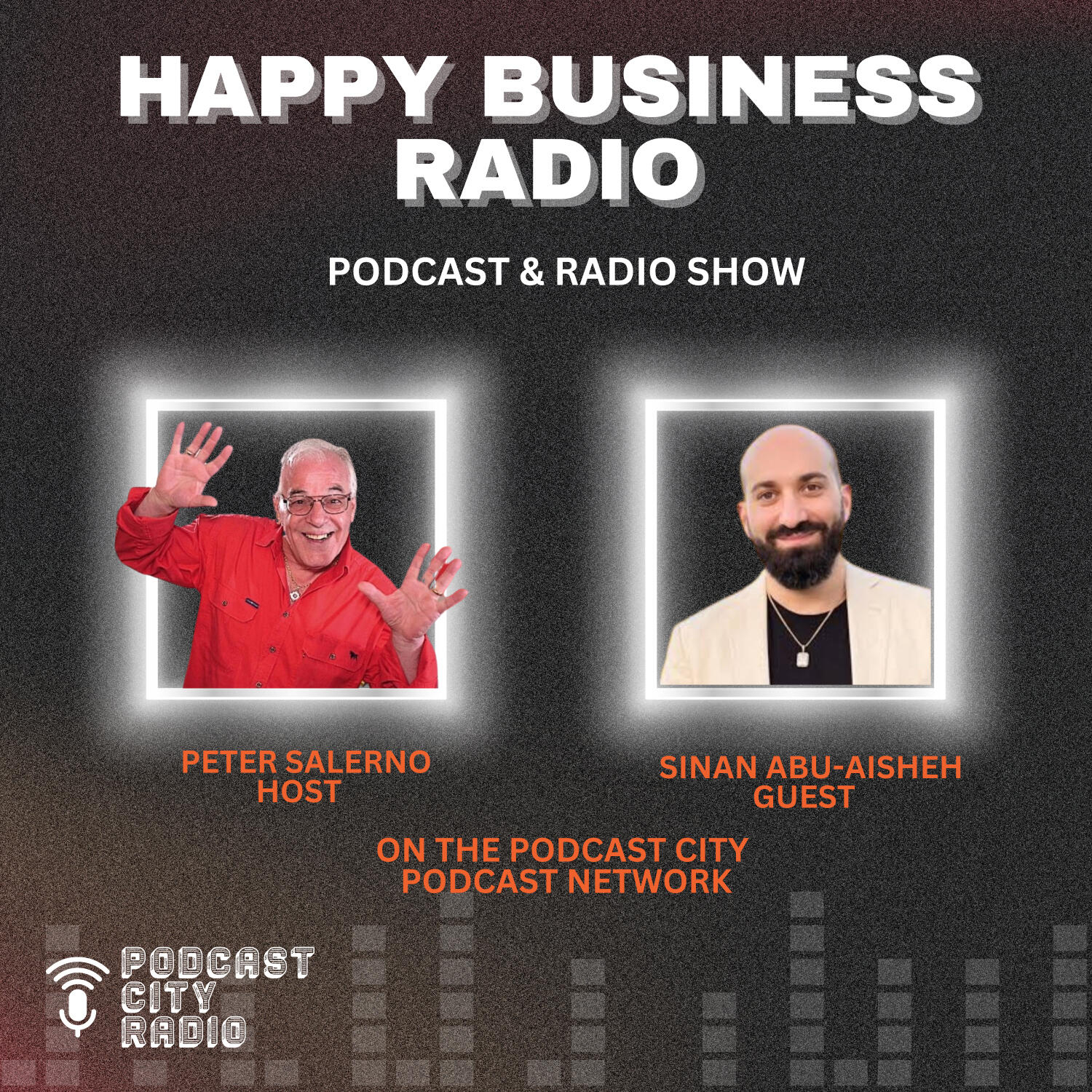
Sinan Abu Aisheh: From No Direction to Success: Sinan Abu Aisheh's Journey of Redemption and Business Mastery
43m 36s
Peter Saleno hosts Happy Business Radio on Podcast City Radio, featuring guests from the business world sharing insights and advice. The show covers topics such as starting, building, and growing businesses, emphasizing networking and collaboration. The discussion highlights the importance of seeking mentorship and coaching, as well as the value of teamwork and specialization within business endeavors. Guests like Synad Abou Asher share experiences and initiatives, such as setting up groups on Facebook to facilitate networking and support among professionals. The conversation also touches on mindset and personal development, emphasizing the significance of taking action to overcome doubts and foster growth. The show aims to inspire listeners to enhance their business acumen and cultivate relationships within the entrepreneurial community to achieve success.
Transcription
9152 Words, 47276 Characters
Now on Podcast City Radio, it is time for Peter Saleno and Happy Business Radio. Are captivating our fun, interesting guests, comments and advice from business professionals, leaders and entrepreneurs. We discussed ways to start, build and increase your business. On Happy Business Radio, Podcast City Radio and the Podcast City Podcasting Network. Now let's welcome Peter Saleno. Yes, hello, hello, hello, hi, hello to everybody. Good morning, good afternoon and good night and thank you so much for listening to this podcast and all the regulars now say good morning, good afternoon and good night simply because we are lucky enough thanks to Ron from Podcast City that this goes to radio but also goes to a podcast and then the podcast can be heard anywhere in the world in your own time zone and the beautiful thing about it is you can go back and listen to it again. I used to get lots and lots of calls saying, oh, can I have a copy of what he said or can I have a copy of what she said or you had somebody on three months ago and when I go and check it was like six or nine months ago and people said, I've been meaning to contact this person you know. Can you give me the details? I said, what was that all about? But here we're up live, you can go back and you can just go through and see all the different podcasts that Ron from Podcast City has put up there and thanks to him, we are now in over 50 countries. It's just growing really, really well and this evening I have a real special guest because privileged to meet this chap not long ago actually and so that's surprising how people come into your life when they're meant to you know and the other thing I can say is some people leave your life when they're meant to and damn, some don't leave enough or don't leave soon enough but anyway, look, Synad, welcome to the program. Thank you so much Peter, it's an absolute honor and privilege to be here with you. Look, it's really good. Look, I'll tell you what I'm going to do, I'm going to get you to say your surname because I know it's in Middle Eastern name and stuff like that and people say, oh, you never say it right. And I said, well, you know, let's be fair, we're not used to pronouncing a lot of these names and when we do, we get close enough, but never grow it. Now, the point is Synad Abou Asher is a coach and a mentor to a lot of people recently started a group on Facebook and it's going gangbusters, you know, you got over a thousand coaches and presenters all signing up to help each other basically, isn't it? So yeah, tell me, tell me a little about or tell us what was the intention of you setting up this group? Well, you know, it aligns with the with the greater purpose. So I believe in collaboration and networking and and building relationships and helping each other out. And so I've been a coach for a few years and and to serve people better, you've got to get people together. Yeah. So I just thought make a safe spot, make a safe, hub for people and grow it to, you know, a thousand and five thousand, ten thousand, all the way to a hundred thousand and we've got other plans for, you know, group coaching, public speaking and many other things that, you know, plan down the road as well. But ultimately networking, it's an opportunity hub, it's a it's a lead generation hub as well. So, you know, it's businesses all about leads and when you can serve people and you can demonstrate your your knowledge and skills and people will come and knock and they knock at your door and say, "Hey, can you help me out?" Yeah. Well, the one thing that Ron and I talk about all the time and the one thing that I know is that I always say, if you, you know, if you have any questions at all, just please ask me, send me a message, send me an email, let me know. And my famous quote, the people here from quote me now are saying, "Oh Peter, I heard you say that." Or Peter says this. Like I always say, if I can't help you, I will find somebody who can because within my network of people, I always have somebody who knows somebody who can help you. So, and that's what I like about this group that you're setting up, you know? So just tell us like if people who are listening to this for the first time and know that you've setting up a group, how do they get in touch with the group or how do they sign up? Well, it's basic. I mean, if you go to, if you go to Facebook and you type in coaches, consultants and course creators, we're the one with a bang, the boom, if you do, you have to pop in the OG boom, it's like an explosion, whether one's with the explosion in the beginning. Yeah. Really, it's, it's, you could say on top of the networking, it's, it's the beginning of the funnel. Okay. So the, the way to find it, so I'm just trying to help people find it. So instead of looking up Sinad to, to come up with the abuysia, is they go on and, and they look up for what you said was the consultant, coaches, consultants and. And course creators, yes. Yes. Yeah. Now, now there's an emoji in the beginning that has like that boom. So if you type in on a live phone, I'm pretty sure on a Samsung, if you type in boom, they'll be like an explosion. And I think there's a fire emoji at the end of that, just a kind of different theater cells. And then if you see the owner, if you click on it and you see the owner of the group Sinad Abuysia, you know you're in the right spot. Good. Good. And of course, if you need any more information, get in touch with me and I'll forward it on to you. So it doesn't matter where you are in the world, you can belong to this group of coaches, mentors, course creators. And the whole idea is that we share as much information as we can with each other. And of course promoting each other, you know, like where an opportunity comes, you say, hey, listen, I know somebody who can do that. And you know, like when I went to Asia, working in Asia, I immediately say to people, what else are you looking for or who else is on the program, you know? So when they booked me, I was asked them who else is on the program or who else do you need. So I've managed to bring a lot of other speakers with me, a lot of other presenters, a lot of other knowledge from different people. So, you know, that's what I like doing, you know, sharing my information and helping others as well. Thank you. And people don't forget that. Peter, they don't forget that anyways. So part of being out of goodwill, it's all just good etiquette for business, anyway. You know, if someone wants to learn about relationships, for example, I'm blessed with a good relationship, but that's not my coaching field. Yes. I can send this to someone else that does relationship coaching for example. Fair enough. Well, that's the, that's the whole idea of this sort of group. And happy business radio is about how to be happy in business, how to have the right there, you know, all those right things happen so that your business grows and grows and grows. And my whole thing was about being coach and mentor and stuff. And even just the other day, I was talking to somebody and they said, oh, look, I definitely needed a coach and mentor and whatever. I said, look, let's get together. Let's work out if this is what you're looking for because I know what areas I'm teach or, you know, can I'm good at? I said, but there's some areas that are, you know, you may need another coach. And after we sat down and talked, we got on really, really well and just wonderful, but the decision at the end of the day came back and I said, well, she said to me as well, I don't think that you're the coach that I want. I'll go, I'm going with this other chap and I said, that's perfect because that's exactly what I wanted, you know, to help her find the coach and the mentor. And like I always say to people, don't be afraid of changing your coach. Don't be afraid of changing your mentor because a mentor or your coach will bring you up to a certain level. Then after that, you have to go to the next level, you know, and to go up there, you're a coach can take you from well to go. But then when you get there, you got to go to the next level. And that's why. I mean, even just if I can throw this in there as well, it might, you might be great. For example, public speaking and you could be great at on, on Zoom, for example, presentations and helping a group of people. But then you're not really good at landing pages or you're not really the actual funnel back in. That's right. That's right. There's different tentacles to a business. Yes. I think that I think that where we fall short is when we think we can do it all ourselves and that's something, there's something called opportunity costs that cost too much time. Yes. So you have to be losing way more money when not going through a certain coach that specialises in that thing. One of my other famous coaches and things that I learned a long time ago, and I'm glad I did learn it a long time ago, it's, you alone can do it, but you can't do it alone. Right. So when you think about it, there's a lot of different meanings of that, but, you know, only you can do it, but you can't do it alone. So in other words, you, you can do it. Whatever you set your mind to, literally, we're a lot stronger than we think we are. And just just after noon, I was reading something that came to me from overseas saying, we never know how strong we are, you know, we never know how strong we are until we've achieved something. And then we say, wow, you know, and then sometimes you look back and think, how the heck did I get here, you know? It was a little survivor of that, you know, talking about that, we, we, I'd like to go back a little bit and just ask you, because, you know, you've had, over the conversations we've had over the phone and that, you've had quite a checkered background, you know, so to get to where you are now and do what you're doing now, you've had a real big change, you know, you've had a ha ha moment, but you've had a whole ha ha, you know, more than a moment it's gone for, you know, a couple of lives, yeah, most people, you know, when they're young, they say, oh, yo, I know what I want to be and some people have some idea or their parents tell them what they want to be, you know, they're last couple of weeks, I've been talking to a group of people who are in professions that they don't want to be in, you know, like this guy said, yeah, I, you know, my mom, ever since I was a little kid, my mom wanted me to be a doctor, you know, and this other chap said he's, his best friend is a lawyer, but he's very good at it, but he hates it, you know, he doesn't want to go into court, he doesn't want to appear, he does all the background stuff, you know, but he's good enough and now he's saying, if I want to go to court, what do I have to do? So I'm teaching him presentation skills in a way, you know, so it's interesting that like you said before, a person might be good at one area, but not good at another, you know, and this guy's an expert on the law, but he's got the biggest jitters about going into court and standing up in front of a judge, you know, and yet there's a couple of other guys, I know, that just love litigating. Yeah, yeah, yeah, yeah, yeah, yeah, so look, let's start the journey. Let's go back, like when you were a little kid, did you have any idea what you wanted to be? I just wanted to be rich and successful, and business person to be honest, I used to watch my uncles running their, their food trade in Jordan and they used to run the, the hummus and the rice and have big factories and they literally supplied the majority of the food chain down there. So I was like, I used to drive, you know, those cars that you have when you're a kid and I used to drive around and drive towards my mansion and, and, and imagine like driving trucks because we're the broke, we're very broke and, and I didn't want to say broke it is saying, you know, if you were born broke, it's not your fault, but if you die broke, it is. Yes. Oh, that's a good one too. Haven't heard that one for a little while, but, but you're true because the fact is, unless you do something about it, you can't expect somebody else to, you know, and, yeah, you know, the other day, I was at the seminar and they brought up, oh, I can't remember how many. A lot of them, you know, 50 or 60 people, Australians, not just from around the world, they have one major lotteries and become broke. Now they've got an organization here that, you know, I remember hearing about it a long, long time ago, but I didn't realize it was such a strong thing. They've set up a group of ex-millionaires, you know, yeah, it's quite interesting. And there's a couple of people saying, if you did it once, how can you do it again? Or, you know, what can we learn from you? You know, so they're studying, they've got this group of ex-multimillionaires and they're studying what went wrong so that they can put this business plan together for new businesses, you know, but also there was a lot of people that they, you know, showed on the screen was that they had previously won a major lottery, you know, like when, you know, 20, 30, 40 years ago, whatever it was. If you won a million dollars, you were, wow, today, unless you win 20 million, it's not worth going even, oh yeah, somebody won five million the other day and they still haven't climbed it. It's been six months, you know. I mean, Brian Tracy, sorry, just to throw this in, Brian Tracy says something fabulous about this because I do believe a lot of the people that win the lottery and they lose it's because of the mindset, you know, you can't exceed the success of your mindset, like your mindset limits your, your ultimate success in life, so if you're, if your, if your money exceeds where your mindset is at, yeah, that if your business exceeds where your mindset is at, it'll always come. It's like a firmist task. Yeah. It looked at it was good in temperature. Brian Tracy said this perfectly, he said, one of his mentors told them just be a millionaire not for the money, but for the person that will make you become the discipline that you develop, the consistency that you develop, the persistence, the overcoming of obstacles and issues and resilience and all that muscle, that's exactly what you need. Because then you could just recreate the money again, yes, it's the discipline and habits that you got to create. Yeah, it's interesting because you say that I'm just something I really believe in because a lot of people inherit money and lose it as fast as they inherited it, you know, unless they've actually earned it themselves and other people have been struggling and worked hard to get the million dollars or, you know, the business or whatever and for some other unforeseen reason, they lose it all and then a few years later, they're back to becoming a multi-millionaire, you know, and we've got lots of stories of people who are billionaires have lost a lot of money, you know, one day they've got eight billion next to it, sign four and then it goes back up to 12, you know. Yeah, yeah, yeah, yeah, definitely. You know, so it's quite interesting how that happened. Look, we need to take a break. This time's just flown. We'll take a break. Sinette, let's take a break and we'll come straight back after these messages. All right. Thank you. We're listening to Happy Business Radio with Peter Salino on podcast city radio. Get ready to jot down some fantastic tips and advice with Peter Salino from Happy Business Radio. Yes, hello, thank you, thank you so much for listening and thank you so much for continuing to listen with us and of course I just want to say thank you to everybody that's becoming a follower and of course, especially thank you to everybody that's sharing it and asking their friends to listen and become followers because that's what this is all about. It's helping each other and as far as I'm concerned, the more people we can help on this earth, the better it is for everybody and believe me, there's some people out there that need a lot of help. But, you know, just one idea, one business tip that I remember from way, way back makes a big difference and I was talking to somebody the other day and I was saying just when when they heard it, you know, they've heard it before, I said, oh, yeah, heard it before. But then all of a sudden they heard it in a certain way or a certain time and it just hit them like a ton of bricks on all of a sudden, they've done really well with it, you know, and at Sinad, there are certain tips or certain things that you pick up and at certain times it doesn't mean a damn thing. Yeah, that's true. You're not really to receive the information sometimes. I don't know. Just like I always say about that, you know, sometimes and what we were talking about just before the break was that if your business grows faster than you, right, you grow, your business grows, you grow, your business grows and unless you grow, your business won't grow any higher and then if it does, it tips over on top of you, puts you under a lot of pressure and that's where people get caught working in the business, trying to struggle from underneath this business, you know, huge pressure and everything else and it's not until they start to grow and realize that sometimes you need to put say that's it, that's all I'm going to do. I'm going to employ somebody else to do that part of the business and when people become smart enough and I always say when you become smart enough to employ somebody to do the work that should be done instead of you, that's when you start working on the business instead of in the business, you know, but you, you're about to give us a quote. So what's, what's one of the quotes that you've used? Well, one quote that's still, it's so simple, but it just, I use this in a lot of examples, like my coaching clients in my own life, it's doubt takes you out of action, action takes you out of doubt. Yeah, it's interesting. That's very simple, but very effective because, and he's a thing, because too many people allow the, the doubt to overtake their mind, therefore they say they wait for the feeling of being excited and in belief mode within themselves to go back out there and actually do something whereas the thing that there's a saying that's it, you know, goes, but do the thing and you shall have power. Yes. It's the action that gets you in that mood, you know, you can't wait for the emotion of, I'm so excited. I feel so good about myself. I'm going to go and work. The best way to do is to actually just get out there and, and take the action. And that's what gets you in the emotional state to keep doing the action, if that makes sense. Yes, makes perfect sense. And the fact is I'm working with some people now that there's a group of four directors that have set up this company. And, but unfortunately they have no idea about business and they're working in a, a particular field and they want to start their own business in that particular field. And yet they don't know how to do it, what to do, what to say, how to, you know, and then this guy has gone on the internet and picked up this big, big business plan, which is like, you know, 50, 60 page long business plan and said, oh, here's, here's my business plan. I said, well, you know, none of this relates to you. I said, then you've saying somebody has to do this and somebody has to do that. Somebody, I want to know who's got to do that. I said, who's got to do it? Who, what, where, and when, you know, so who's got to do it? What's got to be done? And by when? And then that's when you start to bring it all down. And so all of a sudden they're going, wow, why won't we told this before? You know, so that's interesting. Now, look, you were saying how when you were a little kid, you saw your uncle and saw people around you, run businesses and stuff and you wanted to do the same thing. You know, we have a lot of people that have told me a similar story, but tell me what happened to you? Like, you know, how did you go from there through your teenage years, for example? So I come from a family that's my, my father was actually, so I was born in USA. Yep. And so my father was there studying engineering and, and it was, it was a smart fella. He's civil engineer now. He's got his PhD. But before he graduated, he actually, you know, we took a break from USA. We lived in Jordan in the Middle East, came to Australia when I was about, well, I was six years old when we came to Australia and, you know, the, it was always a dream. There was always, I just always wanted to have a better life, you know, it was the hand me down clothes, you know, nothing was brand new and, you know, you know, how it is. I got two brothers out of the me on, exactly how it is. So it was just, you know, we didn't have the money. I still remember once I was actually, I went to, like, came out with target or something like that. And I was looking at toys and, you know, young guy about seven years old. And I looked at my mom and I said, Mom, can I have that? And she said, we didn't have the money to get that for you. And I said, why don't you go to the machine outside? I thought an ATM, I thought an ATM meant you can pull out whatever money you want at any time. I had no idea. And my wife still thinks that. Oops. Did I say that aloud? Oh, God. I'm in trouble. So, you know, it went from that and, and good family. I mean, my, my father was a very influential type of guy, very, very charismatic guy. And, you know, he was involved in religious organizations and I, I watched him. Lead. When he came to Australia, he joined some organizations and slowly, slowly, slowly made it to president. Within a couple of years, he was a president of the whole organization. And I saw rooms of 10, 20 people with, like, little seminars and lectures, really small ones. Yeah. And go to 1,000, 2,000 people. And he was leading all of that and bringing people from overseas, different speakers and recording. Yeah. And, you know, reselling the actual VCR tapes and I was one of the guys that was recording the VCR tapes. Yeah. Remember that. How you used to be able to stack VCR. Oh, yeah. Yeah. A Wallace record. Yeah. Chris Ricotti can record all of them. That's what I was, I was making a dollar per each, each one. Mm-hmm. So, I had the entrepreneurial spirit inside of me because my father was studying and he was leading that organization, but he never had a job. He was importing things from overseas, books, his clothes and selling them at festivals. Yes. I saw the hustle between, you know, buy something for $5 and reseller for $20, $25. So I saw, I saw that in action and, you know, you don't think, you don't realize how much it teaches you at the time, but as you get older, you're like, wait, because I started buying phones when I was younger and selling them and buying a car and selling it when I was 14, 13. Yeah. But something happened as I got a little bit older, you know, I really looked at my father and my father was a type of guy. He was, he was a little bit harder, you know, warm charismatic guy, but to us, it was that Middle East and type of pride, you know, you can't, you can't, I don't remember the time that he said he loves me. I know he loves us, but I don't remember a time at all that he said that. So I didn't grow up in that environment where it was, my mom was, was more loving and showed her love in that way. Yes. Now, there was a divorce in the family when I was about 14 because when he graduated, he went overseas to actually work and things went sideways and, you know, good family, but, you know, there was a split up. And to me, I was really angry because he wasn't around anymore. Yeah. And he was, he taught, taught me martial arts when I was younger. He was a good, he was a four down black belt as well. And so to me, he was, he was the idol, but he's not there anymore, Peter. Yeah. When you didn't have a father figure in your teenage years, and I was watching my brothers, they were, as they were getting older, I come from a Middle East and suburb in Barcelona, and Newport and in Melbourne, Australia. A lot of Lebanese people, especially, you know, 15, 20, 30 years ago, Lebanese people everywhere. And yeah, I'm Palestinian background, but, you know, we, we, we were the Palestinian brothers amongst all the Lebanese, everyone knew us because my father was in the community as a leader as well. And we were just three brothers. Now my brothers, they got involved in gangs. Now there were petty gangs, but there was a lot of fighting and violence involved and I remember, and you tell me how, how far out you want me to talk about this stuff, but you know, I remember my brothers took me out once and I was about 12 years old, 12, 13, and I saw some things that day that, you know, there, there's, there's some times in your life where you have a paradigm shift, and it's, it's a complete cognitive dissonance. Your mind, your beliefs completely shift and so much happens inside of your identity, all in one, one goes. Something might happen, you know, you might think that you're in a relationship with a completely loyal person and then you see the person cheating on you in front of your face and you can't, you know what I mean? Like that's, you know, of whatever beliefs you had. For me, I saw violence that day and I, and my brother, that's all four years older than me was in a relationship. We had a girlfriend and in my family with the values that were brought up with, we don't do girlfriends. So here I am seeing my brother, you know, with his other woman and, and, and I'm seeing violence and I'm seeing all these things and I remember I was carrying a bag. There was about 40, 50 of them, so many different fights. Yeah. And I was carrying a bag that I found out later was a bag full of machetes. Oh, really? Right? So, so you can imagine I'm like, I'm not used to it to, to this extent. Like I understand my dad had stories when he was younger, but, but I've never seen violence to this extent. Yeah. And when we were on the way back home, we were at a train station and my brother that was four years older than me, I was silenced, like I was actually mute and he was trying to find out what's wrong with me. He said, Sinan. What's wrong? Sinan, talk to me. What's, what's wrong? I couldn't speak. Hmm. I just, I couldn't speak. What I saw that day was a shocker to me. So I kind of been explained at a psychological level what happened that day to me, you know, it was very young, but people sometimes are impressionable. And this is what I'm saying that something happened to you that you now can explain, but at the time you couldn't. Yeah. Well, I tried to duplicate them after that. So I started bringing, bringing about all my, my younger friends and we started going out, we started doing the same things at age of 13, 14, 15 and I want to come back, I want to come back and talk about that because that's a very, very valid point that people emulate what they see, whether it's good or bad, you know, and we need to take a break. So let's take another break and we'll come straight back after this. Sounds good. Thank you. You're listening to Happy Business Radio with Peter Saluano on podcast city radio. Let's turn to Happy Business Radio's very own Peter Saluano for an aspiring business quote. Okay. Um, again, I'm going to ask him to give us a quote because like I said, you know, people have heard mine and I've got a whole list here of others and they just come up all the time. So Sinad, you were, we were talking during the break, obviously, sometimes it's hard to not talk and that, but you know, you're so interesting. You've got so much to say and what is more important, you've got a lot to share because people can learn a lot from you, you know, what happened to you as a child, what happened to you as a young adult or a teenager and your teenage years weren't that good. So let's just give us that business tip and then we'll go back into that. Sure. Well, I was at the gym one day and I was trying to figure out systems for my life and I was going in and out of momentum and then I heard something and it was actually from Tony Robbins who said, will power doesn't last rituals do? Ah, that's true. And so that's, that's the day I realized, hold on a second. I'm putting too much brute force into things and I'm going all out massive action and then leading myself into burnout instead, what I needed to be doing is developing systems and processes and rituals in my life to keep the momentum going. It's better to just like a race car, you know, a race car, you could be a hero and get in the race car and just keep racing around the track and think that you're winning because all these people are taking pit stops, but you're not because you're the smart person. You're overlapping them. But then all of a sudden, your tires pop, your engine blows up and then you're out of the race. Yep. That's cool. Which one do you want? Yeah. Yep. So just say that just that tip again. How it doesn't last rituals do good. That's very, very powerful and and of course everybody's going to understand it differently, but you have a listen to it. You break it down slowly and you think, wow, because we've always been told you got to have the wheel power to do this. So the wheel power to do that. Yeah. But you can have enough of it to get you into the ritual. Yeah. You need to start with wheel power and then you keep it going with systems. Okay. That's excellent. That's exactly right. That wheel power to start a business or the wheel power to do something and then it's just not push, push, push all the time. You just got to sit back and relax and put it in automatic and in a cruise control. 100%. Yeah. Now listen, I just want to go back of what happened to you, but also just to let people know that you can come from a bad space, then I want to know quickly how did you get out of it. All right. Sure. Yeah. Sure. Okay. My 30 and 14 we started creating our own gangs and come from a coming from a Middle East and background. There's this stigma. There's this thing that we used to have. I'm not sure. I'm not really in as much communication with the young guys at the moment. How they are with. I don't know. Maybe the TikTok and social media changed things a little bit back and we didn't have that. So to us hanging out was that was we used to just hang out at train stations and go to the city. And it was always, you know, with trouble, but I was a good fighter. So that I use that to my advantage and, you know, did some silly things and people knew me as the as the fighter and developed that reputation for myself. But then I out of anger because my dad at what he did caused my mother. And I understand now everybody has their own reasons. Everyone has their own stories, but at the time when you're 13, 14, 15, you're not thinking of it that way. Yeah. I was watching my mother go to sleep, you know, crying and depressed and, you know, for me, I was, I was borrowing all that in and I created a, hey, for my dad because he never reached back out to me. He never said, Hey, how are you? Are you doing okay? And it goes back to the Middle East and pride a lot of the time, you know, they want you to reach out and I had to do it. Yeah. I don't know how to do it. So everybody has their own belief systems and the way they operate. And I understand that now, so I took that in and, you know, life got a little bit tougher for me because I was younger when he left and I needed him at that specific time, whereas my brothers were kind of becoming more independent. And so I ended up, you know, wanting to be honestly, I wanted to be, we wanted to be gangsters. That's what we started idolizing all the older guys because they had this respect from other people. Like when you mentioned their name, it's like, oh, yeah, no, no, don't mess with that guy. So I liked that. You want to, I want some of that, I want some of that. And so it came with, we came with a little bit of, you know, and I don't say this to condone any of it or, of course, I don't, I say this because it is part of the story. I started committing, you know, violence. I've got 150 charges to my name from the age of 14 all the way to 23. Yeah. I was off bail for only six months of my life. I haven't been locked up in prison for long term. I've been in jail, you know, multiple days, different days, but it just, it got to a point where I saw people with smoking marijuana. I tried it when I was about 15 from marijuana. It got to, it got to speed, Peter and from, from speed, I remember one day, we were doing it. We were just hanging out in cars, just having chats and really, I would say it's a street education. I was around very, very smart people. I'm talking about, you know, people with that plot that understand, shift in his, that understand how to play the game, that understand how to, a lot of the street stuff. Yeah. And so I was a student. Yeah. It was a sponge and it went from, you know, adding the, you know, someone could be violent, but they could be absolute idiot. So I wanted to be intelligent on the streets as well. And so one day I remember I was really drunk and I was at a club. I was about 16 at this time. I had a fake license so I could get it into overrated clubs and one of the guys from one of the very known, well known families, crime families here in Melbourne invited me in to smoke some ice with him and Peter, I went from completely drunk, a couple of puffs to a complete rush that hooked me from that day onwards and that's it. That feeling. Yeah. I wanted it again. And I had that every day. I'm naturally high. I tell people how the high of love and happiness and discipline and assistant. But back then, you know, getting that buzz again was a nice thing. And what it did it helped you be sociable and stay out late and blah, blah, blah party and build your friend and just the way you made you think and it's like a crime drug. I would say the thought that it brings you and so we started doing that. And it got to a point, Peter, where we started becoming a daily habit. Yeah. I would say from the age of about 15 16 to 23, 18 instead of my awake time, yeah, was was a high. So tell me something, this is important. Unfortunately, we're running out of time already. But how did you get out of it? You know, what did you do? What, you know, who, who grabbed you by the throat and said shake the shit out of you and, you know, what happened? Yeah. Well, there was many attempts from friends, older friends, older brothers, friends and all these people to try to kind of kind of come down and say, listen, if you keep going down this road, you're going to, you're probably going to get killed or you're going to be in jail for a long time because I've had driver buys on me before I've been ran over intentionally and run over. And, you know, tired, just miss my face. I've been, I've been slashed on the neck. I've been jammed a couple times. So I've been in dangerous situations before dangerous weapons and, you know, I've done stupid things myself as well, but that whole kind of boldness that I was in could have led to something really bad. So people tried to pull me. My brothers, my brothers were in the best at pulling me apart. They were more yelling at me. Yeah. That makes sense. What do you do? You do crazy, blah, blah, blah. Your life has to sometimes become so un, unfortunately, so disgusting and they're feeling to become so prominent like that disgust in yourself. As Jumbo said, something you need disgust to be able to change. And so I used to, still, I was a good, harder person, deep inside man, no matter what. You beat the shit out of people, but you were nice about it. I'm telling you now, it was always, always that loyal guy. I was always the guy that will have you back. You call me a 3 AM. I'm there. Yeah. Yeah. I like friendship. But what I started to see was my friends were turning on each other and the money was getting involved and this person wanted to be this and this person wanted to be that. And there was a lot of doggyness happening and I didn't realize that that's all going to be that way. One day I forgave my dad. Okay. One day I forgave my dad and I was up all night and I actually ended up forgiving my dad. And that was the day that this thing started to change. You know, I was, I was up really late at night and I said to myself, I said, what, I want to message him. I ended up messaging my dad and he replied straight away and when he replied, we started going back and forth. And I don't know what it was, but something felt good. And from then onwards, I started to shift like my emotions and feelings about who I wanted to be Peter. Yeah. I didn't, I didn't really want to be that person anymore because I started to see where you could end up either Junkie, Junkie. I didn't want to be that way. I didn't want to be known as the drugie, the person that's always on drugs, the person you can't trust, the unreliable person. I didn't want to be that guy, but it was just the environment I grew up around and it's where I felt important and validated. And so after that, with my father, I realized that I was drinking the poison, hoping someone else died. Yeah. That's a good saying. Yeah. And so the transition started happening slowly. I was still taking drugs. It was really hard to get on. There are many people around you that helped you or you did to change yourself. Look, some, I did have friends that were, you know, there for me, not to the depth that I probably needed. The person that ended up staying with me at the end end was my oldest brother. He would just go for walks with me when I was trying to get up the drugs and he just wouldn't talk. He'll just walk with me. And then they pushed me once, one time I had, there was something that happened and I was about to do something really silly. It involves, you know, weapons, it was someone set me up with a task force. This could be another story for another day. I got, you know, task force forward drive came and slammed into, slammed into me in the front. Yeah. Machine guns with another, with another forward drives machine guns with the bellaclavas to my head. Pulled me out of the car, handcuffed me with zip ties in the back from that day on you who set me up and it was actually a woman's family. Yeah. I was supposed to bury back there, by the way, but that's another story for another day. Yeah. And so after that time, my brother tried to calm me down and took me to all the people so they can talk to me and, you know, don't go back, don't go back for revenge. It's their daughter. That's why they did this. That's another story for another day. But I ended up getting involved in martial arts. Yeah. Gone. Sorry. Yeah. I ended up getting involved. We had to take some time out. All right. We've gone over time. Look, let's, let's just leave it there. I want to come back to your martial arts and how that helped you to go through it, all right? Take a break. Thank you. Sure. Thanks. You're listening to Happy Business Radio with Peter Salono on Podcast City Radio. Yes. Thank you. Thank you so much. And thank you for listening so far. And of course, you know, we've got different guests every week and they all have a different story. But when you look at it, the thread is the same. You know, like they all wanted to achieve something or they were misled into thinking that what they were doing was right and then, you know, and Sinatra has had a perfect story for today. You know, of what happened to him as a teenager and how he's getting out of it or how he got out of it. So Sinatra, thank you for staying with us. I know you're very busy and especially now that you've just had another new baby, you know. So congratulations again for that. Thank you. Number six. Thank you. Number six. Wow. That's like, you know, quite incredible nowadays. Have six children. Good on you. Oh, it's heavy. Yeah, for you. Wow. Yeah. Yeah. You know, look, just tell us quickly, how did you get out of all this gang, you know, stuff that you were involved in and dragged into and stayed in for a long time and the drugs and that what helped you to rehabilitate and how did you become a coach and a mentor and all that sort of thing? Because obviously coming from where you came from taught you some things that you now can relate to most people. 100%. I believe the best way to help people out of darkness is to you don't have to go through darkness to help people, but if you have been, yeah, you have a different perspective. And so from my end, I ended up getting involved in martial arts and there was a trainer who he was an ex-special force of soldier in the Lebanese army. It was really, it was a tough guy and he was a brutal trainer and that was the one thing that helped me with discipline so much and he helped me how to overcome, you know, the emotions, how to overcome my anger through training. Right. And it was a channel channeled it in the right direction, channeled it, man. Yeah, and the goal was to, the goal was for me to actually, I was training towards becoming a professional fighter. The goal was to actually join the UFC one day and we were training towards that and I still remember we started in his garage and it was hard training, you know, it was to the point where your, your body's given up, but your mind has to keep going and, you know, the mental toughness that I got from that was, it was brilliant. But then the thing that extended that, so I actually injured myself a couple of times with my knee, I had a knee injury on both knees actually, one of them, my ligament tore. And so I had a bit of a hard change and I decided, you know what, I do all want to be beating people up and getting beat enough myself for the rest of my life, I want to be business person. So I got introduced to network marketing and I actually saw network marketing multiple, multiple times. I wasn't a fan and I realized later that I wasn't a fan because my brother had jumped into so many different ones and he never succeeded in any of them. So I was like, what have you done? And then there was one particular one that he took me to meet some leaders and Peter, you know, when you meet a very charismatic person that knows how to, you know, add humor, add charisma, add storytelling, add experience, knowledge and have this powerful presence. It does something to you. There was a person on me and he knew how to stir the emotions completely. And I set them myself, how the heck do I be like this guy one day? And so I ended up getting involved in the company and went from slow start, not knowing how to dress properly. No, no, what the heck I was doing at the beginning to building, building 30,000 customers in just just a few years, thousands of business partners are sticking on, I was speaking on stage in front of 5,000 people. I was like, that was my complete inspiration because I saw people on stage and I was like, if I can explain it, imagine having goosebumps so deep that they reach your bones. When I saw these people on stage, I was like, I want to be like that. And then four years later, I was on the stage and conventions doing the same thing and sharing my story. And I realized that people were getting impacted from my story. And so I'd share it more and more and then I'd go ahead and have to do a coaching and from there, you know, long story short, and then I built my own coaching company and peak performance and neuroscience and habit change. And now we do business coaching. We help coaches start their own coaching companies and scale it. And just to wrap up this part of the story, which is actually quite interesting because my best friend just put things in perspective, my old best friend that we were, you know, wanting to be whatever we wanted to be back then. He continued down that road, okay? And when we had a bit of a falling out back then and recently I just found out that he's little brothers that I used to see and I used to sleep over at his house. They used to come running out. One of them just died from swallowing drugs and taking it into prison and exploited in his stomach. And the other little brother that I used to look at as my little brother, kid, got locked up in South America for drugs smuggling kilograms of cocaine. And my best mate from back then, he ended up in jail out of the 13 years that we had spoken. He was in jail for 12 of those years. Wow. Spoke to him last year, end of last year and I called him because his brother passed away. So to send my regards and condolences to his family. And he thought his life was finished and he said he might be moving overseas, he's got a kid now blah, blah, blah. So I said, you know, I was trying to encourage him that your life's not over. I thought that he would want to shift after 12 years of being locked up in an hour. A couple months later, I get the news that he's back in for 10 years again. Bloody hell. And for carrying machine guns, explosives, you know, all these things. And it just gave me a perspective of when you can, when you decide to change your life and you take a firm stance, and you go a different direction, even if it's one inch, like a tie, like a little bit, a little bit makes a big difference at the end, yeah, massive difference. And so, you know, I wanted to share that with people because your choices, your daily choices determine your future. Yeah. Look, we've, we've wrenched right at a time, we've run, we've gone over time actually because your story is so powerful and it's so true, like you say, you're living it, right? So tell us again about your coaching, people can look it up on Facebook. So it's coaches, counselors, coaches, consultants and course creators, they can join that group. They can also contact me directly. I'm a very active on Facebook, Sinan S I N A N, Able Asia, A B U dash, A I S H E hate. Yeah. They can contact me directly. I'm friendly. And yeah, you know, we, we help people, like I said, do public speaking as well. Yeah. So like I said, yet another contact you direct or contact me and I'll pass it on anyway. So exactly. You know, thank you so much to everybody that's listening to this. Thank you to everybody that's got right to the end. And I look forward to next week when we've got another couple of very, very good guests. And Sinan, I'm sure we're going to have to bring you back because there are some things that I felt that we skipped over, but if we go a bit deeper in those, we can help people who are there drag them out, you know, and help them, especially what we were just finishing up with. So thank you so much. Thank you. Hang on for a minute. Thank you so much. All right. Thank you. Until next time. Bye. Bye. You've been listening to Happy Business Radio with Peter Salona. Make sure you tune in every Monday at 2 p.m. on Podcast City Radio. Don't forget to download our podcasts from wherever you get your podcasts from. Make sure you like, share, follow and subscribe so you don't miss a thing. [ Music ]
Podcast Summary
Key Points:
Peter Saleno hosts Happy Business Radio on Podcast City Radio.
The show features guests sharing business insights and advice.
The discussion includes starting, building, and growing businesses, as well as networking and collaboration.
Summary:
Peter Saleno hosts Happy Business Radio on Podcast City Radio, featuring guests from the business world sharing insights and advice. The show covers topics such as starting, building, and growing businesses, emphasizing networking and collaboration. The discussion highlights the importance of seeking mentorship and coaching, as well as the value of teamwork and specialization within business endeavors.
Guests like Synad Abou Asher share experiences and initiatives, such as setting up groups on Facebook to facilitate networking and support among professionals. The conversation also touches on mindset and personal development, emphasizing the significance of taking action to overcome doubts and foster growth. The show aims to inspire listeners to enhance their business acumen and cultivate relationships within the entrepreneurial community to achieve success.
FAQs
You can listen to Podcast City Radio and Happy Business Radio by tuning in to their broadcasts or accessing their podcasts online.
The group aims to provide a safe space for collaboration, networking, and mutual support among coaches, mentors, and course creators.
To join the group, search for 'coaches, consultants, and course creators' on Facebook, look for the group with a distinctive emoji, and verify the owner as Synad Abou Asher.
Peter Saleno advises not to be afraid of changing coaches or mentors as each one can help you reach a certain level, and transitioning to another mentor can lead you to the next level of growth.
Peter Saleno stresses that doubt can paralyze you, but taking action can dispel doubt and empower you to move forward.
Peter Saleno advises focusing on practical steps like defining roles, responsibilities, and timelines rather than getting overwhelmed by lengthy business plans.
Chat with AI
Loading...
Pro features
Go deeper with this episode
Unlock creator-grade tools that turn any transcript into show notes and subtitle files.
 PodcastTranscript AI