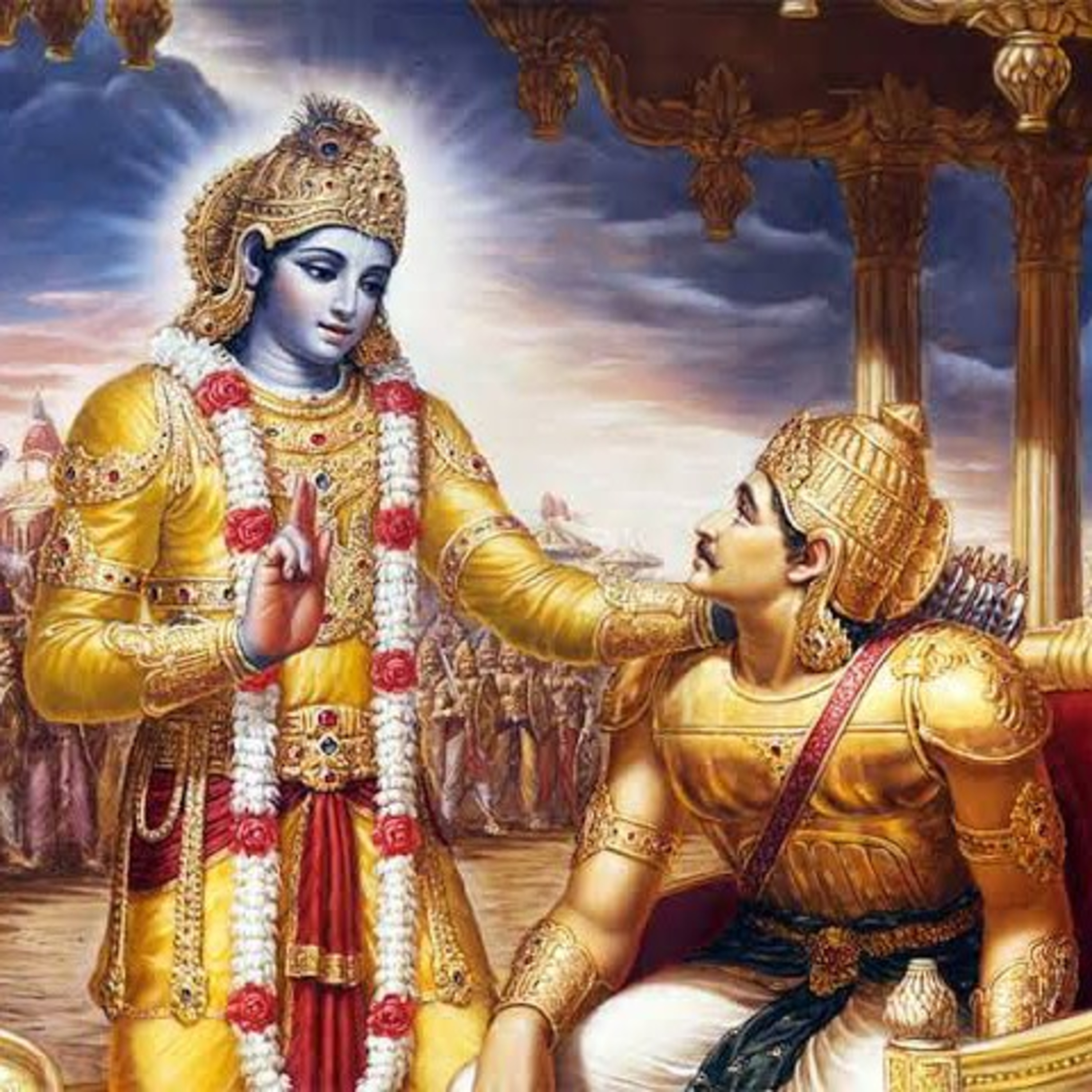
श्रीमद भगवत गीता, अध्याय - 1. Narrated by Shailendra Bharti. Presented by Prasad's Gita Zone.
51m 29s
In this transcription, Shailendra Bharti introduces a new perspective on the Bhagwat Gita, emphasizing the importance of Shri Krishnam and the universal relevance of Gita's teachings. He highlights that Gita provides answers to all questions in life and urges listeners to relate to Arjun's doubts and problems as their own. The discussion transitions to the first chapter of Arjun Vishad Yoga, focusing on Dhritarashtra's curiosity about the ongoing war and Sanjay's divine vision that allows him to describe the battlefield events accurately. The narrative underscores practical truths and life's challenges, drawing parallels between the characters' dilemmas and our own. Through this interpretation, the aim is to make Gita accessible and applicable in everyday life, offering guidance and solutions through the wisdom of Shri Krishnam.
Transcription
1079 Words, 7600 Characters
"Sare gama karva minibhakti"
Bhagwat Gita, Gita Saar Chapter 1
Namaskar, friends!
People have worked on Bhagwat Gita and Gita's knowledge.
You must have heard of so many Gita's.
However, I, Shailendra Bharti, am now presenting to you
another knowledge of Bhagwat Gita.
What is the speciality of this Gita?
If there are any specialities in Gita,
then it is Shri Krishnam.
The rest we all worship.
We are ordinary people.
But this is my special effort
to show us this scripture in today's world.
We can easily understand Gita
and use it in our daily life.
By the way, a lot has been said and heard about Gita.
Maybe there is some kind of religion
which has been written so much.
What is special about Gita?
That it is becoming more important
and more important at times.
If we say it in a simple language,
then Bhagwat Gita is an answer.
Gita is an answer to every question in the world.
There is no question related to life
which is not given to Shri Krishnam Bhagwat Gita.
In our mind, there is no doubt,
worry, worry, any kind of anxiety,
any kind of doubt,
every kind of dilemma in the world is Gita.
Bhagwat Gita has 18 verses
and in each verse,
it is a part of the Vedas and Upanishads.
Don't be afraid of the Vedas and Upanishads.
Don't think that they are far away from you and us.
In each verse of the verse,
you should consider yourself as Arjun.
Because every doubt of Arjun,
every fear of him, every problem of him,
it is our own problem.
And the solution to every problem is
Shri Krishnam.
Don't consider Krishnam only as Arjun's companion.
He will also consider him as his life companion.
According to him,
if we and you go,
then I will tell David
that we will easily overcome all the problems.
I will not be able to talk much about
science or religion or literature, friends.
Here, we will talk about the practical truths
and practical problems of life.
So, come.
I, Shailendra Bharti, take you
on the journey of Bhagwat Gita's 18 verses.
This is the first chapter of Arjun Vishad Yoga.
This is the first chapter of Arjun Vishad Yoga.
This is where the questions of the Dhritarashtra begin.
They want to know
what is happening in the war.
What is their son Duryodhan
and his army doing?
And what is the army of the Pandu sons doing?
After that,
Arjun Vishad is the commander of both the armies,
and after that comes Arjun Vishad.
That means, his sorrow,
his problems, his religious problems.
Come, let us listen to Arjun Vishad Yoga.
(Sanskrit chants)
Dhritarashtra asks Sanjay
what is his son Dhritarashtra doing
to fight in the Dharam Bhumi Kurukshetra.
Dhritarashtra wants to know
what is happening in the war.
Dhritarashtra was blind.
He could not see.
But he was blind from his eyes.
He was not blind from his mind and imagination.
He knew that he was not with the Dharam,
because the Dharam was where Krishna was.
In his son Moham,
he chose war instead of peace.
But he knew that it would not be easy
to win this war.
When we do something wrong in our lives,
we understand that the result of our actions
may not be good.
That is what happened with Dhritarashtra.
That too is seen in this fear and this fear.
(Sanskrit chants)
(Sanskrit chants)
Sanjay looks at the situation and answers.
"Hey, Raja, Duryodhan is looking at the army of Pandavas.
And this is what Guru Dronacharya says."
Sanjay had got divine vision.
He could see the war even if he was away from the war.
Whatever he was seeing, he was telling the same.
He was not saying anything from his side.
He was only telling the situation of the war.
That is, as we listen to the running commentary,
just understand in the same way.
His divine vision was amazing,
that he got us to listen to the song.
(Sanskrit chants)
(Sanskrit chants)
(Sanskrit chants)
(Sanskrit chants)
(Sanskrit chants)
(Sanskrit chants)
(Sanskrit chants)
(Sanskrit chants)
(Sanskrit chants)
(Sanskrit chants)
(Sanskrit chants)
(Sanskrit chants)
(Sanskrit chants)
(Sanskrit chants)
(Sanskrit chants)
(Sanskrit chants)
(Sanskrit chants)
(Sanskrit chants)
(Sanskrit chants)
(Sanskrit chants)
(Sanskrit chants)
(Sanskrit chants)
(Sanskrit chants)
(Sanskrit chants)
(Sanskrit chants)
(Sanskrit chants)
(Sanskrit chants)
(Sanskrit chants)
(Sanskrit chants)
(Sanskrit chants)
(Sanskrit chants)
(Sanskrit chants)
(Sanskrit chants)
(Sanskrit chants)
(Sanskrit chants)
(Sanskrit chants)
(Sanskrit chants)
(Sanskrit chants)
(Sanskrit chants)
(Sanskrit chants)
(Sanskrit chants)
(Sanskrit chants)
(Sanskrit chants)
(Sanskrit chants)
(Sanskrit chants)
(Sanskrit chants)
(Sanskrit chants)
(Sanskrit chants)
(Sanskrit chants)
(Sanskrit chants)
(Sanskrit chants)
(Sanskrit chants)
(Sanskrit chants)
(Sanskrit chants)
(Sanskrit chants)
(Sanskrit chants)
(Sanskrit chants)
(Sanskrit chants)
(Sanskrit chants)
(Sanskrit chants)
(Sanskrit chants)
(Sanskrit chants)
(Sanskrit chants)
(Sanskrit chants)
(Sanskrit chants)
(Sanskrit chants)
(Sanskrit chants)
(Sanskrit chants)
(Sanskrit chants)
(Sanskrit chants)
(Sanskrit chants)
(Sanskrit chants)
(Sanskrit chants)
(Sanskrit chants)
(Sanskrit chants)
(Sanskrit chants)
(Sanskrit chants)
(Sanskrit chants)
(Sanskrit chants)
(Sanskrit chants)
(Sanskrit chants)
(Sanskrit chants)
(Sanskrit chants)
(Sanskrit chants)
(Sanskrit chants)
(Sanskrit chants)
(Sanskrit chants)
(Sanskrit chants)
(Sanskrit chants)
(Sanskrit chants)
(Sanskrit chants)
(Sanskrit chants)
(Sanskrit chants)
(Sanskrit chants)
(Sanskrit chants)
(Sanskrit chants)
(Sanskrit chants)
(Sanskrit chants)
(Sanskrit chants)
(Sanskrit chants)
(Sanskrit chants)
(Sanskrit chants)
(Sanskrit chants)
(Sanskrit chants)
(Sanskrit chants)
(Sanskrit chants)
(Sanskrit chants)
(Sanskrit chants)
(Sanskrit chants)
(Sanskrit chants)
(Sanskrit chants)
(Sanskrit chants)
(Sanskrit chants)
(Sanskrit chants)
(Sanskrit chants)
(Sanskrit chants)
(Sanskrit chants)
(Sanskrit chants)
(Sanskrit chants)
(Sanskrit chants)
(Sanskrit chants)
(Sanskrit chants)
(Sanskrit chants)
(Sanskrit chants)
(Sanskrit chants)
(Sanskrit chants)
(Sanskrit chants)
(Sanskrit chants)
(Sanskrit chants)
(Sanskrit chants)
(Sanskrit chants)
(Sanskrit chants)
(Sanskrit chants)
(Sanskrit chants)
(Sanskrit chants)
(Sanskrit chants)
(Sanskrit chants)
(Sanskrit chants)
(Sanskrit chants)
(Sanskrit chants)
(Sanskrit chants)
(Sanskrit chants)
(Sanskrit chants)
(Sanskrit chants)
(Sanskrit chants)
(Sanskrit chants)
(Sanskrit chants)
(Sanskrit chants)
(Sanskrit chants)
(Sanskrit chants)
(Sanskrit chants)
(Sanskrit chants)
(Sanskrit chants)
(Sanskrit chants)
(Sanskrit chants)
(Sanskrit chants)
(Sanskrit chants)
(Sanskrit chants)
(Sanskrit chants)
(Sanskrit chants)
(Sanskrit chants)
(Sanskrit chants)
(Sanskrit chants)
(Sanskrit chants)
(Sanskrit chants)
(Sanskrit chants)
(Sanskrit chants)
(Sanskrit chants)
(Sanskrit chants)
(Sanskrit chants)
(Sanskrit chants)
(Sanskrit chants)
(Sanskrit chants)
(Sanskrit chants)
(Sanskrit chants)
(Sanskrit chants)
(Sanskrit chants)
(Sanskrit chants)
(Sanskrit chants)
(Sanskrit chants)
(Sanskrit chants)
(Sanskrit chants)
(Sanskrit chants)
(Sanskrit chants)
(Sanskrit chants)
(Sanskrit chants)
(Sanskrit chants)
(Sanskrit chants)
(Sanskrit chants)
(Sanskrit chants)
(Sanskrit chants)
(Sanskrit chants)
(Sanskrit chants)
(Sanskrit chants)
(Sanskrit chants)
(Sanskrit chants)
(Sanskrit chants)
(Sanskrit chants)
(Sanskrit chants)
(Sanskrit chants)
(Sanskrit chants)
Podcast Summary
Key Points:
Introduction to a new interpretation of Bhagwat Gita by Shailendra Bharti.
Significance of Shri Krishnam in Gita.
Every question in the world has an answer in Bhagwat Gita.
Overview of the first chapter of Arjun Vishad Yoga in Gita.
Dhritarashtra's inquiry about the war situation.
Sanjay's divine vision providing insights into the battlefield.
Summary:
In this transcription, Shailendra Bharti introduces a new perspective on the Bhagwat Gita, emphasizing the importance of Shri Krishnam and the universal relevance of Gita's teachings. He highlights that Gita provides answers to all questions in life and urges listeners to relate to Arjun's doubts and problems as their own. The discussion transitions to the first chapter of Arjun Vishad Yoga, focusing on Dhritarashtra's curiosity about the ongoing war and Sanjay's divine vision that allows him to describe the battlefield events accurately.
The narrative underscores practical truths and life's challenges, drawing parallels between the characters' dilemmas and our own. Through this interpretation, the aim is to make Gita accessible and applicable in everyday life, offering guidance and solutions through the wisdom of Shri Krishnam.
FAQs
The speciality of Bhagwat Gita lies in Lord Shri Krishna.
Bhagwat Gita provides answers to every question in the world, addressing all aspects of life.
Bhagwat Gita consists of 18 verses, each derived from the Vedas and Upanishads.
We should consider ourselves as Arjun in each verse, as his doubts and fears reflect our own.
The first chapter, Arjun Vishad Yoga, presents Arjun's sorrow and religious dilemmas, setting the stage for the teachings of Lord Krishna.
Chat with AI
Loading...
Pro features
Go deeper with this episode
Unlock creator-grade tools that turn any transcript into show notes and subtitle files.
 PodcastTranscript AI