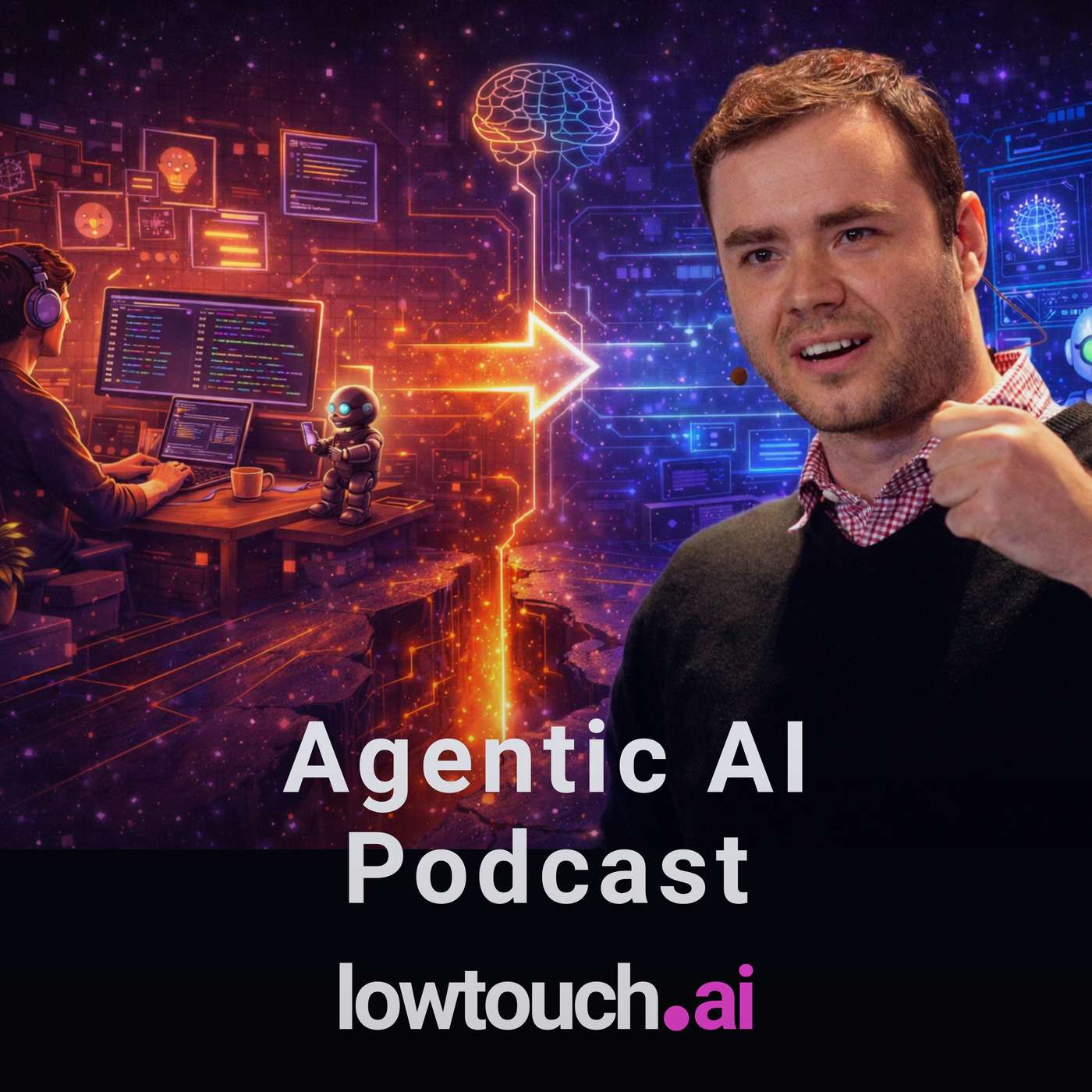
Shift from Vibe Coding to Agentic Engineering | Agentic AI Podcast by lowtouch.ai
15m 0s
The discussion outlines a major transition in software development driven by AI. It contrasts two philosophies: "vibe coding," a fast but chaotic method where developers use natural language prompts to generate code without deep review, leading to unscalable and insecure "garbage code"; and "agentic engineering," a disciplined approach where autonomous AI agents plan, write, test, and iterate on code systematically, offering massive gains in speed and robustness. For enterprises, adopting agentic systems necessitates secure, private AI infrastructure to protect intellectual property and ensure compliance, moving beyond public cloud APIs. This shift fundamentally changes the developer's role from hands-on coding to orchestrating AI agents, demanding new skills in oversight and governance. The conclusion is that while AI handles execution, human strategic direction and accountability are paramount, with the future pointing toward self-improving software systems and AI-led research and development.
It is Thursday, February 12, 2026. And if you have been writing code, or even just managing a team that writes code over the last 12 months, you know the ground has shifted beneath our feet. We aren't just talking about better autocompletion anymore. We are definitely not talking about a smarter clippy. We're talking about a fundamental reimagining of how software is, well, conceived, built, and deployed. It really is. It's the difference between using a new power tool and hiring an entire construction crew. That is the scale of the shift we were looking at today. And we're seeing two very distinct philosophies colliding in the developer world right now. On one side, you have this chaotic, almost magical energy, what the internet dubbed vibe coding back in 2025. And on the other, you have the enterprise reaction to that chaos, a drive for extreme discipline, structure, and autonomy. We call it "agentic engineering." And if you look at the landscape today, I mean specifically, the framework that Andre's Carpathy laid out last year, and you combine that with new enterprise data from places like lowtouch.ai. This isn't just a buzzword war. It is the industry trying to grow up. We are moving from the wow factor of generative AI to the howl factor of running a scalable business. And that's really the mission for this episode of the Agentic AI podcast. We are going to unpack how the industry is moving from this casual, prompt-based coding divides to deploying disciplined, autonomous agents that actually plan, test, and execute their own work. The question is, are we moving fast enough to keep up? And maybe can we do it without breaking the infrastructure we've spent the last 20 years building? That's the real question. Let's start with the phenomenon that really kicked this off. Vibes coding. Hmm. It sounds like something you do in a beanbag chair with low-fi beats playing, but it was a serious shift in developer psychology. It really was. Carpathy coined the term back in February 2025. He defined it as this relaxed, intuitive style of programming. The core idea is that the developer relies almost entirely on natural language descriptions to generate code. It's like, go with the flow mindset. So instead of assessing over syntax or memory allocation or, you know, memorizing the standard library for Python, you are just talking. You're dictating. Exactly. You are using tools like cursor composer, usually paired with a model like Sonnet. The workflow is basically, you tell the AI make this button blue, hook it up to the database and throw a confetti animation when I click it. And the AI generates the diffs, the actual code changes, and you just hit accept. Without reading it. Ideally, yeah. In a pure vibe coding state, yes. You accept the changes without a deep code review. If the app crashes, you don't open the debugger and look at a stack trace. You just tell the AI, hey, that break the login page, fix it. You iterate based on the vibe of the application. Does it feel right? Not on the logic of the code. Carpathy described building projects where he forgot the code even exists. I have to admit, that sounds incredible for productivity. It is wildly productive for creation. That's the appeal, right? It offers massive leverage. You can turn a week and hackathon idea into a deployable product instantly. Remember the menu, just an example? Oh, the app that visualizes restaurant menus from photos. Right. That is the kind of thing that used to take weeks of fiddling with CSS grids, back end parsing image recognition APIs with vibe coding. Developers were building that in hours. The AI handles all the mundane stuff patting adjustments, boilerplate API connections. It feels like magic, because the barrier between idea and reality is almost gone. Okay, so I can build an app in a weekend by just vibing with my AI. But here comes the reality check. If this is so fast and efficient, why isn't every enterprise just, you know, firing their dev teams and switching to vibe coding? Why aren't we running the banking system on vibes? Because vibes don't scale. And more importantly for our listeners, vibes do not pass a security audit. The trap of vibe coding is the lack of foresight. It completely lacks system level reasoning. It's short-sighted. Totally. When you vibe code, the AI is usually addressing your immediate prompt, fix this error, add this feature. It's reactive. It often fails to integrate that change into a larger architecture. It's like adding a room to a house without checking if the foundation can even hold it. So you just end up with this Frankenstein monster of code? Exactly. It's often called the garbage code problem. We have studies showing that as your conversation history, the context gets longer. The error rates just skyrocket. Up to 64% of outputs can include unnecessary parts, hallucinations, or code that conflicts with something you wrote 10 minutes ago. 64%. That is a coin toss. Actually, it's worse than a coin toss. It is. And here's the technical reason why. The context window. Even with massive context windows, models lose track of the broader system constraints. If you forgot the code exists while building it, who is going to fix it when a security vulnerability pops up in an outdated library three months from now? Right. You don't know how it works. You're the architect, but you never looked at the blueprints. Precisely. You relied on a hands-off vibe, but now you have a hands-on crisis. It's fragile. It's great for a prototype. But if you are a health care provider, handling patient data, or a Fintech company, you just can't run on fragile. Which leads us to this solution and the main topic for today, "Agented Engineering." Now, help me distinguish this. How is this different from just better vibe coding? Are we still using AI to write the code? We are, but the relationship is inverted. Vibed coding or, you know, traditional AI assistance is reactive. You prompt, it responds, it's a tennis match. Agentic systems are proactive. They manage long-running processes. They don't just write a snippet. They build a system. So it's less like a typewriter that talks back and more like an employee. That's the best analogy I've heard. If vibe coding is a chaotic, brilliant teenager, a gentic engineering is the disciplined senior engineer. The workflow loop is completely different. It follows a cycle. Planning, execution, validation, and iteration. Let's break those down. Because planning sounds like something AI historically sucks at. What does that planning phase even look like for an agent? This is the part that blows people's minds. The agent doesn't just start typing code. It pauses. It decomposes the requirements into a graph of subtasks. It outlines dependencies first. It might say, okay, to add this feature, I first need to update the database schema. Then I need to update the API. And then I can change the front-dead. Which, let's be honest, is something a lot of human junior developers forget to do. They just start hacking away at the first file they see. Right. The agent thinks before it acts, then comes execution writing and refactoring the code. But it doesn't stop there. The critical differentiator is validation. Automated testing. The agent runs the code. It checks for errors. And here is the magic part. Iteration. If a test fails, the agent's self-cracks. It reads the error log. It realizes, oh, I miss a semicolon. Or I use the wrong variable. And it replants. It creates a feedback loop until the task is actually done. So it doesn't just hand the broken code back to me and say, your turn. No. It loops until it passes the tests you define. You don't step into fixes syntax error. That architecture seems so much more robust. But it also sounds computationally heavy. The notes mentioned this agent has a brain involving memory management. Yes, and memory is key. In vibe coding, the AI often forgets the context of what you did five prompts ago. Because the context window just fills up with chat logs. Agenic architecture uses structured memory management to retain context and prevent redundancy. It also has tool usage. It can use APIs, search the web, use debugging utilities. It's acting like a developer with a full tool belt. Now we have to talk about the speed. I saw a benchmark in the notes that it made my jaw drop. The 252x figure. Yes. Agenic workflows have been shown to complete features 252 times faster than manual workflows. That isn't a percentage increase. That is a magnitude shift. It changes the economics of software development entirely. Imagine the cost of a feature dropping from, say, $5,000 in engineering time, to $20 in compute time. But, and there is always it. But if it's that fast and that cheap, why is the adoption tricky? If I'm sitting in the C-suite or an IT leader listening to this and thinking great, let's deploy the agents. But you can't just download this off the internet and run it, can you? No, and this is where the conversation shifts to the enterprise reality. You can't just run this on a laptop. You certainly can't run it on a public API if you care about your intellectual property. This brings us to the infrastructure discussion. The material from lowtouch.ai brings up a really interesting concept here. The private AI appliance and private AI infrastructure. This feels like a direct answer to all those security fears from vibe coding. It is. Look, if you're a bank, you cannot send your proprietary trading algorithms or your customer PII, you know, personal identifiable information out to a public model API, like open AI or anthropic. And just hope they don't train on it. Right, compliance would shut you down in five minutes. Exactly. So the reality is enterprises need to deploy these secure, no code AI agents on site, or within a private VPC, a virtual private cloud. So the private AI appliance is basically putting the brain of the agent inside your own walls. Metaphorically, yes. It gives you complete data control. You're looking at a model where the infrastructure is scalable, but private. Yeah. It powers these intelligent workflows, but keeps the data governance strictly internal. It's interesting how physical the language becomes their appliance infrastructure. Hmm, it makes it feel much more tangible than just cloud magic. It sounds like something you rack and stack. Well, it has to be tangible to be manageable. If you're building what we call an AI center of excellence, you need a foundation. You can't build a center of excellence on a subscription API that changes its terms of service every week. Let's touch on that. The AI center of excellence. It sounds a bit like corporate speak, but the trend data suggests it's a critical strategy. What is it, essentially? It's a trend where organizations aren't just buying tools. They're building a dedicated
to foster internal expertise, they use agent-assisted training to scale innovation across the company. It's acknowledging that you can't just buy agentic AI. You have to build the organizational muscle to use it. So it's not just about installing the software, it's about changing the culture. Precisely. You need a centralized team that defines the guardrails, the security protocols of that private AI appliance, and then disseminates that power to the rest of the org. Which leads to the biggest anxiety people have, and I know our listeners are thinking this, what happens to the humans? The evolution of the engineer. Right. If the AI is planning, executing, testing, and iterating, what am I doing? Am I just the guy who brings the coffee to the server room? No, but you were evolving. The role shifts from coder to supervisor or orchestrator. You aren't the brick layer anymore. You're the architect in the form. We are seeing data that AI is now handling 70-80% of routine code. If 80% of my day used to be writing syntax, figuring out where the semicolon goes, that is a huge vacuum to fill. It is, but it fills up with higher-level work. We're seeing a demand for new competencies. AI Psychology is a fascinating one mentioned in the text. AI Psychology, that sounds wild. Are we putting the agents on a therapy couch? In a way, it's about navigating hallucinations and biases. I don't mean social biases. I mean technical ones. You have to understand how the model thinks, so you can spot when it's going down a rabbit hole. You need to know how to orchestrate effective prompts, and crucially how to evaluate the output. So governance becomes a technical skill. Governance is a huge skill. The agent might write code that is technically correct. It compiles. It runs. But it might violate a business rule. It might optimize a route that is legally impossible. The AI won't catch that. The human needs to. There is a risk mentioned here, though, regarding skill erosion. And this worries me. The junior developer problem. Exactly. If the AI does all the heavy lifting, do junior engineers ever learn the fundamentals? That's the human and the loop necessity. If you never struggle through the "why" of the code. If you never spent three hours debugging a race condition, do you develop the intuition to supervise the agent? It's like using a GPS. If you use it every day, you eventually forget how to navigate your own neighborhood. That's the perfect analogy. If you lose that deep understanding, you lose the ability to effectively supervise the agent. You become a rubber stamp. And a rubber stamp is dangerous in security critical software. So we need to ensure engineers don't lose their internal compass for code quality, even while they let the AI drive the car. Accountability remains human. The agent can write the code. But if the system fails, the agent doesn't get fired. You do. That is a sobering thought. So looking ahead, the landscape paints a pretty wild picture of the next two to five years. What's the outlook? We're looking at the potential for self-evolving software. Self-evolving software. Imagine systems that don't just wait for a ticket to be filed. They identify inefficiencies in their own code and rewrite themselves to be better. They monitor their own performance and refactor overnight. That sounds like science fiction. That sounds like the start of a movie that doesn't end well for the humans. It's becoming science fact. We're moving toward AI-LID R&D. We're organizations restructure entirely around agent teams. The humans sit in advisory roles. Setting the strategic direction, we need to enter this market. We need to solve this user problem, while the agents execute the research and development to get there. It's a complete restructuring of the org chart. It is. But the key takeaway for the enterprise isn't that agentic engineering replaces human ingenuity. It amplifies it. It moves the focus from syntax where do I put this bracket? To strategy. What are we actually trying to build? That's a comforting thought. We get to focus on the what and the why while the agents handle the how. But only if we step up to that orchestrator role. If we insist on just being coders, we're in trouble. So, as we wrap up this deep dive into the shift from vibe coding to agentic engineering, here is a question for you, the listener, to chew on. Lay it on them. Look at your current team structure. Look at your daily workflows. If agents are handling the execution, the planning, coding, testing, are your teams built for creation? Or are they just built for maintenance? Because the tools for creation just got 252 times faster. Exactly. If you're still structured for maintenance managing backlogs, fixing bugs, slow release cycles, you might get left behind by a competitor who is structured for pure creation. That is the million dollar question. Are you ready to stop fixing bugs and start building futures? This has been a fascinating look under the hood of the next generation of software. We've gone from the magic of vibe coding to the discipline of agentic engineering and the infrastructure you need to make it real. It's going to be an interesting year. Rethink your automation strategy, keep your hands on the wheel, and thanks for listening to the Agentec AI Podcast.
Podcast Summary
Key Points:
The software development landscape is undergoing a fundamental shift from reactive, prompt-based "vibe coding" to proactive, disciplined "agentic engineering."
Vibe coding offers rapid prototyping by having AI generate code from natural language prompts but creates fragile, unscalable, and insecure systems due to a lack of planning and system-level reasoning.
Agentic engineering uses autonomous AI agents that follow a cycle of planning, execution, validation, and iteration, producing more robust and scalable code, with benchmarks showing potential 252x speed improvements.
Enterprise adoption requires private AI infrastructure (like appliances or VPCs) for data security and control, moving beyond public APIs.
The developer's role is evolving from writing code to orchestrating and supervising AI agents, requiring new skills in AI psychology and governance, while human accountability remains critical.
The future points toward self-evolving software and AI-led R&D, restructuring organizations to focus human effort on strategic direction rather than implementation.
Summary:
The discussion outlines a major transition in software development driven by AI. It contrasts two philosophies: "vibe coding," a fast but chaotic method where developers use natural language prompts to generate code without deep review, leading to unscalable and insecure "garbage code"; and "agentic engineering," a disciplined approach where autonomous AI agents plan, write, test, and iterate on code systematically, offering massive gains in speed and robustness. For enterprises, adopting agentic systems necessitates secure, private AI infrastructure to protect intellectual property and ensure compliance, moving beyond public cloud APIs.
This shift fundamentally changes the developer's role from hands-on coding to orchestrating AI agents, demanding new skills in oversight and governance. The conclusion is that while AI handles execution, human strategic direction and accountability are paramount, with the future pointing toward self-improving software systems and AI-led research and development.
FAQs
Vibe coding is a relaxed, intuitive programming style where developers use natural language prompts to generate code, relying on AI tools to handle implementation without deep code review.
Vibe coding lacks system-level reasoning, leading to fragile, unscalable code with high error rates. It fails security audits and creates maintenance challenges due to poor integration into larger architectures.
Agentic engineering is a disciplined approach where AI agents proactively manage long-running software processes, including planning, execution, validation, and iteration, to build robust systems autonomously.
Unlike reactive vibe coding, agentic engineering is proactive and structured. It uses planning, automated testing, and iterative feedback loops, functioning more like a senior engineer rather than a casual assistant.
Private AI infrastructure, such as on-site appliances or virtual private clouds, ensures data control, security, and compliance by keeping proprietary information internal and avoiding reliance on public APIs.
An AI center of excellence is a dedicated organizational team that builds internal expertise, defines guardrails, and scales agentic AI adoption through training and governance, fostering a culture of innovation.
Chat with AI
Loading...
Pro features
Go deeper with this episode
Unlock creator-grade tools that turn any transcript into show notes and subtitle files.
 PodcastTranscript AI