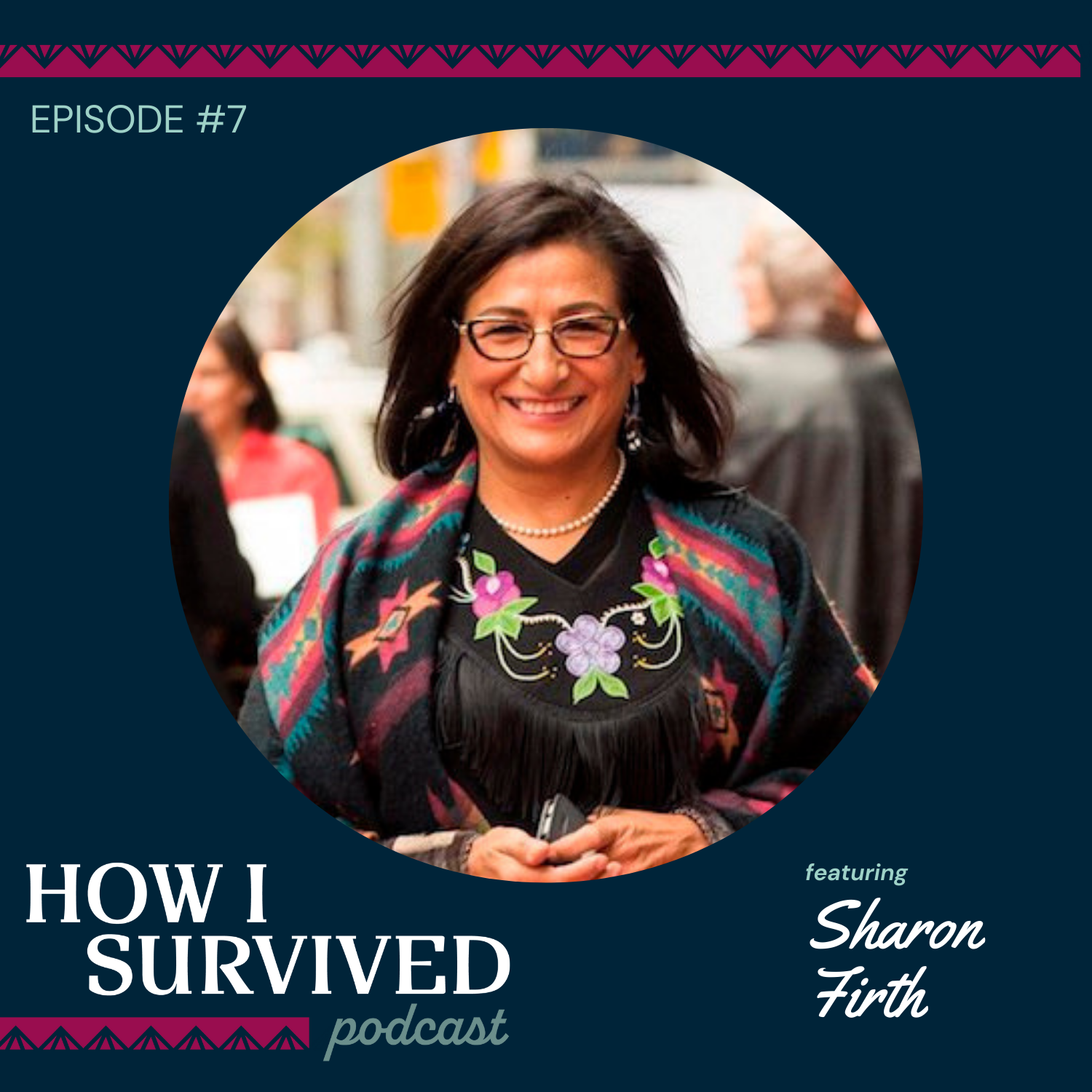
In this podcast episode, co-host Sharon Firth shares her story as a Gwich'in twin and survivor of both residential and day schools. She recounts a close-knit, traditional childhood on the trapline, which was shattered when her mother's tuberculosis treatment forced Sharon and her sister Shirley into Stringer Hall residential school. There, she experienced family separation, suppressed emotions, and abuse. A pivotal positive force was the Territorial Experimental Ski Training (TEST) program, which introduced her to cross-country skiing. Skiing became an outlet for freedom, play, and a connection to the land, starkly contrasting with the oppressive school environment. Sharon and her twin achieved remarkable athletic success, competing in four Olympics, but the TEST program, while transformative, lacked female leadership and faced institutional jealousy. She reflects on how the trauma of school silenced her for years, while the resilience taught by her family and honed through hardship ultimately fueled her athletic discipline and mental toughness, allowing her to eventually reclaim her voice.
(soft music) - Show me Crystal Gale Fraser of Villagy. My name is Crystal Gale Fraser. With Paul Andrew, I am the co-host of How I Survived. This is a podcast about recreation at residential and day schools in Northern Canada. In this episode, you will hear about abuse and trauma. Please look after yourself as you listen. If you are a survivor or an intergenerational survivor of residential or day school and you need help, there's a free 24 hour support line. Call 1-800-695-4419. (soft music) ♪ And you ♪ - When we were indoors, we couldn't laugh and we couldn't cry. So our emotions were really suppressed, but it was a different story when we skied because it was freedom out there and we could express ourselves on skis and enjoy the freedom we had and the playfulness within our whole ski program. 'Cause we were kids. You know, at least that part wasn't taken away from us. And we could have fun and laugh. Sharon and Shirley Firth are household names in the North and beyond. The twin sisters are Gwitchin from McLevich. They were members of the Canadian National Cross Country ski team for an unprecedented 17 consecutive years. They competed at four Olympic winter games. Between them, they won 79 medals at the Canadian Championships, including 48 national titles. Shirley and Sharon are also survivors of residential and day school. Shirley passed away in 2013 from cancer. In January 2023, I visited Sharon at her home in the Bo Valley on Treaty 7 and Maty Lance. (soft music) - Hi, Joe Sharon, for speaking with me today. Could you start by introducing yourself and your family? - Okay, my name is Sharon and Firth. My parents are Fanny Rose Firth and Steven Firth. We lived in a clavicle group on the trap bar trap line there. I have seven sisters, five brothers, I believe. We were actually raised in the traditional home living in the land and learning that lifestyle of being with my parents and doing things with my parents as a family. We did everything together. In those days, that's how we did it. You know, we didn't send the kids off to babysitters or that it was always with my parents. When we were living on our trap line, we lived in a tent, those wallpints. And of course, we didn't have running water. We didn't have flush toilets. The honey bucket was the conversation of the day. We had a wood stove and it was all open concept. And I really liked that word open concept because in all your houses, it's the new development, it's open concept. But yeah, that's how we lived. I remember with my mother, she taught us all the woman stuff. You know, whether it was sewing, cooking, cleaning, gathering wood and gathering small animals. And then the boys went with my dad on the trap lines. The women also were the water carriers. You know, so we'd go down to the river and get a water from there. And everything was like, it was calm. And as kids, we were taught to sit and listen. And I think that's really good because nowadays, I don't see that happening. And with my parents having so many kids, she had to have control of us. So for me, it was a really lovely upbringing. And you know, we were a very close family. My parents really loved us. And they told us so. So that was really, really secure for us. But all that changed when my mom got sick. She thought, "Tee-bee, we are maybe five, six years old." And she went to Charles Campbell Hospital. And we had to go to residential school. The Charles Campbell Hospital was a so-called Indian Hospital in Edmonton. Indian hospitals were supposed to provide medical care. They were under-resourced and kept indigenous peoples segregated from Canadian society. Indian hospitals had similar goals to residential schools. The Charles Campbell Hospital was one of many federal Indian sanitaria across Canada. Over the years, thousands of indigenous peoples with tuberculosis from the NWT and Nunavut were taken to the capsule hospital. Many never returned home. While their mother was at the capsule hospital, Sharon and Shirley had to stay at one of the local residential schools, Stringer Hall. Stringer was the residence for Anglican students at the Sur Alexander McKenzie School in Inuvik. In the residential school, there's a lot of things that was taken away from us. But they couldn't take our memories of our family away. And the most of us girls we were in. We were all in junior dorms, so we were able to see one another. Whereas with my brothers, we were never allowed to go visit them. And even at meal times, we couldn't sit with them or we couldn't go and say hi or anything. So that was really sad because as a family, a close family, we were already separated there. One thing I remember clearly was going to bed, you know, in residential school, because we all had our beds side by side. And the supervisor always yelled out lights out. No one knows or anything. And even if you whispered, you know, you got a beating for it. What was really sad for me was missing my mom, telling the stories and saying our prayers at night. And that really, like it made my heart really sad. And just the loneliness and you know the comfort from her. But we learned to be tough also. We learned to keep our mouth shut, which for the first families is not a good thing. We all had to have the last say. When your mom returned from the camp, so were you able to leave the residential school string or hall? Yes. Because we were in short periods at a time. So when she was gone, yes, we had to be in the school. And the school really changed us. It really hardened us. And it really made us sad people, you know, because we couldn't talk to our parents. Even when she came home, my mom and dad couldn't visit us. And we were living in the same town. So it really did bring a division, at least to our family. And now when I think back, like why? What did that happen? And even not being able to visit our brothers and sisters, you know, to see how one another was doing and playing 'cause we played a lot, one over home. And none of that happened when we were in residential school. Can you tell me about your twin? Oh my goodness. (laughs) My twin. Yeah, no, no, no, I will. Well, with my twin sister, unfortunately, in residential school, we slept side by side. But very often we would wake up sleeping together and that was forbidden, you know. And so we got a lot of strappings over that. But they never separated us, you know, which I'm really glad because we, you know, my mother raised us to be together. Whenever one of us got sick, we were always together, you know, supporting one another and helping one another out. And then when we both got on the team, it was a very difficult situation, you know, and I think back now, like we were both very, very competitive, but surely was the aggressive one. And I was a peacemaker between two of us. And at times, you did difficult for me because I had to keep him out shut. (laughs) Because she was older than me by two minutes. And, but we relied on one another a lot. When we went to day school, you know, that was another horror story because we were so mistreated,
the teachers, we um, we um, don't beat in a lot, you know, we got strapped and the ruler over our heads and stuff like that and it really, I feel that it really ruined me because I lost my voice, I couldn't speak. And um, you know, the feelings that come within, it's so hard to express, you know, what you want to say and sometimes it doesn't come out right and then it causes friction and sadness and misery for yourself. And it's a, um, like we were traumatized in both residential school and, um, in Indian Day School, my twin sister had her fingernail torn off and that, that was trauma for her throughout that incident. She didn't cry. You know, because you had to be strong and she didn't want to, didn't want to show that, that if she cried, it was failure and that she was a weakling. Oh, so, so that, um, you know, that really gained and tough and doesn't harden us. I couldn't speak because of the trauma and the beatings in school. So surely was my spokesperson, you know, we had this twin talk in a lot of body language and a lot of facial and eye expressions. And I think it was only tell maybe when I turned 18 that I started finding my voice back again. So now, now I try to be expressive and be a joyful person and what I'm out there representing native people, especially it's really important for me to speak up and speak right. You know, those skills that were taught to us about being patient, being strong, being determined, being, um, you know, learning to make hard decisions at a very, very young age. That was very difficult, but I think it really formed and shaped us for life on the ski trails. You've talked about skiing a few times now. When and how did you and Shirley start skiing? There was a program that started for indigenous kids when that was the territorial experimental ski training program. It was just by fluke that we, um, that Shirley and I were introduced to the ski program. We were playing with friends and they invited us to try out skiing and then my mom stepped in and said, okay, one of you goes, you both have to go. And, you know, Shirley and I sometimes we wanted to be separated, but a game we knew the value of strength. So with two of us were a stronger team. The coach told us that if we, if we showed up every day and we did our training, we'd get to travel. And that was the bait right there, you know, we, we've never traveled except from our trapline to the clavicle and the new victim. You know, this was such an opportunity to see what the world was like. Um, our first, first, um, major competitions was in Alaska. And we, we skied with, um, with the Americans, of course, but there were some indigenous women there that we still, um, keeping contact with. And, you know, and so through skiing, it taught us how to be friends with different cultures and different people around the globe. The government of Canada launched the territorial experimental ski training program in a new vick in 1967. This was known as the test program. It was built on a cross country ski program that father Moussé developed for Vantakwit Chin in Olkro, Yucon. The goal of test was to see how cross country skiing might affect the motivation and success of indigenous youth. At times, there were more than 250 children in the program. Most of the test skiers were at Roller Hall, the Catholic Residential School. Some of the kids were day students. A few of the skiers lived in the Anglican Residential School Stringer Hall. Because in, uh, in Residential School, children came from clear across the North West territories. So that was a central meeting point for, for kids and the, um, skiing caught their attention. So, so, you know, we all, um, ran together, skied together, played together, and it was a happy atmosphere. But once you go inside behind those closed doors, it's a total different picture. You know, being in control of the supervisors and the priests, you know, that, that took the life out of the kids. You couldn't laugh, you couldn't cry. Your emotions were killed. But to be out there and, you know, find that inner peace was so important for all of us. Can you tell me about your life on the ski team? What was your relationship like with the other skiers? Looking a much surely too, because we always, we trained together, we trained with the guys and, um, gorgeous sisters, Lorraine and your mom, you know, we trained together. Um, so we always had that, you know, that really kind of connection. We weren't, we weren't, um, aggressive with one another. We were there to help, and that's what we did. And, and that competitiveness, you know, we, like, where did we get that from? To, to push yourself on, on the trails, you know, like as indigenous woman to we, we, um, it wasn't about beating one another. It was about doing your best. And sometimes when, when we were told we have to, then the joy was gone because, um, I don't think, think we were trained to be, like from a home to be competitive, to just to do your best. I've heard you talk about how skiing was a way to stay connected to the land. Can you tell me about that? Well, when we lived on our trap line, we did lots of walking and so the trails for skiing at that time, the renaro, so that brought back memories from home and, and, um, listening to the, the, um, skis making noise on the snow, because when we walk, we, like, you break through ice or break through fresh snow or hard snow and, and my mum will tell us stories as we're walking, you know, we would see different animal tracks, so she would explain those to us and the type of different animals. So when we skied, there was lots of rabbits around and that was our food, that was our grocery store. And, um, so, you know, there was a connection to the land because there was land, water, food, you know, the basic necessity for life. Can you tell me about your training routine when you were a part of the test program? Okay, my training program, well, number one, um, again, is indigenous people. We didn't understand training, you know, we went out there and ran and had fun, but to follow a program that was a total new concept for us, we didn't have psychologists or sports psychiatry or anything like that. We just had a, you know, with, with our coach, we had a good relationship and try to understand best what the training was all about. Um, let's see, there was speed training interval training, long distance training, easy training, and to try to listen to your body also, and to put all that together to try to think of how it's going to help us to be fast. And then also, we, um, when we first started skiing, we didn't know what technique was or, or, you know, how, how the movements go together and how to be efficient, how to be fast, how to be strong, you know, the different angles of cross-country skiing, like all that we didn't understand. So we had to learn that and hopefully develop some sort of picture in our mind as to, as to what skiing looked like, because we didn't grow up with, um, like, for example, in Scandinavia, you could, you could see all those Norwegian skiing, you know, but here in Canada, we just had our little, our little team, and whether their technique was good or not, I would know, like, oners with our coach. So he was the one that really developed our mind and our, um, and learning to, to know what technique training was. And man, that was, um, a total different
learning for us, the sport of cross-country skiing, it was part of our culture, but snowshoeing was, running and walking was. So you know, it's kind of similar movements, but on skis you glide and you know, you have our movement, leg movement, upper body movement, and just the different angles learning about that and how to put it all together. So, you know, you have the right kick and in the right movement and you know, you finish off your kick, you finish off your arm movement and all that we had to learn. I'm really proud of our team, I'm really proud that we were part of this test program because that identified us, you know, that it was an indigenous program and that we were successful going to Europe and being, being on that list of elite athletes, you know, in the eyes of the Europeans, that was a big message and a powerful message for us to know that we fit in there. Whereas he and here in Canada, it was, there was so, so much jealousy within different organizations because our program was successful and it's, in my mind, it's sad that it didn't continue because we have raw talent indigenous athletes in the North and I don't know, maybe one day, we'll be discovered, but if you don't tap into the, into the, um, the talent then there's no talent because we would know. You were attending day school when you started skiing but there were also children from the residential schools in the test program. What was the relationship like between the town kids and the residential school kids? There definitely was tension between talent kids and residential school kids because now the kids in the residential school would, would judge us because we were poor, you know, so, so that came out, but I mean, we're out skiing, we're having fun and I think that was when Shirley and I started learning how to train our mind to block out things that are not important and to, um, to learn how to concentrate and learn how to, um, read, read the cross-country trails, you know, because every track is different, so we would memorize the tracks, so that would go back to our parents teaching us those skills of learning animal tracks and the terrain. So, like I'm just thinking about it now that that made sense because when we were out there, we were able to memorize all the bumps and all the hills and downhills and turns and, you know, flats. That makes me wonder what it was like being a student when you were traveling to competitions. Did your coaches make sure that you did your homework? Will the, um, forest learning on the road are, our teachers gave us assignments, you know, for, for a month because most of them were gone for a month and, um, I think we did the homework the day before because we were learning so much, you know, we got to go to museums and, you know, different things in different countries and, um, and, um, you know, we expanded our learning that way. The test program was created by the federal government, but I know there was a military base in a new Vic. Was the military involved? I knew that in a new Vic they did have the military, but, um, as for them, in our program, I don't remember that. I know we did get army skis when we first started and those are the best skis ever because they were individually hours, but as we got better, we got better equipment. But there's one thing that we didn't have. We never had a female supervisor or a female shaperone and that was difficult because we weren't, um, trained to talk to guys, to talk to men about anything. So a lot of those feelings we kept to ourselves, or truly, and I would talk about different things, but anything else beyond that wasn't in our environment. We did not go there. Why don't you think there was any female leadership? Well, number one, they didn't have funding for it, and that's a good question because we needed it. We needed a woman around. Yeah, and that popped up for me too when you were talking about your training regime. Like if there were different expectations for boys and girls or where you mostly, it was just all the same for all of your kids. Well, I think it all went on strength too, because with, with Asad, we wanted to be better, surely night trained with the guys, because they're stronger and we just felt if we're hanging onto them, maybe we could beat the Russians, or those iron curtain athletes, or the best in the world, you know. In addition to being men, the coaching staff in the test program were non-indigenous. What was your relationship like with them? Well, I think sometimes when the coaches were talked to us, and especially if there were male, we didn't, we didn't respond like we wanted to, and I think a lot of times they figured we were just ignorant, stubborn kids, which was good on one hand, but not good on the other hand because, you know, we had to learn. We had to learn what sport was for us, what it meant for us, and what it meant for the future. And, you know, like for example, we aren't skiing today. There was a little rotted in kids out there, and they seemed like they were having a good time like I did, you know. And so maybe, maybe just going out there and playing was good enough, because not everybody's going to want to race, and not everybody's going to want to compete, because once you start competing, it's a different kind of pressure. And those speeds come from within in that, that the mental toughness comes from your own learnings, because like I said, we didn't have sports like colleges or, you know, some training on mine can be strong and, you know, block out unnecessary things, and then fill your, fill your mind in heart with good things because that was taken away from us. So, you know, there was a lot of mixed feelings on, on went to laugh, went to grow, I want to speak, because the trust wasn't there. How do you feel about the test program today? The way we proved that the test program was exactly what it was, it was a test to see we could succeed and we did. You know, and the success was making to the Olympics and the World Championships and the World Cup. And I'm so happy that I was part of that program, because back home, you know, there was, there was not enough going on for young people. And, you know, there was a lot of drinking and drugs and that type of lifestyle and a skiing protected, surely, and high from that, which is still the same today. You know, so how can we get our young people into, you know, getting better education, because a lot of, a lot of them from what I read is, is that when they finish high school, they have to take two, three years of upgrading. So, what's going on there? You know, we have a department of education and, and all those different departments that should be, um, pushing our kids to do better, you know, and the way today is education. The world is changing and we have to change with it and, and, um, you know, the residential school is no longer there. So we should be able to, to, um, compete at all levels. It's, it's very different when you live down south. And when you live up north, because there's no mentors, there's no, there's no, um, guidance. And there's no, there's no role models, you know, to, um, show that, our young people are excelling in school. And you know, they should be also put on stage like we were to show that if you can do it, I can do it. Because there's so many trades and so many, you know, things that we can get into. And if it's, if we're not exposed to it, then we don't know. You went to the Olympics four times, which is a very big deal. When you look back over your long career of competing and racing, what events stand out to you? What were the most memorable? Well, like, you know, the Canadian Championships are always big because it's in Canada. And both Shirley and I were 37 time Canadian champions. You know, the, but no one has broken those records. So I'm really proud of that. You just gave me goosebumps. You were tired from skiing in 1985. How did you make that decision?
Well, my twins sister Shirley finished after the 84 Olympics and I wasn't sure if I could go like I'm being that vicious circle without her. So I had to prove myself when I skied competitive for one year without her. And then when I just looked at all the different kids, there's no native kids around and it would have been very difficult for me to be to be in that circle of young people because they don't understand our lifestyle and they're not going to learn about our lifestyle because they're just not part of us. And so when I decided that's it, for me it was a good solution and good, good decision. And like I did a lot of amazing things as an athlete and I felt that I really represented our people at the very highest level and the respect was there. You know, especially when I went home and visited all our elders, you know, they never forgot what we did. We did receive a lot, but we also gave them a lot. You retired for a second time in 2021. What have you been up to? I'm very active here in this community and I get invited to do different things with different schools and with different boards. I'm in demand right now, but I just want to learn different things about who exactly Sharon. And through my arts and crafts, I think I'm discovering that what I put my mother taught me is it's finally, it's finally giving me satisfaction that I could give a little back in that area and also to not be ashamed to wear my stuff because when when we were in residential school, all our hard work, parkers and moccasins and mucleks and mits and all that was taken away from us. So when I started doing my own sewing, I was scared. I was definitely scared to wear my covers, my Delta covers because it was shame. And so I had to do a lot of self-talk and a lot of put on this courageous face that it's not going to be ripped off, you know, because that was what the white people did to us. They took away something that a soul was for our soul and for survival and and it was from our parents, you know, and so now that I'm doing sewing, I put all the love and love in every stitch and hopefully when the person is wearing it, they're going to feel proud of what they have on because our culture is so important to us. I just think it's really, really important that if you don't feel your culture to look for it, it's lifelong learning and to be so proud of who you are, be proud of your families and support one another and give back to the communities that we can. Sharon Firth retired from the Canadian Cross Country Ski team in 1985, but she didn't stop skiing. For more than two decades, she traveled to communities around the Northwest Territories teaching cross-country ski clinics and inspiring young people. In 2021, Sharon retired for a second time and moved to the Bow Valley with her husband Anders. She continues to ski. In fact, during the production of this episode, Sharon, at 70, completed a 54-kilometer ski in memory of her twin Shirley. Skene has given Sharon so much, but there was a cost. The test program was delivered through the residential and day schools in Inuvic. As Sharon's story makes clear, these institutions negatively affected indigenous children, their families and their communities. I want to say hi to Sharon for sharing her story with us. You can see pictures of Sharon skiing in Inuvic and at a World Cup in Sarajevo in 1983 on our website, www.howyservive.ca. There are other photos and materials related to this episode there as well. If you are a survivor or an intergenerational survivor of residential or day school and you need help, there's a free 24-hour support line called 1-800-695-4419. How I Survived is a collaboration between the NWT Recreation and Parks Association and the University of Alberta. The podcast is co-hosted by me, Crystal Gale Fraser and Paul Andrew. I also provide historical direction. How I Survived is co-produced by Amos Scott and Jess Duncan. Advisory support is provided by Dr. Sharon Firth, Lorna Store and Paul Andrew. Our research assistant is Rebecca Gray and our audio engineer is Brandon Lorrock. To the site to enter Pernorth for sharing your recording booth with us. Our theme song is Love the Light by Stephen Cackfee. The cover art for this podcast was designed by P.P. Guam Piedeguan based on a wall hanging made for the project by Agnes Captana. This podcast is produced with support from the Social Sciences and Humanities Research Council and the NWT and Non-Evit Lotteries. The friends life has been built. The land and all was taken from you. Children loved ones go alone and we, yet you stayed so true. Along your face the demon, you hear the wounds inside. Now that you know the dark, you truly love the light. Standing in the shadow the light will bring to shine on you. And you, the endless sun, your spirit lives stronger each day. Along your face the demons, you hear the wounds inside. Now that you know the darkness, you truly love the light. You drum, you sing your song, you're just lining a deep of the door. And the elder, she spoke, his words, our happiness is our revenge. My friends we face the demon, we heal our wounds inside. Now that we know the darkness, we truly love the light. My friends we face the demons, we heal our wounds inside. Now we know the darkness, we truly love the light. Hey, hey, hey, hey, hey, hey, hey, hey, hey, hey, hey, hey, hey, hey, hey.
Podcast Summary
Key Points:
Sharon Firth, a Gwich'in twin and residential school survivor, co-hosts a podcast on recreation in Northern Canadian residential/day schools.
She describes a loving traditional upbringing disrupted by her mother's TB hospitalization, forcing her into Stringer Hall residential school where family separation, emotional suppression, and abuse occurred.
Skiing through the Territorial Experimental Ski Training (TEST) program provided crucial freedom, joy, and a connection to the land, contrasting sharply with the trauma of residential and day school.
The TEST program fostered athletic excellence, cultural pride, and international competition, but lacked female leadership and faced systemic challenges.
Sharon highlights how the resilience and skills learned from her family and trauma ultimately shaped her success in skiing, though the experience left deep emotional scars, including a lost voice she later reclaimed.
Summary:
In this podcast episode, co-host Sharon Firth shares her story as a Gwich'in twin and survivor of both residential and day schools. She recounts a close-knit, traditional childhood on the trapline, which was shattered when her mother's tuberculosis treatment forced Sharon and her sister Shirley into Stringer Hall residential school. There, she experienced family separation, suppressed emotions, and abuse.
A pivotal positive force was the Territorial Experimental Ski Training (TEST) program, which introduced her to cross-country skiing. Skiing became an outlet for freedom, play, and a connection to the land, starkly contrasting with the oppressive school environment. Sharon and her twin achieved remarkable athletic success, competing in four Olympics, but the TEST program, while transformative, lacked female leadership and faced institutional jealousy.
She reflects on how the trauma of school silenced her for years, while the resilience taught by her family and honed through hardship ultimately fueled her athletic discipline and mental toughness, allowing her to eventually reclaim her voice.
FAQs
It is a podcast about recreation at residential and day schools in Northern Canada, featuring stories of abuse and trauma from survivors.
They are Gwich'in twin sisters from McLevich, survivors of residential and day schools, and former members of the Canadian National Cross Country Ski Team who competed in four Olympic Winter Games.
It was a federal government program launched in 1967 to see how cross-country skiing could affect the motivation and success of Indigenous youth, involving over 250 children from residential and day schools.
Skiing provided freedom and a way to express themselves, offering an escape from the suppressed emotions and control they faced indoors, and helped them reconnect with the land and their cultural roots.
She lost her voice and struggled to express herself for years due to beatings and mistreatment, relying on her twin sister as a spokesperson until she gradually regained her ability to speak around age 18.
There was tension, as residential school kids sometimes judged the town kids for being poor, but skiing allowed them to focus on fun and training, learning to block out negativity.
Chat with AI
Loading...
Pro features
Go deeper with this episode
Unlock creator-grade tools that turn any transcript into show notes and subtitle files.
 PodcastTranscript AI