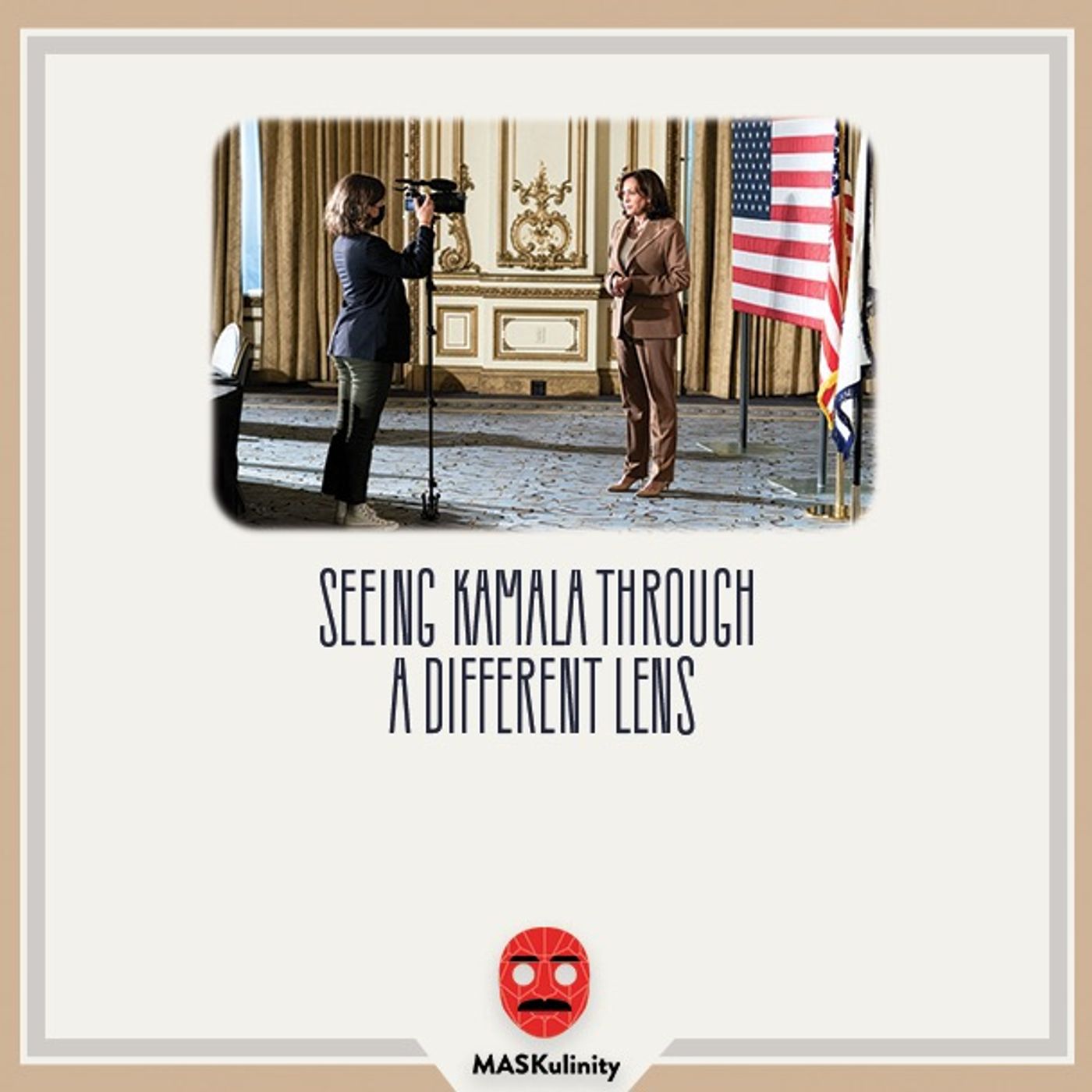
This episode of the show "Masculinity!" examines gender performance, focusing on sexism in media through the lens of Kamala Harris's vice presidency. The host interviews Aza Cohen, who served as Harris's videographer. Aza recounts how media outlets, including progressive ones, often portrayed Harris condescendingly, reflecting deep-seated patriarchal biases. She also details the technical challenges of filming a woman of color, explaining how camera technology has historically been calibrated for white skin tones, a legacy of racism. Working closely with Harris had a profound personal impact on Aza, boosting her confidence and empowering her to assert herself professionally. Additionally, the episode highlights Harris's intentional interactions with young girls, encouraging them to see themselves as leaders rather than focusing on their appearance, countering ingrained gender biases. The discussion synthesizes themes of media critique, technical filmmaking insights, and the empowering influence of female leadership.
But your boy, Roy George, fell off of the first. And it's nothing Zessie Kifler. This is. Masculinity! This show that investigates the performance of Masculinity in the world today and you know his spellet with a hard K. What can I do for you, Roy? Okay. There's a piece of information about you actually that I want to surprise our loyalist of loyalist of loyal listeners with. Wow. First of all, it's out to our loyal listeners and second, I'm impressed. You know, I'm intrigued. I'm impressed with what may I ask? I mean that you want to make this episode about me, all about me. Yeah, you wish, you wish, you wish. You know, as a woman to actually be prioritized by a man in this patriarchal world, I mean, why wouldn't any woman want that? Okay. Well, so to make it about you, for now, actually three or four questions. Okay. I mean, I may have three or four answers for you, maybe. Okay. Well, all right. Didn't you, and this is my question, loyalist, didn't you, Samantha, study film in college was it like your major or something like that, or you took a film class or three or something like that, right? I did. Actually, yeah, I did major in film if you can believe that. Yeah. Okay. Perfect. Good answer. See listeners. How surprised are you? Okay. But with that in mind, I'm wondering, did you take any classes maybe on cinematography? No. I was like trying to be on my like film theory, like criticism type bit. So I was all up in the books. I was actually a literati. Yeah. I was like, who's a literati now? Okay. Yeah. Okay, so second question, did you take any classes on say like blocking or framing, and I'm talking specifically for film purposes? I did not actually see this super intellectual. I get it. All right. Game recognizes. Game is cool. And let's call it that. Yeah. Maybe last question. Did you take any classes on feminism in film? Oh, you know, I didn't, but shout out to Shelley stamps, she always infused feminism into whatever film we were watching. She was like, where are the women? None of them are speaking. So shout out to her wherever she is. That's over here today. No. No. Today's episode. Okay. It touches on all of those things. But let's just say in a very timely way. Well. So you want to do a Golden Globes recap episode? Wow. It is a new year. Is this like your new year's resolution? Sure. If you know anything about Remoy, and I know anything about Remoy, I know that he would never. So. And actually, I guess you really do want to make this episode endearing to me, which let me just say, how kind, how thoughtful. Okay. Well, the actual story for this episode is a timely one because it touches on, let's say, a very challenging time that happened just a year ago. Okay. We got my attention. Right. But one that, you know, synthesizes all those questions and answers you gave that we just did and merges it into it. I'll say a very surprising fashion. Okay. This is what I'll say that I'm intrigued because I legitimately am. I mean, okay. So who did you speak to for this one? Okay. Good question. That would be an old colleague and a friend, Ozak Cohen, our work paths crossed in the past because also works as a videographer, filmmaker, cinematographer. Okay. I mean, that all makes sense. But I'm nowhere closer to getting that whole timely tease that you're trying to get at. I'm not close. I'll just let Ozak do all the revealing. The American people deserve to have women in leadership normalized as a visual element of our everyday experience of politics because sexism and racism doesn't just hold back like women and people of color. It holds back everyone because we are depriving ourselves of the best leaders. Wait, what? I mean, in theory, I'm totally here for what Ozak and you are going to reveal to me, but seriously, what is this about? Well, let's just say I'll give my stump speech right after this short break. Curious about next-gen men? We're a small part of a much larger movement to undefine masculinity for a brighter future. The mission is clear, empower the next generation to use their curiosity, empathy and courage to build a more equitable world. Join the next-gen men community as we learn and unlearn together. We're here to support boys and men to break free from limiting stereotypes. We're not just an organization, we're a catalyst for reimagining masculinity and fostering inclusivity. We're here to help open up possibilities for what men and boys can be. Explore the world of next-gen men at nextgenmen.ca and join the community to make a difference. Next-gen men, shaping tomorrow's leaders one step at a time. Join us and help undefine masculinity and empower the next generation of men to lead with empathy and courage. Okay, so we got film. We got women. We got politics. Again, I'm here for all of these things, but what are we talking about here, Ramoy? Okay, well, let's just say you know one of the hats I wear is a filmmaker, correct? Of course I do. I've even been on one of Ramoy's film sets, maybe even active on the film set. Yes, you have. So that's how the color is. Yeah, the colors. And you know, vaguely speaking, at one point in my life, I also worked in the American political machine. That's how you know Aza, meaning the political work world, like, did I get that right? That's how I know each other. Right. When I worked in politics was when me and Aza met. We worked, you know, let's just say in part for the democratic party in the 2020 election. Well, for better, for worse, like wherever you worked and all the work you did, well, it worked. I mean, it probably wasn't your or my favorite choices for the ticket, but Biden and Harris were better than what ended up happening in the last, or I guess, the next election. You've actually literally said encircled exactly what I want to talk about today. Oh, wait, you want to talk about Kamala or maybe Kamala losing? I don't know if I want to talk about that, actually. Well, I think that'll inevitably come up, but there's something in Kamala losing that I just think we as the culture, at least, like us progressive folks have kind of forgotten already. It's kind of a shame. Oh, okay. Same work about that. Yeah. And it actually, I want to bring it back to Aza's last job, which was what? Well, after she left me or I left her, she ended up becoming, wait for it. Vice President Kamala Harris' videographer. Wait. What? Damn, I'm better delete there tomorrow. Well, okay. But wait. So what is that job? Yeah. That's a pair of questions. So basically, Aza was there on the ready camera and hand to like document the Vice President's kind of every day or their work that can look like everyday life, public appearances, beaches, also policy initiatives. You name it. And that's being documented for like the general public to consume or also for archival purposes. Wow. I mean, I can't imagine how crazy the job that is, like documenting the first woman or black woman at that as Vice President, like that, like that, I don't even have words for that. Like, really exciting. Totally. And from day one, though, Aza told me her job was very intense and challenging, especially what Aza witnessed the Vice President having to deal with each and every day. Here's Aza with more. My first day on the job, it was July 26th, 2022, which is the anniversary of the Americans with Disabilities Act. And I will never forget, she walked in, she's at a table of disabled activists. She did an outfit description and she said something like, I'm a woman and I'm wearing a blue suit and my hair is brown, which is very typical in spaces for people who are visually impaired or blind. And I remember thinking, oh my God, she's so cool. Like, she's so thoughtful. And later that afternoon, the Fox News headline was like, Kamala Harris calls herself a woman basically making fun of her for doing an outfit description and saying it was like, woke bullshit. It was my first time filming her. And I remember so distinctly the feeling of my stomach dropping and thinking, wow, this is a nasty ballgame, yeah, indeed, but not surprising, right, like that kind of level of hate from Fox News. Yeah, not surprising at all, actually. But as it was clear with me, it wasn't actually just a conservative outlet. It was everywhere throughout the media landscape. Oh, interesting. This is not just, oh, Fox News did a bad job covering Kamala Harris. I saw this across every major network, every major newspaper, TikTok creators, influencers of all kinds, the ways that we create images of women and then edit them, obviously affects our ability to perceive them and our ability to picture them as leaders. Yeah, I mean, even before you teased it, before the tape, I could see it like, I want to say I'm like, so surprised, like, I can't believe anybody would say this. But like, I mean, even if I think about it for literally just a second, maybe a fraction of a second, not at all, not at all, surprising. Nope. I hear you. I kind of, let's say, clocking what you're saying, but being used more words, what specifically is not surprising for you? I will use one word, sexism. I mean, I don't know. Sure. Sure. Okay. Yeah. But spell that out for me, Samantha. Will you, to me, our loyal, loyal, loyal listeners, what exactly here is sexist? I mean, it's like what Asa said, right? Like how outlets portrayed the vice president or at times were condescending toward her, proves how deeply ingrained patriarchy or masculine with that hard K is ingrained in our society. Like, she was early, our second in command, and yet because she's a woman, the media would so quickly find ways to just chip away at her leadership, like at every single turn. Yeah. No, you're right. And I think calling out all outlets, even like the more progressive ones, shows the more subtle threads of patriarchy, specifically like you called out. It's like been installed in us or how we've been socialized or conditioned to not be able to, you know, just trust women as God forbid, being our leaders. Exactly. Like, it's just dumb. Blighten is stupid. Wack. Yeah. Well, hearing this story from Asa, this is kind of what really started to synthesize for me how Asa approached her job moving forward. And let me ask those kind of questions I was trying to get at you at the top of the show. Hmm. What do you mean? Yeah. I was really conscious all the time about her, about other black women. She would be on camera with or people of all races that she was on camera with. And so that was the main way that I thought about it was really about like lighting and white balance. Oh, okay. I see. So this is why you asked me about some photography and framing and all that earlier. Exactly. It's interesting to think about because she is like sort of like the first like, you know, baddie in the White House, right? She's the first person who looks that good, who has that great of a tan, who has that like, you know, that nice, luscious skin, right? You know what I mean? I mean, yeah. So, yeah, I feel like, yeah, there's got to be some adjustment around that. Well, okay. Well, actually, I want a little sidetrack here, a little tangent on assuming in your film school studies you did or didn't come across the term white balance before. Very lightly. Right. Okay. Very lightly. So I asked me what that is. I mean, you don't tell you. Kind of. Not really. You ain't the only one. So I would never want to feel school or never really studied formally. I just kind of figured it out on the go. Like working on short films with friends, and then you know, when I started making my own along the way, I just kind of learned along the way, you know? It's like that literati life just, you know, taking everything by storm. You know, shout out to your wife, that's amazing. Very typical. Okay. Relax, relax. So I got my understanding, though, of white balance, like this kind of process of like calibrating your camera and gear, sort of to like capture the correct colors that you're filming in real life, right? And this can be like when you're actually filming or in the editing process or even if like you're doing still photography. Of course you are also a photographer. Hey, she's like, hey, hey, men, they've been in a couple of our shows or maybe one. I don't know. I won't say they haven't built. Of course. Of course. Amazing, you know? Talk or shit. But I honestly never considered white balance as like this important, maybe even controversial process. Like never. But then when Oz had brought it up like she did, it's like, duh, like there's absolutely white supremacy involved. Oh, I figured that's what it was, but you know, I got to know the insider scoop. The history of camera technology is very racist. The original Kodak Shirley cards to calibrate skin tone were based on white women. Camera technology has thankfully evolved, but the mechanism for communicating images with people is rooted in a history of white supremacy and of specifically not deeming it important to reflect accurately what multiple skin tones look like like, like, like, like, like, like, like, isn't that crazy, like white balance? Like I never heard of Shirley cards like Oz has said before, but it turns out there was like literally a woman named Shirley and her like light skin complexion or tone was used to be the sort of like this benchmark for color balance. So there it is again, whether we know it or not, white supremacy. To be honest, we kind of should have figured that out because it's like right there in the name. It's like right there, the name, like, what else could that be, you know, prefer to. And then they call it balance, even though it's obviously not, you know, whatever. It's fine. Right. And you can see with that knowledge that Oz had and knowing her new role being Kamala's videographer, it became like super important to her to do everything with this piece of information, this historical knowledge, along with her professional skills, you know, after the vice president in the most true life way possible. Absolutely. Yeah. Yeah. So that's kind of where Oz was coming from. That was her motivation. But then alongside, you know, working side by side with the vice president regularly, if not daily, she quickly started experiencing something maybe even more profound. I'll call it like sort of disinvised presidents influence. Hmm. I mean, I can kind of imagine, but how well there's one story in particular that points out, and I'll just like, I'll just tell it from here. One day, kind of earlier in my job there when we were filming a video. And of course, I took it really seriously asking her to do a second or third take. I always wanted to make her restate it so that we could communicate effectively, right? Like, this is the vice president, every minute counts. I said something like, oh, ma'am, I'm so sorry, I just need you to do this one more time. And she interrupted me to say, do not apologize for doing your job well. That stuck with me. Even today, I hear her voice saying, do not apologize for doing your job well. Well, well, well, well, well, well, well, well, I'm sure if you heard that from vice president Harris, that would leave some sort of mark on you. No? Yeah. I mean, you know, countless Harris is a politician. She has issues like all of them, but I think it's a struggle to be taken seriously as a woman sometimes. So like, and by sometimes I mean, I don't know. Yeah. And we know and have seen how she's dealt with that, you know, Kamala Harris specifically despite all her accolades, all her experience, you know, and still made it to the level that she did. So someone working at that level of expertise that has been proven to be dope would definitely leave a mark on me. Like Kamala Harris saying that to me, I would feel that in my heart, because I know that is coming from a real place. Well, I think the same was true for Aza, maybe it would honestly change her forever. Sure. I'm specifically, but also just how she shows up day in and day out. I really credit Vice President Harris with building my confidence to stand up for myself. I am a nice Midwestern girl who doesn't talk back, but after working for her and seeing her navigate so many situations with grace and dignity and taking up space and speaking up for herself, it really affected me and it made me more confident in myself as well. Samantha, what gooey warm feelings does that make you feel? Oh, it feels nice. And I just want to say, I think it's worth mentioning that for all the conversations that exist around men being leaders, like it took a woman being a leader to make Aza feel confident to like step into our confidence and like believe in herself in that way. And that championing is everything. You know, like being encouraged to take up space by calm the Harris would be a highlight for most, including myself, like I can't learn. Well, feelings are one thing, but it was more than their staff for Aza because there's one story later in her time with the Vice President that really made evident how big and affect Kamla's influence had had. By virtue of being her videographer, being a White House staffer, I am allowed to be closer to her than the rest of the press. I had gotten this really good shot and other press were kind of coming in and secret service asked someone to step back away from me. And this guy really loudly says, fuck her. I just turned around and I said, don't talk to me like that. So I can't wait for the day that you just turn it to me and say, don't talk to me like that. Because it's definitely going to happen. I mean, I will be mad at it, but I mean, it's not because you're not enraging massaging it. So no, it's not going to happen, but thank you for the greatest compliments you've ever given. Yeah. Of course. No. A little bar of a comment. Please say that again. You know, back to the story ahead. It wasn't just what the Vice President told Aza or how those two interacted. Aza saw something even more salient with like how the Vice President interacted with other women too or actually just like little girls that that really left a huge impression. Oh, I can't wait to hear this one. Well, before we get there, let me let Aza give some context first. What I think is so incredible is how little girls are often interacted with on the basis of their looks or their outfits, right? And I was guilty of this too, like telling a little girl, "Oh, your dress is so cute. Whereas with young boys, the questions are about what are they doing in school or how sports going?" So I wanted to get to this because there it is again. That bias towards gender that we put our finger on earlier and like, you know, how almost unconsciously shows up so often and how boys and girls are treated or spoken to, right? Yeah. It's like one of those things that for me definitely humbles me because I have some good friends that have young kids and like the little girl will like pop up with the cute little dress on and I'll be like, "Oh, I got your cute little dress." And I'll play with cars with a little boy, you know? So I got to check myself on my own biases, like, yeah, I totally feel that. I felt pretty the same and well, as Ozzy saw, Kamala Harris was very intentional, though, to not let those biases win. One time there was this seven-year-old girl, Ali, in a photo line in Miami. She told the vice president that she really likes writing. Vice president Harris said, "Well, you should write a book." And this girl wrote a book and she mailed it to our office. Aww. So did you play that clip because you're part of the "Literati 2" that's cute? Let me shut up, but maybe. It is a really cute story. Bad puns and all, you know. I love it. I really love it. Well. It doesn't just stand there with the cuteness because the vice president told Ali one more critical thing. In fact, as Ozzy remembers, she would tell most if not all girls something very similar. You are a leader. Look at me and tell me, "I am a leader." And she would wait until the kid said, "I am a leader." Even the youngest, youngest, kids, like two, three years old. And it made me think about what a different world we would live in if all little girls were taken as seriously as Kamala Harris takes them. I feel so lucky that I got to work for such a feminist icon because she changed the world for little girls like Ali. And she changed the world for big girls like me. That is so powerful. Yeah. Absolutely, right? Empowering too. Empowering. Yeah, it's perfectly apt. But can you imagine a world where like young girls were empowered, Jackie is early as infants to be like real leaders? And I'm, for my sake, like a world of boys could bear witness to that on the regular? Come on. Oh my God. One of this world all the time and dream about it all day every day. Oh yeah. I mean, here for all of this, like, here we go. As I'm keen to do. When you tell these stories with love and hope, I'm going to have to put my whole, that was advocate hat on. Oh, that hat. It looks so good on you. Wow. Well, thank you. Well, thank you. Thank you. But what about the people out there, right? Probably more of the conservatives, let's say male kind, who say, you know, well, who said actually, not who say who said that's why she lost, like no matter what they say, like women are not fit to be leaders in this country, or you know, whatever bullshit about women not being fit. Right. Well, let me just say Ozzie has a rebuttal quote unquote for anyone who wants to come with that type of rhetoric. Here's Ozzie with more. There have been to my understanding 60 presidential elections in the United States history. Women have lost the presidential election twice. And men have lost the presidential election 58 times, right? And nobody is saying, oh, I wonder if he's qualified. I love the logic of this, right? Because you can't really dispute it. It's just hard, motherfucking facts. I was a hitting with the math, you're okay. But you know, while we're here in the land of devilish advocacy, sure, we're going to grow Samantha. Let's go. Um, well, what about liberals who were dissolutioned with the Democratic Party? And to be fair, I'm looking directly at the viewer more when I say this and I might also be looking at them in the mirror a little bit. Sure, sure, sure, yeah. I'm there with you. I mean, the reflection with you. Yeah. Yeah. Yeah. The Democratic Party were two centrist that they weren't radical enough. Yeah. I don't think you're wrong. And yes, I was definitely in that camp, but you know, Aza has a very honest, pragmatic perspective on all that. If you want a president who has no flaws, good luck to you. Don't live in America. Um, but seriously, there is no presidential candidate who never stumbles or you'll never disagree with also the two party system is flawed and the Democratic Party is flawed. And there's all these flaws within our democracy, right? But at the end of the day, you vote for one of two major party candidates or you vote for a smaller party candidate who likely will not win or you don't vote and you still live with the consequences. Yeah, I don't love this answer, but Aza is not necessarily wrong and, yeah, I concur. I mean, no matter what we're here now, and like, you know, we're like stuck living in these consequences and like, yeah, could have been better, no matter what. So. Yeah. What a reality. And unfortunately, it's like a reality one Aza saw, like literally saw from a very intimate point of view. You mean, well, this gets us to the timely bit I mentioned earlier because January of last year, meaning January, 2025, Aza was like literally there in the White House watching and filming as the transitions were happening between leaderships. God, that is so wild. There must have been so surreal. Oh, yeah, I don't know what I've done. And there's actually one very symbolic moment that Aza witnessed that, like, so clearly encapsulated what the transition meant at its core. The morning of January 20th, I was in the West Wing. I remember seeing a staff person carrying the bus of Abraham Lincoln out of the Oval Office. And I thought to myself, this is such a metaphor that Donald Trump does not want the bus to Abraham Lincoln. And if it had been a president, Kamala Harris, I am sure that she would have kept it. That's so, it's infuriating, it's heartbreaking, it's just it's all the things, but also just so true. Yeah, all of it times, like, cosine by a million, I don't know, you know? Mm-hmm. Like, okay, did you ask Aza how the vice president like handled it all? Like, I mean, I can't imagine the emotional roller coaster that Kamala Harris must have been on. I'm sure she didn't show it. I'm sure she was like, you know, how to face a steal, but, you know, I mean, I don't really want to imagine that. Actually. Well, yeah. I wanted to ask Aza that, but we can't, we kind of like, circle did a little bit, but there is one particular story, maybe like the last story from like, I was experienced from Kamala's last time as a vice president, that kind of like forever solidified what her tenure in that position really should mean for all of us Americans and for a country at large. The last image that I'm thinking of is her last flight on Air Force 2. So, Air Force 1 is for the president, Air Force 2 is for the vice president. She requested an all female flight crew for her last flight. And I just remember thinking, damn, down to the last minute. She made pathways for women that weren't there before. It was, I mean, unsurprisingly, the first time the Air Force had had an all female flight crew was at her request. Okay, so when Aza was telling me this story, I could feel like the emotions bubbling up in maybe tears almost, almost. Maybe I could see tears like on the corners of your eyeballs there too. I don't know. With a heartbreaking one's eyes preserves. Yeah, I mean, I'm having a moment because it's like, will we ever have this moment again? You know, like the intentionality and making sure that that actually happened at least once in history, you know, and that like it may never happen again because of like where we are now and like this, like, honestly, the fear about where we're headed, um, yeah, it's a little, slow choke really, for sure. Yeah. No, I'm with you. I was just saying for like my tears in that moment when I was hearing the story, it wasn't just because of like how disappointing or maddening, like frustrating was that come a loss, but I don't know, like real talk, maybe a little bit more disappointment in myself, like how I've forgotten, like, amidst all this disappointment and even politics of it all, like you pointed out, like what it really meant to have like this female, this woman, this brown black vice president, she in part is South Asian, like me, not to mention one puts so much intention, like we're hearing it, like into the leadership, into challenging the patriarchy and white supremacy, all the status quo is right. Yeah. I mean, the simple, like she and the fact that as a woman, as a half black, half Indian woman, she is the most qualified candidate in history, right? And like to see the way that she was treated, the fact that we are like in such polarized, like partisan bubbles that we forgot what it meant, right? You had so many dissenters who were like leftists, so to speak, who were talking shit about Kama, and I'm like, we have to remember that this has never happened, like we would still be stepping into uncharted territory regardless of what the political system is. So I feel you 1,000 percent on that. Yeah. And I actually, I actually came across like this perspective, meaning Oz, specifically, and some of the view these sort of, she shared because she actually wrote a really cool, really poignant piece in slate about her experience in this videographer role. That's amazing. We'll be sure to share that in our show notes and newsletters for sure. Definitely. Can we read that? Yeah. Once I read that, I was so excited to get Oz on tape for our show, right, for mask. But then in the interview, and the one I was doing with her, Oz, I really was surprised, like no, bullshit, surprise me like with this other element, she was like secretly unveiling through the interview that came from her experience again with the vice president. I like to be in cagey room, why I see no problem. We brought a rollercoaster ride of just truth and illuminate shows, bro, my game is solid like that. No, let me just let Oz's last part of our interview solve for that. I want listeners to be skeptical of the images that they consume because just like a biased headline or a quote taken out of context, images are created by people who are subjective and who have an agenda. It's very important that we all in this administration where this administration is using images to convince people of a dangerous, violent and fascist agenda. This administration is using propaganda techniques that are similar and reminiscent of dictators around the world, and we need to be skeptical. We need to speak up and we need to use our voices to have conversations, comment on images that are unfair of women, images are powerful, images are the way that we communicate with each other. Right. Okay, so more than just like lionizing calmness time as the vice president, it was like also harkening us to be more thoughtful or really like critical of like the media messages we see on the regular, right? What's in the frame? What's not in the frame. And why, especially, and this is like a big part for me and this is like or hearing this from Oz, I was like when it comes to news and stories about women. This is pivotal, which you saying it's so crucial, so critical because it's like now you have to worry about like images being doctored. It's not even just like the fact that, you know, you're only showing one part of the picture. It's like, you, it's in the picture. It's not real. So it's like really, really critical that we question everything that we see, that we make sure that we rely on good sources of information because there's only going to be more propaganda. There's only going to be more. So second, that third, that cosine, that 1000%. Yeah, totally, it was, it was a super important, great reminder. And I'm so grateful, Oz, I brought it to my attention. Actually, if you all want more gems from Oz, you can go subscribe to her newsletter. You can find her on sub-stack at Oz, a Cohen. So that's at symbol a Z Z A C O H E N. And also over on her show art, you'll see a picture of Oz and vice president Harris, that's an official White House photograph by Lawrence Jackson. We'll list this all and more in our show notes. In fact, and since you're, you'll already be on sub-stack. You should sign up for a masculinity newsletter too. It is the same handle we use for our socials. We took our time over the holidays, but we're back, maybe. And that's at masculinity pod. You know, let's always spell with that hard K. And of course, our website is masculinitypod.com. Well, Samantha, it's been, it's been a year, it's been a wild, interesting, yeah, y'all can't see me, but my eyes are wide open because yes, it has a very challenging one, a very, I have not doctor that in your eyes are very big and wide. That's what I'm seeing. I'm trusting the image I see. It's a wild one. It's so nice. I see what you, you know, get there. Nice. Well, you're not wrong, but it's always like these that, you know, move me to keep the fight alive in any ways we can. I'm glad to be part of these two with you on the ride. Little body, enjoy, remote. Well, until the next one, it's your boy, remote, George Philip, the first. And I'm Samantha and Zasee Kefle. Thank you so much for listening. Peace. Ciao.
Podcast Summary
Key Points:
The episode explores the performance of masculinity and touches on sexism in media, using Kamala Harris's vice presidency as a case study.
Aza Cohen, former videographer for Kamala Harris, shares experiences of media bias and the technical challenges of filming a woman of color, highlighting issues like racist camera technology (e.g., Kodak Shirley cards).
Harris's leadership positively impacted Aza's confidence, and Harris intentionally encouraged young girls, shifting focus from appearance to their capabilities and leadership potential.
Summary:
" examines gender performance, focusing on sexism in media through the lens of Kamala Harris's vice presidency. The host interviews Aza Cohen, who served as Harris's videographer. Aza recounts how media outlets, including progressive ones, often portrayed Harris condescendingly, reflecting deep-seated patriarchal biases.
She also details the technical challenges of filming a woman of color, explaining how camera technology has historically been calibrated for white skin tones, a legacy of racism. Working closely with Harris had a profound personal impact on Aza, boosting her confidence and empowering her to assert herself professionally. Additionally, the episode highlights Harris's intentional interactions with young girls, encouraging them to see themselves as leaders rather than focusing on their appearance, countering ingrained gender biases.
The discussion synthesizes themes of media critique, technical filmmaking insights, and the empowering influence of female leadership.
FAQs
The show investigates the performance of masculinity in the world today, exploring its societal impacts and stereotypes.
Samantha majored in film, focusing on film theory and criticism rather than practical aspects like cinematography.
White balance is the process of calibrating a camera to capture accurate colors, and it has historical ties to racism due to early standards based on white skin tones.
Aza was Vice President Kamala Harris's videographer, documenting her daily activities and public appearances for public and archival purposes.
Kamala Harris encouraged Aza not to apologize for doing her job well, which helped build Aza's confidence and ability to stand up for herself.
Kamala Harris told a seven-year-old girl named Ali, who enjoyed writing, to write a book and affirmed her as a leader, inspiring Ali to actually write and send a book.
Chat with AI
Loading...
Pro features
Go deeper with this episode
Unlock creator-grade tools that turn any transcript into show notes and subtitle files.
 PodcastTranscript AI