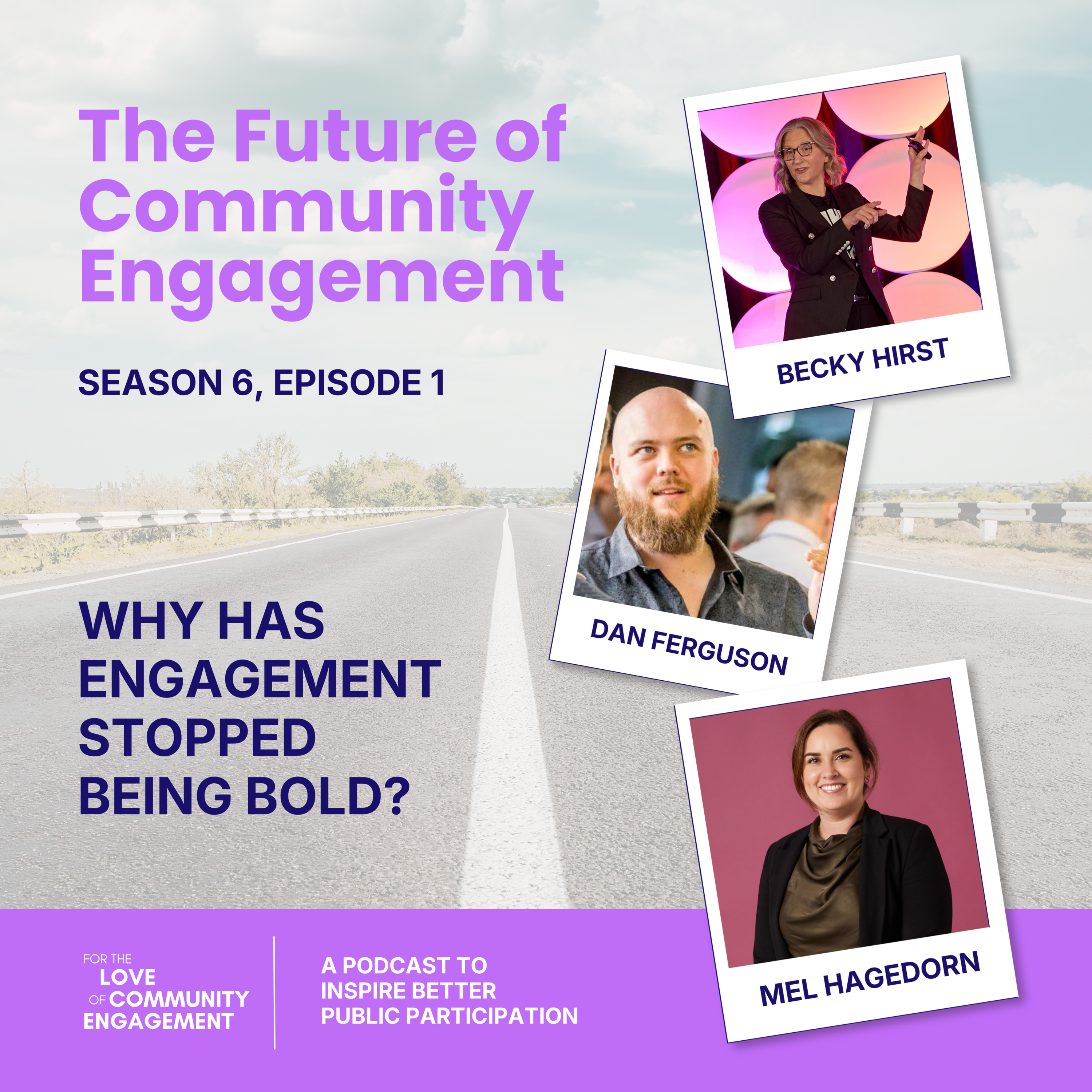
Season 6, Episode 1 - Has Community Engagement Stopped Being Bold?
from For the Love of Community Engagement
55m 21s
In this episode of "For the Love of Community Engagement," host Becky Hurst introduces her new co-host, Dan Ferguson, for Season 6, themed around the future of community engagement. They discuss whether the sector has stopped being bold, with both agreeing it has. Dan notes a decline in community satisfaction, attributing it to engagement becoming a compliance exercise. Mel Haka Dawn, a guest from Cappere consulting, reflects on the sector's evolution from early face-to-face interactions to a reliance on digital tools like surveys, which now dominate 98% of engagement efforts. She argues that this shift prioritizes data collection over meaningful dialogue. Practitioners are constrained by time, budget, and political pressures, often facing punishment for doing thorough engagement that delays projects. Becky adds that the sector has grown, but she feels bored with the lack of innovation. The hosts aim to address these issues through six episodes and a white paper, emphasizing the need to return to listening and understanding communities rather than just processing data. They highlight the importance of grounding future efforts in past wisdom, particularly from First Nations perspectives, to foster genuine connection and boldness in engagement.
This is For the Love of Community Engagement, a podcast to inspire better public participation. We bring you the latest insights, innovation, information and interviews from across the world. Visit ForTheLoveOfCommunityEngagement.com for show notes and more. And here's your host, Becky Hurst. Okay, and welcome to Season 6, episode 1 of For the Love of Community Engagement. The theme for this season is the future of community engagement. Before I introduce you to my new co-host, which is very exciting, I just want to quickly give a quick explainer for my regular listeners. You might be like going, "Becky, hang on, we haven't finished Season 5, and you are quite correct." I started Season 5 a while back, I think I've recorded four episodes, one of which was a massive three hour long monologue about my breast cancer journey. And I think that one probably just peaked the entire season. And so I've paused Season 5 and I have decided that we are going to go straight into Season 6 because I'm ready. And look, basically, when you have a podcast, when you're doing anything, you write the rules and you can change the rules and you can do whatever you want, can't you? Anyway, before we get into the content of today's session now, I've got to do something really important, which is introduce my co-host because talking about the future of community engagement, I can't just do this by myself. And so for this season, I am joining forces with the one and only Drum Roll Pleas. Dan Ferguson. I'm so glad to be here. Now I must remember you are co-hosting this, so I'm not allowed to dominate here. This has to be a true co-lab. I don't worry, if you talk to any of my team, you'll be two chefs in the kitchen. I love it, I love it. I may dominate a bit because I'm a sort of almost born and bred facilitator. I can't stop myself asking all the questions. Should we tell everybody what's this all about? Where did we meet? How did we cross paths? Or who are you? Should we start with that first of all? Who are you, Dan Ferguson? Sure. That's a big question. It's a very loaded question. My name is Dan, I'm the founder and CEO of Community Lands, a community engagement stakeholder relationship management. Seemingly, everything, world domination, company at the moment. And we're really focused on the artificial intelligence revolution, especially when it comes to how we make create and nurture relationships in the world. We're really obsessed with that. We cross paths, as I'm sure many of your out of distance have as well on LinkedIn. And I just kind of like you got on my feet and I was like, oh, this is someone who knows what they're talking about. And then we were lucky enough to meet at the engagement institute conference, catch up. And ever since then we've kind of kept the conversation going. Thankfully, after enough talk, we were able to work together. We found a way to kind of find some sort of, I mean, it's not hard to find synergy between us, I don't think. It's very true. Actually, at that engagement institute conference was brilliant, wasn't it? I was key noting you were workshops and doing all sorts. And I think we literally said something to each other like, I know you, I don't. Yeah. And that was kind of it because we knew each other from LinkedIn. And likewise, you'd shared some of my stuff. I think I shared some of your stuff. And those synergies do just happen like that. Don't they? Look, we're in a, we're in a people industry. So, you know, like, it's, it's, it's, we kind of like a parasocial relationship. You haven't linked in, but it's why love conferences. You get to kind of see people and get you just hit it off. Now, we're all people people. You just don't think like, oh, I only know them from online. It's just kind of like, yeah, we're friends. You know, we've known we've been connected for however long LinkedIn said, you know, kind of thing. That's exactly it. And then when we followed up afterwards, I thought, gosh, I really want to like get to know who you actually are. And what, what is this product that you've created? And I think it was during that that I just went like, oh my good. We need to do something together. And actually what's been lovely when we've announced that we're going to do this kind of program. I mean, we might as well mention we do planning on doing six episodes. For this season, we're going to be exploring the topic of the future of engagement. And we've got a few topics in mind. We're going to have some guests on as we've got today. You know, we're really going to be sort of doing this, this, this kind of thought leadership piece against together, aren't we? And I think that that's that's kind of somebody said to me when we announced that. Wow, like those two brains together. And that really kind of excited me because I thought I know my brain is always let off. And I'm getting the picture that your brain is the same. Yeah, I'm to the dish room on my team sometimes. As soon as you started like interacting with our posts and stuff, all of our team was like, you got a chat with Becky, you got a chat with Becky, you got a chat with Becky. And you know, when I kind of like had a look through all of your stuff in your book. So I was just like, oh, this is a practitioner who like knows, you know, like you've been here for, what is it seven eight years now? No. But you know, you incredibly influential on the space, you are so knowledgeable and everything that we do always I always want to make sure that like we're grounded in the call face knowledge. And it's like the reason why that when we did it, the panel at the engagement institute, like I wanted to have someone from council on there because it's like, I want to make sure that everything we do is always practitioner led. It's always engagement led. It really is grounded in like the truth in the workflows of today. Yeah, I think that's so strong. And that's why it's so good to be doing this work with you. And alongside the podcast, if people are tuning in and listening and thinking, oh, I like the sound of this. Well, this is actually because we just don't do things by halves. We're going to be doing the six podcasts. And as we're doing them, we're going to be co authoring because co hosting isn't enough co authoring a white paper to deliver to the sector all about the future of engagement. And I personally want to take all of these podcasts conversations as well as all of the different comments we get from people via the socials when we share the podcasts. And to go into that paper, because I think this has to be a conversation as a sector, doesn't it? 100%. I mean, we're at the, I think catalyst point, especially with like artificial intelligence giving us this moment to kind of look at what actually not even just artificial intelligence, but every conference I'm going to we as an industry is starting to ask really hard questions of who are we? What do we do? What do we call ourselves? And so like having the ability to then go and create something so special as to look towards the future of what is the future of engagement? Where should it be going? Where are we now? This is an incredibly important moment for our industry to make sure that we can like have and firm an identity own it, like feel like it represents us, but also then look at like, yeah, where do we go? Where have we come from and paying homage to that? Where are we going now? Yeah, and that's the critical question. This is a this is a turning point, I think I mean the last couple of years just technology wise has evolved so quickly, hasn't it? And just as a sector, we need to keep up and not only do we need to keep up, but we need to be preempting what's coming next. And that is going to be really interesting and I'm looking forward to exploring that with you. And in fact already I'm so like the future, yes, includes AI, but I'm so passionate about it also being the absolute opposite of AI. I think that point and we get to explore that we don't need to we don't. We don't know put it all in the intro. Let's do another really important intro thing. I always acknowledge the country that we're on when we're when we're recording and that came from listening feedback actually anybody that's listened to season one lately. I don't listen back to that season. It was years ago, but I didn't use to and somebody said, hey Becky, why didn't you acknowledge the country? So I want to acknowledge that I am on the land of the Ghana people. Who's landed you on Dan? I'm on what are our country? Okay. And that's in Victoria. Is that right? Yeah. So I'm just west of Ballarat. So it's quite a quite a large piece of land across here. Like it's actually it's really interesting just how the kind of geology of it. It's really cool. Yeah. And yeah, the Ghana land is the land that covers sort of Adelaide and the Adelaide Plains. So again, not a big piece of land. And I always try and connect my acknowledgments of country to something. And I think I've actually got bare feet right now. And it's something about this thinking about the future is also about embedding yourself in the past and the present isn't it? And really being grounded about it. And you know, we want to dream big. And we're going to dream big, but equally we've got an entire sector to kind of move with us on this journey. And I think that grounding is really important. And we can certainly learn that. Can't we from our first nation, friends and colleagues. It's it's so true. I mean, just in in the preparation of kind of this whole season and all the work that we've been doing, but also as a company like we stand on the shoulder of the giants and not just in the technological space, but just in storytelling, just in connection and just in like actually how do we build form relationships with one on one and community. It's just being a massive privilege of being able to look back and actually see all of this groundwork that's been put in place and making sure that we're carrying that forward and not just kind of disregarding that like it's really important that we pay homage and look seriously at the all of that incredible knowledge and power that exists in the past as well. Yeah, I'm so looking forward to this Dan. Okay, should we get on with it? Yeah, let's do it. And as if by magic, here we are welcoming our first guest of season six, Mel, Haka Dawn, welcome Mel. How are you today?
- Good, thank you. - Thank you for joining us on the podcast. I wanna kind of do a bit of a bio about you. You've been on the podcast before, back in something like season two, season three, I don't know. It was a while ago. - Yes. - How long time ago in a formal life? - And you are a client executive, is that right at Cappere consulting? - Yes, so I look after the kind of everything outside of Victoria, so we know Cappere was established 18 years ago in Victoria, very well established organization. And we just wanna take the cappiness of engagement everywhere else in Australia and New Zealand. - I love that. So you're busy, I know here in South Australia, you've got some presence now and yeah, brilliant, brilliant, well done. And I've enjoyed watching the growth of Cappere over the years. What does Cappere actually mean? Is it something about people or connection? - It's, it means to listen, to understand. - Oh, there we go, beautiful. - Yes, nice. - Good, and what we try to do is engagement practitioners is really listen to understand all the diverse perspectives to help us with our decision making. - Amazing. And you are also, you are on the board of the engagement institute as well. - Yeah, I am. - I know, there is no saying all this thing. It's sort of, why do we pick you first and foremost? And you might be wondering why we picked you. We just really felt you had the perspective of so many different angles. You've got that strategic overview through that boardwork of the sector. You've got the kind of co-face work that you're doing with Cappere. Also, you have previously worked inside tech platforms as well. So you've got such a brilliant background of everything. - Yeah, it worked on all three levels of government as well. So yeah, and I've worked for not for profit. I just, I have a diversity of experiences, which has kind of led me to be at Cappere. - Amazing. So thank you again for joining us. Okay, I'm going to start us off with the question. Today's theme is about why has, why when, why did the community engagement sector stop being bold? But my first question is, has it actually stopped being bold? Dan, has it stopped being bold? - I think it has. - Oh. - Yeah, I do. And look, it's called me biased and everything like that. But it's such a complex, like, complex topic, but without going into all of the, who's responsible, who is, who is being bold and who isn't, why and all that kind of stuff, I do think that, yeah, as an industry, like we have stopped being bold. And I'm saying that probably, like I'm new to this space compared to a lot of the practitioners. It seems like this industry whilst seemingly still very new and finding its identity, like is quite old, like is quite well formed. But as a community member, like I certainly feel and I think this is reflected in statistics like, the Edmund Trust's barometer in the local government satisfaction school as a Victoria, a fairly substantial decline in satisfaction across the community. So, I attribute that to a lack of boldness. Like I attribute that to, we're starting to like, go through the motions, take and flick, look at this as a compliance exercise and not actually what it's, I think what we, what we as practitioners want it to be there for, to listen and to understand. - Yeah, okay, Mal, what do you think? - Yeah, you go back on a bit of storytelling of when I first started. And so my first job was in state government and you know, it was working with, you know, young people to understand why they weren't enrolling on the electoral roof of Queensland and I didn't know what I was doing was called community engagement, they got an engagement, that word wasn't really out there in the public. And then I kind of went into local government as a community engagement officer, not knowing that this was actually going to be a profession. There weren't many people again that you could connect with. It was people for more walks of life, like I had studied law, I had studied planning, communications, all sorts of things. I think you fast forward a couple of years and then we saw the rise of survey monkey, bang the table, those kind of digital tools kind of started to push the boundaries a little bit. And you know, whereas previously it was all about being out of the community and actually facing up and having a really good discourse of conversation. Then we moved towards where digital platforms, digital tools are just the stock standard. I mean, 98% of all engagement is a survey, which I, there's other tools and methods that kind of collect information. And so we do that now. And you know, for me, it seems like we've moved into just collecting data and collecting massive amounts of data rather than looking at what are the trends over the last kind of couple of years or what has this community been saying to us for the last, you know, months, years, et cetera. And how do we actually have a deeper conversation on that? And what is the actual challenge that we want to have? Like what's the conversation we want to have with our communities rather than this is the wicked problem that we've thought out in whatever organization? Here are our solutions that we've developed in our ivory tower. And so we want to come to you with these three options. Rather than understanding the lived experience. So I feel like we need to do a good of a full circle back to where we were in the early 2000s. And yeah, yeah. Why are we out being bold? I don't know if it's about not being bold. We look at the things that people are really struggling with. So time pressures, financially, they think engagement's really expensive. There's conversations around engagement exacerbating timelines, which is not necessarily true, it's the actual opposite. Yeah. There is political pressure to amount as they will, that's their job. It's it's and it isn't. And so I think there's just this as an industry, we want to be bold, but we've got our hands tied. If I can just have a home that point too, because I 100% agree. Back when we first started community events, like we didn't actually have a solution yet, because we wanted to really sink our teeth in and find a problem. And the prompt we were given by like a state government accelerator in Victoria was, how do we help Victorians better engage with community and after spaces? And we had no idea. We were just like, this is an awesome problem. We want to have a hand in it. Who's doing it? And that's how we kind of stumbled on engagement as an industry. And it's exactly that. Like we asked two simple questions to what is now hundreds of practitioners, which is what do you love about your job? And what do you hate about it? And what we heard was like, these are people people. These are people that love listening, love helping people feel understood, love bringing people into the decision. All of these kind of really amazing, altruistic things and their hands are tied. The things that they hate are the things that stop them from doing their job well. And a quite, they'd always stuck out with me and stuck with me as doing a good engagement job. It punishes me on the backhand. Like if I do a good engagement, either delay projects, and I don't have that luxury, because I've got a deadline already, or I give these communities all these promises of like how much data and feedback and information and knowledge I collect, but they don't have time to actually even use it on the other end. And so I feel like 100% like people really want to do a fantastic job and be bold, but their hands are tied because of various reasons like timelines and budgets. And it doesn't fit neatly into a line item or a project and whatnot. And so often doing really bold engagement actually punishes the practitioner or can punish the practitioner. Yeah, that's so true. I want to just highlight, because I always get in trouble whenever I push boundaries or have conversations like this, that the sector has come a long way, hasn't it? Like in, you know, I certainly, since I've been in Australia seeing the Australian sector, that's about 19 years I've been here and it really has evolved. And when I was reflecting on this whole topic when we come up with it, Dan and we were like, why when did it stop being bold? Did it stop being bold? And I think what I realized was I just got bored of it. I think maybe it's not, maybe it is that we've stopped being bold. There was a real, as you said, Mel, probably like 10 years ago when a lot of those online tools came in. We then of course had the pandemic. In the middle of it all didn't we, which meant we could, oh, finally, we don't have to go and actually meet with people. We've got the perfect excuse and we've got all the tools. And you know, I'm a fan of a survey for some things, but it's just like the go-to tool, isn't it? So I think I've just come to the point that, yeah, I'm just a bit bored and it's time that we had some innovation in the sector.
to start pushing ourselves like, "Where next?" Like, great, we've got lots of different tools and techniques. And I know there's some amazing practitioners that do a lot of the pop-up stuff and a lot of the deliberative democracy. Like, there's so much good stuff out there, but where next? - Interesting. There's coming back, like, you know, the profession has been professionalised. You know, we've got, you know, 15, I know this 'cause obviously I sit on the board, but we've got, we've got, in fact, over 15,000 members here in Australia. That's growing significantly, you know, since I've started my career. Australia and New Zealand are probably leading some of the practice globally. You know, obviously Europe does an amazing job at citizen jury and some of the deliberative stuff. But in general, Australia, Australian practice is amazing. And I think, you know, that is because we are collectively, we have those, you know, deliberative debriefs in Victoria. We are, you know, we are networking and we're not afraid to share our mistakes and our learnings. And I think as an industry, you don't necessarily get that. So you're engineering firms, they're not sharing, you know, their traits, the recruits, but as engagement professionals, I think we're, we care about the people and so we share those things. But like you said, Becky, you know, it's, we're getting bored because we're doing the same thing over and over again. And so is the community. So I think, yeah. We need to think about what happens, all levels of government and, I guess, private industry, kind of connect in to make sure that we're having a holistic conversation. And I think that's the hard work. And that's where we've stopped because, you know, memorand of understanding data security, all those things that, you know, red tape has made it really difficult for multiple levels of government to be talking to one community at once about a multiple thing in having a consistent conversation. We're gonna have it individually, annoyed everyone. - It's so true, isn't it? 'Cause I still don't know anybody that kind of goes, oh, did you see that the council's advertising we can have our say on the open space strategy? Like none of my friends are coming around saying that. - No. - I mean, maybe one day they will. Maybe. Or maybe not. - Something, saying this. - Yeah, but, you know, like there's the other side of it, is like, you know, I don't think being bold means more engagement. Like being bold also doesn't mean like trying to reach absolutely everyone. Because there are portions that don't care. You know, like there are portions that don't care about the open-parks policy. But there are also portions that really do care about these specific niches. So I think it's like a really important to say that, like being bold doesn't just mean showing up in more ways and more places to all people. Like that is really important. Because the people that don't care have just as much of a right to not care as they do, you know, for the ones that want to engage. And I think so often, like that can be, in general conversations, like being bold and, you know, trying to do better, unfortunately gets measured in how many responses or the percentage of demographics and all that kind of stuff and not take into account that like, are we engaged in the right people at the right time in the right way in the right place? So I suppose it sort of moves us on to that question of, what is what would bold engagement look like? Well, actually, you know, and people are going, "All right, tell us, what is it then?" What is bold engagement? And I think you just said something really good there, Dan, about it doesn't mean more tools, it doesn't mean more, I don't know, more things, more way, I don't know. For me, when I was thinking about it, if I started off, I was driving at the time when I was thinking about this conversation. And I thought, "Do you know what would be bold to me, if I turned into my street where I live?" And there is a group of residents having a conversation about something, maybe the open space across the road, let's stick on that theme. And maybe they've all got little clipboards and they're meeting with somebody from the council but they're actually making decisions then and there together, like that's bold for me. So that's nothing innovative or like super powered, it's just literally people having conversations that's visible. Yeah, I got any thoughts. Yeah, I guess what I've been thinking about is instead of engaging on validating decisions, we should be having conversations about the possibilities. So, you know, I think like Victoria, there's engagement around the local plan and the community-visioning processes, nearly only, oh, as far as Western Australia is as well, where they have to kind of develop this long-term vision. But is that bold enough? Are we actually, I don't know, they're deliberative, they're representative sample, et cetera, but should we be doing more of that, more of that visioning of our communities and what we want and setting principles around that rather than here is three options. I come back to the three options, my apologies, but it's what I just think about some of those Aboriginal communities, and I don't want to speak on behalf of them, that there's some real challenges or even housing is a big problem in Australia. And rather than talking about tax changes and/or, you know, should we build this 20 tower thing over a train station, we need to be talking about what is actually possible with community and getting them to buy into that big bold vision holistically from a local government, state government and a federal government perspective. So how, so you're almost saying, it's almost going to the community and saying, like, what are the issues? And driving that, rather than us saying, we've got a framework. Oh, yeah. The area. At the very beginning, bring people in on the journey. They are the ones that live within the community. They're the ones with the lived experience, and all they can see the challenges that are coming up. Yeah. So why aren't we having those conversations? And not everyone's going to get it straight away, because it's a different way of engaging people. Yeah. But by the end of it, you're going to have people that either fully understand whether they agree with it or whether they don't, they have an understanding. And I guess that is what we want to be doing. Yeah. Something to me there is like, I think we need to free ourselves of our current success metrics. Because that's the way that we measure success, that doesn't make sense. Like going back that early, going back that kind of, almost pre-project, like project informing, the way in which we hold engagement, the way in which we reflect on it and improve it, ideally, those two worlds don't mix. And so I think we need to move the test away from, have we heard from the community to, has the community feel heard, like, flip that on its head in a way. And with the processes, what you currently have, I don't think that's possible. With just the kind of like online platform, here's a portal, get to it. It's the projects we have in the pipeline, each get a survey. And we get to kind of like get some feedback on it so that we don't piss off the community. It doesn't have the freedom to be bold. Like, and I think similarly, this is a harder one, but I think organizations need to put a bit of trust in their engagement teams as well. Like, there needs to be that trust that, when they go out to the community, they're not going out to say, give us all these ideas. We'll do the rainbow road. But actually, how we're here to like, you know, you live in this space, you have an ownership over this space, you have a deep desire to see this space grow according to the needs of the community. Let's do it together and find as it may as you said, like finding those problems and then using that to actually inform policy, inform decision inform road maps. Super scary, but oh my goodness, what a world it would be. So do you think practitioners are stuck? Are we kind of trapped in between the community and the decision makers and the way it's always been? We're kind of stuck in this. When I'm thinking I'm bored, maybe it's that we're just, we don't want to do that. We're not getting to do the things we'd really like to do as engages. As an engaging, I just want to go out and say to the community, what's your big vision? What needs addressing? How do you think it should be fixed? And half the time they tell me the solutions, you know? Or you end up with like 20 people in the room, sharing solutions, coming to an agreement together. But then of course, it goes to a decision maker or goes back to the project team and then it gets all lost, doesn't it? So maybe we are already being bold, but we're just stuck with these kind of, this way of doing things that is so sort of regimented and fixed, you know, we do it. Yeah, and I think that one of the challenges that engagement practitioners have is the validation of the work that they do. And how they're doing it is through, you know, this is how many clicks we got on the page. This is how many views, this is how many surveys were completed. These registrations pop up.
et cetera, et cetera, so they can demonstrate a value or all worth. And you see that in consultation reports, et cetera. But it's what is the kind of gold nugget or the threat of the conversations that you've had? Have you, you know, there was some, let's call them deliberative workshops for activity centres and, you know, some of the, some of the outcomes for that weren't in a report, but was actually community connections. So there was people that were new to that community that actually met other people. I'd have now swapped phone numbers and emails and, and have become, there's been a connection within community, et cetera. So that's not written like in a report. And I think that's where if we are designing and being bold in our approaches, we're actually creating an ability for that connection again, because if you look at social media and the way that the news is going, we are, we are pushing either far right, far left, and people can't have a constructive conversation without someone having your wrong, your right. You know, there's, it's, we are having to work with such a divisive community at times. And I think being bold in our engaged approaches helps to bring people from the very outside into the middle to have really constructive conversations where again, you don't have to agree but you understand. And I think sometimes where are so exhausted as practitioners that was trying to protect our wellbeing, that maybe that's also something that we need to consider. So there's a few things going on here, I like to, we've talked about the way we measure engagement, but also needs to change in terms of the community feeling heard as opposed to have we heard the community. I'd love to see more awards that are community nominated. How many awards would there be if the community chose the winning council or the winning who were like, I'd love to do that. And then I've lost my chain of thoughts. I can't remember what the second one was. What was the second one that you just said, Mel? Are you back out wellbeing in terms of like that discourse of us? Yes. Yeah. And that's, that's potentially the other I'm wondering, maybe it isn't that we need to be more bold right now. It's actually that we need to approach community with caution more and more sensitivity and lasting they want is as coming out or singing or dancing like here we are. We're going to be bold because let you say the far right is shouting at the far left and there seems to be no middle ground. Maybe that maybe it's about the practice almost needs to simplify itself to just go back to absolute basics. And I don't know what the answer is how we do that. But for me, it's conversation. It's just I follow a few people on Instagram that there's a follow a left-win journalist in the UK who goes to the right wing protests in the UK and she actually just interviews people without judgment. She just is trying to and she's making content but equally she's just posting what they're saying and trying to understand their standpoint and their point of view. And I think there's a lot of work to be done around that, isn't it? So maybe being bold into the future is just allowing that, I don't know, something to happen. That connection between people to really happen and realise that actually all of our values are kind of similar underneath. It's just how it emerges up on top. I was sorry. I was going to say, you know, God gave us two years and one vow and I feel like we we use it more that so I'm pointing to my mouth for those listening rather than ears. And I think the skill of active listening into, well, practitioners, you know, great, right? But how do we pass that skill on when we are within the community to make sure that our, the people that we're talking to, we're not just here as our clients key messages, etc. But we're actually listening to understand, to take note rather than just listening to defend with these key messages. Now, this is actually, sorry, go on, finish the mix like that. Yeah, because this I guess, you know, we talk about that, this is Gruntel. Are we are we actually doing the project justice if we're just there to defend, like listening to defend rather than listening to understand and document appropriately? Because again, you might have a different outcome for your project, which may or may not be lacked by the organisation and all the project managers. The reason I just got really excited by what you were saying was that active listening, and this is a really good link to you Dan now, because you mentioned artificial intelligence and that's a lot of what community labs includes. It would be really good for us to talk about like the digital, what does bold look like in the digital world these days. But what you're saying for active listening is just reminding me of what I've done with a couple of clients just over the last couple of months, where I've actually been using sort of declaring at the beginning of meetings or workshops that my laptop is taking notes and getting the transcripts and using AI to actually summarise what was said. I am blown away by how neutral it provides and how it hears every side. And I would have always said, oh, I don't write from bias from my perspective, but as a human intelligence, I do kind of, I try and always listen to every side, but I've just been blown away by how artificial intelligence has been able to help me see all the sides and kind of really help identify some of the core issues of a particular situation or a project, whatever it is that I'm working on. So that leads me on, I guess, Dan. What does bold look like in the digital world moving forward for engagement? I think I said it before, which is like meet people where they are when they want, how they want, especially in the language they think in. And post COVID, if we can remember that. I don't know about you, but I feel like that felt like a blip in time, like time kind of compressed, so quick. And it was like, no, that was ages. We've, by necessity, you know, the innovation of the time was like, well, we have to get digital report, we have to have a survey, we have to have, and we kind of built it, you know, we professionalised it in a sense of like, well, this is how it happens. And because it worked then, and it doesn't necessarily not work now, it's just become the norm. And I think, I mean, realistically, I think part of the digital experience needs to actually just get out of the digital experience. We need to get back facing people face to face. We need to get back out in the real world. We need to touch grass. And again, I, it's too insensitive because that's hard to do with limited budgets and limited time and limited teams. Like, I don't want to be insensitive at all to that. Like the teams that we work with on a day-to-day basis are super men and women, you know, like they're incredible with the things that they can pull off with the resources they have. But I think the reality of it is, like, if we do want to be bold, if we do want to push forward and super-ignolaging now, like you said before, like Australian New Zealand, is definitely at the forefront of engagement and consultation. But let's not rest on our laurels. Like, we have so far to go as the numbers around trust and satisfaction tell us, you know, we've got so much room to grow. And that might mean leaving some things behind, which could be that projects by default get an online portal and we're happy, you know, we get a month, we put it up, we get a month off, not a month off. But, you know, we can't just come back to a survey anymore. Like we can't just come back to, you know, Excel spreadsheets. I think, I don't know how far you go back in time with, I think, did you work with Bang the Table? And we can talk about Bang the Table quite because they don't really sort of exist anymore as a fellow company. But they, I don't know if you remember, back in to, I think it was about 2009 that I first met the guys from Bang the Table. And it was bold. It was innovative. It was really like, I'm trying to think what was there before they came along. I think maybe we were just doing survey. They're very, very, very, very, very, very, and those American, yeah, they're angels. And yeah. And I went, they, they, they, they came in with just like discussion forums and that's what I loved. I was like, yeah, conversation online. That's brilliant. That's in a bit more of a safe space than whatever social media was around at the time, probably Twitter and Facebook. And then, but then I remember the sector wanted surveys. And so suddenly they had to build surveys. I think that's how the story went. And then just, yeah, surveys, you're the leading tool, aren't they? I don't mind. Yeah. So Bang the Table was set up. They were, they had digital discussion forums and holes. And you know, you didn't own the data. So you didn't have what you did, you owned your data, but you didn't own the backend. So you didn't know who the participants were and I was their first Queensland client when I went for the local government. And I, I invariably remember, you know, this, this like really robust discussion. And you know, we had a Roger Rabbit, whatever, you know, like letters after it, etc.
having this really good conversation with another person and you know, we were gonna set up a, I can advisory group to help us sort out. It was to do with local laws. And so I actually had the email that being the table, Ray back at Liz Day, it's for those, yeah, yeah, long time, shout out Ray. So I had an email, Ray and go, hey look, you know, we wanted to set this up. Can you, we want to know who these people are? We actually had to contact them to then ask permission to share his, their details with us. Which I guess gave this level of, I can be, as a community member, I, I can, within reason, because there was moderation. You know, I can, I can tell people what I really think, can be really open and honest, because there's a level of, you know, how else was not getting my, my details? Or, which is really good, but yeah, then they moved into providing other digital tools and yeah, there was surveys. I think there was storytelling. So storytelling in their store, like, about lived experiences, which was a really good, there was a really good project that was done by the NDAs, about people sharing some of their stories, that, you know, a couple of stories that were submitted, were actually used in the Australian Parliament to explain some of these. So it can, these tools can be very powerful, if they're fit for purpose, and you're not just designing it to collect data. So it's not about, your technology has helped increase reach, but has it actually improved democratic process? That's a very good question, Dan. Do you have any thoughts? When developing a latest platform conversation, it's like one of the things we wanted to make sure we weren't, was we had a look at the existing landscape. There's so many incredible tools that are out there now. We are being a young company, like we have the privilege of being able to stand on the shoulder of the giants that came before us. And so we did a, like a metal literature review of what works, and what doesn't. And we found that so many of the tools, and like kind of like N plus one competitiveness in the space, academically, doesn't actually contribute to improving democratic processes. I think it was called engagement theatre. And so it might look like it might even feel like to some, but actually when it comes to, does this actually improve the democratic process? And so, I think it's a very good question. I think it's a very good question. Digital like this. So many different ways. But I'm hoping that it is more conversation and less one way hearing. I think better you when I talked about it like a while ago. which was something that actually, no, we just discussed before, which was the message boards, you know, the forums and stuff like that. Like one of the great things that doesn't happen now is conversation is argument is discussion. It's now just, hey, you're putting a box and you answer these questions. And thank you very much. There's no opportunity for the, I mean, for like a bit of term for the far left to meet with the far right. And you know, find a bit of common ground and hopefully, you know, God willing, a bit of understanding. It's just staying your lane and kind of be isolated to your own opinions. I think that's one of the things that I'm hoping we as an industry, especially we as vendors have a responsibility to have a responsibility to. And I think that's one of the things that I'm hoping we as an industry, especially we as vendors have a responsibility to. Helping the industry push towards which is bringing back conversation, bringing back discussion, bringing back opportunities for discourse. Yes. And I like we've all kind of referred there to the far right and far left, haven't we? But it's also the central people, the people. Absolutely. Those of us that sit quite in the middle, a bit either side, like we're, you know, straddled across the middle of that compass. Like just, yeah, bringing just conversation back in community and a bit of what you talked about mel in connecting people and I've realized this week with a few things I've been involved with just in my personal life. I just love connecting people. It's just, you know, you should meet you. You should meet them and they should meet you. And like that's really what engagement to me is about. It started interjecting. At that point exactly. Just in a side like I actually discovered this industry a few years ago, but I just didn't have a name for it back in the 2019, 2020 bushfires. I mean, I accidentally started a charity to put together good Samaritans that had a accommodation and those that were affected by bushfires. And one of the, one of the things we heard was like, hey, some towns aren't hearing your message. Like they don't know your services are there. They don't know the accommodations available. And so we went screw it. Let's get in the car and let's drive around like the East and see what of Australia. And man, the difference of the towns that we go to and it was so tangibly like these people are coming together. They are connecting. They are actually starting to build those connections versus the towns that just fell apart. And this again, so many reasons of infrastructure and capabilities and resources. But working with organizations and working like adjacent tooth. That one is like bushfire, I've heard Victoria. A number of ones in this wilds at Sam Vincent's Paul's. Just the difference of how those communities rebounded after the fires. And going forward. So tangibly different. So incredibly tangibly different. I've actually like seeing communities come together, build resilience through connection. Yeah. Versus those that don't. And like, man, like it's so hard to quantify. It's so hard to kind of communicate that level without feeling it. But if I may be, you know, be so bold. I would love if the industry could push towards that of actually like, hey, we could be the catalyst for connection in our communities. Like how incredible of the responsibility of that. All right. So what I was going to do to say like, wait, sorry, co-host. Shall we start to wrap things up? Because people are probably almost finishing their commute. Should we try and like summarize what we would like to see, but you've just done it. You've just done it. So like, Mel, I'll come back to Dan in case he's got more things that he'd like to see. Like, let's try and I'm putting you on the spot here in like 10 years from now, 20 years from now. It's a bit 50 years from now. Like what does community engagement mean in the future? That's a more your dollar question, isn't it? That I wrote a note in terms of what what what could the future look like? And it's the future of engagement is not about getting more people in the room or more people to complete the survey. But it's about creating the conditions where people's involvement genuinely matters. That the sector does not need more engagement, but it needs more courage about what engagement engagement is actually for. Yeah, wow. I love that. Okay. How do we get that? No, let's not try and answer that. Should we not try and answer? How do we get there?
I think it goes back to the very beginning around having those conversations around what's possible, you know, and that's kind of where it creates that genuine interest. So you know, it's reconciliation week and people are talking about, well, how do we actually want to engage, you know, first nations more, get them, but they, it might be in within their strategic plans of, they don't really care that you're doing your open space plan for this particular park. But what they care about is making sure that, you know, you're keeping the, the, the scarries in this other park or that there's an opportunity for signage. And so I think, again, it's about understanding and understanding your community and who's in it and making sure that we're having conversations at the very beginning and that visioning rather than at the very end. I love that. That's brilliant. I think the debate. Respect the debate. I love that. I'm going to say that mine is I want it to be visible and I'm going to, I'm going to stick with, I'm going to, I'm going to go a bit more practical in terms of I want FOMO fear of missing out that my neighbors are involved in something in my street and I'm not. I almost want it to be like, oh, what's that? What am I meant to be, oh, oh, actually, yeah, I'm just, you know, like it's Friday afternoon as we record this. Imagine is that actually my street is getting together at 5 p.m. on Friday because we're going to be coming up with an idea for say, you know, do you know, I want it to be that kind of really raw, basic, community led FOMO that people want to be involved with it. We've got to get beyond this like I rolling, oh, the council wants us to have our say and we don't, because we don't like the tool or we don't, you know, we're being fit into that particular tool or we know that there's no point. I also was thinking about the way I communicate. I have, and I know Dan, we've talked about this, this is where excited to be about community labs when you said you can pop your transition, your, your, what I'm trying to say when you've done a voice recording transcription. Yeah, yeah. You can pop your transcriptions in and it, you know, AI is amazing at doing this. My friends and I have started voice notes to each other like we are sending good 10, 20 minute voice notes almost daily, whereas we went through an era where we weren't calling each other, but we've suddenly discovered voice notes as a way to do that. And I've got a number of friends that I do this with now and I'm absolutely loving it. And that made me think, gosh, I want to just be able to voice note my council to say, hey, I've got an idea. I'd really like to talk about the open space or whatever it is, the housing, whatever there's the housing should, and that you can just do a quick recording, send it like, imagine that that it's not about me having to fit in that they are doing a survey at this particular time in four years and it will be open for 21 days. It's just that I can come up with an idea and send it in. And that we don't need to worry about these days in terms of how on earth are we going to process all that because we've got AI that can be kind of helping us with that stuff. So that's, that's my practical thoughts. Dan, did you want to have the closing vision? I think as our role currently, like in the room, right, is to be at the front as a facilitator, but I would love in this is probably in the realm of the 2030, 50 years, I'd love to be sitting at the side, listening, like as as engagement practitioners where it's like, we are, we are not the leaders of the conversation. We're just listening in. And I think that comes back to the level of like people feeling powered to have an ownership and responsibility in the world around them and that they can see that their voice is not just a line of an Excel, it's actually tangible and has an impact. Not necessarily all the time, but they can see that they've been third seen and understood. If, if, if, if we, as an industry can be bold in such a way that, yeah, we're sitting on the sidelines and just kind of, we have the phomo in a way. Yeah. How powerful would that be? Oh, the early happening. Is it right? Well, community led organizations. They're already having these things. It's just we, how do we hopefully with it? We need, yeah, exactly right. And how do we actually work with them and partner with them to make sure that what they're trying to achieve is achievable and we can, we can sit back and be part of that kind of listening conversation. So it's already happening. I think we just need to shift our mindset as practitioners of how, how do we actually tap into that? And as a higher sector. All right, that is an amazing point. So I think we should stop there because it is Friday afternoon as we're recording. We all need to go and relax in our pajamas as I'm about to do. Thank you, Mel, so much for joining us. Dan and I have got another, another five episodes to do as part of this season. And we're going to be writing up a white paper, including all of the conversation we've had today that we want to share later in the year. So thank you so much for being part of it and contributing to it. We'll share it on all the socials. How can people contact you, Mel, if they want to? They can contact me. Probably easiest is via LinkedIn. So Mel, hang it on. You know, I look at the computer or engagement institute for now and she'll be able to find me. Amazing. Thank you so much. I really appreciate it. Thank you, Mel. You're awesome.
Podcast Summary
Key Points:
The podcast introduces Season 6 with a new co-host, Dan Ferguson, focusing on the future of community engagement.
The hosts argue that the community engagement sector has become less bold, relying on surveys and data collection instead of deep conversations.
Practitioners face constraints like tight timelines, budgets, and political pressure, which hinder bold engagement and innovation.
The season will explore these challenges through six episodes and a co-authored white paper on the future of engagement.
The sector has professionalized but risks stagnation, needing to move beyond compliance and routine methods.
Summary:
In this episode of "For the Love of Community Engagement," host Becky Hurst introduces her new co-host, Dan Ferguson, for Season 6, themed around the future of community engagement. They discuss whether the sector has stopped being bold, with both agreeing it has. Dan notes a decline in community satisfaction, attributing it to engagement becoming a compliance exercise.
Mel Haka Dawn, a guest from Cappere consulting, reflects on the sector's evolution from early face-to-face interactions to a reliance on digital tools like surveys, which now dominate 98% of engagement efforts. She argues that this shift prioritizes data collection over meaningful dialogue. Practitioners are constrained by time, budget, and political pressures, often facing punishment for doing thorough engagement that delays projects.
Becky adds that the sector has grown, but she feels bored with the lack of innovation. The hosts aim to address these issues through six episodes and a white paper, emphasizing the need to return to listening and understanding communities rather than just processing data. They highlight the importance of grounding future efforts in past wisdom, particularly from First Nations perspectives, to foster genuine connection and boldness in engagement.
FAQs
The theme is the future of community engagement.
The host paused Season 5 after recording a long monologue about her breast cancer journey and decided to move directly into Season 6 because she felt ready, noting that podcast hosts can change the rules as they wish.
The new co-host is Dan Ferguson, founder and CEO of Community Lands, a community engagement stakeholder relationship management company.
The white paper is a co-authored document being created alongside the six podcast episodes. It will explore the future of engagement, incorporating podcast conversations and social media comments from the sector.
The host acknowledges the land based on listener feedback from earlier seasons, to honor the past and present, and to ground discussions about the future in a sense of place.
The first guest is Mel Haka Dawn, a client executive at Cappere consulting and a board member of the Engagement Institute. She has experience across all levels of government, not-for-profits, and tech platforms.
Chat with AI
Loading...
Pro features
Go deeper with this episode
Unlock creator-grade tools that turn any transcript into show notes and subtitle files.
 PodcastTranscript AI