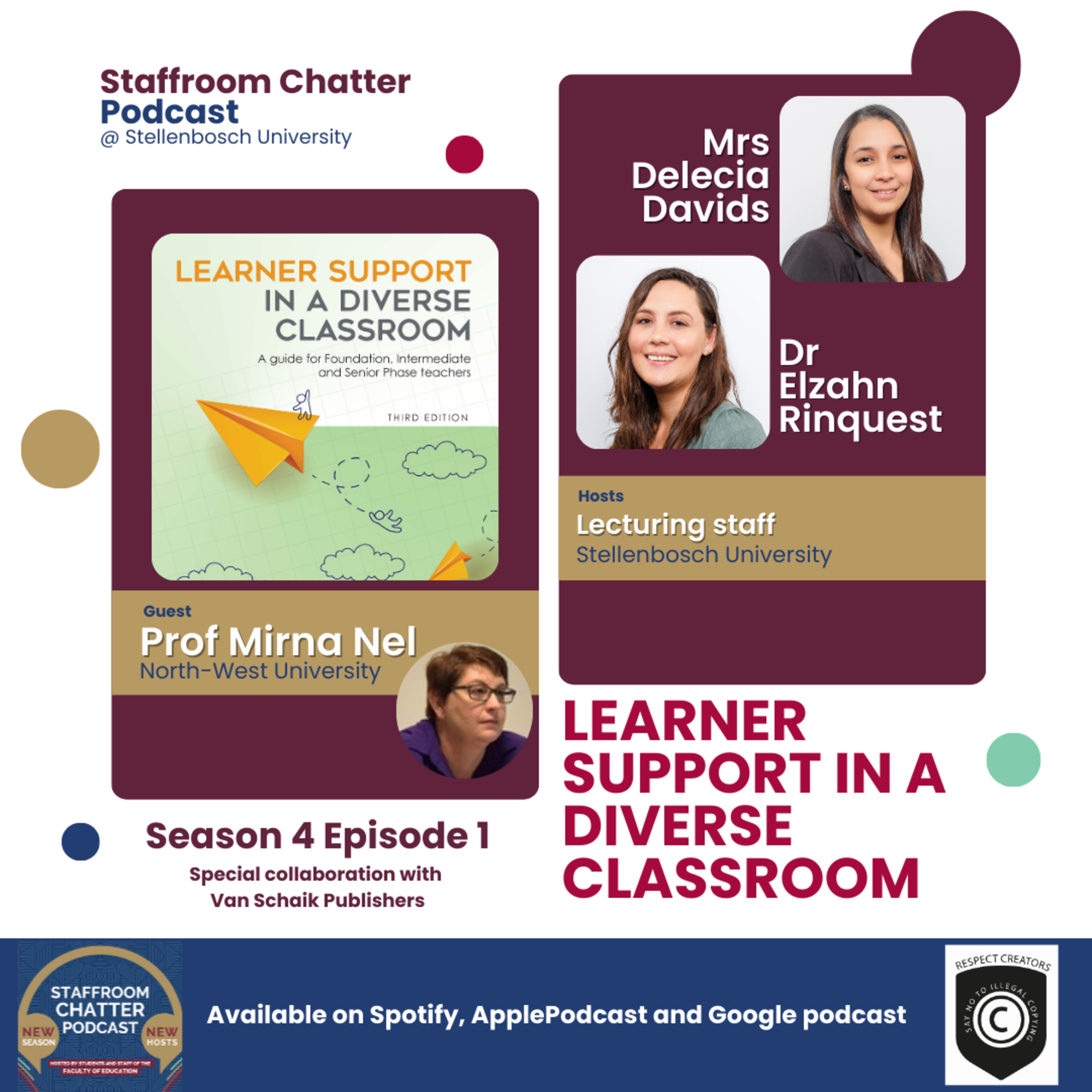
Season 4 Episode 1 –Learner Support in a diverse Classroom With Prof Mirna Nel
43m 52s
This episode of "Star from Chatter" features a discussion with Professor Mernanal, a scholar in inclusive education, about her book *Learners Support in a Diverse Classroom*. The conversation centers on the critical need for inclusive education in South Africa, defining classroom diversity broadly to include disabilities, language, socio-economic factors, and varied learning needs. Professor Mernanal explains that the book aims to provide both theoretical foundation and practical guidelines for supporting diverse learners, targeting pre-service teachers but also used by practicing educators. Key challenges identified include a systemic fixed mindset, where education remains content- and results-driven, hindering flexibility. Teacher training is noted as insufficient, often isolating inclusive education rather than embedding it across curricula. The dialogue also addresses how gifted students can be overlooked, as the system prioritizes average learners, and emphasizes that true inclusion requires adaptable teaching and a shift from labeling differences to addressing systemic barriers.
Welcome back to Star from Chatter. In this special season we throw to be collaborating with FUNSKYP publishes, a leading voice in South African academic publishing. I am Alzone Rinkwest. And I'm DeVisha Davids. We are academics and teacher educators at Staten Bosch University. Together we're delving into the crucial topic of inclusive education in South Africa. In this episode we're joined by Prof Mernanal, a leading scholar in inclusive education from Northwest University. The recent book Learners Support in a diverse classroom, a guide for foundation, intermediate and senior face teachers, published by FUNSKYP, is the topic of today's conversation. And we are happy to introduce a phenomenal academic and author of the book, Learners Support in a diverse classroom, a guide for foundation, intermediate and senior face teachers. This is the third edition of the book. Welcome Prof Mernanal to our show with me in the studio is DeVisha Davids. And maybe we should later introduce herself and Prof Mernanal. So could you share a bit about your background and your expertise in the field of Learners Support? Thank you Alzone for your DeVisha. Yes, so I am actually a qualified speech therapist many many years ago. I did the degree, speech therapy and audiology in that time. And the after I did course the education diploma, those days it was course the higher education diploma, which is now also a PhD CE. And then I did my masters in education and then also the PhD educational psychology. So I moved away from focusing on speech therapy as such. But I worked for the education department for many many years in these support services, speech therapists, after the transformation we moved more to be consultants and not so more, you know, doing therapy. So yeah, I worked in a system which was very much a medical focus to a much more, you know, inclusive, such ecological focus, which was very nice for me. I was appointed in 2006 as a lecturer at the University of those North West University and got involved in developing modules in life orientation and learner support and inclusive education and continuing doing my research in those field specific. My masters and PhD focus very much on learners learning in English, which is not the first language. I was also that degree. I have many many years of experience in practice and then of course in academics as a lecturer and a researcher. That is so great to come from speech, it's like where you are at and we should be learning from you. So thank you so much. Can you then for the book, maybe just give us a brief overview of what the book entails. The business we haven't seen the book or read the book. What does it entail and what prompted you for the specific focus? And so of course, you know, when the whole movement to inclusive education started, there were many, many teachers who were not trained in what inclusive education is all about or how learner support works and inclusive education requires from all teachers to be able to support learners in all classes. And even up to now lots of our education training does not really focus on inclusive education and learner support, you know, unfortunately the dream is still there that it is seen as an additional focus additional subject and inclusive education and the support applies to every teacher. So this book of no one now was the first one who would have had up and said we need to start with this book and then she pulled me in and you know we started editing and co editing this book also with some other authors. But also which was really important for us is in this book because it is a book that needs to be used for the training of pre service teachers. So of course the theoretical knowledge understanding is very important and for us it was really important that students understand what inclusive education is all about because if you don't understand that it's going to be very difficult to apply it. But it is a book so it's not really for teachers in practice, or it wasn't really written for teachers in practice, but I get many teachers that come to me and say that they use this book as a guide for them because there isn't really something that they have in their hands. So the reason we started with this book is to provide a good understanding, good theoretical foundation, but much, much more giving guidelines, steps, practical suggestions on how to deal with a diversity of learners in your classroom. Thank you so much. I think that's so important. I think when we hear words like "intercity" and "diversity" you know we often sort of have a very narrow view of what that is in even peace of the teachers as such. Could you define for us in the context of your book how you use the concept of diversity in the classroom and then why do you say it's such a crucial aspect of all teaching? I want to start with a two hours on before the book cost orders that you actually spoke about, inclusive education and strict education. Now I know that that's how many people in the education department also talk about it and it's wrong because inclusive education covers every classroom, special schools, mainstream schools every classroom. So of course a big part of this is on including learners with disabilities as you know those of you know why by the six they just one of the main reasons why this policy was implemented. It's to make sure that the learners with disabilities get education because lots of them were excluded. If we talk about diversity of course it's about inclusion of children with disabilities but it is about differences and I'm also using the word differences very carefully because you know if you use the difference it can also very much label you know if you see as you are seen as not normal and that putting that in inverted comments. So I want to be very careful how you use the term that friends but of course the abilities are making your classroom even if you have a school's environment so I'm so economic environment you have different learners from different backgrounds languages, religion, sexual orientation, socio economic circumstances, health issues. So basically every child in your class could have different needs and very much the thing that I want to emphasize is that you should not see the difference within the child so it's not just about the child it's actually this child comes from and also differences that the system actually creates. You know with the system status they say children into cohorts so you know they all that the clever children are in one class and every children in another class and those are not exactly the difficult children on another class or people who are just grouping even in one class children according to which they see its signage. So diversity actually is about deaf learning needs if I can say it in brief like that. I think what's interesting from years that you know all of these initiatives let's call them initiatives that start us the program really to education is often very difficult to bring them into the mainstream. Can you maybe comment on why that kind of change is so difficult to even with the language as you would just say you know we talk about special needs education but that narrative. I was shifted a long time ago why is it so difficult for the system to adjust and perhaps even for teachers to adjust in their thinking of how to conceptualise this in the classroom and then obviously also to act on these different needs that they see in front of them. So I think it's a very good question. I so wish I could solve the problem so it comes with centuries of how we taught and how the education systems were developed and how policies were developed you know so. Unfortunately I don't know if you know the whole terms the concepts about a fixed and a growth mindset so I really this this is a big problem for me and I see this is one of our main challenges to really implement inclusive education truly and fully. Yes I need to be very careful I'm very critical yeah you can read some of my articles where I'm very honest about this you know it's very much easier to teach signness so we've always put the same week we. How we judge children to be the same in the same group in the same class and then unfortunately we would always believe you know that what we are born with is is what what we are going to be the rest of. So this whole thing about you know nurturing developing that actually with teaching learners can improve you know the past in my years I could taste were done and not denying the worth of what you can get from an I could taste but unfortunately it labeled and stereotypes or you know so. And then that day you would taste it you've got an I could score that school was written in your due to court or eight lab and that's how you were told so if you had an I could ski for 100 and average you know you were always an average child if you could be. And if 100 you are always the child is going to struggle.
And then even if you've got a high IQ school, lots of pressure and expectations were placed on you. So that fixed mindset, you know, of that development, the environment, the systems, actually all supplier role. What happens in the home, what happens in your peer groups when they're collected. And the government keeps on emphasising that with a curriculum. So of course, we have YKP6, if you read all the curriculum documents, they say, be flexible, be inclusive, but that has not happened. Basically, a curriculum that must be done, so we are so focused on content-driven results, driven education. You know, there are not lots of learning takes place, you know, and being able to be flexible in a classroom to accommodate those different learning needs. So if we can change that, if we can get away from a content-result, driven curriculum and not focusing on pass rates, and really focusing on how learners learn and how we need to accommodate different learning needs, then I think things would go much, much better. So I'm here for a system overall pro-mode analysis. When you were talking, I actually, as I was reading through the book, I found that particular concept around giftedness, and how you talk about it as a barrier sometimes. Quite interesting. So, an a tele-quick story, and then perhaps just to see your thoughts on that. And I think that helps with understanding diversity, not only as responding to special needs or disability, or disability. When I was in grade four, so I'm not saying that I am gifted, but my teacher made me feel that I was. I was thinking for, I had an exceptional teacher who really was responsive to my needs. And I think at that was the first time a conversation even with my mom, and I, to this day, I kept saying to her, she was the one who decided I couldn't skip grades because my teacher at that point did a few tests with me, which I obviously didn't know what was happening at the time, but I remember very clearly we wrote an exam in grade four, a mathematics exam, and I was, I was done in five minutes with the whole paper, and I thought I hundred percent, and my teacher was like, "No, no, no, no." And so what she then did sort of, I almost want to say with our thinking, because again, I'm a child, that time, she gave me the more difficult problem. So I had not encountered before, and that sort of started a conversation with my parents, but perhaps I should do half a grade, and you know, for the next two years or so, just to see my progress and so on. And I'm almost completely against that for her own reasons, because you know, socially, she had reasons for not wanting me to skip grades. But when I reflected on that when I sort of being older and obviously being an education, I do feel that there was a lot of times where the challenge to which I think I could have arose, to was not made because I was then taught the same. So could you speak a little bit to the idea of giftedness, and also how it can be a barrier when students aren't being challenged in a way that they should, because I found that very, very interesting. I didn't think of giftedness as a barrier in a classroom at all. I just mentioned that not most of the time here at all, so I can only speak from what I know in my experience, so exactly that because unfortunately, you know, system education system very much focuses on the average child. And you know, because that's the way to make sure that you can finish the curriculum and address most of the children. But then unfortunately, and then which is what's all you that the learners are struggling also to more attention, because as you say, you know, that's also the other good place to speak to education, but there is this appropriate supplies for that job. Always system in place for that children, unfortunately, also very much exclusion, but they start going to the middle to your question. So exactly that you know with giftedness as not so you would get in many other countries who would actually get schools or systems specifically for the gifted where you can be more challenged. It's very difficult for teachers to think about, create, task, strategies, activities for children who seem clever when they are. I'm very, very honest about that, you know, because remember it is also because teachers need to be on in control and outside that with a lot of respect. So in not being able, you know, if a child in your class challenges you and it seems to know more than you, then it's quite scary for many, many teachers, you know, because they need to feel in control and to be able to teach the children. So the system does not really accommodate that unfortunately, you know, in these days you are not able to skip grades anymore, which was the opportunity, but absolutely it's your mom says, I mean, there's also social and emotional issues that you need to consider. But that's exactly you know, and I want to come back to the term a flexible curriculum that the curriculum must be flexible in how you apply it to accommodate with other kinds of activity source for those learners who are struggling. And then of course also for those learners who are learning much faster than other learners and sadly much of our gifted learners get lost in the systems. I had experience in the past that we had gifted learners who are actually placed into special schools of schools for children with behavior problems simply because they they struggle in school so that's exactly also happens. When I read it and you know, there's a beautiful table in a book where you talk about those kind of behavioral, you know, cues that you just can look at. And again, I was surprised at the fact that you know, they can display the same kind of behavior as the students with behavioral issues, because I didn't do what I was born is I just, you know, I always had a book to just either what we both. I can just say when I was when I was dying faster, but really what I just went to come into and thank you so much for you know, I need to learn a little bit about my own experience. And I think that as a as a story is just to say I think the pattern the fixer more curriculum is of course so important, but perhaps also to say that teachers having the disposition of adaptability and fixability is equally important because they have to respond to use in front of them. And I'm struggling with thinking about how does one teach adaptability in a pre service. So I want to comment on that. Yes, so we had a project over a few years ago that the bottom of our education training got all universities together that we can exactly talk about how do we deal with inclusive education in a teacher education program. I need to say this very respectfully there was little knowledge and understanding what inclusive education was all about. Few universities actually tried to address it. So there were a few universities that developed specific modules, but then it would be a semester module. So in the four years of training, they would have a semester module on inclusive education and maybe some had more modules. They were universities who also tried to have module specific on learner support. We tried to develop an algorithm to develop an any lecture specifically on learner support, but because it was not a school subject, you know, it was really quite a fight to have it. So our students could choose it additionally. And unfortunately that disappeared from the curriculum now. We had, as you know, they developed a new teacher education policy. We, the whole issue of inclusive education is very much emphasized. We also had a larger search project with five universities. We won university specific adult with developing modules that was with the political cultural and inclusive education. And the rest of us worked on how do we infuse or embed inclusive education in all the subjects. So of course those specific modules are very, very important. But how do you also tell the math teacher, the language teacher, the science teacher on how to deal with different needs in your classroom. Certainly I must say it's still a very big issue. So there were many conversations, many meetings, many some poses, many conferences, lots of research, but yeah, that has not changed as it should have changed. Yeah, so I'm very honest about this and I don't want to generalize because I know that most universities work very hard to try and deal with it to make sure that every lecturer who's in teacher education deals with inclusive education. In some way, specifically in strategies, teaching strategies, but certainly I don't think it's done enough or adequately at all. Manana, can I actually follow that up with a question? I have a history. My teaching career, I spent eight years in special education teaching and managing. And there's where I learned, I mean, I just also had a B8 degree, normal teacher degree, can't come mainstream school into special needs or them, another that teach learners with autism. So I was like, you know, sort of sort of had it in with some of the challenges, etc. And then I found myself in classrooms where we were teaching caps, but in with kids with very disability in one classroom. And so I feel it's like a type of human being that could do that because it asks of you in team in looking at that child and learning from that child in the way that they learn, you know, I mean adapting to that.
that but also flexibility within the school structure and within the management of that school. Actually, the school must offer you that scope. So at a special need school, which is classified, they have to offer you the scope and it's less driven by outcomes. It's more like we're creating kids that believe in themselves, you know, the approach is different because they often come into the high school part from mainstream and they would be depleted or like they would have a vacation, they would hate learning because they've been trauma-trying in mainstream by teachers and students. So they find some form of belonging in this space. And so we want to use that knowledge and spread it out and give it to the previous teachers. But once I joined the university, what I've been confronted with and I don't work in necessarily in education psychology or something like this, I work in sociology of education. But I often hear the, when I try and push for this, inclusive of education idea and we need to respond to it more with more rigor almost in our teaching courses, then what I often get back is, no, that is what the education psychologist should be doing. And I like you do not feel that it's because we see white paper six, we see all the other things and we should be training all teachers because those kids are everywhere. I also worked in a township school and you know, they're children undiagnosed and so you see 55 of them, half of them can't write their names, etc. So if we talk about, and this is not easy and I think it's a conundrum and it's like the hated curriculum differentiation, how does one do that? What is it? So even students when they come back from practice, they're like, oh, I didn't know, they fall apart literally because when I meet these kids and often like you've said and Dali Shav said, even gifted kids, even kids that are bored, even kids that don't like you will have behavioral issues and you're quite frantic with the behavior behavior behavior. And how does one from St. Thomas that moment into a learning, engaging, teaching and learning environment, what in that space, what is the role of curriculum differentiation and what is it, what is it supposed to look like? Yeah, so we would rather use the term an inclusive bit of God to then differentiation. So I see you're not, you're not nodding. So you've heard that, because if I come back to what I've said earlier also and I want a profilessive of Walton, we wrote our chapter on differentiation, is the expert on this, you know, and she sees it very nicely here, is that the difference of being different, often signifies deficit or defines or adivian sorry, because being the same or every just often regarded as normal and desirable. This is a person who has aspects in the German who sees in this book for much of my life being different, equated to being bad, even though I've never thought of myself that way. So difference leads to other things, it's again that thing because you know, they are them and they are us. So I want to start there, that if we talk to the differentiation, is the term that we use, it is used by the education department, but I would really rather talk about inclusive, an inclusive bit of God to which basically in simple terms, it means that you need to teach in such a way. So you need to be innovative flexible in your teaching and how you assess, you should not, I like to use the word stuckness, you know, teachers like a recipe. Unfortunately. Yes, because that's just easier to prepare and to do the thing. So if we talk about inclusive bit of God to it's really how to be flexible, that you teach in such a way, that you use a variety of ways to teach, a variety of assessments, that you understand and know your learners, where they come from, you know, the context, where they are, how they circumstances look like. And immediately I hear the thousands of teachers telling me that they are 4 to 50 children in the classrooms, how do they do that? And I know that that is a very difficult one to answer. But if we are open to being flexible and not teach just according to a recipe, that is prescribed, that you actually take the courage to be innovative, to be creative, be critical, think and not just teach your learners to be critical, think is back to be a critical think yourself, you know, if you open a book or learning material to be critical about that, and reflection, I mean, you know, feedback, reflection, all those kinds of strategies are very, very important to include in any case a bit of God to approach. My, one of the previous speakers actually, I think that if so, just before this, also spoke about the idea that curriculum differentiation is seen as a reactive approach to, you know, what you find in the classroom, and they also spoke about universal design of learning, for instance, as a more proactive, you know, I do know that you also deal with those concepts in the book. So I think, you know, the term inclusive pedagogy, our series is now coming up. I want to maybe ask two questions, and the one is a bit mischievous. Should all pedagogy not be inclusive? I want absolutely. And that's not a mischievous question. It's absolutely, you know, so they should not be, we should talk about inclusive pedagogy, not at all about differentiation actually. So absolutely, it's not a mischievous question. We should try and all teachers are to be inclusive pedagogogists. Otherwise, we will never have inclusive education systems. I ask the same question to another, you know, group of editors of the book. What happens to the debate around equity and equality when we talk about inclusive pedagogy and all of these multiple assessments and how it was assessed differently? What can you say to teachers to help them think through those concepts? Because oftentimes, particularly in police those teaching, I used to teach them the practical learning, the teaching methods module. And we introduce those terms to the students and they say to me, yes, but what about fairness, you know, so what can you help us to think through those concepts? And particularly if our goal is to have inclusivity and dementia, that all known as learn, how can you respond to that? Assessment is actually one of the biggest trouble makers when it comes to exclusion. Now what we do with assessment, formal testing, and I know that most teachers also, I mean, the term continues assessment is also there, but even in continuous assessment, you still use all many times formal testing and assessment is still used as tools to define or determine how children progress. So when we talk about assessment, it's always about the process also, not just about the process. So you would see in a book and I'm looking for the right English words. Creative? Thank you. That's great. That was developed or inspired by a colleague of mine working in assessment year, unfortunately, passed away a few years ago, and he had this process of learning support in assessment process. I adapted it a little bit. It's on page 82. I adapted a little bit so that it's more about learning support and not just assessment. You know, we've seen this process. So it's really about starting, covering information about the learners learning, analysing it, interpreting it, recording it. Of course, you need to have some formal recording, but you know what also happens with recording, it's about marks. Absolutely. Yeah. So it's only some marks are used to make a decision about where learners progress to. And of course, we know much more. So, you know, if a learner struggles with writing or reading, that's the most common tool that we use to assess. So why can you not use alternative ways? You know, given learners the opportunity to do it in an all-all way, or even use a computer, as on you worked in special education. So you know, there are many alternative different deaf and different groups that we can use. You know, so don't just talk about the marks, but how the child's progress in the process, you know, a struggle for maths, I must be very honest, I cannot do maths. But that was one of my biggest challenges and one of the areas in education that makes me very upset because it's always about marking the right answer, but you don't cease the process. So if a child does again, it comes back to recently. If a child does not follow the recipe that has been taught by a teacher, the sum is wrong. So yeah, so all of them very much about the process, not just getting to the right answer, the way a learner learns, being knowledgeable about where this learner comes from. You know, because I mean on many days, a child comes to school not feeling well, someone died or these sickness or whatever. You know, and that is the taste for the day, that's the mark that child goes and that's how you get labeled. So it's the bigger picture and unfortunately our system does not allow for that. Our system, you know, you need to do the formal testing, that's how we progress child, the child struggles, see if you quickly give a definition about flexible curriculum teaching and assessment. So it means, especially in the foundation of intermediate phase, we are teaching foundational knowledge and skills. So if you need to teach spelling in one week, you know, and your lesson plan says by the end of the week, I need to be done with this. So you follow your plan by the end of week you are done respect the whole three go to few.
class or not they get, but unfortunately you just simply need to continue to the next lesson. Lots of children then remain behind because of different reasons not because they have the intellectual disability and sadly many of these learners actually get labeled a serial topic and then place them to special education. Just think about the language. I mean so many of our learners are learning in a language which is not their mother's child. You know I actually want to include first language learners. I think we all know that our learners language are not good enough these days. So many of these learners get labeled the slow learners and again not because of their intellectual disability but because of many other factors. So I want to say I think I found my spirit animal in you where it comes to marks. Wonderful. In my first one of a few of my first lectures were first just I keep saying to them if you're going to ask me if this thing is for marks then we're going to have an issue because I think that is so important. It is about understanding what is learning look like and how can we achieve it in multiple ways and also what does a mark tell you? You know I'm just thinking about as you were talking you know if someone doesn't get the right arms and mats or if they're not able to you know arrives and read you get a two for instance percentage on your report that's home to your mom. What is she supposed to do with that knowledge of a two right? I got as a bar. So with that being said I think particularly with the in the math chapter you speak about learners context and bringing in you know where they are and how to teach to context. But I want to ask in terms of sort of the broad idea around learner support. How could parents and the broader community be involved in supporting learners in diverse classrooms? I feel your fire right through this. But like you know like a deep song. No, it's a deep song. But I just want to come back to what would you told your students you know through the years teaching I would get very upset as you can hear I'm very passionate about my field. So you know we would have this nice interactive class and then they would always be the student doing up the hand, you saw her hand asking well there's been the exam all the tests. So yes if if I can please give one message through the spot cards and learn don't worry about the and test the exam. Yeah. So this book was basically written for a teacher education for pre-service teachers but we really try to write it so of course there is a lot of theory in it also. You would have seen in every chapter there are guidelines and practical tips to make the theory practical. So there are much in this also for parents you know if they want to take this book and understand what inclusive education and learning support is all about and some practical tips. We cannot do inclusive education without parents in the broader community because if parents in the broader community keep on practicing exclusion where the child with I don't want to use the word "special needs" when inclusive education was started and why by the success it's so clearly that we actually should have moved away from using the word "special needs" and I always say we are all special we all have special needs. Of course. And the policy said let's talk about barriers to learning but unfortunately with every term it's used that's an exclusive term so you know the one thing that really gets to me is that we actually now talk if a child is placed in a special class or a special needs class school then we now talk about the inclusive children. So I think that is a very important role that parents in the community need to play is the use of terminology and how we stereotype and how we label and how we judge. You know so if they can see that every child is a child who has problems in different kinds of ways. So there's a big responsibility from educators side to make sure that parents and the broader community understands that. Absolutely. You're making me think of my mom so the message is shout out there to my mom so I'm sorry. A formal educator but she's done remedial reading courses and she's one of those I was echoed in a community tani's you know. Community aunties rather because we couldn't say tani and that she she literally has like a group of students that some of the teachers from the school where my baby brothers used to attend where they ask her to do to sort of do that kind of reading with the learners and some of them are in grade seven and read on grade two level and then she is able to provide that kind of personalized support that was not always possible but I think that orientation to supporting and also understand that she's proud of the broader community from her own kids that she's doing this with. I think it's so so important and so special and I can when I sometimes was that I see the kids laughing and they really are building confidence and unfortunately outside of the mainstream you know classroom which which I think is still probably the biggest challenge to say how do we you know also still need those spaces but how do we make the classroom more inclusive where students can feel like they belong where they where they can learn and where they are really just seeing from there are special or not. He spoke special everybody is special as we are saying this I'm just thinking I often say as I also work with learners with ASD autism spectrum and I'm like we are all on a spectrum of this thing and that thing I'm saying when I like everybody has a thing something and we need to respond as teachers we have to respond to delusia I have to respond to men are the top of human that you are and see and that's the kind of to me it's like a issue of humanity and just and just see that. And if we trade teachers to want to do that and I think in essence they do want to do that and then we get to the curriculum the catchers very prescribed and we tell them but it can be flexible and you need to have the kind of overwhelmed overwhelmed and then you throw this diverse group of kids in front of them and totally overwhelmed. I just want to make this one point the thing that saved myself and I'm sure you can maybe has a final response to we're running out of time but this is a lovely having this conversations here we can go up for hours is planning to respond to all your learning so firstly like you said earlier knowing them and taking that time maybe in the beginning of the year or wherever when you have some moments to get to know the kids in your class or even each day or 50 of them and you can do that I mean we can do that of course you can and then respond to that as you are planning for your lessons and so don't just rock up and take the textbook and try and teach because that's when we drown and the kids also see them we leave them behind. I want to as a higher question maybe I don't have to be sure to say she's chatting like this. We can continue this chat of the spot cost back for a follow-up but I have to weigh in my question as a final answer. I think I want to incorporate it but that's the question. It's not a lot of things to be said. And because I'm scared I'm going to forget also answer there are two important things that you mentioned here it's about humanity so you would actually see some of my lost publications were about inclusive education being humane and how you know it's it's an issue about humanity so I'm so glad that you mentioned that because it's about humanness also about being humane it's a key principle it's a key integral part of if inclusive education that we should emphasize that because if we see where the world is well I mean history is also like that but if we see where the world is going to now being inclusive gives us that opportunity to be humane towards everyone around us and planning it just gets you at the point about planning very important in this whole place is reflection feedback and we don't give enough time to think sorry I'm sorry Alicia I just want before I forget I'm so important point is that I want to mention. Well I was actually brought up something that I forgot what I wanted to ask you but I think as a closing I'd like to ask you about advice that you have for educators policymakers parents who ever but particularly for teachers around you mentioned something I don't want about courage and I want to add agents to that basket because I do feel that a lot of what we're talking about particularly when it comes to voter support and the curriculum is somewhere that teachers do is a sense of agency when it comes to interpreting and implementing curriculum documents and do you have any advice for how teachers can sort of you know really ignite that agency particularly when it comes to implementing that support and also obviously the courage to do so. Yeah so the courage unfortunately is really very important because the one thing that my students always tells me is that we teach them all these very nice things about how to be an inclusive teacher but when they get to the practice it's a whole different story you know because then they senior teachers they school management the districts are saying this is what you need to do and this is the format that you need to use and this is the strategies that you need to use so there's very very little leeway for them to actually be creative in a way to um and teach an inclusive way. So courage is really very important in being a change agent but still even within all those those requirements and prescriptions and recipes they just follow. Sit down and think about what you do be critical around regarding your own teaching because in a way that
teacher, even if you follow the recipe in a way that you teach the teaching strategies that you follow, the system strategies that you follow in how you get to the end results could make a difference. Yeah, so Alicia, I think that ensures be critical, be reflective, be innovative, be creative and take care of each other and try to in a way, don't be stuck, please. Yeah, don't get stuck. Don't get stuck, don't get stuck in this whole fixed mind, sex, have a growth mind, think, believe that all in a scan learn, even if it's very difficult with the circumstances. I say this with a lot of sympathy and empathy because I know that the circumstances in our education system and classrooms are not easy. But if you don't, I mean, with one little state, we can make a big difference. So do let. I'm so happy that you say that just before Alicia closes on to say just like somebody will have the idea that teachers cannot make impact, but I truly am told. No, she makes friends with teaching in that classroom in direct contact with that child make such a big impact. Absolutely. I saw it because I mean, if you ask your students, name the teachers who made a difference in your life, impact. I do. Exactly. And they can name them. So all those teachers, but they can also name those that they. Yes, I'm very first class. Can you raise your hand if a teacher ever believed in you in such a way that you actually became that thing or said something to you that took away a dream that you had and they have that equally like, as I say, you have a large impact in a classroom. One word that you can say can make a break a child. So, thank you for encouraging us to remember that again and to stay in this space when we as teachers or please service teachers continue to learn and not sit or get stuck in our ways of doing and teaching even us as early career. I could there be some teacher trailers. Absolutely. Absolutely. This conversation to me today is going to really, really inspiring the problem. I am really happy. I don't make me very happy. Yes, I think I've even been nagging me about social needs, education. That's a special name. I know, I know, talking to that kind of developmental growth that happens for us as well. I think what I am really, really thankful for particularly with your conversation today is the robustness with which you shade and critique the respectfully during so, but also the energy that you have for this topic and for this focus. I think having a guidebook with practical implementation methods is so important and it's covered so many important topics today. I would encourage every pre-service, in-service teacher and also parents for community to really buy the book and to even find you and engage with you in different ways. We were speaking to Prof. Morninal editor of Learner Support at diverse crossroads, a guide for foundation, interneedian scene at phase. You can find this book at your nearest front skyk store and we will link some of Prof. Morninal's newest research also in the bio to the podcast. It has been incredible chatting to you. Thank you so much and all the best of whatever you still need to do for us in terms of education. You are up for the rest of your career. Thank you. It was absolutely my pleasure. I always love this opportunity to talk about it. It's so important that many, many people hear this. So thank you for for asking. I really appreciate it. Thanks very much. Thanks, everyone. [Music]
Podcast Summary
Key Points:
The conversation focuses on inclusive education in South Africa, discussing the book *Learners Support in a Diverse Classroom* and the challenges of implementing inclusive practices.
Diversity in the classroom encompasses not only disabilities but also differences in language, socio-economic background, religion, and learning needs, emphasizing that barriers often stem from systemic issues rather than individual deficits.
A major obstacle to inclusive education is a fixed mindset within the education system, which is content- and results-driven, rather than focusing on flexible teaching strategies that accommodate diverse learners.
Teacher training programs often inadequately prepare educators for inclusive classrooms, with inclusive education sometimes being treated as a separate module rather than being integrated across all subjects.
The discussion highlights that gifted learners can also be marginalized, as the system tends to focus on average students, and teachers may lack strategies to challenge advanced learners effectively.
Summary:
This episode of "Star from Chatter" features a discussion with Professor Mernanal, a scholar in inclusive education, about her book *Learners Support in a Diverse Classroom*. The conversation centers on the critical need for inclusive education in South Africa, defining classroom diversity broadly to include disabilities, language, socio-economic factors, and varied learning needs. Professor Mernanal explains that the book aims to provide both theoretical foundation and practical guidelines for supporting diverse learners, targeting pre-service teachers but also used by practicing educators.
Key challenges identified include a systemic fixed mindset, where education remains content- and results-driven, hindering flexibility. Teacher training is noted as insufficient, often isolating inclusive education rather than embedding it across curricula. The dialogue also addresses how gifted students can be overlooked, as the system prioritizes average learners, and emphasizes that true inclusion requires adaptable teaching and a shift from labeling differences to addressing systemic barriers.
FAQs
The book provides a theoretical foundation and practical guidelines for supporting diverse learners in inclusive education settings, targeting pre-service teacher training but also used by practicing teachers.
Diversity encompasses differences in abilities, languages, backgrounds, socio-economic circumstances, health, and more. It views learning needs as shaped by both the child and systemic factors, not just individual deficits.
Challenges include a historical fixed mindset in education, a content-driven curriculum focused on results, and insufficient teacher training that embeds inclusive practices across all subjects.
It highlights giftedness as a potential barrier when learners aren't challenged, noting that rigid systems often fail to provide appropriate tasks, leading to disengagement or misplacement.
She is a qualified speech therapist with a PhD in Educational Psychology, having worked in educational support services and academia, specializing in inclusive education and language learning.
Effective training requires both dedicated modules on inclusive education and the infusion of inclusive strategies across all teaching subjects, though current efforts are often inadequate.
Chat with AI
Loading...
Pro features
Go deeper with this episode
Unlock creator-grade tools that turn any transcript into show notes and subtitle files.
 PodcastTranscript AI