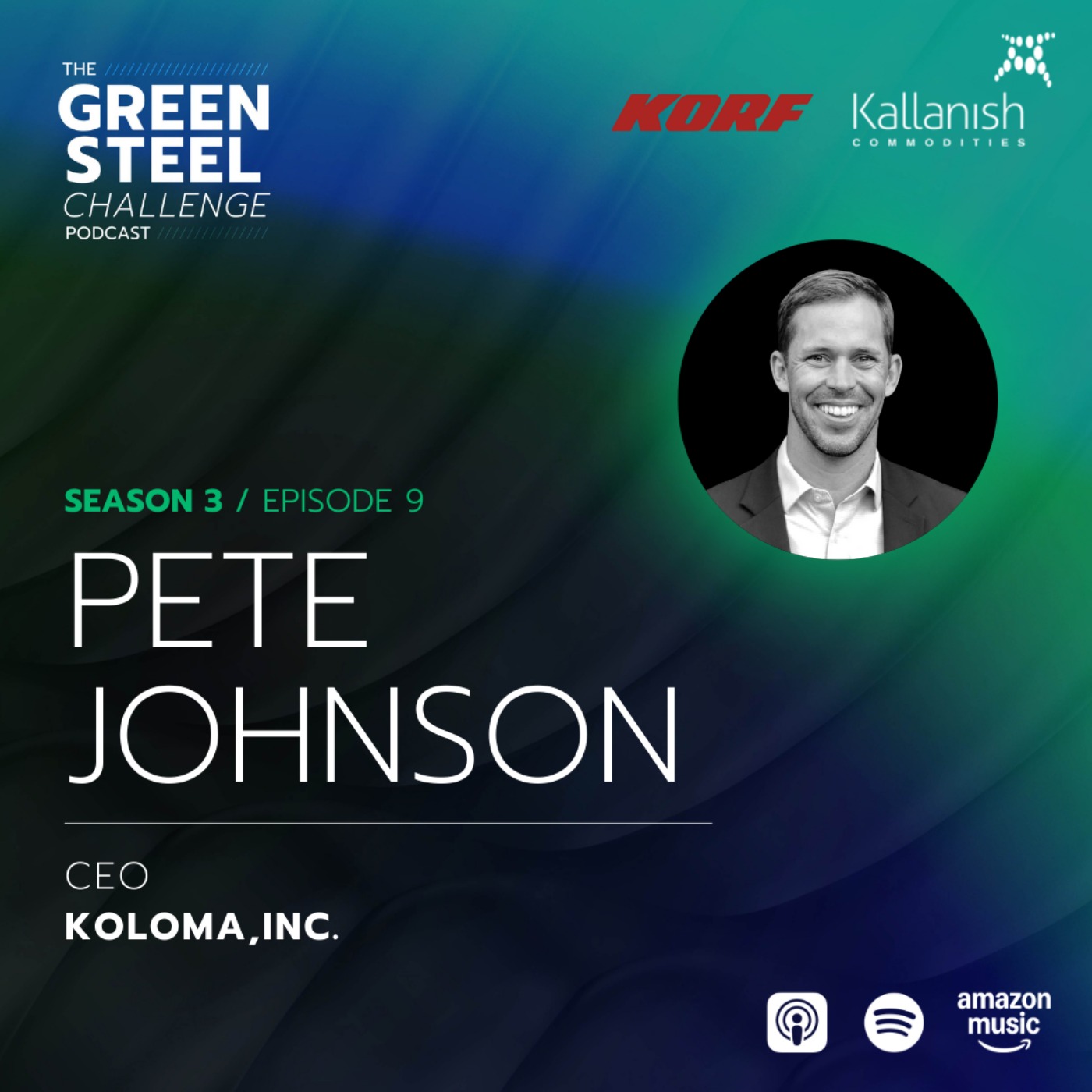
The Green Steel Challenge podcast, hosted by Astrid Koff, explores innovative solutions for decarbonizing steel. In this episode, guest Pete Johnson, CEO of Koloma, discusses natural hydrogen—hydrogen formed naturally in the Earth's subsurface through processes like serpentinization, where water reacts with iron-rich rock. Koloma originated from a lab with over 20 years of data analyzing hydrogen-rich gas samples, providing a significant advantage in identifying viable hydrogen reservoirs. Johnson explains that if hydrogen can be found in conventional reservoirs similar to natural gas, it could be produced at very low costs, potentially around $1–$1.50 per kilogram, making it economically transformative. The extraction technology is largely established, but the main challenge lies in exploration and understanding hydrogen systems. Koloma has begun drilling and has found promising accumulations, though commercial viability is still being assessed. If successful, natural hydrogen could supply the steel industry, particularly for hydrogen-based Direct Reduced Iron (DRI) processes, significantly reducing carbon emissions. The potential scale is vast, with estimates suggesting trillions of tons globally, which could reshape the energy transition landscape.
This is the Green Steel Challenge. Hi, I'm Astrid Koff and welcome to the third series of the Green Steel Challenge. Season 3 will place an even greater focus on innovation, new energy, fresh ideas and breakthrough technologies. We challenge conventional thinking and look beyond the obvious. Exploring creative solutions to the pressing challenge of decarbonizing steel. Drawing inspiration from my late father Willie Koff, the steel pioneer and rebel behind the Minimil and DRI revolution, this podcast aims to be a catalyst for bold thinking and real change. As always, Dr Mike Woltz and James Smoss are right here with me. Hello. With their insights from years of strategy and project management consulting across the steel industry. Today we are diving deep into one of the most intriguing frontiers in clean energy. Natural hydrogen. Hydrogen that occurs in the earth and can be extracted without carbon emissions. My guest is Pete Johnson, CEO and co-founder of Koloma, based in Denver, Colorado. Nice to be here. Koloma is focused on exploring, identifying and producing natural hydrogen. Hydrogen that originates or accumulates in the earth's subsurface via geochemical processes rather than being manufactured. Pete, please tell us how did Koloma begin and what's the big vision? Well, Koloma has an interesting origin story. I like to tell people, Koloma is not really a startup company. Koloma is about a 20 year old lab testing company that decided it had enough data to go do something different. I had spent some time. I had founded a few companies. I had founded another methane to hydrogen pyrolysis business. I was in the middle of a break between that working in oil and gas private equity for a group of friends who were looking to build an energy transition investing arm. I was looking at every kind of hydrogen deal under the sun. I wasn't really seeing anything that caught my eye as a real path to fossil parity pricing, which is what you really need to make markets work in hydrogen. I got approached by Bill Gates' climate venture team, Breakthrough Energy Ventures, who I had been friends with and looked at a bunch of deals with. They said, "Hey, we're thinking about trying to organize a geologic hydrogen effort you are interested in getting involved." My second reaction was that sounds like a silver bullet. I don't really believe in those things. I'm not sure I'm interested in playing make believe. They said, "No, no. Here's some data. We want you to read these papers. Then we're going to make some introductions. You can think about this." I started looking at the data and essentially the way this hydrogen forms is it's not a mystery. There's a few different geochemical pathways for hydrogen formation in the subsurface. One is radialysis where you can have radiation from uranium, splitting water and creating hydrogen. I would say the more meaningful one is what's called serpentinization where water trickles down and meets iron-rich rock. The water oxidizes the iron and it puts out a hydrogen molecule as part of that. That's a downhill reaction. It's exothermic and it's happening in very, very large quantities under the subsurface. There's really no technical argument that this isn't happening. We have hydrogen venting out of the seafloor along the mid-Atlantic rift. That outcrops at Iceland, you've got a bunch of hydrogen coming out of the steam vents in Iceland. We've got hydrogen seeping out of almost every continent in pretty large quantities. The best estimate I've seen is about 20 million tons of hydrogen just seeping out of the earth's surface every year. There's not really a strong argument against the fact that the earth produces vast amounts of hydrogen. I got there at a few papers and said, "Okay, that's really interesting. The question is not, does the earth produce hydrogen? The question is, does the earth trap hydrogen? Can we access it? Can we find it?" Or is this just needle in a haystack, gold in the ocean type of a pursuit? That's where I got to. If you step back and you say, "What if?" What if the earth does capture and trap hydrogen in large conventional reservoirs similar to the way that we find oil and gas? It stands to reason you could produce a gas at a similar price per volume as natural gas. If you find it in good reservoir rock, then the price per volume we can produce conventional gas is about $3 to $4 an MCF. If you can produce hydrogen at $3 to $4 an MCF, that's like a buck to a buck 50 kilogram hydrogen. That is just earth change. I got this in my head and the wheels started rolling and I started thinking, "What would I do if I had hydrogen at that price in places that I could sell it?" I finally came back and I said, "Okay, I'm interested. Tell me why you think we should start a company because there's still a lot of work to do." They said, "Well, we want to introduce you to a guy who's spent a lot of time looking at this." They introduced me to Tom Dara. Tom was a professor at Ohio State, tenured professor, award-winning Geochemistry and Geology professor. While he was kind of scrapping for tenure and building his academic career, also had built a small commercial lab that became the world's leading lab for measuring hydrogen rich gas from the subsurface. That is a very small niche business, like a $300,000 year revenue business. Basically, anybody in the world drilled a well looking for oil, gas, water, geothermal, mining, and they pulled out an abnormally high amount of hydrogen or other noble gases. His lab was the best lab in the world to actually analyze that and help them understand what that meant from a geology and Geochemistry standpoint. Because of that, over a number of years, Tom ended up looking at 30,000 high hydrogen gas samples and starting to piece together where this hydrogen was showing up, where were the most hydrogen rich regions, where were the places where you could find 90% hydrogen under the subsurface versus 5% hydrogen on the subsurface. Which regions was hydrogen showing up that also had the potential to have reservoirs and traps and seals and actually a hydrogen system that could lead to commercially viable hydrogen. Tom had built this database. He had also built the tools to be able to determine the age of the gas, the depth that was formed at, and the temperature was formed at. Once a sample comes into his lab, he can figure out this hydrogen is probably about 4 million years old, was likely formed 6,000 feet deep. Here is the large, mafic iron rich rock that likely was the source rock for this hydrogen. Let's go, we can go start exploring around that and see if there's a viable system around. This is what Tom had as part of his database and his data advantage and his technology advantage. I looked at this and I said, "Gee's like, this is a really interesting puzzle piece here, right? This doesn't guarantee you that you're sitting on top of the biggest commercial plays. It doesn't tell you exactly where to drill but it tells you where to start exploring and it cuts years off of an exploration program. It also could be used as training data to build machine learning based tools and AI based tools and things you can back test against this data." We took that and we said, "Okay, we think we can build a company here." So break through, wrote a check, I put in some of my own money, Tom put in some of his own money. The first thing we did is we bought Tom's testing company and incorporated that into a business that was now focused on technology-advantaged, data-advantaged, hydrogen exploration. Was your background as a geologist or a chemist or what? No, no. So I have an undergraduate degree in physics and then I have a graduate degree in mechanical engineering from Stanford. I had a fairly broad career in engineering. I started out in the fiber optic space and then I moved into solar and helped build and sell a solar company that was backed by Kozla and Cliner Perkins. Then I founded a company called Monolith Materials that does methane pyrolysis and high temperature hydrogen formation and then I spun out a waste to hydrogen business. So I've accidentally been in the hydrogen business for a long time. But no, I mean, if the world ended and I needed a job in oil and gas, I'd be a topside well-pad engineer. I'm not a subsurface guy. And it's an interesting story. As I was kind of getting more and more interested in this, I felt the cold icy grass per fomo coming in and you know it. So I actually called some of my buddies from the oil and gas industry who I knew well and had looked at geothermal deals with them and CCS deals with them who were kind of the guys I leaned on for subsurface expertise. I had a good job. I was in. private equity, I was coaching Little League Soccer, like life was pretty good for me. And I told them I was about to do something crazy and I said, "Look, can you come meet with Tom, pour through this data and talk me out of this?" And ultimately, they came and they met, they kicked the tires. And you know, the view was, "Look, this is a massive data advantage, a massive head start. It doesn't guarantee success. This is a hard thing. But if you had this kind of head start in natural gas exploration or helium exploration, you would take the opportunity and go after it." And that was sort of the message I got from geologists, exploration geologists and reservoir engineers who were close friends and confidence in mind, who actually ended up putting money into the business. And that was a huge swing for me to make the decision to take the leap and do this. And this is a big swing. Like, this is a really big swing. It's a hard business to build. Going first can be great in some ways, but going first is really hard. There's one natural source that you read about in Mali that somehow got discovered by somebody dropping a cigarette on it or something. Is that actually producing natural hydrogen now or is that the only one? Yeah, and look, I don't want to speak, you know, that's owned by a separate company who has a lot more data than I do. What I understand is that, you know, they've drilled a number of wells, but they are continually producing hydrogen. That hydrogen is powering a village with a reset engine. It's not a huge amount of hydrogen, but it's high percentage hydrogen. It's in the 90% and it's been continually producing for years and years without any decline. So really interesting. Yeah. They clearly found a small accumulation, a small reservoir that can commercially produce, you know, how big that one is. We're not sure there's probably bigger ones around that area, I would guess, and, you know, it's in need of a large regional exploration program. Are these reservoirs or are they springs? I mean, you also read that it's self-generating, that it's actually not a finite resource. It's a spring rather than a well. I think we have to be, we have to be careful about that. The gas and molly from the measurements we've taken is, it's old gas. It's hundreds of thousands of years old, so it's not, it's not like that gas is being generated in real time. What you may see is that the gas that's being produced may be coming from a deeper accumulation that's filling it up. So we don't, we don't know for sure if it's this continually generated gas, or if it's, you know, being filled from something deeper with a spill and fill type of a thing. What I can tell you is the reaction that forms hydrogen is a lot faster reaction than oil or gas. And so this idea that you could actually have some recharge happening while you're draining a reservoir is very viable. You know, think about a few orders of magnitude faster reaction. There's also a lot of research and development in actually being able to stimulate hydrogen out of, you know, unoxidized iron rich rock early early days. If you're familiar with the TRL scale, it's like TRL 2, TRL 3 mostly happening in labs. But so that's a possibility that the gas and molly, based on the data we've seen suggests it's coming from an accumulation and there might be some recharge, but, but not, not necessarily spring. It's not just hydrothermal hydrogen coming out of the ground. Right. So in terms of the future of natural hydrogen in general, I guess now it's just, just is doing a lot of heavy work in the sentence. It's just exploration and extraction. Is all the effort your company and elsewhere going primarily to finding commercial good reservoirs or sources is is the extraction just kind of straightforward side of it or what? How is this kind of pan-actri-bill-guys-tuel plan? Success is finding hydrogen accumulations in, I would say, reasonably porous and permeable reservoir rock, though, you know, like a conventional gas discovery. And largely speaking, hydrogen is a low-density molecule. It has different chemical properties than natural gas that may make it work better in some types of rock and worse in others, but largely speaking, hydrogen should build a flow laterally through porous media pretty well, right? And once you put a well into that porous media, if there's a good seal on top, that well is the low-pressure point, and that gas is going to find the well and find its way out of the well. So it, we fully expect a large commercial discovery of hydrogen to behave very, very similar to natural gas or helium, which is another small molecule, which we produce with wells. The extraction is, I would say, you know, you can never say it's zero risk, but for four decades in the US and Europe, we've been storing hydrogen under the ground in salt cameras. And because of that, hydrogen wells and the casing design and the cement design and the well-head design, the Christmas tree, what people call it, hydrogen purification, those are all off-the-shelf engineering solutions available. There's not, there's not a lot of work going that needs to go into designing what a hydrogen well should look like, you can drill these wells with a standard oil and gas rig with a few extra sensors to make sure you have you have safe operations. It's not the technology is not really in the extraction. The technology is in the finding and understanding hydrogen systems and where they are similar and where they are different from oil and gas, because not everything is the same. Some of the risks that you have to address are different. There are certain subtleties about how to drill for hydrogen, how to look at it, how to test it in your mud logging, what kind of drilling fluids to use. There are definitely learnings that we've had along the way, but I'd say the big challenge is just getting better and better at finding it and understanding the systems. Okay, so where are you at now then? So, Coloma launched the business and then started building these hydrogen systems, models and using all this data and we've built and patented about 20 different tools. We have a hundred patents. We've done all that. The reality is that's great. Nobody's going to assign much value to that unless all those things result in discoveries. Right, and so a couple years ago we started drilling wells and what we started drilling, you would call them strap wells where you were still fairly data poor in areas. Remember, when you come into the Permian Basin, people have been shooting seismic data on the Permian for decades and decades and we know very well what the subsurface looks like. We're in places that people have barely explored at all and so they're very data poor, but it started out with a set of strap wells that we drilled to just confirm that the subsurface regions and the source rock regions that we thought were promising were, in fact, promising and what we found was really amazing. You know, the gas component in the poor space was predominantly hydrogen. We found a lot of different things. We found massive accumulations of hydrogen that weren't necessarily in reservoir rock that was going to support commercial flow rates from wells. Some of the things we're working on, we, like, juries out. We think we may be sitting on top of some really interesting stuff, but it needs some engineering work behind it. So, we're kind of writing the throws of assessing some of the early things we found and broadening out now that we have matched those and taken our learnings and really built a broader and more effective hydrogen systems model to exploring and broader places. So, you know, last year we sort of collected all this data that we had and we put this in front of the market. The view kind of became, hey, with what we're seeing and the tools that we're validating, this is now sort of a matter of when and not if. And, you know, we raised a really large round great support from the investment community. We went out and we hired a top gas explorer named Tim Chism who was the guy responsible for the discovery of Guyana for, for, for Hesse and Exxon. So, Tim came in paired with Tom and I've got this just amazing duo of the world's leading geochemists and geoscientists and natural hydrogen systems paired with one world's leading explorationist who's now assembled a world class gas finding team. And, and, and now we're building sort of a broad U.S. international portfolio to, to get after this in a big way. What sort of volumes are we talking about potentially from natural hydrogen? Is it fit player or is it the main source or what could it be? The jury's out on that number. We have our own internal views. The, the U.S. GS came out with a view a couple of years back that they think there's the potential for trillions of tons of hydrogen reserves across the world. And, and like, when you think about that number, that's like, you know, normally we think in TCA for terawatt hours or things like that, just to put in perspective, that's hundreds of years of the world's energy. Right? That, that goes beyond just the hydrogen market. I mean, we think it could be really, really big. But there are challenges with hydrogen. Hydrogen, hydrogen is a much more reactive molecule than natural gas. And so, you know, you're not going to find billion-year-old hydrogen still waiting in the subsurface. Most of the hydrogen we find is, is younger than that. And that's because hydrogen will eventually re-react with rock or re-react with microbes in, in the ground. And so there's a, you have to be at a certain depth to be hot enough that the microbes won't touch it and you can't be close to certain other, other,
materials in the ground of the hydrogen will re-react. So there's a lot of ways you can lose hydrogen as well. So our number is probably a little bit smaller than the USGSs, but this is big. Like it could be really, really big. It could just kind of rewrite the rules of the way we're thinking about energy transition if we start to get good at this. But there's a lot of work to do. Now let's say it is going to be big. How will colomas hydrogen fit into steel making supply chains? I mean, thinking about there's roughly two billion tons of steel produced per year. And 140 million of those tons are made by a DRI process. And the DRI process can use methane or can use hydrogen. It can be converted to use either of those most DRI processes today. Use methane. And that's about a 40-50% carbon reduction off of coal-based steel making. Roughly speaking, about 60 kilograms of hydrogen goes into making a ton of steel versus the DRI. And I'm using kind of rounded numbers to make to make math easy and keep numbers in my head. But that means, you know, if we could find large accumulations of hydrogen, you could convert the whole steel industry over to a hydrogen-based steel production method using DRI. And the great thing is you can build DRI now and you can make it flexible fuel where you can use natural gas or hydrogen. The really interesting thing I've seen and I've had some conversations with executives at steel companies is the bogie for the cost of hydrogen to go into be sort of cost parity. What I've seen is about buck 80 a kilogram. And if we can find hydrogen reserves in the ground, that's a fairly straightforward number to hit in most regions. You know, the best reservoirs will be cheaper than that. The worst reservoirs will be more expensive than just like oil and gas. So the great thing is I think geologic hydrogen, if this industry can grow, could supply hydrogen to steel in a way that it can be produced carbon zero, net zero at cost parity with blast furnace steel. Sounds like it can be an absolute game changer. It could be. I mean, this can be a game changer in steel and fertilizer, in synthetic fuels and shipping fuels. So the ability of this to impact these large energy and materials markets is enormous. It's energy. So it ultimately always comes down to price point and availability. Right? The other thing to think about is if I need clean hydrogen for steel making, I need it 24/7. Nobody's ever nobody ever has and I don't think anybody ever will come up with a solution for intermittent operations of steel production. You need to run at a 24/7 basis because this is a hot process. And so that makes sort of, you know, powering the hydrogen production component of a steel production facility with hydro with solar or with wind really hard. Right? Because storage is in add so much. So if you can, you know, if you can put a DRI steel facility near in geologic hydrogen resource and have 24/7 around the clock, clean hydrogen fueling this facility, you can produce clean steel at cost parity. And you know, in some of the regions we're working, and we're doing geophysics right now, you know, you're close to a port, you're close to iron supply and we think there's large hydrogen under the ground. And the local communities, the local economies are just looking their chops thinking about becoming, you know, exporters to the world of clean steel. You were just saying you spoke to steel producers. Are you thinking of partnerships or are you talking about partnerships in the steel industry? Well, we already have some. Two of the four largest iron mining companies in the world are investors in Coloma. We don't disclose names right now on that. But so we were already partnered with some of the upstream suppliers in the steel industry. And they're, you know, if they can stumble on hydrogen access and we can provide that to them, they might actually go downstream and just start producing the clean steel as well. We've had lots of conversations with the downstream steel producers as well who are very interested, you know, the, so yeah, we're pretty connected into the industry and I think everybody knows what could happen if we can start, if we can start making progress on this. Just to go back to Astrid's question, I'm just to put my mind up, rest. Is it the case that say somebody builds a DRI plant in Germany and many should have been built or are being built or will be built? At the moment, they're relying on natural gas brought in conventionally. Hopefully we'll go over to hydrogen by renewables or whatever way. Say natural hydrogen becomes available. Is it just the case that natural hydrogen will be brought to bear at the steel plant or the DRI plant in transmission systems vaguely familiar to natural gas? Is that right? Yeah, it's a good question. So I would say hydrogen, you know, hydrogen can be transported via pipeline. The same way that we move gas, we move oil, right? There's 1,600 miles of pipeline that has been operating for decades in the United States. There's hydrogen pipelines that are operating in Europe and being planned in Europe. So there's lots of ways to move hydrogen by pipeline. That's expensive and building pipelines today is really hard. There's a lot of an imbiism. There's a lot of challenges in getting permits and getting right away in pipelines. What I think is more likely when a subsurface geologic hydrogen resource has discovered a praised and confirmed, it's actually a lot easier to move iron pellets than it is to move hydrogen. A lot cheaper. And so an example of this, we were doing some early exploration in a region that was close to a large river that had inland ports on it and we had a lot of interest from the iron industry and the steel industry to actually barge pellets up the river, bring them to a DRI facility that could be located on top of the resource, convert that to clean steel and then export that out. And so what I think is more likely is that you would see Greenfield DRI facilities built close to the hydrogen resource. And that's likely the, I mean, at some point somebody's going to have to take a risk on the resource, right? That's either the pipeline builder or that's the facility builder. We think the lowest, sort of the lowest pain pathway is to build the resources, build the plants on top of the resource. And that's really how it started, right? That's the reason why the U.S. refinery complex is in Houston. Is because that's where oil was first discovered so the refinery complex is built on top of it. That's what we think. For existing DRI facilities that want to convert over to hydrogen, I think then the question will be okay if you add a pipeline to a hydrogen resource and connected to here is that the cheapest form of hydrogen, how does that compete with natural gas? What kind of a premium can you get on, you know, carbon free versus half carbon? I mean those economics will happen. It won't always work. You know, a DRI facility built somewhere that's really far away from hydrogen resources. I don't think that's going to, I don't think that's going to work at least not for not for a long time. There must be a lot of analysis to say, okay, we're going to have this resource, it's going to generate lots of hydrogen. What's the best way to use that hydrogen to result in the biggest impact on decarbonizing the economy? Is it the way we've talked about cleaning up hard to abate sectors like steel or do you put a power station over the top of the hydrogen source? Largely speaking, hydrogen is most valuable from a climate perspective as a feedstock for producing other things. So think about synthetic transportation fuels, steel, ammonia-based fertilizers. That's where it's most valuable and actually achieves I would say the best cost margins and the best kind of CO2 reduction impact. Hydrogen for power, as an engineer, that kind of makes me cringe a little bit because hydrogen is so valuable as a feedstock for producing other things. But the reality is if you know if the world can start stumbling on large resources, you'll be able to produce that hydrogen for about a bucket kilogram maybe and that will make it possible to produce power at 10 cents and 10 cent power will compete with geothermal and it'll out compete nuclear. So this will be a way to make carbon-free power on demand when the sun isn't shining, the wind isn't blowing, that is going to be competitive with any other sources of base load, low carbon power. It's probably the, you know, it might be a 20 percent lower climate impact, climate benefit using hydrogen to replace natural gas than it is to use hydrogen for making steel, right? And part of it is is hydrogen and steel replaces carbon, you know, cooking coal, hydrogen and power replaces natural gas, which has some hydrogen involved in the power production so that you can kind of think about it and you can kind of geek out and think about that from just a chemistry perspective. In the ideal way, what time frame are you looking at to be successful? What are you hoping for? What we're involved in now is building out a really broad portfolio and the whole goal, the whole goal with that is benefiting ourselves, being an early move
like I said, there's great things about it and there's challenges about it. We are taking risks that the rest of the industry is just waiting and watching and gets to sort of sit on the sidelines and watch that. And we've got a lot of the big companies that we're talking with who are kind of ready to swoop in as we de-risk this. The value that we're creating right now is we are acquiring and securing land positions all over the world in all of the best places, the most prospective places. So it's sort of as if standard oil before they started working in Saudi Arabia, least all of the land analogs to Saudi Arabia before they started drilling. So we're actually being quite methodical about our drilling pace and our exploration pace and we're really focusing on rolling up positions and building out partnerships that broaden our land positions out. My guess, you know, based on that and the geophysics work that we're doing now to gather to make sure we're drilling on the largest structures and the largest traps, I think we're probably pacing on a discovery in 27 or 28 is probably what I would, you know, what I would hang my hat on is that, you know, it's likely going to take us another couple years of drilling, you know, some strap wells or drilling some smaller things to really de-risk some of these places. But I think at 27, 20, 27, 20, 28 timeframe to get a discovery would be, would be great. Possible it comes earlier, you know, exploration is probabilistic, you know, you de-risk as much as you can and then ultimately you drill and even in frontier oil exploration where we've been at this for 100 years, the industry view is a frontier exploration well has about a 25% chance of success. You got to believe that with the learning, you know, the learning rate and the ramp that we're on, it's, you know, we're not as good at finding hydrogen as we are at finding oil. And so your numbers probably lower than that just generically and we're obviously trying to find places where we have very high confidence. So there is a probabilistic approach to this. You want to make sure you're taking lots of independent risks and lots of different, you know, diverse plate types and fairways and that's what we're doing. But what does discovery look like? I mean, everybody knows what happens when you find oil, it squirts out the ground and what does hydrogen discovery look like? You would drill a well and you would find that you're getting commercial level gas flows out of that well or that you can with a little bit of engineering. If you're drilling in a place where, you know, a sequence of wells, your average cost for a well might be $3 million. A commercial flow rate would be such that you're going to generate a two or three year payback on your well. So if you drill a $3 million well, you got to produce about a million dollars worth of hydrogen per year and they'll be a decline rate on that. So a commercial well means you have sufficient flow rate and you've tested it for, you know, a number of months and you've been able to collect some data and look at the decline rate and you know that the well IRR is going to support a large project there. Then you would launch into a process called a prazel where you're going to drill a bunch of different wells around the area and you're going to shoot 3D seismic and really try to figure out what the size of the gas envelope is there. And once you've gone through that process, so 3D seismic and 6 wells with well tests, you've now sort of appraised this resource and you'd bring a third party reservoir engineering firm in, you know, we've worked with Miller and Lents in the past. There's other firms that you can go to and they're kind of like the big four in the accounting world, right? They come in and they look at all your data and they say, if you're oil or gas, they say, here's what your reserves are, right? And they kind of stamp this and certify it and that's what's used in public disclosures. In helium, it's not quite as formal because you don't have quite the same process, but we expect you know, hydrogen will sort of follow the helium process where the resource is assessed by a third party. Once you have that third party assessment, that whole asset has a certain value assigned to it that's, you know, the industry tends to think about discount rates and whatnot. But that's the equivalent of sort of a proven, undeveloped natural gas resource and you can make deals and you can go out and make off-take deals and go start drilling all your development wells. So think about discovery, six to 12 months of appraisal work and then you move into a development period where you're you're drilling a lot of wells. And from then on in again, it's not that dissimilar to conventional drilling for gas. Our view is it's going to be pretty similar. There will be differences I think we can't be overly complacent and believe it's just going to be exactly the same. You know, gases, gases behave differently, helium and natural gas behave a little bit differently and have to be thought of a little differently. So I would say, you know, 90% is going to be pretty similar. The 10% will be slightly different, but I don't think you're going to run into unsolvable problems. But in terms of the permitting and all that good stuff, it's going to be this similar kind of hope Yeah, permitting look that the US the US Mineral Rights Act specifies that, you know, an oil and gas lease is for oil and any type of gas besides helium. So I mean, we're we're just doing gas leases. Hydrogen, you know, this is a subtlety that it's semantics, but hydrogen is just a natural gas. The same way that nitrogen is the same way that helium is the same way that CO2 is. So there's there's really no there's no laws, no permitting issues that need to be addressed for the most part. This is just this is another form of natural gas. So essentially, I mean, it's essentially carbon free coming out of the well. How much carbon gets spent getting into it's like building an EV, you know, it operates with zero carbon, but putting it together generates some emissions. A ton of hydrogen holds about 33 megawatt hours of energy. So that's thermal energy, right, if I just burned it, right? Yeah. The amount of energy required to produce a ton of hydrogen via electrolysis is about 60 megawatt hours. So this is why people talk about poor round trip efficiency. The amount of the amount of energy required to produce a ton of hydrogen via the natural gas process, the methane reforming is about 45 to 50 megawatt hours. If you're going to capture the CO2 at another 5 to 10 on top of that. So those are what are called secondary energy forms where we take one form of energy and we convert into another. Hydrogen is just an energy carrier at that point with a low efficiency. Our best estimates is that it'll take about three megawatt hours of energy to produce a ton of hydrogen for out of a well to produce and purify. And so, you know, 11 to 1. Yeah, so that's that's the difference. So, geologic hydrogen would be a primary energy source where you are adding energy into the system versus taking energy out of the system. And in today's world with the hyper scaling and the energy crunch that everybody's going to, adding energy into the system becomes really important versus pulling energy out to produce carriers that may or may not be useful at the price point they can be made. From a carbon impact standpoint, our best estimates is that we're looking at somewhere around 0.2 to 0.3 kilograms of CO2 per kilogram hydrogen. And that's on par with what you can get with electrolyzers. If you did embody emissions where you look at the steel and the materials and the mining to produce it, nothing can come close to what we're doing just because it's such low cost input materials input. So this will be as this will be as clean as anything that the world will see using electrolyzers with renewables, but it's primary energy. The hundred trillion trillion dollar question is where is all this hydrogen? Is it disper I guess it doesn't bear any resemblance to where existing gas comes from? It's can't just shut down. I can't hear you. I'm not breaking up Mike. Is it the case it's dispersed unevenly? There are going to be winners and losers in this region. Very much so. This is actually one of the things that made me excited about this is hydrogen, where we think the most interesting places for hydrogen are, places where iron rich rock has come up close to the surface, but the iron has not been oxidized by the air and that iron has been touched by water in an environment where hydrogen could then be trapped. That iron rich rock tends to be in volcanic or igneous regions and we tend to find that in rifts and in places where plates are colliding. This is places where the earth's crust gets thin and the magma comes up close to the surface. If you think about where are the rifts and where are the places where plates are colliding, oceanic and transcontinental plates, the Pacific Rim is really interesting. There are certain rift zones in the US and in Europe that are pretty interesting. What's exciting to me is that you look at the Pacific Rim and you look at the amount of population that lives there and the amount of growth of population that's happening in Southeast Asia and India. This is a resource that's actually located right on top of some of the world's biggest growth areas. We form to partnership, we have a partner operating in Australia called Cloma Australia that has a license and solve our technology. They are working. They've acquired soon.
16 million acres through licenses and active applications in Australia. Australia has got a lot of data that suggests the rock there is really good and really productive. We recently received an award of over half a million acres in the Philippines, which is a really compelling area. Southeast Asia is very promising. We're working in the Midwest, the US. We're working in some other places. It's spread out, but it's not the same places where oil and gas are. This is very different geology, we're looking for very different formations. Ultimately, we think it will be produced in a similar way, but these are kind of frontier areas. The most prospective plays are hydrogen, tend to coincide with populations and great hydrogen markets, and it's kind of a lucky break. Is there a synthetic version of serpentinization? Yeah, very good question. There's probably 10 or 15 companies working on this concept of can you do this synthetically. There's 10% of the earth crust is iron-rich basaltic rock that most of that rock is probably not a candidate for natural hydrogen because it doesn't have all the other elements of the system, traps and seals and structures on top of it. The concept here would be you would drill a well into this rock, you would inject water with the right temperatures and properties and some people are working on catalysts and other things in the water. That water would react with the iron and the rock. Hydrogen would be generated and then you somehow find a way to pull that hydrogen back out. It might be injectors and producers or it might be sort of a huff and puff the way we do this in oil and gas. I would say we know the process works. We've received a grant. We're working with a bunch of partners in the US on this. We know the process works. We know about how much hydrogen you can generate per cubic meter of rock depending on the rock and we've mapped every single rock type all over the world. We have 330,000. We have just lots and lots of rock samples to know how productive different rocks can be. So we know that process will work in theory. I think there's a question there which is how much reactive surface area can I access per well and how fast can I get the reaction to go? How much can I recover? Because again, the economics of this, if I'm going to drill a horizontal well, it's going to be a $5 million well and let's just make it really make them that easy. It's like $15 million well. I've got to recover $2 million worth of hydrogen per year. Can I generate enough hydrogen quickly enough with a high enough recovery rate doing that synthetic stimulation to pay that back? I think that's a hard, I think that's actually a pretty high hurdle. So we're working on it. Other people are working on it, but that's a 10 year R&D project. How big is the community of people looking at this technology and is it growing exponentially the closer you get to critical mass? So when we formed Coloma, that was four years ago. There were just a couple of companies working in the space. Today there's over 80 companies working in the space. So there's a lot of people pursuing it which actually makes us feel good. It's like we're not nuts. But I'd say there's probably less than 10 companies who are financed such that they can actually go acquire the geophysics and drill the wells. At the end of the day, exploration is expensive. You've got to find people willing to put their money where their mouth is and take risks. There's a smaller number of people, smaller number of groups there. Look, there's some other great groups working on this who are smart people who are pulling great techniques and data out of places. We're actually really collaborative. Exploration is a team game where you partner with others and you share risk and you try to share learnings because anybody's success helps. It floats all boats. This isn't a thing where you want to crush the competition or do anything like that. You actually want to encourage other good groups to be working. You play this game where it's like, okay, that group's working over there. Let's make sure we've got some land but let's let their head of us. Let's watch there and let's work here and let's all as an industry try to take these independent risks so we can figure this out faster rather than slower. Are you looking for young engineers to employ in your company and want to get them excited about the project? The more where we look more is for young geologists. Geology is a little bit of a dying art in the world because I think a lot of young people sort of see this as well. If I'm a geologist, I'm just working in oil, gas or iron. Largely speaking, I think some people have kind of villainized these industries. You actually have a very aging workforce in oil and gas and mining and you see the same thing in nuclear, right? Nuclear is kind of hot again so you see people going in but you've got these aging workforce. We're working on intern programs. We're pulling in but it's geologists, geophysicist, seismic interpreters. That's the most critical element. The engineering of this isn't, it's not rolling off a log. It's hard but there's less engineering and more geology and exploration is what we do. Interesting. We'll come back to you in 27, 28 when you've got the text that tells you that your ship came in. The problem is we won't tell anybody. There's never going to be that moment where I'm waving a banner and yelling loud like we're going to go even more quiet so that's just how it'll work. That will be the key. We can't get hold of you. This is one where if it works out the way we think it kind of changes the game. So it's worth the swing in our opinion and we've got some risk taking investors who see the same thing we see and they're all in so we appreciate their support. Really enjoy the conversation with you guys. Thank you Pete for offering us a fascinating glimpse into the future of clean hydrogen and its potential to transform the way we think about energy and industrial decarbonisation. Next time we will welcome from California John Lichtenstein, partner at World Steel Dynamics. For the very latest steel news, pricing and market data, stay ahead with Kalanishk commodities. Your trusted source for steel industry information. Get an unrivaled team of experienced journalists all around the world. Get accurate updates and market reports to help you make informed business decisions fast. The latest data, market information and steel news is at Kalanishk.com. In this fast paced world, knowledge matters. Hi, it's Astrid. My dad, Willie Corff was known as the Steel Rebel. A man who built a global legacy from nothing but determination and bold ideas. His incredible story has inspired me all my life and now I'm proud to share it in English for the first time. The book is called The Steel Rebel, Willie Corff and I think you will love it. Now out on Amazon.
Podcast Summary
Key Points:
The Green Steel Challenge podcast focuses on decarbonizing steel through innovation, featuring a discussion on natural hydrogen as a clean energy source.
Koloma, led by CEO Pete Johnson, leverages a unique 20-year dataset and proprietary technology to explore and extract naturally occurring subsurface hydrogen.
Natural hydrogen forms via geochemical processes like serpentinization and could potentially be produced at costs competitive with natural gas, revolutionizing energy and steel production.
While exploration is challenging, early drilling has shown promising hydrogen accumulations, with the potential for large-scale commercial discoveries that could significantly impact the steel industry's transition to green hydrogen-based DRI processes.
Summary:
The Green Steel Challenge podcast, hosted by Astrid Koff, explores innovative solutions for decarbonizing steel. In this episode, guest Pete Johnson, CEO of Koloma, discusses natural hydrogen—hydrogen formed naturally in the Earth's subsurface through processes like serpentinization, where water reacts with iron-rich rock. Koloma originated from a lab with over 20 years of data analyzing hydrogen-rich gas samples, providing a significant advantage in identifying viable hydrogen reservoirs.
50 per kilogram, making it economically transformative. The extraction technology is largely established, but the main challenge lies in exploration and understanding hydrogen systems. Koloma has begun drilling and has found promising accumulations, though commercial viability is still being assessed.
If successful, natural hydrogen could supply the steel industry, particularly for hydrogen-based Direct Reduced Iron (DRI) processes, significantly reducing carbon emissions. The potential scale is vast, with estimates suggesting trillions of tons globally, which could reshape the energy transition landscape.
FAQs
The Green Steel Challenge is a podcast series focused on innovation and breakthrough technologies to decarbonize the steel industry, drawing inspiration from steel pioneer Willie Koff.
Natural hydrogen is hydrogen that occurs naturally in the Earth's subsurface through geochemical processes like serpentinization, unlike manufactured hydrogen which is produced industrially, and it can be extracted without carbon emissions.
Koloma uses a proprietary database of 30,000 hydrogen gas samples and advanced tools to analyze the age, depth, and source of hydrogen, enabling targeted exploration and reducing the time needed to locate viable reservoirs.
Natural hydrogen could enable cost-effective hydrogen-based steel production via Direct Reduced Iron (DRI) processes, potentially converting the entire industry to a cleaner method with significant carbon reductions compared to coal-based steelmaking.
Extraction involves drilling wells into porous reservoir rock with good seals, using standard oil and gas rigs with some modifications for safety, as the technology is largely off-the-shelf due to experience from hydrogen storage in salt caverns.
Key challenges include finding hydrogen trapped in commercially viable reservoirs, understanding hydrogen systems' differences from oil and gas, and managing hydrogen's reactivity, which can lead to losses in the subsurface over time.
Chat with AI
Loading...
Pro features
Go deeper with this episode
Unlock creator-grade tools that turn any transcript into show notes and subtitle files.
 PodcastTranscript AI