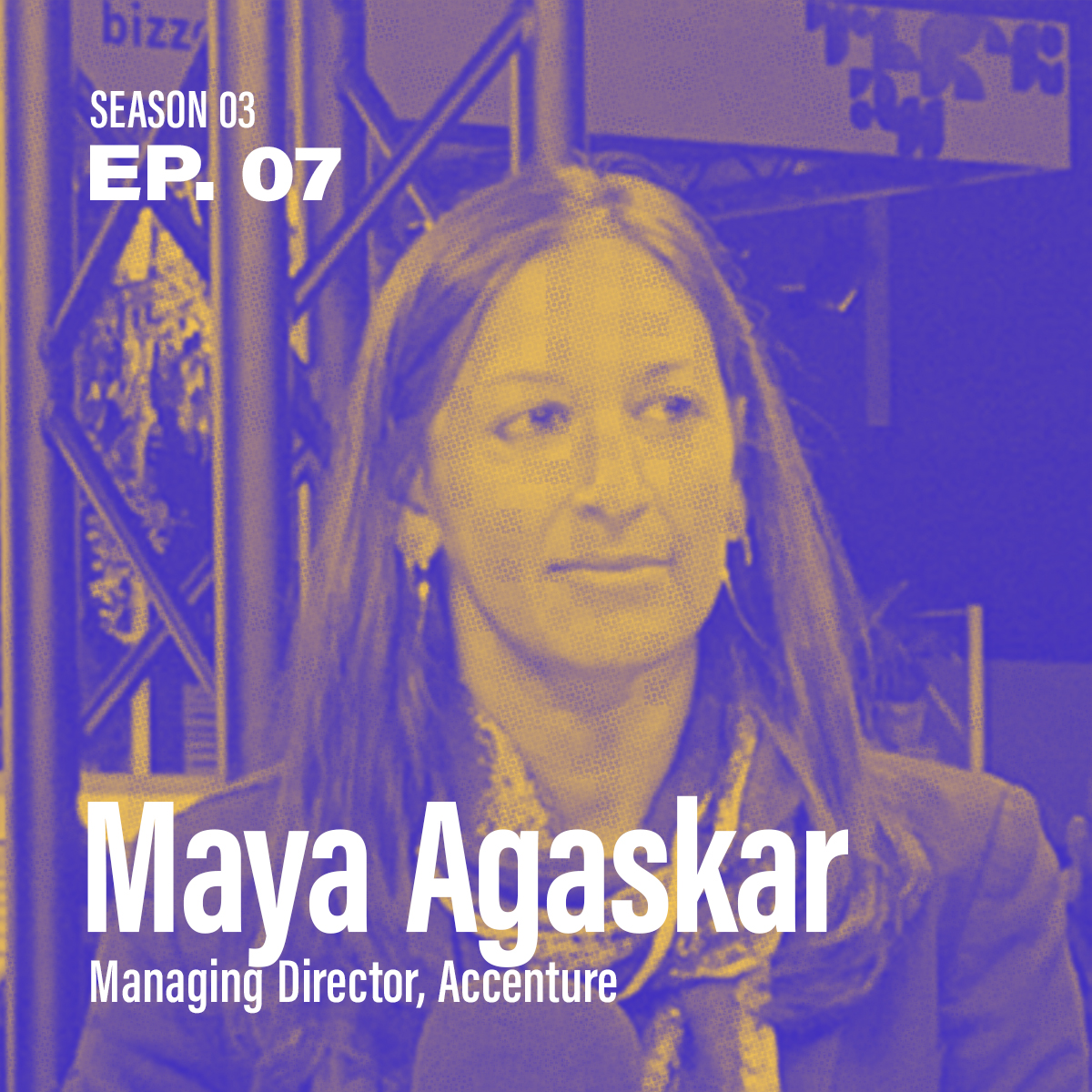
Season 3, Episode 7 - "How does platform thinking fit into digital transformation?" with Maya Agaskar, Managing Director, Accenture
17m 18s
The transcription features a conversation between Andrew and Maya Agaskar from Accenture on enterprise cloud adoption and digital transformation. They delve into the significance of building platforms within businesses to drive innovation and improve customer experiences. Maya highlights the varying stages of digital maturity among clients, ranging from advanced digital models to those still transitioning to the cloud. The discussion also covers the concept of platform thinking, both externally and internally, to enable rapid innovation and connectivity. Examples are shared, illustrating how companies are decoupling monolithic back-end systems to create flexible layers for enhanced customer interactions. The dialogue underscores the shift towards experience-led services and the need for platforms to support this evolution. Maya emphasizes the importance of understanding customer needs and leveraging data analytics for informed decision-making in digital strategies.
Transcription
2813 Words, 16376 Characters
Hey, it's Andrew, and welcome back to Season 3 of Network Disrupted, where I, along with
some very smart guests, help fellow technology leaders trade notes on navigating disruption
in our space. This season, I've set a goal of exploring the issue of enterprise cloud
adoption from as many angles as I can. Today, I'm joined by Maya Agaskar, who is a managing
director at Accenture, working with tons of Fortune 100s on all angles of their digital
transformation strategies. In this episode, Maya and I talk about the digital transformation
journeys that we see many of our customers taking on, and what it will take to support
those from a talent and a technology perspective. We dig into the concept of building platforms
all over the business, and how that can support innovation that impacts end customers. As
a fun addition, we talk about where we think the businesses we've grown up knowing are
headed. So let's go. And if you have a moment, please don't forget to leave a review on
Spotify, Apple, podcasts, or wherever you listen to these. The feedback is always so helpful,
and you'll be helping more people like you discover the show. Maybe you can give me a
sense of the complexity. We love the pilot-proofing concept approach. Influences, everything influences
the human experience. There were several failures along the way. We want to be early adopter
customers. You are handling sensitive information. That's where it's loved. Maya, thank you again
for joining. Thrilled to have you today. And why don't you start by just telling us a bit
about what you do at Accenture. Great, Andrew, and thanks for having me. So I am a member
of our interactive practice, which works with our customers to focus on driving out what
we call the business of experience. So historically, we used to talk about customer experience.
We now are looking at every business being a digital business. And specifically, as those
customers rotate to digital, how they can focus more on employee experience, how they
can focus on partner experience, and how they can focus on in-customer experience. So every
touch point a customer, partner, or internal employee has is thought about in a meaningful
and delightful way. And those touch points are connected and informed by deep data analytics
and predictive experiences. And so I am fortunate enough to be a member in that space of a team
called Bloom. We work on driving growth strategy and innovation with some of our largest customers.
So customers who want to innovate in the experience space, haven't quite done it before, are thinking
about white space disruption or establishing new products and services or taking their existing
products sweet and adding digital services to it. I am fortunate enough to get to both
work with our internal teams and those customers to help identify what those experience-led
services can be and then ultimately get to build them with our customers.
Yeah, that's fantastic. And I love how you take it sort of from the expansion of customer
experience or where a lot of that started. I used to always say, "Well, going back ten
or twelve or fourteen years, if a company doesn't know who its customers are and how they're
using its products, then they're eventually going to fail or they're not going to be able
to grow at least." That was critical and was working with customers that launched amazing
strategies like Nike around connected fitness in an industry where they were completely
disintermediated from their customers initially, right? Like the retailers knew their customers
or John Deere, something we talked about before on connected tractors or agricultural farming
solutions, really, what they're trying to build. But I realize now it's well beyond
that, as you just said. Yeah, for sure, you need to understand your customers. You need
to understand how they're using your products. You need that data to inform strategies, but
there's employees. I mean, every single touch point has got to be digitized.
So, when you're working with your customers, I guess they're probably all over the place,
but are they just starting this journey? Are they trying? They've failed. Where are
they along that life cycle and how much transformation has occurred already and how do you sort of
measure where they are, assuming some sort of model in terms of how you interact with
them, sort of understand what their goals are, where they're going, where they are today
and what they need to do.
This is a great question. And we have customers that are on all sorts of different stages
of maturity of their digital journey. We have ones that are very sophisticated. They have
platforms in place. They've centralized their data. They have what we call digital factory
models stood up, where they have an innovation pipeline that is running in parallel with
multiple application development pipelines. They've reorganized their workforce into,
you know, services-oriented guilds. They have very specialized talent that they're able
to bring together for short periods of time to drive out innovation or to drive out development
depending on whether or not they sit on that innovation segment or the development segment.
We have other customers. I worked with one last year that, for example, aren't yet on
cloud. And what they're finding is there's pressure for them to move more of their data
information the way they work to the cloud because they're finding that some of the things,
all the shifts that we've already talked about, you know, shifting to digital products, shifting
to value-added services, they're not able to make when they're still in a very traditional
infrastructure environment. They don't have the skills, but beyond that, they don't even
have the technology capabilities to be able to support some of the work they want to do.
If you're a utility company and you are still on a physical back-end server in a data center,
it makes it awfully hard to have a customer-facing portal where a customer can come in and see
their bill and pay it online. Again, it sounds like something that is so simple that due
to the liquid customer expectations that we talked about at the beginning of this call,
customers are expecting. Yet the company has so many barriers that they have to make from
a raw technology standpoint to a talent standpoint to an organizational standpoint before they're
able to do what should seemingly be fairly simplistic because a portal requires the integration
of all of that customer data and all of that internal data and all of that financial and
billing data, much of which oftentimes is in back-end systems, which in many companies,
historically, it's been siloed. On the other end of the spectrum, again, we work with customers
that have actually gotten to the point where they are able to rapidly evolve potential value-added
services and test them in the market. You had mentioned the Porsche example where you
can do Porsche for a day. Companies oftentimes don't know whether or not they want to stand
that up as a full separate business line. They want the opportunity to innovate around
an idea, be able to almost beta test the business or product idea in the same way we might beta
test software and then see if customers are going to buy it. If customers are going to
buy it, what is the uptick in it? What is the right price point? How do you maximize the
value of bringing that new product or service to the market before you actually launch it?
Something that goes back to lean principles and other principles that are the larger the
company, the more difficult they are to embrace normally because you're used to the software
development terminology, used to more of a waterfall-type business plan versus a, "We're
going to experiment here. We're going to launch this. We're going to learn." Based on that,
we're going to do something else, but we're not quite sure what that something else is
yet. It's a different way of thinking altogether.
We talked a bit about this idea of platform thinking. Can you give me some color on what
you mean by that?
We think about the next evolution. I know you and I talked a bit about digital products
and digital services. If we think about some of who the most effective players are today
in high tech, we tend to think of Microsoft, we tend to think of Amazon, we tend to think
of Google. One of the things that has made them as large as they are is their ability
to have a platform model where they almost serve as a connector. A good way to think
about it is they serve as the glue between potential customers and between companies
who are leveraging their technology to be able to expand their own products and services.
You have this almost circular economy where you have customers coming to Google to consume
something that they like and you are providing a ready market for other companies who are
developing other innovations to be able to develop their products and services on that
platform. That's probably not the best way to articulate it, but you're essentially serving
as the glue in between extremely large audiences. It allows these companies to grow extremely
fast, essentially think about it as your product scaling itself. You are allowing other people
to build on top of the foundation that you have created. That allows you to almost, again,
be the glue, but also create a much larger market because you're reselling products and
services that you're not having to create or invest in.
When I think of it from a technology standpoint, I look at the transformation of IT over years
where things used to be project-based. We need this value, and so we're going to submit
our requirements to IT, and IT is going to go build this value. They're on the hook for
selecting it, purchasing it, deploying it, and the SLA is around there providing the
value that I asked for versus today where companies, our business units need to build
that value on their own. They're on the hook for that on the digital side and the technology
side. Therefore, the IT team needs to think about building a platform for them to innovate
on so that we can expand rapidly, so that we can still control for cost, reliability,
security, all of these core things that are our jobs, but we have to hand the reins over
to somebody else. Basically, IT is a service to connect to what we're talking about before.
It's the servitization of IT from a more project product focus to a platform focus where success
is people madly using this platform to build and build and build because now they're connected
to revenue versus contractual value for delivering a new purchasing system.
100%. We've talked on this call about a platform that really is externally facing. One of the
other things that we're seeing are platforms, as you mentioned, that are internally facing
within an organization. One of the things I've talked a lot about is that I work with
our customers to help them achieve what we call the business of experience. If we think
about really building an experience layer within an organization, you're going to need
access to all sorts of back-end systems. You're going to need access to data stores and companies
that can shift some of their internal IT onto a platform that can have these different layers
that are served, that has a standard DevSecOps layer, that has a standard data processing
layer and then can have an experience layer on top of it, can actually help enable some
of these experiences for the end customers and for the employees and for partners who
might be coming in to create B2B transactions or so forth with that company. It's one way
for companies to better serve their customers, to better serve their employees, and to better
serve their partners. You don't always have to be in the business of platforms to be using
a platform.
Right. Absolutely. I think that thinking, and reminded of a podcast we did a couple of
years ago, somebody was working in the federal government and just trying to build that platform
out of data. Part of it was around customer experience. This was part of the Department
of Agriculture, I think, and the number of times that their customers, so commercial
farmers, had to add the same data into different forms was ridiculous. They were creating customer
experience issues and therefore they weren't getting the data they needed, but also internally
they weren't able to leverage that data to drive out better decisions, better solutions,
and everything else. It's just another agricultural example of the same point. I think it's a
critical point. When you start working with a new client, is that idea new to them, or
they're thinking along those lines and that's why they're speaking to Accenture?
It depends on the client. Some of our clients know that they want to head that direction,
and they say, "We want to become an experience-led company. We want to revamp our entire customer
experience, or we want to revamp our entire employee experience, or we want to create
a digital B2B sales channel that can drive a billion dollars in sales for us next year."
As it comes with that amount of specificity, other times it comes as a need. I had a customer
probably five years back and they wanted to deliver a single-page web application so that
customers could pay their bills. If a customer was in default in their bill and they hadn't
paid their bill, they could resolve that default online. This was a utility company. The nuance
here is that if your bill goes in default, they have to give you, I think, three times
to contest it before they shut off your electricity. Certainly in Canada, but also in Northern
States, shutting off your electricity in the middle of winter becomes a human issue. Setting
up these systems so that customers can interact in a way that's familiar to them on their
mobile device or on their laptop is a big deal. With this customer, they knew that they
wanted to be able to serve this single-page application, but one of the limitations that
they found was that most of their customer data rested historically in SAP back-ends.
You couldn't build your experience directly on the SAP back-end or you could, but it would
be extremely expensive. It would be extremely brittle. The testing of it added huge overhead.
One of the things we've seen with many of our customers, and they started this journey,
many of them started maybe five or six years ago. We still have some customers who haven't
trudged this direction yet, but they're looking at decoupling those monolithic back-end systems
from this lighter experience layer, this lighter analytics layer, so that you have this flexible
layer on top that can interface via APIs into your SAP or your Oracle back-end and you can
customize your experience with much greater frequency than you touch the back-end. If
we think about our conversation earlier in this podcast about the car companies and how
you have this physical product and you have this series of software products and the software
products are moving in a much faster pace, we are seeing the same with customers as they
digitally decouple these systems. You have this massive ERP system, which is your slow
pace and then you have an experience layer, analytics layer on top of it that can be much
more nimble and flexible and you can change with much greater regularity to evolve or
flex to your customer's changing needs. They're doing it again through this layer of almost
open APIs and microservices, which serves as the plumbing between the different platform
layers.
No, for sure. It's also been amazing to see this whole idea of a system of record versus
system of engagement and the number of companies SAP has bought over the years whose business
model was to create a better system of engagement on top of that incredibly important system
of record. It's a huge part of that strategy. It lowers entries to barriers, which I think
is fantastic. Well, super. It's been great talking to you. I learned a lot and we'll
catch up again soon and just thank you for your hour.
Yeah, thanks for having me, Andrew. Great chance to talk about a lot of key ideas that
I think are top of mind for us every day.
[Music]
Podcast Summary
Key Points:
Discussion on enterprise cloud adoption and digital transformation strategies.
Importance of building platforms throughout a business to support innovation.
Insight into different stages of maturity in digital transformation journeys.
Platform thinking explained in the context of technology transformation.
Emphasis on creating internal and external platforms for enhanced customer experiences.
Examples of clients' needs and challenges in digital transformation efforts.
Summary:
The transcription features a conversation between Andrew and Maya Agaskar from Accenture on enterprise cloud adoption and digital transformation. They delve into the significance of building platforms within businesses to drive innovation and improve customer experiences. Maya highlights the varying stages of digital maturity among clients, ranging from advanced digital models to those still transitioning to the cloud.
The discussion also covers the concept of platform thinking, both externally and internally, to enable rapid innovation and connectivity. Examples are shared, illustrating how companies are decoupling monolithic back-end systems to create flexible layers for enhanced customer interactions. The dialogue underscores the shift towards experience-led services and the need for platforms to support this evolution.
Maya emphasizes the importance of understanding customer needs and leveraging data analytics for informed decision-making in digital strategies.
FAQs
Season 3 of Network Disrupted focuses on exploring the issue of enterprise cloud adoption from various angles.
Building platforms in business involves creating a system that connects customers with companies using technology to expand products and services.
Companies measure their digital transformation progress based on factors like centralizing data, establishing digital factory models, and reorganizing workforce into specialized talent guilds.
Shifting to digital platforms enables companies to innovate rapidly, test new value-added services, and adapt to changing customer needs more efficiently.
IT in modern businesses focuses on building platforms for business units to innovate, ensuring cost control, reliability, and security while connecting to revenue.
Platforms enhance customer and employee experiences by providing access to back-end systems, data stores, and standardized layers for a seamless and personalized interaction.
Chat with AI
Loading...
Pro features
Go deeper with this episode
Unlock creator-grade tools that turn any transcript into show notes and subtitle files.
 PodcastTranscript AI