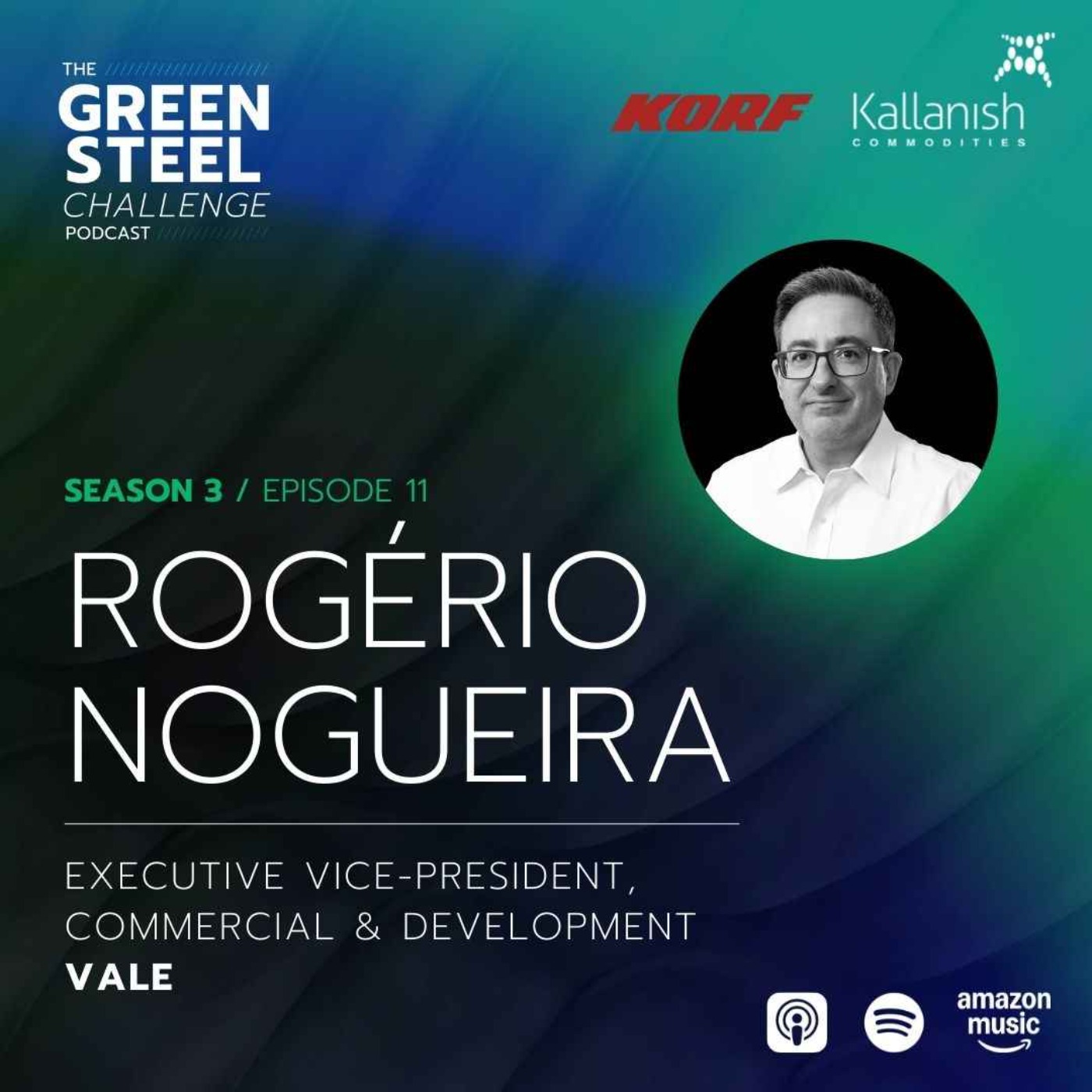
The discussion centers on the decarbonization of the steel industry, featuring insights from Vale's executive. Vale, a leading producer of high-grade iron ore and nickel, emphasizes its role in reducing emissions through high-quality ore that supports direct reduction processes and its investments in technologies like iron ore briquettes. The trend toward decarbonization is considered irreversible, fueled by growing public concern, governmental policies such as the EU's Carbon Border Adjustment Mechanism and China's planned carbon pricing, and substantial industry investments in alternatives to coal-based steelmaking. However, challenges persist, including the economic advantage of coal, the need for technological advances in renewables and carbon pricing, and the necessity to reconfigure supply chains due to the logistical constraints of cleaner reductants like hydrogen. Vale advocates for creating industrial hubs in regions with competitive energy resources to produce low-carbon metallics efficiently, highlighting locations like the Middle East and Brazil as ideal for integrating production and enabling a transition to green hydrogen in the future.
This is the Green Steel Challenge. Hi, I'm Astrid Corp and welcome to the third series of the Green Steel Challenge. Season 3 will place an even greater focus on innovation, new energy, fresh ideas and breakthrough technologies. We challenge conventional thinking and look beyond the obvious. Exploring creative solutions to the pressing challenge of decarbonizing steel. Drawing inspiration from my late father Willie Corp, the steel pioneer and rebel behind the minimal and DRI revolution. This podcast aims to be a catalyst for bold thinking and real change. As always, Dr Mike Wollge and James Smoss are right here with me. Hello. With their insights from years of strategy and project management consulting across the steel industry. Today I would like to welcome from Brazil, Algerio Noguera, executive vice president of Vale. Very nice talking to you today. Vale is one of the world's largest producers of high grade iron ore and nickel. Headquartered in Brazil with major operations across South America, Asia, the Middle East, and also North America and Europe through Vale based metals. The company supplies a significant share of the global steel industry and plays a central role in the decarbonization of iron and steel value chains. And I before I go into this specifics just to let you know, I think, as let our colleagues know that I started my career working for your father's company. We've learned this about 35 years ago. Very nice to reconnect with you so many years afterwards and get to talk about some of the other great diseases. That's wonderful. Thank you. Rogerio, can you please give us an overview on Vale and its involvement in decarbonization? I think Vale, as you just mentioned, is a major mining company. We are focusing three cobalt. It's actually copper, nickel, and iron ore. So we have what we call energy transition materials, which is a particularly copper and nickel, which is very important for decarbonization and the battery transmission line site. But we also have the iron ore business where we are again recovering the position of probably this year of the largest iron ore producer in the world. With this year we're going to produce about 230 million tons roughly of iron ore with the goal to get the 350 to 160 long term. One of the things that we do have, which differentiates us, is stability to produce high quality iron ore. And this high quality iron ore makes a difference in terms of carbon emissions in the integrated steel process. But also allows us to play a role in the process of the future that we believe is going to be the direct reduction, be it with natural gas or with green hydrogen in the future. We believe we have the very unique set of resources that allows us to play a very important role in the decarbonization of the industry. We split the world up into say North America, Europe, and Asia. How do you see the decarbonization process in the steel industry developing in those regions and how are how is valley responding to those different scenarios? I think this is a great question. Let me let me start by saying that we believe that still decarbonization will happen. Despite all the world challenges, the base might be different in different geographies and I can touch on that as per your question. But we really believe that the strength is irreversible. Now for a few factors, first I think population awareness, the thought topic of climate change and global warming is every day more in people's minds. And still is important because as you all know, still is about 10% of sealed to emissions globally. So there's no way that still is not going to be part of the decarbonization process. I think secondly, there's a lot of commitment being made by governments. If you take the European Union, for example, as you start this 2026 with a C-bound implementation, the gradual reduction of the free allowances. There's a lot of commitment that has been made. It's been very serious. Even China, we sell and it's a very important market to us. China has set very firm commitments to peak carbon emissions by 2030 to have a net zero by 2060. And this is a very firm commitment. They're even talking about establishing a carbon pricing mechanism by next year. So there's a lot of commitment. And not only from governments, when you talk, we can look into the specific sectors, such as the IMO, the International Maritime Organization, who has set its own set of rules for carbon emissions as well. Despite all the pushbacks, they just receive from the US under the Trump administration. There's a lot of initiatives coming on board to regulate emissions in the maritime sector and the freight sector. Third, I think there's also a lot of investments on the private sector at an industry level that have already been made. If you look into, for example, again, the EU, which is taking a pioneering role, a lot of countries and a lot of regions and a lot of companies have already invested significantly. Take Germany, for example, by the major integrator steel makers, being Germany have already invested significantly. This includes South Geiger, who is all going towards moving from a coal base steel making process to more of a natural gas/green hydrogen reduction. Same happens with Austria with Vist, with in Sweden, with SSAB and Instagram recently implemented. Everybody is investing. There's a lot of commitment being made. Not only in Europe, but if you look into Japan and Korea, so the largest steel makers are making moves towards implementing electric arc furnaces and moving out of the gradually moving out of the coal-based steel making. There's a lot of investment that has been made and we believe that this is, as I said, from irreversible. I think the challenges as we see it are eventually "will pay the bill." And that might make a difference in terms of the pace in different locations. Well, the fact is the situation will pay the bill is because steel making based on coal is cheap, is efficient. Co-king coal or coal mineral coal is abundant. It's relatively cheap and there is an asset base which has already established for so many years. So it's very difficult to compete with and the new solutions that need to evolve, they have reductions which are yet scarce, namely charcoal, natural gas, green hydrogen. They will need some topics to be put in place. So that's an additional failure for competitiveness. And last but not least, one topic which I think is important for us to discuss. They don't travel as well as coal because of energy density. So they might need the implementation of those new decarbonized steel making process. My need is still supply chain reconfiguration which is a very important topic that I think is going to be important for us. Well, let's but not least, I think the point being is in order for decarbonization to really pick up and become mainstream. Technology needs to evolve. For example, renewable energy needs to be cheaper, nuke, which is not renewable but it's carbon-free needs to be more present and cheaper. The carbon pricing needs to be in place. So the pace of decarbonization now trying to get before your passion is going to be driven a lot by technology and by the introduction of a carbon pricing system. So you have Europe which is pioneering that efforts as we all know. We now have the UK and we're trying to get to a similar similar system to the European Union by 2027. China is not for example, it's not behind. They're talking about introducing which might be a surprise to many people, but they're trying to introduce a sort of carbon system by 2026.
So the world is moving. And I think that the sort of a base of them moving, it's what's going to, uh, what's going to define which region is going to move first in the urbanization. But having said it, I think the trend, uh, is irreversible, as I just said in the beginning. I think we would agree with all of that that the trend continues despite lots of things going on around. Is there a detail on the Chinese tax carbon tax or, oh, sorry, carbon pricing proposal or is it purely conceptual at the minute? James, I, I just came back from China. I've heard this from practically war clients from Chinese economists. The more do itself is not clear, but it's going to be a tax, whether it's going to be a ETS like system or you treat the carbon. But the fact is everybody's talking about, 2026 is going to be a year with, uh, in which the government will introduce some sort of a carbon mechanism. So, you know, the form as you ask is not clear, but definitely if there is a, there is the intent of, of it to be introduced. Yeah, that's, that's very good news. We've talked a lot about there needs to be a clear price of carbon. And then we might see some equivalency in those cost routes, um, that makes the integrated route not quite so cheap. I also think like here on this side of the world, we are like most people are not aware how far advanced China is in decarbonisation. This is extremely interesting. But China right now is investing significantly in renewable energy. Just this year, more than 250 gigawatts of capacity have been installed here today, October 2025 in solar. They're currently constructing more than 30 at this point, more than 30 nuclear power plants. They're building that large hydroelectric plant into bed. So they put in significant investments in transmission lines from the West to the East coast, where energy is going to be consumed. So there's a tremendous amount of effort put into China for a broader decarbonisation. Um, you see, and they will have the conditions to do so. A lot of their, their automotive industries are already shifting towards electric. If you go to Chinese industrial plant on board, you'll see tag boats which are electric. You'll see a lot of equipment which already have moved from fossil fuel based to electric. So they're actually building up all their manufacturing, their, their, their equipment, um, electrically based. So and they're putting a lot of efforts in and money into developing the renewable energy or carbon-free electric energy. Um, generation transmission in this distribution. Having said it, I think the fact of the decarbonisation, they still decarbonisation in China is going to be a little bit more challenging because China has maybe challenge not the right word, but China has the most modern integrated, still making park. So a lot of the bless furnace is a lot of the co-covens, a lot of the center plants are just new. So they're investing a lot in technologies which are different from direct production with natural gas and green hydrogen. They're investing significantly in trying to develop, uh, CCUS. They're developing ideas and investing in ideas in R&D to extend the life of the bless furnaces, reducing their emissions. But there will come a time that we believe that they will also need to change. And I say that because we have conversations with many major SOEs, still makers, SOEs in China, private, large, private still meals are looking for different solutions, isn't it? But at the end of the day, China can't achieve its goals without the help of Valle and you are an absolutely integral part of China and indeed all of these other regions doing what they want to do. Now the two things you've mentioned, again, agree with James, they come up time and time again and completely agree. He's a technology and supply chain. So I think there's those two issues will be interesting to hear about what Valle are bringing in terms of, say, I know Brickett, so these mega hubs that you're developing, be good here about those. I think in the end, as of today, we don't see a silver bullet or a one single solution for decarbonizing steel making. It will depend, for example on the quality of, I don't know, it will depend on your location. So the way we see it is that there's going to be space for, for example, using lower grade iron ore and producing agglomerating using direct production, using a meltrite technology and then supplying a lower carbon, a material or a producing lower carbon steel. The point for us is this is not going to be the cheapest. And what Valle is trying to do is actually develop and again giving its unique position in terms of high quality iron ore is developing and it's promote what we believe is going to be the most competitive supply chain for decarbonizing steel. You know, I think the first thing that we have done is that we established our own, back, you know, five years ago, our own CO2 commitments. So we have our scope one and two commitments for reduction of CO2. But we also, I think we were pioneering and quite aggressive, establishing scope 3D targets. We said we would actually help the steel making would help our clients reduce CO2 emissions. And we said we would try to reduce our scope 3 emissions by 15% by 2035. That's what we said. That was our commitment. As part of that, we started investing in new technologies and one of the key technologies that we have invested in is on iron ore brackets. I actually leave a little bit of an idea of what we're doing, what it is, and what kind of impact it has. But also we have been investing in solutions. One of the solutions is the creating of large hubs where we intend to foster the production of hubs being industrial large industrial complexes where we would be producing together with our clients and investors an intermediate low CO2, a metallic. They'll be the feed for the industry of the future for the downstream of the future. I'll give it a little bit more idea of that. So we believe the role we have to play on this is actually fostering the creation of those those supply chains. They will help decarbonize the steel making is actually developing and investing technology. And last but not least is guaranteeing the security of supply. And that's not easy. It's actually having high quality iron ore for this new process is readily available for our clients for the longer term. So that if you're comfortable in establishing themselves and changing their production processes. Why do you see the need for hubs? What's the underlying requirement for there to be co-location of the agglomeration or the manufacture of the metallic, near whatever else you need involved in those hubs? Thanks for the questions. This is very important. Let me step back a little bit. Why? Why hubs? First of all, the traditional steel making, the integrated steel making was always based on the regional geography. So it had an integrated steel making in Japan, in China, in Southeast Asia. You name it. The industry establish itself this way because coal has very high energy density. So it travels very well. So you can send more from the US to China, from the US to Japan, from Australia to Japan. So it travels. So it's possible for say Japan and Korea to have their own integrated steel making. And so happens with iron ore. But when you go to different reductives, when you're talking about natural gas, when you're talking about hydrogen, it's more difficult, it's not as economically vital to travel all over the world. It makes much more economic sense to say, I will actually have the production of a metallic feed, a green metallic feed where the sources of competitive natural guess are.
or the future potential for generating green hydrogen is. So this is the whole idea. So instead of you actually take the upstream part of the industry, which was originally based on coal, you know, you actually reconstructed in regions where you can produce it much, much more economically. And when you do this, we are also challenging the traditional concept that you need to produce that glomerates far from its usage. So why not produce, for example, that glomerate close to the where you're gonna produce the metallics by having a direct reduction furnace? If you allocate both, you have a lot of synergies, not only you can operate them as a, especially when you're talking about breakers, you can operate them as a single equipment. You can feed directly, you have a lot of synergies in terms of heat, usage, you can recycle fines, you can customize the kind of feed that goes into, into your product. There are a lot of synergies that as you reconfigure the whole supply chain, we think about creating this industrial house where you can even concentrate, I don't know locally, you can, you can for example, then I glomerate and you can produce metallics in one same region. And you can do so creating very effective, large scale industrial complexes that can distribute from there to the whole world. So think about, for example, a plant in Japan who previously imported, hoping coal, imported, I don't know, and had blast furnaces, co-covas and centriplants. They would actually decommission the whole upstream or there of their plant. They'll have only an electric hard furnace, for example. And then import a green metallic that they could source from this very economically. So this is a complete reconfiguration of the global supply chain for steel management. - That's right. - And Valet, yes. And Valet is the catalyst for those, the most viable catalyst for those hubs, as an iron-on supplier. - We see ourselves as a very important player to promote it because we do have what it takes in terms of iron or quantity. Our iron ore can get to a 67, 68% Fee content with very low cynica, very low alumina that allows us to produce a very high Fee, HBI, very high Fee metales, green metallics with very low condominants, which is very appropriate for a direct feed in an electric hard furnace. So if you think about Valet having a row of being the promoter, and inviting a lot of players to come together and working with the governments where you do have boot logistics, competitive natural gas prices, that you have competitive utility prices in general. And that you can produce a really competitive intermediate product. And more importantly, I think as we looked into the world, we mapped above four regions, four or five regions, where we believe would be this really winning locations around the world, right? So take the middle is, for example, which is one of them. The middle is located in the center of the world. It is easy for you to ship from there to Europe, to Asia, your name it, to India. It has a bit of natural gas, it has good logistics, it has infrastructure, it has area, not only that, if you think about migrating from natural gas to green hydrogen in the future, has lots of space for you to put solar energy, wind farms for aerobic energy generation. So you can not only establish a green hub, competitive as of now, starting with natural gas, with a certain carbon footprint, but you can gradually migrate to use green hydrogen as a redactant, thus decreasing the carbon footprint gradually, especially as technology improves as electricity costs reduce, as it lateralizes become more competitive for producing green hydrogen. So it's a win-win for the short, medium and long term. That's a different idea. - When will you be the three B? (laughs) - North Africa, I'm not gonna dispute some of the to geopolitical risks, and I can't talk about it as well, because we've met the whole world, a United States in the Gulf of Mexico. Brazil has a certain extent because of, but Brazil has some specificities of migrating directly to green hydrogen because of a lot of our energy, especially in the North being hydroelectric 24/7, and Australia, more particularly because of natural gas on the west coast because of sun. So those are sort of the regions that we met that's very competitive for. - Yeah. - In our case, differently from Australia, we have a solution to use very high quality, I don't know. In Australia, you need to use a different kind of process to be able to use a lower grade iron ore, which is very difficult to be benefited, but Australia has also the conditions to. - I mean, as if that is in such a massive change for the future steel industry. Do you see the participants in these one, two, three, four, five mega hubs you talk about? Are these the established steel industry players? Valet is obviously going to be at the front end of this, supplying the raw materials, maybe something a little bit further downstream, but in terms of the producing of the metallics and then taking them on, is this going to be the Japanese steel mills that we're all familiar with? Or is it going to be new players, new industry coming out of this? - Like, it's been a combination, we have talked to many players, who have actually a lot of the incumbent or moving from blessed furnaces to electric car furnaces. Some of the, a lot of these incumbents in Europe, they incumbent in Japan, Korea, even in China. Okay, some very important incumbent incumbent's enjoying. And they are all looking to supply this, this green metallics. They're important to say that one thing that we, we didn't know when we started this some years ago, natural gas supply is not unconstrained. So natural gas is actually a scarce resource because you always have competition for selling as NNG for using natural gas for other industries. So there's a certain bottleneck in terms of competitive natural gas availability. So what we have noticed is that there has been a lot of interest from many players to be the first ones to establish themselves and to be able to tap into those competitive conditions. But there has been interest, interest which is broad, as I said, from incumbents, but also from new players, people are coming to the industry trying to establish themselves and disrupt their whole supply, existing supply chain. It's been a combination. - Can you talk a bit about, let's go back to Brickets. Can you just explain a little bit how Brickets come to be, what need their answering and what exactly the product is? - We've been exploring Brickets for many, many years. We initially started exploring Brickets for Blastfans. The reason why we started exploring is because we wanted to find different solutions for palatons in replacing Lumpets and a cheaper basis. So it actually would be able to do numbers in the rest of the trials and they're very comfortable that it is a very good replacement for, actually with the beauty more productivity and with few rates results in Blastfans as compared to palatons. But this was just the initial line of work. By the way, important also that with Brickets, we had less emissions than with the traditional center plants and palatons. So there's a twofold. It actually has a lower CO2 footprint and it used better productivity and few rates and better few rate results in Blastfans. It has been a breakthrough because Brickets have always been looked at a cold agglomeration, has always been looked at something very difficult and I think we managed to find a formulation which has been quite successful. But I should say that the most important transitions that we've been able to develop Brickets for direct reduction and why I say that because we want to challenge the traditional sub-blit chain model that we produce.
pellets, or it glomerates in Brazil and we supply it on a seaborm basis. So Canada produces it, whatever, Sweden produces it. But what we want to do with brickets, because its footprint is smaller, it's a lower footprint. We want to put it collocated. And by collocating, we can, for example, use the heat of the shaft furnace, or the reproduction furnace, to cure the brickets, reducing even further the, we need a very low temperature for curing, in our case, slightly above 200 degrees centigrade. So if you can use the synergies of the shaft furnace to cure the brickets, we can't even lower your carbon footprint. You can have a single crew operating both equipments. We can just call engineering, both together. The last but not least, what we actually were able to observe is that the productivity with brickets increased significantly in the shaft, much more than the last furnace, significantly in the shaft furnace versus pellets. The numbers are significantly high. So in terms of productivity increase, our reserve, the numbers, but I'll just let you know that, so the benefits are lower carbon footprint, higher productivity, lower cost, the usage of residues, because if you do have a simpler model, sometimes when you don't have a centripetal model, you have how to recirculate them, how to use your new residues. So by collocating, you create a lot of flexibility. And as I said, you can customize the feed that you're going to use. So the model for else involved is the following, talking about the direct reduction. We are supplying the technology, we can co-invest and collocate, but let the client operate the agglomeration plant, which is the breakeading, to be able to get it with the shaft furnace. And we would be the suppliers of pellet feed, so adequate pellet feed or adequate centripetal. Brickets can use both pellet and centripetal. But the client can also buy from someone else, so it increases the flexibility from the client, or having its agglomeration. And so what we're trying to do is provide solutions. In the end, our goal is to provide solutions, which will make the decarbonized supply chain much more competitive. And we believe that by introducing briquets into the supply chain, this is going to be really much more competitive than by using pellets. And thus, we'll be able to compete more head to head with the integrated stimulus. So our goal is really to promote the decarbonization with the introduction of the technology and of this new supply chain configuration. The briquets can be used in both electric arc furnaces and BOS. They are designed to use in the shaft furnace for direct production and then the HBI, which is the DRI and HBI would be used in the electric arc furnace. They are not planned for the viewers. They're planned to use the shaft furnace into the RIF for direct performance. Right. Okay. How do you see that product's growth as starting to displace conventional ion ore supply? We have in our case, we have converted two pellet plants into briquetting. We are doing large industrial shrubs. And this is where we are, we have run more than 10 industrial trials in blast furnaces, getting to about in some cases, the smaller blast furnace 100% briquets with very good performance in larger blast furnace. Here I'm talking about blast furnaces over 3000 cubic mirrored. We have get to 25% briquet, roughly 30% with very good performance. But we are extending the the the drives longer time, increasing, sharing the burden. So we're still working to to have longer campaigns, if you will. Okay. We're doing the same with direct production as well. But the results that we have, some of the preliminary results that we have very extremely, I think foraging, if you will. So have we seen the last filet pellet plant ever constructed or indeed the last pellet plant anywhere constructed? I should say that the last filet plant, most likely, maybe the last. Our goal is to make the carbonized supply chain the most competitive one. Yeah, to compete head to head with the integrators too. So we want this technology to be probably for eight. And we're doing a lot of work in that range. What are the biggest barriers to this happening aside from the availability of capital and the willingness of partners and so on? What are the things that you would like to see taken out of the way that would accelerate this process? People need to have confidence that this process is sound that they can because they're going to put a significant investment days on the availability on the performance of this kind of most kind of problems. So those are not very easy to see. So we need to really continue our tests. We need to show that we need to have a sign off from the larger engineering providers in the direct production world and talk about midricks. And I'm talking about energy. Now, the move that I'm yelling. So their sign off in it. Their sign off is extremely important on the direct production. So and we have been working with both of them just to get their closer so that they follow all our trials that they help us develop the products that they do sign off. So technology certainty and comfort, I think this is the first one. The second one which is extremely important is guarantee or security of supply of high feed iron ore. And that's the part that we believe we need to play. Because everybody with developing and putting investments are looking for really long-term contracts of high grade iron ore, we're talking about 30, 50 years. This is our our job to show our clients that we have significant resources to supply them. The price system is competitive, is fair. So these are some of the challenges that we need to work with our clients. I'd say those are the two most important ones. Right. We've been saying, I mean amongst the small coterie of people, we talked to we've been saying for some time that iron units are underpriced partly because we're not capturing the carbon emissions cost. And whether it's scrap or it's iron ore or it's pellets or whatever it is, they're going to have to go up in price to drive the efficiency process in decarbonization and pay for the capital investment. Valley has talked about the price has to get above $90 a ton in terms of iron ore in order to match demand. Is that part of the same process of getting these assets in place in order for us to be successful? When you talk about those numbers, we're talking about the current situation with the integrated steel steel. We believe that that's the case today. When we talk about a county for investments, which it would need to be made on a new new industry with new with a new asset base, which is not depreciated, so prices will need to be higher. Not iron ore prices, but they they would need to be a carbon system in place that would actually allow for this new technologist initially to compete face to go ahead to it. Why do I say initially? Because I think these technologies are going to evolve significantly and down the road, it's going to be possible to see low carbon steel making as competitive as coal based steel making, but that's not the case in the beginning as always with all the new technologies. So on top of their price that you just made, this you just mentioned, James, they would need to be some sort of carbon system to to equilize them because of both of both. Do we have a kind of time scale of when one of these mega homes might be up and running and what kind of size might we talk about initially or how might the size develop? The concept is that we have the infrastructure in place that would allow for scale and scale will bring cost down, be it for a port that you need to invest by stock or
about utilities. It starts with a minimum scale. And our view is that that minimum scale is what's going to is going to anchor all the future investments. So what we believe that the initial initial size for would would be from 2.5 to 5, you know, tons of HBI or two mega-moges, either an agile nor midricks. But with the capacity to increase significant length and each of these 30 million would be sort of something that we would be expecting. 30 million tons of HBI and some of these mega-moges in the actual complexes. Now just notice when we're talking about global steel making on a 1.9 billion tons, 30 million tons might not see much, right? But that's what we're talking about. But this is already significant. It's a very important step. There's a lot of heavy lifting. It is. It's a significant investment together. You think about the investment for 30 million, or even for one mega-mog you're talking about being as a building invested, plus infrastructure. But we believe that once you have the first one's invested, you could share infrastructure costs, then things start to get easier. But putting the first one in place in every niche location is what's going to be difficult. By what timeline do you see there? The first investments that we're expecting to see, or the see investment decisions, find investment decisions we're expecting to see next year, but first half next year, 2026. We're only talking about three years of construction. So, 2029, around the 2029, the building study would be seen the first of the end of the operation. So pretty soon. Hopefully. It's a significant commitment from clients, from ourselves, from governments, or very supportive. But the governments play a very important role when they're trying to attract investors to their phone country. They need to think long-term because they are signing long-term natural gas contracts, electricity contracts. And one of the things that we have been discussing with them is look at the countryvator, the incantrivator that you are creating. So they really need to have a long-term vision too. And this is part of the job that Paul is having. By promoting, I mean also talking to governments discussing this potential value creation that comes in terms of taxes, jobs. So new industries that they could develop down the road. It's a very, a sort of vision area, if you will, very inspirational work to be doing. It's visionary and long-term collaboration. It has to be. It has to be. You've got to believe that, as I said, that the carbonization, and we do really believe it's irreversible, that this is going to be the direction of the future. They're going to be, they're going to be other competing technologies because to replace 1.9 or part of 1.9 billion tons of steel, which is currently, so it's actually less than that because part of it's already being produced with scrap electric, or French, but I said, to replace the 70% of the world steel, which has produced currently under integrated processes, it will require many solutions. At least that's what we anticipate. But we believe that the one we're trying to promote is going to be the most competitive one. Is there anything else you'd like to add in the end? Yeah, there is area. They're going to be competing solutions. We believe that we're going to be, and we are promoting the most competitive one because we're combining high quality iron ore, geological location, scale, the countries which are willing to develop solutions because they're going to be creating in the country, but this is going to be limited. So it's going to be on a first-come, first-served basis. And it's important that people understand that if they want to join a participate, they need to, they need to start thinking about it right now, even though decisions are difficult because there is uncertainty. But the awkward reason is that it's a risk we work. Yeah, absolutely. It was interesting to listen how one of the world's largest miners is rethinking its product, partnerships and global footprint and how high grade ore, innovative break-its and hydrogen ready mega-hups could change the trajectory of green steel in the coming decade. Well, thank you very much. I was really a pleasure having the opportunity to talk about this fascinating topic. As we see today, thank you for that. In the next episode, we will be joined by Stefan O'Bourneau, physicist, entrepreneur and CEO of NewClear, a company developing next-generation reactors that run on recycled nuclear waste. For the very latest steel news, pricing and market data, stay ahead with Kalanishk commodities. You'll trust its source for steel industry information. It's an unrivaled team of experienced journalists all around the world. Get accurate updates and market reports to help you make informed business decisions fast. The latest data, market information and steel news is at Kalanishk.com. In this fast-paced world, knowledge matters. Hi, it's Astrich. My dad, Willie Corff, was known as the Steel Rebel. A man who built a global legacy from nothing but determination and bold ideas. His incredible story has inspired me all my life and now I'm proud to share it in English for the first time. The book is called the Steel Rebel, Willie Corff. And I think you will love it. Now out on Amazon.
Podcast Summary
Key Points:
Vale is a major mining company focusing on copper, nickel, and high-quality iron ore, positioning itself as a key player in decarbonizing the steel industry through its resources and technologies like iron ore briquettes (briquettes).
Global steel decarbonization is seen as an irreversible trend driven by public awareness, government commitments (e.g., EU CBAM, China's carbon pricing plans), and significant private investments in technologies like direct reduction and electric arc furnaces.
Challenges include the cost competitiveness of coal-based steelmaking, the need for technology advancement (e.g., cheaper renewables, carbon pricing), and supply chain reconfiguration due to the lower energy density of alternatives like natural gas and hydrogen.
Vale promotes the development of industrial "hubs" in strategic regions (e.g., Middle East, North Africa, Brazil) to co-locate production of low-carbon metallics, leveraging local resources like natural gas and future green hydrogen to create efficient, scalable supply chains.
Summary:
The discussion centers on the decarbonization of the steel industry, featuring insights from Vale's executive. Vale, a leading producer of high-grade iron ore and nickel, emphasizes its role in reducing emissions through high-quality ore that supports direct reduction processes and its investments in technologies like iron ore briquettes. The trend toward decarbonization is considered irreversible, fueled by growing public concern, governmental policies such as the EU's Carbon Border Adjustment Mechanism and China's planned carbon pricing, and substantial industry investments in alternatives to coal-based steelmaking.
However, challenges persist, including the economic advantage of coal, the need for technological advances in renewables and carbon pricing, and the necessity to reconfigure supply chains due to the logistical constraints of cleaner reductants like hydrogen. Vale advocates for creating industrial hubs in regions with competitive energy resources to produce low-carbon metallics efficiently, highlighting locations like the Middle East and Brazil as ideal for integrating production and enabling a transition to green hydrogen in the future.
FAQs
The Green Steel Challenge is a podcast series that focuses on innovation, new energy, and breakthrough technologies to decarbonize the steel industry, challenging conventional thinking and exploring creative solutions.
Vale is a major mining company producing high-quality iron ore, copper, and nickel, which are key for decarbonization. It aims to reduce emissions through its products and by promoting competitive, low-carbon supply chains and industrial hubs.
Decarbonization is advancing globally, with Europe pioneering efforts through regulations like carbon pricing, while China and others are investing in renewables and setting emissions targets. The pace varies due to factors like technology, costs, and regional commitments.
Key challenges include the high cost and efficiency of coal-based steelmaking, the scarcity and expense of alternatives like green hydrogen, and the need for supply chain reconfiguration and technological advancements to compete effectively.
Vale's industrial hubs are large complexes co-locating production of low-carbon metallic feeds with partners in regions with competitive energy sources. They optimize supply chains, reduce emissions, and support the transition to greener steelmaking processes.
High-quality iron ore with high iron content and low impurities enables more efficient steel production, lowering carbon emissions in traditional processes and supporting direct reduction methods using natural gas or green hydrogen.
Chat with AI
Loading...
Pro features
Go deeper with this episode
Unlock creator-grade tools that turn any transcript into show notes and subtitle files.
 PodcastTranscript AI