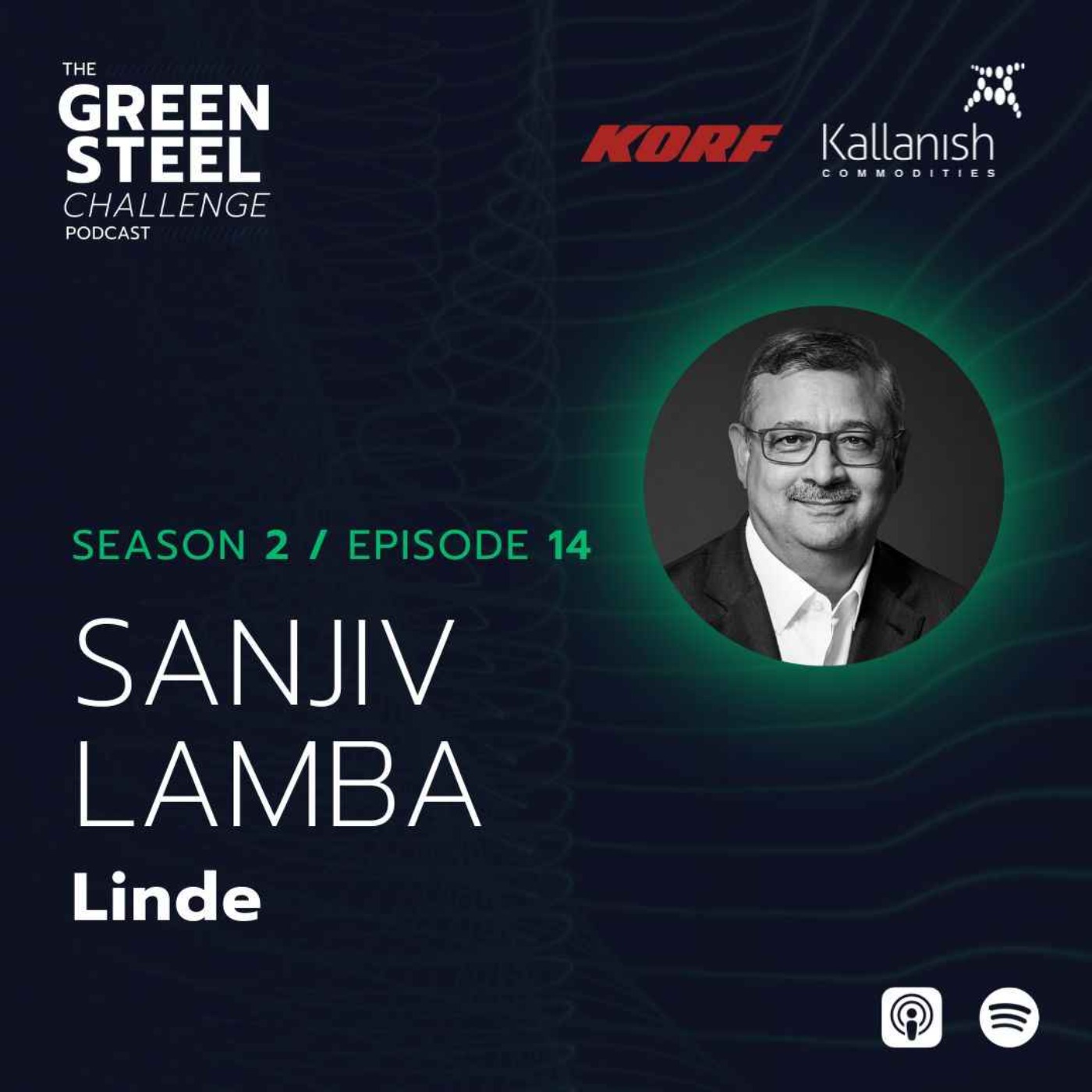
In this podcast episode, Astrid Corp, Mike Woltz, and James Moss interview Sanjeev Lamba, CEO of Linde PLC, about the company’s role in steel decarbonization. Linde, a global leader in industrial gases, has supplied oxygen, nitrogen, and argon to steel mills for over 145 years, often via long-term contracts and pipeline networks. Lamba outlines Linde’s three-pillar decarbonization strategy: decarbonizing its own operations, helping customers reduce emissions, and supporting clean energy carriers like hydrogen. For steel, Linde prioritizes hydrogen-based DRI, blast furnace off-gas recycling (which extracts hydrogen from waste gas), carbon capture, and efficiency technologies like REBOX oxy-fuel burners. Lamba stresses that while hydrogen DRI is exciting, it is not feasible to replace all blast furnaces; instead, pragmatic solutions like off-gas recycling and carbon capture can significantly reduce emissions from existing plants. Linde’s “build-own-operate” model, already proven in traditional gas supply, helps steelmakers manage financial and technology risks. Lamba notes that Linde has over $4 billion in decarbonization projects under execution and expects this to double, with a long-term pipeline of $50 billion over ten years. He advocates for low-carbon-intensity hydrogen regardless of “color,” and highlights Linde’s decades of experience in hydrogen and carbon capture, including CO2 capture for beverage carbonation. Overall, Linde aims to enable steel decarbonization through innovation, investment, and risk-sharing partnerships.
This is the Green Steel Challenge. Hi, I'm Astrid Corp and welcome to the second series of the Green Steel Challenge. A podcast that focuses attention on the efforts being made towards decarbonising the steel industry worldwide. Whilst we spoke in the first series, mainly to CEOs in the international steel industry, we will extend in the second series to speak to leaders of the whole value chain of the steel industry and let's start up, have a chance to present what they have been working on as well. Joining me each time will be Dr. Mike Woltz, an independent consultant and project developer in the Steel and Special Metal sectors, and James Moss, strategy consultant and partner at first river consulting. This podcast is produced by the Willy Corp Foundation and Kalanish. Today I'm excited to welcome from the US, Sanjeev Lumber, CEO of Linda PLC. It's a pleasure to be on the show. Linda is a leading global industrial gases and engineering company with 2023 sales of $33 billion. Their mission is to make the world more productive every day by providing high quality solutions, technologies and services, helping to sustain, decarbonise and protect our planet. The company serves a variety of end markets, including chemicals and energy, food and beverage, electronics, healthcare and relevant to this podcast, manufacturing, metals and mining. Linda delivers state-of-the-art gas processing solutions to support customer expansion, efficient-seep improvements and emissions reductions. So now over to you, Mike and James. Thank you, Astrid. Today we're talking to Sanjeev who is CEO of Linda. Linda is the world's biggest industrial gas company. It's important to stress that we're talking about industrial gases here, rather than natural gas and gas and oil. So this is atmospheric gases, oxygen, nitrogen, argon or process gases, CO2, hydrogen, which I'm sure we'll talk about. Absolutely key component and supplier to the global steel industry. Every steel mill on the planet that you go to will have some kind of facility to provide these industrial gases and Linda chances are it will be one of those. So welcome to the show Sanjeev. Just to kick off, tell us a little bit about what decarbonisation means to Linda. Thank you. It's great to have this conversation. These are important conversations to have. And I'm delighted that you guys are making sure that these are out there and people are thinking about these things. Let's start with Linda. So we are the world's largest industrial gases and engineering company. The engineering portion being important because that's where our technology solutions are built and developed. For most of our 145 years of history, we have been serving steel customers. And that's very important for us because you know the industrial gas business really grew up with steel. Steel cannot be made without oxygen and it drove the development of larger oxygen plants over time, seeking efficiency, seeking reliability and safe delivery of oxygen and then moving on to nitrogen argon and other gases as well. So we are delighted that we have had the opportunity over more than a century to work with steel companies. Typically we would locate our asset next to the steel mills, serve them using pipelines and usually enter into long term contracts. And I've always said to our teams that we are married to our steel customers. It's like a marriage and we have to make sure that both sides are working hard to make sure that that marriage successfully provides value to both partners in that in that contract as it were. So that's kind of how we do it. In addition to that, obviously recognizing safe reliable, efficient delivery of gases to steelworks is so critical to their success. We constantly innovate and work on understanding how you can boost each one of those elements. So our innovation focus is on reliability. Our innovation focus is obviously on safety, which is in a top of mind for us every day. And needless to say cost effective solutions and as we talk about decarbonization, you'll hear me talk a bit more about that because that sits front and center in many conversations. Now, as I look at the steel landscape today and again you guys are the expert but let me give you my perspective sitting outside in a little bit. You know, every steel entity today requires gases and you know, there are as I look at it, I think about two thirds of all the integrated meals today, you know, obviously use high gas intensity and have significant gas usage, which minimizes a little bit as we go to about a third of the install capacity in EFs and many meals. Our positions for each one of these, you know, we have a unique offer that goes into each one of these steel meals that we can provide and to do that we have around the world hundreds of separation units. Many kilometers, I would give you an estimate probably ranging between if I look at it globally about 600 to a thousand kilometers of pipeline networks in the US alone, we have more than 250 miles of pipeline, supplying about 65% of all the integrated steel production here in the US and similarly elsewhere in the world as well. So, one of the ways in which you know, we think about our contribution to the steel industry is saying yes, we provide gases but what is the technology input that we are able to provide that allows our customers to become more efficient and better at what they do and that really is, I would say our competitive advantage, which is our gas application portfolio for the steel industry is rich and continues to develop. I mean, this is really cutting edge technology being applied to use gases to enhance whichever improvement whichever part of the steel mill requires that improvement. As you know, Lindy invented the AOD process for stainless steel, you know, which accounts for almost 75% of the global stainless steel production. We have about 350 installations today, which also use Lindy technologies and gas applications such as courget technologies are our Reeboks application for reheating and we'll talk a bit more about that as well. So, from a Lindy perspective, I'd round off by saying look, we are here supporting our customers, developing and enabling sustainable operations, which clearly help the environment every day. This is not something we're going to do tomorrow, this is happening today and I'll give you the example, right? In 2023 as an example, we did a study that showed that Lindy's oxygen and blast furnaces was helping the industry overall across the world. These are our customers avoid about 10 million tons of CO2 through coax savings and productivity enhancements. Our Reeboks oxy fuel solutions, which reduce fuel consumption in reheat furnaces, make them also ready for hydrogen, you know, in the future as in when that opportunity arises. So, an example of how the solutions were able to offer provide clearly reliable safe efficient gases, but more than that provide an opportunity for continued improvement in the steelworks and continuous improvement in the sustainability efforts that all of the ingredients are available. So, that's what all the steel companies are so keenly pursuing. That's fantastic. That's, they're useful and your last couple of paragraphs there tapped on the fact that there's been ongoing optimization, like you say, hydrogen using the blast furnaces over the last five or 10 years. Right now, today, especially in Europe, we've seen such a fundamental change of one technology going to another technology. Now, one of those technologies, as you've said for an integrated plant, is the BOS technology. O is oxygen. So, obviously, this is absolutely key for where Lindy sits in this. Yes, Lindy's obviously played a vital part in that yearly optimization towards efficiency and decarbonisation, although the two are linked. But now, we're seeing this massive change, especially in Europe, and involving the HWIRD hydrogen. How is Lindy responding to this? Is there an overall arching strategy, or are you just responding to each of your individual clients who want this, that or whatever? A couple of years ago, we presented our decarbonisation strategy. So, Lindy's decarbonisation strategy laid out a roadmap for how Lindy was going to execute on its decarbonisation efforts broadly. So, I'll give you the broad view first, and then we'll talk about steel sitting within that. So, we said that we expect significant, and here I'm talking about, we said about $50 billion of investments to support decarbonisation globally. Within that, we laid out that there were three pillars that drove that strategy and its execution. So, the first pillar was really decarbonising our own operations. We have our own sustainability goals. We also want to make sure, as you heard from our mission statement, we want to make the world more productive sustainably. We have efforts within the corporation to make sure.
that we are minimizing our own emissions. We've set some very ambitious goals to that extent. And therefore decarbonizing our own operations, investing in that is one of those pillars. The second pillar, probably the most important pillar in our strategy was about helping our customers decarbonize their processes. And the third pillar was really supporting the development of new energy, export carriers, where clean energy molecule could move either as hydrogen or as a derivative hydrogen. So it could be ammonia or methanol and so on and so forth. So those three pillars drove our strategy and our strategic engagement and their execution was really driven around this overall strategy. Now the good news is, I mean if I give you a quick two minute, this was about two years ago when we presented the strategy, you know fast forward to today, 2025. We've got projects under execution in excess of four billion dollars. So we talked about 50 billion over a 10 year period out of that four billion dollars already under execution. We're currently developing a number of projects and this spans all industries and I'll focus on steel in a minute. But spanning all industries, we're developing projects that we expect that this investment of four plus billion to double in the next few years. And these are investment decisions that we will work and execute on. So we're putting a lot of money on the ground. I still see a healthy pipeline of projects across the world, across different end markets, which provide that feeder into that 50 billion over 10 years that I talked about earlier. So I think it's important to just maybe provide that as a backdrop before I talk about, you know steel really. And it's the second pillar where we're helping our customers decarbonize their processes while Lindy is working with its steel customers. And we are evaluating various decarbonization options. You know, most of that focus is on hydrogen. You mentioned clearly a lot of interest and excitement around hydrogen and DRI. But at the same time, I'd say to you, we're also spending a fair amount of energy looking at ways to decarbonize. You know, we probably have more than 800 blast furnaces out there. We're looking at ways creative and innovative ways to decarbonize those blast furnaces as well. Many of whom are likely to remain. So in my mind, for the blast furnace, for example, what we're doing is trying to take off gas and look at how we can extract hydrogen from that blast furnace gas and recycle it effectively to provide a very neat and effective solution. But the hydrogen DRI pieces where, as you rightly put it, lot of the excitement is. One of the things I always remind people when I'm having a conversation about steel and actually even for other industries, but mostly mainly for steel, I'd say is the fact that the first step in any decarbonization effort must be to reduce emissions using what is available. And I think an important part of that in a good example, I've given this instance, is utilizing you know, Lindy's technology around re-box, which ensures that the reheating efficiency of the re-eating furnace improves dramatically and emissions come down quite significantly. So that must always be the first step. But broadly beyond that, you know, clearly, hydrogen's being top of mind for people. When I think about decarbonization for steel, I do think a little bit more broadly. My view is the industry should be looking at hydrogen supply and I think it's low carbon intensity hydrogen. So you'll hear me say, I don't like colors around hydrogen. I think they're misleading and somewhat misguided. We should be thinking about how hydrogen with the lowest carbon intensity can be cost effectively brought into the steelworks for decarbonization. So the first step. But in addition to that, I'd say to you, you should also be thinking about carbon capture. There are certain, you know, geologies which allow for carbon sequestration to happen. Their carbon capture proves to be a very effective method for decarbonization. And of course, as I mentioned about the blast furnace, off-gas recycling, there are opportunities for us to create innovative solutions that are looking at taking off-gas streams and doing, you know, work on those, you know, kind of using a PSA technology as an example to get the hydrogen separated and recycle back in. So all of those technologies will be at play. Now, as you know, hydrogen is not new for Lindy. You know, we've been in the hydrogen business for more than five or six decades now. We have developed a wealth of knowledge and know-how around the molecule itself. But more importantly, the infrastructure that is needed to make sure that you're able to provide safe, reliable, efficient, you know, hydrogen molecule for whatever, whatever end use it is, including for the RIs as we are in currently in conversation around. The same goes with carbon capture and sequestration. It's, you know, the carbon capture portion is proprietary technology that Lindy's developed and deploying today fairly actively. We find there's a lot of interest in the market around that. One other thing I usually remind customers, my steel customers in particular is I recognize the concerns that they have around the decarbonization investment. And we talk about Europe in a minute, but, you know, I recognize that they're concerns and those concerns range from the financial commitment that is needed, the technology risk that are perceived to be quite high. And really, we are in an early adoption kind of stage of that of that technology and systems. And this is my Lindy plays a particular role, which I think is important to emphasize over here. We can provide value to steel makers by investing in owning and operating these assets. The advantage of this build on operate type of a business model is that and the steel makers have seen this operate really well on the on the traditional side of oxygen nitrogen argon supply to the steel works for decades. So they understand how the model works. But the reason it is important is because it helps take away both some of that financial commitment that lump, you know, lump of capital that you need to put on the ground, that Lindy has the ability and willingness to do. But also takes away any any concerns or risks that they might perceive around the early adoption of the technology, whether the technology works, whether the hydrogen or carbon capture, you know, is going to be effective, etc. Lindy takes that risk, right? This is a core part of our technology portfolio. It's something that we know well and we are happy to take that responsibility. And if things are, you know, need to be tweaked or worked on, that is part of the activity that we undertake to to minimize the risk related to decarbonisation for steel works. That's fascinating. And one of the, I mean, there are so many aspects to this. I'm struck by how much contribution you can make to the integrated process route. A lot of the conversations that we've had have been talking about moves to electric arc furnace and obviously then to DRI. We'll talk about DRI in a minute. But can you talk a little about in addition to the reheat furnaces and so on, where you can have the most impact on conventional blast furnace and B.O.F technology in reducing carbon emissions? Every steamaker I know is thinking about this and looking at every aspect of it. And you know, there are some various, simple areas that they are working on, you know, minimizing wastage and enhancing efficiency, looking at tweaking the operational parameters to make sure that they are doing the best or the most they can with the least amount of input, etc. I mean, all of those efforts are both necessary and, you know, we are working at world-class steel players who are all very mindful of this. So that's always the first step. The next step I always say is are there processes that are easily, you know, that are easily impacted on emissions, reducing emissions by use of technologies that are currently available, not new technologies, not complete revamp. So in my mind, it is important that, you know, we look at both the aspects of of ensuring that we are minimizing emissions that happen from our existing operations while at the same time ensuring that we are also looking at new solutions which often, you know, require new access to be put on the ground. So, and that's a conundrum, right? The fact that how do you maximize the value that you have from the install base that currently exists by ensuring minimization of, you know, emissions in that and maybe complement that as opposed to replace that with a whole new suite of EFDRIs. And in my mind, that's a more pragmatic solution because the cost of putting a whole, you know, install capacity across the world of EFs and DRIs to completely substitute the integrated steel plans that we have is just not feasible. I cannot see, I can't word those economics out. So every effort should be put in looking at minimizing, you know, emissions. And one of the reasons we're developing this blast furnace off gas recycling technology offer is because we feel that that is a very, you know, that's a very pragmatic way of looking at that install base of blast furnaces we have and addressing a need that sits within that. There's a pain point. You have emissions and what can you do with them? And I think between a combination of carbon capture and sequestration and the recycling of off gas recovery of hydrogen and making sure that you minimize, you know, uh,
by recycling the hydrogen, you minimize the use of external feedstock and minimized emissions, I think it's really a smart way to think about this as well. So in my mind, both of those have to complement each other. Can you tell us what the state of the art of carbon capture is and how likely that technology or technologies are to be successful? Great question. So let me just go back into history a little bit and remind you that every time you have a beer, you have a pseudo molecule that makes that experience of the beer fantastic, right? That's your pseudo molecule usually comes from Linda. There are a couple of other people who might try and supply it, but really comes from Linda. And the reason and the way we do that is by capturing that CO2 from a process, cleaning it up, putting it through liquefaction and getting liquid CO2, which is qualified to be food grade and then provided for carbonation of beverages. As an example, that's been happening for decades. So when people ask me, hey, carbon capture kind of new technology, I have to remind them that for as long as you've been having beer, there has been some form of carbon capture happening because CO2 has been captured and provided for that carbonation process. So that's just one, just to kind of provide us some historical context over there. The reality is scale up of carbon capture is a more recent phenomenon, so the technology has been available. Now, Linda currently offers two technology options within that space. We offer an amine technology. This is widely held, widely used, and you know, it's a tested technology, I would say to you, which is really the use of solvents to disassociate or impart capture the CO2 and then regenerating the solvent releases the CO2 to be captured in a slightly more concentrated form, if you will. The challenge with amine solutions is that you have very large footprint and a lot of solvent is needed to regenerate and you need enough steam to regenerate that solvent. So that it is a complex, it's like a chemical, it is a chemical process, not like a chemical, it is a chemical process and it has a large footprint. So we look to that and there are many there are many applications, and particularly where the CO2 concentration tends to be lower, and there is an excess steam availability that the amine solution is a very good solution for capturing that CO2 and then taking the concentrated CO2 and then conditioning it. You can liquefied and you can sequester it or you can directly pipe it and sequester it or you can liquefied and use it. I mean, all of those options are available. The other proprietary technology that Linda is developed is called its high-soup carbon capture technology, which is more a combination of our P.A.A. technology and cryogenics, which you know where you don't have steam availability, where you have cheap renewable energy available as an example. This would be the best technology to deploy and we are actually building it out, you know, for a Canadian project and elsewhere, where we see the future of, you know, providing these two solutions depending on what the needs are, you would then deploy one or the other. And I think both of those solutions offer very cost-effective carbon capture. Now, the thing with carbon capture, as I said earlier is you've got to know what you do with that CO2 molecule. You've now effectively captured it, you've conditioned this CO2 what you do with it. There are, you know, there are certain geologies, the US, Canada, Middle East, Australia, parts of Northern Europe, where you can actually sequester them. There are aquifers underground that you can take it and sequester it. CO2 sequestration is not new, it's been done for a long time. In fact, as you know, CO2 has also been re-injected often from, you know, for fracking purposes, etc. So it's a well-established understanding of how you sequester and many geologies will allow you to do that. In some cases, it's a little bit if you're a landlord and you're struggling with that, then you have to think about what you do with that CO2. And there are probably three options available for that CO2. An option is that if there is really a chemical process where CO2 is a component that's needed, you know, methanol production is a good example of that. Then, you know, that's a really good way to capture that CO2 and put it into, you know, it's a chemical sink, if you like, where you then capture and put it into the chemical molecule. In other cases, you can liquefy that. So let's say you're sitting in the middle of Germany, you don't really have the ability to sequester locally. You can liquefy the CO2, move it on, and then sequester it in the Nazi as an example, where, you know, economic operates, carbon sequestration, facilities, etc. And then there is probably a very small amount of CO2 that you can capture, clean up liquefy, turn it into food grade, and then utilize it in beverage carbonation, which is an example I just gave you a few minutes ago. So that's that's how I think I see broadly the carbon capture sequestration piece. And again, I have to say in many parts, this is a very cost effective way of decarbonization. Okay. So what we have, it's an old established process or technology, which has been around for decades in the brewery or all kinds of industries. What we now have are some modern technologies that can be brought to bear on much larger volumes. Correct. Then it's all about where to sequest or where to capture. So this is basically geological aspect of trying to work out where these projects should be. So everything's there. What is the main constraint? Because everybody's talked about carbon capture. It's going to be this, it's going to be that. It never, ever quite takes off. What now is the is the constraint in one or two big projects coming on stream now or in the next couple of years? So I'm going to give you two examples from outside the steel industry. And these are Linda examples because these are at hand and what things that we're working on as we speak. So, you know, we have a project, which is, you know, generating low carbon hydrogen or also known as blue hydrogen using natural gas to an autothermal reforming process. And then we're capturing the CO2 coming out of the process, which is a concentrated stream about 95 percent. And then we are conditioning that CO2 and passing it on for sequestration. That project is already happening as we speak. It's being executed, right? It'll start up in the next couple of years. So there's not, there are no constraints. This is happening. I mean, this carbon capture unit is being built as we speak. And the sequestration will happen two years on the road three years on the road as the plant starts out. So there are no constraints. The other example I'll give you is Dow Alberta where we are supporting Dow's operations in Alberta by generating low carbon hydrogen using the same method. Natural gas conversion through an autothermal reformer producing hydrogen, which is low carbon intensity because we're capturing the CO2 through a carbon capture unit and we're putting it into a pipeline that is going to sequester it. Canada has an installed, you know, an infrastructure for carbon sequestration has been running for a decade plus I would say. And again, no impediments to that. I mean, we see that, you know, as being fairly straightforward. And, you know, in the Canadian case, we'll be capturing more than two million tons per annum of CO2. So not small. Similarly in Texas as well, we're doing a project in Beaumont. We'll be capturing around two million tons of CO2. So the economics are not driven by prospective penalties for the emissions. These are happening in jurisdictions where there are no such things as caps on your CO2 emissions yet. So presumably the payback is relatively straightforward as well. It's a good point and I think I want to maybe elaborate on that a little bit. So as you know in the US, there is a 45-q provision that provides today $85 per ton of CO2 capture. Yeah. It's a provision that goes back to 2008. Some people get excited about IRA and stuff like that. But the reality is, you know, the 45-q has been around since 2008, you know, probably the IRA offered about $50 a ton through the IRA process and got up to about $85 per ton of CO2 captured. So that incentive does help. But the fundamentals of producing low carbon hydrogen for use in an ammonia process or in decarbonization of a cracker, you know, that has to stand on its own fee. Now in Canada, as an example, you've got both incentives and penalties at play, right? There is a carbon tax that is growing and there are some incentives available because the Canadian government is supporting, you know, the decarbonization effort that customers like DAO are making and rightly so. But I think the fundamental economics of the project are there and I think the incentives and penalties of carbon tax in this instance in Canada, so I'll bring that all together to make it a really meaningful and, you know, a project that then meets people's investment criteria. So to answer your question, I think, you know, carbon capture sequestration, I mean, the ETS mechanism in Europe as an example will drive certain set of behaviors, right? Seaband will drive certain set of behaviors and I think those penalties, some incentives, I think that combination is what makes, you know, what makes the magic happen if you will because that makes the carbon capture sequestration become really, really impactful. But I think that that's where the work needs to happen. Now, the constraint on carbon capture sequestration that more often than not I hear about is, hey,
I'm sitting in the middle of Europe, I don't really have an avenue for sequestration. And I think that's something that is being taught about even in the halls of the European Commission and pathways for pipeline networks to capture CO2 and allow it to get to a point where it can be effectively sequestered. Those are things that I think will require some infrastructure development. But even those instances, if you were looking for a short-term solution, you could liquefy the CO2, move it and take it to a point where you can look at injecting it back in. Is my understanding that in Europe, well, for the UK where I am right now, people talk about the North Sea. So I guess that is just a difficult project because it's underwater. But is my understanding that that is a significant area for possible sequestration? Yes, and not difficult to be honest, because we've been taking oil and gas out of not sea for very long. Infact, infrastructure is already there. Correct. Correct. And it's a well-established project. And as you know, in the UK, supporting T-side as a project and looking at a couple of other locations as well. And all of those are likely to go, or at least some of them are likely T-side as an example, likely to go to the North Sea. Yeah. So after what you've just described about carbon capture, is very clear. A lot of people, possibly including me, would think, well, why don't we just carbon capture everything? So is this something that in these regions that we talked about, geological regions, North America, Canada, US, Middle East, North Sea, there's a small one. Do you see the carbon capture becoming much more significant than it is now, a really fast area for growth? The simple answer to that is yes, I won't give you a timeline for it. That smart person won't talk to me. You can always say yes, but don't give a timeline. And I say that with a reason, right? So there is a fundamental issue that I think needs to be better understood, which is on the demand side. Right. All the conversation we've had thus far is supply side. Can we produce? Can we capture? Can we sequester? Can we clean up? Can we put hydrogen in? And all of that makes a lot of sense. Most of that is driven by either commitments on net zero, that a number of companies have made and are now trying to find the path to getting to net zero effectively without completely de-industrializing, or are driven by the fear of penalties that are likely to be at play. The fact that I think needs to be really where work needs to happen is what I call demand activation. There needs to be a demand pull for these products, low carbon products, and there needs to be a willingness to pay for these low carbon products. And if that is the case, then all of these cases will look pretty strong. And as I said earlier, my view would be that geographies which have the geology to support sequestration will certainly op down that path and say it makes more sense for me to do sequestration because the infrastructure is available, the geology is there. Let me do this because it's the most cost effective way of getting carbon intensity of steel produced down significantly versus another geography where those benefits of infrastructure and geology may not be there. And people might say, hey, this is the best option to put hydrogen in because, you know, and that's how I think people will go down that path of saying, well, what do the economics really support? Because look, carbon capture and sequestration is, as I described to you earlier on, a fairly dense chemical process. Does require significant investment as well? Somebody has to underwrite that. And usually the best way to do that is to have the demand activation happen and a pull from the market which is willing to pay for the product that is differentiated. And there is obviously some offset that happens through penalties, carbon taxes, an example, or incentives that are available as well. But it is a complex scheme to put together because you've got multiple stakeholders who all have to pull their weight for this to work through. Hence, it takes time. I mean, the governments in Europe have provided significant billions of dollars of subsidies and supporting capital to revamp the steel infrastructure. But the economics are not there because the long-term operational costs of running a steel mill, the initial infrastructure, yes, some subsidy over there is helpful. But unless you have some kind of a contract for differences where the OPEX is also getting some support in the absence of customers willingness to pay growing substantially, steel mills will not be able to provide that steel at a cost-effective level. And also the fact that around the world, everyone's taking a different view on this. There are geographies where there is a commitment to a long-term reduction in emissions, but you don't see that in the short term, who are naturally advantage because of carbon intensity of the product they're producing is much higher. But there is no distinction in the market and there is in fact no standards in the market to define what is green steel or what is low carbon steel versus, you know, what is what is normal steel. And you don't see that in a pricing differential either. Just carbon catcher lend itself to a clustering of multiple industries like the Rua or T-Syri. Search that the economics are amortized over a lot of users across sectors that are hedged as opposed to just a steel plant having to have its own infrastructure to sequester its own capture carbon. Is this all about industry or clustering? Yes and all. So there are two aspects to carbon capture that we have to keep in mind. The first is the fact that, you know, when you try and think about clustering it, if you had similar industries, let's say you had three steel mills in the same collocated or located within a reasonable distance where you could build a network and actually do the capture and get some scale benefits out of that. But that isn't always going to be true because if you've got other industries in the mix, the carbon intensity and the flow gas that you're capturing the carbon off or the off-cast that you're capturing the carbon off, you know, each one of that will have very different characteristics. They'll have different chemicals within that. The separation needs to be different. And therefore, you know, if you had homogeneous integrated steel plants, your ability to do that would be more. But if you had multiple, you know, multiple different industries, multiple different plants, a chemical plant, versus, you know, a steel plant versus a refining, all in the same complex. And I think you have to customize the capture element of it. Now for sequestration, the infrastructure that you build, a common infrastructure into which multiple users can feed in the CO2 that's been captured in condition. That obviously is something you can leverage in a large industrial complex. We should switch to hydrogen. The two issues that have come up for us in terms of hydro, I mean, there are multiple issues, but the two core issues around hydrogen and its use in making iron or steel is a scale because, I mean, the steel industry operates at awesome levels of tons and magnitude. And then there's the core question of given the scarcity of green energy. Do you use the green energy to make hydrogen or do you use the green energy directly to to electro win iron, iron or in a couple of different technologies that are being tested at the moment? How do you see the development of hydrogen as an energy source for reducing iron in the industry over the next few years? Before I address those two specific questions around scale and renewable energy, let me just kind of give you a sense of how I think about hydrogen, because there are lots of colors used about hydrogen and carbon intensity. So I think it's worth maybe taking a minute and just talking about how I see the hydrogen development today. Yeah, and this applies for every end market, but clearly for sticky as well. So as you know, for most part today, majority of hydrogen production is using natural gas to a steam-meat tender forming process in SMR in which you convert hydrogen and you have CO2 emissions. And you know, that's the traditional form of hydrogen. We call it gray hydrogen for if we are using using colors. We call it high intensity hydrogen, a high carbon intensity hydrogen as well. Typically to produce a kg of hydrogen, you produce about 10 kgs of CO2. Right, so that's the one to 10 kind of town rule. Increasingly, and this is all at scale by the way, we have taken natural gas and used the auto-termal reforming process for separating and getting the getting the hydrogen out from that and a very highly concentrated stream of CO2. What happens in a steam-meat tender reformer is that the CO2 comes out in the flu gas at a very low pressure, and I think becomes more difficult to capture, etc. I'm not going to get into some of that intricacies, but you know, this auto-termal reforming process has really provided a very high concentration of CO2
be captured easily, resulting in a low carbon intensity hydrogen becoming available, where the intensity of CO2 in the hydrogen is less than 3 kgs. So down from, you know, 70% reduction in carbon intensity from 10 kgs of CO2 per kg of hydrogen down to less than 3 kgs of CO2 per kg of hydrogen. So you have what we call low carbon, you know, low carbon hydrogen or what people would otherwise call blue hydrogen. That's available. It's at scale. You know, steelwork requirements can easily be met using low carbon hydrogen or blue hydrogen today. No constraints. Easily doable. Obviously, we talked about geology for carbon capture and sequestration earlier on that would apply. The third form of hydrogen that is being talked about and I'm talking about some of the larger hydrogen production technologies. There are some many smaller ones that we can talk about as well. But on the third one is what we call renewable hydrogen, other people call green hydrogen. I don't like colors as I've probably said before because they're misleading and so, you know, you should really think about it from a carbon intensity point of view. And low carbon, you know, hydrogen gets their intensity below 3 and renewable hydrogen, which is using an electrolyzer, either an alkaline electrolyzer or a pym electrolyzer or there are some new technologies getting developed SOEC, which I'll touch on in a minute. Solid oxide electrolysis. Those are what we categorize as renewable hydrogen. Where effectively, you take renewable energy, you use that, put that renewable energy into an electrolysis process, you use water and then you separate and get the hydrogen molecule. The carbon intensity of that is very low. Ultra low, you can call it. So that's the third. There are various other forms of hydrogen being currently talked about geologic hydrogen that comes from underground. There is hydrogen using electrolyzers, using nuclear power as opposed to renewable energy and so on and so forth. And, you know, there is a methane paralysis process and so on and so forth. Let's not touch on those. These are the three. The gray, the blue or low carbon hydrogen or the renewable hydrogen or green are the three primary sources. So in terms of scale availability, if you had a plant located in a in a geology where you could do carbon sequestration, low carbon hydrogen or blue hydrogen is the solution that you should be pursuing today. There is from an economic point of view, there is absolutely no doubt around that. No doubt. The economics are very, very, very clear. Renewable or green hydrogen will typically be anywhere between three to five times the cost of low carbon or blue hydrogen. But it's constrained by geology, as I said earlier. So from a scale point of view, I wanted to just address that. The reason I say this is because there are geologies in Europe which can use a Nazi and do carbon sequestration well and those should actively be looking at the use of low carbon hydrogen or blue hydrogen in the process. And I think that's a cost effective solution you can do effectively. Now, the only other point I'd mention over here is one of the reasons why people debate the the low carbon hydrogen is if you have the geology do the carbon capture anyway, then do you really want to go down the path of doing hydrogen which anyway requires carbon capture or just doing direct carbon capture. And some of our customers are going through that process of thinking through and saying well what is the long term sustainable model, what makes sense. And I think in cases like that you know blue hydrogen or low carbon hydrogen is very, very impactful coming to the point of renewable energy. So there isn't enough renewable energy in the world today to get to the aspirational goals that we've set for hydrogen production by 2035 that just isn't as your well aware those goals keep getting revised downwards every year. Right. If you go back five, seven years ago when those goals came out the IEA and everyone else and all wow the world's going to you know the hydrogen's going to be the one one and only piece and you know it's going to solve all our problems. Hydrogen is not there is no magic bullet for decarbonization. I have to constantly remind people look hydrogen's my business but I have to be realistic and say there is no single you know form of decarbonization that is going to happen in the world there will be a portfolio of solutions technologies energy basket will you know have a portfolio of mix in it which will enable us to have much lower carbon intensity of industrial processes and that is the heart of a pragmatic policy statement that I would say is necessary and something that people need to recognize if we really are to get something done on this otherwise ideologically we will be stuck with green hydrogen or renewable hydrogen that comes from electrolysis where you are constrained by three key factors and look we Lindy has a ownership in ITM as you know we've been talking and working with them on on scale up and and we see the technology roadmap we also see the technology roadmap of other electric electrolyzer producers and our view is that scalability remains a challenge. Today an electrolyzer stack is typically five megawatts but you know one of the New World kind of generations coming out at 20 megawatts not yet tested but 20 megawatts. You talked about scale for a hydrogen plant so we're talking about gigawatts of hydrogen requirements right so if you were to do a gigawatt of hydrogen requirement and you had five megawatts of of stacks that's 500 you know stacks of or that's 200 stacks of five megawatts of 500 stacks of two megawatts which is what is widely available you you've lost any benefit of scale already add to that there is obviously a lot of large footprint and lots of infrastructure required around that etc etc so the point is I think scalability and the electrolysis technology you know really needs a lot more work to make sure scalability is there there is another aspect which is capital intensity our assessment from a Lindy point of view is that the capital intensity i.e the capex required per megawatt of hydrogen produced from an electrolysis process needs to come down by anywhere between 60 to 70 percent that's 60 to 70 percent there's a lot of work to be done on that technology roadmap to get us there at that point in time with an assumption that renewable energy is available at reasonable costs you really have a good point of inflection for renewable or green hydrogen but it is in my assessment probably seven maybe even 10 years out as scale cost effective with access to renewable energy that ensures there's reliable safe and cost effective supply of hydrogen so that really is the challenge and you know that's why I say ideology and just to say green is the only solution is misleading because actually it's doing a disservice to to the industrial you know infrastructure and capacities that be out the numbers that we often use on this show are about 50 to 60 kilograms of hydrogen per ton of steel and the prevailing price of hydrogen is about let's say seven dollars per kilogram some people are talking about three dollars per kilogram two point five dollars per kilogram in 2030 or the future does Lindy have a secular number to which they think the hydrogen price could go down to you know the reality is you know it depends on where you are at what the cost of renewable energy is so if you are sitting in the Middle East and you've got really low cost of renewable energy or if you're sitting in India and you've got really low cost of renewable energy yeah you can get to a point where hydrogen starts looking more attractive but getting it from India or let's say Saudi Arabia into Europe you know there's a cost to that so how do you get a hydrogen molecule from India or the Middle East to Europe you do that by producing ammonia so guess what to take that molecule of hydrogen that we thought is going to be quite cost effective we're now adding significantly more capital and producing ammonia okay yeah maybe maybe that makes sense you then take that ammonia put on a ship and you know go down five seven ten days of of travel to get to a point where you then put more capital on the ground and build an ammonia tank to obviously offload the ammonia into the tank and then you build what is known as an ammonia cracker to take that ammonia crack it and get the hydrogen molecule separated out of that cracking process all right so you can understand I laid that out for you because that's a practical reality of how people are thinking about moving a molecule from point A to point B and when you do that the energy losses across that entire system first in producing ammonia then you know moving it from point A to point B then in disassociating that ammonia back into hydrogen is significant in addition to all the you know capital cost you put in the cost of shipping and so on and so forth and that's what makes the economics challenging so you know people who talk about getting ammonia into Europe I can tell you you know it ranges between seven to eight dollars even if the hydrogen produced at the and the point of you know production may be quite attractive now in due course a decade plus down the road liquid hydrogen will move it'll be marginally better just as energy moves so will liquid hydrogen it'll probably be better on economics based on that but probably still not good enough to to solve
I mean, you know, the steel people, the steel customers I speak to, they say to me, look, if you get get it to me, you know, between two to and a half, three dollars, four dollars, you know, maybe I can make a case, but at seven, eight dollars, that looks very difficult. You're obviously very excited about this. I've got a feeling that this is all good news for a company like Linda. This is nothing but opportunities. Well, first of all, do you agree with that and be, what is your view on steel industry decarbonisation going forward to 2030 and 2040? Are you very positive about it? Or do you have reservations? How's all this discussion of the last 45 minutes? Or got a pan out over the next 10 or 20 years, do you think? So let's start with me saying I am absolutely excited about this. It's a great opportunity for Linda to use it, you know, world-class technology portfolio and a lot of the innovation and development that we do are on the technology side and bring it to bear to support our world-class steel companies who are committed to and actively exploring decarbonisation and make sure that they have, you know, clean a steel available for customers who hopefully will be willing to pay more as a consequence. So I think it's a hugely exciting opportunity. It does provide many opportunities for us to work together with our steel customers, where, you know, for most part we have existing relationships. So we're excited about that opportunity. Overall, I'd say to you that I am excited that decarbonisation and steel will make progress. No questions. It will make progress over the next decade, decade and a half. You will see substantial movement happen. And there are early steps already being taken and again, I'll give you Linda examples to court here. But, you know, as you know, we are building the S-Epiration Plan for Stegra in Bowdoin and Sweden. It's an important project to watch and see how it moves forward and, you know, really probably the first of its kind at scale. Excited about that. Excited about the fact that we've done hydrogen injection in the blast furnace. You know, this is an exciting new area that we think there is some value we've done, you know, trials with cliffs in the US and also with in Turkey with Erdemir. I think I can see people are thinking about every option that's available to them to reduce emissions. I think that is exactly how the industry should be thinking. And I'm really pleased that the steel industry is taken a very strong view on we're going to explore every option and then see what's the most cost effective one. You also know that there is, you know, the first full-scale installation, you know, which uses 100% hydrogen as a fuel in the reheat furnaces in Sweden. Again, those furnaces use led is re-box technology. So we are excited about that. We've been working with Oveco for a long time and we've seen some real good innovation come out of that. So that's pretty exciting as well. Many other projects. I mean, we are working with many other customers today, you know, and the range across that whole piece, whether it's CO2 capture, whether geology permits it, whether it's hydrogen, whether it's blast furnace, off gas, recycle. We are seeing a lot of traction and that's what gives me the confidence that, you know, when world-class companies decide that they want to move down a particular path and they want to make an impact, usually they get it done. You know, it's our job to provide the technology impact into that and help them go down the path of getting a very effective decarbon, industrial decarbonization, you know, process in place that both support the industry and its evolution, but also, you know, helps the planet and reduces emissions broadly. Wow, great. Yeah, that's our, our hour of discussion. I'm afraid. I think we've got to point two out of eight, but it's been absolutely fabulous. And I hope I think we've got to need a part two. You've got time. That's been extremely interesting and rewarding and I certainly learned a lot. I think you must have James, I think, too. Because those start at a lower level of knowledge in the first place. No, I think the reality of being in your position, Sanjeeva, and confronting the realities of decarbonization is a very important message to get across and much appreciated. It's a pleasure. I enjoy talking to you guys. There is a bit of passion around the topic. Yeah, yeah, yeah. That's, that's, that's all you need. Thank you for this very informative discussion. I'm looking forward to our next episode in a few weeks. We will welcome from Washington, DC, Adina, René Adler, Executive Director of the Global Steel Climate Council, known as GSCC. The Willie Corp Foundation is dedicated to fostering innovation and excellence in the steel industry, named after Willie Corp, a trailblazer in steel manufacturing, the Foundation supports research, education, and industry advancements. Whether you're looking to enhance your knowledge or drive sustainability in steel production, the foundation is your go-to resource. Join the global community of steel innovators at corpsteal.com and be part of shaping the future of the industry. [BLANK_AUDIO]
Podcast Summary
Key Points:
Linde is the world’s largest industrial gases and engineering company, supplying oxygen, nitrogen, argon, and hydrogen to the steel industry for over a century, with long-term partnerships and pipeline networks.
Linde’s decarbonization strategy has three pillars
For steel, Linde focuses on hydrogen-based DRI, blast furnace off-gas recycling (extracting and reusing hydrogen), carbon capture, and efficiency technologies like REBOX oxy-fuel solutions.
Linde emphasizes reducing emissions from existing blast furnaces (e.g., via off-gas recycling and carbon capture) as a pragmatic complement to new DRI-EAF routes, given the high cost of full replacement.
Linde’s “build-own-operate” model reduces financial and technology risk for steelmakers, leveraging decades of experience in traditional gas supply.
Summary:
In this podcast episode, Astrid Corp, Mike Woltz, and James Moss interview Sanjeev Lamba, CEO of Linde PLC, about the company’s role in steel decarbonization. Linde, a global leader in industrial gases, has supplied oxygen, nitrogen, and argon to steel mills for over 145 years, often via long-term contracts and pipeline networks. Lamba outlines Linde’s three-pillar decarbonization strategy: decarbonizing its own operations, helping customers reduce emissions, and supporting clean energy carriers like hydrogen.
For steel, Linde prioritizes hydrogen-based DRI, blast furnace off-gas recycling (which extracts hydrogen from waste gas), carbon capture, and efficiency technologies like REBOX oxy-fuel burners. Lamba stresses that while hydrogen DRI is exciting, it is not feasible to replace all blast furnaces; instead, pragmatic solutions like off-gas recycling and carbon capture can significantly reduce emissions from existing plants. Linde’s “build-own-operate” model, already proven in traditional gas supply, helps steelmakers manage financial and technology risks.
Lamba notes that Linde has over $4 billion in decarbonization projects under execution and expects this to double, with a long-term pipeline of $50 billion over ten years. He advocates for low-carbon-intensity hydrogen regardless of “color,” and highlights Linde’s decades of experience in hydrogen and carbon capture, including CO2 capture for beverage carbonation. Overall, Linde aims to enable steel decarbonization through innovation, investment, and risk-sharing partnerships.
FAQs
It focuses on efforts to decarbonize the steel industry worldwide, featuring leaders from the entire value chain.
Sanjeev Lumber is the CEO of Linde PLC, a leading global industrial gases and engineering company with 2023 sales of $33 billion.
Linde supplies essential industrial gases like oxygen, nitrogen, and hydrogen to steel mills, often through long-term contracts and pipelines, and provides technology solutions to improve efficiency and reduce emissions.
The pillars are: decarbonising Linde's own operations, helping customers decarbonise their processes, and supporting new energy export carriers like hydrogen or ammonia.
Linde develops technologies like blast furnace off-gas recycling to extract and recycle hydrogen, and also offers carbon capture and sequestration solutions.
Linde focuses on low-carbon intensity hydrogen supply, avoiding color labels, and leverages its long experience in hydrogen production and infrastructure.
Chat with AI
Loading...
Pro features
Go deeper with this episode
Unlock creator-grade tools that turn any transcript into show notes and subtitle files.
 PodcastTranscript AI