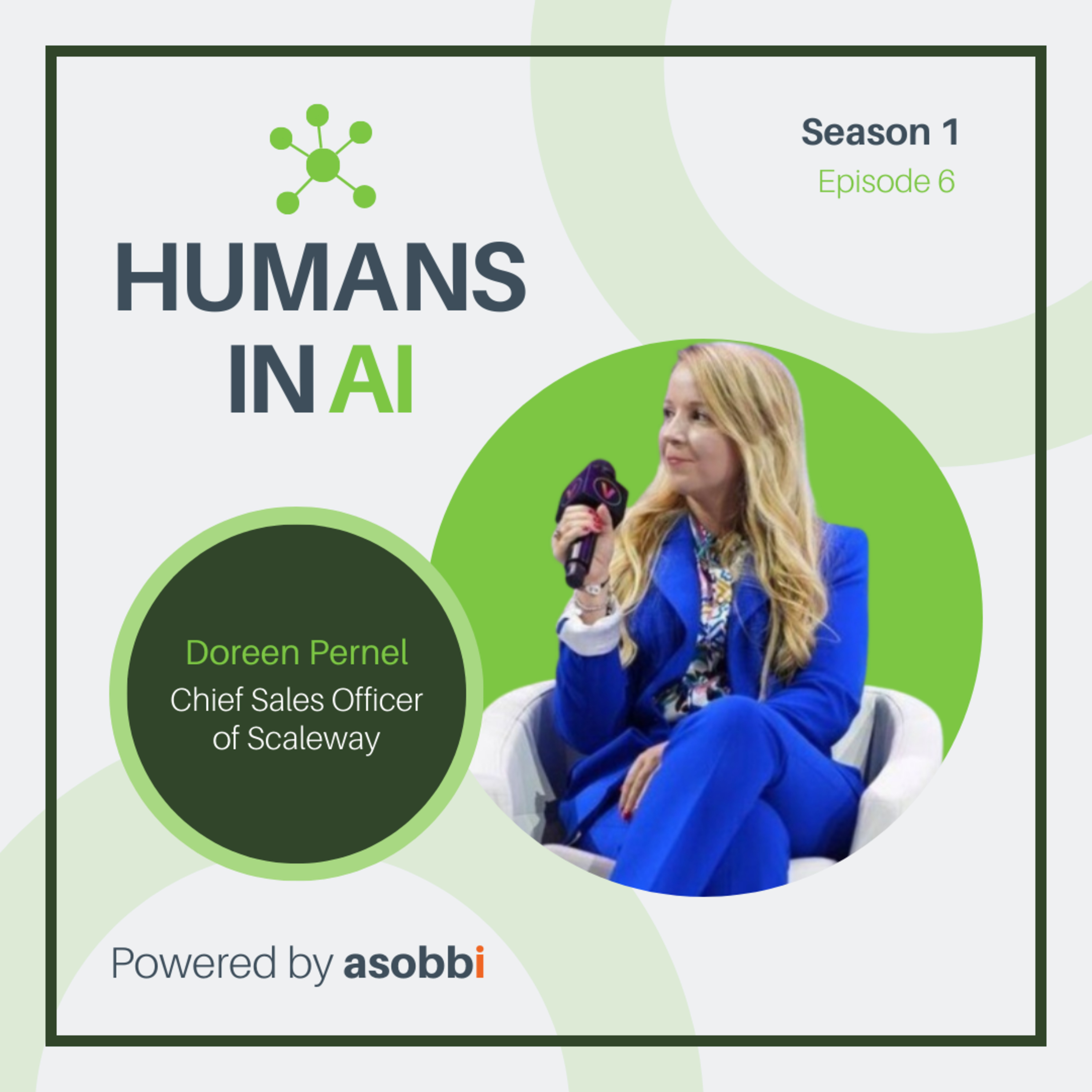
Season 1 | Episode 6: Doreen Pernel, CSO of Scaleway, outlines her path to sales leadership, sustainability & diversity within AI
from Humans In AI
46m 14s
In this podcast episode, Dorian, Chief Sales Officer at Scaleway, discusses her career path from early roles in accounts receivable to leading sales teams globally. She began in inside sales at Bloomberg, then moved to SaaS companies like Box and Meta/Facebook, managing diverse regions and remote teams during the pandemic. Dorian attributes her success in inside sales to resilience, teamwork, and innovation—viewing the role as selling time for collaboration, not just a product. Transitioning to leadership, she learned to tailor motivation to individual drivers and maintain energy reciprocity, even across time zones. A pivotal moment came when she raised her hand to take a VP role at Dataiku, following Sheryl Sandberg’s advice, despite feeling underqualified; she "faked it until she made it" by seeking mentorship and feedback. She candidly shares failures, like entering markets without cultural insight, and emphasizes that decision-making, even when flawed, is crucial for growth. Her current role at Scaleway was inspired by the company’s investment in AI infrastructure, sovereign cloud capabilities, and sustainability, as well as partnerships with Nvidia. Dorian sees Scaleway as part of a European revolution in AI, navigating a competitive landscape by leveraging its unique open-source, green-tech positioning. Throughout, she stresses that embracing challenges and learning from mistakes are key to career advancement and leadership success.
Hi there and welcome back to another episode of the Humans in AI podcast. This is the podcast where we dive into the real-life stories that top leaders and entrepreneurs within the art-spatial intelligence, eye-performance computing and day-center space. These people truly are at the top of their game. We're going to have honest and authentic conversations all aghess. We're going to chat about the career journeys, the highs and the lows and even the less as they've learned from mistakes they've made and the victories they've celebrated along the way. It's all about sharing their experience and their knowledge and how they see the future of the space they're in. So if you're looking for practical advice from people who are the same path as you or just a little inspiration you're in the right place. We're going to be dropping new episodes every Thursday so make sure you stay tuned. Don't miss out. Good morning. Thanks for coming in today. How you doing? Hey, hey Nick and doing what about yourself? Yeah, very good and indeed, very good indeed. Well thank you very much for joining us today. Really appreciate you coming on the show. For the benefit of people obviously that haven't met you before. Don't know you. Do you mind just doing a quick introductions to yourself? Who you are? Current role where you work? Very much a helicopter view if that's all right. Yeah, so my name is Dorian. Like you mentioned, I currently work at Skareaway and Chief Says Officer. So really what it means is that handle all the teams across the set cycle and handle the good to market strategies. Absolutely, absolutely. That's fantastic. Well thank you very much for coming on as I said before. So I mean firstly just want to sort of dive into a bit about your background. You know, you're a you know, a lady that's travelled the world from what I can see. So obviously you've got lots of experiences there and seem to start your career in accounts receivable and payable and then moved into inside sales as well. So obviously I think it's Australia. Did you master's in? Yes, my master's was in Australia. So I studied in the business school of Sydney. So it was a choice because I really wanted to have this specific master's. It was not only for the beach and the sun. It was really to help my majors in not only business but as web psychology at work and that was the kind of only place that the time that I found this combo. So that's why I chose this in this university. And yes psychology at work definitely gonna help in a career in sales for sure. So I mean what made you actually move into sales? It's an aggressive industry. It's fun. It's rewarding. What sort of got you interested in doing yourself? It's a very good question. A lot of people just end up in sales at some point. But I always kind of knew I wanted to be with clients. I wanted to have a day that will be just so around day by new people, kind of new technologies as well. And so like a lot of young individuals are just look at what's out there. And I did a few internships to kind of find my way into sales. So I did many different things when I was in intern and then I did the first one in sales. And I was like this is so much fun. And then you have the atmosphere and the vibe on the floor being able to to go and see clients. And then of course the money because it's it's good money when you're in sales and we won't be lying here. So all this like this mix together was really appealing and and at the time we were not a lot of women in sales and I was like oh that's not why that. And so I got myself engaged into different roles, pretty quickly changed into the sales cycle which I think it's kind of a strength but it was it was all you know not planned but a bit then. And obviously you moved I think he went to New York for a little while but you settled in London for a good few years and started your career with I think it was with box in inside sales. So what made you sort of go down the inside sales route? So to go back into the root of that decision I started at Bloomberg and so at Bloomberg we have to say that at the time over 10 years ago it was a monopolistic kind of business. Rooters was out there but our clients and they didn't have a choice in terms of platforms and so when I wanted to go into a SaaS company I kind of quickly saw that Bloomberg was not the normal word and so when I spoke to my soon-to-be manager I'm like I don't feel comfortable getting into sales within your team without having done the inside sales job. So really during the call coming the album strategy, the account mapping, like everything from the beginning of the set cycle to them being an amazing AEM. So for many people it cannot be set back but for me it was not because that was not a skill I had, learn at Bloomberg. So I really needed to go back into that. Absolutely and inside sales itself is not too dissimilar to recruitment. It's phone base, it's email marketing, depending on the organisation it's very activity, KPI driven and it's a tough job and not everybody's cracked up for either are they. So you do see people go in and you do see people go out pretty quickly. I mean what from people that are moving into the inside sales or the SDR site role, what do you see as sort of the key skills and behaviours that make it success because you've done that journey and obviously you've come out the outside now as a CSO. What made you successful? I think and to be frank Leonan, here for me the inside sales job, ISAR or BDR or SDR whatever the name it's still the hardest job because you need to be so resilient and having this positive attitude for every step of the way because you're gonna receive more knowledge than yeses. So you have to be in that kind of mood to hey, every day is a good day, let's go for it. Kind of being as well close to to your team and that's really important for me the best SDRs and inside sales, they're not only resilient, they're really good at teamwork and they get the energy from each other and be like hey just got that call, that was stopped, you know crack a joke and go back into it into a good mood because if you are kind of the kind of person that will be more you know in a solo type of job then you be like okay I keep the bad energy to myself and you know it just beats up so I think you know one resilient of course two teamwork and the last thing the best ISARs I've seen is the one that are innovative. The one that we do stuff that no one does and we get the prospect interested. So whether it's like now you know videos and like voice recording people are used to it but standing on their business cards with the little notes of the post or getting a very fun social media post that will get people interested or even like tracking their prospect into events it's not stalking but you know those that will be a bit different. It's kind of innovation to not follow the crowd but be the exception that I think is very important. Yeah now I agree I think you know years and years ago I used to see people going into just turning up to offices with doughnuts in London just to try and sort of be a bit different. Don't see it quite so much, Eddie Royal I think that's all the times past that you know being creative you know whether it be voice notes you know whether it be you're turning up at events or creating events it you do have to separate yourself from the crowd don't you and I think you're right being resilient and remaining positive. I often find as well with people in that sort of role it's yeah they don't have to be necessarily the best salespeople you know they need to be good communicators and they need to have a bit of a process and and create consistency as well don't they? Yeah 100% and what I see is like and sorry to catch you here is that you are not selling the product you are selling time then for us to sell the product together and it's really this when you have this in mind you're selling time to get the people interested and like you were seeing with the right process and I think that's what works best. And I'll see see you did that role you were successful you then got your sort of first taste into into management I think then you you actually moved to workplace from Facebook I guess that's meta is it now or yeah so you move there and and you obviously manage multiple teams looking after different regions what was you know we often see successful sales people move into management and they don't always transfer into management successfully how did you sort of navigate that gap and jump into first all the leadership role? Yeah so I had to change to kind of try a few things at box.com where I was team lead and learning from my managers so grasping this first full-time like
let's say manager role was for me just a step. So I didn't feel lost. And I joined not only in amazing companies such as Meta/Facebook at the time, but I knew the leadership in place was great. My direct manager and my DPs, they were really on the kind of leaders that would coach you to be the best leader you can be. They would spend time with you. And that was throughout the pandemic as well. And so we were closer than ever, even though we were not together in the same office. We were all here for each other, giving tips and working at MSAS, we could because at the time we were sitting at communication platforms. So that was really needed for companies. So managing different regions that was on different times on that was a challenge. Because I was before focused on EM/EM/EM, here I had APAC EM/EM/LATAN. So the clients needed time at any time of my day. So I had to kind of put myself into a reason to say Tuesdays and Thursdays would be more APAC and then LATAN would be more Wednesday and Friday and Monday would be crazy. But I tried to kind of separate my week into different schedule time. A bit like you know, when you are doing a job when you have different schedules for different days and you do night shift and then morning shift. It was a bit this, but being available, yeah, workplace or the communication to let any time for the team. I can imagine. I mean, not only the different time zones, but obviously, you know, back then, we've had COVID, so we've got a lot more hybrid working now and what have you and remote working. We used to working in that hybrid remote way or was it actually being able to coach, manage, mentor people, you know, for a screen? Was that a new skill set for you as well? Because not everybody can do that. I mean, some people need to be in the room. They need to be in the building. So actually get the best out of their staff. How did you find getting the best out of people that were on the other side of the planet? Yeah, it's not easy. And I think it's finding this link in between all the team members. So the team that I managed was around 50. And so it was really important to know them individually to know their drivers, 'cause of course, a lot of says people, their drivers would be money, but not only. Some would be recognition, some would be on top, some would be to challenge themselves into a better quarter than the quarter before. So it would be just to survive, because that was a tough time. So really to know and talk to them and being available always had in my carandard those times that were free for, you know, and proptuous meetings and just having those chips at. And it's still the case that I kept a very good relationship from my past companies with some people I managed, you know, because then you have this bond. And that helps. And I think because I motivate them, they're motivating me back. And so you know, it's this transfer of energy that pretty helped. And it's not bullshit the way I said it. It's really true when you give energy, people give this energy back to you. And so you're even more energized factor. I totally agree. I think it is reciprocal at the end of the day. So you bounce off other people. And if you've got a good team around you, it makes you a better leader as well for sure. And so obviously work with workplace and Facebook. You then moved on. You then moved into, you know, another Inside Sales Manager role, which quickly turned into a VP role. And you moved back to Paris as well. So I mean, that must have been nice to go back home surely after having a few years away. What sort of triggered the move to move on from Facebook to the next role? I think you said it a bit in your question. I wanted to move back to France. So that was as well a personal move, which I'm really happy about if we talk of IORI, I have no baby from that move. So really, I could, you know, get this together. But on the professional side, I wanted as way to challenge myself into a more technical kind of industry. And so I didn't know that much from the data science industry. But at the time, big data was everything. You know, we were talking a little about AI and ML. And of course, that was a topic, but big data was the trend. And it just started to become bigger and bigger. And so I was like, I need to take the way. And so joining that I call, I join knowing that joining a startup, becoming a scale up, I would have challenge and opportunities. And so when I joined, I knew opportunities will be there. I didn't know that would be that quickly. But when my boss had the time left the company, I raised my hand. I went to our general manager and I was like, Gregory, I'm here. If you need to replace that person now, I will step up and I build up a full plan very quickly, propose a few alternatives. And showcase what I did before. For place at bobs.com, at Bloomberg. And I made myself as the solution. And it's really something that I got a lot from Sherry Sandberg, who were the COO of Facebook at the time. And she wrote many, many books on women empowerment and how to manage a career. And she said, "Be a black man, raise your hand and make yourself the solution." And this is what I did, super challenging, because I didn't know how to do that form. I stepped up in the role that I knew, maybe 50%. So then I had to kind of fake it until you make it and learn from so many people, like you around me, and I was bossing older VPs that I knew. I was like, how do you do this? How do you do that? Can you come and shadow me? Can you getting older feedback? So in a few months, I grew, I don't know, like I never grew before. But it was tough because you would get bash from feedback to feedback. So really, when you get through that, you have to be really resilient, which I go from an inside sense, job in the past, and be like, OK, next one, next, continue. And I got fortunate to be there, but as well as where I raise my hand to take the role. It's extremely brave. I mean, so there are a lot of people out there that don't necessarily take the flunge. And the fact that you put your hand up, behave like a man to a degree, and made yourself the solution is incredible. And I think it's something that you should be very proud of yourself. I mean, it's a great move. I mean, obviously going into that regional VP role and the biggest learn, you knew 50% of the job. You quickly knew how to get the other 50% and by leaning on other people and asking questions and asking for advice. Was there any decisions you made during that time that backfired or did it all go quite smoothly? No. Thank you for the compliment, first of all, that many things happened and didn't turn out to be good decisions. But the thing that I always tend for as a leader is, I will make a decision. And I think that's the worst thing for a leader or manager is to not make decisions. It's to like this directive. And that's the worst you can do for a team. And so at the time, you're in the scale up, you have to go very, very fast. And so of course, I made a decision that were not good. But I think that was Einstein that said, part of the past of success is mistakes and failures. And I have to say, many failures, many mistakes. But it will not be balanced but so many successes and learnings and a few that we did. We entered two countries without comprehensively understanding the culture differences. We moved too quickly that we spam some clients and we're completely blacklisted with our email addresses. So we have to create new ones. You learn that if you don't do anything, nothing happens. And you just learn, you don't repeat the same mistakes. And we were doing those post-mortem meetings where I bid at. So what's the point? OK, so we lost that just because of that. We didn't make that an opportunity because of these. And I will share regionally with older leaders and the leaders will share back to their team leaders and to the teams. So everyone knew what kind of fucked up in other regions to not replicate these end mistakes. But I'm super proud of my mistakes and failures because I think that how I got shot.
and I'm even prouder of my successes, but I don't shy away to discuss everything that we did that because I'm happy we tried, you know. Absolutely. I mean, if you don't do anything, you know what the results are going to be. So you have to make those mistakes. You have to actually be great take action. It will work, it won't work, but it will be as long as you learn from it. And after that, you know, I think from my career, it's been the times where actually I've been really out of my comfort zone. And, you know, I've had to be brave, I've had to make decisions that I wasn't 100% certain on and I've learned from them and invariably it works out for the best. So, you know, it definitely works there. So obviously big data was huge. You know, we talked about big data for a few years, you know, 2018, 19, 20, 21. And now it's very much around AI, isn't it? And it's around sort of the infrastructure to enable AI. And obviously you took the move to scale away and I think what a brilliant business, but you know far more about why it's such a brilliant business than I do. So, you know, what made you take that sort of move and jump into the organization? Yeah. And so the move had the chance to knew about the future investment of scale way in AI. So I got super interested to be like, okay, scale way is already a very powerful company. They do sovereign cloud. They are they want to become leader in Europe. You know, I knew the roadmap. I knew how incredible was the product to be 100% open source to have their own layers of code that will be American. So to have a true sovereign team. I knew that the product would be on very much on green IT with sustainability, which was as well at the time really important. And I knew that Xavier and so our first investor got Xavier will invest more into scale way and getting to AI through scale way. And so I was like, this is amazing. And I know it's not that long ago, but two years ago, Nvidia was not the first capitalistic company. And now it's the case, but they were saying, okay, so now we're going to invest in GPUs from Nvidia and scale way is going to be the biggest power for startups and enterprise to run the algorithm to train and to function them. And I was like, wow, okay, I want to be part of that journey. And so when I signed up to scale way, I knew the challenges ahead. And again, nothing was perfect. But for me, it was a big yes to be part of this new range of product and part of, you know, kind of the revolution for me. It was a revolution. The GPUs from Nvidia, the power that you could like kind of trigger to companies, I found it amazing. I mean, it really, but it's also really competitive market spaces, and it because we are seeing, yeah, there's lots of smaller. You're probably a little bit further ahead in the journey than others, but you are seeing lots of smaller sort of European sovereign cloud businesses popping up across across Europe. How, what do you guys do to remain competitive and to remain, you know, certainly one of those sort of leaders in Europe? Obviously, you've also got the lights of companies like Callweed coming into Europe now as well. What is it you guys are doing to actually remain that and maintain that competitive edge? It's difficult. So I won't, I would put that here. I'm really difficult market. If I take it from my time at Bloomberg, where I was in a monopolistic market. And here I am in the biggest competitive market, I've been so far. So you have the three American iceberg scalar plus the Chinese one. So already taking globally a lot of the market shares is not home. And then you have like your thing, those smaller, let's say challenger that are coming in place like Callweed and other smaller European brands. And then you have scare away that are leading the market in Europe in terms of GPUs and AI power. And for the public sovereign cloud really wanted to be not only the leader, but actually put in writing what it means to be sovereign because right now you don't have a true definition. So you have to be innovative and you have to be innovative not only from your products, which we are we have an amazing team of R&D that created many products for the first time around and revolutionized the markets. But you have to be three steps ahead from the other either scalers because if you don't play with your cards, you will be eaten alive. So for us, it's proximity. So we are very close to our clients. All our syllabus myself included would meet with clients. We are part of all the years and we talk to all the existing clients. That's why we are innovative because the other I first scalers didn't have the luxury to have the proximity like we do. For us, of course, everything is about money right now. We are competitive in terms of pricing, but we want to put it as a package. We don't want to say, "Hey, that's that much of that product and you take it and you just put line by line. This is what do the I first scalers." So for us, when the clients will come in to come at a scare away, it's a full package. It's a team, a product team, engineering team, sales team, support team, that will be there for them plus the price. So the ROI, especially now that AI is everywhere, people look for human. And they look for the connection. You come to the office to visit our data centers. You won't believe how many clients are lining up to visit our data centers that are part of the IDIAD group. It's a branch called OCOR. And so we want to make sure that we play those cards well. So innovation of products, proximity, and having this package for you when we start a scare away to say, "Yes, open source, yes sovereign, yes sustainability, yes security, but it is not an easy market at all." So obviously, it is a competitive marketplace with lots of challenges as we talk about and some of the bigger hyperscalers. You have got some extremely innovative products. But now, as the CSO, you've got one of the biggest teams. How do you keep them motivated? How do you keep them driven to ultimately achieve your objective, which is that bottom line number at the end of each year? What do you do to actually make sure that works? Yes. So it's very difficult. The motivation is to be kind of everyday ingredients. So it's a bit the same thing that I've done before. The proximity always opening my agenda. And having as well the transparency when you hire. The transparency to say, "Hey, welcome to the jungle, welcome to a challenging market." And we as well hire people that are self-motivated. People that are very hungry for it. When we interview, we know some people that won't match not only the culture but the challenging market. Not everyone can sell scale way and scale with the competitive environment. So I have to say I'm blessed with a team that is used and know what's coming out. But we have our quarters and we have good months and months that are more difficult. So it's as well being vulnerable to them and be like, "I know it's tough. I know I'm asking you a lot of you. I know there is this and this new competitor and whatever happening. But let's be together, let's commit to each other and showing that you always believe in it, but you are as well show transparency and kind of being real of what's going on. You're like, "Okay, that number here is not the best. This is not the idea. But we are working on this. Look at the roadmap, look at what we are putting together. Look at the other CXO being so involved and something very particular that I'm proud of. For example, for our QBR, so the quarterly business review, all the CXO are here. Many people from the product team as well, the engineering team, which is not common. And they come to all the QBRs from all the AELs and the listen to their needs. They listen to what they want to do, they listen to the current deals, maybe they know someone, maybe they can help. And so the fact that they see it's not only me, but it's an entire company that's behind them. I think that's really particular to scare away. I haven't seen it everywhere else. I say, of course, it's thanks to the team, the leadership team, but not only. It's everyone together. So I want to say that.
I don't say it's me on the motivating the team, it's a full leadership team behind me. That definitely is unusual. I've not heard that before, but I can see why that breed success inspires innovation, inspires people to actually strive forward to obviously meet the common goal and create a real team. We work on culture as organisations have all got their own way of creating a culture to breed success. Some work better than others obviously, but that's definitely a new one for me for sure. You made a comment at the beginning, obviously, when you made the decision to get into sales, women were quite underrepresented in sales, those years ago, not that long ago, it's still very young. Where we are today, do you feel that we've really improved and strived because, as a recruiter that supplies into a lot of organisations within the cloud market, within the SaaS market, certainly within the AI market these days, we do have a lot of businesses asking for us to help with their D&I, certainly trying to find really good female talent, how have you guys gone about doing that, or is that something that you're still striving towards? It's a topic, and I think D&I should be encouraged, but never at a wrong, so even when I hire myself, I would just have a pool of candidates that will be balanced. So what I like to do when I hire for AI's or C&C and whatever the role is, I ask for the pool of candidates to be balanced, and then the best to win. If it's a man, if it's a woman, it's the best to win at the end. But it's still a big discussion because the more technical I go in my career in terms of industry, so from Bucks.com, which was a bit technical, and then DataIQ, which was pretty technical, and not scare away, which is in fast structure, you know, you get another layer of ethnicity, of course I see less than less women, but we want you an a-won and welcome them. And so the thing that I always repeat, it don't be scared to apply, because you never know, and you don't fit another person's job position, no one knows, surprise. But to make sure that you apply for it, and you make the move for your career, and internally and scare away, we created a community to help women, you know, to be together and to talk not about women's stuff at all, but to be business oriented, you know, to be like, what it means to have a business mindset and to enable them to drive those kind of discussion and to kind of hold their career into their hands. And so we created a mentoring program and many other things that will drive them to be more responsible and take the accountability for their career and their work life balance, which is, I think, pretty important, whether you want to be a mom or you have this passion that takes you 20 hours a day, that would be a lot, but 20 hours a week, and into your agenda, that's pretty important, you know. So we want to make sure that we drive this and we drive that message. I mean, again, it's something that we don't see enough of. I think the fact that you're doing more, but you're right, it is about having the right person in the right role, but taking a balanced approach and trying to get balanced short-list and actually trying to be inclusive. And nobody's perfect for a job, so apply, it's about the energy, the attitude, the behaviours, and the willingness to learn, isn't it, really? And if they can demonstrate that, but the fact that you are inclusive, the fact that you are building an environment for people to be successful is obviously, it's a great thing. So obviously, with SCOAWA, you're stressed about being highly innovative. You've talked a little bit about, obviously, about the European sovereignty side of things. We touched on the fact that you're open source. I mean, what was the reason for going down the open source through? I mean, you've got organisations that are very pro-open source, others that go the other way. What's the reason for you guys going down that route? So that was really from the beginning. It's in the DNA of SCOAWA, the first engineers into the company and the first CEO. That was the guideline, and as well, it was to build every new product and feature, to be open source, to be agnostic, to welcome any kind of companies to come into our product line and solutions, to enjoy it and SCOAWA. And the key of SCANAN is open source. You cannot SCOAWA everywhere if you're not open source everywhere. And that was our choice, maybe not the easiest choice, to not put any layer of VMware internally, which is now a good idea. But it's harder because we have over 80 line of products. And so just imagine the book of codes for engineers. So that's why at SCOAWA, half of the employees almost are engineers, developers, and we are really proud of it. And that's really atypical in the business as well. We rely on internal knowledge to build our products, no one else can. So we have to keep a very tight library of all the knowledge and everything that's being done. And of course, thanks to the leadership as well, we are able to continue into that role, and to keep that decision to stay forever at SCOAWA. And that's why as well, we win deals because clients really enjoy that. Absolutely. I think it really does encourage freedom, doesn't it? And I think we talked about that before by creating an open source infrastructure. It encourages freedom, but that freedom then, honestly, encourages loyalty to you guys. They don't want to go anywhere else, so they can also use what you're doing. That's great too. And then the other thing, the big thing on everyone's agenda, particularly within this market space at the moment, is around sustainability. We know data centers assume a lot of energy. What are you guys doing to reach your sustainability goals? Because obviously, your customers do care about that. So what is it you guys are actually doing to make sure you hit those boxes? Yeah. And customers really care about it. I can confirm it is now part of the RFQ. It's a line. And we were ready for it for years back because our data centers do not consume a lot of data. They do not consume a lot of energy, whether it's electricity or it is water. So we have technology inside of data centers that will ensure that we lower this bill. And so for our clients, when they see that their impact when they consume public cloud or AI products or dedicated servers, they know that's going to enter into their values. And you value, or it's a value they carry from years ago. And on top of that, we just issued a calculator. So that's pretty new. Now you can calculate really what you consume and what is really at the end of the year, your carbon consumption, which is super important nowadays. And it's even becoming in France and Europe below that is in enterprise above 500 employees. They will have the end of the year to put on paper what were their consumption. And thanks to our new product to a disc calculator, any enterprise will be able to know, which is new. And I think that's really important to know what are you doing, you know, with all the data. Oh, okay, maybe I should stop your picket. Maybe I should be more aware of ways, you know, to consume products in the cloud. And that helps. That's the first I've heard of that. Obviously, I speak to a lot of people in different businesses, some of themselves. And they're doing lots of innovative ways to reach those sustainability goals. But I haven't seen the transparency as yet. We're actually a customer can actually see and do a calculation and work out what they're doing. Is that just because we're not talking about it or is this quite unique to you guys? So the carbon print, it's going to become the new thing. You want to hear more about in the next couple of months. We were innovative to launch it first. And we are super proud of it. And now it's going to become a law anyway. So people will have to move ahead. And I was just reading this morning on green IT for the bad luck next year. And 30% of the companies will be around green IT in terms of green tech. And I think that says it all that the new generation of tech we had did that. We had AI. I know it's going to be green tech. And I think that's really interesting to see the wave go in.
in the right direction for the planet too. I mean that's yeah that's that's really fascinating and again it's it's something that we're going to be talking about now next year the year after so the fact that you're on top of it and you're a spearheading it is incredible and before we finish up one last thing I just want to sort of cover off with you is obviously you guys have got some fantastic customers on your books you've got some you know very good partners on your books as well you've also been doing quite a lot around the startup incubation side of things haven't you and you've done a bit of work on that this year what have you you know was just fill us in yeah give us a little bit more idea of what you've been doing within the startup programs and and how that's gone yes um so we are involved in multiple external programs are and as well we have our own programs so externally we have a collaboration with Meta aging phase HEC where we share a startup program to help European AI companies within a program where each one of us will give them resources so for us it's obvious it's our AI GPU power you're going to have Meta giving them the knowledge and the internal human resources to be there are go reason and of course a new phase that comes with the name and HEC will be there trebator and we have another program with that we share with NVIDIA because we have a very partner of NVIDIA so we have our startup program together it's called inception that we share and we have startups again not only with credit but with the true proximity and they have people to ask questions and to see the future after the credits and that's the same thing we do with our internal program the the worst thing for a startup will be the cost at the end of the program so you don't want startups to go from one program to another program and do like five logos within like five years you want to commit them into having the right behavior of consumption and so without program we have our startup program and we have our alumni program so when they leave the startup program they get to another program where they have more education on how to consume how to understand their build at the end of the month and the end of the year when it comes to public cloud or the GPUs so we want to ensure that we have them to be made sure because at some point they're going to be a scale up and when they become a scale up you want to make sure that they manage everything around not only their phenops but as well around the way that they consume not only for the planet we were saying but to make sure that they are sustainable for other years that that's really good I think yeah obviously I deal with a lot of startups you know one one person vans to you know 10-20-30 people and often they are you know the CEO is an engineer so having that sort of mentorship that you can talk about the consumption just that sort of business advisory piece isn't it really to help them on that journey because they're not only doing something new as a startup but they're doing something new for themselves and going on a journey that they've never done before so the fact that you're giving them that too as well as technical expertise definitely hoping to see them those startups being a little bit more successful than if they were on their own for sure and before we finish up then just one last question obviously it's exciting business lots going on the market in AI is crazy I think you know no one can tell what's going to darken five years I don't think it's moving too fast but what does the you know what's the sort of next 12 months lit light for you guys so very exciting if I cannot say everything but I can say for it it looks international so you know going above and beyond your pn front years and it looks like acquiring more clients that would like to do the change for sustainability reasons or sovereign to reasons and and we know when we get into that market you are a challenger but your roadmap and the product roadmap is not as a challenge because of the innovation that we carry so internationalization lots of new features and products to come that would be innovative like I just mentioned and we are growing and scaling internally so more people to recruit so if I can do my little advertisement here if you want to work for a scary way you just have to you can so reach out to you anybody else that should reach out to you can we talk perhaps no I read all my messages so they can reach out to me there you go you watch this now you get your inbox is going to be full that's been fantastic thank you very much really appreciate it it's been it's been a great session great to learn more about you and your journey and certainly great to learn about the business what you guys are doing as well we'll have to do another episode in a year's time and see what's happened we'll do thanks for having me you can have it all be there you too all best now take care thank you what a great conversation with Dory where she shared a journey of transitioning from inside sales to leading the entire sales org it's been really insightful hearing about how she keeps the team motivated during really difficult market conditions it's been a fantastic first season for the human's and AI podcast and that's it now been an absolute pleasure getting to know everybody's stories we've already started recording for season two which will be airing in the new year so until then have a great Christmas and look out for updates on the next season speak soon
Podcast Summary
Key Points:
Dorian, Chief Sales Officer (CSO) at Scaleway, shares her career journey from accounts receivable to sales leadership, with roles at Bloomberg, Box, Meta/Facebook, and Dataiku.
She emphasizes that inside sales (SDR/BDR roles) is the hardest job, requiring resilience, teamwork, and innovation to stand out and succeed.
Moving into management, she highlights the importance of knowing individual team drivers, being available, and maintaining energy exchange, especially in remote/hybrid settings.
Dorian credits Sheryl Sandberg’s advice—"raise your hand and make yourself the solution"—for stepping into a VP role at Dataiku, despite knowing only 50% of the job initially.
She openly discusses mistakes, such as entering new countries without understanding cultural differences, and stresses the value of learning from failures through post-mortems.
Her move to Scaleway was driven by its AI infrastructure focus, sovereign cloud offerings, sustainability, and partnerships with Nvidia, positioning it as a European leader.
Summary:
In this podcast episode, Dorian, Chief Sales Officer at Scaleway, discusses her career path from early roles in accounts receivable to leading sales teams globally. She began in inside sales at Bloomberg, then moved to SaaS companies like Box and Meta/Facebook, managing diverse regions and remote teams during the pandemic. Dorian attributes her success in inside sales to resilience, teamwork, and innovation—viewing the role as selling time for collaboration, not just a product.
Transitioning to leadership, she learned to tailor motivation to individual drivers and maintain energy reciprocity, even across time zones. A pivotal moment came when she raised her hand to take a VP role at Dataiku, following Sheryl Sandberg’s advice, despite feeling underqualified; she "faked it until she made it" by seeking mentorship and feedback. She candidly shares failures, like entering markets without cultural insight, and emphasizes that decision-making, even when flawed, is crucial for growth.
Her current role at Scaleway was inspired by the company’s investment in AI infrastructure, sovereign cloud capabilities, and sustainability, as well as partnerships with Nvidia. Dorian sees Scaleway as part of a European revolution in AI, navigating a competitive landscape by leveraging its unique open-source, green-tech positioning. Throughout, she stresses that embracing challenges and learning from mistakes are key to career advancement and leadership success.
FAQs
Dorian is the Chief Sales Officer at Scaleway, where she handles all teams across the sales cycle and go-to-market strategies.
She chose Australia because the University of Sydney offered a unique master's program combining business and psychology at work, which was not available elsewhere.
She was drawn to sales because it allowed her to work with clients, learn new technologies, and enjoy the energetic atmosphere, plus the financial rewards were appealing.
She highlights resilience, strong teamwork, and innovation as crucial, since the role involves constant rejection and requires creative ways to engage prospects.
She relied on strong coaching from her managers, stayed available across different time zones, and focused on building personal connections with her team to motivate them.
She took Sheryl Sandberg's advice to 'raise your hand and make yourself the solution,' stepping up when her boss left and presenting a plan to take over the role.
Chat with AI
Loading...
Pro features
Go deeper with this episode
Unlock creator-grade tools that turn any transcript into show notes and subtitle files.
 PodcastTranscript AI