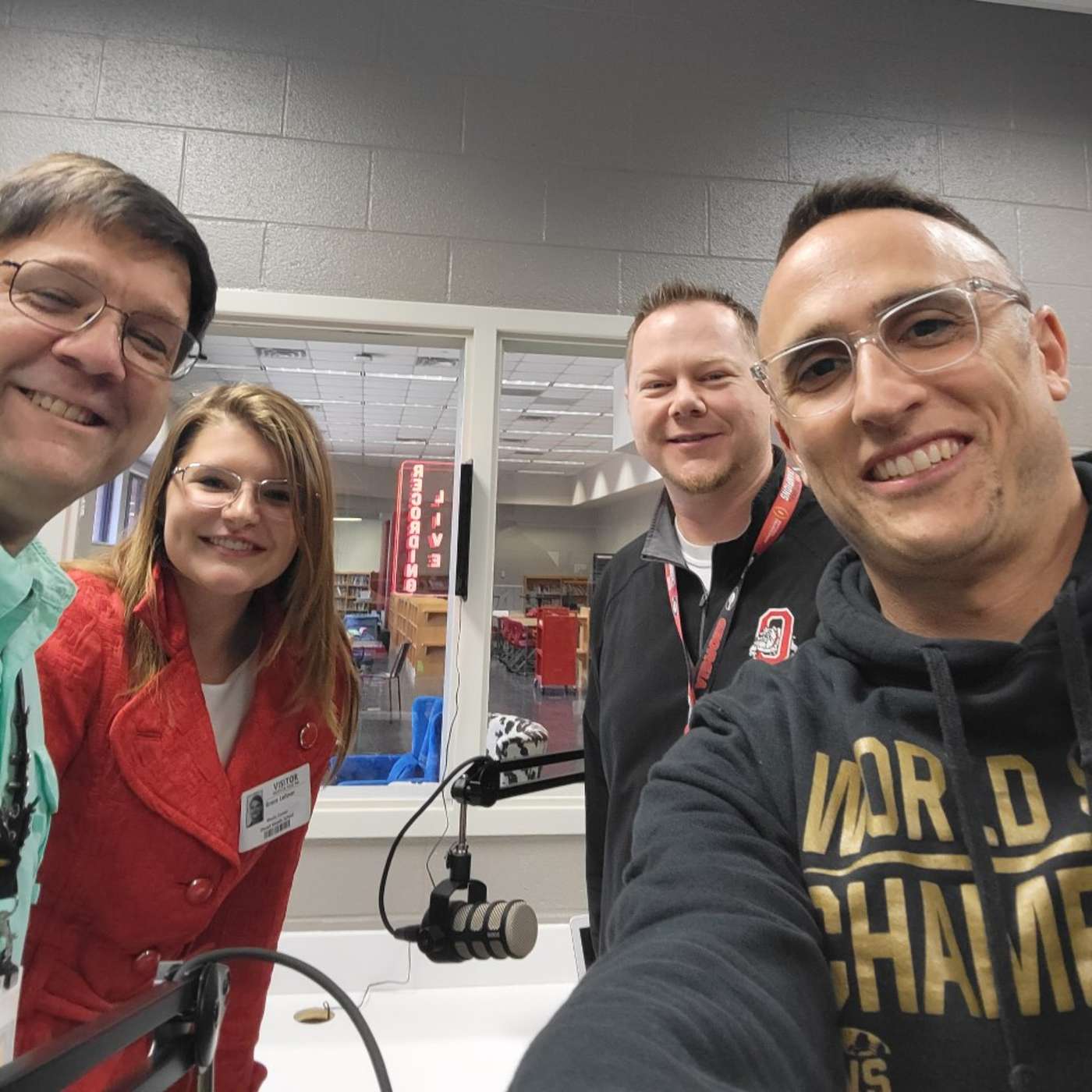
The Bulldogs Unleashed podcast featured Mr. Bill Schuyler, a teacher from Forsyth Central High School's STEM Academy, along with his student, Grace Leitner. They discussed the development of the STEM Academy, its programs in biotechnology, engineering, and computer science, and the student application process. Grace shared her experiences in the biotechnology pathway, highlighting hands-on learning and real-world applications. Mr. Schuyler emphasized the STEM Academy's unique curriculum, which fosters interdisciplinary connections among subjects. The close-knit community within the Central Cluster was also highlighted, emphasizing support and collaboration among students and teachers. The podcast provided insights into the STEM Academy's student-centered approach, commitment to academic excellence, and the holistic development of well-rounded individuals prepared for future endeavors.
Transcription
4921 Words, 26994 Characters
Welcome to the Bulldogs Unleashed podcast presented by Sycam Studios.
My name is David Miller, joined by Greg Walkup and Greg today.
We are lucky to have an amazing teacher from Forsyth Central High School who is part of
the STEM Academy over there, Mr. Bill Schuyler.
Oh, yeah.
I can't wait.
Love Bill.
I've worked with him over at Central, so I can't wait to get into this episode a little
bit more about the STEM Academy, and he's bringing one of his students, which is cool.
So if you want that student perspective, that'd be good to listen in.
Don't forget to follow the Bulldogs Unleashed podcast on Spotify and make sure you click
on the bell so that you receive a notification every time a new episode drops.
Ladies and gentlemen, please welcome to the show today, one of the teachers who is part
of the STEM Academy over at Forsyth Central High School, Mr. Bill Schuyler.
Bill, thank you so much for being on the show today.
No problem.
I'm joined to be here.
Absolutely.
But you did not come alone.
You brought a student with you.
Go ahead and introduce who you brought with you today.
Oh, I brought one of my seniors.
Her name is Grace Leitner.
Hello.
Hey, Grace, how are you?
I'm good.
How are you?
I'm good.
How are you doing for being on the show today?
Yeah.
So Grace, we'll get to you in a moment.
But we do want to start with Bill.
Bill, you've been at Central for 23 years.
23 years.
23 years.
So you've been there for a while.
You've seen the STEM Academy when it was maybe an idea.
Yes.
And then how it has all come to fruition.
So we're going to get to that.
But tell us a little bit about yourself.
Maybe you're, I guess, your journey into education and what led you to Forsyth Central
High School 23 years ago.
Well, my journey actually started in Auburn University and trying to get to vet school,
which didn't happen.
I ended up in research at Emory University for about 12 years.
And on a whim, both my wife and I kind of transitioned into high school education 23
years ago.
I've been doing that ever since.
She is recently traded to the assistant principal level.
And I won't tell what high school she's at.
It starts with an L.
Yes.
I think it's the only L high school I've had yet.
Yes.
So that's great.
So you've been at Central for 23 years.
Tell us what, and we ask all of our guests who are part of the Central Cluster.
We talk about the heart of Forsyth.
Tell us what, in your opinion, makes the Central Cluster so unique and what really makes it
the heart of Forsyth County.
My basis to be in there for 23 years as your teachers, the administrators, everybody in
the cluster, from the custodian level all the way up to the principal, is a very tight,
close-knit group.
We are not afraid to share our glows, not afraid to share our grows.
And we're there for one another consistently.
And I think one of the other questions, the next question here, I'll relate a little bit
more because you probably remember back in 2014, some stuff, and it kind of gives evidence
to that.
So it's a close-knit family where Greg reaches out to me, we're here, someone from Cumming
Elementary reaches out to us, we're there, I need help, I know I can count on just about
anybody in the group.
Nice.
And that's what I love, even with Bill, you know, we were somewhat career tech and thing,
but you know I was doing the teaching pathway, but an honors mentorship program, it didn't
matter, it didn't matter if we were in different hallways or different content areas, if there
is a way to help, we're going to help each other out, that's what I love, and similar
to here as well.
Now correct me if I'm wrong, was the STEM Academy the first kind of Academy that Central
started?
I'm not as familiar, you know, we have communities, we have film and STEM.
STEM has been around, we're on our 13th year, it was developed quite a back, my wife and
I were both on the development portion of that, and we discussed what was going on for
probably over a year, they renovated rooms over at Central and we started the STEM program
with two pathways, biotechnology and engineering, and students could decide which pathway to
go, we've since modified every year, we group together as a teacher and say okay what do
we need to do better, how can we improve, and so we're always modifying and changing
what's going on with the program.
And within the STEM program, just to give the audience a little bit peek into it, you
know here's STEM, right, but can you dive a little bit to more of the specifics within
that STEM Academy or program, what different programs are there?
Okay, so I teach biotechnology pathway portion, and biotechnology we basically get into a lot
of research areas that is going to be used in college.
We start off with DNA, we move on into proteins, and then we get up into some really advanced
level stuff that a lot of students won't get to until their junior, senior year in college.
So they walk into college having a familiarity with what goes on in a basic research lab.
The engineering is the same level of intensity.
I don't know much about the engineering portion, that's why I'm science, but they just as
strong with that, and we just recently had a computer science, which is above and beyond
my head.
And Grace, so we'll go to you now, so you're a senior at Forsyth Central High School.
I guess what is, what was your specialty over at Forsyth Central?
He mentioned some of the other, these classes that they have, what was the one that really
drew you to STEM, and that kind of was your passion.
So I'm in the biotechnology pathway in the STEM Academy, which as Mr. Schuyler said is
a lot of lab-based, research-based classwork, so you're on your feet, you're actually physically
doing something, you're not only learning, but you're applying what you're learning,
which has kind of been a bit of a profound experience in high school, because a lot of
the times you're just, you're doing a lot of book study, but this was real life.
I actually had an internship last summer in a COVID lab where I was doing PCR COVID testing,
and all of the stuff that we were doing in the lab, all of the stuff that we learned about
in AP Bio, in our first biotechnology class, we were applying in that lab, running PCR,
testing DNA. I understood exactly how that process occurred, and then was able to replicate
it, which was, I think, something that was a very unique experience coming out of Fourth
Side Central's biotechnology pathway, and that was as a junior in high school.
That's amazing. So where did you get to do that at? What lab were you at, or like, where
was that taken place at?
Actually in Ohio, I have family up there, and so it kind of ended up broadening the amount
of places that I could apply to be an intern, because I could stay with my family, and then
commute to this lab, it was industry lab diagnostic partners.
Is that the coolest thing you've done so far in high school when it comes to?
I think so.
Yeah.
That's cool. And you have aspirations you're moving on from Central, you're going, we heard,
you're going to be a Wolfpack, right?
Yes, Wolfpack.
NC State.
NC State.
That's awesome.
So that'll be biomedical engineering and political science, double major.
Being part of the STEM Academy, it's really a commitment, right? It's a four-year commitment.
Did you know, as a freshman, maybe what you're getting into? I know it's probably very hard
to start and make all the way to completion, right? What's been the hardest part and what's
been the most enjoyable part of being in the STEM Academy as a student?
So we went into our freshman year, and I vividly remember there was this open house, and Miss
Kay was there, and she said, "What we do in the STEM Academy is you're a live frog and
we put you in a pot of water, and then we just crank up the heat until it's boiling
and you don't even realize it, because, you know, it's been working up for so long."
And I was like, "That's terrifying. But I definitely want to see this through."
And so I think that the hardest part has been kind of acclimating every single year to a
new course load, to hard classes. I'm graduating with 12 or 13 APs and 55 credit hours going
in to college. So halfway through my junior year.
Yeah.
Sounds like us as students, right, Miss Kamala?
Absolutely not.
Not.
Absolutely not.
Me neither.
No.
So it's been challenging, and you have to learn how to study, and beyond that, you have
to learn how to continue to have a social life, to continue to be involved, to have that
high school experience and that life experience and not just be stuck in your books. So I
think finding that balance has been a challenge, but one that I have reaped the rewards of
and that I will continue to reap the rewards of.
And then the most enjoyable probably has been the community, the community that you build
around you, because you have so many people that are, they have so many diverse interests.
And you're in the same kind of classes, and you have the same kind of work ethic and the
same kind of drive. And we get together and we have Christmas parties and we do friends
giving. And then the next day, we're sitting down and we're studying together. And so it's
kind of this community that's forged from both the hard academic work and then the kind
of people that you're around.
That's been kind of a common theme, I think when we've talked to the Film Academy and
Humanities is you have a group of students who are going through similar things. And
so they can relate to one another and they build that sense of community.
They support one another.
100%.
Exactly, exactly.
Yeah, and you need that. So Mr. Scholar, we'll go to you then for this next question. She
talked about the most enjoyable part of the STEM Academy as a student perspective. What
about you as a teacher perspective? What's been the most enjoyable part?
100%. It's working with the students. This year is especially, if I could retire this
year, this would be the drop the mic year.
Really?
Yes. And these students, when they start working on something and they just finished up Capstone,
which is a research project, and they have this light bulb go off over their head. You
can actually sometimes see it. It just, that's why I'm there. They keep me there.
See, here's a deal with Bill Scholar, Joe. He's a humble dude. He's a humble guy. What
people don't realize is my five years at Central, kids loved him. They loved him over
there.
They do.
And the reason they love him is because he's, he's fair, but he pushes and then he knows
when to stop and give him a breath and then he pushes. And that's why I respected you a
lot. And I still do. It's because you're a teacher that pushes people to reach their
fullest potential. And sometimes that's not the easiest route. And then STEM, if you want
to be part of STEM program, if you want an easy route, right, it may not be that way.
It's a stretch.
Yeah.
You know, just in these guys, the senior group here, I pushed them and they stretched and
I pushed them some more and they just continue to take every challenge I put in front of
them on head on. They're like, I'll call her, she's a sponge. And you put her in a class
and it doesn't have to be science. And she just absorbs the knowledge. And then she'll
go and she'll cross link areas and put things together that most students don't.
Yeah, it's awesome.
Because she actually wants to go into law.
Okay.
Definitely.
Nice.
So take a medical perspective into policy.
Let me ask you this and Grace, let's say we got a student out there is listening, right?
And they want to be part of the STEM program. Like, can you walk them through that process?
Let's say, like, Mr. Schuyler just mentioned three different areas of STEM, right? How did
you, I guess, decide or figure out first to apply for STEM? And then once you're, you're
there, the frog, right? Once you got there, which area you're going to go? Can you speak
to those two points?
Yeah. So I think it definitely started in middle school. I had one teacher, I was at
Vickery, so Ms. Neighbor, and she kind of sat there, she sat down with us and she laid
out all of our options for high school. She said, you have the IB program at South, you
have the Alliance Academy here, the different pathways. She said, you have the STEM Academy.
And so then, you know, you have to Google those, you have to research them and kind
of which ones are you drawn to and you can apply for multiple. And that application closes
sometime in November for the STEM Academy specifically. And I knew that I wanted to be pushed hard
in high school. I knew that I wanted to be, I know, I wanted to excel. I had goals that
I had for college, for scholarships that I wanted to achieve. And so I think that having
a goal in mind and then just relying on that support system that's built in for you in
Forsyth County, that's definitely a place where you start. And then in terms of deciding
a pathway, your freshman year, you go in undecided. It's like going in undecided your first year
of college. You're in the same classes, you're meeting with all of STEM. There are different
people from the pathways who come and introduce you to the kind of stuff that they're doing.
And for me, it was kind of a, I knew that it was very hands on, both of them, but I wanted,
I was more curious about the lab work. And then I was interested in kind of the more
biology side of things, like you have certain classes that are required for biotechnology
that aren't required for engineering and vice versa. And then I think either my sophomore
or junior year was when the computer science pathway was added. And so that adds a third
avenue. And I think you can either actually do computer science and biotechnology or computer
science and engineering. And so really just making sure that you're doing yourself the
justice of exploring your interests is kind of how you will succeed on that front.
And kind of what's unique about the STEM Academy, kind of segueing off what Grace said, is
if you went engineering, it doesn't mean in college you can't go biotechnology or medical
school. It's, and the same thing for biotechnology. I actually had students that were biotechnology
thought they were going to med school and ended up in aerospace design at Georgia Tech.
And so it's really more of a thinking development, how to think critically and how to face problems
and realize that if this doesn't work, what am I going to do to change it?
That's exactly it.
So not quit.
And can I have the stuff for a second to say, first of all, Mr. Walker, how, like, how amazing
Grace sounds right now? Like, how many high school students say, how many eighth grade
students said, I want to go into high school and be, I want to be pushed and I have goals
and driven like how mature you sound is absolutely amazing.
What was in her water? We could have our own personal kids, Dave and Millie.
No, it's just, so that's just a credit to you and probably your family and what they
have, you know, fed into you is just that you had goals and you want it to be pushed
because to be great, you have to be pushed. And for you to recognize that and to have
teachers who see that in you as well, right? I mean, that's amazing.
So congratulations for being honest. Is that kind of the when you're looking at those applications
and you're getting teacher recommendations, is that part of the process? Mr. Schuyler of
looking those kids and enjoy to be pushed like Grace?
I mean, that is a little bit. And we actually start seeing that their freshman year and into
their sophomore year. And from there, we'll start kind of getting them into areas where
they think that we're going to excel, they're going to excel and do very well in. And so
it is difficult as an eight when the students apply as an eighth grade for us to see that.
But we've worked over 12 years, our application process has gotten pretty, pretty strong to
where where we see a really good inside view of what that candidate is.
Awesome. So we want to close before we get to our last segment here with that was unique
in the fact that 100% of our students technically feed into Forsythe Central High School. So
if any of our students or our parents who listen to this podcast, if they're interested
in the STEM Academy for next year, I guess it'd be seventh graders who about to be eighth
graders, you know, what should they look forward to? What, you know, what, I guess, information
should they look to to to get information about the STEM Academy?
Well, there are several opportunities, one of which is we try to come over here during
some of y'all science night that's in the first semester. And we do kind of like outreach
programs where they come in and the students such as Grace and several other will run activities,
do various science type, just I call it nirvana. Yeah. And both biotechnology engineering and
into a computer science aspect of it. So they come in and they kind of see these are run
by by STEM students, they can ask the students that my students questions, honestly about
what's going on in STEM, how do they decide what do they want to do. And the, the central
students will tell me exactly what it is. Then you will start getting receiving letters,
your counselor, your teachers about the application process, which usually starts in the fall.
And we try to close out applications just before Thanksgiving so we can start looking
and deciding around Christmas. We do accept applications from out of district. So anywhere
in the county can apply. And we kind of go from there. And it's a the entire STEM teachers,
which is about 12 to 13 teachers, we are all in on the decision making. Okay. And then
with the different options, you know, especially when you talk about out of district and STEM
again, what in your opinion, and we'll kind of wrap it up here, but in your opinion, what
do you think makes the four size central STEM Academy different or unique or what makes
it really to others? What makes it unique than any other pathway in any other school
is they have a set curriculum with other classes in math science and then their CTA pathway,
biotechnology, engineering or computer science. But instead of having those classes as individual
classes, like I remember when I went through high school, I went to my science class. And
then when I walked out of the science class, I flipped a switch and went to my history
class and I flipped the switch and went to my English class. And in the STEM Academy,
there is no flipping of switches where we work with the math teachers, we work with
the engineering teachers, we work with computer science teachers to create a more cohesive
connections between all the different content. And now that you know, I'm also teaching part
of the humanities AP Seminar, I get, even though it's not a requirement for STEM students,
I try to get STEM students into that AP Seminar class because it's just going to help them
make a better person overall.
I love that, because we talk about connection, right, Mr. Miller?
Yes.
More well-rounded students.
Yes.
And that's how it is in the real world, right? You go into your engineering job or any other
kind and you're thinking about all of the kinds of things that go into that. You're not
just thinking math, you're not just thinking science, you're not just thinking literature,
you're thinking about how they all connect.
Yes. I'll connect to those interdisciplinary connections of math, science, ELA, history,
all that, how it all connects together. So, I love that.
Good stuff.
Absolutely. So, we're going to transition now for Mr. Schuyler and Grace. If you don't
know, we're moving on to our next segment, which is called the hot seat.
This is where it gets hard. That was the easy stuff.
That was the easy stuff.
This is where it gets hard.
That's the hard stuff. So, the hot seat is where we ask a series of questions and we
would like a one-word or a short phrase response. And we're not too linear on the one word.
A lot of people will just go on. But, are you all ready to play?
All right.
All right. Here we go. So, Mr. Schuyler, we will start with you. Favorite music or favorite
music artist?
Favorite music genre will probably be classic rock and roll, '70s and '80s.
All right. I can't go wrong with that.
I'm hailing right there.
Love it. Grace, how about you?
ACDC.
Oh, there we go. I like it.
Grace, we'll start with you on this one. Favorite go-to snack?
Apples.
Apples. We got a lot of students when they come on the show that are eating a lot healthier
than I am.
That'd be the last of my list.
Mr. Schuyler, how about you?
Chocolate.
Yeah, there we go. Now you're talking my language. Love it. If you could sit down. Mr. Schuyler,
we'll go with you on this one. If you could sit down at the dinner table with anyone past,
present, who would it be and why?
Probably Michael Crichton, who is the author of Jurassic Park and several other books that
have a science fiction background of it, but then there's real science to it. So, when
he wrote Jurassic Park, he probably had no idea that we could eventually possibly get
to that actual state with that. So, I just think he's just ahead of the game.
That's crazy to think that too. That could be a real possibility.
Grace, how about you?
Probably Rosalind Franklin. She was the woman behind the discovery of the double helix and
the DNA structure.
Greg, you're familiar with that one.
You're familiar with her work?
I was trying to look on Google to see if that was fact-checking. Not only the fact-checked
Grace, she knows what's up.
That sounds right.
That's awesome. Grace, we'll go with you with this one. Favorite movie?
Spider-Man.
Okay. Mr. Schuyler?
Monty Python, The Holy Grail.
Classic. Mr. Schuyler, we'll start with you on this one. Favorite hobby?
Two. I enjoy kayaking and the other one is I build replica model boats that are all wood.
Still like Spanish galleons and right now I'm working on the Mississippi Riverboat.
Nice.
Like miniature model size?
I'm talking the Riverboat one is maybe about a foot and a half and about eight inches tall.
Yeah.
Sell them or just for you?
No, it's all wood. I just get planks and I cut them all down.
That's cool.
Grace, how about you?
Reading and hiking.
If you chose reading, what's your favorite genre of book to read?
It actually kind of varies. Memoirs, but I just finished Ready Player One and that was
amazing.
Grace, we'll start with you on this one. Give us one item that's on your bucket list.
Oh, I was going to say skydiving, but I already crossed that one off.
Oh, you did that one already.
I want to hike Everest.
Oh gosh.
Wow.
How was skydiving?
It was very fun. It was scary. It was amazing.
Did you do it with someone or?
Yeah, I have a childhood friend and then yeah, I tanned him.
Yeah.
Greg, would you ever skydive?
I would have to tanned him because I would forget everything he told me about training.
You ever jumping out of a plane?
I don't know if I could do it.
Do we do it?
I don't know.
30 years?
Me and you?
No.
Do it.
Do it.
I did bungee jumping once.
Once?
One and a half?
I was like, I'm done.
I survived, so I'm not doing it again.
Mr. Schuyler, how about you? One thing on your bucket list.
The Galapagos Islands.
Yeah.
I'd go there.
That would be awesome.
Mr. Schuyler, we'll start with you on this one. Favorite place to vacation?
Outdoors. Beach. Mountains. I love national parks. Glacier. Yellowstone. Tetons. You
name it, if it's outdoors, I'm there.
You're there. I like that.
Grace, how about you?
Probably like old cities where you can see ruins of ancient things or like Boston, you
know, you go and you visit like how the government was created and like, you know, Power of Yours
run.
Correct.
That's awesome.
And we will, Mr. Schuyler, I'll go with you first, because Grace hadn't seen these ahead
of time, so I'll give her time to think about it.
Any hidden secret talents or facts or stories, anything about you that no one may not know
about you?
Oh, wow. I actually kind of have two unique things, if that's okay. I actually met Casey
Jones, who was a commander of the Blue Angels back in the mid-70s. That was very interesting.
We got to go kind of climb all over this plane. Didn't get to go into the cockpit, but meet
him, so that was pretty cool. And the other one was, in the research, I am one of the
first, my research group was the first people who did some of the background studies on
flow nays.
Oh, wow.
Before it came out into the prescription realm and now into the over-the-counter stuff.
Yeah, over-the-counter stuff.
Well, thank you.
Yeah.
You did this morning.
For me, too.
Thank you.
Thank you, Mr. Schuyler.
That's awesome.
If you could use it now, you're just thinking, "Mr. Schuyler."
All right. And Grace, how about you?
I'm drawing a blink on this one.
That's all right. Well, I would say the skydiving one would have been a good one.
I'm writing a book, but it's not really a secret. It's like a children's book.
Really?
Yeah.
That's cool.
About type 1 diabetes and the process by which you develop it and all that to normalize.
On her spare time, Mr. Miller, she's writing a children's book.
Tech engineer, law, climbing, skydiving and writing a children's book. She's not even
18, probably.
We'll ever do, we'll ever do.
100%.
Well, you two both have survived the hot seat.
Thank you so much for playing and thank you so much for being here. Grace, congratulations
and good luck on your future endeavors at NC State.
Mr. Schuyler, thank you for what you do for our students and what you do in the STEM Academy.
It is a pleasure and we are just thankful for teachers like you who invest in our kids.
That's why I'm here for. Thank you. Enjoy it.
That was our latest episode with Bill Schuyler, who is one of the STEM teachers over at Forsyth
Central High School. And Greg, you had the opportunity to work with Bill for many years.
And what he does for that Academy and not just him, but all the teachers that are part
of the STEM Academy is amazing that we have this right across the street from Howell Middle
School.
Crazy. Yeah. And Bill's lights out that whole team over there of teachers or lights out.
And if you want a program like Bill mentioned where it's rigorous, a program where the teachers
know their content, but more importantly, they connect with the student STEM Academy
is definitely something to check out.
Thank you for listening to the Bulldogs Unleashed podcast. My name is David Miller reminding
you that we are all better together. Thanks again.
Podcast Summary
Key Points:
Introduction of Mr. Bill Schuyler, a teacher from Forsyth Central High School's STEM Academy.
Discussion on the STEM Academy's development and programs.
Student perspective from Grace Leitner on her experiences in the biotechnology pathway.
Overview of the application process and student experiences in the STEM Academy.
Unique aspects of the STEM Academy's curriculum and interdisciplinary approach.
Summary:
The Bulldogs Unleashed podcast featured Mr. Bill Schuyler, a teacher from Forsyth Central High School's STEM Academy, along with his student, Grace Leitner. They discussed the development of the STEM Academy, its programs in biotechnology, engineering, and computer science, and the student application process.
Grace shared her experiences in the biotechnology pathway, highlighting hands-on learning and real-world applications. Mr. Schuyler emphasized the STEM Academy's unique curriculum, which fosters interdisciplinary connections among subjects.
The close-knit community within the Central Cluster was also highlighted, emphasizing support and collaboration among students and teachers. The podcast provided insights into the STEM Academy's student-centered approach, commitment to academic excellence, and the holistic development of well-rounded individuals prepared for future endeavors.
FAQs
Normalmente, el compromiso de los estudiantes en el programa de la Academia STEM es de cuatro años.
Los estudiantes interesados en unirse al programa de la Academia STEM deben aplicar, generalmente en noviembre, y pueden explorar diferentes áreas antes de decidir su enfoque.
Lo que la hace única es que integra las clases de matemáticas, ciencias, y sus respectivas vías de estudio en un plan de estudios cohesivo.
Los caminos de estudio disponibles son biotecnología, ingeniería y ciencias de la computación, cada uno con enfoques específicos y desafiantes.
Los estudiantes en la Academia STEM construyen una comunidad sólida basada en intereses diversos, trabajo en equipo y apoyo mutuo.
El proceso de solicitud suele comenzar en otoño y está abierto a estudiantes de todo el condado, con aplicaciones aceptadas de fuera del distrito.
Chat with AI
Loading...
Pro features
Go deeper with this episode
Unlock creator-grade tools that turn any transcript into show notes and subtitle files.
 PodcastTranscript AI