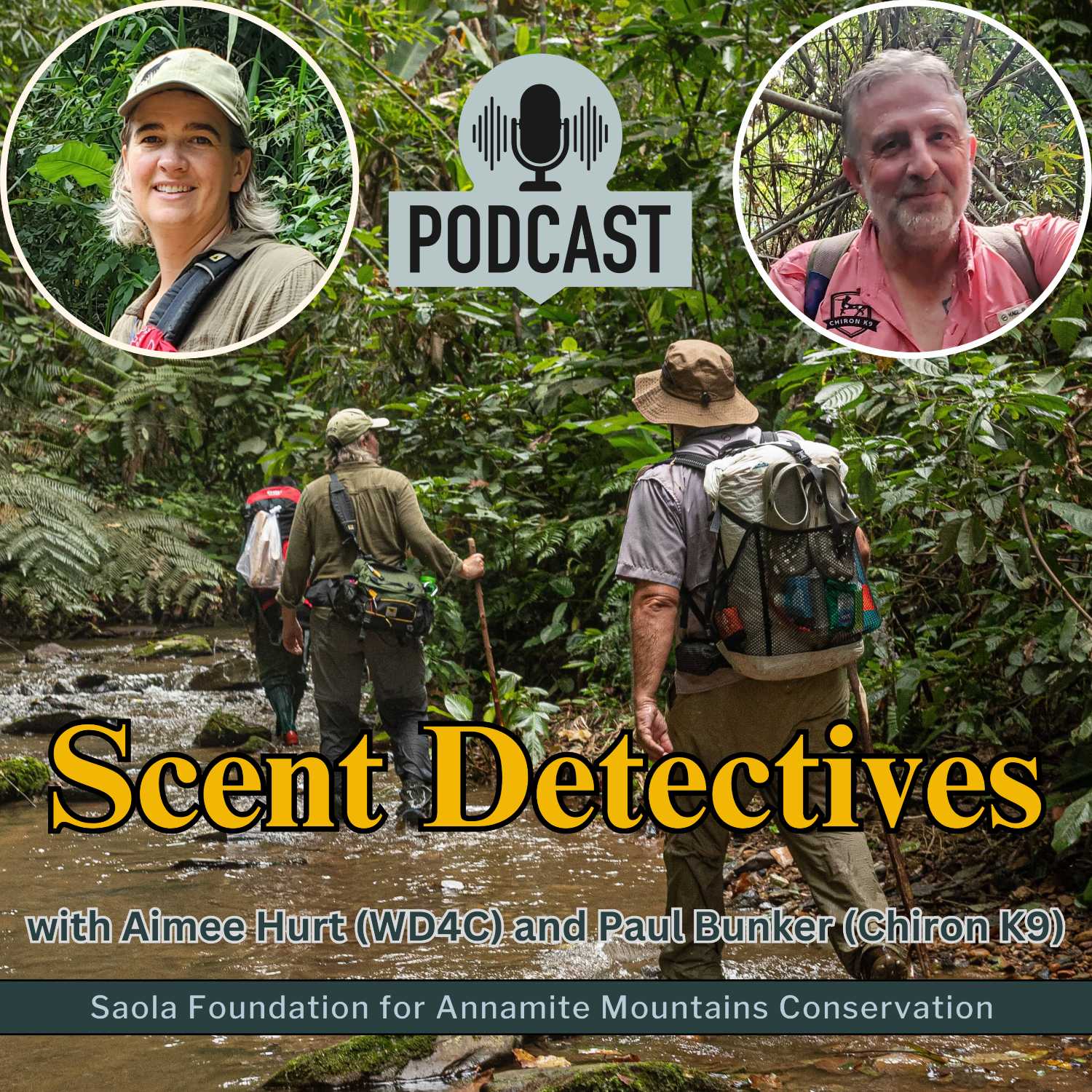
Scent Detectives with Aimee Hurt (WD4C) and Paul Bunker (Chiron K9)
44m 48s
Amy Hurt and Paul Bunker discuss their work with scent detection dogs, focusing on the challenging saola conservation program in Laos. Amy, co-founder of Working Dogs for Conservation, has decades of experience using dogs to find wildlife scat globally, including in remote Cameroon forests for cross-river gorillas. Paul, a former military dog trainer, has worked in extreme environments like Canada, where he faced harsh weather and isolation. Both emphasize the extraordinary capabilities of detection dogs, such as remembering specific locations after a year and distinguishing targets by age. The primary difficulty in the saola program is the absence of saola scat for training; instead, dogs are trained to generalize from other scat types and to locate snares. The project also involves training local handlers who are new to this type of dog handling, in a rugged, remote forest. Both were initially skeptical about the feasibility of finding saola without scent samples, but now see a path forward through creative training and strong support systems. They are excited by the challenge, which pushes the boundaries of dog training and conservation science.
[Music] I'm really happy to have both of you here today. I've seen all the wonderful photos that you've both been doing at your time in LOW. And I just wanted to get to know a bit about both you, Amy Hurt and you Paul Bunker. So Amy, you're with working doctor conservation and Paul, you're with current K9. Can you both tell me a little bit about yourself and what you do? So Amy, you can go fast. Sure. So I'm one of four co-founders of working dogs for conservation. So we're a conservation detection dog organization based in the US. And we work all over the world. We started working together in mid-90s when it became possible to get DNA out of SCAT. And then we decided to become an organization in 2000. And I've been here as the field of conservation dogs rose around the world ever since. Amazing. And how about you, Paul? I started my dog career dog training actually with my father before I decided to join the military as a dog trainer. I served 22 years in the Royal Army Retten Recall of the British Army. And when I retired, they asked me to move over to the US and set up an off-leash detection program for the Department of Defense. That was primarily to support Iraq and Afghanistan. So I did that for seven years. I think it was. I took the, then I went up to North Carolina joined the program up there training, comeback tracking with K9s. Was program manager for handler training for the Marine Corps and then. Research and development in K9 detection for office and naval research became the director of the school up there. And after a year decided to branch out, start my own company, which was nearly six years ago. So now I concentrate as a consultant and trainer in detection and happy to have partnered with working dogs conservation on this project. Amazing. Thank you. So first question I want to ask you both is what are some of the most challenging cases that you've worked in a size from now? So you can do it. First thing me. Yeah. Sure. Yeah, because with your military background, you're probably going to best me and in whatever my answers are here. I've worked in Cameron looking for cross river gorilla. Dung and that was very challenging and shares a lot of. Commonalities with with Lao in terms of remoteness and you know the hot. You made an environment with with dense forest and their. Similar thing, you know, you're it's it's remote and if a dog or person gets injured, it's going to be a while until you can get help. And you know there's some wildlife there to be concerned about the gorillas for one and green and black mamba snakes. So that that probably tops the list. Yeah. That sounds quite interesting. And then how about you pull. Yeah, I mean in the military, obviously we deploy to less friendly places. And I was always part of the canine community. So you know we would go out to these countries and sport military missions. But funny enough, I think the most challenging experience I've had was Canada of all places. And that was in the recent past. We were up there for four months. Working six days a week and you had to deploy everywhere. I want to broke boat. Basically you were your own life support on the canine element. I mean, you were hours from a veterinarian. There was bear and moose and beaver and deer and all the hazards that we had to encounter because we were on foot along the edge of a river and actually waiting through the river quite a lot of that time. So it was more that you were remote with no real professional support system if you like you was it. So if anything happened, you had to deal with it on the ground and then extract yourselves by calling it we had satellite phones because there was no mobile service calling in emergency boats to take us back to the nearest town and those sort of things. So I think, you know, that was the most challenging overall and it covered the whole period of winter through summer, which was extreme and in the winter it was minus 10 degrees. So it was quite severe weather, you know, as well on top of everything else. So like very cold and then very hot. Yeah, mosquitoes in the summer and super hot and dehydration was obviously always concerned and overheating and then the winter, windshield and dealing with that with the dogs, you know, it was the extremes from one to the other. Okay, yeah, they both sound like very challenging places. Definitely want some help if I was in that situation. So can you both tell me what's one thing that hardly anyone knows in your working life knows about you. And so this could be whether you know, it's something that you do when you're out there that only you do. Or anything that you can think of. I think this is a little tricky because pretty much all I do in life is is work right and so I work a lot and closely with all my co workers and I've known most of them for years. So I'm pretty much an open book at this point. I can't think that there's as much that that, you know, the peak my regular co workers don't know about me. And then, you know, the nature of like this project is, you know, Paul and I met in person for the first time in the airport and Bangkok as our flights arrived. But but then you're together all the time and you know this and that you just get to talking and even if it's for these these short. Stints in the field it's all you're living together and working together and so it seems pretty you just get to chatting and knowing all sorts of things about each other. You just get get start doing things and learning from each other. Yeah. It's like a big sleep away camp, you know, it's just it's very intense time together and so yeah you get get really comfortable and you make a lot of really long lasting relationships. Which is really nice. How about you Paul, is there anything that maybe hardly anyone in your working life knows about you? I don't think professionally because you know nowadays social media and we market ourselves or at least allow people a lot of snapshots into what we're up to all the time. I only have one training partner that works with me so same as Amy was saying you know you work together all day every day. You get to know a lot about each other professionally. About goals and what you're doing etc so yeah it's kind of difficult to think of something people don't know about me my working life. One thing and this is US based that I don't think anyone within the canine community necessarily knows about me is that I'm a direct descendant of the person that owned bunker hill which was the first major battle in the Republican war. Revolutionary war, retail and bunker hill and I'm a direct descendant of one of those bunkers and actually I went up to Boston last year and visited it and they bulldoze the hill and use the this earth to make an to fill in part of the harbor from expanded so unfortunately there's nothing left of it but. That's just people wouldn't know about me yeah well that is definitely a very interesting fact for sure is a shame they are they bulldozed it down yeah bunker flats. So now I want to dive a little bit deeper into getting there a bit about sent detection dogs because I know both of you work canines and that's kind of more of your specialty so what are some of the extraordinary things about sent detection dogs. Yeah so I think one thing i'm always impressed by is is how they learn and what they learn and how how much more kind of comprehensively they're able to put together the sent picture and and the search then. Then maybe I even realized we were preparing them for in training and this is both a great thing and also something that as trainers we have to be careful of because they they are always building the this the context and the sent picture and their understanding of what the job is and so if we aren't attentive to. So we're presenting them they could take the wrong picture away. the neat.
little field anecdotes is a previous dog I was working with it. She's actually that's her painting back there. We were working in Hawaii and looking for an invasive snail and we worked to a year apart and the second year she ran up to this one boulder and started very carefully sniffing around the base of it and I looked at my notes from last year and then kind of looked around the area and realized that there were not that many snails to find in that area but that was a place that she found a snail the previous year and so she just recognized the land features or perhaps there's a particular smell in that area and there wasn't a snail there of the second year but the way that she approached the boulder and searched she was like oh I remember there should be a snail here and so you know that was just a good demonstration of how she had kind of encapsulated that training in her mind and you know really having that great place memory a year later was just pretty impressive. Yeah, that is very impressive. It's a way where you can tell if they remember the wrong smell or the wrong idea of what you want them to be able to find? Can you tell quite easily or is it only when you start searching? You realize actually they're not trying to they're not finding what you want. Well you can see the you can recognize difference in search to behavior like there search behavior looks different when they're searching for a trained target versus say maybe there's birds in the area that would be interesting to a dog or there's other dogs and and they're just kind of having general dog interest. You can recognize that behavior but otherwise it might be when they find a target if it's not the right target at that point you would realize hang on somewhere along the way we trained them to also include this other similar target for that sort of thing. Thank you and Paul can you also answer what are some actually things about sent detection dogs? I've been training dogs for 40 years now actually professionally and you know in those 40 years training or coaching or how we approach guiding dogs to what we need them to do is change considerably. You know when I started it was very much ask make the dog do something good boy pat it on the head you know when it was very kind of compulsion based without compulsion we didn't use checkchains or tools to train our dogs but at the same time you know we didn't have this huge understanding that exists today about animal learning and dog training and over those 40 years I've seen a huge shift in the way not only do we train dogs but our understanding of the capability and I think conservation in particular has pushed the boundaries of understanding of dog training because you know we've trained explosive detection and narcotic structure detection for decades and conservation work really has been in the last two decades maybe started to push the boundaries because it's not standardized work you know the the board spectrum of the odyssey looking for whether it's a reptile which actually is trying to evade being found so you have something that's no longer passive something that sat there to you found like marijuana you've now got something that's actively trying to get away from the dog and disguise itself on being found or invasive plants in a field of plants or you know so many examples now of where we have to really push the boundaries of our understanding of the capability of dogs with that as well I do a lot of supportive research with universities and we're really starting to tap into that understanding of just how incredible the dogs are and how we can use that capability and hone it to exactly what we want and all the time I get amazed even after 40 years of just what we can ask the dogs to do and how they can do it now recently I completed a project where the dogs had to be able to tell the difference between the same target based on age and that was the only difference just age and they did it 100% there was no question that they had the capability and we've deployed these dogs into the field it wasn't just lab-based they're able to go out there and actually search in area and dismiss the same targets because they're old and only respond on fresh examples 100% of the time no question and it's just things like that that I think one conservation is giving us an opportunity to actually push those boundaries because we need it and two it gives us an opportunity to actually challenge the dogs and see at what point can't they keep up with us and at the minute they're way ahead of us in what they're capable to do I think it's our imagination as humans that's holding us back or maybe just the lack of confidence in just how good these dogs are so I think that's the thing you know the extraordinary thing with the scent dogs is we don't know how good they are at this point but we learn in a lot. Well that's really fascinating and hopefully we can do so much more in the future as well with them. What do you think is the hardest part of the program to find salad and with these dogs? I think we're both going to have the same answer I'm sure is the fact that there is no salad scat available for us to train the dogs on you know and that's a huge challenge because typically when you train a send over the detection dog you use the scent of the target you want you associate it with a positive reinforcement a toy a treat combination whatever it is but something pleasant you teach the dog a behavior of what it's to do when it smells that item and that's how we train the dogs in this case there is no salad scat so we don't have that whole step which is a very important critical step in training the dog locate salad scat we don't have any scout salad scat so to approach that what we've done is we've or we are teaching the dogs to what's term generalized this is where we give them examples of similar type scats that are held in captivity and there's been lots of organizations zoos and foundations within the United States that have shipped different scat tours and we've been training the dogs on these different examples of scat the idea is that when they go into the lalforist that they will respond that is give us an alert on any example of scat which is located in the forest then that could be pig deer anything that they come across but hopefully also saula because they've learned that any scat within this environment could lead to me getting to play with my ball or get a piece of cheese or whatever the reward is so that is for me you know that is definitely the major challenge there is a secondary challenge that which is snares which the locals deploy in the forest they are significant snares because they're trying to catch large mammals we were fortunate that we were able to confiscate some from the forest area during our reconnaissance mission that Amy and I went on to late last year and I brought them back with me and we've been training the dogs to actually locate the snares but when they locate the smell of the snare they stay back two or three feet from it but it allows us then to actually find these snares and confiscate them in the field or the handlers will without the dogs being at risk from the snare so that was kind of a secondary thing but the primarily because we're looking for saula scat it's the fact there's no saula scat. Yeah I can imagine that's quite hard to kind of train what the order would be that they're trying to find yeah um definitely um what about you Amy what do you think is the hardest part of this program or would it be the same in that this day? Yeah well I totally agree with Paul um in addition it's the kind of the intensity and remoteness ruggedness of the environment combined with the um you know the missing component of the saula scat to to actually train with in addition we have um handlers who are very keen learners but absolutely brand new to this type of relationship with the dog and so all of that like this is a complicated um demanding endeavor and it would be for any of us with decades of training and handling experience and we're bringing on you know a team of new handlers so having to learn those skills in a very complex and environment with um like a tricky scent picture it's a big it's it's ambitious
And I think that's why we put together with Salah Foundation, a dog team leader who's come over to the States and she's done some training here. We're going to have remote support for the teams. These check-ins will go back to the field and visit. So it's just layer upon layer of support and continued communication to really help these new handlers work on a really complex project. Yeah, definitely. And definitely with the social rugged terrain, it's a little harder to find where to go and work with the dogs as well. What did you both think when you approached to work for the Salah program? Have you heard of Salah before you were approached? It was probably a decade ago that we were first approached by, I don't know who it was, because it's my coworker, Alice's job. She feels these initial inquiries. So I can't remember what organization came to her and said, can we find Salah? And at that time, getting back to Paul's point of this field of conservation, we're learning how to do this and how to work with the dogs all the time. And 10 years ago, when we were approached, there's no Salah. We can't have scat, we can't, they have the scent glands around their eyes, but we thought that might be an interesting target to work with. But again, no animals, so we can't access that scent either. And so at that time, we thought, it's like looking for bigfoot. We have no samples. We can't train the dogs to find it. So sorry, no, we can't help. And I think just the diversity of our gets we've worked on since the additional understanding of how dogs of old-faction work and how they learn that other entities have worked on, of the fresh blood and ideas like Paul coming into the field. I think all of that meant this time when we started talking with Salah Foundation. It was like, yeah, this is a big ask. We're going to have to creatively go about it, but there's actually sort of a plan of action and a path forward that we could see. Yeah, definitely. It is definitely a big task. And how about you, Paul, what did you first think when you heard about Salah and the program? I'm thinking it must have been 18 months two years ago that Mark from working dogs conservation called me. Maybe 18 months ago or little less. And said, hey, we've got this project, you know, just kind of sound route, would you be interested? And the initial discussion was very short and brief. It would be in Lough. There's no target to train the dogs on. You'll be training local tendlers. Do you want to go? And you know, at that time, it was one of the list of these really interesting challenging projects, but you know, a quick phone call and then you don't hear for quite a few months and think, yeah, that's gone away. But then, you know, things started to escalate and we need to copy your passport and his some tentative dates. And I started to realise that actually this is real. You know, he's going ahead and immediately I was excited because, you know, it's a huge challenge for me as a dog trainer, which I really enjoy. But also for the dogs, you know, and like I said, we're pushing the boundaries all the time and there's another example of something where we really need to push the boundaries of our understanding of dog training and training dogs, etc. So, yeah, I was really excited when I heard about it. I'd never heard of a cellar. Of course, I had to Google it, you know, when things started to get a bit more serious, I had to Google where I was, you know, and try and get some background information. But at the same time, yeah, hugely excited at the challenge that this project is offering. Yeah, it definitely is such a unique opportunity. And one that would be really rewarding once we find the cellar. So I wanted to know some of your experiences, they love because both of you last year went to Laos with the candidates in the forest. So I wanted to know what surprised you the most about working in Laos, especially for example, you poor, you had to Google it, you didn't know where it was on the earth. I mean, there was several surprises. I'd never been to any Asian country prior. So all my understanding of Asia was the internet and films, etc. I landed in Bangkok and I spent a night there, then flew over to Laos and then I come remembering me. We spent three, four weeks in Laos, I think it was doing various tasks to support the mission, you know, cleaning information and going into the forest for several days and seeing the actual train and what we'd be doing. I think for me, the biggest surprise and, you know, I don't know if surprise is the right word, but it's just how friendly the people are and how helpful they are. And, you know, everyone just wants to help each other and look out for each other. And they were just super, super friendly, happy, you know, easy to get along with and pair in and ensuring you're always all right and looked after. And, you know, that was such a breath of fresh air for me to go into that sort of culture and just have that total friendliness and happy culture that I found anyway. That's wonderful. How about you, Amy? What's probably the most about working in Laos? I think to find how much tourism was there. It was just unexpected. I've been to other countries that sort of aren't on the map of tourism and granted. So it was really neat to be mostly like the, a lot of European tourists in the Vantian and at that time, not yet Chinese tourists. We heard the pandemic still having things close down. Someone said, you know, this is really interesting time because the Chinese tourists aren't here. Normally, they would be. But so it was just kind of neat to just think about how this is on somebody else's radar for tourism. But also the food, which I love and I didn't know how kind of similar I was more familiar with Thai food and Vietnamese food. And so I expected some similarity. But I didn't know that it would strike me in this like happy spot. But the way that that Thai and Vietnamese food does as well. And so that's really welcome. I think sticky rice is one of my favorite things. Favorite foods ever. And so to get to have that all the time. And when we were in the fields, you know, to come back to a big, a big, um, serving of sticky rice every day was, was great. And really welcome because it can be really helpful to have like familiar, comforting food when you're in a new place and when we're in the forest, you know, things are rugged and you just, you need to be satisfied with what you're eating. And you know, if you're in a place where the food doesn't work for you, it can be an extra challenge. So that was a really nice surprise. Yeah, food is definitely very important and it's good to have some comfort food. And so that's really good to hear that. It was really yummy and you loved it. So some more experiences of Lao. And if you could change three items of your fill kit, what would it be? Well, I'll follow on because I struggled eating out there one because I can't eat any spice. Being English, you know, we're not used to those sort of foods, but actually it makes me sick. In different ways, you know, I can get a very upset stomach, my face will swell and different. So I have to be very careful and, you know, a lot of the Lao food did have spice in it. So that limited my diet capability. So I think one of the things I'm going to take is and I liked the Appalachian Trail a few years ago and had similar sort of issues even in the US. And I ended up, it's a powder that you mix with water and it gives you all the vitamins and nutrient that you need plus calories. So I'm going to take that as part of my kit so that I have some boost in my nutritional requirements while we're living in the forest particularly. Because I think during the next phase, we're going to spend a lot more time out there with the dogs actually training and doing the work. I also wore boots and at the time of going there, I didn't realize that to get into
forest you had to wait up three kilometers of stream and then every day you're waiting up and down streams because that's part of your easier access points. So I was actually in boots, proper big boots and they are not suitable for that sort of terrain. So I'm going to change them out and have more like a sandal type boot that is more suitable for the water crossing and the use in the entry and exit points of waiting through the streams. And the final one is leeches. There was a lot, a lot of leeches and I was prepared for mosquitoes and I had body nets and everything and there was no mosquitoes. It was leeches that were the worst part and you know at one point I think the first night in my hammock. I found five leeches on me and one was stuck on my face and then on my beat and so I'm going to leech proof a lot more. I'm going to get the leech proof socks for when you're waning through the streams try and prevent some of that but yeah some sort of leech proof equipment instead of mosquitoes. Yeah but it definitely sounds essential especially with all the leeches. I've seen that I think Lee Dottridge had to buy these really fluorescent yellow socks just so that you can try and get them off his legs. How about you Amy? So I'm going to bring my own power bank this time. Luckily Paul I had a high capacity one so he could recharge his phone and and mine but I'll be a self-sufficient this time because I found myself wanting to take a lot of photos when when we were you know deployed for the day by hiking around but then back at camp too I was finding insects and following that I was just like taking photos and videos all the time and so really kind of wore wore down my my phone. I'll second the the leeches. I think my plan for that is that I didn't I didn't have any benedrill on hand and the leech bites make me very itchy so that would be my plan is to to help have both some some ointment and some pills I can take to to try to minimize how much I react to the leeches and then I think I would like a maybe like a hammocky sort of chair something with a back that I can rest on in in the day at camp. The the guys made these awesome chairs out of like bamboo and stacks of rock and they were really comfortable as both like a stool and also worked great as a table but I just found after hiking around for the day I wanted to be able to lounge a little bit and then I would think well maybe I'll just go in my hammock and then I'm like no I'm in my field outdoor damp clothes I don't want to get in my bed with those clothes I don't want to change and so you know I was like I just need maybe sort of a string chair the hammock chair with a back all a little bit to luxury you know but now now I know better. Yeah but definitely essential especially if it's a long expedition they're a little help so I want to wrap up with some technical questions Paul so you are developing a SCAT ODA collection device can you tell us a little bit more about why you're creating this device and what it can do. So the idea with this is that when we do found SCAT is going to be in limited supply or potentially you know hopefully it will lead to more and more but initially limited supply and to concentrate on training the dogs on the SCAT because as soon as that SCAT is found we're going to really push that hard on the dogs and get their nose to understand exactly what it's like. If we keep placing out that limited amount of SCAT in the forest floor something to train the dogs it can compromise the actual smell partly because parasites bacteria moulds start to interact with the SCAT and actually destroy it and each time you plant it out and pick it up you know you're affecting it either by transferring some ODA onto it from you or the environment but also it's starting to dry out because of the environment and it's the moisture that we want. So the idea is that we can place the SCAT in a sealed jar and it has teflon tubes out of it it's run by a battery powered positive air pump and what it will do is allow us to pump air into the jar and pump the smell of the SCAT out onto gauze which we present to the dogs instead. So the dogs will receive is the headspace we call it the smell without having to take that SCAT out keep planting it and messing with it and destroying it. So it's hopefully will give lots of exposure on the SCAT over time while maintaining the integrity of the limited amount of samples we got until we get to a point where obviously we find in plenty of SCAT samples and we don't have to worry about that. So I developed that device it's based on prior devices I've developed and it all stems from something called an olfactometer which is a canine research device that Texas Tech University Dr Nathan Hall and his team built and I have one in the lab and it's kind of a very much condensed battery powered easy packable version of that so it's a proven concept that we'll take into the jungle and actually use with us or the handlers will depending when the first SCAT is found and actually continue the training and that's the reason that I actually built that device and I'll be taking it to lay out with me. That's amazing how long does it take for smell to disappear or dissipate from a SCAT that's not in the device and how long can the device keep the smell? Well that's a depends question and there's lots of those in dog training because the environment the climatic conditions the interaction with insects and when Amy and I was there Amy set up an experiment where she planted different scats out and beetles came and dispose of it I think some of it within 12 hours and then some longer but very quickly they start to process this down and pull it into the ground so it can be very short amount of time or SCAT can sit there a long time you know it depends what environmental factors are actually interacting with it. Within a sealed jar then I mean it can last a long time the where he is mold starts to grow if there's any mold spores that are on it before you seal it in a jar and also it starts to ferment you know and it can cause issues and until we actually have some cellar and start to put it in the jar and see how long it lasts that's difficult to say. I mean I hope that any mold sport that is introduced can be controlled and that actually is molded within the loud environment so it's something that would be part of the scent picture anyway but these are considerations we have to look at as we start to use the device and actually experiment with it. The SCAT could be dried some you know to help out that process and start to age it as we go along so yeah there's a lot of depends in there because we don't really know and the environment is going to act depending on the time of year you know I think with time of year we're going it's a lot of rain is happening and that's going to affect the SCAT that's been dropped as well if it's getting washed out or heavy rains on it. Yeah definitely definitely a lot of factors for sure and thank you and Amy you've been in some amazing places with your dogs where are you off to next in your detection dog work. I make a visit colleagues in Alberta Canada we mentor their program and help them get get started and and their dogs are working now on invasive muscles and feral swine but mostly by design apart from Lao I'm not going on any big overseas projects this year and that's that's by design because my retired dog Lily who is 15 years old and she likes to be around me I like to be around her she worked until she was about 13 and now has been enjoying an active retirement but you know I won't have all the time in the world left with her and so we've we've kind of worked my my work plan that I get to drive most places I go these days so Lily can come in tow and yeah so apart from from going back to Lao that's that's my big exception I'm gonna stay close to home stay close to Lily. Yeah that sounds good and it's good that she's enjoying a nice retirement and then the last question that we have is um when are we going to find out for a seller the big question I think that's one where
We'd hope to find it soon, but there's so many different factors that can happen. It could be luck, it could be sent to Techion Dog, it could be one of the handlers. We're about when do you hope to find the first hour on the 2-year mission? Do you think is most likely? I mean, the hope is the last week that I'm there, I'm also lost with the dogs. That will be the hope that very early on we proved the capability and I'm there to witness it. But I think as a dog trainer, particularly on a project like this, where canines have never been trained to find a sailor, or in this environment, and there's so many challenges, etc. That any opportunity to prove that the canines can actually support the mission and locate sailor skat and actually push this whole project forward. At any point, will be a massive leap forward, but also, you know, it's just an excitement that I think only dog trainers that actually do this know what it's like to have that first fine and just everything's proven and the dogs are doing what they should do and capable. So I'll be happy at any time, but it would be nice to be there when it happens. Yeah, definitely. Yeah, I bet. I second that ball. And also, I really, I do love the multidisciplinary approach to this. You know, people in the field, trackers, dogs, of course, there's the extra challenge to the sailor moving around, right? So, so it's not like a static thing that we're looking for and we could grid through the forest and find it because it won't move. You know, we could be moving this outlaw could be moving, but you know, tracks and skat will persist at least for some time in the forest. So we have a better chance of zeroing in on them. And I do feel like in the, probably 40, some different conservation targets I've worked on, I feel like there's a bit of a pattern for the beginner luck. Like you sometimes start out, start out hot and you think, oh, this is we're going to find a lot. And then sometimes it's like you find it right in the beginning and then you don't find it again for a while. So I think there's, there's a, the universe has given us a precedent that sometimes early, early in the process. Is when you get lucky or when you have a visitor who has not usually been a part of the day in a day out search, a good luck charm comes, comes and visits the, the program. So if we don't start finding sell out, we'll have to start organizing good luck charms to go visit the teams in the forest. Yeah, definitely all the good luck trans all fingers crosses. Thank you, both Amy and Paul for being apart this Q&A. Can you both tell us where we can find a little bit more information about what you're doing? And if it's like on social media or website, Amy, would you like to share us what information that would be? Sure. So you can find our website at wd4c.org and that's the number four. And you can also find us on Facebook and Instagram. And yeah, we'd love to hear from people and know you're out there crossing your fingers and rooting for us and that's endeavor. Yeah, and Paul. Yeah, Instagram is my main source of snapshots of what's going on. And then sometimes on my business Facebook, both Shaion K, the number nine. And I, you know, I do post quite regular on those. And obviously when we're in now, we'll be posting regular as well. Thank you. And if you go to Paul's right right now, look through it and you'll see Norman and Bertie, the dogs who will be going to laugh. So if you want to see what they look like, they're there, they're on social media. Yeah, I'd recommend it because they're very cute as well. Thank you, Amy and Paul. And if anyone's interested in the Salah Foundation, you can go to www.salahpandation.org to find out more about what we're doing and sign up to Andy's letter. [Music]
Podcast Summary
Key Points:
Amy Hurt co-founded Working Dogs for Conservation, using dogs to detect wildlife scat (e.g., cross-river gorillas) since the 1990s; Paul Bunker, a former British Army dog trainer and consultant, now partners with her on conservation projects.
Both highlight remote, challenging environments—Amy faced dense forests with dangerous wildlife in Cameroon; Paul dealt with extreme weather and isolation in Canada, with no veterinary support.
The main challenge for the saola program is the lack of saola scat for training; dogs are taught to generalize from other scat types and also trained to locate snares.
Extraordinary scent detection abilities include dogs remembering specific locations and targets after a year, and distinguishing targets by age with 100% accuracy.
The saola project involves training local, novice handlers in a rugged, remote forest, requiring layered support and creative training methods due to no target scent samples.
Summary:
Amy Hurt and Paul Bunker discuss their work with scent detection dogs, focusing on the challenging saola conservation program in Laos. Amy, co-founder of Working Dogs for Conservation, has decades of experience using dogs to find wildlife scat globally, including in remote Cameroon forests for cross-river gorillas. Paul, a former military dog trainer, has worked in extreme environments like Canada, where he faced harsh weather and isolation.
Both emphasize the extraordinary capabilities of detection dogs, such as remembering specific locations after a year and distinguishing targets by age. The primary difficulty in the saola program is the absence of saola scat for training; instead, dogs are trained to generalize from other scat types and to locate snares. The project also involves training local handlers who are new to this type of dog handling, in a rugged, remote forest.
Both were initially skeptical about the feasibility of finding saola without scent samples, but now see a path forward through creative training and strong support systems. They are excited by the challenge, which pushes the boundaries of dog training and conservation science.
FAQs
Working Dogs for Conservation is a conservation detection dog organization based in the US that works worldwide, co-founded by Amy Hurt and others in 2000.
Paul served 22 years in the British Army as a dog trainer, then set up an off-leash detection program for the US Department of Defense, worked with K9s in North Carolina, and became a consultant and trainer in detection.
Amy worked in Cameroon searching for Cross River gorilla dung, facing remote conditions, dense forest, and hazards like green and black mamba snakes.
Scent detection dogs can be trained to distinguish targets based on age alone, such as fresh versus old scat, with 100% accuracy, showing their capabilities exceed human imagination.
The hardest part is the lack of Saola scat for training, so dogs must generalize from similar captive scats, along with challenges like snares and a rugged environment.
The dogs are trained to locate the smell of snares and stay back two to three feet, allowing handlers to find and confiscate them safely.
Chat with AI
Loading...
Pro features
Go deeper with this episode
Unlock creator-grade tools that turn any transcript into show notes and subtitle files.
 PodcastTranscript AI