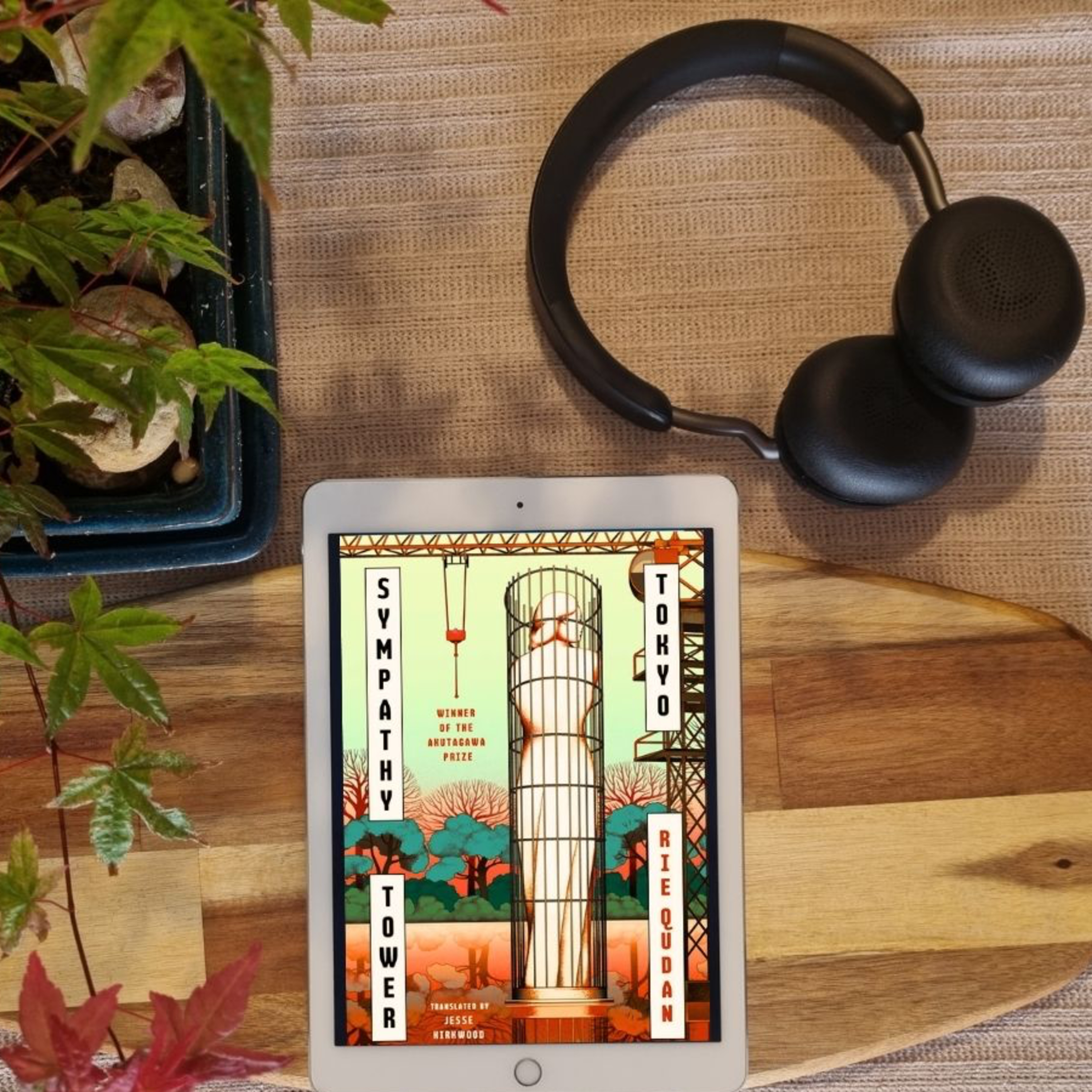
Hi everyone and welcome back to the Reading Materials Podcast, a podcast in which two friends read a book and then get together to talk about it on the show. My name is Nasea and my name is Corey and I know it's only been three days since we last recorded but how have you been in those three days Corey? Yeah not too bad thank you. I am in a different place again. We're at my grandparents, we're at the boys' grandparents house, my in-laws and so you will hear Edward yelling in the background if the magic of Edison can't get that out. Not much to report really. Well I read a book and did some drawing and did some parenting. That drawing that you sent me the other day which now I'm going to tease the listeners because they obviously have no idea what I'm talking about but did you draw that on the iPad or by hand? No it was by hand. Very nice thank you. If you would like to put it on our Instagram so the listeners can see what we're talking about then you can do that. Sure yeah okay. Are you doing some sort of a challenge or it's just for your own actually have been trying to do a sketch a day since for the last couple of months because my normal creative outlet is knitting or sewing and we don't have enough space in our house at the moment for me to get all that stuff out with the children's stuff everywhere and I was finding that in the evenings I was just going nuts because I was just sitting there playing games on my phone while we were watching TV and that doesn't work for me. So I've been trying to do a sketch day and I've got so much better in the 60 days. Yeah it's an app that is literally called Sketch a day. It gives you a prompt so like the prompt for the one that I sent you was bikini. Spoiler alert it's a picture of a woman in a bikini. It was a vintage advert from 1947 because I objectification of women and blah blah blah. Like yesterday was sip so I did a picture of a sparrow having a drink. Ah you're so talented boring and yeah it keeps me out of trouble. Yeah I was always amazed at your creativity you always seem to find the time to do all sorts of things and like I'm struggling just to keep my head above water with the reading so in the evenings I actually usually if I have time to read in the evenings I start at like 10 or 11 because by the time you put the child to bed you eat your dinner you clean up because inevitably there's a mess everywhere and I just can't take it anymore. Yeah reading time is like an hour before bed. Yeah it is a bit of a struggle isn't it? We're both kind of really in the thick of it at the moment. I think we are yeah it gets easier so they tell me yeah if we didn't have Philip my life would be a lot easier from I mean that sounds terrible I love Philip's pieces don't want to but Edward I understand. Like Edward goes to bed he's in bed and it's earlier than it used to be and he does a lot of independent play during the day he doesn't require as much supervision and you've got a new walker as well so you're going to be really like keeping your eye on her all the time but when she's more confident you'll feel less like you need to keep an eye on her and it will get better. Yeah until we decide to have baby number two in the next week. We'll just ignore that for now. Yeah okay amazing I'm still at home we are going to visit my parents tomorrow and where is that in the Netherlands they live in the Netherlands now so we're going to the hague for a week. My grandmother is going as well so Percy's great grandmother will be there looking forward to it she'll get to spend loads of time with grandparents and great grandma and Dres and I will be working the whole time so not really a holiday for us but still a change of scenery. Yeah. Changes as good as a rest. Lovely so we're recording a little bit earlier than usual just because I was hoping to get this in before we go so that we can still publish episodes every week until we clear our TBR. Yeah I'll never do that. Yeah no we'll never do that. Today's episode is another advanced reader copy review. This time we're talking about sympathy tower Tokyo by I hope I'm going to pronounce this correctly. Rie Kudan I think so. I hope so. I'm sorry if I butchered that she is a Japanese author right? Yeah and we were very kindly sent this advanced reader copy by Penguin. The book came out three days ago I think at the time of recording so on the 21st of August yeah we're recording is the 24th of August so by the 10th this episode airs it will have been out for a week that's the translated work that was just released. The book itself in Japanese I think was released maybe a year ago because yeah 2023 so two years ago it has already won awards. Do you want to tell us a little bit about the author? Yeah there's not loads about her and the so I had a look at the Wikipedia page and then all the links that led you off Wikipedia were in Japanese and my laptop really struggled with translation so basically what I have found is that she got her first sort of prize for writing in sixth grade which I assume was for one of her assignments. She worked as a laboratory assistant when she graduated from university but I'm not sure what she studied or what kind of assistant she was and this was her third book. Her first book came out in 2021 I believe and it was all about music I can't remember what the title was and as you say this novel came out in 2023 and has won the Akuta Gawa Prize which has the sort of premiere prize for literature in Japan. We'll know now talk about it in a minute but the book was written partly using AI. There's a bit of confusion on the internet about where she announced this but some sources say at the awards say many for the prize and others say at a press conference but in any case she announced it I believe after she won the prize so there was a bit of a controversy because that came out and obviously having won the best prize for literature and then saying that you'd used AI to write it was a bit controversial but yeah I mean we'll discuss that element of it shortly that's all I have I'm afraid the native form of her name is Kudan Riyue I think. And the book was translated by Jesse Kirkwood and they have also been awarded prize for translating and yeah translated into English I'm assuming into English yes yes translated into English by Jesse Kirkwood yeah okay I don't know if there's other translations as well into other languages there are other translations I shall talk about that shortly oh okay excellent wonderful yeah lovely thank you again to Penguin and Viking for sending us this it's a very short book it's only 133 pages which is why I cheekly asked if we could sneak it in earlier than usual and for those people who have not read it yet please be aware that we will be spoiling the entirety of the book in this episode so if you don't want to be spoiled go and read it or listen to it the audio book is already out as well it's also very short it's just four hours it's available on audible and through Spotify premium for those who don't want to pay for an audible subscription do you want to read the blurb or would you like me to do it I can do the blurb so this is the blurb from Goodreads sympathy tower Tokyo by Rie Kudam welcome to the Japan of tomorrow here the practice of a radical sympathy toward criminals has become the norm and a grand skyscraper in the heart of Tokyo is planned to house wrongdoers in compassionate comfort sympathy tower Tokyo a claimed architect Sarah Macchina has been tasked with designing the city's new centerpiece but is driven by doubt haunted by a terrible crime she experienced as a young girl she wonders if she might inherently disagree with the values of the project which should be the pinnacle of her career as Sarah grapples with these conflicting emotions her relationship with her gorgeous and much younger boyfriend grows increasingly strained in search of solace in need of creative inspiration Sarah turns to the mowing words of an AI chat spot awarded Japan's highest literary prize sympathy tower Tokyo is an extraordinary novel from one of the most exciting new voices in world literature partly inspired by conversations with an artificial intelligence it offers an extraordinary defense of the power of language written by humans a touching exploration of the imagined to impulse and an often hilarious send up of our modern world
relenting conformity. Unrelenting conformity. Relenting conformity would be weird. Yeah okay before we get into our thoughts, already I want to talk to you about something which is the blurb itself. Do you think that is an accurate description of what the book is actually about? I don't know. I don't know myself what I think the book is about if I'm really honest with you. And the reason I mentioned that there were other translations is because I as I do took to the good read reviews. There was somebody who'd done a review and they'd read it in Italian and then somebody else who'd read it in some other language maybe German and they had different interpretations again and they sort of clarified some things that I hadn't maybe picked up on. Given how much this book is about language I'm really wondering how much it changes each time it's translated and by each person who has read it because although it's only 132 pages it contains a lot. Yes. Yeah I was a little bit disagreeing with the blurb because I think it's a little bit misleading. So when we start the book she hasn't actually been tasked with designing the tower. She's only going to put forward her application like her design for public tender I guess for a committee to then pick the actual design for the building. I also didn't feel like she had a strain relationship with tact at all. No. Well I mean okay yeah we'll get into the the details and the dynamic between the two of them but I didn't really feel like there was a real strain in their relationship or that that was a central theme of the book and I also didn't feel like she turned to the AI chatbot for creative inspiration. I think she turned to it for different reasons. So yeah I just found it a little bit misleading when I read the blurb actually after I had read the book because when I read the blurb before we got the book I thought the book was going to be somehow about her starting a romantic relationship with an AI chatbot which I thought oh that's very timely you know AI is everywhere now chat GPT is all over the place. But yeah so that was my first thing stepping away from that then. You said that you weren't quite sure what the book was about. Did you like it though overall or what were your overall thoughts? Yes I did really like it. I think it's so different to anything that we've read recently which I do tend to find with all the well all the Japanese books we've done. I've read a few translations recently. Yeah it was really interesting food for thought. I made the mistake of having a couple of beers before I started reading it and as a nursing mother don't judge me too harshly. I haven't had that much beer for a long time so I was looking at my notes afterwards thinking what was I talking about but it really basically every page or every section fled up something in me which you know it's quite unusual these days. Yeah I would agree with that. I think I even messaged you this. For the first time I wish I was the kind of person who could annotate their books. Yeah and I mean obviously I could if I really wanted to but I just can't physically make myself right in a book that I own. So there were so many parts of the book where I was like oh I wish I could just underline this so that I could bring it up when we when we talk about it with Corey because as you say it is very different to most of the books that we've read but definitely very different to the books that we have read recently and I completely agree I find that with all of the translated works that I have read and I have only read a few they have all been by Asian authors and there's just something so different to the themes that they explore and how they explore them it feels more raw it feels more unfiltered and uncensored I feel like a lot of the western books that we read almost like they sugarcoat things or they just wrap it up in in a nice little way that doesn't make you uncomfortable when you're reading it whereas I find that with Asian authors that I've read they don't shy away from the messiness of humans and life so I really enjoyed it I had a really good time with it I think it's the kind of book that I hope I will get to reread maybe listen to it I read the physical one this one this time and yeah I'm very curious about where our discussion will go to because as you say very short book but packed full of things to talk about yeah so where do you want to start let's do the main character who was Sarah Sarah yeah how were you saying it in your head I was trying to give it a Japanese spin but I think I would just call her Sarah yeah well actually before we do that let's talk about the prologue or the forward introduction whatever it was it talked about the Japanese language which I found really helpful yeah so there are the three systems kanji here are gana and katakana and the two that were talked about in here were kanji and katakana and kanji is the pictorial where each character has a meaning that will change depending on the context and the characters around it whereas the katakana is phonetic and is used for a lot of the English words that are creeping into the Japanese language that was really interesting I didn't know that and it also had a guide to pronunciation with the O with a bar above it which has pronounced O and then a normal normally written O which is an O that was so helpful it meant that I could read the book without worrying about all of that so for context I tried to read the autobiography of Gorbachev who was one of the Russian presidents and I couldn't read it because the language was so inaccessible to me and I would say that Russian and Japanese probably on to me are equally inaccessible from the point of view of you know I know nothing about either of them and they're both complicated languages but I found this so much more accessible because there was that translation and explanation of just how to pronounce things I was saying Sarah MacKinnah because it specifically stated that you say her surname MacKinnah well actually I couldn't decide between Sarah or Sarah I've got two friends which I spelled Sarah with an H and Sarah without an H and so I was sort of wobbling between the two yeah I found the four word really interesting as well as you say very useful and now talking about it it made me think of my experience with other languages and the only other language that I would say that I use frequently enough that has a different alphabet to English is Greek I would say that most young people I'm gonna say I don't want to be ages here but I would say the younger generation the ones who have grown up with mobile phones would probably be more inclined to use it's not its own language it's not like the three systems that you were just talking about but they would write Greek using the Latin alphabet when they're texting each other like they wouldn't change you know the the keyboard to Greek characters and then text each other that way they would make it into English so Greeklish is what we kind of call it that's kind of what I've also got used to when I'm texting Andreas Cousins who don't speak English I would text them in Greek using the Latin alphabet and therefore completely change the spelling of the words to the point where if I were to actually try to spell it we're using Greek characters I think I would struggle now it's an interesting thing to think about and I guess that's one of the central themes as well of the book about what does this do to a language when you stop using the alphabet that it's supposed to be used and you start bringing in foreign words and changing the spelling and is Japanese then still Japanese if you're you know if you're calling buildings like sympathy tower Tokyo which are not Japanese words really but yes so that's that's all I want to say about that. It is interesting I mean anybody who's been to Paris will have seen the what is it called the academy and that's really protect the French language because they're so worried about losing the Frenchness and in some ways actually keep it stalled at a certain point because language evolves but it is interesting because
I use emojis a lot when I'm texting. Texting, I think, has accelerated language a lot. But you're telling me that you're texting in Greek-lush, despite the fact that we're of that generation. I'm like, "Oh, but what about the proper Greek, you know?" (laughs) Yeah. We're in that middle generation where we had some time without and some time with. Mm-hmm. So like our children, probably, they'll have other things that are different and weird for them. But this would just be normal to them. And maybe Percy will really struggle to use the Greek alphabet. Maybe, yeah. If Greek-lush becomes a, you know, well, I suppose in school, they would use it. But I can very strongly remember sitting in a lecture with our friend Kathy, who is from Cyprus, therefore Greek Cyprus. She wrote an A, except she obviously wrote it as an alpha because that's her language. And I suddenly was like, "Oh my God, Greek people write in maths because the only way I had ever encountered Greek characters was through maths, symbolism." Mm-hmm. That doesn't really have much of a point other than to say language is such a fluid thing. Mm-hmm. And an increasingly globalized world. I mean, here we are reading Japanese novels. Mm-hmm. It's a relatively recent accessible thing. Yeah. Yep, I completely agree. Cool. Right, on that note then, tell me about Sarah. So Sarah is an architect. She's 37 years old. She's very famous. She's rich. She, I would say, has elements of some kind of being on a spectrum. She is very good at maths. In fact, she talks about herself in the past as maths girl, because she's dissociated from the girl that she was because she was raped when she was a teenager, accepting everybody said it couldn't be because it was her boyfriend. And so the fact that she withdrew consent at a particular point is irrelevant. So she grapples with that a little bit as well. Mm-hmm. She is really concerned about the use of kata-kana and the impact it's having on the Japanese language. She really hates the name, sympathy tower Tokyo. And eventually manages to get it to be called Tokyo Tor-zoro, which is suggested by her boyfriend, Taked, and that becomes the sort of popular name for it, much like the Gerkin in London probably has a proper name. I wouldn't even know it. She has a real kind of spiritual relationship with architecture. And it can really affect how she is and how she feels and what she thinks. Yeah, I was really thinking about this. I was really trying to decide is she supposed to be the way that she's written? Are we supposed to understand that she is on the spectrum? Or is the environment that she grew up in and the culture that she grew up in so wildly different from the one that I know that the way that she thinks about things and the way that she reacts? Is it just cultural? Because I feel like a lot of the books that we've read by Asian authors, the characters are written in this way. So does that now mean that they are all on the spectrum? I mean, I suppose we are all somewhere on the spectrum. That is why it's called the spectrum. Or, you know, I really don't know, because I completely see what she's talking about. And I did also get this feeling. But I'm just trying to think, am I just judging too quickly? Just because she thinks differently, does that mean that she is one way? Or is it really just a cultural thing? And from what I know about Japanese culture, they are so strict. They are so, you know, there are so many rules. And it's so important how you act in society that maybe this is just a product of that, the way that she deals with situations and the way that she thinks about things. I honestly, I don't know. So the thing that made me call it being on the spectrum, rather than cultural was the fact that she referred to herself as math's girl. And that kind of indicated to me one of the things when you're, well, I suppose when you're labeled as autistic, is this concentration on one thing and like really excelling it at the one specific thing. But you're right. It could just be me being too quick to judge. And that kind of thing is kind of on my mind a lot at the moment just because of where I am with my own children and sort of wondering who they'll be and whether obsessions are traits of autism or whether it's just a model as being toddlers. So it could just be my own cultural influences affecting that. Difficult to know. It is, yeah, yeah, yeah, because I mean, I can think back to certain periods in my life when I was so obsessed, what I would consider so obsessed with something. But I wouldn't label myself as being on the spectrum. But then I don't know. I've never spoken to anyone about it who would be able to tell me when we were the other. But anyway, that's a whole other thing. She was a very interesting character and most of the book was written from her POV so we had a lot of her internal dialogue and yeah, the things that she's grappling with are, obviously this sympathy tower Tokyo, she hates the name of you said, as you've said, because she thinks it's just not really Japanese. And also grappling with the notion of the person who designs a building, do they need to agree with what the building represents and what it will be used for? Because in this case, sympathy tower Tokyo is supposed to be a new kind of prison for criminals. Okay, we will get into what they're actually called in the book because that's another theme of the book. But that is going to be its function. It's supposed to house people who have broken the law and have been put away for punishment. And the whole point is that it's supposed to be, let's rethink how we view criminals. First of all, let's not even call them criminals anymore because it's a very negative and derogatory term. Let's give them a different name. They are now called homo-miserableus, which is Latin, yes, for sad people or people who don't have happiness in their life. And let's feel sympathy towards them because they aren't really criminals because they were born evil. They broke the law because they grew up in an environment where they didn't know happiness. And if anything, they are actually victims of circumstance. And so we should feel sympathy towards them. They never really had a choice in how their life was going to turn out. And so yes, they, let's say, belong in an institution, but the institution, as such, is this grand tower ultra-modern where they have a library on the top floor and they overlook the hall of Tokyo. And they live there for free because the taxpayers are paying for it. And they can just do whatever they want really. And so Sarah is grappling with this notion of, "Well, do I actually agree with the fact that this is how criminals will be treated?" Should I even have an opinion? I'm just the architect. I'm just here to design the building. What do I care what it's actually going to be used for? I found that really interesting. Absolutely. I think it's one of the Scandinavian countries. They do something obviously not prime real estate in ultra-expensive skyscrapers in the middle of the city, but they do have a system where it's much more about rehabilitation rather than punishment. And this, I guess, takes that to the extreme. And at the end of the book, we're now in 2030. The building's been open for six months. And there's a rule that if the homeowner's aroublers don't want to leave when they reach the end of their sentence, they don't have to. And so by the end of the book, nobody has actually ever left the tower because it's such a wonderful place to live that why would they want to? Yeah, that was quite interesting from the point of view. I mean, as a taxpayer, you could totally see people getting really cross about that. But also,
I think it speaks to the fact that you always hear about people getting institutionalized when they've been in an institution for a long time. And this, despite the fact that it's sort of focusing on rehabilitation rather than punishment, hasn't worked because they've gone so far the other way that people don't want to leave anyway. And so can you really say that they've been rehabilitated because they're not then joining or rejoining society? Yeah. And are we working towards a world where everybody lives in these, you know, enormous self-contained skyscrapers? It's a really interesting concept. Yes, I think I know exactly what you're talking about about the Scandinavian system. I remember when, because his name was Brivik, that's when it kind of came to light. He was the one who killed a lot of young teenagers in a summer camp in Norway. And he was put away for life. And then a few years later, he was, I think he sued the Norwegian government or something because he was saying that he was being kept in humane. That his imprisonment was somehow against his basic human rights, even though he, you know, if you compare it to some of the prison systems that you might have seen on TV from America, he lives in quite a luxurious facility. And so, yeah, I remember there were discussions online about, okay, this man has killed dozens of children. And yes, the Norwegian taxpayers are paying for his accommodation, which is nicer than some people live in, not in an institution, you know. And he has access to a television and he has his, you know, as many books as he could possibly want, et cetera, et cetera. And yeah, it raises a lot of questions about how we treat people who have broken the law, because obviously you have, it's also, you have people in sympathy, tower Tokyo who are rapists who are mass murderers, serial killers, but you also have people who just deal bread to feed their children. Should they be punished the same way? I would argue, no, it's not the same level of criminality. And if people are upset with their tax money being spent for luxurious accommodation for homo-missarabilists, why are they not upset about it being used for horrific accommodation for the same people? Yeah. The way that, I mean, I imagine that it is, because prisons, I think, are paid for by taxpayers everywhere, no? I don't know. I wouldn't know. I haven't looked into it. Anyway. I think another really interesting subject that you could spend a whole episode just talking about this. And how you and I feel about it. And I don't know how I feel about it. How do you feel about it? Do you know? I think I definitely agree that rehabilitation is better than punishment in some instances. I mean, I have watched documentaries about American prisons and we've all seen, or just a new black, or maybe we have an all seen, that's quite old now, but it's definitely the system that we have in Britain doesn't work because people go in for a certain amount of time. They come out again and they are really likely to reoffend the statistics on reoffence after release from prison are crazy high. I wouldn't pretend to have looked into it or to know what they are, but we know that that doesn't necessarily work. But the whole victim of circumstance thing is another element of this where if you're brought up in poverty and you are left in awful circumstances. So it turns out the tapped mother is a criminal, sorry, a homo miserables, who was housed in this building by the end. And she was, I believe, raped, anyway, she got pregnant and she was very young, she didn't want to keep the baby, but the father refused to have anything to do with it so she couldn't get an abortion because you needed the man's signature in order to do so. And as a result, she struggled to raise her child and became a, I think she was committing fraud and ended up here. For me, I think rehabilitation would be more like rather than living in luxury as if you have made it, where's the education, the being able to go back out into the world and earn a decent enough living that you don't then feel the need to commit crimes in order to get by or not even feel the need, like you have to. I think it kind of goes so far the other way, probably deliberately, because it's also sort of pointing out that we are as societies going so far towards tolerance, that we may look at somebody who's deliberately murdered people, children and go, oh, poor them, they had a poor upbringing, but at a certain point you're upbringing, surely, surely doesn't matter, like you know that what you're doing is wrong and that you shouldn't be doing it. That's just such a horrific crime. And then they're being rewarded by, in sympathy to our Tokyo, being put into this building that would cost you know, an arm and a leg if you had to pay for one of those homes. Yeah, yeah, I agree. I think this whole nature versus nurture concept in the book is introduced by Masaki Sato. He is the man who has coined the term "homo miseravillus", whose opposite is "homo Felix". Yeah, to me personally, I had a problem with these terms because, in terms of evolution as far as I know, giving different species, different names is because they are different species, as in genetically, evolutionarily speaking, they are different to each other. Correctus is not the same as Homo sapien for a reason. It's not just because they were born into a different level of society that they are inherently different to people who were born into another level of society. So I found it interesting that they went so far as to start claiming that we were almost separate species living at the same time. But I guess maybe this was maybe another commentary on what you were saying about being so careful nowadays about what you call things and what you call people because you just don't want to offend anyone. So better to just give it a blank in term. There was a mention at the beginning about what she wanted to call the gender neutral bathrooms in the building and how she had used the exact Japanese translation for it. And somebody much younger than her who was only using Kansakana came back to her and told her, well, that's not inclusive enough. You can't really use that term, that's derogatory. This is what we should call it. And she had to take a step back and say, well, actually, what would I know about what it should be called? Because I am a female. I've never had to deal with thinking about which bathroom do I go into and what should that bathroom be called. So I will leave this in the capable hands of someone who is probably more knowledgeable on the subject than I am. I feel like this is a lot of what people have to do nowadays. They want to call something, but they've always called it and then somebody will call them out and say, actually, you can't use that term anymore because it might offend XYZ people. Yeah. I mean, you know that I grapple with this a lot. Basically, every time we record the number of times I caveat and I don't know enough about this, because it is quite tricky to, I mean, you don't know what you don't know. So until you make the mistake, you can't fix it. But in making the mistake, sometimes it can be so tricky. Yeah, but I feel like I've digressed because we were talking about Sarah. Well, yes, but that's how this question works, isn't it? Yes, but I found Sarah really interesting. I found it really interesting how she thought about architecture and also how Adam and she was that there's a difference between sketches and drawing and what she actually does, which is architecture. Her whole point about being maths girl, I hadn't thought too much about it and what it actually says about her. I thought that maybe it was just her way of disassociating with herself from the person that she was before the maths Olympiad, which would be the girl who had been raped by a man. I got the impression that he wasn't actually her boyfriend. It's just that people assigned that label to him so that they could then argue that she had not been raped because society. She was interesting because she was maths girl, but she said that she had placed bronze in the future.
the mathematical Olympiates but not in the category for girls but in the mixed gender category, which I wonder if that had actually been a category or if she had just fought so hard to be able to compete against the boys that she was the only girl who had competed. I don't actually, that wasn't really clear to me, that I found interesting. But then she stopped doing maths. Why did she stop doing maths? Do you remember? I have a feeling it stopped making as much sense to her but I may be wrong. I feel like that was probably a very central thing but I was so tired when I read it last night and I don't remember. In any case, she kept talking about Zaha Hadid. And you've put her as your talking point. Do you want to expand on that? Yeah, so Zaha Hadid is or was a very famous architect. I believe she put in a bid for the National Stadium of Tokyo. In real life, it was rejected for being too expensive and unrealistic. But in this universe, it has been built. She has achieved almost God-like stature for Sarah. Towards the beginning of the book, Sarah kind of goes to the stadium and has like a spiritual experience and she wants, she realises that this is how she's going to design the tower. I was really confused and I remain slightly confused about what is real and what is not real in this book because Zaha Hadid is a real person or was a real person. I don't know. In the book, it suggests or it mentions that she's died. So I don't know if that's real or not. She has, yeah, she died a few years ago. I also then try to look at whether the homo is a raobless and homophilic thing is real and it is unclear to me because so many of the articles that I read or I caught snippets of were it looked from the excerpt on the search engine that they were talking about something and then I would click into the article and somewhere on most of them I would find sympathy to our Tokyo referred to. So I feel like that is an invention of the author. The inclusion of a real person has really changed the novel for me because it makes it that much more grounded in real life but also makes it at this moment in time we record in 2025. It makes it almost timeless because it's talking about our very recent history, quarantine, the 2020 Olympics but it's also talking about the future up to 2030 and so it makes the book feel really timeless at this moment in time. Yeah, which I thought was incredibly interesting. Yeah, I see what you're saying. Okay, so you did more research than I did because I just took it at face value that this is the reality but you're absolutely right. The actual stadium in Tokyo was not based on Zaha Hadid's design and however there was mention of the Alwakara stadium that was built in Qatar that was also designed by Zaha Hadid and that in fact is based on her real design and the funny thing was that the whole discussion about the stadiums was the fact that they look like the female genitalia and that was part of the reason why they apparently did not go with the design or they didn't want to go with the design in the book for the national stadium in Tokyo but as you say in the book they do go with Zaha Hadid's design and yeah it's but it's so funny because you only know what the stadium what the stadium might look like if you look at it from above but if you're inside the stadium like you don't know it really does look like that actually I see that you've you've google the picture of it yes but that's your resentment. That's why I wanted that's what led me down all of this because I researched this while I was still reading the book because she was so taken by the structure of the stadium that I was like I need to see this and I was like well it must be real because you know and so yeah I um yeah wow I mean I love it I want to know if her Japanese design was ever released but anyway we're massively diverse anyway we are I would imagine that perhaps the reason that Zaha Hadid features so prominently is because okay maybe this is just my ignorance of architecture but even I as a layperson who knows nothing about architects or who are the most famous architects have heard the name Zaha Hadid so perhaps she's just supposed to represent a famous female architect that perhaps people would have heard of and I guess in Japan people would have heard of her because it would have been in the news that she was the one who had designed the original stadium and as it says in the book the stadium was controversial for a number of reasons not just the fact that it was so expensive but then the fact that the Olympics even went ahead anyway even though it was the height of the pandemic and how many people got sick from COVID and eventually died blah blah blah and Zaha Hadid unfortunately this seems to have plagued her with the stadiums because she had issues in Qatar as well because migrant workers who were building the stadium were dying in the heat and for whatever reason people thought that Zaha Hadid should take some responsibility for that even though I mean she was just the architect who had designed it it I would say it's not really her fault that the conditions in which the people were working were such that it led to them dying but in any case I also know no for because she designed a public space in Cyprus in the capital in Nicosia which was also controversial and criticized and very expensive and apparently impossible to build based on her vision so it seems like she had very grandiose futuristic plans that making them a reality was not easy all the architects that she mentioned in the book are real people because when I googled their names they are real architects yeah it was really interesting the way that she thought about it the fact that the design of the new sympathy tower Tokyo should somehow play off of the design of the stadium because there are two such symbolic buildings in the skyline of Tokyo they're so close to each other they should play off of each other and she almost viewed them as a mother and a child kind of thing which I found really interesting I really wish that we had gotten the design there is a building on the cover of the book I don't think that is sympathy tower Tokyo at the end of the book she's standing looking at the tower and she's talking about a statue and I was wondering if that was the statue rather I think it's supposed to be yeah I mean up until the very last page of the book where she's talking about being immortalized as a statue and just being able to just stand there for all eternity I thought that this was going to be the tower but yes I think it's supposed to represent her as the statue looking at the tower that she has designed and was in fact built okay shall we talk about tact yeah so tact is Sarah's boyfriend let's call him he is 14 or 15 years her junior so she's 37 and he's in his early 20s 22 23 you've already mentioned that his mother is a homo miserabilist slash criminal who by the end of the book is living in sympathy tower Tokyo and she had him when she was 15 years old and because she had grown up in such poverty and with such an unloving mother she wanted her son to have a different upbringing and she was very particular about the clothing that she had been forced to wear and so her whole mission was to ensure that her son would be able to dress in better clothes but because she couldn't afford the better clothes she would steal things and then sell them online to make more money and then be able to afford to buy new clothes and he is now working as a shop assistant in a designer clothing store somewhere in Tokyo and Sarah sees him through the shop window and is immediately taken by how beautiful he is and this is one of her things as well she wants to be surrounded by beautiful things and she is willing to pay him or support him financially so that he will remain beautiful. He doesn't really. talk much because Sarah just monologues all the time, but he has some interesting questions and he seems to be quite understanding of her state of mind. I didn't really feel there was much of a romantic connection between them, based on the blurb, I also wouldn't say that there was a real strain, like it's just that they didn't really communicate in the dialogue. So I also didn't get that there was much of a romantic thing between them, and I think it's very much convenience. There's a lot of tact viewing her as his mother because she's the same age as his mother, roughly, and so he's sort of grappling with viewing her as a mothering figure rather than a girlfriend, and when we first meet him he wants to have a sleep because he's not feeling well and she's not got a twin bedroom in her hotel, she's got a, you know, one bed, so there's this whole thing of, oh, if you sleep in the bed, but I'm not pressuring you to do anything, you can just have a sleep. And then she's also talking to him and she says, this is I direct quote, "When I come across the structures aesthetically pleasing as you, it gives hope to me in my weakness, it makes me realise just how beautiful the humans can become, and then slightly further on, when you hugged me in the hotel room earlier I was very happy, and if you were to get even closer to me, for example, to enter inside me, I'd probably be beside myself with joy." That's it made me sort of, well it embedded the spectrum idea in my head because nobody talks, well nobody in my culture talks to potential romantic partners like that, but it's also her very clearly saying, this is not a transactional relationship. Yes, yes, I mean they have a whole discussion, well she monologues at him about the potential of them having sex and what that means, because she, as you say, is very clear about what she wants from him and the real, that the only reason she's interested in him is because of his looks, and so she is willing to pay him to continue looking the way that he looks so that he will be able to maintain whatever regime he uses to make his skin as beautiful as it is, and she realises that potentially they will have sex when they go back to their hotel room, but if he's uncomfortable with this because it's turning way too much into a monetary transaction as if she's paying him for sex, then they don't, that doesn't have to happen. So yes, she's very clinical, very logical about where their relationship may physically go. That's why I say that I don't think there are romantic partners in the sense of there is no real emotion, like the romantic feelings is more what I'm getting at. I'm not saying that they don't have a physical sexual relationship they might do, we don't really know, we don't find out, but I don't view them as being in love with each other is more what I'm saying. In the traditional sense that I would be accustomed to. I would agree with that. And tact, tact is the one who convinces her that if she has such a problem with the name sympathy tower Tokyo, that she can just in every interview that she does if she wins the competition and her design is the one that is picked, she can just refer to it by a name that she wants people to actually call it, which is the Tokyo dojo dojo, and that is what happens. So she just starts referring to it as that. And even though it's real name sympathy tower Tokyo, that's not what anyone really calls it. There's also the comment about Twitter and the fact that it's no longer called Twitter, it's called eggs, but everyone still called it Twitter. And he ends up working at the tower by the end of the book. He becomes one of the, oh, what do they call him? Supporter? Supporter, yes, because what are they going to call the prison guards? Because they can't be called prison guards, they need to be called something else. Yeah. So what will they be called? And yes, they come up with the term supporter, which I, again, just so interesting how what importance we place on names and titles and labels and words, yeah. Yeah. Okay, I'm going to move us on. So the language element of it, which is kind of where we're heading now, in terms of do we call them supporters, etc. I found that super interesting. There's a lot of her monologue about the Katakana versus Kange and the fact that we're using so many English words in our Japanese language. And she comes across as quite a traditionalist, but then she's using AI extensively. For philosophical reasons, more than to answer specific technical questions, which is what I would turn to AI for. And I think even by the end of the book, she has quit architecture and she seems to spend all of her time trying to make AI realize that it is AI. I thought that that was really interesting because she seems to be so change of verse. And yet she's like really engaging with AI in a way that I wouldn't necessarily expect. After the introduction that we had to her in the book. Yeah, I found the inclusion of AI very interesting as well. It doesn't surprise me that part of the book were written by AI. I wonder if the parts that were written by chat GPT or some other AI were the actual AI discussions if you see what I mean. Yes, they were. Yeah, because they felt very like what chat GPT does. And I'm not sure I have a problem with that. I don't think, oh, I know, this is going to be opening up a whole other kind of worms. Like I know what people's issue with chat GPT and AI is. And I understand I really I do and I really do sympathize with all the authors whose works were stolen and you know put into AI. I'm sure it is a discussion that needs to be had and I'm glad that it is being had. But if it's being used for a book like this in the way that it is being used, I don't necessarily think that's wrong. Well, I don't know. Maybe it is possible to write like AI by a human. I wouldn't know. I've never tried. I agree. So I think the reason it was so controversial when she first said it is because she originally said that 5% of the book had been written by chat GPT and then she later clarified that it was the elements that were the interactions with AI ball. I think it's called. I was slightly offended until I then found out the elements that had been written by chat GPT. I instantly became like okay with it. Whereas if it hadn't been that it was an actual conversation with chat GPT then it would have been more hard on it. So would I? Yeah. I find it interesting how would AI have been able to write some of the sections when they were about concepts that she had come up with for the book. So had she written the entirety of the book without chat GPT, hence introducing the idea of homo miserabilis, yari yari yari, fed that into AI and had its spew back to her the meaning of homo miserabilis. That's what I've been wondering as well. Because the first use of AI is her asking what is the meaning of homo miserabilis in Latin and its spews out an explanation. But the explanation that it gives is from the book itself. It's not a concept that has existed before as far as we know. Yeah. I honestly couldn't tell you. Fascinating. That is all I really have to say about the AI element of it. I found interesting its inclusion. It's not what I thought it would be based on the blurb that I the way that I had interpreted it. I think it's still interesting though. Maybe there is a book out there about a woman who falls in love with AI. Probably there is. What else would you like to talk about? I now have a baby in the room with me just so you're aware. How did you enjoy the jump into 2030 and the way that the novel ended? I liked it. I thought it was interesting. I had wondered how would we close off this story? Would it just be about the concept of sympathy tower Tokyo or will we ever actually see its completion? I think it was well done. I don't think I would have wanted to spend five years talking about how the tower was being built, etc. So jumping forward in time and talking about the build as a thing that had already happened, I thought was a good way to do it. She still managed to touch upon the fact that it was continuously divisive and controversial to the point where people were sending her death threats and also threatening her in public because of her role in the project. It was interesting to visit the tower. Again, I wish we had known more about what it actually looked like. I found the inclusion of Max fascinating and I wonder why the author felt the need to include a character like him. Was it supposed to be a general commentary on the western world's fascination with Japan and objectification and sexualization of Japanese women which I feel is a thing that happened.
happens in particular because the character of Max was pretty gruesome to me in some of his comments about Japanese women. Tell me about Max. Yeah, so Max, he's a, what do you call them, South of the Third Rake journalist. He's known as a racist in America, he's a beast. And he's fallen in love with Japanese women every time he's come to Japan, which has been, I think, twice. He gets the scoop somehow of being the first person to see Sarah in the flesh for, I think it's years, it might be months. I think it might have been partly a commentary on how the world, but especially America has a fascination with Japan, but I also think it served the purpose of demonstrating how tolerant Japanese society has become. Sympathy Tower is described to us as being something that is just accepted by everybody in Japan. And Max talks to a woman who's sitting on the stairs having lunch with her toddler and he says, don't you care that there are murderers, etc. in there. And she says, oh no, you know, they're home aerobics or arbours, we have to feel sympathy for them. And Max can't get his head around it. So I think it was probably to acknowledge the juxtaposition between the Japanese and the idea versus western culture, not only America. There was a lot of emphasis on skincare and cleanliness and, yeah, Max had really terrible body odor or how westernans tend to smell really bad to the Japanese people, which I thought was super interesting. It showed a level of intolerance, which was completely at odds with the rest of the message. Like Sarah makes him wash his hands before she'll let him into her room, etc. So while they're progressive in some ways, obviously there are other ways that they aren't in the novel. Yeah, I can't make up my mind. I think, again, I don't know enough about Japan and Japanese culture to really know if they do play such an emphasis on the way their skin looks. I didn't read too much into the fact that she asked him to clean his hands. It felt in line with her character. I would imagine Max is so wildly different to the people that she would interact with. And as you say, she hasn't actually interacted with another living human face to face in so long. She is just living in her hotel room. And he comments on that as well. Like he says, you shouldn't be living like this, lying low like some criminal. You ought to march straight back into the world and reclaim your place among its greatest architect. So she is herself kind of hidden away because of this huge backlash that she has received from people who so disagree with what sympathy tower represents. He was interesting. I think as you say, he was perhaps supposed to be the outsider who just doesn't fully understand the way that we don't fully understand. He's the only one who actually questions what it represents and what it has become. Everybody else, as you say, has just kind of gotten in line and said, yep, this is absolutely this is how it should be. And even the people who threaten Sarah are just we never meet them. They're just random people. I was also interested in the fact that the man who came up with the idea, Massaki Seta was killed. That was fascinating. I don't really know what to make of that scene. I was wondering if Tucked had been the one who had killed him because we're told that Tucked is a supporter, but he is living in the tower. Oh, interesting. Okay, that had not occurred to me at all. I just kind of took it for granted that he would live there because where else would he live? Yeah, it was just a thought that occurred to me as I was sort of waiting for a big reveal. Because I think that's the thing about the end that was interesting was that there was no big reveal of anything. It just kind of ended. Yes, I'm not sure that's something that many authors in our sphere ever do. And that maybe is another cultural thing. Yeah, fascinating. That had literally not occurred to me at all that it could be tacked. I'm trying to find a section in the book because he I'm talking about Max. Oh, here we go. Creating a utopia always means cutting off all contact with the outside world, same goes for dystopias. I thought that was a very interesting line. They ban comparisons. You're not allowed to say X is better than Y. Yes. And it was giving me real big brother vibes. Have you read Big Brother? You mean 1984? That's the one. 1984. Yes. Yes. Actually, yeah, I would liken the ending of this book to the ending of 1984. Yeah. Because it just stops so abruptly. I would agree. I was thinking about it at some point when I was reading it. How did you like the jump into 2030 to bring us back to your original question? Yeah, I really liked it. I liked that we saw some of the architecture after it had been designed and the reception of it. I liked that Sarah had become a recluse rather than being like world famous, etc, etc. I thought it was really interesting that she now absolutely hated the tower and her design and she didn't want to associate with it. There's obviously a lot that happens between tact and Sarah in the four years that we're missing because when we see them last in 2026, tact is just debating whether or not he ought to tell her that his mother will be one of the inhabitants of the tower. And then when we get to 2030, she asks him how his mother is. There's sort of a lot of moving the story on about them without actually having to go through the nuts and bolts of that which I enjoyed. I'm glad we had, as you say, we got to see the tower after it had actually been built. And I like that we saw Max's concept of it because it made it obviously a bit more understandable to a westerner, which I am. I really enjoyed that it wasn't just Sarah narrating because when you're reading her chapter, it is a monologue, but it always is when you're reading somebody's POV. So then to see tact and have him describe the way that Sarah just monologue that him rather than talking to him, helped to really flesh out her character. And even to have the section from the book that described Homer Miserables, I really enjoyed the way that those different sections helped you understand the whole concept. Yes, I agree. I think stylistically I really liked the book, the way that it was written, which brings me to my question. I already talked about how I feel that the translated works that we've read have been quite different to the western books that we have read. Do you feel the same and how do you like the translated books that we've read stylistically? I do. I find them very interesting stylistically. They can be quite difficult to read because we are so embedded in our own cultural identity from a fiction point of view or a literature point of view. I would like to read more because a lot of the questions I think we've had have been, is this a cultural thing or is this a book thing? Yeah, because I would compare this to say when we read convenience store women, but that was written by a woman from South Korea, not Japan. But the main character in that book I would say had similarities to Sarah and then the other two books that we've read, I think those were by Japanese authors, but they were different. Was the cat one, did we do the cat one for the podcast? We did do the cat one, the traveling cat chronicles and then we also did the before the coffee gets cold. Yes, yeah, I like the different style, even just to give us a refresh from some of the stuff that we are reading all day every day. Yes, agreed. Yeah, okay, you had one more question. Do you have a preferred format for reading books? We've done a lot of audiobooks recently. I am very glad I read this book rather than listening to it, but I did start noticing and I don't know if it was because it was an advanced reader copy, but there were parts where the text of the page was actually blurry, which I found quite difficult. Yes, I noticed the same thing. I think it's just a formatting thing, but I also read the physical book. I don't know. I like to say that my preferred format is physical books, but it's been so long since I read a physical book. This is the first one that I've read in months. But I agree, I'm glad that I read it instead of listening to it because I feel like maybe some of the elements of the language of the Japanese language would have been lost on me having listened to it. I like the differences between the katakana and the kanji. It's clear in the book because you have it written out in front of you. Whereas I listened to the preview the first four minutes just on just an audible just to get a sense for it. And yeah, I think it would have been lost on me that way. I think it depends on the book. I did already start listening to another audiobook and I'm really enjoying it and the narrator. So I think it really just varies. I used to be a strong supporter of the book.
just physical, but I am now a big fan of the audio. So hard to say. Do you have a preferred format? I still prefer physical, but circumstance dictates. Yeah. I'm hoping that I'm going to be able to find some time to do more physical books, but it's tricky. Yeah, me too. It's really funny. We've we've been sent so many physical copies and I feel like I've actually ended up listening to more of them than actually listening to the physical than reading the physical books. Yeah, about that publisher's. Please do keep sending them to us though. Yeah, we love them. Okay, let's wrap it up then. Out of five stars then. I think it's a full four stars. I think so. Four or four and a half. I found this interesting, really fascinating read. Yeah. And a great discussion, I think, a much more in-depth discussion than I think. I feel like we've had in a while. Yeah, I wouldn't put it five just because it didn't evoke like a strong emotion in me and I feel like that's usually what tips it into a five for me. Yeah, a great. But very very for such a short book. It packed a punch and I really enjoyed it. So I'll say four and a half. Lovely. Excellent. So next time, I think we'll be doing what people what will people think by Sarah Hamden. That's what we have in our recording schedule as the next episode that will be released. We already spoke with Sarah Hamden. That interview is already live. So if people want to listen to it, please do so. Thank you, Corey, for this great discussion. I'm going to turn my camera back on so I can see you for a little bit. Bye. Hello. God, you're so big. I know. He's so big. Hi. Hello. You get away. You can wave, but he's ready for sleep. Okay. Excellent. Wonderful. In that case, have a lovely nap, Philip, and have a lovely afternoon. Corey and I'll talk to you soon. Yes, you too. Thank you very much. Thank you. Bye. Bye. Bye. Thank you for listening. If you'd like to know more about us and the podcast, visit our website at readingmaterialspodcast.com. We also publish additional content, including blog posts around the world of books and our thoughts on the topic. If you'd like to get in touch, email us at
[email protected] or find us on Instagram @readingmaterialspod. Until next time, keep reading.
 PodcastTranscript AI