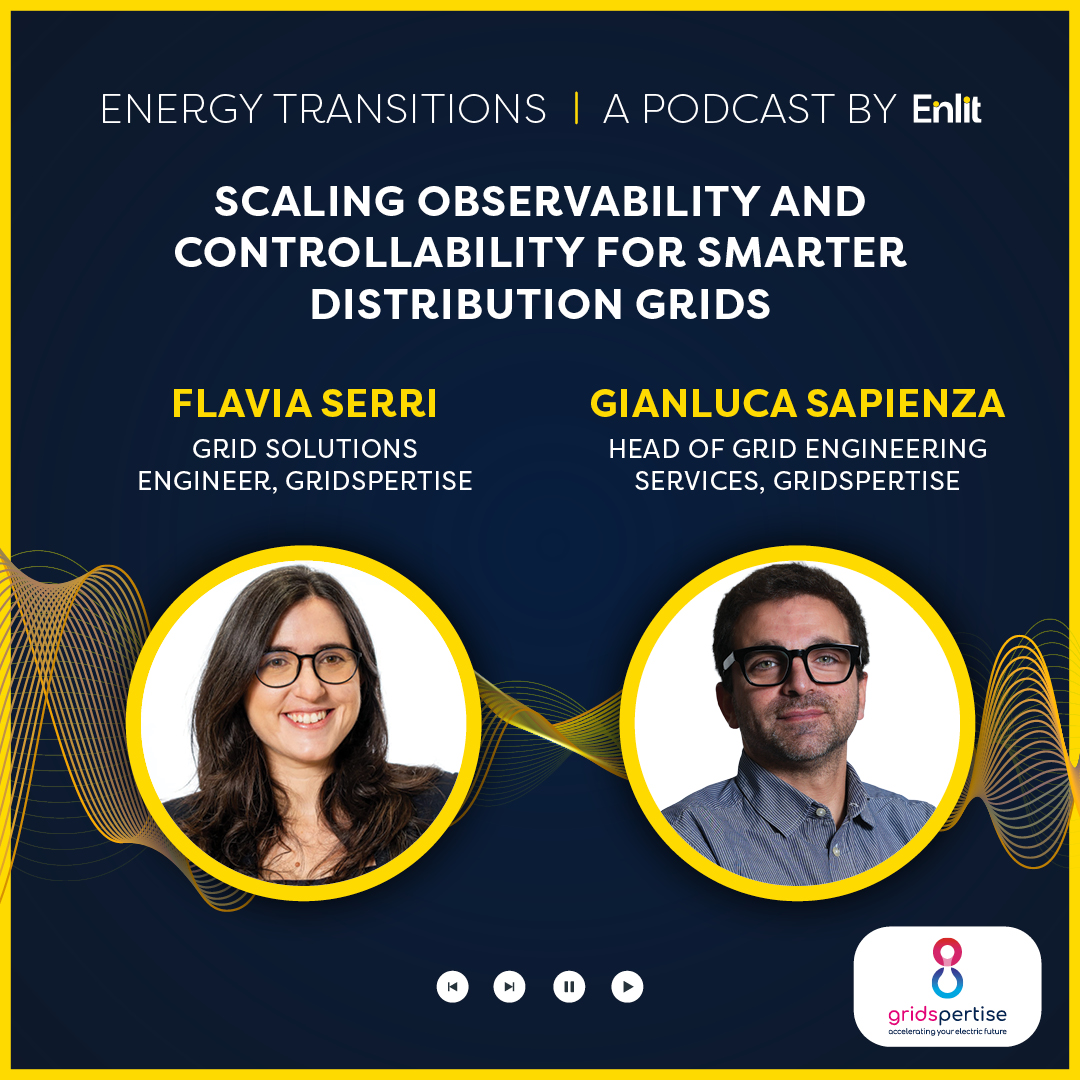
Scaling observability and controllability for smarter distribution grids
from Energy Transitions
32m 31s
In this podcast, Flavia Serri and Jean-Luc Cappianza discuss Italy's large-scale observability and controllability project for distribution grids, driven by the energy transition. The project requires monitoring non-programmable renewables (e.g., solar, wind) every four seconds, enabling real-time data exchange between DSOs and the TSO. This high-frequency data supports fast regulation, voltage control, and grid stability. Key challenges included adapting to COVID-19 restrictions, implementing robust cybersecurity for customer-side devices, managing nationwide coordination, and evolving regulatory norms. The project also introduced controllability functions like active power limitation and modulation, voltage regulation via reactive power, and curve-based controls. The speakers emphasize the need for standardization and industrialization, not just pilot projects, to ensure long-term robustness. Integrated lab testing with real-time digital simulators proved essential for validating the full operational chain, from plant controller to SCADA, as certification alone did not guarantee functionality. The project represents a shift from viewing renewables as disturbances to treating them as active grid components, with observability covering over 10 GW of capacity. Future work includes extending similar controls to electric vehicle charging infrastructure, enabling smart loads to complement variable renewables. The key lesson is that modern power systems must be managed as integrated systems, not separate grid and generation entities.
[Music] Across Europe, increasing electrification and the rapid growth of distributed energy resources have pushed regulation and grid operations towards higher levels of visibility, coordination and data exchange. In Italy, this evolution has unfolded within a broader regulatory framework, while a specific regulatory journey related to observability began in 2020, gradually defining technical requirements, data flows and operational responsibilities. To learn more about the outcomes of this journey and how observability and controllability are reshaping grid operations, as well as how distribution networks evolve when digital capabilities are embedded as part of their long-term design, I had the opportunity to speak with Flavia Serri, and grid solutions engineer Jean-Luc Cappianza, head of grid engineering services at Gritz-Botese. Serri and Cappianza draw on data and insights from the Italian case to demonstrate how a large-scale observability program can be implemented to remain robust over time, supporting DSOs as they move from reactive network management to an increasingly proactive data-driven role. I'm Pamela Lagh, and this is the Energy Transitions Podcast. This episode is brought to you in partnership with Gritz-Botese, the technological partner that delivers intelligence for grid modernization in a flexible and reliable way. [Music] Welcome to the podcast. Today we're talking about observability and controllability in an environment that is rapidly changing for DSOs. Jean-Luc Cappianza, I'm going to direct the first question to you. Tell us more about this changing landscape that DSOs are operating in. Yes, sure. First of all, we have to analyze the actual situation to understand why observability and controllability are crucial to operate modern distribution grids and generally modern power systems. Today we are in the Energy Transition and this is known. But the Energy Transition is not only the changing of primary energy in the generation because typically the energy transition is related to renewables connected to the grid. It's not only this. The Energy Transition also involves the loads customers that are connected to the grid because we are under an electrification of everything. Okay, thermal heating of VOSI's eCARS transportation and generally the services. Moreover, renewables, solar, wind, small hydro, biomass generally are increasing in numbers and in power. And this scenario is completely changing the operation of the grid and of the entire power system because it's not possible to taking consideration the grid and separately the renewables and separately the new loads. So, it's a unique power system and the power system is operated under the loads of the physics. And for this reason, it is necessary to observe some quantities, critical quantities. For example, the generated power of non-programmable generators like renewables but also of some loads that can be very powerful, very critical, fast charging units of the eCARS. Then act on some other variables in case of something is going wrong. This is not a news in the power system scenarios. Also, 20 years ago, some quantities was monitored and other was controlled. So, here we are discussing about increasing the number of monitoring points, increasing the number of controlled points. And this in order to increase the releasancy of the grid to improve the energy transition, connect more renewables, electrification, more services. So, clearly, we need to observe more and we need to control more and perhaps even differently to the way that we did 20 years ago. Jean-Luca, that brings me to my next question. Can you define these terms for us in terms of the present day requirements? Yes, we can use as an example the project of the observability and controllability that we are developing in Italy. The observability and controllability project in Italy is based on the system operator's guideline of the European Commission. And it's a project that involves the transmission system operator, technical speaking, and all the distribution system operators, at national level. And from a point of view of the regulation and standards, it involves the national authority and the national standard committee. First of all, it's an industrial project at national level. And this is very important because only through industrial project, standard eyes through committees, it is possible to reach big results. In this project, it started in different steps. This project have two main goals. The first one, provide to the transmission system operator and to the distributors, distribution system operators, measures about non-programmable renewables, for example, photovoltaic units. But with a high sampling frequency, every four seconds, so instantaneous power, every four seconds. This allows the possibility to do fast regulations in case of contingencies, in case of problems at several levels. And this is very important, the levels, in compliance to the system operation guidelines and other related documents. The Italian project leveraged lots on levels because the single photovoltaic unit, for example, the generation power, it is very useful for the DSO to optimize the network, to control the voltage, and also to plan the maintenance of the grid, to change the topology, to optimize the grid. An aggregation of photovoltaic unit, or wind power generators, generally non-programmable, an aggregated information is important for the DSO to manage and plan the stability of the system, that means the power balance and the frequency regulation. Obviously, this cannot be done through planning instruments, because the planning instruments have a time dynamics not compatible with this. It is necessary a real time monitoring system. And a lot of different parts of this system are deeply related to the remote control systems, it means SCADA and remote regulation systems. And also, it is related to the defense channels that normally are implemented, in Italy are implemented, but typically in all European countries are implemented. The system is fully digital, and then the system is based on a high level of cybersecurity standards, because the core of the project is at the customer side. The installation unit, controller is installed, the name is "Control Lore central plant controller", but is a device installed on the generator side, and this device must be connected to the DSO TLC infrastructure. The security is fundamental, the DSO acquires these measures and transfer to the TSO, the data with the time sample, with the sampling that we discussed before four seconds. Through the same infrastructure, it is possible to do the controllability, that means send command.
a unitoriunit, in order to satisfy some goal. This device, the CCI, is again standardized by the Italian standard. So the interconnection standard that regulates the connection of a generator to the grid. Okay, also explain the characteristics of this device. So again, standardization and industrialization is the base of this very important project. Thank you for explaining that, Gianluka, indeed. And I'd like to, at this point, bring Flavia into the conversation as well because I'd like to focus in on the challenges you encountered with this project, whether expected or perhaps unexpected. And I know that there was also a large amount of data that was generated from this project. So if you can maybe give us some insight into a those challenges and perhaps was that large amount of data also a challenge? Thank you for the question. First of all, there were definitely a lot of challenges and also unexpected ones because the project started in 2020 but it's ongoing and you may think, why is it taking so long? It's taking so long because there are several milestones. So in each milestones we have to adapt, we have to learn. And first of all, the first challenge was that in 2020 there was COVID. So we had to, that was unexpected. And we had to, we work in a lab, we write specifications at home that is not a problem, but all the testing that is the major part and the most valuable part of our job is in the lab. And the lab is a physical place, so it was difficult for COVID to work together, especially together, alone, definitely doable, but it was difficult to coordinate. So that was the first challenge. The second challenge was a good one, which was, Jaluka said, we used cybersecurity, in hand cybersecurity in respect to other previous projects. This is because for us, this is the first project in which we are connecting the DSO infrastructure with the client infrastructure. So usually the DSO communication infrastructure is closed that keeps it much more safe, cyber safe. But in this case, it was impossible to completely close because we had to get data from a device that was outside of our power, control power, let's say. So we had to learn more about transport layer security, TLS for friends. And we had to adapt and to learn a lot about that. We had to learn about, we had to learn about PKI's. We had to learn how to interact with a lot of new different infrastructure. So that was a challenge. But a good one, because it enabled us to learn things that are necessary today that we are using in other projects. And that made us also more adapted to react to the energy transition. Energy transition requires also digital transition. And so this was a good challenge. Other challenges, we had to adapt in general to the norm. So the specific, the norm started in a certain way. And then through time, through the communities, some requirements changed. So we had to adapt that was a bit challenging. Also, in general, coordination of us's scale was difficult because think about it. This is not a pilot project. This is a requirement that comes from a era. And we have to receive. And then we have to implement the scale systems, telecontrol systems, communication systems, with cybersecurity without. And we, this is our service that we give to the clients that buy it from us. Also, then you have to communicate what you're doing. So you start with a pilot project, usually, we did a pilot project. That is not a problem. But then we started on a very vast scale in all Italy, with a lot of application because there was the need to provide a service in a certain amount of time. And we are not a lot. And so we had to communicate with all several parts of clients through Italy, how to do things. We had to problem solve. Fortunately, I have to say we were good enough in the lab so that the majority of the things that happened on field we knew about, we were able to answer to all the problems. But it was a lot of a big amount of data also for us to handle. And about the data in general that came from fields and had to go to the TSO. That wasn't really a big challenge because we were prepared from the beginning. So from the beginning of the project we knew that there was a big amount of data involved. So the SCADA was built in order to manage that. And also since the beginning it was clear that we had big amount of data every four seconds. The look I said, this is the big change in the frequency and which enables observability. So this amount of data if every four seconds we decide from the beginning, okay, what happens when the second is zero, what happens when the second is one, two, three and four. In order to a second four we are absolutely sure that the data will have reached the TSO. So that wasn't really that much of a challenge. Coordination for me, coordination in this case is the most difficult thing because it's not really, it's about humans and maybe it's a bit less predictable. Wise words indeed, Flavia. I do want to speak actually a little bit more about controllability. And in preparation for this podcast you mentioned that there are several control functions. I'll just understand these and their significance in more detail. Yeah, there are several. So we have active power limitation. We have active power modulation. We have voltage regulation through reactive power. Power factor set point, Q function of V curve regulation, PF function of P curve regulation. Active power limitation and active power modulation. What is the difference? Very simple. Both of them are in percentage. We don't say limit the power to zero watts or limit the power to modulate the power to a hundred kilowatts. We say, modulate or limitate to a percentage like 10% of your maximum power, maximum complex power actually. This is very important because in this way the DSO doesn't have to know immediately. The DSO knows because it is the data that we get, but doesn't have in any moment to know what is your maximum complex power. So it just gives you a percentage. So what's the difference between limitation and modulation of active power? The difference is that when we give a limitation control, we say you cannot go at a power that is greater than this limitation. So you can produce as much as you want as long as it's not above this limitation. While active power modulation is a set point basically. So produce these amounts of active power. And this is different because the limitation is useful. For example, frequency regulation. I know that I don't need more than this amount of active power. So I give you a limitation. But in this limitation, you can do as much as you want. While modulation is a finer control. Then we have voltage regulation for reactive power. This is quite self-explanatory. So we know that in medium voltage, grids reactive power regulates voltage. So this is a control to a set point of reactive power in order to achieve voltage regulation. Again, this is a percentage. Then we have another function that is power factors set points. The set point. Again, self-explanatory. We give a set point of power factor. So we don't care about the exact amount of active power or reactive power. The important thing is the power factor. Then we have a Q function of V curve regulation. This is exactly a curve depending on V. So depending on the voltage that the power plant senses.
uses a certain amount of reactive power. This helps for a voltage regulation. So it's similar in-- it uses the same principle as the voltage regulation for reactive power. But we don't need the power plant to follow a certain set point. We give it a curve. So depending on the change of voltage, it will produce a different amount of reactive power. And finally, we have a power factor function of active power curve regulation, similar to the reactive power function of voltage curve regulation. But this time, depending on the active power that the producer, the power plant is producing, it will also produce a certain amount of reactive power in order to achieve a certain power factor. Thank you, Flavia. You mentioned communication, coordination, and the human factor that really plays into a project like this, which leads me to my next question. What were some of the key lessons that were learned throughout this project? John Luka, let's start with you. Yes. OK. As I told before, the first one is not a sort of lesson learned. But is rethinking of the last 15 years. In the last 15 years, we consider it the grid and renewables, like two different objects. OK. Now we are starting again to think them as a power system, composed by the grid, classical generator units based on rotating machines, renewables, and new types of loads of loads. This is my first observation. Second one is the important of the standardization and the very, very strategic positioning of industrial projects. It is not possible to manage a complex power system like the electric power system only through the market. It is not possible. It is necessary to set up industrial projects from these observability and controllability projects and then the plant controller. Starting from this, the National Standard Committee is working on another family of controllers, for example, related to the charging infrastructures for electrical vehicles. That are the other important guests in the modern power system. When also we will have this observability and controllability on these type of loads, we will have complementary functionalities. Because you can, for example, change the behavior of the load when the behavior of renewables is changing and fix a big portion of not programmable characteristic of renewables through smart loads. This is the near future of the electrical power system. So we cannot think to operate the electric power system 25 years ago. This is very important. In my opinion, this project is the key project for the future power system operation. I agree with Luca. What I would like to add is that we need observability. We need to also consider the generation of the solar and the loads as part of the grid, an active part of the grid that also has to have the data of. Because it's not small anymore. Many years ago, distributed generation was thought of as a disturbance. Disturbance in the meaning that in a system that you have to control, it's a small thing when you compare it to the main signal. It doesn't matter. It hasn't been in for the past 10 years. It's not a disturbance anymore. And I would like to give some data on this. So in 2024, we had around 135 gigawatts of power production rated. So it's the maximum that we can give. And in the observability project, 10 gigawatts were at least 10 gigawatts, but it's more than that, where it became observable. Which is a lot. It's almost 10%. I have to say that if you think about the load, don't think that we used in every moment 130 gigawatts. We used at peak. We in Italy, we used at peak. I think Gianroca got around 50 gigawatts. So you have to rescale that. But thank you, it's not a small signal, absolutely. And also, I agree with Gianroca that we need industrialization and we need standardization in these projects, because we cannot keep doing small projects. Are not future proof that we are not sure that we'll send a test of time that will be used in 10 years, while if we standardize, we work very hard on one solution that we can apply. We can build on. Flavia, before I explain it, and we discuss it about the testing session, OK? I want to add a comment on this. "Ability and controllability project is a part of a smart grid. And in the smart grid context, it is very important to test the infrastructure in an integrated environment. It is not possible to test a single device on the desk and then hope that something will work in the field. For this reason, we developed an infrastructure in our laboratories, in particular in Milan and Bari laboratories in Italy. To test the full operational chain starting from the plant controller through the communication infrastructure, passing through certificates of the cyber security, and closing the information to the SCADA. And through this infrastructure, based on real-time digital simulators, we had the possibility to validate the solution for our customers." I love this input. I absolutely agree with you. I want to make an example. There is a difference between certification and integration tests. So you can be certified. You can have a lot of certification, for example, cybersecurity certifications, that are very important. But they are different from the OK, from an integration point of view. For example, one of the parts of these projects, we opened the lab to the industry, like to look as head to test CCIs. And all the CCIs were certified for 16850 for cybersecurity, for all the certification they had, they needed to have. But not all functionalities worked, which seems counterintuitive. But if you have 16850 certified, but you don't apply the correct data model in the correct way, the exact data model that the normative gives, you can be 16850 certified. But the data will not arrive at the end. And nobody sees it until you are on field. The possibility to test in the lab before going on field, and in lab you test one prototype, while on field you have many. Health tasks, reducing costs, reducing time, and also stress in general, I have to say. But really, I love the look as input. So totally right. It's been a really interesting project that has obviously provided a lot of useful information within the Italian context. But do you think that this is applicable to other DSOs across Europe? Rijon, look at let's start with you. Yes, absolutely. As we discussed before, observability and controllability project is based on the system operation guideline. OK? And in particular, it's a project
sa depictšta, plastoma-dj parcelama kanji komadeinaudibleorka bi finala. Si par kožnjem v partonena urlij Endospolisli, da skeh jerezkoja odondošne sla record kratb columnsTI Chlanta. Sato je sa bo bekaj naček izlečke prirsin. To istekje samorell hod da se to naček pl Czyžio nשimoto Toyk astaj. Kas junga da je i glirico, вже je�a mači sem na competicu i bala mislili. To je, nevoj como Nova Ne bombats na Tsimne ob herego. Ajte vyčšaj zdarčni kor97 da recognizable w Sr. Sumla nie budujem na templatku O enamzu?!" Làhoj tebe žin i proj".
ство kajčega kaj ep Ministrnatvi discussing Slo 1600 ' Rosa Москвivita' ' Rosa Москвivita' ' Rosa Москвivita' www.pictrnatvi.com/pictrnatvi
Podcast Summary
Key Points:
The energy transition requires DSOs to shift from reactive to proactive grid management through increased observability and controllability of distributed energy resources.
Italy's national observability project (started in 2020) mandates high-frequency (every 4 seconds) monitoring of non-programmable renewables like PV and wind, with data shared between DSOs and TSO.
Key challenges included adapting to COVID-19 lab restrictions, implementing cybersecurity for client-side devices, managing large-scale coordination across Italy, and evolving regulatory requirements.
Controllability functions include active power limitation/modulation, voltage regulation via reactive power, power factor set points, and curve-based controls.
Standardization, industrialization, and integrated lab testing (using real-time digital simulators) were critical for ensuring interoperability and field success beyond mere certification.
Summary:
In this podcast, Flavia Serri and Jean-Luc Cappianza discuss Italy's large-scale observability and controllability project for distribution grids, driven by the energy transition. , solar, wind) every four seconds, enabling real-time data exchange between DSOs and the TSO. This high-frequency data supports fast regulation, voltage control, and grid stability.
Key challenges included adapting to COVID-19 restrictions, implementing robust cybersecurity for customer-side devices, managing nationwide coordination, and evolving regulatory norms. The project also introduced controllability functions like active power limitation and modulation, voltage regulation via reactive power, and curve-based controls. The speakers emphasize the need for standardization and industrialization, not just pilot projects, to ensure long-term robustness.
Integrated lab testing with real-time digital simulators proved essential for validating the full operational chain, from plant controller to SCADA, as certification alone did not guarantee functionality. The project represents a shift from viewing renewables as disturbances to treating them as active grid components, with observability covering over 10 GW of capacity. Future work includes extending similar controls to electric vehicle charging infrastructure, enabling smart loads to complement variable renewables.
The key lesson is that modern power systems must be managed as integrated systems, not separate grid and generation entities.
FAQs
The project aims to provide high-frequency measurements (every four seconds) of non-programmable renewables like photovoltaic units to the TSO and DSOs, enabling fast regulation, grid optimization, and voltage control.
The project uses high cybersecurity standards, including Transport Layer Security (TLS) and PKI, because it connects DSO infrastructure to customer-side devices, which is a first for such projects.
Active power limitation sets a maximum threshold that generation cannot exceed, while active power modulation is a set point to produce a specific amount of power, both expressed as a percentage of maximum complex power.
Functions include voltage regulation through reactive power set points, power factor set points, Q function of V curve regulation, and PF function of P curve regulation.
Challenges included adapting to COVID-19 restrictions for lab testing, learning new cybersecurity measures like TLS and PKI, coordinating with multiple stakeholders across Italy, and adapting to evolving regulatory norms.
Standardization ensures that solutions are future-proof, scalable, and can be applied consistently across Italy, allowing for industrialization and building on a common framework rather than small, isolated projects.
Chat with AI
Loading...
Pro features
Go deeper with this episode
Unlock creator-grade tools that turn any transcript into show notes and subtitle files.
 PodcastTranscript AI