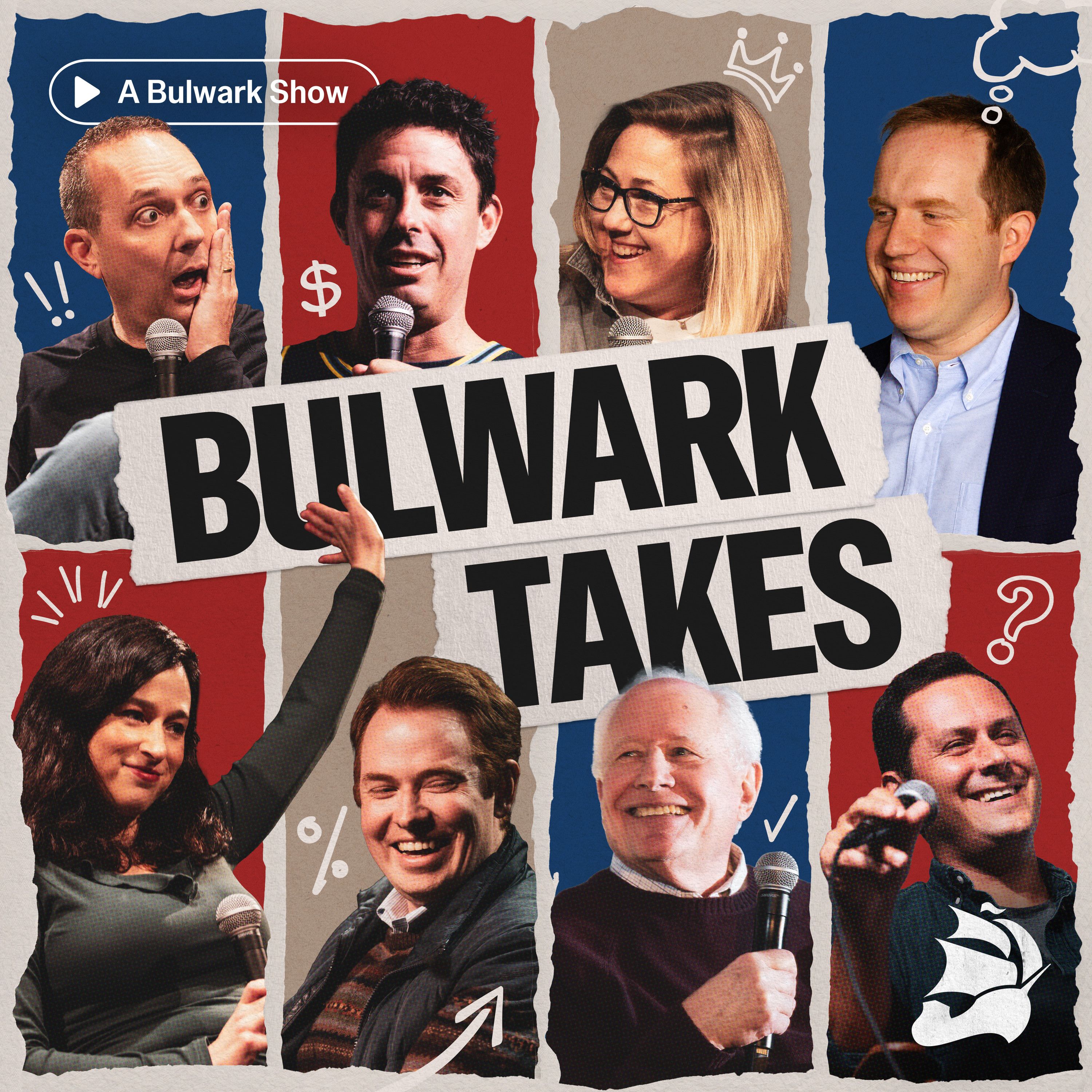
Sarah Longwell: Trump’s Failures Give Democrats a Once-in-a-Generation Opening | Bulwark on Sunday
50m 27s
Sarah Longwell’s new book, *How to Eat an Elephant*, offers a compelling analysis of American political dynamics, rooted in eight years of focus group research and grassroots activism. The book begins with a historical account of early efforts to oppose Trump, including the founding of the Bullwark movement in 2018, which aimed to unite Republican voters against authoritarianism. Longwell emphasizes that while voters initially supported Trump due to economic optimism and distrust in mainstream institutions, Trump’s failures in delivering on key promises have eroded that support. She argues that the Republican right has built a self-reinforcing ecosystem of media, politicians, and voters that amplifies lies and undermines democratic norms. In contrast, Democrats must shift from reactive, elite-driven politics to offensive, truth-based campaigns that reflect real voter concerns. A key insight is that political coalitions must prioritize unity over ideological purity, allowing for internal disagreement while maintaining a shared goal of defending democracy. Longwell highlights the importance of authentic communication — using real voters’ voices in messaging — and warns against the dangers of treating political issues as abstract debates. She also critiques the Democratic Party’s tendency to present a façade of crisis without meaningful action, calling for wartime generals and diplomats who act decisively. The book concludes with a vision for a new political future: one where the MAGA movement is discredited, and the next generation of democracy is built on truth, resilience, and inclusive collaboration. Longwell stresses that the book is not about personal policy preferences but about what a winning coalition must look like — one grounded in voter insights, strategic clarity, and a deep commitment to democratic survival. She urges readers to adopt this mindset and join the growing community of political activists committed to change.
I welcome to Bullwork on Sunday live. I'm joined by Sarah Longwell, author of the new book. What's the actual publication date September 8th? So what is that Tuesday? That's Tuesday. The book comes out Tuesday, pre-order it. You can pre-order it. Here it is. How to eat an elephant, excellent book, add an elephant, one voter at a time. And it's already getting ready for views and a wonderful event on Thursday night here at Sixth and I in Washington. You and I are going to do an event together in Cambridge on Thursday. You're doing a big thing with JBL Tuesday in New York. So huge launch, well deserved. I've read it. You should all read it and buy it and we'll talk about it today and talk about, you know, the issues it raises too. Anyway, Sarah, thanks for joining me. Thank you for having me on this platform that we do together all the time. Well, this is usually we talk about current events and we will talk about current events, but I really think the book is so it's interesting really honestly and important to it's worth focusing on a bit. Well, hold on you because, you know, I got to tell you Bo Christel, you can't get him to listen to anything on the pods. You're like, Bill, did you listen to this show? And he's like, why would I listen to the show? But you read the book. You sat down with it and you actually read it. And I was so pleased that, you know, I'm always trying to get you to watch the focus groups and you're like. That's, that's different. It's not I would have to actually watch voters telling us why they're voted for Trump, but I can't. I know that there's, I can't really, I know I sort of made myself go through the focus group parts, but it was this. It's important. I'm also, this is just my peculiarity in my age. I'm a reader, not a watcher more. So I do skim a ton of reading, skim, a ton of transcripts from the all of our podcasts. I'm just not a watcher for watcher. I guess I should watch them. Would you watch the regular time or one and a half or two time people speak out there? I do one and a half. I do that. And it's funny because Tim and I send each other voice memos back and forth. He literally records himself at one and a half. Like Tim, the reason Tim consumes all this content, he listens to everything I like to. And yeah, it's an easy way to get through things. A good tip for you all as you, as you as you watch and listen to all of our, all of our content. Okay, Sarah. So in the, in the JBL, what a short wonderful short preface to the book. And he says, I'll just feed this one sentence is strictly how to eat an elephant is half field report and half battle plan with a touch of history, throw it in for spice. I thought we could begin with a touch of the spicy history and then go to the field report, which is, we took what your analysis of Republicans over the last decade. The Democrats now and, and especially the focus groups that you've been doing for almost a decade, right? And then a little bit on the battle not more than a little on the battle plan. So the history. What do you want to see about the history? Well, the history bill almost begins with you. And this is a, it was, it was delightful for me to get to tell the story of the early days. And it's like not even enough. It's not close to enough. You know, I do go through a sort of meeting you because we met in one of those rooms that back in 2017, 2018 were pretty popular. There are a lot of rooms of cyber Republicans that would get together to try to figure out what were we going to do about Trump. And I walked into this meeting one day and you were in there doing as you do, you were like sort of holding forth and you had a lot of analysis and you were, it wasn't, it's not holding forth in a bad way. You were just, I never, but he was listening to you. And I was remember sitting there because I had walked in a little bit late. And I thought to myself, man, if I could get Bill crystal to work with me on something, we could really do something cool. And so I did I corner drew after the whole thing and you were kind to me, especially because I was being like moderately aggressive the way that I am like, come on, let's do something and you were like, OK, let's go get coffee. And we'll talk about what we could do. And I make a joke at your expense in the book about how you will get, I was flattered at the time, but you're, you will get coffee. Anybody who says like, Bill, yeah, I want to tell you an idea, you'll be like, let's get coffee, like that's your go to MO, but you know, after that, what is not in the book, although actually, no, I think I do say it that we would meet up regularly between our offices. And you would get tea and I would get a drink with alcohol in it. And, and we would think about what we could do and we landed on the idea that we should primary Trump. Like we thought, let's see if we could primary Trump, because we were both kind of operating under the assumption, because especially in those early days, Republicans were still at least quietly on our side, right. And I remember this part, like they would, we could get a meeting, if I had you, you could get a meeting with anybody. And, and, and I was there to be sort of the, the way that I am, right. And I'm excitable and I'm saying to will herd and Adam Kinzinger and Mark Cuban and Larry Hogan, like you'd get the meeting and then I'd walk in and I'd put my hands on them and I'd say, you got to do this, what are you doing? Like we need to do something about this, you can't just talk. And you were always, you were gentile, you were like the straight man. And I was there to be sort of the, the lunatic that would wind them up, but they would all have the same question, which is, okay, well, how would we do that? We do that without embarrassing myself. And we were so sure, so, but we had to prove it. So we went, I started doing the focus groups to show all these guys that there was a path. And the first lesson of doing focus groups wasn't actually learning that, no, there wasn't really a path, that, that there was, there were people who were, and it was, there's a bunch of things that I learned along the way that I didn't know at first. One of the things I was like, well, people do like the idea of other options, they are open to somebody else, but of course I realized after doing these for years that people are always hypothetically open to other options, they just are. But it didn't mean that they weren't more or less satisfied with what Trump was doing. They felt like the economy was good and that he was out there shaking things up. And over the course of doing the focus groups, I really began to realize how out of touch, I think, or just how I misunderstood the voters. Because I came from Think Tank Magazine operative world where the people, the Republicans, you're around, talk about free markets and limited government and American leadership in the world and they all read, I don't know, Hiic and Adam Smith or whatever. And then you get to the voters and the voters are like, I watched The Apprentice and I think Trump is a great businessman. And you just, it was a whole different world. We had to navigate in terms of trying to think about how to persuade people. Yeah, no, I think that's right. A couple of footnotes on, I mean, in 2016, I had actually tried to get someone to primary, new people to come into the race late in the primary against Trump and then even in the general election where I thought the Republican third party candidate would take votes from Trump and preventive becoming president. We got pretty far with some people. Jim Mattis had a couple of meetings, very serious ones with him, very impressive guy. He understood what the country that the Trump should not be president. Ironically, since he became his defense secretary, but I don't criticize him for that because I think he did a lot of good there. But he didn't run Mitt Romney. Anyway, so I got through this a little bit of trying to get people in 2016. I will say when we tried in 2018 to get primary candidates, I think we knew Trump is unlikely to be defeated. We thought it was important to raise the flag. If one thought the Republican party could be salvaged, I think we both moved on from that. I would just say about those meetings, so it's called the beating of the concerned kind of a goofy name, maybe, but anyway. And they were at the discounted center. And I want to give them credit for competing those meetings, because as you say, they were kind of, you know, little bit of a lot of people sitting around and lamenting things. But I remember Susan once asked, this is sort of pre-COVID. So we actually went to these meetings physically in the basement of that building, CNN was there, which is rather the standard center was that I think it's moved. And Susan said, I mean, you're learning a lot from these meetings. And I remember saying, I will say to my credit, you know, you never know what comes out of a meeting like this. You meet a few people, something gets lodged. It's not the meeting. The point of the meeting is the meeting. The point of the meeting is they were all one place and something could come of it. And I'm going to do very much feel that your corner meeting was a good thing. And we decided to launch defending democracy together. I think that was January 1st, 2018. It was the official launch date of that. That was the, you know, the thing. That was Republicans for the rule of law, though. Yeah, Republicans became Republican voters against Trump Republicans for Ukraine. It was a lot of different things. Yeah, Republicans rule of law defending when Trump was going to fire a baller. So the bull work, we launched, you launched really, but in Ben Parker in September, I think of 2018, but I was sort of involved and I was always in the back of my mind at that point that we were going to get closed down at the weekly standard, which we were three months later. And so it was kind of a backup possibility, though the way in which it took off and you and JVL and Catherine and Jim Swift and Charlie and me. I can't remember that first meeting in the conference room. It's a permanent where you were then VP and really were helping Rick run it and you were kind enough to let us use that facility for that. And Rick was really to his credit for for months for a year, really, I think to use the permanent offices as we got the bull work going. Yeah, that was a, that was a, I'm very proud of what we did then, honestly. And as you are, and I think you describe it a little bit in the book, but yeah, it was, it was kind of. Yeah, I don't know. It was fun to go revisit a little bit of that because it was a very, there was a very like focused time for me, a time where I desperately wanted to do something to push back on Trump. And I felt like to your point about these meetings, like the reason that they were ultimately so useful is that they put us all together. Right.
um for those uh for people who were like trying to figure out what to do um we were able to uh come up with things and you know that even the primary and trump is such a good example of why a lot of times like trying and failing at your original idea can still lead to a lot of great things because ultimately what it did was you and i built a relationship of friendship we we were traveling together we were talking to different republicans we started figuring out how we could raise money to do more research to try to run ads and and also look we started out thinking that there was a republican party to be saved right you're right actually you're completely right that our idea at the time was much more sort of Reagan in 76 it was like could you run and lay the predicate for pulling the republican party back from the thing that trump had had seemed to animate um you know i that's that was sort of our pitch to a Larry Hogan is like hey you could be the future if you run now if nobody runs now and makes this alternative case like he'll own the future and i think we were really right about that but quickly we when we realized there wasn't going to be somebody who was going to run who was going to be serious enough to to do him real damage um which was the goal originally it was sort of to primary trump and to do uh a lot of damage to him let a democrat win but like our role was going to be on the republican side we had to make a choice then about whether we were we were basically going to flip our our focus and go try to elect a democrat which is exactly what we did and that was the beginning of us being republican still i think in our minds who were conservatives who though were like absolutely we need a democrat and we were willing to put our credibility our policy ideas like everything on the line to try to elect a democrat going into 2020 which was kind of the next iteration of what we did strategically and republican voters against trump i will say which is so it has now outlived its usefulness i suppose at least for us but it was very it was really important you did a great job on that and that was really important in 2020 and i think studies actually showed this i mean we actually did provide an umbrella might have happened anyway obviously but we provided an umbrella and we did advertising and we did targeted stuff in key states to help move for public and some percentage not a massive number obviously since trump still got to whatever he got in 2020 but at the key few percentage points Biden needed i think in Georgia and in Pennsylvania and in Michigan and in Wisconsin to help move them over to give them a rational justification for make them feel comfortable voting against trump and at least staying home but in most cases actually voting for Biden and it was your insight also i just want to give you credit for this you don't really talk like this in the book i don't think since it's more focused on the focus groups in the bulwark that the at the kind of as that would work were not big shots in Washington not simply produced as in Washington with actors or big shots telling voters here's what you should do but other voters saying on their cell on their you know saying into their phones you know hey i'm a republican i vote of republican all these years i don't like the democrats watch you know or i'm pro-life or i'm a veteran i don't really trust the democrats but you know this is a crisis we need to vote against trump we can't give them a second term we need to vote for the democrat and we didn't those were lightly produced really i mean we we didn't take it all we cut them occasionally or whatever you know sometimes we would tighten them up yeah but i mean really these were actual voters in key states and we typically played in each state voters from that state saying it and people really felt i think that this was someone like them who has with difficulty and grudgingly come over to to vote against trump uh but that that fight in a model for them and i remember that you remember i remember someone from uh the official democratic establishment type saying you know i like those ads but uh the you criticize the democrats in those summer you shouldn't do that that and of course the totally totally missed the point very good we get to this second about the democrats right the whole point was to get a republican to vote for the democrats you had to acknowledge that it wasn't the democratic party wasn't perfect and you hadn't agreed with them on a lot of issues for the preceding ten or 20 or 30 years if you're a adult life right i remember being abused by the democrats not understanding it was more effective to have you know john smith republican voter in al-tuna you know pennsylvania or something you know say the truth about that he was it was hard from to make this decision but he really felt to make it this was your insight though i really want to say uh well i appreciate that but it also i'll tell you when i think about republican voters against trump and uh some of the very smart ways that that we did different kinds of communications and advocacy then what i really think about is how much the communications environment has changed even in the intervening six years because that campaign wouldn't work today in in the age of ai um no one would trust that those voices were real like one of the things about how authentic they were back then it was also like really the beginning of everybody kind of doing this on their phones like constantly looking into the eyes of somebody um and making a straight to camera video which is now the default way in which people communicate but even going into 2020 it was not yet um and so part of the book is about the shifting communications environment and how um democrats really need to adapt to it because republicans because they got somewhere between a 40 or 15 year heads it depends on how you think about the right wing media ecosystem getting built but they did have a huge head start in both their uh how much they diminished the mainstream media's credibility but then not only did they whine about it they went and built their own media ecosystem which has been both enormously damaging to what to like knowable truths and and people people knowing what the reality is but it has been enormously beneficial to republicans who have a built in megaphone uh an amplification system for just about any message that they want to put out where uh the mainstream media who you know i try pretty hard not to like do that knee jerk anti mainstream media thing but when you have sort of the rules of neutrality neutrality always defaults to the benefit of the authoritarian in any you know situation that neutrality uh because then people it's like look christine welker chatting and laughing with Stephen Miller the thing that it shows like she saying well i have to be give both sides sort of a good hearing and uh but what voters say is well if they were really authoritarians if they were really fascist if they were really dangerous christine welker wouldn't laugh with them and so they don't take you seriously this is why the mainstream media almost like inadvertently ends up in a trap of normalizing what is happening and i'm a big proponent the reason we then built the bulwark is that you have to have media entities independent media entities that don't feel bound by those things so you can just tell the truth as you see it we have no need for neutrality um we're going to say what we think is right and wrong damaging our helpful straightforwardly and that is a very freeing and i part of my solution like part of the battle plan is that more people should do that the barrier to entry that was there when when the right wing media ecosystem started building up isn't there anymore and like it shouldn't be the case that there is only a right wing media ecosystem and the mainstream media like uh and there is um like i believe that there should be a more pro-democracy um that can be overtly pro-democracy and overtly calling out the fascist i think that media ecosystem should be much bigger than just us people talk about us as anti-trump you can get a wide range of anti-trump uh new media and i think that there should be um or people who are progressive or whatever like let a thousand flowers bloom but i also think there should be more media infrastructure from people who are um you know less it's less about being progressive or being a moderate but just saying like this is what is a threat to democracy this is how like we get out of it which is i think what we do and i think we've been truthful and tried to be truthful and it's called it as we've seen it which i do think it's been very important to our overall effort i mean it's the right thing to do obviously anyway and that's what i would want to do but i remember where i when i took over the warning shots and i remember it's Lucas Berthes of February 12th 2024 when Charlie left um for i i just i hadn't really thought about what you know until the weekend before kind of what to write since it's supposed to be kind of on the news and somehow there was maybe some stuff maybe a poll come out that 70% of voters and even majority of democrats wanted Biden not to run again i can't run away and the primary this primary is just beginning so it was plausible if you got knocked down that you could have had a slightly truncated primary process obviously didn't end up happening was he got out so late so the first thing out for warning shots i don't know if you remember this was Biden shouldn't run Biden should should withdraw now you would you would have been saying that in 2023 and a lot of others had to it's an LA car bowl and various people but um it was kind of and i remember our colleague Catherine Lowe who's with us from there at the beginning also uh it sort of runs a lot of the marketing side of things at the bulwark says said to me literally see how that how people react to that and we're going to lose a few people can be annoyed really this is morning shots at the bulwark it's February 24th trump is you know unbelievable threat to the nation and you're telling Biden up to step aside and have a risky primary process was god knows what could happen in that process
And what was interesting was people, our readers, a lot of some of them didn't agree, if you look at the comments, but they did not rebel against someone telling an uncomfortable truth. We didn't, if I recall correctly, maybe Katherine, you know, just to just stop the figures, just stop the numbers a little bit to reassure me a little bit, but we didn't lose many readers or subscribers or anything like that and obviously we've had a pretty good fear sense. So people welcome, I think, the fact that of telling the truth and not going along with the democratic establishment or liberal orthodoxy, you know, in a knee jerk way, which I think is impressive in general. It's not just us. I really don't want to make this but the bulwark. I mean, I think the pro-democracy movement, I mean, it has its limitations and there are people who it is who say things we don't occasionally agree with or get annoyed at them or whatever, but on the whole, it's a pretty principled and principled version of a big tent movement. I guess, I guess I would say, don't you think? I do think. I do. And just on our readers, though, I, every time somebody, I see somebody online or something and they, I'm unsubscribe because they don't like a take that one person here had, I always think like, that's okay because that person probably didn't belong with us because to be with us is to tolerate the fact that we have a big group of people, like we try to sort of live our own big tent deal, which is like we don't agree on all this. I bet, actually, at the time that you said Biden shouldn't run, I had been saying that up until the point at which he was the nominee and I was like, Bill, what are we supposed to do? Like, I felt like you went on too long with that and we disagreed about it. We argued about it on stage. We argued about it. And ultimately, you were correct. And maybe Jay and JVL was very much the other way and to his, you know, and again, he argued it in his newsletter and very eloquently about it. JVL and I fought about it in the earlier days when I was saying he shouldn't run again and he was talking about the benefits of incumbent. Like, this is, this is fine. This is good. The, the ability to, to be a community. I talk about this in the book. This is like one of my bigger takeaways. Actually, one of my bigger recommendations for Democrats and it's something I learned doing the bull work, which is if you want to build a community, you have to be a community. And you have to model what it looks like to be a political party or a community where the disagreement makes you stronger. You maintain a set of baseline values that unites you. And from those baseline values, you're able to have that a wide range of discussions and disagreements because you're like, everything, though, even if we disagree, it's on the service of something good versus, you know, we have to, I don't know, hate each other because we disagree, which I think the factional fight currently going on on the Democratic side is it sort of modeling the opposite. It's a lot of like you can't be in the tent. You can't be in the tent. You're the damaging the tent. You're bad for the tent. And that, there's, I think some of those I agree with and some of those I don't, but instead of saying actually our project is to zero in on what we agree on and then go fight the thing that we think is dangerous. And I do think that the bull work continues to be sort of 90% understands that directionally what we are doing is saying we believe that the authoritarians are inside the gates and we want to do whatever we can to stop them and it has less to do with policy and less to do with ego. It just has to do with how do we solve or push back against this thing that has overtaken us and American politics over the last decade and how do we reverse it or not even reverse it? How do we build something new sort of from its ashes, right? Trump has is burnt it all down. So what are we going to build next? Is the question that I try to wrestle with in the book and also, you know, I wrote it for the bull work community, basically, because the bull work community at live shows or in the comments, everybody was like, what do we do? And people were so, and I want to say like at the point at which I wrote this book and decided I was going to write it, it was probably maybe like six months into Trump 2024, Trump 2.0, it's actually Trump 2025, because there was a real feeling at that moment that America was lost. The idea of electing Trump a second time had done enormous psychological damage to people who had thought America wasn't going to be like this. It heard all of us. We were, we struggled with, with what it meant about America, what it said about America. And, you know, I just, I wanted to sort of buck people up. I wanted to explain why I thought people had sort of taken a pass on Kamala Harris, why they had gone for Trump despite the insurrection, despite all the legal, you know, he had the documents in Mar-a-Lago, the, the super documents he had. You know, he, there was the January 6 trial, like how could America vote for this guy? And I, I really wanted to sort of pick people up and dust them off and say like, this fight's not over. And America is not lost. And in fact, there is now a historic and generational opportunity, because if there's a thesis in the book, it really is this, that Trump is a bleeding target. And even, even as, you know, as I wrote the book then over the course of a year, I watched Trump start to fall, make mistakes, fall off a cliff, voters reject him. He couldn't do the things that they'd actually hired him to do. And I was sort of begging people to understand and it's why listening to the voters is so important. It's like, the voters didn't love Trump, but they did prefer the economy of Trump 1.0 pre-COVID. That was so much of it was this carefully curated businessman. Look, he's, he's not going to do any wars. He's going to close the border. But most importantly, he's going to focus on our material well-being, which is what we're hiring him to do. He has failed at all of that. The lie of Trump, right? He was a conman. He was never going to lower grocery prices. He was never going to fix inflation. Those are, they're just like a button where that can be done. Although there is a button, a tariff button, and there is a war button, which he has done without Congress to make things infinitely worse. And so now I'm saying, now is the time for office, right? This is like for predator. If it breathes, if it bleeds, I can kill it. Okay. He is a bleeding target right now. And the entire MAGA movement right now, we have the opportunity to discredit it, to hang it as an albatross around Marco Rubio's neck, around JD Vance's necklick. I'm sort of begging people to look forward a little bit and say to themselves, how do we make sure that Trump leaves? This is where the bush line comes in, right? If we make sure that Trump leaves office at in the 20s. And everybody looks back at this historical moment and says what a disaster that was, how did we fall for that? That is an inoculation tool against further authoritarian impulses. It's an opportunity to drive Trump out of public life. It's a to bury the people who've stood by him, to discredit all of the anti-anties and all of the pro-Trumpers who said that this guy was going to be great for us. Like, now is the time for office. Now is the time to build. Now is the time to walk into 2028 and make sure that the next 10 years belong to the pro-democracy building the next thing movement and that MAGA sort of consigned to the ash heap of history. But we had to do some things to make that happen. Now, you've been basically in our internal vote discussions, a defender of the American people or an understander of the American people as opposed to JVL into some degree of media. It was like, oh my god, how could they do this? But I will say you were right in this very important way. It's the public. I mean, I'm on all these calls as you are with a bunch of liberal elites, such as call of pro-democracy. I won't do those calls anymore. I just know. I know. I know. Anyway, I don't know why you do that. They're parts of the coalition or anyway, I do them lawyers and they're doing some good things and finding some good fights. But there's a lot of handwriting about how could the public believe this? How could the public believe it? He has lost more of the public than he has at the elites. The public is reacting to Trump 2.0. I wish it were a little faster. I wish it were a little more comprehensive, whatever. But if you go from 50% to 38, I just call it now in, I guess, 20 months, that's rare. That's a pretty big, big drop and it's going to have a big effect on these midterms and a big effect going forward, especially if we can go on the offensive and stay on it. The elites have been really have stuck with them. So much for its transactional, I suppose. The business people have once they've made their deals, they can't really figure out how to reverse that. But the terrible thing is a lot of them don't even want to reverse it. We've had so much of the media's indulged this notion that, look, privately, they really disapprove of Trump. I don't know. It's awfully private, right? They can't jump ship now. What are they? I guess maybe after the election, if Democrats control water both houses, then they sort of maneuver to get back and be okay with the Democrats, but they are following the public. So you were right always, I think, to focus on the public. And not the elites, but say a word about, I mean, you say in the book how important it is to have a forward looking vision. You say, you say a lot in the book about it being playing offense. I mean, what is the, what core elements of the battle plan would you call out? You've mentioned a couple already, but yeah, look, I basically think Democrats have to reimagine the communications infrastructure. And that goes from, because if you think about the vectors, I talk a lot about the Republican triangle of doom. And so that is the right wing infotainment media ecosystem. It is the Republican power.
politicians, and it's the Republican voters, the electorate, right? And they're in this sort of toxic and symbiotic relationship where they reinforce each other. You know, you think about how did Trump make January 6th or the idea that the election was stolen? How did it make it so 70% of Republicans believed that lie? Well, it wasn't just because Trump set it. It was because Trump set it and then some of the newsmaxes of the world that OANN started to pick it up. And there was an audience for that. And people were mad at Fox News for calling the elections, like Fox News is a left-wing news place because it said that Arizona called Arizona for Joe Biden. So suddenly Fox is trying to chase the election deniers because and the election deniers are building such momentum that, you know, then they're semi-normal Republicans. Like at first, it's your your Marjorie Taylor Greens and your Lauren Boberts and your Andy Biggs and it's your weirdos, but pretty soon Kevin McCarthy's like, oh, no, voters are demanding this for me. I need to show up and say that there was something irregular about the election. And once you're semi-normal politicians or your bigger name politicians bless the lie, it gives permission to an entirely new set of the Republican electorate to also buy into the lie. And so the question is, okay. So if those are the vectors for Republicans, do Democrats have any of those vectors at their hands? And how do they use the truth and amplify the truth and have their elected officials going on offense with the real story? And I will say one of my biggest fears about the book was that I would walk in to 2026 here. The book would come out and that like the environment would be awful. There'd be no sign of Democrats figuring any of this stuff out and they'd be doing all the wrong things. There's plenty of the wrong things, but there are also some people doing the right things. John also, who I will not shut up about because it feels like he read the book when it comes to how to do communications. He is on offense communications. He's doing contrast messaging. He's saying, here are all the ways Trump is corrupt. Here are the ways he betrayed you. And then here is my alternative plan. And he's doing it relentlessly. He's got a social media strategy. He's got a way. He's got his own communication style that is authentic to him. He's a documentary filmmaker and as somebody who likes to give speeches, you don't know have to do the same thing, but he understands how to do offense and what's happening. He's winning in a red state by crazy margins and against like not a terrible candidate. He's not running against her show walker. He's running against, you know, a perfectly like fine Republican without sort of exceptional deficiencies and he's still running away with it. And I'm saying that, that is what I'm talking about. Yeah. And I think we should, I mean, look, people, they have read what you said is if you read the book. But of course, he or his top aides have read the book and listen to you and watch the focus group. And so we should, you know, you should feel, we should feel somewhat good about whatever I think some of the good things that are happening, I and not a lot of the one to figure it out without us. But, you know, as I watched to this morning, Kate Connelly. So she's running in New York, 17, she's a special combat veteran, special ops, a bronze star, a recipient, a fantastic, very impressive woman. I met with her. I think this is a lot to say, this sounds like, yeah, I met with her at six months ago and she got in touch. She's a bulwark reader and viewer and said she's just wanted to talk. She was at that point getting ready to run at a complicated primary. And just wanted to talk about politics and what I thought and stuff. I don't know if you met her yet, but anyway, really fantastic. And we had very nice cup of coffee. I guess she proves that you're, yes, your point about it. I'm a sucker for getting a cup of coffee in Arlington, I remember this. Very impressive. And she went on to win the primary against pretty good candidates. And so they wasn't like they were, she was running against someone awful, but she is the most, the most impressive in my judgment. And now it's in a very tough race against Mike Lawler in that, you know, swing district, which Lawler has held a couple of times and it's probably one of the more presentable Republicans. So she and Lawler were on TV this morning. I built my take a look at her. She was terrific. Terrific on Higgsath, who I've been obsessed with, I mean, unbelievable damage she's doing through the defense department and making more of an issue, but it's really scary to have the military politicized, obviously, really puts everything in question. And she understands that having served. And I just watched her and thought this morning, and thought, you know what, there are some Democratic candidates I'm not thrilled about. And there's hangers on, you might say, and streamers in the Democratic Party, I'm not only not thrilled about, but it should be kicked out of the tent if one could kick them or at least I personally wouldn't have them in the tent. And there are others who are just okay, whatever. But a lot of the candidates, especially the younger ones, are impressive. I do feel like people are a little bit too much hand-regging on the Democratic side, both the Democratic with the Capitol D and the pro-democracy side that you think I feel pretty somewhat optimistic actually about that. Yeah. I mean, just on this factional fight and the, and who gets kicked out of the tent and who's in the tent. I mean, I sort of think when it comes to tents in general, it's, you should want, like the political parties are these great, evening tools, right, that, that where you have all these rough, you got your disaffected Republican, former Republicans like us and your far lefties and it's like, can they exist under the same tent? And I think that the answer is absolutely yes, because like, what do they do with guys in the military? They're all walks of life or whatever and they have different political views and what do they do with them? They give them a project to work on together. Guys, we all have a project to work on together and that is defeating the authoritarians who are trying to take over our politics and our culture. And I think that if everybody can focus on that, then that is how the big tent can work. I think the problem for the tent becomes when the, the fight inside the tent becomes so intense and so all consuming that you forget that over in the other tent, they're trying to destroy the country. And, and so, you know, I get my frustration with people is less, obviously, I have ideological frustrations or policy frustrations or I have, you know, personality frustrations, but my biggest frustration is when there are people who are part of the coalition who say if the coalition doesn't do exactly what I say it, it has to do. I'm, I'm out or I'm not voting with it or I'm not doing it. So for the people who wouldn't vote for Kamala Harris or who called Joe Biden-Genocide Joe as opposed to figuring out how to help the Democrats win. And this is just the thing I'll say for the never-Trumpers. For all you people be like, well, there are Republicans, we don't want to hear from Republicans. I was like, guys, I put all my policy preferences aside. I didn't try to make the Democratic Party more Republican. I do try to say, hey, now I've listened to voters for eight years. Here's what they tell me they want. And I've sort of subsumed most of my personal look. If it was a political party of Sarah Long, policy preferences, we would talk about the national debt and deficit reduction and education reform all day long, because those are the things that really light me up when the world is normal, but the world is not normal. And so I subvert my policy preferences in favor of how do we save America from what's happening right now? And I think that should be the baseline of everybody who wants to be in the tent. >> No, that's so well said. And we can have our arguments. When we were making policy, hopefully, at some point in the future, it had a democratic swoldy environment with the normal debates. You know, they'll be Jeffersonians, they'll be Hamiltonians, or whatever, however you want to characterize the differences. They'll be free market types and worse, you know, welfare state types. And those are the debates we want to have. But we do need to feed absolutely the authoritarians. And I would say in the second term, this is one thing we've been very focused on at the bulwark. I mean, there's been a little bit of a tendency among liberals to not take the authoritarianism seriously enough. Because it's so goofy and Trump's, you know, goofball on the people around him are weird always and all this, but did agree of it, the breadth and depth of the authoritarian project in the Trump administration second term, DOD and DHS and DOJ, and the Postal Service and the FCC, I mean, it's impressive, you could almost say it away. And very dangerous, I think. And so it can be goofy and dangerous, particularly dangerous at the same time, and we can't take R.I. off that, in my opinion. And this is, again, you know, I try to use my frustration with Democrats in every instance to be like, and here's how we could change this. And so, for example, one of my great frustrations with Democrats has been that they keep saying democracies on the line, okay? They told us democracy was on the line in 2024, then you have to act like democracies on the line. Like, the reason that voters are so frustrated with the Democratic Party is they're like, you guys keep telling us everything is on the line, democracy's on the line, America's on the line, our futures on the line. And then you call up, you know, Jared to have a chat like everything's normal. And that's why I do think voters are demanding wartime generals instead of peacetime diplomats. They want people, they want to elect people. And I do think one of the reasons that there's been more, you know, outsider insurgency is because of the frustration that voters have with mainstream Democrats for saying, why are you treating this Republican Party? Like, it's the party of Mitt Romney and you guys are going to have a normal conversation. You're not. And they sort of want Democrats to reflect back to them what Democrats say in their words and then not in their actions. And I feel this way. I feel this way. I feel that level of urgency. I think we are under reacting to Trump as Americans. And so for me, and this is what the book is really about. Again, it is not about Sarah Longwell's personal preferences. It is about
What does a winning coalition look like? And what are the ways it's all about how you win? And it is about what do you do to win? So for example, I'll take one of the hardest chapters in the book, which is called Trans America. And it's about the issue of the way that Republicans have weaponized the trans issue in politics and how Democrats struggle to navigate it. And I think, look, I say a lot in the chapter and we don't have to go through all of it, but one of the things that I really point out is that I came up in the marriage wars. So I am 25 in 2005. I am just coming out in 2005. And this is the year that Massachusetts became the first state to pass a gay marriage, make it legal. But that kicked off a whole bunch of-- in all of the states, they were putting up referenda to block gay marriage, including in California. It was famously propane. And gay people were a real wedge issue. Everything was about gay people and how we shouldn't be allowed to get married. And if you allowed us to get married, it was the end of Western civilization. And it feels very similar to the way trans people are being used as a wedge issue. And so I spent from 2005 to 2017 or '18 working with young conservatives for Freedom to Mary, log cabin, Republicans, along with, as a volunteer. But I was on the board and I was an outspoken advocate of gay marriage from the right. And I learned so many lessons, but one of the lessons that I learned-- one of the lessons I learned was that persuasion is possible, because I watched people change their minds in a very fast period, too, that there's ways that you can persuade people. And I can go through all those lessons. But the biggest one on politics was, you didn't make politicians walk the plank on your issue if the public wasn't there yet. And so Barack Obama, in 2028, when I was 28 years old, he wasn't for gay marriage. Now, you can all say, but we all know he was for gay marriage. And I'll be like, yeah, so was John McCain. None of these guys actually opposed gay marriage the way that they talked about it, but they took a public stand to get elected. And John McCain, the Republicans, he had to act more anti-gay marriage than he was. And Barack Obama had to do one man, one woman stuff, and it's religious. But they functionally had the same position. Their voters didn't, though. But the majority of voters still opposed gay marriage. And Barack Obama had to live with that reality. And he would say, to the advocacy community, I will change my position the second you make it safe for me, too, politically. And I think that there has to be some pragmatism. Everybody's like, you can't throw trans people under the bus. And my guidance really is to not throw trans people under the bus to basically affirm people's dignity to act with much more compassion, to go on offense against the weird ways that Republicans are obsessed with this issue. But to also understand there's a 70, 30 split on things like sports and kids transitioning. And you've got to let your politicians navigate that in ways that might not be satisfactory to the coalition. And the coalition has to do the educational work while giving the actual candidates room to maneuver so that they can win and make things better for trans people overall. Well, that's very well said. And I look at people go. But I think it's a huge difference between attacking, demonizing, dehumanizing, people firing, people from the military who transitioned 10 years before and are preserving with distinction with zero problems in the multi. And then saying they're dishonorable because they transitioned 10 years before and at age 35 or whatever. And they're now 45 and have served with distinction. Huge difference between that and some of the trickier issues where you do need to get people room, I think, on the sports maybe in particular and how to handle kids and so forth. But that's really the key, right? I mean, you can be a vehement oppose a potent of dehumanizing people in America, which is what they're doing. It's in a way I find the trans issue. I say a lot of discussion. In a weird way, easy, the Republican position because right now the Trump administration is so grotesque. It's so fascist that you don't have to all be an exact agreement about how we handle a school telling parents of a 12-year-old. That's a complicated issue, obviously, with parents and families and schools. You don't have to all be an agreement on that to say that what the Trump administration is trying to do is grotesque and just horrible in terms of basic human rights. So I think your advice is very important. And you said before I liked your formulation before about wartime generals and peace time diplomats. But you know, one modification might be we also-- you could have wartime diplomats, right? I mean, that's a part of being a big coalition, is we have our generals and we have our diplomats. But the diplomats in World War II, the US, the British, understood we were at war. You know, there's room for persuasion and diplomacy, as well as fighting. It just has to be in the context of understanding the situation we face. Yeah, I mean, part of it is like what I mean is that-- you don't call Jared Kushner up and act like-- Well, that's what I'm saying. --a Kushner is an honest broker or somebody worth dealing with. And part of getting people to the table in a way that is favorable to you is to you beating them up and making them feel like they've got to come to the table. Like, there's just my frustration. And my favorite chapter in the book or one of my favorite chapters is the one I got to write about Republicans are for Mars and Democrats are for Venus. Because there's a couple things that are unique to me. One of them is how many voters I've listened to. But the others that I have been an operative or I've been sort of behind the scenes doing political work on both the right and the left. And so I have seen the way that they're-- the difference in their infrastructure exists. And Republicans are straight up mercenaries. They have-- they build companies and LLCs and raise money. And everything they do layers up in service to beating Democrats. And it doesn't really-- that's the reason Trump-- there was no real revolt. Because once it became clear that the financial incentives were with Trump, all the operatives went with Trump. And because that-- that's how their ecosystem works. The Democratic ecosystem is, first of all, not LLCs or financials. It's all C3s. It's all issue advocacy and nonprofits. They try to unionize their own nonprofits. They don't want to-- they're saying like after COVID, we don't want to come back into the office. And sometimes I'm like, Democrats, you don't get Fridays off. You got to put on pants, go into the office, and fight the authoritarian. So like some of that is just me coming up on the right. And there being no sense of, oh, yeah, it's a summer Friday or mental health breaks or any of that. But that is not how the right thinks. And the Democrats also have this very unruly coalition of people. But their incentives are to push their politicians in the direction that they want them to be as opposed to helping their politicians win. And that is a big asymmetry that Democrats have to deal with. Whereas everything about the Republican ecosystem is about beating Democrats. And everything on the Democratic ecosystem is about beating Democrats, right? It's like this left-right fight. That's tough. That's a tough asymmetry. And I think it's being fixed. Actually, it has improved a lot. I hope I think in the last 18, 20 months. And I think the horrors of what Trump is trying to do have focused the minds amongst some people. And I hope we've helped focus their minds a little. And you certainly have Sarah. So people should go get this book. You want to say one more thing? I want to say one thing on this, which is that right now, the number one New York Times bestseller is Ted Cruz's biography of Clarence Thomas. OK? Now, if you don't love me, or you don't maybe think that we-- you're like, I don't know if I'll read this book, whatever. You should. It's a fun book. I wrote it for you if you're a part of the board community. And it is as much as you're like, oh, but I don't want to listen to the voters forever. I do think the one thing people will tell you about the book is that it is a fast, fun read, because I try not to make it so political science-y or whatever. But more important to me is that the right-wing ecosystem takes a Ted Cruz book about Clarence Thomas and makes sure that it's number one of the New York Times bestseller. Because they've got a machine that does that for them. And so the only thing I want in the world right now is to knock Ted Cruz off the New York Times bestseller list. And so that is the help that I am asking for right now. I want our machine to fight back with that. A reasonable ask, I think. And then as a step on the way to defeating Donald Trump and defeating Trumpism and saving the country that we love. So that's a good ask. By the book, honestly, it is a great-- Sarah said, I read it, it is a fun read and a great-- and certainly it's sort of like, rise a little bit. I don't take this comparison. I don't have those meetings. I want to-- different people will take different things in the book. There's a lot of interesting stuff in there. There's a lot of about communications, theory and strategy. There's stuff about the current political environment. There's stuff about the voters. There's stuff about both parties. As you've heard Sarah discussing today, I mean, there's really a lot to learn from this book in addition to the overall themes. I always find this you read a good book. There are things you pick up that you hadn't really thought that much about. And that are discussed for eight pages, not for 80, right? So but it's a good read. You should read it. You should buy it. You should recommend it to your friends. You should also join the book. Community, if you're not already part of it. And it's been growing in a way that we so much appreciate. And so thank you, Sarah, for joining me today. Good luck on your tour. You're off to New York tomorrow, I think. And then I'll see you up in Harvard Square at Cambridge on Thursday.
and then you're off to the West Coast, so be busy two or three weeks for you, huh? - It will be, but I'm excited about it. I'm really, you know, the sixth and I was such a kick because it's the board, all the board people come out and I love to see them, and it's so fun. So I'll see you guys on the road. - See you all on the road. Thanks, this is Aaron for joining us today, and see you all on various, on the board work. Thanks for joining us. - Bye-bye.
Podcast Summary
Key Points:
Sarah Longwell’s new book, *How to Eat an Elephant*, blends field research, historical context, and a battle plan to analyze voter behavior and challenge authoritarianism in American politics.
The book draws on years of focus groups and grassroots campaigns, revealing that voters are not ideologically aligned with traditional political narratives, but are instead motivated by economic concerns and a desire for stability.
A central strategy for Democrats is to rebuild communications infrastructure by countering the Republican "triangle of doom" — infotainment media, partisan politicians, and a loyal electorate — through truth-based, authentic, and forward-looking messaging.
Summary:
Sarah Longwell’s new book, *How to Eat an Elephant*, offers a compelling analysis of American political dynamics, rooted in eight years of focus group research and grassroots activism. The book begins with a historical account of early efforts to oppose Trump, including the founding of the Bullwark movement in 2018, which aimed to unite Republican voters against authoritarianism. Longwell emphasizes that while voters initially supported Trump due to economic optimism and distrust in mainstream institutions, Trump’s failures in delivering on key promises have eroded that support.
She argues that the Republican right has built a self-reinforcing ecosystem of media, politicians, and voters that amplifies lies and undermines democratic norms. In contrast, Democrats must shift from reactive, elite-driven politics to offensive, truth-based campaigns that reflect real voter concerns. A key insight is that political coalitions must prioritize unity over ideological purity, allowing for internal disagreement while maintaining a shared goal of defending democracy.
Longwell highlights the importance of authentic communication — using real voters’ voices in messaging — and warns against the dangers of treating political issues as abstract debates. She also critiques the Democratic Party’s tendency to present a façade of crisis without meaningful action, calling for wartime generals and diplomats who act decisively. The book concludes with a vision for a new political future: one where the MAGA movement is discredited, and the next generation of democracy is built on truth, resilience, and inclusive collaboration.
Longwell stresses that the book is not about personal policy preferences but about what a winning coalition must look like — one grounded in voter insights, strategic clarity, and a deep commitment to democratic survival. She urges readers to adopt this mindset and join the growing community of political activists committed to change.
FAQs
The book is scheduled for release on September 8th.
The book explores how to counter the rise of authoritarianism in American politics, combining field reports and strategic analysis with a focus on voter behavior and political communication.
She references the early 2017–2018 meetings of Republican operatives to discuss strategies against Trump, which eventually led to the founding of the 'Bullwork' movement to defend democracy.
The book emphasizes that focus groups revealed how voters, particularly Republicans, were more influenced by economic concerns and media narratives than by ideological principles, challenging preconceived notions about political preferences.
Republicans have built a self-sustaining media ecosystem that reinforces their messaging, giving them a powerful advantage in amplifying their messages and undermining mainstream media credibility.
Democrats should adopt a 'forward-looking' strategy, using offense-based messaging, authentic grassroots communication, and a unified vision to challenge authoritarian narratives and rebuild public trust.
Chat with AI
Loading...
Pro features
Go deeper with this episode
Unlock creator-grade tools that turn any transcript into show notes and subtitle files.
 PodcastTranscript AI