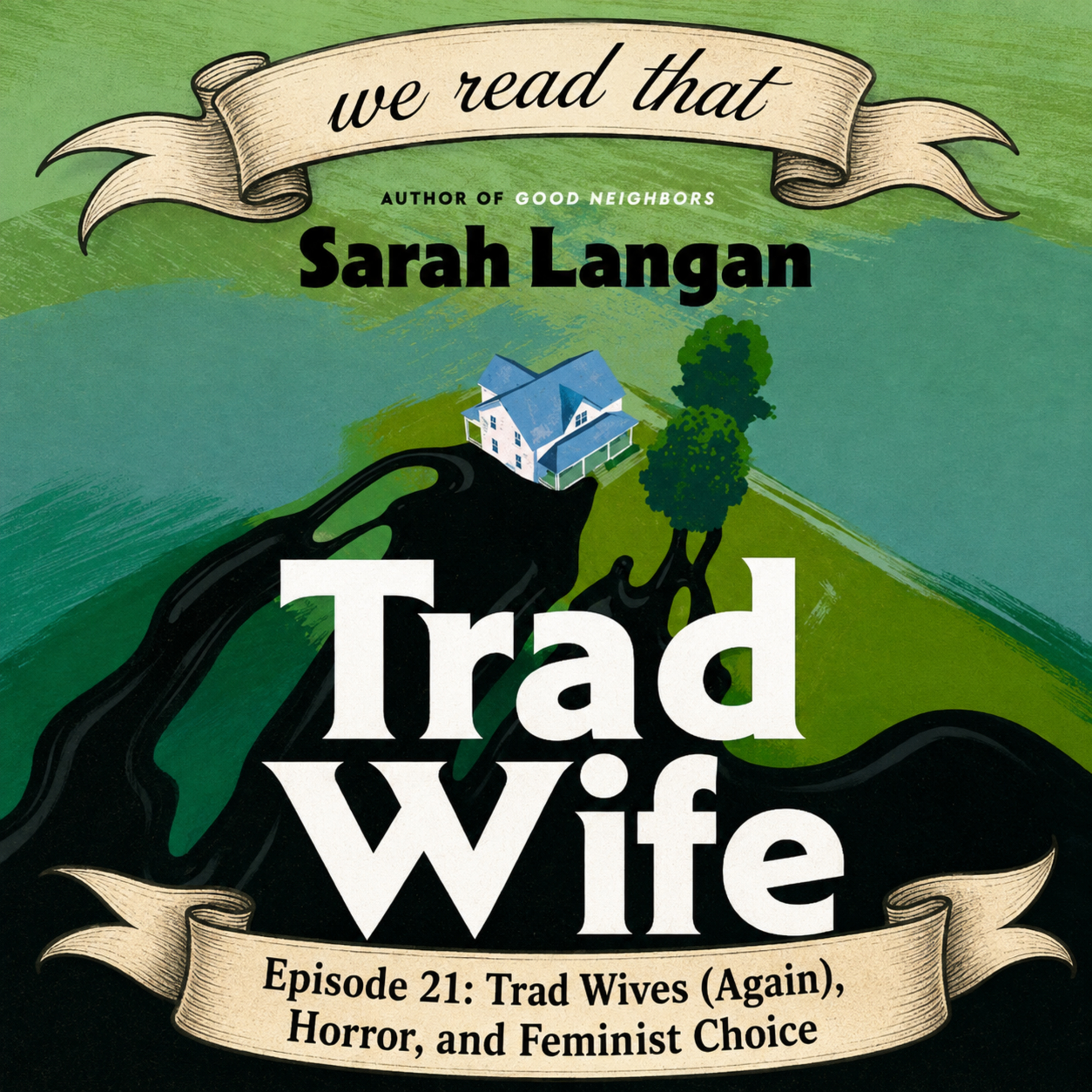
Speaker 1Hello, hello, hello. This is We Read That, the ultimate book podcast. My name is Jenny. And I'm Dani. And this is the podcast where we assign each other fiction books and then talk about them. This week is my pick. And we are reading Tradwife by Sarah Langen, a horror spin on the whole Tradwife phenomenon. And this book just came out earlier this summer in May. So I'm very excited to talk about it with you, Jenny. Yay, me too. So before we do that, we always have our bookish question of the week. And I will admit, I had so many things we could talk about this week, so many things in the news, so many great pop culture moments in books. But what I really want to know, Jenny, is when you walk into a bookstore, what makes you feel like this is a bookstore for me? Because we have visited bookstores together. We have a couple types of bookstores I know we really enjoy. But I want to know for you, if you could have your ultimate bookstore, what would it be? What is the vibe? Breathe it in, visualize it, you know, set the scene.
Speaker 2I have a bunch of thoughts. And I'm building this off of the Sanford, which is a bookstore in Chicago I found in April. And I really find with that one. Okay. So I want the walls to be in a darker color, maybe like green. And there's lots of light wooded shelving everywhere. And there is lots of books, but then there's also a table with like recommendations from the staff, which would be really helpful. The books that they have, and this is going to sound super elitist, and I apologize. They're not all just romance at the front with these kinds of covers that all look the same. Because I've been to a bunch of bookstores, right? And I totally get it. For selling purposes, this is super popular right now. So you want to show as a bookstore, this is what we have, right? But I don't want to just have that because that turns me off just a little. There's this really great bookstore in Champaign. Every week they do like themed weeks of like Salvador Dali or something like that. And it's books that sort of relate to that. There's like effort in curating some sort of, not experiences. I don't need to experience a bookstore, but like here is something, if you haven't picked this up yet, go for it, right? Right. But I think the one thing that really turns me off when I go in and I see just like this display of like animated, AI covers that all look the same to me, I'm out. But when it's this good mix of like, we have romance, we have literary fiction, here are the cool nonfiction things that recently come out. But also we have some older stuff that they bring out. So I guess what I'm describing is aside from like the fine green walls that I apparently need, I love a bookstore where I can tell that the owners and the staff really do love books and care about them.
Speaker 1I understand that. Would you have like a coffee shop attached? Do you need book merch? Is there a ratio of book merch to books that's too much or too little?
Speaker 2I do think there should be some comfy chairs. Nice. Like a couple. I'm not saying this is like a hangout spot, right? But it would be nice to just like take a moment. Coffee places are nice, but I also understand, you know, you don't have to do it all for us. Oftentimes, because when I've seen bookstores with coffee stores, suddenly the coffee store becomes the domino. Right. But for me, the bookstore that I'm thinking of, the literary, for instance, in Champaign, relatively close by where I live, it's both a bookstore and they do have a cafe, but it is a bookstore that really focuses on sharing love for reading, sharing love for all kinds of literature, right? Also creating community. They run like three or four book clubs a month. Romance, science fiction, nonfiction. Right. And it just keeps going. And there is kids reading sessions. And now I'm just hyping up the literary. I apologize. No, it's great. No, I love it. I love it. Show it some love. They have some, they have like, bedazzle your favorite book night, or they have,
Speaker 1they have movie nights. And so I'm sorry, I'm imagining myself like over here, like bedazzling the cover of like Hornblower and the Hotspur. Like just, you know, like, woohoo, 19th century naval warfare. Yay.
Speaker 2But, but what I'm getting at, and I'm seeing sort of this theme emerge, I really like a bookstore that cares about the books, but also cares about creating this community. It just feels good when you walk into a town or you drive into a town and there's a cute coffee shop, you immediately like your heart goes a little bit warmer. If there's a bookstore, right, then there, it feels like it adds life to it. And when it becomes part of the community, where like-minded folks or people who are interested in reading, they're like, oh, I love it. I love it. I love it. I love it. I love it. I love it. I love it. I love it. I love it. I love it. I love it. I love it. I love it. I love it. I just love that. Yeah, that's nice. I don't really need coffee. Coffee's nice. But, you know, when I'm bedazzling books at night, I don't really need a caffeine boost. Wait, have you actually bedazzled a book? I want to sign up for next month's thing. Oh my gosh, I love it. What book are you going to bedazzle? I don't know yet. They said you can both bedazzle your own or
Speaker 1you can buy something there. I think we all know you're like bedazzling Anne of Green Gables.
Speaker 2I know, but then I feel like I'm desecrating.
Speaker 1Very well. Very well.
Speaker 2You asked earlier about Bookmerge, right? And we've had long conversations. I've recently thought about my stance on Bookmerge. And the one Bookmerge I will support is when a bookstore has their own Bookmerge. Oh, that's fun. Like a sticker from the bookstore. Or like a tote bag. One of my favorite used bookstores is the Bookmill in Montague, Mass., which is just gorgeous. Right. And I do a t-shirt, the tote. And I just, because it feels like this is something that they make. And you're, even if you're not buying a book, you're still supporting a store in a way. Right. I don't know. I'm a hypocrite in so many ways. What about you, Dani? Do you need a coffee store?
Speaker 1No, I don't need a coffee store. I do need to feel like it has some kind of heart or soul. I like a little bit of a curated experience. Kind of similar to you in the sense that I really like a good themed table. Maybe something that's themed around, you know, something popular or something tongue-in-cheek or even like, Christmas in July, right? Kind of thing that has a variety of genres. I think that's really important because I do want inclusivity in that regard. Right. I think for some reason, it's really important for my bookstore to have a community board. And I noticed this when I was visiting family in Florida this summer that every single bookstore I went into in the part of Florida where I'm from, not a single one had a community board.
Speaker 2That's a bummer.
Speaker 1Yeah. And I was like, well, that's kind of weird. Neither do the coffee shops, really. It's kind of odd. I have found increasingly that a lot of bookstores are one of two veins. One is highly curated experience with a lot of book merch, which I'm sure is a good seller, which is really fun, right? But fewer books, more kind of like a retail experience with some recommendations, which I appreciate. Or use bookstore that smells like mold where they have just thrown every book they ever like possible. And I find that overwhelming. Like, so for me, there's kind of like a happy medium there between I don't want it to feel stuffy, dark, but when it's too much, it's too much. I do understand that like in order to rotate stock, you have to have a back room that's pretty big. I get that. Like, I'm not, you know, begrudging that. But there is a near me and you're familiar with this as well. There's a wonderful used bookstore that I think does a really nice job of like balancing the curated experience. In the very front, they have a staff recommendation. Everything is very clearly labeled by section. They do have things like records, puzzles, things like that. And I think you can buy that are also used. I enjoy that a lot.
Speaker 2I mean, my favorite part about that particular bookstore in upstate New York is that the first shelf when you walk in is the relatively new books and, you know, and staff picks. Say what you want about, you know, supporting local bookstores and stuff like that. But some books be expensive. Thirty, thirty two dollars, right? Yeah. And I've been very lucky at that particular bookstore. If you get there on time and they just put out new stuff, I've gotten books there that had come out within the last two weeks that are there for seven, eight dollars. Yeah. But I also love the fact because it all runs on donations and volunteers and volunteers. But people, you know, I read this new book. I want somebody else to enjoy it. So here we go. I took advantage of that generosity from a stranger a few times.
Speaker 1Yeah. The other thing I love about that particular bookstore is that it has rare books behind the counter and the women primarily. I've never seen a man working there. I'm sure there are men that volunteer there, but that work there love books. They all have their own genre that they love and they'll chat with you. That's the thing is like if I go to a bookstore, I kind of want staff there to like want to engage about books. Like if I ask like for a recommendation or something like that, kind of like if I went to a hairdresser, I'd be like, what do you think with my hair? What do you think with my hair texture? Like what would be a good cut for me? Right. I want someone to be like, oh, these are the books I've enjoyed. What do you think? Which I feel like maybe puts too much of an onus on the people working at the bookstore because, you know, sometimes a job is a job and that's OK. Right. But yeah, that's kind of my my vibe on. I think you and I have a similar vibe on bookstores. I think what really
Speaker 2makes a bookstore stand out to me is also, as you said just now, it's sort of the people. Yeah. That breathe life into it. I totally get it. A job is a job. off as a job, but sometimes it just feels cool when you see that the people who run it or who work there also enjoy books. And that really just warms my heart. Recently in my area, there's a relatively new mobile bookstore, which is pretty fun. I think my algorithms on social media have also been showing me more and more people who revamp like little vans. And from my understanding, it's like a farmer's market thing, like on the weekends or when a brewery has a thing going or something, they bring like a smaller curated stock of books to people. And I really enjoy that both because it's cute and aesthetic. And these people put so much effort into these vans and they're just adorable. But at the same time, it also, and that goes back to a little bit of my community thing, it adds something to a place that might not have books, right? Yeah. When that there is a place that you can support literacy, support small bookstores, support small businesses through just finding new cool literature. I don't know, it just adds something to it. I used to live in central Massachusetts for a while and they had that too, where we have quite a couple branches of libraries from the library system, but there were weekly mobile libraries that would drive around and basically meet the people where they are in case you have transportation or you're elderly or kid, whatever it is, right? But like reach for the people who are there. And I think that's a really cool thing. People who might not be able to otherwise get to a bookstore because it adds something to it. If you can get your hands on a book and just be part of that, it just, there's just something that adds to your life. No, that's fair.
Speaker 1Yeah. I was looking up here, bookstore lists of bookstores to visit around the world. There is one bookstore that I really love in Bucharest. And I know that I've mentioned this before. It's Kutrashti Karusel, which is a really beautiful bookstore in Old Town, Bucharest. The building, itself is gorgeous. And so I think like part of what makes that an incredible experience is you walk in and it's like five floors of books and then a cafe on the top. But the building itself is beautiful and they have quite a lot of merch, some that's book related, some that's not like in the very back. There's like teas and coffee cups and things like that. So it's also a little bit of a retail experience, but they've done a really nice job, I think, of sectioning off their floors. They also understand that their primary clientele, of course, are going to be Romanian speakers, but they also have a nice variety of books that are Romanian authors that are translated into English. Some of which you can find online, some of which though you can't. There's some very famous Romanian authors there that they have translated. But then on our last trip there, I really enjoyed looking up some new authors. I make it a point every time I go to pick up a book by a new author. And so the one I picked up is Astronaut with an exclamation point. I haven't read it yet because my husband stole it from me. Yay. I'm making him branch out. It takes place in communist Romania. And it's this detective story that also weaves in some social commentary. But I think I spent like 45 minutes perusing the books. And I do use that term correctly, like really intensely reading every book. And at one point, one of the staff came over like, oh, can I help you? I was like, oh, like I come here like every year, every other year. And I always try to pick up a new author. And they were like, okay, I will let you enjoy it. I was like, yes. But we also really love to go there and pick up children's books in Romanian. But one thing I did think was interesting that really frustrated me was last time we were there, you couldn't even walk in because everybody was like just on their phone recording. So I get it, you know, and I was also guilty. Like I also, you know, was recording. But I realized one of the things I like about that bookstore is like it's chock full of merch. It's a very big and books. It's a very big space, but it doesn't feel overcrowded. Whereas we were in Daunt Books and Marlbone, which it says is housed in a gorgeous 1910 Edwardian building. The staff there was very nice. It was so chock full of books and such like a rabbit worn space that it felt like I felt overstimulated. In the back was an incredible children's section and that had more space. And then upstairs they had like a rare book library and that had more space. It was just overwhelming to me. It was like too much. And it was very narrow spaces for the amount of people that were there. But you bring up an
Speaker 2interesting point, right? When we travel, you know, our social media is probably geared towards that. And I do that too. I'm guilty of that too, right? That we see bookstores as a site for tourism. Right. Because I do think a bookstore in a way reflects history, but also reflects what matters to the community, right? The display case of Romanian authors tells you who to read from the country that you were, right? Well, I think it's the bread and butter of certain bookstores. You know, we need to attract people. So we got to curate a nice experience. I wonder what it's like when you become one of those bookstores, like eight bookstores to visit in London to have a beautiful Sunday afternoon or something like that, right? When you said like everybody was recording. A couple of years ago, I went to Maastricht for a week-long workshop. I googled, I mean, what do you see in Maastricht? I'd never been there. It's in the Netherlands, in the southern part of the country. And one of the first things that you will see is Buchhandel Dominikanen, which is an old Dominican church that lost its sacred function 200 years ago. And I'm quoting here from visitmaastricht.com. It is this beautiful old church that you walk into. And in the middle, you have so many books and on the sides, on the left and the right, they've created these levels on which you can walk. And there is like the English speaking section. That's cool. And kids section, there's coffee in the back, right? First of all, we stood in line to get in there because I think they opened on a Sunday at noon or something, so we were like there waiting. I already knew I wanted to get a merch tote, which I got. I didn't get any books by Dutch speaking authors, but I did get my son a children's book that is very popular in the Netherlands. Not that I can read it, but the pictures are really pretty. I do see bookstores also as this place to visit to get a sense of the country that you're in. Danny and I were over the summer hopping around as we do as jet setters. I was in Poland for a bit and I had a day out with my husband in Krakow. I've been to Poland and Krakow quite a bunch. That's where my family is from. I did look up just cute bookstores. There was one that was just in this old, beautiful mansion. Two apartments that they had renovated and there were treats and coffee and rooms. And it was really geared towards though an English speaking crowd. Like a lot of the books were English speaking. They did have community boards with like English stand-up comedy and English tutors and Polish tutors. I don't know if it was solely geared towards expats, but it was geared towards people who speak English. The other bookstore that I went to was called the American Bookstore. Straight to the point. Just straight to the point. Everything's English in there. It was a tiny, tiny room with white bookshelves from the floor to the ceiling. And it was just a tiny, tiny room with white bookshelves from the floor to the ceiling. And it was all Romantasy. All of it. And it was not an inviting space. It felt more like a closet where if you want to read Romantasy in English, this is your place. I don't know why it was called the American Bookstore because with the exception of everything being in English, I don't know how was America coded. It's the American Bookstore. That's fine. But that was an interesting experience to me as well. How you can curate a bookstore into a tourist trap or an expat. Right. And I'm speaking here, obviously, specifically for English-speaking expats. Right. Anyways, that was just sort of my tangent on what bookstores can be. Should we talk about Tradwife?
Speaker 1This week on the podcast is my pick, Tradwife by Sarah Langen. It is interesting that there are multiple books by the name Tradwife. So do you have any idea what the Dear listeners, if you want to read this book or are thinking about picking up a book by the name of Tradwife, please make sure it's a Sarah Langen edition. Although Jenny has read other books by the name Tradwife and will fill us in. Sure. Currently there's three.
Speaker 2There's two Tradwife books that are two words and one Tradwife book that is one word. Okay. There you go.
Speaker 1Google algorithms SEO optimization. As we always do, I will begin by reading The Death Jacket. I requested this and was approved. Thank you, dear. From NetGalley as an advanced reader copy. I am reading the Goodreads summary, which is always taken from the publisher. So your favorite influencer is about to be exposed. A deliciously sinister new novel from three-time Bram Stoker award winner Sarah Langen. Every day, millions watch Mia Wright, the quote unquote Tradwife queen on her idyllic 300 acre farm with her handsome husband, seven perfect children, and a life of from scratch, meals and pastoral bliss. She is an icon of modern femininity, but behind every perfect image is a secret. And in this case, the secret is a horror desperate to save her tarnished career. Journalist Jenny Kaplan arrives at black Swan farm to profile Mia. Jenny is ready to write a scathing expose determined to expose the deception behind Mia's curated life. But soon Jenny has more to contend with than staged videos and picture perfect poses. There's something wrong with her. She's at the farmhouse. Some things slithers through Jenny's dreams. And at night, the children sing strange nursery rhymes. She's losing time. She's losing her hair. She starts to worry that she's losing her mind. There's a horror at the heart of Black Swan. And it's just waiting for Jenny. Tradwife will make you question what's real and what's just a perfectly curated deception. Will you see the lie? So, Jenny, the floor is yours. What are your thoughts on this particular book, Tradwife, by Sarah Langan?
Speaker 2I guess we can start with Jenny Kaplan a little bit as the journalist. She's a disgraced journalist who essentially gets canceled for a personal essay she writes in which she, I think, discloses, right, that she had an abortion. And she's a journalist and she wrote this, her hip news outlet published it. And we've seen a lot of these kinds of articles come out or personal essays. It is very much a book that's been published. It's a book that's been published. It's a book that's been of our time to have these personal disclosure essays. What it does cause, though, is this shitstorm where she gets essentially laid off and receives backlash from her professional and personal community because to disclose something so personal is uncomfortable.
Speaker 1Well, we should also clarify there's a very particular community that is canceling her.
Speaker 2What is that community, Dani?
Speaker 1The conservative dude bros. Yes. And then her company, the entire publishing portfolio, bought out by the implication is a conservative family with a lot of money who wants to, like, you know, stop the, quote unquote, liberal woke media. So that is part of why she gets canceled.
Speaker 2Sure. She gets canceled.
Speaker 1She becomes a target of the, of the, and this is important for later in the story as well.
Speaker 2Sure. She becomes a target of the right, essentially the conservative right, extreme conservative right. There's political ideologies, a spectrum. These are just crazy cuckoo bananas people. She gets canceled and, uh, in an attempt to sort of revitalize her career, her gives her a last saving grace, like last lifeline to write this expose about me. All right. And I think sort of similar like ballerina farms in our real world, a beautiful estate husband does the chores on the farm, millions of kids, beautiful homesteading environment, linen clothes, beautiful kitchen, this and that. And, uh, Jenny takes the job, right? Because she has nothing else going on. And she's like, I need to pay rent. And she goes to the farm. I thought what was really interesting is, is this assumption of a progressive or liberal thinking woman going to these farms, right. And to expose them. There are these bigger exposes that try to, I don't know, bring light to the behind the scenes. How's this even possible? Because women in the trad wife network do portray a life in which, you know, gender roles are very, very heteronormative, very traditional, but it also creates a lifestyle that some people aspire to. What these trad wife influencers do not disclose though, is that in order to make all of this beauty work, they have a full staff going and, you know, somebody who runs the farm, nanny, daycares, cleaning ladies, right. Cause it takes a lot of time to be an internet personality. It's a job, but Jenny goes to, goes to the farm. It's called black Swan farm, similar to what we see in the real world. There's also merch that the farm has. There's a brand attached to it. I think, I think it was New York or Pennsylvania.
Speaker 1I'm pretty sure it's Pennsylvania, which is already a very weird state. And I will live by it. I will stand by that. Okay. All of our listeners from Pennsylvania can be like, what? No, it's true. That's true. It's an, it's an interesting state with a lot of varied characteristics in it.
Speaker 2The positions by Danny do not represent the position of, you read that. So it's Pennsylvania. The local economy is supported by the black Swan farm, and from the get go, when Jenny arrived, she has just a weird feeling. She stays at a inn that is kind of weird. The people are just, and there's, you know, it could be sometimes in the beginning, you can sort of ignore it because big city girl, you don't understand small town, local customs. Right. And I think Jenny also internally tries to set that aside. So she's not so prejudiced against this, but she's also clocking it. Like do you want to help me out a little bit?
Speaker 1Yeah. So she starts out by initially writing a piece about Mia Wright. And then at the end of the conversation, she's there for a day. Jenny goes back to her regular life and then her editor's like, Oh, you know what we should do? We should do like a one week swap where you go and you live on the farm for a week and we'll have a photographer come take a picture of you at the start. And then like at the end, after a week he'll come and like, you know, and then we can see big city meets small town expose kind of thing. So initially she's not going to do it. Finally, she does agree to do it. And then she shows up at this farm and weird shit starts happening slowly over time. So the, the, the primary plot development in the novel takes place over the period of a week on a personal like side for the, for Jenny, this brings up some trauma she has to work through. She had a boyfriend during COVID who had a serious mental health crisis and is essentially schizophrenic. And she is, which partially led to her terminating the pregnancy. So there's a lot of stuff that comes up with that throughout her time there. But she also starts to get the sense that like, she starts losing time. Her body starts freezing. The kids are doing weird things. She notices that like Mia, when she's recording does this thing where she claps, let's begin clap. And then the entire room changes and like the entire vibe changes. It's also a suspect because these accidents quote unquote, keep happening during filming. I'm like, Oh, Mia burns herself or the kid trips or, you know, the dog trips her. And then she like drops the tacos or whatever. Jenny gets a sneaking suspicion that this is all staged. So she's digging into this, but she's also very attracted to Mia, like not sexually. Then weird things start happening. Like she starts losing time. There's this yellow fog and this horrible smell. She starts having these weird dreams. Her hair starts falling out. And it's kind of like the film get out where you're like, Oh girl, go just go. And then of course, by the time she tries to go, it's too late. And big spoiler, big, big spoiler, big, big spoiler. So if you don't want to hear it, move ahead. Yeah. So what, one of the things I liked about this book, this is part of the spoiler. I promise is that it has this built in lore about the origins of the town, the origins of the farm that is very feminist in its own right. And essentially this group of women called the widows took over the town when it was first established and the men's didn't like that. So they murdered the widows except one woman wouldn't die. So they go out and they burn her alive, like at the stake, like a witch. Right. And in her head, she's like, Oh my God, I'm going to kill you. And in her death, she curses the town. Yes. And that curse is real. And it just demands a sacrifice. This creature that comes out through the fog called Mr. Yellow. And that is ultimately what we find out is happening at the farm is Mr. Yellow is taking over these women to kind of like be their bride or something like that. And Jenny slowly starts to trade places with Mia. And we keep cycling. So like you have a baby, you do your duty. Then you go find someone new to prey on and you go from there.
Speaker 2Right. And the entire community, like the husband, the town, they're all in on it. Yeah. They all know this. They all know this. And they're facilitating this, which is why Jenny and Mia, because Mia sometimes has lucid moments, cannot escape because they're being portrayed as hysterical or she's just having enough of her episodes or something like that.
Speaker 1And they won't let them leave. Right. The bargain is that Mr. Yellow will let you go once you have perpetuated and furthered whatever his grand scheme is of like world domination, kind of like pinky in the brain, like tonight, pinky, we take over the world. Right. Kind of thing. And given him a child, which was an icky body horror there. I really hated that. But anyway, like I didn't hate it. I just like like forced pregnancy. One way they do that is by getting these products out that have some kind of it. Wasn't fully clear because it's like, you know, lore. It's the connection to the earth. Yeah. And then that like creates a connection. So you use the product and then you become susceptible to their influence, which is why when Mia's clapping, it connects with people. So it's definitely I was not aware when I when I started reading it that it has elements of supernatural horror. I personally really enjoyed that about the book. I also did not mean to assign you a horror book. I thought this was more like domestic thriller. But no, this is firmly in the supernatural horror genre with the slow burn. There's also another really big twist that I really like about this book. It's really appreciated. And that is that we find out that the person behind the screen that caused Jenny to get canceled is the ex-boyfriend who had the mental breakdown. But he did it when he was totally lucid. He was just really
Speaker 2angry with her. Yes. So the boyfriend is not part of the conservative far, far right kooky bananas crew, but rather he just co-opts their language and their anger to hurt
Speaker 1Jenny as much as possible. And he regrets it because he does try to come and rescue her at the end. But it had all these layers of like, what is absolution? What is forgiveness? What is forgiveness for yourself? For a horror book, it brought up some really interesting questions. But Jenny, what was your take on this book? Now that we've talked about the cuckoo bananas plot where listeners are like, what the hell are these people talking about? Yeah, it's got a lot of moving parts, people. I know. Ultimately,
Speaker 2it's a story about a supernatural natural force, that forces liberal women to take on trad wife roles and service the trad wife cause and trap more women into it. And it preys on weak, susceptible women. And by weak, I don't mean physically weak, but vulnerable in a moment who then have to, I guess, endure their time as Mia Wright version number X. And it is a weird book in that sense because honestly, I wasn't really sure what to make of it even after I finished it because it touched upon, as you say, so many different layers. It is a supernatural horror story, right? You definitely get this slow encroachment of creepiness. Yeah, the unsettling unraveling. Yes. And I think Sarah Langen did a really great job at sort of bringing it all together at the end. The yellow fog that takes over the farm, but there's also this fog that takes over the reader in a sense because it becomes weirdly muddled and you're like, wait, what? Yeah, you don't have all the answers until the end. I don't have a lot of horror experience, but I somehow bring it all back to Rosemary's Baby. It still sits for me as like this example of what it means to gaslight women and prey upon a woman and sort of use her body as a vessel to advance a cause. And when I read these types of books, trad wife books, I'm not saying every trad wife or every woman that lives a traditional lifestyle is living Rosemary's Baby, but this book, Yesteryear, there's like this thing of where you become sort of trapped within your own body. And just by being a woman, you have to serve a specific cause.
Speaker 1Yeah. I think that's an interesting comparison too, because this book compared to Yesteryear, very different genres. And in Yesteryear, like it's by choice for the most part, insert discussion here we had about the patriarchy, blah, blah, blah, go back, listen to that, listen to our episode about Yesteryear. It was our season one finale. In this book, it's less about choice, right? And actually, even after she's taken over and becomes like Mia, Jenny, as Mia, still fights it. Like she doesn't give Mr. Yellow what he wants. And finally, he's like, well, we can make this easy or we can make this difficult. Like you have a choice. And she holds out for a while, for like a year.
Speaker 2For me, it was just like this framework of like enclosed space, woman trapped, we're gaslighting her and telling her she is crazy rather than the situation around her is crazy. Right. And so that's where I sort of found myself. That's fair. So to bring it back to the book, I thought the setup was really cool, right? Right. Because you're bringing in a character from the outside to a claustrophobic space, even though it's 300 acres, and you're slowly forcing them to stay and be tied to this wall. You have hints of religiosity, you have hints of, or like you see the very negative, negative, negative effect. You have hints of far-right hate on the internet and what it can do when you just shout people down and do not engage in dialogue anymore, but you're just shouting and spewing hate. So there's a lot of these like big tropes that come together that I think we associate when we bring in conversations about the trad wife movement. Feminism, patriarchy, the far-right movement, religion, it's all there. At times, I felt it was overcrowded. Like you're trying to bring in everything. Right. That you're supposed to, quote unquote, I don't know what you're supposed to, but it felt like I need to bring in all these things. All these elements, yeah. All these elements. If you're bringing in far-right crazies, I didn't really feel like Sarah Langen developed the idea that much. It was just more the catalyst for why Jetty was in the situation. Right. She wasn't.
Speaker 1Yeah. I mean, I agree with you that there were some threads that I think were like not pulled or denotted in a way that they, that would have been more satisfying. I guess if I, if I had one critique of this novel, it would be that I think the pacing was off. So it was a very much a slow burn at the beginning and then it accelerates, which I don't mind. But then the ending, the last 10% felt extremely rushed to me. I needed more time. When Mia comes back, now that Mia is Jenny and Jenny is Mia, I know it's confusing. She does this whole expose and she explains what Mr. Yellow is. And it reminded me a little bit of our conversation of Beautiful Ugly by Alice Feeney that we had last season, where it was, I am not a fan of pretty resolution of via monologue. So I wish the book had been a bit longer, actually, and had resolved some of those plot points at the end, or just not resolve them. But if you're going to resolve them, resolve those plot points in a way that feels a little bit more organic. Sure. I did think there was an interesting thing for me that got me thinking about some of my conversations I've had with the younger folk, with conversations I've had with students or children of friends who are in their late teens, early 20s. And that is the consequences of putting your entire life out there. I thought there was a really interesting conversation that Jenny has with the ex-boyfriend where she confronts him and is like, what the fuck? You did this to me and, you know, like this online hate thing. And his response is not to take responsibility, of course, right? Which is not okay. But his response is, well, did you think about any of the consequences about what would happen to me, how I would feel about you sharing all this stuff from our personal life? And I feel very torn because I understand what the boyfriend's saying, or the ex-boyfriend's boyfriend is saying in terms of like privacy. But at the same time, these things did happen to Jenny. She was in a pandemic with a partner who was having a complete mental breakdown, who was like doing a Howard Hughes moment of like peeing in jars, right? Of like not responding, not being interested in therapy or help. His parents, who were Jesus freaks, for lack of a better way to put it, right? Very, very conservative. They're like, well, Jesus, you know, will help him. And she's like, no, I need your help, right? There doesn't seem to be much sympathy for her. And she's like, from any of the characters about why she made the choice to terminate her pregnancy, which it is her choice, right? It got me thinking about some of these conversations I've had with people about, well, when you put your entire life online, yes, that is her experience, but it's also his experience. And so I thought it was this interesting potential thread to pull out maybe in another conversation about how much do you share? What experience do you own versus someone else owns?
Speaker 2I think you're bringing up a really interesting point because availability, right? We have Mia Wright also using social media to essentially share a lot about her life, right? But I do find with influencers, the draw in is that they disclose a lot about their personal life, but there's also a limitation to how much they actually share. And I think if you will listen to interviews with them or the more popular they get, I think there becomes also a more curated sense to it. When it comes to Jenny, right? She's a journalist, she's a writer, and she makes herself the story in a way, right? I don't really always enjoy that. I know we need these kinds of reflections and memoirs and broader discussions about personal experiences to create community and to show this has also happened to me. But in a way, she also makes herself the story. Right. With the onset of social media, a lot of like journalists, you know, I think Jake Tapper, posts quite a lot about his family. But like, we are also interested in the people who inform us and share stories about the world with us. But it is a choice to make yourself this vulnerable, right? And disclose what is going on in your personal life. Robbie Hoffman, the stand up comedian, you know, like her or not, but she said something interesting in terms of like, you can say whatever you want. But in a way, you can't be upset when people get upset by what you said. For me, I think it's a really important thing to do. And I think it's a really important thing to It made totally sense that if I was the ex-boyfriend who's gone through a horrific mental health episode, and I'm not saying Jenny should have been more patient. It's fucking horrible sometimes to be a caretaker, even when you love the person deeply, because you are not taking care of the person that you met and fell in love with. You're taking care of a different version of them that is not connecting with you in a way. And I know through sickness and in health, but that doesn't mean you have to do it with a person. And I think it's a really important thing to do. And I think smile all the fucking time.
Speaker 1Well, and also to be completely alone during the pandemic. I mean, that's difficult.
Speaker 2So I don't think there is a bad guy and a good guy. I do think that the boyfriend can absolutely be upset about his ex-girlfriend not sharing that she was pregnant, right? Because, you know, why didn't you talk to me, right? What I don't think is okay is to then create a far-right conservative campaign against your girlfriend. To threaten her, to scare her, and to cause her to lose her job, right? I don't think that is appropriate because I think, again, the more appropriate way would have been, hey, Jenny, can we talk? I just read your article. What the fuck is going on here, right? Yeah, I agree. And it also is not just about the two people involved in making this baby, but it's like family, friends who are reading this, right? You are airing your dirty laundry in public. And I'm okay with people not being on board on your feminist journey of disclosing everything and being an open book. Jenny has some sort of accountability here, too. She's traumatized by experiencing this mental health crisis. So the way she describes this, right, it's the peeing in the jars. It's the selling of stuff. It's the complete lack of care for her, for their lives that they've built, the isolation. That is trauma. That will fuck you up in your own way. Yes. I don't know. Sometimes there is no perfect right or wrong. wrong i feel for her but sometimes i wish people just talk to each other i guess the next question
Speaker 1that i have for you is given that your expertise now in the trad wife rabbit hole i'm curious as to why we seem to be having why you think we seem to be having this cultural moment surrounding trad wives and i want to preface this by saying that this has become such a big cultural moment that trad wives are now rejecting the label on the call her daddy podcast apparently a very well-known conservative traditional lifestyle influencer who does not like wear prairie dresses and all that stuff but lives a traditional life rejected the trad wife and she said nope i i'm not you know you can't put me into a box i do these things for my husband because i love him and yeah we have more traditional gender roles but that's what works for us and blah blah blah blah blah and there's been some discussion that part of this pushback is because there has been such an explosion of media surrounding trad wives now you mentioned there are now three books two of which are horror i don't know about the third book uh named trad wife we also have yesteryear which has just blown up in popularity it's a very good book i think and and we agreed we we enjoyed it so what do you think about this discourse
Speaker 2that's happening i'm fascinated by it but not because i want to watch it i don't follow any trad wife account right i am just interested in the discourse surrounding it so i might not be the best person to speak on it because i have not consumed this content but my understanding is that they've trad wives on social media have existed for like a decade or so right and this articulation and this demonstration of this could also be your life right right social media allows us to get glimpses curated glimpses of communities or ideas that we just might not be familiar with my algorithm recently showed me a woman who left the amish slash mennonite community and got married and had three kids but what she actually shows right that she's not shunned as like popular culture will tell us where she can't speak to anybody anymore it is more like i left my religion but i'm still religious and i still see my family on the weekends and i still am invited to the community and stuff like that i thought that was an interesting video to watch just because i also think in these black and white communities i'm still religious and i still see my family on the and white stereotypes sometimes about stuff that i don't know and like once you leave the amish you may never come back because pop culture
Speaker 1has told me i mean that is true in some communities but that's not true at all and especially many mennonite communities are much more integrated into the economic and cultural fabric around them but for me it's like
Speaker 2when i don't know something and i don't live that lifestyle right it's interesting when social media just shows right and again it's curated it would never be the entire experience but it allows us to get clemsism to that and i think 10-ish years ago when the first trad wives came out and showed like hey actually you don't have to be you know what's her name cheryl something lean in all the way you can have it all yeah the lady boss corporate lady make the money have your 1.2 kids this that right eat your 600 grams of protein every hour right do the pilates yoga and run right there are ways in which you can also live your life that doesn't i guess quote forces you to become more like a man or have it all or something like that right and i think there's like an interest in that because as a millennial life can sometimes get really hard like with all the shit that you have to deal with right and so i do feel like oh you know what my candle farm in vermont wouldn't that be nice but i still want my netflix and i still want access to like take out but it's more i think there was an attraction in the slowing down and i think that really exploded during covid and because we were all forced to slow down i think there's a dual fascination with women and other observers who really just want to aspire to that right right and then i think there's the people i wouldn't categorize myself as those but i think who hate watch that shit
Speaker 1what bothers me is that it's sold on this pretext of like you know getting back to a slower life and that is true but i think people who aren't part of that associate that with like leisure time no like in many ways i feel like yeah it's slower but you're even more busy it's just the work and labor looks different i think it's interesting how we package things i understand the frustration that women have because i have it as well with like you can have it all no i fucking can't i'm exhausted all the time there was recently a tiktok that went around about a stay-at-home mom who told her husband i'm taking personal time off for a week i'm going on vacation alone and he was like okay that makes sense if you worked an office job you'd get pto she's like i'm going to be gone for a week and i don't want anyone to touch me i don't want to call me i just want time away which in many ways seems like a fairly equitable marriage one could say right what i find interesting about the trad wife phenomenon is this idea that you know you can slow down and yet you still have to have the perfect body and this and that well
Speaker 2isn't the assumption here that if you slowed down and you didn't care about uh your corporate life or that you didn't care about your life and you didn't care about this or whatever or if you didn't care or didn't fall into the traps of this progressive world right you can actually be healthier that you can actually be more thoughtful mindful more religious i thought that was also part of it that yeah maybe one of the reasons why you might not be as good you've been led astray and if you come back to this slower lifestyle you make your own food you have time you're more intentional as a person you're more intentional as a person you're more intentional as a parent i'm not advocating for it i'm just thinking these stereotypes that are being pushed right i
Speaker 1think there's also a disconnect here sometimes in pop culture because i think people equate trad wives with stay-at-home moms and those are two very different things stay-at-home moms are are often a choice that's like economic right because child care is so fucking expensive in the united states trad wives are a different mindset in terms of what should a marriage look like which i think is interesting and i
Speaker 2think with traditional wives or the trap wife movement my understanding at least of the discourse has been this understanding of traditional gender norms and i always tell my students whenever you hear traditional like your alarm bell should go off because somebody decided what traditional is exactly there's no such thing it's traditional but these assume traditional values the woman cares for the family and the house the man is the provider outside i think there's also these choices you're expecting a woman to make and i think that's a really important thing to think to make in terms of how they dress what sort of aesthetics they aspire to and we saw that again in this book and other books beige everything is clean there's not much chaos there's not color because color can be chaotic and disorienting your dresses the materials you wear are different you take the time to make your sourdough starter because it's better and healthier and this and that your cutting board is three hundred dollars because it's carved from wood then blessed by the gods or something right there are these choices that you think are making your life better right because i think because i think this display of trad wife content or this choice to present your life in this way is to show i am unique i am interesting let me show you how my thing works right i think with people like nara smith who was on call her dad this week and also ballerina farm obviously these are very big names in the community but when you go down a few tiers there's also these many different camps that you can categorize them and it's not just trad what is tribe wife is tribe wife right there is far right movements there's the anti-vaxxers there's the raw milk people there's the homeschooling people right and now i'm just coming with tropes but some overlap some make these specific choices some you know honestly we just bought a farm in pennsylvania but our kids go to public school because i don't know how to do math right there's these choices that individual influencers make but i think we convolute them and put them all together because they are in our there is a big intersectionality so to go back to your question i think we're fascinated by it because it seems like such a big group with very different strands you know it's fair i understand that nara smith might want to reject that because all trad wives are kooky bananas as pop culture has shown us and maybe she doesn't want to be cuckoo bananas right i find that interesting go on to a relatively centrist left podcast to be like talk to i mean first of all be on this podcast but also say you know what i'm just making my own choices please don't group me in with others and that's why i went down a rabbit hole too with this because it's so different from what i do but does it strike you as a little bit of a difference between what you're doing and what you're doing and what you're doing and what you're doing and what you're doing and what you're doing a little bit like i'm not like other girls the nara smith comment yeah sure part of the interview was also clarifying that people forget that nara smith used to be a model right that she earned her own money that she is of the world she's
Speaker 1cosmopolitan and stuff like that and so that somehow makes her choice better and more valid i think it's like this is still all like get off my patriarchy soapbox this is still like a symptom of our societal expectations of women and choices blah blah blah blah blah explain a little
Speaker 2bit more do you think her turn towards traditional quote-unquote
Speaker 1roles is an expectation yes i mean i think part of it is i also think that the discourse of well i'm different because i had a career and i chose this and therefore this is somehow now more acceptable i think is really problematic in some ways it's similar to the ballerina farm discourse i mean also brings up question about what constitutes choice right like her husband doesn't let her drive oh i didn't know that yeah um and that's how it's framed not i choose not to drive it's my husband doesn't let me drive and here's why right according to what i read about from the interview there is this question of is part of why we are attracted to these women on the social media sphere because they hold up traditional patriarchal norms of beauty if you saw a trad wife and i'm not talking about stay-at-home mom i mean a true trad wife who was overweight or had bad skin who was conventionally unattractive who lived in a home that was not perfectly curated would you still find that lifestyle appealing i'm not saying there's anything wrong with any of those things i mean either they have really great genetics or the incredible amount of like time these women are spending at the gym because after you've had six children majority of people would not have the physique that they have because literally hormones and things move and things shift and things prolapse do you know
Speaker 2do you know how i heard that for the first time about ballerina farms like how it penetrated my consciousness no tell me when she had i believe her last latest kid last kid i don't know and two weeks after she gave birth she had flown to new york city to compete in the mrs america competition and she fit the dress and i did think for a hot second like what's wrong with me i didn't fit in any dresses two weeks after i gave birth at the same time danny and maybe i'm just trying to a piece of contrarian thinker inside of me and i i will hear this argument of the feminist movement at a certain you know one of the later stages right that the reason why you can make these choices and decide i'm gonna homestead and my husband is not gonna drive is what the feminist movement fought for to have these choices no i understand that and i agree with that sentiment my problem is right that i don't know if ballerina farm decided for instance tomorrow i'm done with this and i'm gonna become a paralegal if this is gonna work because i don't know what kind of relationship they have and what sort of economy has been built up around the brand similarly if nara smith decided tomorrow hey actually sweetheart i want to drive myself to pilates is that gonna work again i don't know what type of relationship they have and what sort of agreements they've made with each other as partners but i do love the fact sometimes that i can rely on that my husband will do the grocery shopping because i fucking hate grocery shopping i don't know if this is gender norms or this is just agreements between partners where i'll remember to uh pack the clothes for a trip for a kid and he makes sure we have yogurt that
Speaker 1everybody likes right i think there's another aspect of the to get back to the feminist choice idea right is that i think that that works really well this idea of like we fought so you could have this choice but the assumption there is that it becomes a choice a true choice and not a societal pressure i think what gets lost in that equation is that part of that feminist dream is that you have thrown off the shackles or the bonds of patriarchy and now you're in a point where you have this equality and you have choice the problem is we never reach the point of real equality so those choices are not actually choices do you think
Speaker 2there are choices within a limited spectrum of possibilities i don't even
Speaker 1think it's about that i think it's about like i think the problem is that societal expectation and in particular the problem is that the problem is that the other patriarchal constraints become so insidious that we don't even know that they're affecting us right like why do i feel prettier with makeup why when i go to work do i put on makeup part of it is because it's a way for me to like express myself because i don't have tattoos i don't have piercings right like it's part of my artistic endeavor but then part of it is also you know the patriarchal bargain of i have internalized that this is more attractive and therefore i feel more attractive right so i think there's this idea about what actually is choice and when you have those societal constraints or pressures we still have very limited ideas about what constitutes femininity i mean it's improved from where we were but there's still a lot of room for growth that when this is viewed as the what an ideal woman should be when you have those shoulds is it really a choice sure the other thing i find incredibly problematic about the discourse is i think that the trad wife community is very attractive to me because it promises rest you can get away from your life but then when you actually look and you can bake bread i enjoy baking bread i don't actually bake bread i enjoy baking because i don't have to when things become things you have to do it no longer is rest okay like solid child care of seven kids not rest especially what i think is really interesting is all these trad wife narratives are taking place in rather i surprisingly isolated communities so it's still that you can do it all alone but in like remote forced proximity if we want to move towards a model where women are going back to like staying home okay but there has to be a community and a village to help you i think that's something that is also missing from a lot of this right it's like where's the mother-in-law who's like coming and taking the kids where's the you know where's the grandma who's there that seems to not be present in a lot of these narratives but i do understand the appeal i mean it is exhausting to be a working woman i know you and i talk about this a lot but i think it's really important that it's also exhausting to be a stay-at-home mom because that is also labor right i would like people in the community to be honest about what it's actually like and i feel like one thing i did really like about this and again i don't know because i haven't been part of it because i have rejected that choice one of the things that i really liked about the this book by sarah langan is that it made us think about these questions about choice and lack of choice in a way that i think contrasts really well with yesteryear and the choices made there to become a trad wife this this piece with sarah langan delved into some of these questions that i have really wrangled with about what is rest and how do you do these things and how do you keep a community and what i think is really hilarious about this book is like because literally it's the devil because you have supernatural forces that are helping you control people and i kind of thought that was really funny even if it wasn't
Speaker 2intended to be i appreciate where you just when the rest part comes up but i also think it's really funny because i think it's really funny because it's thought about that one of the reasons that jenny in the book trad wife is able to morph into this mia yes because the physical attributes are relatively similar and so there is this conventionality about how a trad wife is supposed to look like right that they're easily exchangeable and replaceable and that the audience
Speaker 1oh that's interesting i missed that that is funny not funny like yeah that's really i that's a good insight jenny i missed that and that the audience also
Speaker 2doesn't notice that this is the you know this is not the original mia this is a x mia that's hilarious they're mia number x right and so i'm just thinking about jenny becomes just a different person and there's no like it's pretty fast it's pretty fast there's no kind of face swapped her or something but we're just sort of dressing her a little bit differently we'll put a wig on her because she's losing her hair anyway a little bit of rouge and here we go it almost feels to me also like this cheeky critique of who are we actually watching right you don't know who's actually behind the camera it's interesting lots of places to go with it so so what i wanted to touch upon a little bit because again i i have not read all of the trad wife content and if you google right now books about trad wife there is several less obvious ones that are just called trad wife yesteryear has a different name some might also argue you know like the stepford wives that book and the movie are also a representation of that there's all kinds of things i took the time this week instead of working to read i'm gonna admit i sped read saratoga shaffer's trad wife book which is a very similar story and i think danny would actually really like it young woman in the middle of nowhere married to a very religious man who likes his wife in a certain way right and she sort of forcibly decides to become her own trad wife the only problem standing in the way of becoming popular and exploding on social media is the fact that she can't get pregnant she makes a wish in a in a well and essentially what happens is a fallen angel impregnates her and things happen out of that and then she's like i don't know what to do with her it also reminded me a little bit probably too much of rosemary's baby but one of the key dynamics here is that she was constantly curating her life she was exploding on social media and receiving the acknowledgement and appreciation of the broader bigger names in the community okay because she was pregnant she was basically just copying the life of another woman in terms of aesthetics and clothes right hiding the whole time a very conservative upbringing and a very conservative upbringing and she was basically just copying the life of another woman in terms of aesthetics and clothes right hiding the whole time a very conservative upbringing and a very conservative upbringing and a very conservative upbringing in which she was perpetually told by her father girls do this boys do that of course yeah and even though she was an accomplished scientist a trauma during college years forced her to basically just leave leave that behind. What I found fascinating is, because yesteryear, I'm still having a hard time categorizing it, what it is. And depending on how you read it, it could be horror, it could be mystery, it could be a comedy, it could be satire, right? Right. Sarah Langen's Trad Wife, very much a horror novel, right? The fog slowly envelops us and we're just trapped in it. Right. Sarah Toga Schaefer's also a horror story. Sometimes very sexy, but a very clear horror story. Right. About what isolation can do to you. Right. If I look at the list of books that exist out there, a lot of them tend to be murder mysteries that happen in isolation. And I think our perception also of Trad Wife culture is framed through what we consume, obviously. But I find it interesting that often. Authors are making this choice to frame this as something negative and a form of entrapment in a way. Yeah. Yeah. And at the same time, this clash of liberal versus conservative ideas of what it means to be a woman. Yeah, that's fair. And that trope comes up over and over and over. I think it's also maybe a reflection of what the Trad Wife movement as a phenomenon has done to us and what sort of conversations it brings out. And this choice. by popular culture to deal with this in a certain way also just reflects to me, or at least tells me that we don't really know what to make of it yet. Can I add one last thought? Of course. I'd like to say something. No, no, no, no. No, no, listen. I'm listening. I found this author, Elizabeth Richardson, on TikTok, who started posting at the time when Yesteryear was coming out, that she also had a Trad Wife novel written. I think she was discovering that she had a Trad Wife novel written. I don't remember. But the choice that Ms. Richardson has made is to post every Tuesday and Friday chapters of this novel on her sub stack. The novel is called Trad, all in caps. And I'll add the link to it. And their chapter 26 came out today. And I read it over the last few days. It's an interesting read because I find her take a little bit different because the premise is that you have, once again, a 20-something-year-old woman who is a Trad Wife. And she's an old journalist in New York City. But you have to say, like, the Pace Picante commercial, New York City. It comes out throughout the chapters that she also came out of a, not a Trad Wife community, but a fundamentalist community that she left at some point. Her family is not on social media. This is genuine, true believers. Sure. Let's have as many kids as we can and traditional abusive reports. But she decides, because she, as a journalist for an online magazine, is also on the Influencer Beat. I don't know if that's a thing, but she's on the Influencer Beat. And she writes a lot about Trad Wife. Right. And as a creative assignment for herself, she creates her own Instagram and creates her own fake Trad Wife called Martha. And Martha becomes incredibly popular because she, as a journalist, knows what to say and how to stoke the fire. Right. She announces pregnancy, but she realizes shortly after she announces this fake pregnancy, there are people who are reaching out and all like, oh my God, do you have a registry? I would love to buy you something. She clears multiple registries with incredibly expensive baby stuff that is all sent to her little apartment in New York City. And she starts selling crap, for instance, right? So she's created a side hustle for her where she fakes a personality. Right. And she grifts, essentially, these people. It makes cash that. She finds this community very attractive. Right. She understands the dopamine hits you get from the likes and the comments and the community that you create. You could say, oh my God, you're just cheating these people. You're grifting from them, right? How dare you? But at the same time, you know, whether you sell gifts that have been sent to you for a fake pregnancy or you sell fucking herbal protein shakes. That had no value to your nutritional balance. Right. What's the difference? Or aprons that cost $2,000 and you will not bake the breast bread with it. Right. So I'm just like, there is a grift she develops, but I don't know how I can find her harmful. I'm sure it's going to all explode in her face at some point. I don't see the difference between somebody pretending to be a trad wife and somebody pretending to not have the staff that they do. Right. I thought there was also a take. It is not a horror story. It just seems like one of those weird girl lit books where woman slowly gets herself into a very unhinged situation. How is she going to get out? Right. Exactly. Sorry, Dani. That was my last take on what I've been exploring on the internet.
Speaker 1No, I think it's really interesting. The fact that there are so many different variations of this means that we've really captured something that women, I'm assuming primarily women, are really interested in. And I think that tells us something about ourselves. Yeah. Jenny, let me ask you, as we always ask, why do you think I assigned us this book?
Speaker 2You hinted at it at the beginning. I think you were trying to get me to read more horror. Yeah, that's fair. And I think we both have a secret, weird obsession with trad wives. Yeah, that's probably true. Yeah. So there is not much mystery behind why you assigned this to me. Okay. Well, there you go. Did you like it overall? For me, it feels almost like a scholarly endeavor where I'm collecting data points of like, how does pop culture talk about? Yeah. Okay. Well, you're just a nerd, so. I am a nerd, but I find it, for me, it's interesting that horror seems to be the first genre that is really breaking out in this particular niche of culture. That we frame these as horror stories. That's fair. You know, and I wonder what this is about us as society. But that is sort of where I'm drawn to. I'm glad I read it. I read it very quickly.
Speaker 1Oh, yeah. It was really engaging, really captivating. And to the author's credit, she's very active on social media and engaging with her as well. So thank you, Ms.
Speaker 2Langdon. I know you said earlier that it was a slow burn and then it rapidly picked up. But in terms of pacing, for me, it worked simply because creepiness or unsettledness comes in slowly. Because I think our alarm bells would go off way quicker if the creepy shit was immediately in your face. Right. That's fair. And so I didn't mind it because I think at a certain point, the book reaches a tipping point where we're just in it. There's no way out.
Speaker 1It goes off the rails.
Speaker 2Because we didn't really talk about Mia Wright as part of the. Mia Wright as both victim and perpetrator. Victim of the curse and the environment she is in. But also perpetrator in the sense that she is desperate enough to entrap another woman in the same horrific situation. In order to get out and live her life again. I can sympathize with this idea of like, I just want to get out. But if you know what your successor is going to experience and you're willingly getting them in just so you can get out, it makes me feel really icky about you. And I know that the Jenny Kaplan version of Mia Wright, so the latest iteration of Mia Wright, will do the same.
Speaker 1Oh, yeah. So it'll just keep. Keep going. But that's the patriarchy. Like, that's a statement of the patriarchy.
Speaker 2And I kind of love that. Sure. I'm going to talk about this at a later point in some other episode. But this idea of like, what does it mean for this expectation for women to stick together? Oh, interesting. Should they stick together? What does sticking together mean? What's the goal around forming female alliances? I think it was interesting to see this also happening here, where you'd expect girls are going to support girls or something like that, right? Girl power. Yeah, yeah, yeah. But then you have a woman entrapping another woman to advance her own cause. And so this is poignant, but also not maybe obvious critique that maybe the author throws out there. But I don't think she resolves everything. I think she just brings up a lot of really interesting questions. Hmm. I like that. Yeah. Yeah. Dani, what have you just read? What are you currently reading?
Speaker 1So, and what am I going to read next? So I finished the seventh Dungeon Crawler Coral book. It took me a while. The Inevitable Ruin. I really loved it. I was so sad when it ended because I was really enjoying it, even though it was a bit of a nail biter. I am currently reading The Ending Writes Itself by Evelyn Clark. I am very excited to talk about this book with you. It is slated to be our next episode. So for listeners who would like to read along, go with that. And then probably after that, I'm going to read The Girl with a Thousand Faces. I have a lot of reading to do, Jenny. I am behind, girl. But I love it. I love it. What about you?
Speaker 2I just finished a book called, well, I finished a bunch of random Trad Wife stuff. So I did read Trad Wife by Saratoga Schaefer. And I just finished on a very long road trip. I started and finished with my husband, which was also a fun experience. I've listened together to the audio book, Safari Murder Party. Yeah, that sounds fun. It is hilarious.
Speaker 1And I'm debating whether we should talk about this. Yes. I think we should, because I want to read it. And I don't want you to give me any more spoilers about it. But the current book I'm reading is called The Girl with a Thousand Faces.
Speaker 2reading is called Tropesick, which is a new book that came out this year. It's a romance story where the author plays around with traditional romance tropes. Oh, fun. I'm not sure if I like it yet because I feel like a lot of romance books I've been picking up lately have the first person perspective. And for some reason, that kind of puts me off lately where I'm just like, how many more internal monologues do I have to follow? But that's okay. I'm evolving as a reader. My next book that I'm reading is also The Girl with a Thousand Faces. We'll be reading buddies for real.
Speaker 1Yeah. Yeah. I'll send you a picture every time I finish a page. I realize I inadvertently have assigned you a lot of horror this season, so I need to remedy that. I think that's just like what I'm just feeling. I'm just feeling like that kind of vibe. That's okay. Yeah.
Speaker 2All right, folks. This was fun. As always, thank you so much for listening. Support us on our socials. You can find it in the show notes. I always put it there. I will also add a link to the sub stack that I found because it's just fun. Wonderful. Danny, this was lovely. This was great fun. Happy reading. Happy reading, everybody.
 PodcastTranscript AI